01/04/2025
By SENTAYEHU
PERI-OPERATIVE CARE
1
CHAPTER 9
01/04/2025
By SENTAYEHU
2
Surgery
 is a means of treating injury and disease.
 It encompasses three phases preoperative, Intraoperative
and postoperative.
 All three phases are referred to a Perioperative nursing.
Surgery may be performed
 for diagnostic (e.g. excision of a tumor or inflamed appendix)
or reparative (e.g. multiple wound repair).
It may be reconstructive or cosmetic (e.g. mammoplasty or face
lift) or
 palliative (e.g. to relieve pain or correct a problem for instance a
gastrostomy tube may be inserted to compensate for the
inability to swallow food).
01/04/2025
By SENTAYEHU
3
Degree of urgency
It can be classified as elective or emergency.
1. Elective surgery: may be planned weeks to months
ahead and based on the client’s choice.
 It is performed to satisfy the desire of the client but not
needed to preserve the client’s life, body part or body
function.
E.g. cosmetic surgery,
2. Emergency surgery: is performed to preserve the client’s
life, body part or body function.
E.g. to control internal hemorrhage
01/04/2025
By SENTAYEHU
Cont’d…
4
Degree of risk:
 It can be classified as major surgery or minor according to the
degree of risk to the client.
1. Major surgery: it involves a high degree of risk for a variety of
reason.
 It may be complicated or prolonged large loss of blood may occur
vital sign may be involved. E.g. organ transplant, open heart
surgery
2. Minor surgery: It involves little risk produces few
complications.
E.g. breast biopsy
01/04/2025
By SENTAYEHU
5
PERI-OPERATIVE CARE
• is a period of time that constitutes the surgical
experience including:
 preoperative,
 intra-operative and
 post operative phases.
01/04/2025 5
By DelelegnT.
Pre-operative care
01/04/2025
By SENTAYEHU
6
 is a care given for a patient from the time the decision is
made for surgical intervention to the transfer of the patient
to the operating room
Purpose
 To prepare the patient emotionally, mentally for surgery
 To prevent complication before surgery unless it is an
emergency operation
 To promote patient and family involvement in care
Informed Consent
01/04/2025
By SENTAYEHU
7
 Prior to any surgical procedures, client must sign a
surgical consent form. This requirement protects clients
from having any surgical procedures that do not want or do
not know about. It is the part of a physician legal
responsibility which involves providing the client until all
the information needed to make the decision undergo
surgery.
Informed consent is necessary in the following circumstances.
Invasive procedure such as a surgical incision a biopsy a
cystoscopy or Paracentesis.
Procedures requiring sedation or anesthesia.
A non surgical procedure
General checkup
01/04/2025
By SENTAYEHU
8
Assessing general risks The degree of risk involved in
surgical procedure is affected by the clients
 Age many young and elderly clients are greater surgical
risk than children and adults.
 Nutritional status: two nutritional problems that can
increase surgical risks are obesity and malnutrition due to
protein, iron, and vitamin deficiencies.
o Obese patient have overtaxed hearts and elevated blood
pressure and incision in overly fatty tissues are difficulties
to suture and prone to infection.
o Protein and vitamins are needed for wound healing
vitamin K is essential for blood clotting.
…
01/04/2025
By SENTAYEHU
9
 Fluid and electrolyte status
 Medication: - the regular use of certain medication can increase surgical
risk.
 E.g. anticoagulant increase blood coagulation time, Tranquilizers may cause
hypotension and thus contribute to shock
 Health problem: such as angina pectoris, sever hypertension, myocardial
infarction etc.
 Blood coagulation disorder: that may lead to sever bleeding, hemorrhage.
 Upper respiratory tract infection: they may predispose the client to
postoperative lung infection.
 Uncontrolled neurological disease such as epilepsy
 Diabetes mellitus: which predispose the client to wound infection and
delayed healing.
 Screening test: The physician orders preoperative radio logic and laboratory
tests and examination.
01/04/2025
By SENTAYEHU
10
Equipment:
1. Blood pressure apparatus
2. Stethoscope
3. Enema equipments and solution as needed
4. Catheterization equipments
a. Flashlight
b. Preoperative checklist
c. Container for dentures, glasses
Cont’d…
01/04/2025
By SENTAYEHU
11
d. Appropriate storage for valuables and clothes
e. Information packets regarding surgery
f. Informed consent forms
g. Intravenous fluids, IV set, syringe and needles, and
equipment as needed
h. Preoperative medication
i. Transfer cart
Procedures of pre-operative care
01/04/2025
By SENTAYEHU
12
1. Explain the procedure
2. Check whether the client has any questions regarding the
surgery and understands the procedure.
3. Wash hands
4. Verify admission orders regarding type of surgery, any
risks (including recent changes in vital signs), and client
preparation
5. Verify the client by checking name tag and asking name
6. Make the patient NPO for six to eight hours
7. Complete the preoperative checklist, including history,
physical assessment, and check of valuables.
Cont’d…
01/04/2025
By SENTAYEHU
13
8. Perform neurological assessment, including checks for
orientation, eye coordination, handgrips, knee bends, and
plantar and dorsi-flexion of the feet
9. Perform vascular assessment including checks of pulse,
blood pressure, and apical pulse rhythm, peripheral pulses,
and temperature. Compare with previous information.
 Clients over 50 years may require baseline
electrocardiogram
Cont’d…
01/04/2025
By SENTAYEHU
14
10. Auscultate the lungs bilaterally front and back. If any
wheezes, rhonchi, coughs, upper respiratory infections, or
increased temperature, notify physician or qualified
practitioner
11. Assess the gastrointestinal system (time of last meal, food
allergies, bowel sounds, last bowel movement, time of last
fluids).
12. Assess the genital/urinary system (last menstrual period,
last void, state of pregnancy, estrogen replacement therapy).
…
01/04/2025
By SENTAYEHU
15
13. Assess skin and muscle tone for any skin breakdown,
redness, bruises, decreased skin integrity
14. Ascertain any allergies or adverse reactions during previous
surgeries or use of anesthesia.
15. Obtain medication history, including the time and date of
the last dose of medication
16. Ascertain any history of drugs/alcohol use and when they
were last used.
17. Check weight.
Cont…
01/04/2025
By SENTAYEHU
16
18. Check if family is available and who is present
19. Ascertain if client has signed the surgical consent.
20. Remove all valuables with the exception of wedding rings
if requested. Tape rings in place. Check and document
whether valuables are placed in a locked area, safe storage
area, or given to family.
21. Check if eyeglasses and dentures are removed; place in a
labeled container
Cont’d…
01/04/2025
By SENTAYEHU
17
22. Maintain elimination as needed (catheterization, enema)
23. Administer intravenous fluids according to orders
24. Administer medications according to orders.
25. Ascertain that preoperative checklist is complete.
26. Transport the client to appropriate area.
27. Inform family members where surgical waiting area is and
establish a way to contact them when surgery is completed
Preoperative teaching
01/04/2025
By SENTAYEHU
18
 It includes teaching moving, leg exercise, deep breathing
exercise and coughing
Purpose
Moving:
 To maintain blood circulation
 To stimulate respiratory function
 To decrease stasis of gas in the intestine
 To facilitate ambulation
Leg exercise: To stimulate blood circulation there by
preventing thrombopheleblitis and thrombus formation
01/04/2025
By SENTAYEHU
19
…
01/04/2025
By SENTAYEHU
20
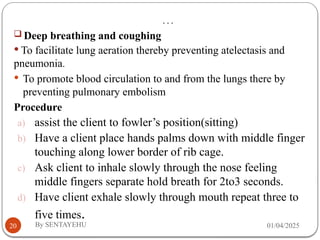
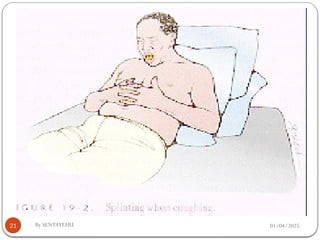
 Deep breathing and coughing
 To facilitate lung aeration thereby preventing atelectasis and
pneumonia.
 To promote blood circulation to and from the lungs there by
preventing pulmonary embolism
Procedure
a) assist the client to fowler’s position(sitting)
b) Have a client place hands palms down with middle finger
touching along lower border of rib cage.
c) Ask client to inhale slowly through the nose feeling
middle fingers separate hold breath for 2to3 seconds.
d) Have client exhale slowly through mouth repeat three to
five times.
01/04/2025
By SENTAYEHU
21
Intra-operative care
01/04/2025
By SENTAYEHU
22
Definition:
 Intra-operative care is a care given for a patient from when
the patient is transferred to operation room table to when
the patient is admitted to the recovery room or post
anesthesia care unit.
01/04/2025
By SENTAYEHU
23
Purpose of Intra-operative care
• To prevent risk of infection
• To reduce risk of injury related to
Positioning
chemical hazards
foreign objects left in the body
…
01/04/2025
By SENTAYEHU
24
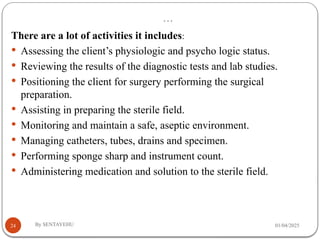
There are a lot of activities it includes:
 Assessing the client’s physiologic and psycho logic status.
 Reviewing the results of the diagnostic tests and lab studies.
 Positioning the client for surgery performing the surgical
preparation.
 Assisting in preparing the sterile field.
 Monitoring and maintain a safe, aseptic environment.
 Managing catheters, tubes, drains and specimen.
 Performing sponge sharp and instrument count.
 Administering medication and solution to the sterile field.
…
01/04/2025
By SENTAYEHU
25
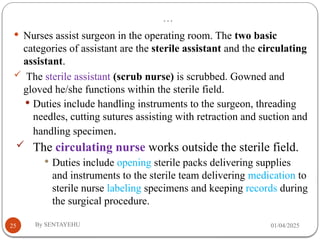
 Nurses assist surgeon in the operating room. The two basic
categories of assistant are the sterile assistant and the circulating
assistant.
 The sterile assistant (scrub nurse) is scrubbed. Gowned and
gloved he/she functions within the sterile field.
 Duties include handling instruments to the surgeon, threading
needles, cutting sutures assisting with retraction and suction and
handling specimen.
 The circulating nurse works outside the sterile field.
 Duties include opening sterile packs delivering supplies
and instruments to the sterile team delivering medication to
sterile nurse labeling specimens and keeping records during
the surgical procedure.
01/04/2025
By SENTAYEHU
26
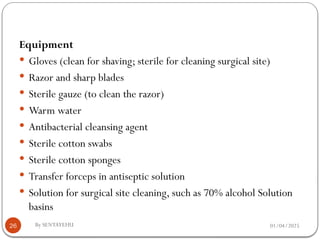
Equipment
 Gloves (clean for shaving; sterile for cleaning surgical site)
 Razor and sharp blades
 Sterile gauze (to clean the razor)
 Warm water
 Antibacterial cleansing agent
 Sterile cotton swabs
 Sterile cotton sponges
 Transfer forceps in antiseptic solution
 Solution for surgical site cleaning, such as 70% alcohol Solution
basins
01/04/2025
By SENTAYEHU
27
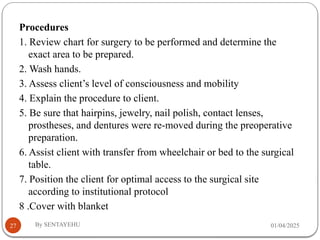
Procedures
1. Review chart for surgery to be performed and determine the
exact area to be prepared.
2. Wash hands.
3. Assess client’s level of consciousness and mobility
4. Explain the procedure to client.
5. Be sure that hairpins, jewelry, nail polish, contact lenses,
prostheses, and dentures were re-moved during the preoperative
preparation.
6. Assist client with transfer from wheelchair or bed to the surgical
table.
7. Position the client for optimal access to the surgical site
according to institutional protocol
8 .Cover with blanket
Cont’d…
01/04/2025
By SENTAYEHU
28
9. Cover hair if required
10. Assemble equipment needed
11. Remove ring(s) and watch. Wash hands and apply clean
gloves.
12. The surgical prep sites follow, depending on the type of
surgery to be performed.
 Head and neck: The site extends from above the eyebrows and
includes the ears and both anterior and posterior areas of the
neck. The face and eyebrows are not shaved.
Cont…
01/04/2025
By SENTAYEHU
29
 Lateral neck: Clean the external auditory canal with a cotton swab.
 Anteriorly, prepare the side of the face, from above the ear to the
upper thorax to just below the clavicle.
 Posteriorly, prepare from the neck to the spine including the area
above the scapula.
 Chest surgery: The site extends from the neck to the bottom of the
rib cage and to the lateral midline. The shoulder and arm of the
operative side should be included.
 Abdominal surgery: The preparation site extends from the axilla to
the pubis extending bilaterally to the lateral midline. All visible
pubic hair should be shaved.
01/04/2025
By SENTAYEHU
30
 Perineal surgery: Shave all pubic hair and the inner thighs to
the midthigh.
 The area starts above the pubic bone anteriorly and extends
beyond the anus posteriorly.
Cervical spine surgery: Posteriorly from the top of the ears to
the waist.
 The area extends on each side to the midaxillary line.
Lumbar spine surgery :Posteriorly from the axilla down to
the midgluteal level of the buttocks. The area extends on each
side to the midaxillary line
01/04/2025
By SENTAYEHU
31
 Rectal surgery: Shave the buttocks from the iliac crest
down to the upper third of the thighs, including the anal
region. The area extends to the midline on each side.
 Flank surgery: Extends anteriorly from the axilla, down to
the upper thigh, including the external genital area.
 Posteriorly the area extends from the midscapular to the
midgluteal regions
01/04/2025
By SENTAYEHU
32
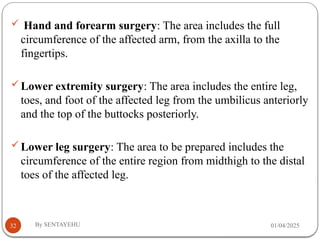
 Hand and forearm surgery: The area includes the full
circumference of the affected arm, from the axilla to the
fingertips.
Lower extremity surgery: The area includes the entire leg,
toes, and foot of the affected leg from the umbilicus anteriorly
and the top of the buttocks posteriorly.
Lower leg surgery: The area to be prepared includes the
circumference of the entire region from midthigh to the distal
toes of the affected leg.
Cont…procedure
01/04/2025
By SENTAYEHU
33
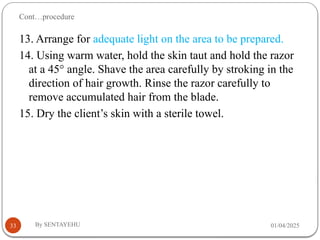
13. Arrange for adequate light on the area to be prepared.
14. Using warm water, hold the skin taut and hold the razor
at a 45° angle. Shave the area carefully by stroking in the
direction of hair growth. Rinse the razor carefully to
remove accumulated hair from the blade.
15. Dry the client’s skin with a sterile towel.
Cont’d…
01/04/2025
By SENTAYEHU
34
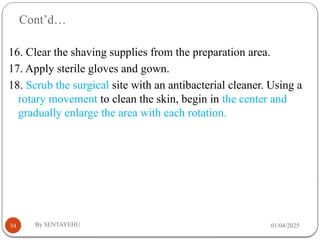
16. Clear the shaving supplies from the preparation area.
17. Apply sterile gloves and gown.
18. Scrub the surgical site with an antibacterial cleaner. Using a
rotary movement to clean the skin, begin in the center and
gradually enlarge the area with each rotation.
….cont
01/04/2025
By SENTAYEHU
35
19. Continue this process for three to ten minutes as prescribed
by institutional policy.
20. Clean any hidden areas in the surgical site (the ear canals, under
the fingernails, the umbilicus) using cotton swabs.
21. Rinse the area with sterile water. Wait for the site to dry or pat
dry with a sterile towel.
22. Cover the area with sterile drapes leaving the surgical site
exposed
 C:UserstoshibaDesktop
Hand_washing,scrubing_gowning_gloving
Surgical Hand Scrub Learning Module.mp4
 C:UserstoshibaDesktop
Hand_washing,scrubing_gowning_gloving
Gloving,Gowning,and Surgical Scrub.mp4
Postoperative Care
01/04/2025
By SENTAYEHU
36
Definition:
 Postoperative care is a care given for a patient which
begins with the admission of the patient to the post
anesthesia care unit and ends after follow up evaluation in
the clinical setting.
Purpose
 To prevent any complication from anesthesia
 To detect sign of post operative complications
 To rehabilitate the patient
 To re-establish physiological equilibrium
 To alleviate pain
01/04/2025
By SENTAYEHU
37
Equipments
1. Vital sign equipments
 Stethoscope
 Sphygmomanometer
 Thermometer
2. Watch, Anesthetic bed
3. Oximeter
4. Blankets
5. Cardiac monitoring equipment
6. Sterile dressings as needed
7. Client’s chart with postoperative orders
8. Incentive spirometer (may be optional)
9. Supplemental oxygen, if needed
10. Sequential stockings and/or antiembolic stockings (as ordered)
11. Gloves
01/04/2025
By SENTAYEHU
38
Procedures
1. Wash hands and apply gloves.
2. Check the client’s temperature, pulse, respiratory rate, and
blood pressure upon the client’s arrival in the unit.
3. Identify client via armband and verify the client’s identity
with the chart.
4. Inform the client that she/he is out of the operating room
and in the recovery room.
Cont’d…
01/04/2025
By SENTAYEHU
39
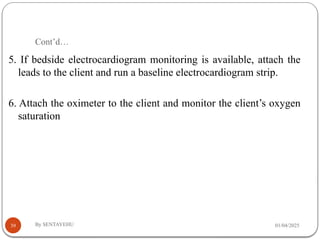
5. If bedside electrocardiogram monitoring is available, attach the
leads to the client and run a baseline electrocardiogram strip.
6. Attach the oximeter to the client and monitor the client’s oxygen
saturation
01/04/2025
By SENTAYEHU
Cont…
40
7. Check intravenous (IV) site using gloves. Check IV
solution(s), flow rate, and that the IV line is taped as
necessary
8. Check surgical dressing and site, if visible. Assess
dressings for amount and type of drainage. Reinforce
the dressings as needed.
9. Complete a total head to toe assessment
…
01/04/2025
By SENTAYEHU
41
10. Encourage the client to deep breathe, cough, and use the
incentive spirometer
11. Check and implement postoperative orders.
12. Inform the client’s family or significant other that the
client is in the recovery room.
01/04/2025
By SENTAYEHU
42
13. Turn the client every hour, maintaining proper
alignment.
14. Upon discharge by the postanesthesia care-giver, a full
report of the postanesthesia phase and intraoperative
course of events should be given to the nurse assuming
care of the client.
15. Remove gloves and wash hands.
General instructions
01/04/2025
By SENTAYEHU
43
• If patient shows any sign of shock immediate action should
be taken and then reported to the doctor. The head of the bed
should be lowered.
• Do not leave unconscious patient alone.
• Keep patient flat in bed with the head to the side (no pillows)
and avoid chilling.
• Watch color of skin, lips and fingernails carefully.
• If there is any bleeding carry out the necessary measures and
report immediately.
• The patient is having pain after he is awake. Analgesic may
be given according to orders.
• Limit visitors in the patient’ room.
• Carry out post operative orders carefully.
• Place patient in a comfortable position.
Post operative care of specific surgeries
01/04/2025
By SENTAYEHU
44
Brain surgery
 Patient must lie on his back without pillows unless ordered.
 Room should be dark and quit to prevent irritation to the brain.
Breast surgery
 Encourage deep breathing often because of danger of pneumonia.
 Special arm exercise should be given.
Abdominal surgery
 Encourage deep breathing
 Turn from side to side often.
 Sit patient on edge of bed on the first day post operative and start
walking on the second day unless contraindicated.
 Intake and output should be recorded.
 If gastric suction is present make sure it is working properly.
 Frequent mouth care for patients who are to allow drinking.
…
01/04/2025
By SENTAYEHU
45
Eye surgery
 Must lie very still because the incision and sutures can be
damaged by pulling on the eye muscles. Both eyes may be
covered.
 Room may be quiet and dark.
Spinal surgery
 Must lie on abdomen of back with bed flat and supported
by fracture board mattress.
 Patient may be in a body cast. Care must be given to
prevent bed scares where the cast rubs.
…
01/04/2025
By SENTAYEHU
46
Thyroidectomy
 Place in high fowler position. This will make it easier to breath
since the pressure of dressing and swelling may give chocking
feeling.
Client’s are usually discharge from the post anesthetic room
when;
 They are conscious and oriented.
 They are able to maintain a clear airway and deep breath and
cough freely.
 Protective reflexes (e.g. gag, swallowing) are active.
 They are able to move four extremities.
 Urinary intake and output is adequate.
 Vital sign has been stabled.
 Level of consciousness and orientation to time place and person:
Asses reaction to verbal stimuli and ability to move extremities.
01/04/2025
By SENTAYEHU
…
47
Client’s are usually discharge from the post
anesthetic room when;
 They are conscious and oriented.
 They are able to maintain a clear airway and deep breath
and cough freely.
 Protective reflexes (e.g. gag, swallowing) are active.
 They are able to move four extremities.
 Urinary intake and output is adequate.
 Vital sign has been stabled.
 Level of consciousness and orientation to time place and
person: Asses reaction to verbal stimuli and ability to
move extremities.
01/04/2025
By SENTAYEHU
48
 When caring for post-surgical patient, think of the
“4 W’s”
1. Wind: prevent respiratory complications
2. Wound: prevent infection
3. Water: monitor I & O
4. Walk: prevent thrombophlebitis
Yakenyelay!
አመሰግናለሁ:: 01/04/2025
49 By SENTAYEHU

ppt for nurses chapter 9 perioperative care.pptx

  • 1.
  • 2.
    01/04/2025 By SENTAYEHU 2 Surgery  isa means of treating injury and disease.  It encompasses three phases preoperative, Intraoperative and postoperative.  All three phases are referred to a Perioperative nursing. Surgery may be performed  for diagnostic (e.g. excision of a tumor or inflamed appendix) or reparative (e.g. multiple wound repair). It may be reconstructive or cosmetic (e.g. mammoplasty or face lift) or  palliative (e.g. to relieve pain or correct a problem for instance a gastrostomy tube may be inserted to compensate for the inability to swallow food).
  • 3.
    01/04/2025 By SENTAYEHU 3 Degree ofurgency It can be classified as elective or emergency. 1. Elective surgery: may be planned weeks to months ahead and based on the client’s choice.  It is performed to satisfy the desire of the client but not needed to preserve the client’s life, body part or body function. E.g. cosmetic surgery, 2. Emergency surgery: is performed to preserve the client’s life, body part or body function. E.g. to control internal hemorrhage
  • 4.
    01/04/2025 By SENTAYEHU Cont’d… 4 Degree ofrisk:  It can be classified as major surgery or minor according to the degree of risk to the client. 1. Major surgery: it involves a high degree of risk for a variety of reason.  It may be complicated or prolonged large loss of blood may occur vital sign may be involved. E.g. organ transplant, open heart surgery 2. Minor surgery: It involves little risk produces few complications. E.g. breast biopsy
  • 5.
    01/04/2025 By SENTAYEHU 5 PERI-OPERATIVE CARE •is a period of time that constitutes the surgical experience including:  preoperative,  intra-operative and  post operative phases. 01/04/2025 5 By DelelegnT.
  • 6.
    Pre-operative care 01/04/2025 By SENTAYEHU 6 is a care given for a patient from the time the decision is made for surgical intervention to the transfer of the patient to the operating room Purpose  To prepare the patient emotionally, mentally for surgery  To prevent complication before surgery unless it is an emergency operation  To promote patient and family involvement in care
  • 7.
    Informed Consent 01/04/2025 By SENTAYEHU 7 Prior to any surgical procedures, client must sign a surgical consent form. This requirement protects clients from having any surgical procedures that do not want or do not know about. It is the part of a physician legal responsibility which involves providing the client until all the information needed to make the decision undergo surgery. Informed consent is necessary in the following circumstances. Invasive procedure such as a surgical incision a biopsy a cystoscopy or Paracentesis. Procedures requiring sedation or anesthesia. A non surgical procedure
  • 8.
    General checkup 01/04/2025 By SENTAYEHU 8 Assessinggeneral risks The degree of risk involved in surgical procedure is affected by the clients  Age many young and elderly clients are greater surgical risk than children and adults.  Nutritional status: two nutritional problems that can increase surgical risks are obesity and malnutrition due to protein, iron, and vitamin deficiencies. o Obese patient have overtaxed hearts and elevated blood pressure and incision in overly fatty tissues are difficulties to suture and prone to infection. o Protein and vitamins are needed for wound healing vitamin K is essential for blood clotting.
  • 9.
    … 01/04/2025 By SENTAYEHU 9  Fluidand electrolyte status  Medication: - the regular use of certain medication can increase surgical risk.  E.g. anticoagulant increase blood coagulation time, Tranquilizers may cause hypotension and thus contribute to shock  Health problem: such as angina pectoris, sever hypertension, myocardial infarction etc.  Blood coagulation disorder: that may lead to sever bleeding, hemorrhage.  Upper respiratory tract infection: they may predispose the client to postoperative lung infection.  Uncontrolled neurological disease such as epilepsy  Diabetes mellitus: which predispose the client to wound infection and delayed healing.  Screening test: The physician orders preoperative radio logic and laboratory tests and examination.
  • 10.
    01/04/2025 By SENTAYEHU 10 Equipment: 1. Bloodpressure apparatus 2. Stethoscope 3. Enema equipments and solution as needed 4. Catheterization equipments a. Flashlight b. Preoperative checklist c. Container for dentures, glasses
  • 11.
    Cont’d… 01/04/2025 By SENTAYEHU 11 d. Appropriatestorage for valuables and clothes e. Information packets regarding surgery f. Informed consent forms g. Intravenous fluids, IV set, syringe and needles, and equipment as needed h. Preoperative medication i. Transfer cart
  • 12.
    Procedures of pre-operativecare 01/04/2025 By SENTAYEHU 12 1. Explain the procedure 2. Check whether the client has any questions regarding the surgery and understands the procedure. 3. Wash hands 4. Verify admission orders regarding type of surgery, any risks (including recent changes in vital signs), and client preparation 5. Verify the client by checking name tag and asking name 6. Make the patient NPO for six to eight hours 7. Complete the preoperative checklist, including history, physical assessment, and check of valuables.
  • 13.
    Cont’d… 01/04/2025 By SENTAYEHU 13 8. Performneurological assessment, including checks for orientation, eye coordination, handgrips, knee bends, and plantar and dorsi-flexion of the feet 9. Perform vascular assessment including checks of pulse, blood pressure, and apical pulse rhythm, peripheral pulses, and temperature. Compare with previous information.  Clients over 50 years may require baseline electrocardiogram
  • 14.
    Cont’d… 01/04/2025 By SENTAYEHU 14 10. Auscultatethe lungs bilaterally front and back. If any wheezes, rhonchi, coughs, upper respiratory infections, or increased temperature, notify physician or qualified practitioner 11. Assess the gastrointestinal system (time of last meal, food allergies, bowel sounds, last bowel movement, time of last fluids). 12. Assess the genital/urinary system (last menstrual period, last void, state of pregnancy, estrogen replacement therapy).
  • 15.
    … 01/04/2025 By SENTAYEHU 15 13. Assessskin and muscle tone for any skin breakdown, redness, bruises, decreased skin integrity 14. Ascertain any allergies or adverse reactions during previous surgeries or use of anesthesia. 15. Obtain medication history, including the time and date of the last dose of medication 16. Ascertain any history of drugs/alcohol use and when they were last used. 17. Check weight.
  • 16.
    Cont… 01/04/2025 By SENTAYEHU 16 18. Checkif family is available and who is present 19. Ascertain if client has signed the surgical consent. 20. Remove all valuables with the exception of wedding rings if requested. Tape rings in place. Check and document whether valuables are placed in a locked area, safe storage area, or given to family. 21. Check if eyeglasses and dentures are removed; place in a labeled container
  • 17.
    Cont’d… 01/04/2025 By SENTAYEHU 17 22. Maintainelimination as needed (catheterization, enema) 23. Administer intravenous fluids according to orders 24. Administer medications according to orders. 25. Ascertain that preoperative checklist is complete. 26. Transport the client to appropriate area. 27. Inform family members where surgical waiting area is and establish a way to contact them when surgery is completed
  • 18.
    Preoperative teaching 01/04/2025 By SENTAYEHU 18 It includes teaching moving, leg exercise, deep breathing exercise and coughing Purpose Moving:  To maintain blood circulation  To stimulate respiratory function  To decrease stasis of gas in the intestine  To facilitate ambulation Leg exercise: To stimulate blood circulation there by preventing thrombopheleblitis and thrombus formation
  • 19.
  • 20.
    … 01/04/2025 By SENTAYEHU 20  Deepbreathing and coughing  To facilitate lung aeration thereby preventing atelectasis and pneumonia.  To promote blood circulation to and from the lungs there by preventing pulmonary embolism Procedure a) assist the client to fowler’s position(sitting) b) Have a client place hands palms down with middle finger touching along lower border of rib cage. c) Ask client to inhale slowly through the nose feeling middle fingers separate hold breath for 2to3 seconds. d) Have client exhale slowly through mouth repeat three to five times.
  • 21.
  • 22.
    Intra-operative care 01/04/2025 By SENTAYEHU 22 Definition: Intra-operative care is a care given for a patient from when the patient is transferred to operation room table to when the patient is admitted to the recovery room or post anesthesia care unit.
  • 23.
    01/04/2025 By SENTAYEHU 23 Purpose ofIntra-operative care • To prevent risk of infection • To reduce risk of injury related to Positioning chemical hazards foreign objects left in the body
  • 24.
    … 01/04/2025 By SENTAYEHU 24 There area lot of activities it includes:  Assessing the client’s physiologic and psycho logic status.  Reviewing the results of the diagnostic tests and lab studies.  Positioning the client for surgery performing the surgical preparation.  Assisting in preparing the sterile field.  Monitoring and maintain a safe, aseptic environment.  Managing catheters, tubes, drains and specimen.  Performing sponge sharp and instrument count.  Administering medication and solution to the sterile field.
  • 25.
    … 01/04/2025 By SENTAYEHU 25  Nursesassist surgeon in the operating room. The two basic categories of assistant are the sterile assistant and the circulating assistant.  The sterile assistant (scrub nurse) is scrubbed. Gowned and gloved he/she functions within the sterile field.  Duties include handling instruments to the surgeon, threading needles, cutting sutures assisting with retraction and suction and handling specimen.  The circulating nurse works outside the sterile field.  Duties include opening sterile packs delivering supplies and instruments to the sterile team delivering medication to sterile nurse labeling specimens and keeping records during the surgical procedure.
  • 26.
    01/04/2025 By SENTAYEHU 26 Equipment  Gloves(clean for shaving; sterile for cleaning surgical site)  Razor and sharp blades  Sterile gauze (to clean the razor)  Warm water  Antibacterial cleansing agent  Sterile cotton swabs  Sterile cotton sponges  Transfer forceps in antiseptic solution  Solution for surgical site cleaning, such as 70% alcohol Solution basins
  • 27.
    01/04/2025 By SENTAYEHU 27 Procedures 1. Reviewchart for surgery to be performed and determine the exact area to be prepared. 2. Wash hands. 3. Assess client’s level of consciousness and mobility 4. Explain the procedure to client. 5. Be sure that hairpins, jewelry, nail polish, contact lenses, prostheses, and dentures were re-moved during the preoperative preparation. 6. Assist client with transfer from wheelchair or bed to the surgical table. 7. Position the client for optimal access to the surgical site according to institutional protocol 8 .Cover with blanket
  • 28.
    Cont’d… 01/04/2025 By SENTAYEHU 28 9. Coverhair if required 10. Assemble equipment needed 11. Remove ring(s) and watch. Wash hands and apply clean gloves. 12. The surgical prep sites follow, depending on the type of surgery to be performed.  Head and neck: The site extends from above the eyebrows and includes the ears and both anterior and posterior areas of the neck. The face and eyebrows are not shaved.
  • 29.
    Cont… 01/04/2025 By SENTAYEHU 29  Lateralneck: Clean the external auditory canal with a cotton swab.  Anteriorly, prepare the side of the face, from above the ear to the upper thorax to just below the clavicle.  Posteriorly, prepare from the neck to the spine including the area above the scapula.  Chest surgery: The site extends from the neck to the bottom of the rib cage and to the lateral midline. The shoulder and arm of the operative side should be included.  Abdominal surgery: The preparation site extends from the axilla to the pubis extending bilaterally to the lateral midline. All visible pubic hair should be shaved.
  • 30.
    01/04/2025 By SENTAYEHU 30  Perinealsurgery: Shave all pubic hair and the inner thighs to the midthigh.  The area starts above the pubic bone anteriorly and extends beyond the anus posteriorly. Cervical spine surgery: Posteriorly from the top of the ears to the waist.  The area extends on each side to the midaxillary line. Lumbar spine surgery :Posteriorly from the axilla down to the midgluteal level of the buttocks. The area extends on each side to the midaxillary line
  • 31.
    01/04/2025 By SENTAYEHU 31  Rectalsurgery: Shave the buttocks from the iliac crest down to the upper third of the thighs, including the anal region. The area extends to the midline on each side.  Flank surgery: Extends anteriorly from the axilla, down to the upper thigh, including the external genital area.  Posteriorly the area extends from the midscapular to the midgluteal regions
  • 32.
    01/04/2025 By SENTAYEHU 32  Handand forearm surgery: The area includes the full circumference of the affected arm, from the axilla to the fingertips. Lower extremity surgery: The area includes the entire leg, toes, and foot of the affected leg from the umbilicus anteriorly and the top of the buttocks posteriorly. Lower leg surgery: The area to be prepared includes the circumference of the entire region from midthigh to the distal toes of the affected leg.
  • 33.
    Cont…procedure 01/04/2025 By SENTAYEHU 33 13. Arrangefor adequate light on the area to be prepared. 14. Using warm water, hold the skin taut and hold the razor at a 45° angle. Shave the area carefully by stroking in the direction of hair growth. Rinse the razor carefully to remove accumulated hair from the blade. 15. Dry the client’s skin with a sterile towel.
  • 34.
    Cont’d… 01/04/2025 By SENTAYEHU 34 16. Clearthe shaving supplies from the preparation area. 17. Apply sterile gloves and gown. 18. Scrub the surgical site with an antibacterial cleaner. Using a rotary movement to clean the skin, begin in the center and gradually enlarge the area with each rotation.
  • 35.
    ….cont 01/04/2025 By SENTAYEHU 35 19. Continuethis process for three to ten minutes as prescribed by institutional policy. 20. Clean any hidden areas in the surgical site (the ear canals, under the fingernails, the umbilicus) using cotton swabs. 21. Rinse the area with sterile water. Wait for the site to dry or pat dry with a sterile towel. 22. Cover the area with sterile drapes leaving the surgical site exposed  C:UserstoshibaDesktop Hand_washing,scrubing_gowning_gloving Surgical Hand Scrub Learning Module.mp4  C:UserstoshibaDesktop Hand_washing,scrubing_gowning_gloving Gloving,Gowning,and Surgical Scrub.mp4
  • 36.
    Postoperative Care 01/04/2025 By SENTAYEHU 36 Definition: Postoperative care is a care given for a patient which begins with the admission of the patient to the post anesthesia care unit and ends after follow up evaluation in the clinical setting. Purpose  To prevent any complication from anesthesia  To detect sign of post operative complications  To rehabilitate the patient  To re-establish physiological equilibrium  To alleviate pain
  • 37.
    01/04/2025 By SENTAYEHU 37 Equipments 1. Vitalsign equipments  Stethoscope  Sphygmomanometer  Thermometer 2. Watch, Anesthetic bed 3. Oximeter 4. Blankets 5. Cardiac monitoring equipment 6. Sterile dressings as needed 7. Client’s chart with postoperative orders 8. Incentive spirometer (may be optional) 9. Supplemental oxygen, if needed 10. Sequential stockings and/or antiembolic stockings (as ordered) 11. Gloves
  • 38.
    01/04/2025 By SENTAYEHU 38 Procedures 1. Washhands and apply gloves. 2. Check the client’s temperature, pulse, respiratory rate, and blood pressure upon the client’s arrival in the unit. 3. Identify client via armband and verify the client’s identity with the chart. 4. Inform the client that she/he is out of the operating room and in the recovery room.
  • 39.
    Cont’d… 01/04/2025 By SENTAYEHU 39 5. Ifbedside electrocardiogram monitoring is available, attach the leads to the client and run a baseline electrocardiogram strip. 6. Attach the oximeter to the client and monitor the client’s oxygen saturation
  • 40.
    01/04/2025 By SENTAYEHU Cont… 40 7. Checkintravenous (IV) site using gloves. Check IV solution(s), flow rate, and that the IV line is taped as necessary 8. Check surgical dressing and site, if visible. Assess dressings for amount and type of drainage. Reinforce the dressings as needed. 9. Complete a total head to toe assessment
  • 41.
    … 01/04/2025 By SENTAYEHU 41 10. Encouragethe client to deep breathe, cough, and use the incentive spirometer 11. Check and implement postoperative orders. 12. Inform the client’s family or significant other that the client is in the recovery room.
  • 42.
    01/04/2025 By SENTAYEHU 42 13. Turnthe client every hour, maintaining proper alignment. 14. Upon discharge by the postanesthesia care-giver, a full report of the postanesthesia phase and intraoperative course of events should be given to the nurse assuming care of the client. 15. Remove gloves and wash hands.
  • 43.
    General instructions 01/04/2025 By SENTAYEHU 43 •If patient shows any sign of shock immediate action should be taken and then reported to the doctor. The head of the bed should be lowered. • Do not leave unconscious patient alone. • Keep patient flat in bed with the head to the side (no pillows) and avoid chilling. • Watch color of skin, lips and fingernails carefully. • If there is any bleeding carry out the necessary measures and report immediately. • The patient is having pain after he is awake. Analgesic may be given according to orders. • Limit visitors in the patient’ room. • Carry out post operative orders carefully. • Place patient in a comfortable position.
  • 44.
    Post operative careof specific surgeries 01/04/2025 By SENTAYEHU 44 Brain surgery  Patient must lie on his back without pillows unless ordered.  Room should be dark and quit to prevent irritation to the brain. Breast surgery  Encourage deep breathing often because of danger of pneumonia.  Special arm exercise should be given. Abdominal surgery  Encourage deep breathing  Turn from side to side often.  Sit patient on edge of bed on the first day post operative and start walking on the second day unless contraindicated.  Intake and output should be recorded.  If gastric suction is present make sure it is working properly.  Frequent mouth care for patients who are to allow drinking.
  • 45.
    … 01/04/2025 By SENTAYEHU 45 Eye surgery Must lie very still because the incision and sutures can be damaged by pulling on the eye muscles. Both eyes may be covered.  Room may be quiet and dark. Spinal surgery  Must lie on abdomen of back with bed flat and supported by fracture board mattress.  Patient may be in a body cast. Care must be given to prevent bed scares where the cast rubs.
  • 46.
    … 01/04/2025 By SENTAYEHU 46 Thyroidectomy  Placein high fowler position. This will make it easier to breath since the pressure of dressing and swelling may give chocking feeling. Client’s are usually discharge from the post anesthetic room when;  They are conscious and oriented.  They are able to maintain a clear airway and deep breath and cough freely.  Protective reflexes (e.g. gag, swallowing) are active.  They are able to move four extremities.  Urinary intake and output is adequate.  Vital sign has been stabled.  Level of consciousness and orientation to time place and person: Asses reaction to verbal stimuli and ability to move extremities.
  • 47.
    01/04/2025 By SENTAYEHU … 47 Client’s areusually discharge from the post anesthetic room when;  They are conscious and oriented.  They are able to maintain a clear airway and deep breath and cough freely.  Protective reflexes (e.g. gag, swallowing) are active.  They are able to move four extremities.  Urinary intake and output is adequate.  Vital sign has been stabled.  Level of consciousness and orientation to time place and person: Asses reaction to verbal stimuli and ability to move extremities.
  • 48.
    01/04/2025 By SENTAYEHU 48  Whencaring for post-surgical patient, think of the “4 W’s” 1. Wind: prevent respiratory complications 2. Wound: prevent infection 3. Water: monitor I & O 4. Walk: prevent thrombophlebitis
  • 49.