CATHETERIZATION
LABORATORY
CATHETERIZATION LABORATORY
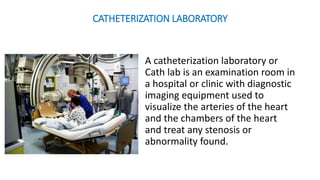
A catheterization laboratory or
Cath lab is an examination room in
a hospital or clinic with diagnostic
imaging equipment used to
visualize the arteries of the heart
and the chambers of the heart
and treat any stenosis or
abnormality found.
Aim and Objectives
• To provide a high-quality
diagnostics and interventional
service for patients.
• To provide comfortable
environment for patients that
maintains both privacy and dignity.
Importance of Cath Lab
 Diagnosing and fixing problems.
To evaluate or to confirm the presence of coronary artery disease.
To determine the need for further treatment.
For integrated patient care.
For multi-departmental approach.
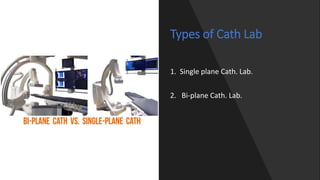
Types of Cath Lab
1. Single plane Cath. Lab.
2. Bi-plane Cath. Lab.
Location
• Traditionally near the diagnostic radiology suite.
• Close to surgical suite
• No cross traffic and no interference with other
departments.
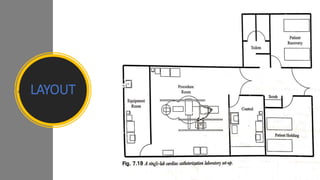
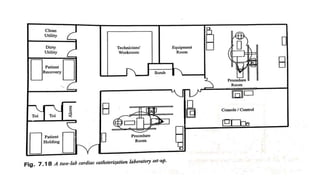
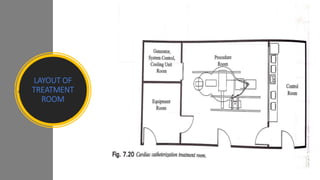
LAYOUT
zz
LAYOUT OF
TREATMENT
ROOM
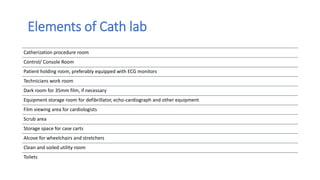
Elements of Cath lab
Catherization procedure room
Control/ Console Room
Patient holding room, preferably equipped with ECG monitors
Technicians work room
Dark room for 35mm film, if necessary
Equipment storage room for defibrillator, echo-cardiograph and other equipment
Film viewing area for cardiologists
Scrub area
Storage space for case carts
Alcove for wheelchairs and stretchers
Clean and soiled utility room
Toilets
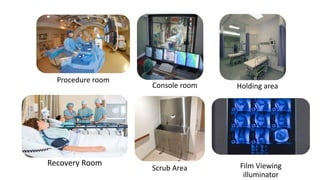
Procedure room
Console room Holding area
Recovery Room
Scrub Area Film Viewing
illuminator
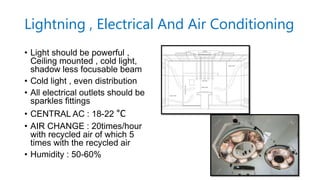
Lightning , Electrical And Air Conditioning
• Light should be powerful ,
Ceiling mounted , cold light,
shadow less focusable beam
• Cold light , even distribution
• All electrical outlets should be
sparkles fittings
• CENTRAL AC : 18-22 °C
• AIR CHANGE : 20times/hour
with recycled air of which 5
times with the recycled air
• Humidity : 50-60%
Design
Considerations
• Absolute Minimum for Existing Facilities: 850 net
square feet (78.97 net square meters) (29’-0” x 29’-
0”), 24’-0” min dimension
• New and Existing Facilities: 900 net square feet
(83.61 net square meters) (29’-0” x 31’-0”), 24’-0”
min dimension.
• Control Room: 190 net square feet preferred, 120
NSF minimum
• Equipment Room: Minimum 120 net square feet
and accessible from the Control Room or the
restricted corridor and not accessible from the
procedure room
• Scrub station should be located adjacent to the
entry door of the Laboratory.
Planning
Parameters:
• Convenient functional flow between related
departments like ICU,CCU etc.
• Avoidance of outdoor noise & unrelated
hospital traffic flow
• Sliding doors & smooth, non-slippery floors
• Ceilings should be painted with washable
paints
• Provision of high speed autoclaves & X –
ray films illuminators
MANPOWER
• CHIEF CARDIOLOGIST
• ASSISTANT ANGIOGRAPHER
• SCRUB NURSE
• CIRCULATING NURSE
• TECHNICAL STAFF
• -CARDIAC CATHETERIZATION TECHNICIAN
• -RADIOLOGY TECHNICIAN
• -TECHNICIAN FOR MONITORING AND
RECORDING
• NON-TECHNICIAN STAFF
• -MEDICAL TRANSCRIBER
• -CLERKS
• -HELPERS/AIDES
FLOW OF
DEPARTMENT
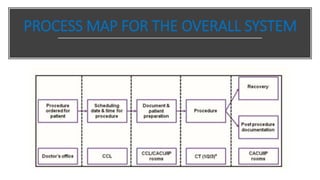
PROCESS MAP FOR THE OVERALL SYSTEM
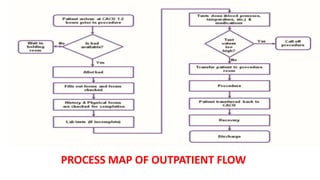
PROCESS MAP OF OUTPATIENT FLOW
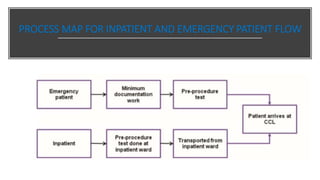
PROCESS MAP FOR INPATIENT AND EMERGENCY PATIENT FLOW
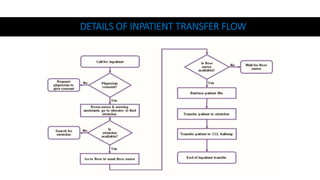
DETAILS OF INPATIENT TRANSFER FLOW
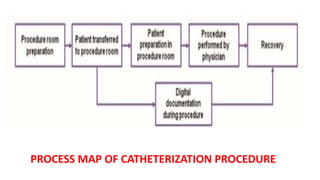
PROCESS MAP OF CATHETERIZATION PROCEDURE
EQUIPMENTS:
TOOLS AND DEVICES
• PROCEDURE TRAY SHOULD INCLUDE:
• Sterile
• - sterile towels and drapes for procedures
• -gowns and gloves
• -equipment covers
• - sterile gauze
• -scalpel , needle , scissor ,hemostats
• -syringes for heparin/saline flush lidocaine and blood oximetry
• Labels with marking pen for any item filled with a solution.
• Basin for heparin/ saline mixture and waste fluids,
• Skin prep solution
• Connection tubing
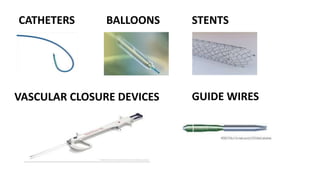
CATHETERS BALLOONS STENTS
VASCULAR CLOSURE DEVICES GUIDE WIRES
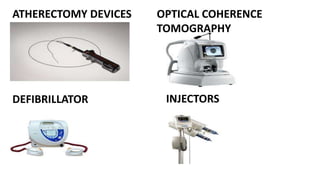
ATHERECTOMY DEVICES OPTICAL COHERENCE
TOMOGRAPHY
DEFIBRILLATOR INJECTORS
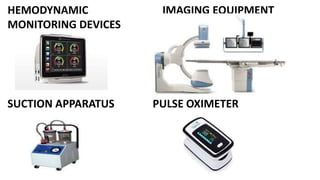
HEMODYNAMIC
MONITORING DEVICES
IMAGING EQUIPMENT
SUCTION APPARATUS PULSE OXIMETER
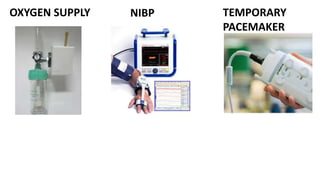
OXYGEN SUPPLY TEMPORARY
PACEMAKER
NIBP
Procedures Performed in the Catheterization Laboratory
• Diagnostic procedures
Diagnostic cardiac catheterization:
A catheter is inserted through the skin (percutaneous) into an artery,
usually in the upper thigh or wrist, and then is threaded through the
body's arterial highway to the heart, where a special dye is injected
into the coronary arteries to reveal any possible blockages.
Biopsy:
A diagnostic procedure to obtain a myocardial tissue sample from the
ventricle of the heart aid in the detection of a disease process (i.e.,
myocarditis, cardiomyopathy, etc.) or to monitor rejection after heart
transplant.
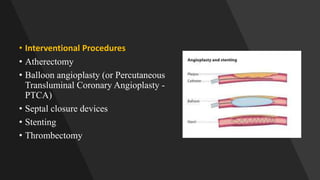
• Interventional Procedures
• Atherectomy
• Balloon angioplasty (or Percutaneous
Transluminal Coronary Angioplasty -
PTCA)
• Septal closure devices
• Stenting
• Thrombectomy
NEURO CATHLAB
Neuro Cath lab is a diagnostic equipment for performing cerebral
angiography.
Angiography is an X Ray based procedure in which a contrast medium
is injected in the blood stream, which allows to create a clear picture
of blood vessel so that doctor can identify any blockages or
abnormalities.
Along with Brain Tumors this advanced Neuro Cath lab
helps to accurately diagnose all types of vascular
malfunctions in the brain such as:
Stroke
Aneurysm
Atherosclerosis
Vasculitis or inflammation of the blood vessels
Blood Clots
Tears in the lining of an artery- Dissection
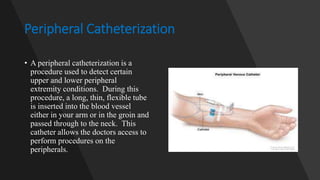
Peripheral Catheterization
• A peripheral catheterization is a
procedure used to detect certain
upper and lower peripheral
extremity conditions. During this
procedure, a long, thin, flexible tube
is inserted into the blood vessel
either in your arm or in the groin and
passed through to the neck. This
catheter allows the doctors access to
perform procedures on the
peripherals.
Form for Cath
lab
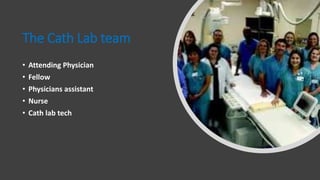
The Cath Lab team
• Attending Physician
• Fellow
• Physicians assistant
• Nurse
• Cath lab tech
Coordination with other Departments
• Radiology department
• Laboratory
• Neurology department
• CSSD
• Cardiac OT
• Cardiac ICU
• Wards
• Stores
• Biomedical unit
• Billing Department
RECORD
KEEPING
• While writing a record we need to ask
ourselves, who is to refer these records.
Records from the Cath lab are referred
majorly by the following groups:
• Lawyers
• The hospital billing and quality control
team
• The medical care givers i.e. doctors,
interns and the nurses.
Information
provided in
the records
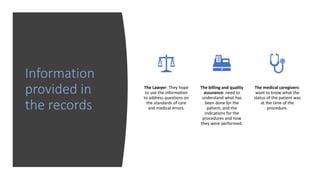
The Lawyer: They hope
to use the information
to address questions on
the standards of care
and medical errors.
The billing and quality
assurance: need to
understand what has
been done for the
patient, and the
indications for the
procedures and how
they were performed.
The medical caregivers:
want to know what the
status of the patient was
at the time of the
procedure.
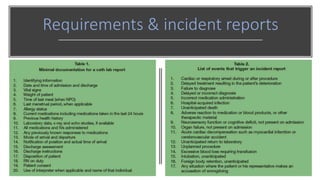
Requirements & incident reports
CASE STUDY
The study examined the effects of new policies
implemented in the Cath lab in June 2014. The policies
resulted from an analysis of Cath lab workflow that
include creating a process flowchart that outlined and
time-stamped every step in a typical patient’s care. Thus
removing the issues that obstruct work-efficiency.
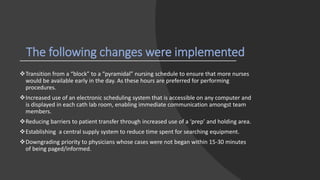
The following changes were implemented
Transition from a “block” to a “pyramidal” nursing schedule to ensure that more nurses
would be available early in the day. As these hours are preferred for performing
procedures.
Increased use of an electronic scheduling system that is accessible on any computer and
is displayed in each cath lab room, enabling immediate communication amongst team
members.
Reducing barriers to patient transfer through increased use of a ‘prep’ and holding area.
Establishing a central supply system to reduce time spent for searching equipment.
Downgrading priority to physicians whose cases were not began within 15-30 minutes
of being paged/informed.
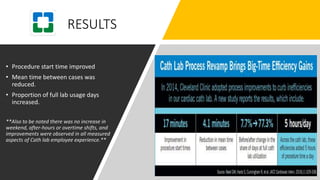
RESULTS
• Procedure start time improved
• Mean time between cases was
reduced.
• Proportion of full lab usage days
increased.
**Also to be noted there was no increase in
weekend, after-hours or overtime shifts, and
improvements were observed in all measured
aspects of Cath lab employee experience.**
Quality
Control
Improvement
(QCI)
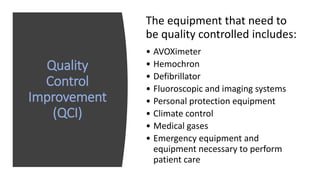
The equipment that need to
be quality controlled includes:
• AVOXimeter
• Hemochron
• Defibrillator
• Fluoroscopic and imaging systems
• Personal protection equipment
• Climate control
• Medical gases
• Emergency equipment and
equipment necessary to perform
patient care
THANK YOU

Cath Lab: A presentation about all the aspects regarding management

  • 1.
  • 2.
    CATHETERIZATION LABORATORY A catheterizationlaboratory or Cath lab is an examination room in a hospital or clinic with diagnostic imaging equipment used to visualize the arteries of the heart and the chambers of the heart and treat any stenosis or abnormality found.
  • 3.
    Aim and Objectives •To provide a high-quality diagnostics and interventional service for patients. • To provide comfortable environment for patients that maintains both privacy and dignity.
  • 4.
    Importance of CathLab  Diagnosing and fixing problems. To evaluate or to confirm the presence of coronary artery disease. To determine the need for further treatment. For integrated patient care. For multi-departmental approach.
  • 5.
    Types of CathLab 1. Single plane Cath. Lab. 2. Bi-plane Cath. Lab.
  • 6.
    Location • Traditionally nearthe diagnostic radiology suite. • Close to surgical suite • No cross traffic and no interference with other departments.
  • 7.
  • 8.
  • 9.
  • 10.
    Elements of Cathlab Catherization procedure room Control/ Console Room Patient holding room, preferably equipped with ECG monitors Technicians work room Dark room for 35mm film, if necessary Equipment storage room for defibrillator, echo-cardiograph and other equipment Film viewing area for cardiologists Scrub area Storage space for case carts Alcove for wheelchairs and stretchers Clean and soiled utility room Toilets
  • 11.
    Procedure room Console roomHolding area Recovery Room Scrub Area Film Viewing illuminator
  • 12.
    Lightning , ElectricalAnd Air Conditioning • Light should be powerful , Ceiling mounted , cold light, shadow less focusable beam • Cold light , even distribution • All electrical outlets should be sparkles fittings • CENTRAL AC : 18-22 °C • AIR CHANGE : 20times/hour with recycled air of which 5 times with the recycled air • Humidity : 50-60%
  • 13.
    Design Considerations • Absolute Minimumfor Existing Facilities: 850 net square feet (78.97 net square meters) (29’-0” x 29’- 0”), 24’-0” min dimension • New and Existing Facilities: 900 net square feet (83.61 net square meters) (29’-0” x 31’-0”), 24’-0” min dimension. • Control Room: 190 net square feet preferred, 120 NSF minimum • Equipment Room: Minimum 120 net square feet and accessible from the Control Room or the restricted corridor and not accessible from the procedure room • Scrub station should be located adjacent to the entry door of the Laboratory.
  • 14.
    Planning Parameters: • Convenient functionalflow between related departments like ICU,CCU etc. • Avoidance of outdoor noise & unrelated hospital traffic flow • Sliding doors & smooth, non-slippery floors • Ceilings should be painted with washable paints • Provision of high speed autoclaves & X – ray films illuminators
  • 15.
    MANPOWER • CHIEF CARDIOLOGIST •ASSISTANT ANGIOGRAPHER • SCRUB NURSE • CIRCULATING NURSE • TECHNICAL STAFF • -CARDIAC CATHETERIZATION TECHNICIAN • -RADIOLOGY TECHNICIAN • -TECHNICIAN FOR MONITORING AND RECORDING • NON-TECHNICIAN STAFF • -MEDICAL TRANSCRIBER • -CLERKS • -HELPERS/AIDES
  • 16.
  • 17.
    PROCESS MAP FORTHE OVERALL SYSTEM
  • 18.
    PROCESS MAP OFOUTPATIENT FLOW
  • 19.
    PROCESS MAP FORINPATIENT AND EMERGENCY PATIENT FLOW
  • 20.
    DETAILS OF INPATIENTTRANSFER FLOW
  • 21.
    PROCESS MAP OFCATHETERIZATION PROCEDURE
  • 22.
  • 23.
    • PROCEDURE TRAYSHOULD INCLUDE: • Sterile • - sterile towels and drapes for procedures • -gowns and gloves • -equipment covers • - sterile gauze • -scalpel , needle , scissor ,hemostats • -syringes for heparin/saline flush lidocaine and blood oximetry • Labels with marking pen for any item filled with a solution. • Basin for heparin/ saline mixture and waste fluids, • Skin prep solution • Connection tubing
  • 24.
    CATHETERS BALLOONS STENTS VASCULARCLOSURE DEVICES GUIDE WIRES
  • 25.
    ATHERECTOMY DEVICES OPTICALCOHERENCE TOMOGRAPHY DEFIBRILLATOR INJECTORS
  • 26.
  • 27.
  • 28.
    Procedures Performed inthe Catheterization Laboratory • Diagnostic procedures Diagnostic cardiac catheterization: A catheter is inserted through the skin (percutaneous) into an artery, usually in the upper thigh or wrist, and then is threaded through the body's arterial highway to the heart, where a special dye is injected into the coronary arteries to reveal any possible blockages. Biopsy: A diagnostic procedure to obtain a myocardial tissue sample from the ventricle of the heart aid in the detection of a disease process (i.e., myocarditis, cardiomyopathy, etc.) or to monitor rejection after heart transplant.
  • 29.
    • Interventional Procedures •Atherectomy • Balloon angioplasty (or Percutaneous Transluminal Coronary Angioplasty - PTCA) • Septal closure devices • Stenting • Thrombectomy
  • 30.
    NEURO CATHLAB Neuro Cathlab is a diagnostic equipment for performing cerebral angiography. Angiography is an X Ray based procedure in which a contrast medium is injected in the blood stream, which allows to create a clear picture of blood vessel so that doctor can identify any blockages or abnormalities.
  • 31.
    Along with BrainTumors this advanced Neuro Cath lab helps to accurately diagnose all types of vascular malfunctions in the brain such as: Stroke Aneurysm Atherosclerosis Vasculitis or inflammation of the blood vessels Blood Clots Tears in the lining of an artery- Dissection
  • 32.
    Peripheral Catheterization • Aperipheral catheterization is a procedure used to detect certain upper and lower peripheral extremity conditions. During this procedure, a long, thin, flexible tube is inserted into the blood vessel either in your arm or in the groin and passed through to the neck. This catheter allows the doctors access to perform procedures on the peripherals.
  • 33.
  • 34.
    The Cath Labteam • Attending Physician • Fellow • Physicians assistant • Nurse • Cath lab tech
  • 35.
    Coordination with otherDepartments • Radiology department • Laboratory • Neurology department • CSSD • Cardiac OT • Cardiac ICU • Wards • Stores • Biomedical unit • Billing Department
  • 36.
    RECORD KEEPING • While writinga record we need to ask ourselves, who is to refer these records. Records from the Cath lab are referred majorly by the following groups: • Lawyers • The hospital billing and quality control team • The medical care givers i.e. doctors, interns and the nurses.
  • 37.
    Information provided in the records TheLawyer: They hope to use the information to address questions on the standards of care and medical errors. The billing and quality assurance: need to understand what has been done for the patient, and the indications for the procedures and how they were performed. The medical caregivers: want to know what the status of the patient was at the time of the procedure.
  • 38.
  • 39.
    CASE STUDY The studyexamined the effects of new policies implemented in the Cath lab in June 2014. The policies resulted from an analysis of Cath lab workflow that include creating a process flowchart that outlined and time-stamped every step in a typical patient’s care. Thus removing the issues that obstruct work-efficiency.
  • 40.
    The following changeswere implemented Transition from a “block” to a “pyramidal” nursing schedule to ensure that more nurses would be available early in the day. As these hours are preferred for performing procedures. Increased use of an electronic scheduling system that is accessible on any computer and is displayed in each cath lab room, enabling immediate communication amongst team members. Reducing barriers to patient transfer through increased use of a ‘prep’ and holding area. Establishing a central supply system to reduce time spent for searching equipment. Downgrading priority to physicians whose cases were not began within 15-30 minutes of being paged/informed.
  • 41.
    RESULTS • Procedure starttime improved • Mean time between cases was reduced. • Proportion of full lab usage days increased. **Also to be noted there was no increase in weekend, after-hours or overtime shifts, and improvements were observed in all measured aspects of Cath lab employee experience.**
  • 42.
    Quality Control Improvement (QCI) The equipment thatneed to be quality controlled includes: • AVOXimeter • Hemochron • Defibrillator • Fluoroscopic and imaging systems • Personal protection equipment • Climate control • Medical gases • Emergency equipment and equipment necessary to perform patient care
  • 43.