D. Y. Patil College of Engineering, Akurdi
Department of Mechanical Engineering
A
Project on
SOLAR MPPT, INVERTER AND AUTOSWITCHING
Sponsored by
“Nutan Infotronics (P) Ltd”
1
Department of Electronics and Telecommunication
SOLAR MPPT, INVERTER AND AUTOSWITCHING
D. Y. Patil College of Engineering, Akurdi
Department of Mechanical Engineering
SOLAR MPPT, INVERTER AND AUTOSWITCHING
Guided By :-
Mrs. M.M. Karad and Mr. R. Singh
Presented By :-
Jayprakash Singh
Anirban paul
Yogesh sonni
2
Department of Electronics and Telecommunication
SOLAR MPPT, INVERTER AND AUTOSWITCHING
D. Y. Patil College of Engineering, Akurdi
Department of Mechanical Engineering
INTRODUCTION:
Solar energy is referred to as the energy that comes from the sun’s
rays. Solar energy is widely available today. We only need the right
instruments to capture the sun’s rays and convert those rays into
energy.
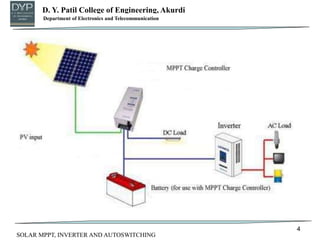
Solar panels is a larger photovoltaic system to generate and supply
electricity. With a proper charge controller, the prospect of having to
pay 30-50% more up front for additional solar panels makes the
MPPT controller very attractive.
For AC loads, Such loads are fed by inverters, it’s essential that
output voltage of the inverters is so controlled as to fulfill the
requirements of AC loads.
The excess power generated by panel can also be shared by
auto-switching.
3
Department of Electronics and Telecommunication
SOLAR MPPT, INVERTER AND AUTOSWITCHING
D. Y. Patil College of Engineering, Akurdi
Department of Mechanical Engineering
4
Department of Electronics and Telecommunication
SOLAR MPPT, INVERTER AND AUTOSWITCHING
D. Y. Patil College of Engineering, Akurdi
Department of Mechanical Engineering
5
Department of Electronics and Telecommunication
SOLAR MPPT, INVERTER AND AUTOSWITCHING
D. Y. Patil College of Engineering, Akurdi
Department of Mechanical Engineering
6
Department of Electronics and Telecommunication
SOLAR MPPT, INVERTER AND AUTOSWITCHING
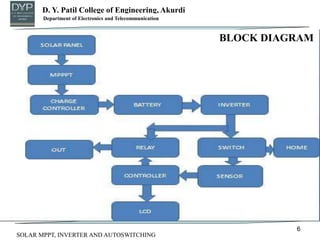
BLOCK DIAGRAM
D. Y. Patil College of Engineering, Akurdi
Department of Mechanical Engineering
7
Department of Electronics and Telecommunication
SOLAR MPPT, INVERTER AND AUTOSWITCHING
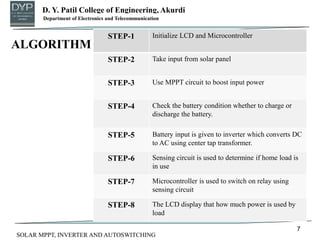
STEP-1 Initialize LCD and Microcontroller
STEP-2 Take input from solar panel
STEP-3 Use MPPT circuit to boost input power
STEP-4 Check the battery condition whether to charge or
discharge the battery.
STEP-5 Battery input is given to inverter which converts DC
to AC using center tap transformer.
STEP-6 Sensing circuit is used to determine if home load is
in use
STEP-7 Microcontroller is used to switch on relay using
sensing circuit
STEP-8 The LCD display that how much power is used by
load
ALGORITHM
D. Y. Patil College of Engineering, Akurdi
Department of Mechanical Engineering
8
Department of Electronics and Telecommunication
SOLAR MPPT, INVERTER AND AUTOSWITCHING
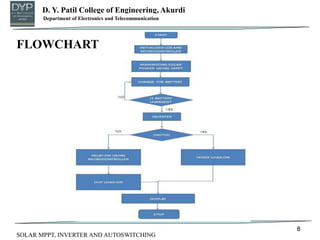
FLOWCHART
D. Y. Patil College of Engineering, Akurdi
Department of Mechanical Engineering
9
Department of Electronics and Telecommunication
SOLAR MPPT, INVERTER AND AUTOSWITCHING
D. Y. Patil College of Engineering, Akurdi
Department of Mechanical Engineering
ADVANTAGES:
 No pollution.
 Renewal source.
 Long lasting solar cells.
 Low maintenance.
 Easy installation.
10
Department of Electronics and Telecommunication
SOLAR MPPT, INVERTER AND AUTOSWITCHING
D. Y. Patil College of Engineering, Akurdi
Department of Mechanical Engineering
DISADVANTAGES:
 Initial cost.
 Location.
 Pollution.
 Inefficiency.
 Reliability.
 Installation area.
11
Department of Electronics and Telecommunication
SOLAR MPPT, INVERTER AND AUTOSWITCHING
D. Y. Patil College of Engineering, Akurdi
Department of Mechanical Engineering
APPLICATION:
 Industrial purposes.
 Solar lighting.
 Power plants
 Commercial use.
 Household purposes.
 Power pump.
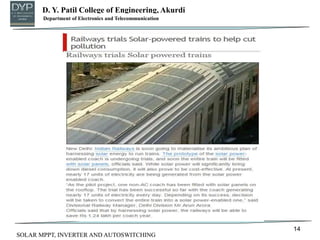
 Solar car.
12
Department of Electronics and Telecommunication
SOLAR MPPT, INVERTER AND AUTOSWITCHING
D. Y. Patil College of Engineering, Akurdi
Department of Mechanical Engineering
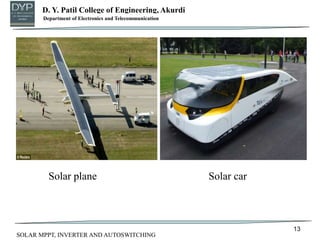
Solar plane Solar car
13
Department of Electronics and Telecommunication
SOLAR MPPT, INVERTER AND AUTOSWITCHING
D. Y. Patil College of Engineering, Akurdi
Department of Mechanical Engineering
14
Department of Electronics and Telecommunication
SOLAR MPPT, INVERTER AND AUTOSWITCHING
D. Y. Patil College of Engineering, Akurdi
Department of Mechanical Engineering
15
Department of Electronics and Telecommunication
SOLAR MPPT, INVERTER AND AUTOSWITCHING
D. Y. Patil College of Engineering, Akurdi
Department of Mechanical Engineering
16
Department of Electronics and Telecommunication
SOLAR MPPT, INVERTER AND AUTOSWITCHING

SOLAR MPPT, INVERTER AND AUTOSWITCHING

  • 1.
    D. Y. PatilCollege of Engineering, Akurdi Department of Mechanical Engineering A Project on SOLAR MPPT, INVERTER AND AUTOSWITCHING Sponsored by “Nutan Infotronics (P) Ltd” 1 Department of Electronics and Telecommunication SOLAR MPPT, INVERTER AND AUTOSWITCHING
  • 2.
    D. Y. PatilCollege of Engineering, Akurdi Department of Mechanical Engineering SOLAR MPPT, INVERTER AND AUTOSWITCHING Guided By :- Mrs. M.M. Karad and Mr. R. Singh Presented By :- Jayprakash Singh Anirban paul Yogesh sonni 2 Department of Electronics and Telecommunication SOLAR MPPT, INVERTER AND AUTOSWITCHING
  • 3.
    D. Y. PatilCollege of Engineering, Akurdi Department of Mechanical Engineering INTRODUCTION: Solar energy is referred to as the energy that comes from the sun’s rays. Solar energy is widely available today. We only need the right instruments to capture the sun’s rays and convert those rays into energy. Solar panels is a larger photovoltaic system to generate and supply electricity. With a proper charge controller, the prospect of having to pay 30-50% more up front for additional solar panels makes the MPPT controller very attractive. For AC loads, Such loads are fed by inverters, it’s essential that output voltage of the inverters is so controlled as to fulfill the requirements of AC loads. The excess power generated by panel can also be shared by auto-switching. 3 Department of Electronics and Telecommunication SOLAR MPPT, INVERTER AND AUTOSWITCHING
  • 4.
    D. Y. PatilCollege of Engineering, Akurdi Department of Mechanical Engineering 4 Department of Electronics and Telecommunication SOLAR MPPT, INVERTER AND AUTOSWITCHING
  • 5.
    D. Y. PatilCollege of Engineering, Akurdi Department of Mechanical Engineering 5 Department of Electronics and Telecommunication SOLAR MPPT, INVERTER AND AUTOSWITCHING
  • 6.
    D. Y. PatilCollege of Engineering, Akurdi Department of Mechanical Engineering 6 Department of Electronics and Telecommunication SOLAR MPPT, INVERTER AND AUTOSWITCHING BLOCK DIAGRAM
  • 7.
    D. Y. PatilCollege of Engineering, Akurdi Department of Mechanical Engineering 7 Department of Electronics and Telecommunication SOLAR MPPT, INVERTER AND AUTOSWITCHING STEP-1 Initialize LCD and Microcontroller STEP-2 Take input from solar panel STEP-3 Use MPPT circuit to boost input power STEP-4 Check the battery condition whether to charge or discharge the battery. STEP-5 Battery input is given to inverter which converts DC to AC using center tap transformer. STEP-6 Sensing circuit is used to determine if home load is in use STEP-7 Microcontroller is used to switch on relay using sensing circuit STEP-8 The LCD display that how much power is used by load ALGORITHM
  • 8.
    D. Y. PatilCollege of Engineering, Akurdi Department of Mechanical Engineering 8 Department of Electronics and Telecommunication SOLAR MPPT, INVERTER AND AUTOSWITCHING FLOWCHART
  • 9.
    D. Y. PatilCollege of Engineering, Akurdi Department of Mechanical Engineering 9 Department of Electronics and Telecommunication SOLAR MPPT, INVERTER AND AUTOSWITCHING
  • 10.
    D. Y. PatilCollege of Engineering, Akurdi Department of Mechanical Engineering ADVANTAGES:  No pollution.  Renewal source.  Long lasting solar cells.  Low maintenance.  Easy installation. 10 Department of Electronics and Telecommunication SOLAR MPPT, INVERTER AND AUTOSWITCHING
  • 11.
    D. Y. PatilCollege of Engineering, Akurdi Department of Mechanical Engineering DISADVANTAGES:  Initial cost.  Location.  Pollution.  Inefficiency.  Reliability.  Installation area. 11 Department of Electronics and Telecommunication SOLAR MPPT, INVERTER AND AUTOSWITCHING
  • 12.
    D. Y. PatilCollege of Engineering, Akurdi Department of Mechanical Engineering APPLICATION:  Industrial purposes.  Solar lighting.  Power plants  Commercial use.  Household purposes.  Power pump.  Solar car. 12 Department of Electronics and Telecommunication SOLAR MPPT, INVERTER AND AUTOSWITCHING
  • 13.
    D. Y. PatilCollege of Engineering, Akurdi Department of Mechanical Engineering Solar plane Solar car 13 Department of Electronics and Telecommunication SOLAR MPPT, INVERTER AND AUTOSWITCHING
  • 14.
    D. Y. PatilCollege of Engineering, Akurdi Department of Mechanical Engineering 14 Department of Electronics and Telecommunication SOLAR MPPT, INVERTER AND AUTOSWITCHING
  • 15.
    D. Y. PatilCollege of Engineering, Akurdi Department of Mechanical Engineering 15 Department of Electronics and Telecommunication SOLAR MPPT, INVERTER AND AUTOSWITCHING
  • 16.
    D. Y. PatilCollege of Engineering, Akurdi Department of Mechanical Engineering 16 Department of Electronics and Telecommunication SOLAR MPPT, INVERTER AND AUTOSWITCHING