BALLARI INSTITUTE OF TECNOLOGY AND
MANAGEMENT
Project Title
SOLAR UPS
Under The Guidance Of:
Prof. K.NARASIMHULU B.E. ,M-Tech
Project associates:
SHAIK NAFEESA
SHAIK JAINAB BANU
PRAKASH NAIK
VINOD KUMAR K H
3BR15EE076
3BR15EE077
3BR15EE062
3BR15EE099
CONTENTS
1. Abstract
2. Introduction
3. Literature survey
4. Block diagram and Circuit diagram
5. Working principle
6. Components
7. Merits and Demerits
8. Application
9. Conclusion
10. Reference
ABSTRACT
▶
This Project provides the research and development of a solar powered UPS in India’s market as an
alternative source of energy.
We face unprecedented energy crisis in rural and suburban area. The problems become more severe during
summers. However, winter in no different as there was still an average power outage of 3-4 hours every
day.
Those without generators and UPS faced tremendous problems in these outages. The prices of both
continued to increase due to a sharp increase in their demand. We are not using solar UPS as there
replacement but it can be used as backup energy during grid failure.
This project consists of solar panel which consist solar cell which convert solar energy into electrical
energy. We also have charging circuit which will charge 12V DC (direct current) battery and inverter circuit
will convert itAC (alternative current).
INTRODUC
TION
▶ Solar power in India is a fast developing industry. As of December 2017 the country's solar power
had 17.05GW total capacity. India expanded its solar-generation capacity 8 times from 2,650 MW
on 26 May 2014 to over 20GW as on 31 January 2018.
▶ The improvements in solar thermal storage power technology in recent years has made this task
achievable as the cheaper solar power need not depend on costly and polluting coal/gas/nuclear
based power generation for ensuring stable grid operation.
▶ Most of the rural area still face the problem of electricity which force them to be reliable
on kerosene lamp. This major problem can be overcome by usage of solar energy. I have studied the
model through which this major problem can be eliminated
LITERATURE SURVEY
Serial
number
Author Research Thesis Y
ear of
research
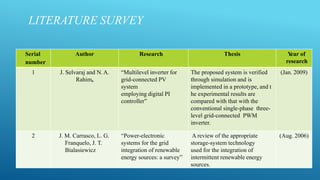
1 J. Selvaraj and N.A.
Rahim,
“Multilevel inverter for
grid-connected PV
system
employing digital PI
controller”
The proposed system is verified
through simulation and is
implemented in a prototype, and t
he experimental results are
compared with that with the
conventional single-phase three-
level grid-connected PWM
inverter.
(Jan. 2009)
2 J. M. Carrasco, L. G.
Franquelo, J. T.
Bialasiewicz
“Power-electronic
systems for the grid
integration of renewable
energy sources: a survey”
A review of the appropriate
storage-system technology
used for the integration of
intermittent renewable energy
sources.
(Aug. 2006)
PROBLEM STATEMENT
The world demand for electric energy is constantly increasing, and conventional energy
resources are diminishing and are even threatened to be depleted. Moreover; their prices
are rising. For these reasons, the need for alternative energy sources has become
indispensable, and solar energy in particular has proved to be a very promising alternative
because of its availability and pollution-free nature.
Due to the increasing efficiencies and decreasing cost of photovoltaic cells and the
improvement of the switching technology used for power conversion, our goal is to
design an inverter powered by PV panels and that could supply stand-aloneAC loads.
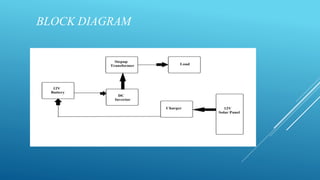
BLOCK DIAGRAM
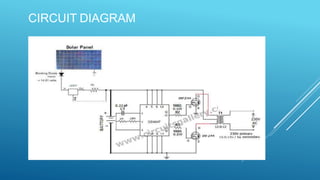
CIRCUIT DIAGRAM
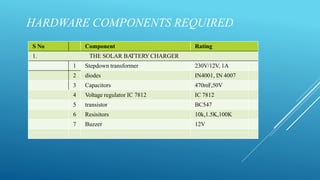
HARDWARE COMPONENTS REQUIRED
S No Component Rating
1. THE SOLAR BA
TTERY CHARGER
1 Stepdown transformer 230V/12V, 1A
2 diodes IN4001, IN 4007
3 Capacitors 470mF,50V
4 Voltage regulator IC 7812 IC 7812
5 transistor BC547
6 Resisitors 10k,1.5K,100K
7 Buzzer 12V
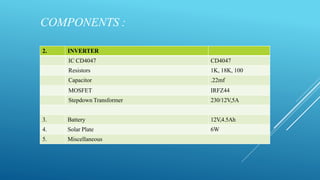
COMPONENTS :
2. INVERTER
IC CD4047 CD4047
Resistors 1K, 18K, 100
Capacitor .22mf
MOSFET IRFZ44
Stepdown Transformer 230/12V,5A
3. Battery 12V,4.5Ah
4. Solar Plate 6W
5. Miscellaneous
SOLAR INVERTER ADVANTAGES:
▶ Solar energy is a renewable energy which helps in reducing global warming and greenhouse effect.
Solar energy helps in saving money as many people have started using solar based devices.
▶ Asolar inverter is really convenient for those people who use limited amount of energy.
▶ There is this synchronous solar inverter which helps both small homeowners and power companies
as they are large in size
▶ There is this multifunction solar inverter which is the best among all and works efficiently. It
converts the DCpower to AC very carefully which is perfect for commercial establishments This
inverter is effective in cost i.e. less expensive than generators
▶ Apart from solar inverters there are other devices too that make use of solar energy namely, solar
cooker, solar heater.Solar inverters are way better than normal electric ones.Also their maintenance
does not cost much money
SOLAR INVERTER DISADVANTAGES
▶ Initially you need good amount of money for buying a solar inverter.
▶ Its efficiency is totally dependent on amount of strong sunlight.
▶ The solar panels that are used to attract Sunlight requires lots of space as it depend on
amount of sunlight.
▶ Solar Inverters can work at no sun but it require fully charged battery.
APPLICATION
▶ Remote weather monitoring system.
▶ Remote communication system.
▶ Satellite communication.
▶ Solar power based transport system.
CONCLUSION
▶ Photovoltaic power production is gaining more significance as a renewable energy
source due to its many advantages.
▶ These advantages include everlasting pollution free energy production scheme, ease of
maintenance, and direct sunbeam to electricity conversion.
▶ However the high cost of PV installation still forms an obstacles for this technology.
Moreover the PV panel output power fluctuates as weather conditions, such as the isolation
level, and cell temperature.
▶ The describe design of the system will produce the desired output of the project. The inverter
supply anAC source from a DC source.
REFERENCE
1. Khan B.H Non-conventional source of energy,5/e Mc Graw Hill Education(India)
2. J.B Gupta; Electronics Devices & circuit,3/e Vikas Publication.
3. Ashfaq Hussain: Electrical Machine, Dhanpat Rao Publication.
4. S Salivahanan & S. Arivazhagan: Digital Electronics ,Vikas publication. Muhammad H .Rashid
“Power Electronics” Pearson.
5. Wikipedia.com/solar energy.
THANK YOU…

solar-ups_compress.pptx

  • 1.
    BALLARI INSTITUTE OFTECNOLOGY AND MANAGEMENT Project Title SOLAR UPS Under The Guidance Of: Prof. K.NARASIMHULU B.E. ,M-Tech Project associates: SHAIK NAFEESA SHAIK JAINAB BANU PRAKASH NAIK VINOD KUMAR K H 3BR15EE076 3BR15EE077 3BR15EE062 3BR15EE099
  • 2.
    CONTENTS 1. Abstract 2. Introduction 3.Literature survey 4. Block diagram and Circuit diagram 5. Working principle 6. Components 7. Merits and Demerits 8. Application 9. Conclusion 10. Reference
  • 3.
    ABSTRACT ▶ This Project providesthe research and development of a solar powered UPS in India’s market as an alternative source of energy. We face unprecedented energy crisis in rural and suburban area. The problems become more severe during summers. However, winter in no different as there was still an average power outage of 3-4 hours every day. Those without generators and UPS faced tremendous problems in these outages. The prices of both continued to increase due to a sharp increase in their demand. We are not using solar UPS as there replacement but it can be used as backup energy during grid failure. This project consists of solar panel which consist solar cell which convert solar energy into electrical energy. We also have charging circuit which will charge 12V DC (direct current) battery and inverter circuit will convert itAC (alternative current).
  • 4.
    INTRODUC TION ▶ Solar powerin India is a fast developing industry. As of December 2017 the country's solar power had 17.05GW total capacity. India expanded its solar-generation capacity 8 times from 2,650 MW on 26 May 2014 to over 20GW as on 31 January 2018. ▶ The improvements in solar thermal storage power technology in recent years has made this task achievable as the cheaper solar power need not depend on costly and polluting coal/gas/nuclear based power generation for ensuring stable grid operation. ▶ Most of the rural area still face the problem of electricity which force them to be reliable on kerosene lamp. This major problem can be overcome by usage of solar energy. I have studied the model through which this major problem can be eliminated
  • 5.
    LITERATURE SURVEY Serial number Author ResearchThesis Y ear of research 1 J. Selvaraj and N.A. Rahim, “Multilevel inverter for grid-connected PV system employing digital PI controller” The proposed system is verified through simulation and is implemented in a prototype, and t he experimental results are compared with that with the conventional single-phase three- level grid-connected PWM inverter. (Jan. 2009) 2 J. M. Carrasco, L. G. Franquelo, J. T. Bialasiewicz “Power-electronic systems for the grid integration of renewable energy sources: a survey” A review of the appropriate storage-system technology used for the integration of intermittent renewable energy sources. (Aug. 2006)
  • 6.
    PROBLEM STATEMENT The worlddemand for electric energy is constantly increasing, and conventional energy resources are diminishing and are even threatened to be depleted. Moreover; their prices are rising. For these reasons, the need for alternative energy sources has become indispensable, and solar energy in particular has proved to be a very promising alternative because of its availability and pollution-free nature. Due to the increasing efficiencies and decreasing cost of photovoltaic cells and the improvement of the switching technology used for power conversion, our goal is to design an inverter powered by PV panels and that could supply stand-aloneAC loads.
  • 7.
  • 8.
  • 9.
    HARDWARE COMPONENTS REQUIRED SNo Component Rating 1. THE SOLAR BA TTERY CHARGER 1 Stepdown transformer 230V/12V, 1A 2 diodes IN4001, IN 4007 3 Capacitors 470mF,50V 4 Voltage regulator IC 7812 IC 7812 5 transistor BC547 6 Resisitors 10k,1.5K,100K 7 Buzzer 12V
  • 10.
    COMPONENTS : 2. INVERTER ICCD4047 CD4047 Resistors 1K, 18K, 100 Capacitor .22mf MOSFET IRFZ44 Stepdown Transformer 230/12V,5A 3. Battery 12V,4.5Ah 4. Solar Plate 6W 5. Miscellaneous
  • 11.
    SOLAR INVERTER ADVANTAGES: ▶Solar energy is a renewable energy which helps in reducing global warming and greenhouse effect. Solar energy helps in saving money as many people have started using solar based devices. ▶ Asolar inverter is really convenient for those people who use limited amount of energy. ▶ There is this synchronous solar inverter which helps both small homeowners and power companies as they are large in size ▶ There is this multifunction solar inverter which is the best among all and works efficiently. It converts the DCpower to AC very carefully which is perfect for commercial establishments This inverter is effective in cost i.e. less expensive than generators ▶ Apart from solar inverters there are other devices too that make use of solar energy namely, solar cooker, solar heater.Solar inverters are way better than normal electric ones.Also their maintenance does not cost much money
  • 12.
    SOLAR INVERTER DISADVANTAGES ▶Initially you need good amount of money for buying a solar inverter. ▶ Its efficiency is totally dependent on amount of strong sunlight. ▶ The solar panels that are used to attract Sunlight requires lots of space as it depend on amount of sunlight. ▶ Solar Inverters can work at no sun but it require fully charged battery.
  • 13.
    APPLICATION ▶ Remote weathermonitoring system. ▶ Remote communication system. ▶ Satellite communication. ▶ Solar power based transport system.
  • 14.
    CONCLUSION ▶ Photovoltaic powerproduction is gaining more significance as a renewable energy source due to its many advantages. ▶ These advantages include everlasting pollution free energy production scheme, ease of maintenance, and direct sunbeam to electricity conversion. ▶ However the high cost of PV installation still forms an obstacles for this technology. Moreover the PV panel output power fluctuates as weather conditions, such as the isolation level, and cell temperature. ▶ The describe design of the system will produce the desired output of the project. The inverter supply anAC source from a DC source.
  • 15.
    REFERENCE 1. Khan B.HNon-conventional source of energy,5/e Mc Graw Hill Education(India) 2. J.B Gupta; Electronics Devices & circuit,3/e Vikas Publication. 3. Ashfaq Hussain: Electrical Machine, Dhanpat Rao Publication. 4. S Salivahanan & S. Arivazhagan: Digital Electronics ,Vikas publication. Muhammad H .Rashid “Power Electronics” Pearson. 5. Wikipedia.com/solar energy.
  • 16.