แผนการจัดการเรียนรู้ภาษาอังกฤษเพื่อการสื่อสารตามรูปแบบ PPP
กลุ่มสาระการเรียนรู้ภาษาต่างประเทศ/วิชาภาษาอังกฤษ
ชั้นมัธยมศึกษาปีที่ 4
Unit: Science and Technology Topic:Transport & Communication Systems เวลา 3 ชั่วโมง
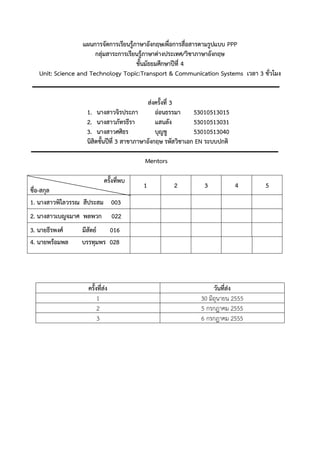
ส่งครั้งที่ 3
1. นางสาวจิรประภา
อ่อนธรรมา
53010513015
2. นางสาวภัทรธีรา
แสนลัง
53010513031
3. นางสาวศศิธร
บุญชู
53010513040
นิสิตชั้นปีที่ 3 สาขาภาษาอังกฤษ รหัสวิชาเอก EN ระบบปกติ
Mentors
ครั้งที่พบ
ชื่อ-สกุล
1. นางสาวพิไลวรรณ สีประสม 003
2. นางสาวเบญจมาศ พลพวก
3. นายธีรพงศ์
4. นายพร้อมพล

1

2

3

4

022

มีสัตย์
016
บรรทุมพร 028

ครั้งที่ส่ง
1
2
3

วันที่ส่ง
30 มิถุนายน 2555
5 กรกฎาคม 2555
6 กรกฎาคม 2555

5
แผนการจัดการเรียนรู้ภาษาอังกฤษเพื่อการสื่อสารตามรูปแบบ PPP
กลุ่มสาระการเรียนรู้ภาษาต่างประเทศ/วิชาภาษาอังกฤษ
ชั้นมัธยมศึกษาปีที่ 4
Unit: Science and Technology Topic: Transport & Communication Systems เวลา 3 ชั่วโมง
สอนวันที่............เดือน……..............................พ.ศ. 2555
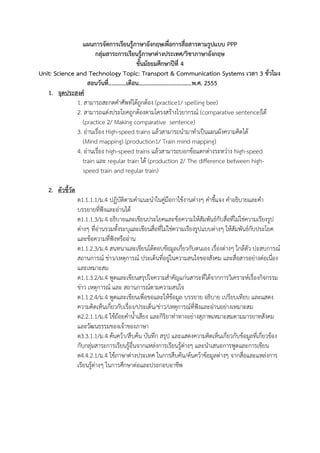
1. จุดประสงค์
1. สามารถสะกดคาศัพท์ได้ถูกต้อง (practice1/ spelling bee)
2. สามารถแต่งประโยคถูกต้องตามโครงสร้างไวยากรณ์ (comparative sentence)ได้
(practice 2/ Making comparative sentence)
3. อ่านเรื่อง High-speed trains แล้วสามารถนามาทาเป็นแผนผังความคิดได้
(Mind mapping) (production1/ Train mind mapping)
4. อ่านเรื่อง high-speed trains แล้วสามารถบอกข้อแตกต่างระหว่าง high-speed
train และ regular train ได้ (production 2/ The difference between highspeed train and regular train)
2. ตัวชี้วัด
ต1.1.1.1/ม.4 ปฏิบัติตามคาแนะนาในคู่มือกาใช้งานต่างๆ คาชี้แจง คาอธิบายและคา
บรรยายที่ฟังและอ่านได้
ต1.1.1.3/ม.4 อธิบายและเขียนประโยคและข้อความให้สัมพันธ์กับสื่อที่ไม่ใช่ความเรียงรูป
ต่างๆ ที่อ่านรวมทั้งระบุและเขียนสื่อที่ไม่ใช่ความเรียงรูปแบบต่างๆ ให้สัมพันธ์กบประโยค
ั
และข้อความที่ฟังหรืออ่าน
ต1.1.2.3/ม.4 สนทนาและเขียนโต้ตอบข้อมูลเกี่ยวกับตนเอง เรื่องต่างๆ ใกล้ตัว ปะสบการณ์
สถานการณ์ ข่าว/เหตุการณ์ ประเด็นที่อยู่ในความสนใจของสังคม และสื่อสารอย่างต่อเนือง
่
และเหมาะสม
ต1.1.3.2/ม.4 พูดและเขียนสรุปใจความสาคัญแก่นสาระที่ได้จากการวิเคราะห์เรื่องกิจกรรม
ข่าว เหตุการณ์ และ สถานการณ์ตามความสนใจ
ต1.1.2.4/ม.4 พูดและเขียนเพื่อขอและให้ข้อมูล บรรยาย อธิบาย เปรียบเทียบ และแสดง
ความคิดเห็นเกี่ยวกับเรื่อง/ประเด็น/ข่าว/เหตุการณ์ที่ฟงและอ่านอย่างเหมาะสม
ั
ต2.2.1.1/ม.4 ใช้ถ้อยคาน้าเสียง และกิริยาท่าทางอย่างสุภาพเหมาะสมตามมารยาทสังคม
และวัฒนธรรมของเจ้าของภาษา
ต3.3.1.1/ม.4 ค้นคว้า/สืบค้น บันทึก สรุป และแสดงความคิดเห็นเกี่ยวกับข้อมูลทีเ่ กี่ยวข้อง
กับกลุ่มสาระการเรียนรู้อื่นจากแหล่งการเรียนรู้ต่างๆ และนาเสนอการพูดและการเขียน
ต4.4.2.1/ม.4 ใช้ภาษาต่างประเทศ ในการสืบค้น/ค้นคว้าข้อมูลต่างๆ จากสื่อและแหล่งการ
เรียนรู้ต่างๆ ในการศึกษาต่อและประกอบอาชีพ
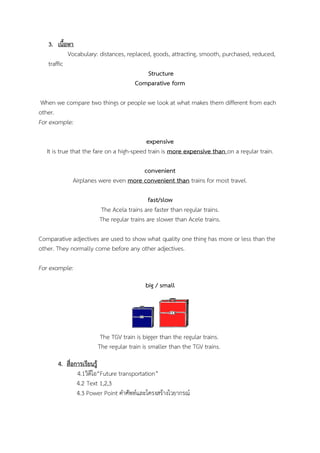
3. เนื้อหา
Vocabulary: distances, replaced, goods, attracting, smooth, purchased, reduced,
traffic
Structure
Comparative form
When we compare two things or people we look at what makes them different from each
other.
For example:
expensive
It is true that the fare on a high-speed train is more expensive than on a regular train.
convenient
Airplanes were even more convenient than trains for most travel.
fast/slow
The Acela trains are faster than regular trains.
The regular trains are slower than Acele trains.
Comparative adjectives are used to show what quality one thing has more or less than the
other. They normally come before any other adjectives.
For example:
big / small

The TGV train is bigger than the regular trains.
The regular train is smaller than the TGV trains.
4. สื่อการเรียนรู้
4.1วิดีโอ“Future transportation”
4.2 Text 1,2,3
4.3 Power Point คาศัพท์และโครงสร้างไวยากรณ์
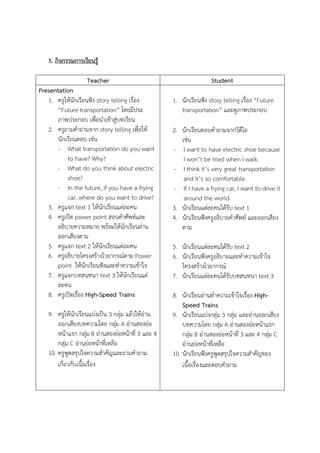
5. กิจกรรมการเรียนรู้
Teacher
Presentation
1. ครูให้นักเรียนฟัง story telling เรื่อง
“Future transportation” โดยมีประ
ภาพประกอบ เพื่อนาเข้าสูบทเรียน
่
2. ครูถามคาถามจาก story telling เพื่อให้
นักเรียนตอบ เช่น
- What transportation do you want
to have? Why?
- What do you think about electric
shoe?
- In the future, if you have a frying
car, where do you want to drive?
3. ครูแจก text 1 ให้นักเรียนแต่ละคน
4. ครูเปิด power point สอนคาศัพท์และ
อธิบายความหมาย พร้อมให้นักเรียนอ่าน
ออกเสียงตาม
5. ครูแจก text 2 ให้นักเรียนแต่ละคน
6. ครูอธิบายโครงสร้างไวยากรณ์ตาม Power
point ให้นักเรียนฟังและทาความเข้าใจ
7. ครูแจกบทสนทนา text 3 ให้นักเรียนแต่
ละคน
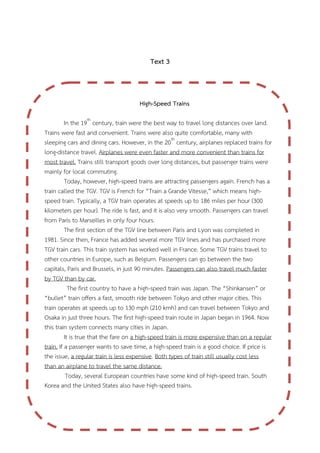
8. ครูเปิดเรื่อง High-Speed Trains
9. ครูให้นักเรียนแบ่งเป็น 3 กลุ่ม แล้วให้อ่าน
ออกเสียงบทความโดย กลุม A อ่านสองย่อ
่
หน้าแรก กลุ่ม B อ่านสองย่อหน้าที่ 3 และ 4
กลุ่ม C อ่านย่อหน้าที่เหลือ
10. ครูพูดสรุปใจความสาคัญและถามคาถาม
เกี่ยวกับเนื้อเรื่อง

Student
1. นักเรียนฟัง story telling เรื่อง “Future
transportation” และดูภาพประกอบ
2. นักเรียนตอบคาถามจากวิดีโอ
เช่น
- I want to have electric shoe because
I won’t be tried when I walk.
- I think it’s very great transportation
and it’s so comfortable.
- If I have a frying car, I want to drive it
around the world.
3. นักเรียนแต่ละคนได้รับ text 1
4. นักเรียนฟังครูอธิบายคาศัพท์ และออกเสียง
ตาม
5. นักเรียนแต่ละคนได้รับ text 2
6. นักเรียนฟังครูอธิบายและทาความเข้าใจ
โครงสร้างไวยากรณ์
7. นักเรียนแต่ละคนได้รับบทสนทนา text 3
8. นักเรียนอ่านทาความเข้าใจเรื่อง HighSpeed Trains
9. นักเรียนแบ่งกลุ่ม 3 กลุ่ม และอ่านออกเสียง
บทความโดย กลุม A อ่านสองย่อหน้าแรก
่
กลุ่ม B อ่านสองย่อหน้าที่ 3 และ 4 กลุม C
่
อ่านย่อหน้าทีเ่ หลือ
10. นักเรียนฟังครูพูดสรุปใจความสาคัญของ
เนื้อเรื่องและตอบคาถาม
Teacher
Example:
- The “bullet” train is found in…
- What is the French train called?
- How fast can the high-speed
trains travel?
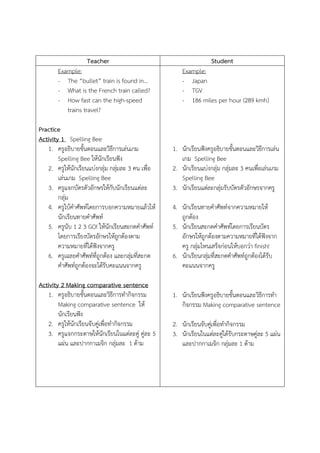
Practice
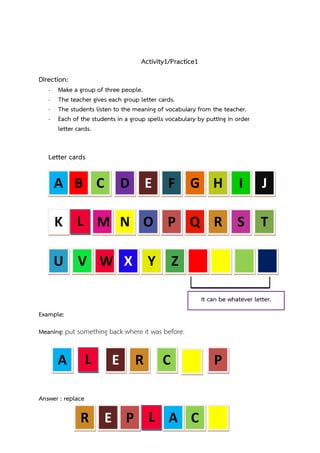
Activity 1 Spelling Bee
1. ครูอธิบายขั้นตอนและวิธีการเล่นเกม
Spelling Bee ให้นักเรียนฟัง
2. ครูให้นักเรียนแบ่งกลุ่ม กลุมละ 3 คน เพื่อ
่
เล่นเกม Spelling Bee
3. ครูแจกบัตรตัวอักษรให้กบนักเรียนแต่ละ
ั
กลุ่ม
4. ครูใบ้คาศัพท์โดยการบอกความหมายแล้วให้
นักเรียนทายคาศัพท์
5. ครูนับ 1 2 3 GO! ให้นักเรียนสะกดคาศัพท์
โดยการเรียงบัตรอักษรให้ถกต้องตาม
ู
ความหมายที่ได้ฟังจากครู
6. ครูเฉลยคาศัพท์ที่ถูกต้อง และกลุมทีสะกด
่ ่
คาศัพท์ถูกต้องจะได้รับคะแนนจากครู
Activity 2 Making comparative sentence
1. ครูอธิบายขั้นตอนและวิธีการทากิจกรรม
Making comparative sentence ให้
นักเรียนฟัง
2. ครูให้นักเรียนจับคู่เพื่อทากิจกรรม
3. ครูแจกกระดาษให้นักเรียนในแต่ละคู่ คู่ละ 5
แผ่น และปากกาเมจิก กลุ่มละ 1 ด้าม

Student
Example:
- Japan
- TGV
- 186 miles per hour (289 kmh)

1. นักเรียนฟังครูอธิบายขั้นตอนและวิธีการเล่น
เกม Spelling Bee
2. นักเรียนแบ่งกลุ่ม กลุ่มละ 3 คนเพื่อเล่นเกม
Spelling Bee
3. นักเรียนแต่ละกลุ่มรับบัตรตัวอักษรจากครู
4. นักเรียนทายคาศัพท์จากความหมายให้
ถูกต้อง
5. นักเรียนสะกดคาศัพท์โดยการเรียนบัตร
อักษรให้ถูกต้องตามความหมายที่ได้ฟังจาก
ครู กลุ่มไหนเสร็จก่อนให้บอกว่า finish!
6. นักเรียนกลุมที่สะกดคาศัพท์ถูกต้องได้รับ
่
คะแนนจากครู
1. นักเรียนฟังครูอธิบายขั้นตอนและวิธีการทา
กิจกรรม Making comparative sentence
2. นักเรียนจับคูเ่ พื่อทากิจกรรม
3. นักเรียนในแต่ละคู่ได้รับกระดาษคู่ละ 5 แผ่น
และปากกาเมจิก กลุ่มละ 1 ด้าม
4.

5.
6.
7.

Teacher
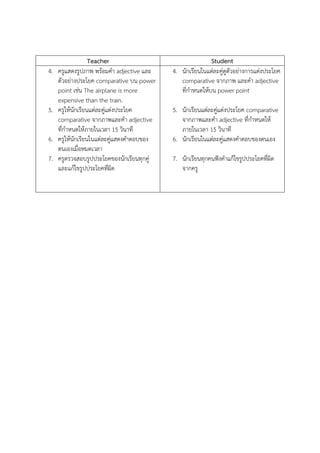
ครูแสดงรูปภาพ พร้อมคา adjective และ
ตัวอย่างประโยค comparative บน power
point เช่น The airplane is more
expensive than the train.
ครูให้นักเรียนแต่ละคู่แต่งประโยค
comparative จากภาพและคา adjective
ที่กาหนดให้ภายในเวลา 15 วินาที
ครูให้นักเรียนในแต่ละคู่แสดงคาตอบของ
ตนเองเมื่อหมดเวลา
ครูตรวจสอบรูปประโยคของนักเรียนทุกคู่
และแก้ไขรูปประโยคทีผิด
่

Student
4. นักเรียนในแต่ละคู่ดูตัวอย่างการแต่งประโยค
comparative จากภาพ และคา adjective
ที่กาหนดให้บน power point
5. นักเรียนแต่ละคู่แต่งประโยค comparative
จากภาพและคา adjective ที่กาหนดให้
ภายในเวลา 15 วินาที
6. นักเรียนในแต่ละคู่แสดงคาตอบของตนเอง
7. นักเรียนทุกคนฟังคาแก้ไขรูปประโยคทีผิด
่
จากครู
Teacher
Production
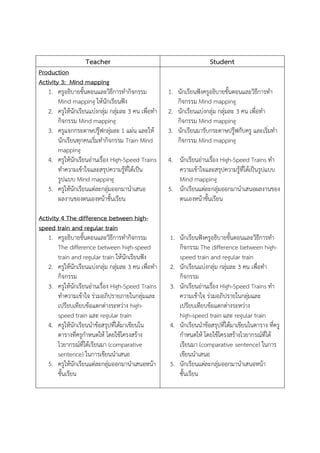
Activity 3: Mind mapping
1. ครูอธิบายขั้นตอนและวิธีการทากิจกรรม
Mind mapping ให้นักเรียนฟัง
2. ครูให้นักเรียนแบ่งกลุ่ม กลุมละ 3 คน เพื่อทา
่
กิจกรรม Mind mapping
3. ครูแจกกระดาษปรู๊ฟกลุ่มละ 1 แผ่น และให้
นักเรียนทุกคนเริ่มทากิจกรรม Train Mind
mapping
4. ครูให้นักเรียนอ่านเรื่อง High-Speed Trains
ทาความเข้าใจและสรุปความรูที่ได้เป็น
้
รูปแบบ Mind mapping
5. ครูให้นักเรียนแต่ละกลุ่มออกมานาเสนอ
ผลงานของตนเองหน้าชั้นเรียน
Activity 4 The difference between highspeed train and regular train
1. ครูอธิบายขั้นตอนและวิธีการทากิจกรรม
The difference between high-speed
train and regular train ให้นักเรียนฟัง
2. ครูให้นักเรียนแบ่งกลุ่ม กลุมละ 3 คน เพื่อทา
่
กิจกรรม
3. ครูให้นักเรียนอ่านเรื่อง High-Speed Trains
ทาความเข้าใจ ร่วมอภิปรายภายในกลุ่มและ
เปรียบเทียบข้อแตกต่างระหว่าง highspeed train และ regular train
4. ครูให้นักเรียนนาข้อสรุปที่ได้มาเขียนใน
ตารางที่ครูกาหนดให้ โดยใช้โครงสร้าง
ไวยากรณ์ที่ได้เรียนมา (comparative
sentence) ในการเขียนนาเสนอ
5. ครูให้นักเรียนแต่ละกลุ่มออกมานาเสนอหน้า
ชั้นเรียน

Student
1. นักเรียนฟังครูอธิบายขั้นตอนและวิธีการทา
กิจกรรม Mind mapping
2. นักเรียนแบ่งกลุ่ม กลุ่มละ 3 คน เพื่อทา
กิจกรรม Mind mapping
3. นักเรียนมารับกระดาษปรู๊ฟกับครู และเริ่มทา
กิจกรรม Mind mapping
4. นักเรียนอ่านเรือง High-Speed Trains ทา
่
ความเข้าใจและสรุปความรู้ที่ได้เป็นรูปแบบ
Mind mapping
5. นักเรียนแต่ละกลุ่มออกมานาเสนอผลงานของ
ตนเองหน้าชั้นเรียน

1. นักเรียนฟังครูอธิบายขั้นตอนและวิธีการทา
กิจกรรม The difference between highspeed train and regular train
2. นักเรียนแบ่งกลุ่ม กลุ่มละ 3 คน เพื่อทา
กิจกรรม
3. นักเรียนอ่านเรือง High-Speed Trains ทา
่
ความเข้าใจ ร่วมอภิปรายในกลุ่มและ
เปรียบเทียบข้อแตกต่างระหว่าง
high-speed train และ regular train
4. นักเรียนนาข้อสรุปที่ได้มาเขียนในตาราง ที่ครู
กาหนดให้ โดยใช้โครงสร้างไวยากรณ์ที่ได้
เรียนมา (comparative sentence) ในการ
เขียนนาเสนอ
5. นักเรียนแต่ละกลุ่มออกมานาเสนอหน้า
ชั้นเรียน
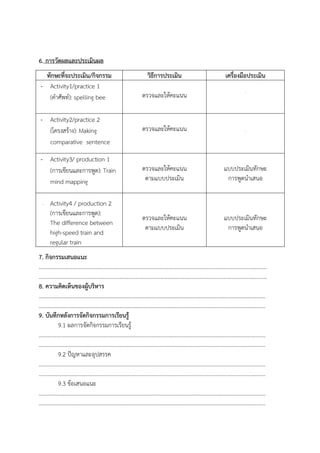
6. การวัดผลและประเมินผล
ทักษะที่จะประเมิน/กิจกรรม
- Activity1/practice 1
(คาศัพท์): spelling bee

วิธีการประเมิน

เครื่องมือประเมิน

ตรวจและให้คะแนน

-

- Activity2/practice 2
(โครงสร้าง): Making
comparative sentence

ตรวจและให้คะแนน

-

- Activity3/ production 1
(การเขียนและการพูด): Train
mind mapping

ตรวจและให้คะแนน
ตามแบบประเมิน

แบบประเมินทักษะ
การพูดนาเสนอ

ตรวจและให้คะแนน
ตามแบบประเมิน

แบบประเมินทักษะ
การพูดนาเสนอ

-

Activity4 / production 2
(การเขียนและการพูด):
The difference between
high-speed train and
regular train

7. กิจกรรมเสนอแนะ
………………………………………………………………………………………………………………………………………………….
………………………………………………………………………………………………………………………………………………….
8. ความคิดเห็นของผู้บริหาร
…………………………………………………………………………………………………………………………………………………
…………………………………………………………………………………………………………………………………………………
9. บันทึกหลังการจัดกิจกรรมการเรียนรู้
9.1 ผลการจัดกิจกรรมการเรียนรู้
…………………………………………………………………………………………………………………………………………………
…………………………………………………………………………………………………………………………………………………
9.2 ปัญหาและอุปสรรค
…………………………………………………………………………………………………………………………………………………
…………………………………………………………………………………………………………………………………………………
9.3 ข้อเสนอแนะ
…………………………………………………………………………………………………………………………………………………
…………………………………………………………………………………………………………………………………………………
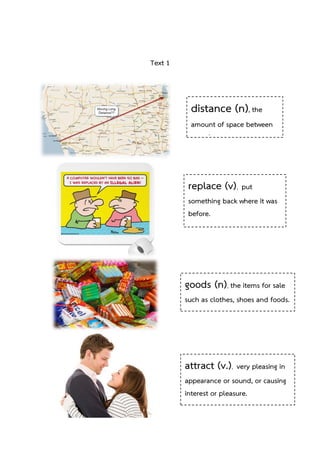
Text 1

distance (n), the
amount of space between
two places.

replace (v), put
something back where it was
before.
places.

goods (n), the items for sale
such as clothes, shoes and foods.

attract (v.), very pleasing in
appearance or sound, or causing
interest or pleasure.
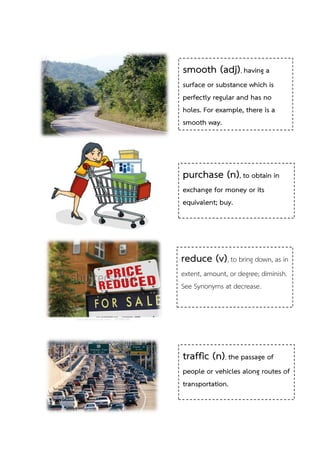
smooth (adj), having a
surface or substance which is
perfectly regular and has no
holes. For example, there is a
smooth way.

purchase (n), to obtain in
exchange for money or its
equivalent; buy.

reduce (v), to bring down, as in
extent, amount, or degree; diminish.
See Synonyms at decrease.

traffic (n), the passage of
people or vehicles along routes of
transportation.
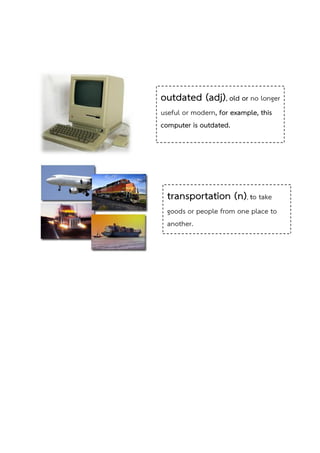
outdated (adj), old or no longer
useful or modern, for example, this
computer is outdated.

transportation (n), to take
goods or people from one place to
another.
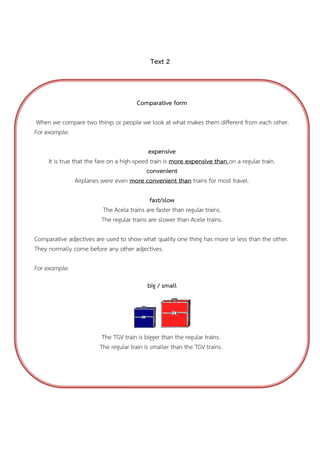
Text 2

Comparative form
When we compare two things or people we look at what makes them different from each other.
For example:
expensive
It is true that the fare on a high-speed train is more expensive than on a regular train.
convenient
Airplanes were even more convenient than trains for most travel.
fast/slow
The Acela trains are faster than regular trains.
The regular trains are slower than Acele trains.
Comparative adjectives are used to show what quality one thing has more or less than the other.
They normally come before any other adjectives.
For example:
big / small

The TGV train is bigger than the regular trains.
The regular train is smaller than the TGV trains.
Forming the comparative
Form

Rule
For example
Add -r to the end of the
Words of one syllable ending in 'e'.
wide - wider
word.
Words of one syllable, with one Double the consonant
vowel and one consonant at the and add -er to the end of big - bigger
end.
the word.
Words of one syllable, with more
Add - er to the end of
than one vowel or more than one
high - higher
the word.
consonant at the end.
Change 'y' to 'i', and add Words of two syllables, ending in
er to the end of the
happy - happier
'y'.
word.
Words of two syllables or more, Place 'more' before the convenientnot ending in 'y'.
adjective.
more convenient
The following adjectives are exceptions to this rule:
- 'good' becomes 'better'
- 'bad' becomes 'worse'
- 'little' becomes 'less'
Ex. A regular train is less expensive than a high–speed train.
When comparing two things like this we put than between the adjective and
the thing being compared.
For example:- A high-speed train is more expensive than on a regular train.
- The Acela trains are faster than regular trains.
Text 3

High-Speed Trains
In the 19th century, train were the best way to travel long distances over land.
Trains were fast and convenient. Trains were also quite comfortable, many with
sleeping cars and dining cars. However, in the 20th century, airplanes replaced trains for
long-distance travel. Airplanes were even faster and more convenient than trains for
most travel. Trains still transport goods over long distances, but passenger trains were
mainly for local commuting.
Today, however, high-speed trains are attracting passengers again. French has a
train called the TGV. TGV is French for “Train a Grande Vitesse,” which means highspeed train. Typically, a TGV train operates at speeds up to 186 miles per hour (300
kilometers per hour). The ride is fast, and it is also very smooth. Passengers can travel
from Paris to Marseilles in only four hours.
The first section of the TGV line between Paris and Lyon was completed in
1981. Since then, France has added several more TGV lines and has purchased more
TGV train cars. This train system has worked well in France. Some TGV trains travel to
other countries in Europe, such as Belgium. Passengers can go between the two
capitals, Paris and Brussels, in just 90 minutes. Passengers can also travel much faster
by TGV than by car.
The first country to have a high-speed train was Japan. The “Shinkansen” or
“bullet” train offers a fast, smooth ride between Tokyo and other major cities. This
train operates at speeds up to 130 mph (210 kmh) and can travel between Tokyo and
Osaka in just three hours. The first high-speed train route in Japan began in 1964. Now
this train system connects many cities in Japan.
It is true that the fare on a high-speed train is more expensive than on a regular
train. If a passenger wants to save time, a high-speed train is a good choice. If price is
the issue, a regular train is less expensive. Both types of train still usually cost less
than an airplane to travel the same distance.
Today, several European countries have some kind of high-speed train. South
Korea and the United States also have high-speed trains.
In the United States, a high-speed train called Acela operates from Boston
to Washington, D.C. via New York City. This route is popular because passengers
arrive directly in the center of each of these major cities. The Acela trains are faster
than regular trains, partly because they stop in fewer cities along the route. But the
Acela trains don’t travel as fast as high-speed trains in other countries. The train
tracks along the route are designed for older types of trains. Because of these older
tracks, the Acela trains have to travel more slowly.
Many of these high-speed train lines have reduced air traffic between cities.
Increased train travel will also help reduce crowding at airports. What once seemed
to be an outdated from of transportation is now in style again.
Activity1/Practice1
Direction:
-

Make a group of three people.
The teacher gives each group letter cards.
The students listen to the meaning of vocabulary from the teacher.
Each of the students in a group spells vocabulary by putting in order
letter cards.

Letter cards

A B C

D E

F G H

I

J

K L M N O P Q R

S

T

U V W X

Y

Z
It can be whatever letter.

Example:
Meaning: put something back where it was before.

L

A

E

R

C

Answer : replace

R

E P L A C

P
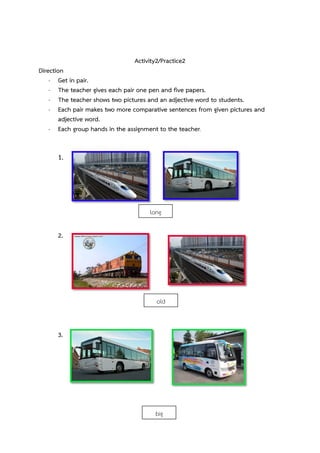
Activity2/Practice2
Direction
- Get in pair.
- The teacher gives each pair one pen and five papers.
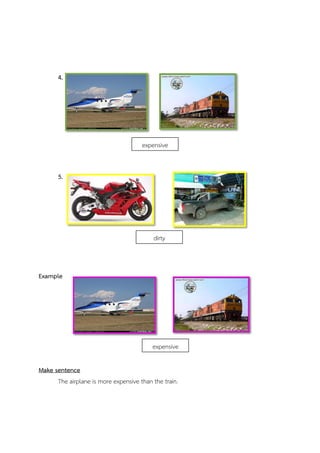
- The teacher shows two pictures and an adjective word to students.
- Each pair makes two more comparative sentences from given pictures and
adjective word.
- Each group hands in the assignment to the teacher.

1.

long
2.

old

3.

big
4.

expensive

5.

dirty

Example

expensive
Make sentence
The airplane is more expensive than the train.
Activity3/ Production1
Direction:
- Make a group of three people.
- The teacher gives each group a paper.
- Each of the students in a group reads text 3 (High-speed trains).
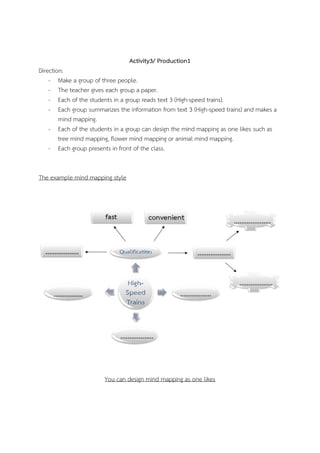
- Each group summarizes the information from text 3 (High-speed trains) and makes a
mind mapping.
- Each of the students in a group can design the mind mapping as one likes such as
tree mind mapping, flower mind mapping or animal mind mapping.
- Each group presents in front of the class.
The example mind mapping style

You can design mind mapping as one likes
Activity4/ Production2
Direction
- Make a group of three people.
- Read text 3 (High-speed trains)
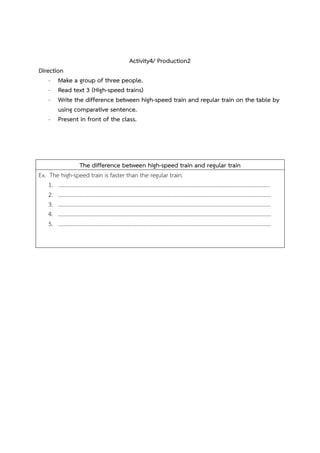
- Write the difference between high-speed train and regular train on the table by
using comparative sentence.
- Present in front of the class.

The difference between high-speed train and regular train
Ex. The high-speed train is faster than the regular train.
1. ……………………………………………………………………………………………………………………………………….
2. ………………………………………………………………………………………………………………………………………..
3. ………………………………………………………………………………………………………………………………………..
4. ………………………………………………………………………………………………………………………………………..
5. ………………………………………………………………………………………………………………………………………..
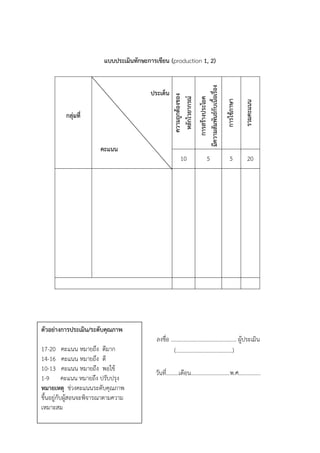
รวมคะแนน

คะแนน

การใช้ภาษา

กลุ่มที่

การสร้างประโยค
มีความสัมพันธ์กับเนื้อเรื่อง

10

ประเด็น

ความถูกต้องของ
หลักไวยากรณ์

แบบประเมินทักษะการเขียน (production 1, 2)

5

5

20

ตัวอย่างการประเมิน/ระดับคุณภาพ
17-20 คะแนน หมายถึง ดีมาก
14-16 คะแนน หมายถึง ดี
10-13 คะแนน หมายถึง พอใช้
1-9 คะแนน หมายถึง ปรับปรุง
หมายเหตุ ช่วงคะแนนระดับคุณภาพ
ขึ้นอยู่กับผูสอนจะพิจารณาตามความ
้
เหมาะสม

ลงชื่อ ............................................... ผู้ประเมิน
(………………..…………………)
วันที่.........เดือน............................พ.ศ................
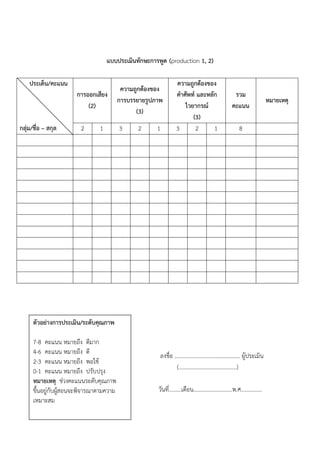
แบบประเมินทักษะการพูด (production 1, 2)
ประเด็น/คะแนน
การออกเสียง
(2)
กลุ่ม/ชื่อ – สกุล

2

1

ความถูกต้องของ
การบรรยายรูปภาพ
(3)
3

2

1

ความถูกต้องของ
คาศัพท์ และหลัก
ไวยากรณ์
(3)
3
2
1

รวม
คะแนน
8

ตัวอย่างการประเมิน/ระดับคุณภาพ
7-8 คะแนน หมายถึง ดีมาก
4-6 คะแนน หมายถึง ดี
2-3 คะแนน หมายถึง พอใช้
0-1 คะแนน หมายถึง ปรับปรุง
หมายเหตุ ช่วงคะแนนระดับคุณภาพ
ขึ้นอยู่กับผูสอนจะพิจารณาตามความ
้
เหมาะสม

ลงชื่อ ............................................... ผู้ประเมิน
(……………………………………)
วันที่.........เดือน............................พ.ศ...............

หมายเหตุ
PPP Model

PPP Model

  • 1.
    แผนการจัดการเรียนรู้ภาษาอังกฤษเพื่อการสื่อสารตามรูปแบบ PPP กลุ่มสาระการเรียนรู้ภาษาต่างประเทศ/วิชาภาษาอังกฤษ ชั้นมัธยมศึกษาปีที่ 4 Unit:Science and Technology Topic:Transport & Communication Systems เวลา 3 ชั่วโมง ส่งครั้งที่ 3 1. นางสาวจิรประภา อ่อนธรรมา 53010513015 2. นางสาวภัทรธีรา แสนลัง 53010513031 3. นางสาวศศิธร บุญชู 53010513040 นิสิตชั้นปีที่ 3 สาขาภาษาอังกฤษ รหัสวิชาเอก EN ระบบปกติ Mentors ครั้งที่พบ ชื่อ-สกุล 1. นางสาวพิไลวรรณ สีประสม 003 2. นางสาวเบญจมาศ พลพวก 3. นายธีรพงศ์ 4. นายพร้อมพล 1 2 3 4 022 มีสัตย์ 016 บรรทุมพร 028 ครั้งที่ส่ง 1 2 3 วันที่ส่ง 30 มิถุนายน 2555 5 กรกฎาคม 2555 6 กรกฎาคม 2555 5
  • 2.
    แผนการจัดการเรียนรู้ภาษาอังกฤษเพื่อการสื่อสารตามรูปแบบ PPP กลุ่มสาระการเรียนรู้ภาษาต่างประเทศ/วิชาภาษาอังกฤษ ชั้นมัธยมศึกษาปีที่ 4 Unit:Science and Technology Topic: Transport & Communication Systems เวลา 3 ชั่วโมง สอนวันที่............เดือน……..............................พ.ศ. 2555 1. จุดประสงค์ 1. สามารถสะกดคาศัพท์ได้ถูกต้อง (practice1/ spelling bee) 2. สามารถแต่งประโยคถูกต้องตามโครงสร้างไวยากรณ์ (comparative sentence)ได้ (practice 2/ Making comparative sentence) 3. อ่านเรื่อง High-speed trains แล้วสามารถนามาทาเป็นแผนผังความคิดได้ (Mind mapping) (production1/ Train mind mapping) 4. อ่านเรื่อง high-speed trains แล้วสามารถบอกข้อแตกต่างระหว่าง high-speed train และ regular train ได้ (production 2/ The difference between highspeed train and regular train) 2. ตัวชี้วัด ต1.1.1.1/ม.4 ปฏิบัติตามคาแนะนาในคู่มือกาใช้งานต่างๆ คาชี้แจง คาอธิบายและคา บรรยายที่ฟังและอ่านได้ ต1.1.1.3/ม.4 อธิบายและเขียนประโยคและข้อความให้สัมพันธ์กับสื่อที่ไม่ใช่ความเรียงรูป ต่างๆ ที่อ่านรวมทั้งระบุและเขียนสื่อที่ไม่ใช่ความเรียงรูปแบบต่างๆ ให้สัมพันธ์กบประโยค ั และข้อความที่ฟังหรืออ่าน ต1.1.2.3/ม.4 สนทนาและเขียนโต้ตอบข้อมูลเกี่ยวกับตนเอง เรื่องต่างๆ ใกล้ตัว ปะสบการณ์ สถานการณ์ ข่าว/เหตุการณ์ ประเด็นที่อยู่ในความสนใจของสังคม และสื่อสารอย่างต่อเนือง ่ และเหมาะสม ต1.1.3.2/ม.4 พูดและเขียนสรุปใจความสาคัญแก่นสาระที่ได้จากการวิเคราะห์เรื่องกิจกรรม ข่าว เหตุการณ์ และ สถานการณ์ตามความสนใจ ต1.1.2.4/ม.4 พูดและเขียนเพื่อขอและให้ข้อมูล บรรยาย อธิบาย เปรียบเทียบ และแสดง ความคิดเห็นเกี่ยวกับเรื่อง/ประเด็น/ข่าว/เหตุการณ์ที่ฟงและอ่านอย่างเหมาะสม ั ต2.2.1.1/ม.4 ใช้ถ้อยคาน้าเสียง และกิริยาท่าทางอย่างสุภาพเหมาะสมตามมารยาทสังคม และวัฒนธรรมของเจ้าของภาษา ต3.3.1.1/ม.4 ค้นคว้า/สืบค้น บันทึก สรุป และแสดงความคิดเห็นเกี่ยวกับข้อมูลทีเ่ กี่ยวข้อง กับกลุ่มสาระการเรียนรู้อื่นจากแหล่งการเรียนรู้ต่างๆ และนาเสนอการพูดและการเขียน ต4.4.2.1/ม.4 ใช้ภาษาต่างประเทศ ในการสืบค้น/ค้นคว้าข้อมูลต่างๆ จากสื่อและแหล่งการ เรียนรู้ต่างๆ ในการศึกษาต่อและประกอบอาชีพ
  • 3.
    3. เนื้อหา Vocabulary: distances,replaced, goods, attracting, smooth, purchased, reduced, traffic Structure Comparative form When we compare two things or people we look at what makes them different from each other. For example: expensive It is true that the fare on a high-speed train is more expensive than on a regular train. convenient Airplanes were even more convenient than trains for most travel. fast/slow The Acela trains are faster than regular trains. The regular trains are slower than Acele trains. Comparative adjectives are used to show what quality one thing has more or less than the other. They normally come before any other adjectives. For example: big / small The TGV train is bigger than the regular trains. The regular train is smaller than the TGV trains. 4. สื่อการเรียนรู้ 4.1วิดีโอ“Future transportation” 4.2 Text 1,2,3 4.3 Power Point คาศัพท์และโครงสร้างไวยากรณ์
  • 4.
    5. กิจกรรมการเรียนรู้ Teacher Presentation 1. ครูให้นักเรียนฟังstory telling เรื่อง “Future transportation” โดยมีประ ภาพประกอบ เพื่อนาเข้าสูบทเรียน ่ 2. ครูถามคาถามจาก story telling เพื่อให้ นักเรียนตอบ เช่น - What transportation do you want to have? Why? - What do you think about electric shoe? - In the future, if you have a frying car, where do you want to drive? 3. ครูแจก text 1 ให้นักเรียนแต่ละคน 4. ครูเปิด power point สอนคาศัพท์และ อธิบายความหมาย พร้อมให้นักเรียนอ่าน ออกเสียงตาม 5. ครูแจก text 2 ให้นักเรียนแต่ละคน 6. ครูอธิบายโครงสร้างไวยากรณ์ตาม Power point ให้นักเรียนฟังและทาความเข้าใจ 7. ครูแจกบทสนทนา text 3 ให้นักเรียนแต่ ละคน 8. ครูเปิดเรื่อง High-Speed Trains 9. ครูให้นักเรียนแบ่งเป็น 3 กลุ่ม แล้วให้อ่าน ออกเสียงบทความโดย กลุม A อ่านสองย่อ ่ หน้าแรก กลุ่ม B อ่านสองย่อหน้าที่ 3 และ 4 กลุ่ม C อ่านย่อหน้าที่เหลือ 10. ครูพูดสรุปใจความสาคัญและถามคาถาม เกี่ยวกับเนื้อเรื่อง Student 1. นักเรียนฟัง story telling เรื่อง “Future transportation” และดูภาพประกอบ 2. นักเรียนตอบคาถามจากวิดีโอ เช่น - I want to have electric shoe because I won’t be tried when I walk. - I think it’s very great transportation and it’s so comfortable. - If I have a frying car, I want to drive it around the world. 3. นักเรียนแต่ละคนได้รับ text 1 4. นักเรียนฟังครูอธิบายคาศัพท์ และออกเสียง ตาม 5. นักเรียนแต่ละคนได้รับ text 2 6. นักเรียนฟังครูอธิบายและทาความเข้าใจ โครงสร้างไวยากรณ์ 7. นักเรียนแต่ละคนได้รับบทสนทนา text 3 8. นักเรียนอ่านทาความเข้าใจเรื่อง HighSpeed Trains 9. นักเรียนแบ่งกลุ่ม 3 กลุ่ม และอ่านออกเสียง บทความโดย กลุม A อ่านสองย่อหน้าแรก ่ กลุ่ม B อ่านสองย่อหน้าที่ 3 และ 4 กลุม C ่ อ่านย่อหน้าทีเ่ หลือ 10. นักเรียนฟังครูพูดสรุปใจความสาคัญของ เนื้อเรื่องและตอบคาถาม
  • 5.
    Teacher Example: - The “bullet”train is found in… - What is the French train called? - How fast can the high-speed trains travel? Practice Activity 1 Spelling Bee 1. ครูอธิบายขั้นตอนและวิธีการเล่นเกม Spelling Bee ให้นักเรียนฟัง 2. ครูให้นักเรียนแบ่งกลุ่ม กลุมละ 3 คน เพื่อ ่ เล่นเกม Spelling Bee 3. ครูแจกบัตรตัวอักษรให้กบนักเรียนแต่ละ ั กลุ่ม 4. ครูใบ้คาศัพท์โดยการบอกความหมายแล้วให้ นักเรียนทายคาศัพท์ 5. ครูนับ 1 2 3 GO! ให้นักเรียนสะกดคาศัพท์ โดยการเรียงบัตรอักษรให้ถกต้องตาม ู ความหมายที่ได้ฟังจากครู 6. ครูเฉลยคาศัพท์ที่ถูกต้อง และกลุมทีสะกด ่ ่ คาศัพท์ถูกต้องจะได้รับคะแนนจากครู Activity 2 Making comparative sentence 1. ครูอธิบายขั้นตอนและวิธีการทากิจกรรม Making comparative sentence ให้ นักเรียนฟัง 2. ครูให้นักเรียนจับคู่เพื่อทากิจกรรม 3. ครูแจกกระดาษให้นักเรียนในแต่ละคู่ คู่ละ 5 แผ่น และปากกาเมจิก กลุ่มละ 1 ด้าม Student Example: - Japan - TGV - 186 miles per hour (289 kmh) 1. นักเรียนฟังครูอธิบายขั้นตอนและวิธีการเล่น เกม Spelling Bee 2. นักเรียนแบ่งกลุ่ม กลุ่มละ 3 คนเพื่อเล่นเกม Spelling Bee 3. นักเรียนแต่ละกลุ่มรับบัตรตัวอักษรจากครู 4. นักเรียนทายคาศัพท์จากความหมายให้ ถูกต้อง 5. นักเรียนสะกดคาศัพท์โดยการเรียนบัตร อักษรให้ถูกต้องตามความหมายที่ได้ฟังจาก ครู กลุ่มไหนเสร็จก่อนให้บอกว่า finish! 6. นักเรียนกลุมที่สะกดคาศัพท์ถูกต้องได้รับ ่ คะแนนจากครู 1. นักเรียนฟังครูอธิบายขั้นตอนและวิธีการทา กิจกรรม Making comparative sentence 2. นักเรียนจับคูเ่ พื่อทากิจกรรม 3. นักเรียนในแต่ละคู่ได้รับกระดาษคู่ละ 5 แผ่น และปากกาเมจิก กลุ่มละ 1 ด้าม
  • 6.
    4. 5. 6. 7. Teacher ครูแสดงรูปภาพ พร้อมคา adjectiveและ ตัวอย่างประโยค comparative บน power point เช่น The airplane is more expensive than the train. ครูให้นักเรียนแต่ละคู่แต่งประโยค comparative จากภาพและคา adjective ที่กาหนดให้ภายในเวลา 15 วินาที ครูให้นักเรียนในแต่ละคู่แสดงคาตอบของ ตนเองเมื่อหมดเวลา ครูตรวจสอบรูปประโยคของนักเรียนทุกคู่ และแก้ไขรูปประโยคทีผิด ่ Student 4. นักเรียนในแต่ละคู่ดูตัวอย่างการแต่งประโยค comparative จากภาพ และคา adjective ที่กาหนดให้บน power point 5. นักเรียนแต่ละคู่แต่งประโยค comparative จากภาพและคา adjective ที่กาหนดให้ ภายในเวลา 15 วินาที 6. นักเรียนในแต่ละคู่แสดงคาตอบของตนเอง 7. นักเรียนทุกคนฟังคาแก้ไขรูปประโยคทีผิด ่ จากครู
  • 7.
    Teacher Production Activity 3: Mindmapping 1. ครูอธิบายขั้นตอนและวิธีการทากิจกรรม Mind mapping ให้นักเรียนฟัง 2. ครูให้นักเรียนแบ่งกลุ่ม กลุมละ 3 คน เพื่อทา ่ กิจกรรม Mind mapping 3. ครูแจกกระดาษปรู๊ฟกลุ่มละ 1 แผ่น และให้ นักเรียนทุกคนเริ่มทากิจกรรม Train Mind mapping 4. ครูให้นักเรียนอ่านเรื่อง High-Speed Trains ทาความเข้าใจและสรุปความรูที่ได้เป็น ้ รูปแบบ Mind mapping 5. ครูให้นักเรียนแต่ละกลุ่มออกมานาเสนอ ผลงานของตนเองหน้าชั้นเรียน Activity 4 The difference between highspeed train and regular train 1. ครูอธิบายขั้นตอนและวิธีการทากิจกรรม The difference between high-speed train and regular train ให้นักเรียนฟัง 2. ครูให้นักเรียนแบ่งกลุ่ม กลุมละ 3 คน เพื่อทา ่ กิจกรรม 3. ครูให้นักเรียนอ่านเรื่อง High-Speed Trains ทาความเข้าใจ ร่วมอภิปรายภายในกลุ่มและ เปรียบเทียบข้อแตกต่างระหว่าง highspeed train และ regular train 4. ครูให้นักเรียนนาข้อสรุปที่ได้มาเขียนใน ตารางที่ครูกาหนดให้ โดยใช้โครงสร้าง ไวยากรณ์ที่ได้เรียนมา (comparative sentence) ในการเขียนนาเสนอ 5. ครูให้นักเรียนแต่ละกลุ่มออกมานาเสนอหน้า ชั้นเรียน Student 1. นักเรียนฟังครูอธิบายขั้นตอนและวิธีการทา กิจกรรม Mind mapping 2. นักเรียนแบ่งกลุ่ม กลุ่มละ 3 คน เพื่อทา กิจกรรม Mind mapping 3. นักเรียนมารับกระดาษปรู๊ฟกับครู และเริ่มทา กิจกรรม Mind mapping 4. นักเรียนอ่านเรือง High-Speed Trains ทา ่ ความเข้าใจและสรุปความรู้ที่ได้เป็นรูปแบบ Mind mapping 5. นักเรียนแต่ละกลุ่มออกมานาเสนอผลงานของ ตนเองหน้าชั้นเรียน 1. นักเรียนฟังครูอธิบายขั้นตอนและวิธีการทา กิจกรรม The difference between highspeed train and regular train 2. นักเรียนแบ่งกลุ่ม กลุ่มละ 3 คน เพื่อทา กิจกรรม 3. นักเรียนอ่านเรือง High-Speed Trains ทา ่ ความเข้าใจ ร่วมอภิปรายในกลุ่มและ เปรียบเทียบข้อแตกต่างระหว่าง high-speed train และ regular train 4. นักเรียนนาข้อสรุปที่ได้มาเขียนในตาราง ที่ครู กาหนดให้ โดยใช้โครงสร้างไวยากรณ์ที่ได้ เรียนมา (comparative sentence) ในการ เขียนนาเสนอ 5. นักเรียนแต่ละกลุ่มออกมานาเสนอหน้า ชั้นเรียน
  • 8.
    6. การวัดผลและประเมินผล ทักษะที่จะประเมิน/กิจกรรม - Activity1/practice1 (คาศัพท์): spelling bee วิธีการประเมิน เครื่องมือประเมิน ตรวจและให้คะแนน - - Activity2/practice 2 (โครงสร้าง): Making comparative sentence ตรวจและให้คะแนน - - Activity3/ production 1 (การเขียนและการพูด): Train mind mapping ตรวจและให้คะแนน ตามแบบประเมิน แบบประเมินทักษะ การพูดนาเสนอ ตรวจและให้คะแนน ตามแบบประเมิน แบบประเมินทักษะ การพูดนาเสนอ - Activity4 / production 2 (การเขียนและการพูด): The difference between high-speed train and regular train 7. กิจกรรมเสนอแนะ …………………………………………………………………………………………………………………………………………………. …………………………………………………………………………………………………………………………………………………. 8. ความคิดเห็นของผู้บริหาร ………………………………………………………………………………………………………………………………………………… ………………………………………………………………………………………………………………………………………………… 9. บันทึกหลังการจัดกิจกรรมการเรียนรู้ 9.1 ผลการจัดกิจกรรมการเรียนรู้ ………………………………………………………………………………………………………………………………………………… ………………………………………………………………………………………………………………………………………………… 9.2 ปัญหาและอุปสรรค ………………………………………………………………………………………………………………………………………………… ………………………………………………………………………………………………………………………………………………… 9.3 ข้อเสนอแนะ ………………………………………………………………………………………………………………………………………………… …………………………………………………………………………………………………………………………………………………
  • 9.
    Text 1 distance (n),the amount of space between two places. replace (v), put something back where it was before. places. goods (n), the items for sale such as clothes, shoes and foods. attract (v.), very pleasing in appearance or sound, or causing interest or pleasure.
  • 10.
    smooth (adj), havinga surface or substance which is perfectly regular and has no holes. For example, there is a smooth way. purchase (n), to obtain in exchange for money or its equivalent; buy. reduce (v), to bring down, as in extent, amount, or degree; diminish. See Synonyms at decrease. traffic (n), the passage of people or vehicles along routes of transportation.
  • 11.
    outdated (adj), oldor no longer useful or modern, for example, this computer is outdated. transportation (n), to take goods or people from one place to another.
  • 12.
    Text 2 Comparative form Whenwe compare two things or people we look at what makes them different from each other. For example: expensive It is true that the fare on a high-speed train is more expensive than on a regular train. convenient Airplanes were even more convenient than trains for most travel. fast/slow The Acela trains are faster than regular trains. The regular trains are slower than Acele trains. Comparative adjectives are used to show what quality one thing has more or less than the other. They normally come before any other adjectives. For example: big / small The TGV train is bigger than the regular trains. The regular train is smaller than the TGV trains.
  • 13.
    Forming the comparative Form Rule Forexample Add -r to the end of the Words of one syllable ending in 'e'. wide - wider word. Words of one syllable, with one Double the consonant vowel and one consonant at the and add -er to the end of big - bigger end. the word. Words of one syllable, with more Add - er to the end of than one vowel or more than one high - higher the word. consonant at the end. Change 'y' to 'i', and add Words of two syllables, ending in er to the end of the happy - happier 'y'. word. Words of two syllables or more, Place 'more' before the convenientnot ending in 'y'. adjective. more convenient The following adjectives are exceptions to this rule: - 'good' becomes 'better' - 'bad' becomes 'worse' - 'little' becomes 'less' Ex. A regular train is less expensive than a high–speed train. When comparing two things like this we put than between the adjective and the thing being compared. For example:- A high-speed train is more expensive than on a regular train. - The Acela trains are faster than regular trains.
  • 14.
    Text 3 High-Speed Trains Inthe 19th century, train were the best way to travel long distances over land. Trains were fast and convenient. Trains were also quite comfortable, many with sleeping cars and dining cars. However, in the 20th century, airplanes replaced trains for long-distance travel. Airplanes were even faster and more convenient than trains for most travel. Trains still transport goods over long distances, but passenger trains were mainly for local commuting. Today, however, high-speed trains are attracting passengers again. French has a train called the TGV. TGV is French for “Train a Grande Vitesse,” which means highspeed train. Typically, a TGV train operates at speeds up to 186 miles per hour (300 kilometers per hour). The ride is fast, and it is also very smooth. Passengers can travel from Paris to Marseilles in only four hours. The first section of the TGV line between Paris and Lyon was completed in 1981. Since then, France has added several more TGV lines and has purchased more TGV train cars. This train system has worked well in France. Some TGV trains travel to other countries in Europe, such as Belgium. Passengers can go between the two capitals, Paris and Brussels, in just 90 minutes. Passengers can also travel much faster by TGV than by car. The first country to have a high-speed train was Japan. The “Shinkansen” or “bullet” train offers a fast, smooth ride between Tokyo and other major cities. This train operates at speeds up to 130 mph (210 kmh) and can travel between Tokyo and Osaka in just three hours. The first high-speed train route in Japan began in 1964. Now this train system connects many cities in Japan. It is true that the fare on a high-speed train is more expensive than on a regular train. If a passenger wants to save time, a high-speed train is a good choice. If price is the issue, a regular train is less expensive. Both types of train still usually cost less than an airplane to travel the same distance. Today, several European countries have some kind of high-speed train. South Korea and the United States also have high-speed trains.
  • 15.
    In the UnitedStates, a high-speed train called Acela operates from Boston to Washington, D.C. via New York City. This route is popular because passengers arrive directly in the center of each of these major cities. The Acela trains are faster than regular trains, partly because they stop in fewer cities along the route. But the Acela trains don’t travel as fast as high-speed trains in other countries. The train tracks along the route are designed for older types of trains. Because of these older tracks, the Acela trains have to travel more slowly. Many of these high-speed train lines have reduced air traffic between cities. Increased train travel will also help reduce crowding at airports. What once seemed to be an outdated from of transportation is now in style again.
  • 16.
    Activity1/Practice1 Direction: - Make a groupof three people. The teacher gives each group letter cards. The students listen to the meaning of vocabulary from the teacher. Each of the students in a group spells vocabulary by putting in order letter cards. Letter cards A B C D E F G H I J K L M N O P Q R S T U V W X Y Z It can be whatever letter. Example: Meaning: put something back where it was before. L A E R C Answer : replace R E P L A C P
  • 17.
    Activity2/Practice2 Direction - Get inpair. - The teacher gives each pair one pen and five papers. - The teacher shows two pictures and an adjective word to students. - Each pair makes two more comparative sentences from given pictures and adjective word. - Each group hands in the assignment to the teacher. 1. long 2. old 3. big
  • 18.
  • 19.
    Activity3/ Production1 Direction: - Makea group of three people. - The teacher gives each group a paper. - Each of the students in a group reads text 3 (High-speed trains). - Each group summarizes the information from text 3 (High-speed trains) and makes a mind mapping. - Each of the students in a group can design the mind mapping as one likes such as tree mind mapping, flower mind mapping or animal mind mapping. - Each group presents in front of the class. The example mind mapping style You can design mind mapping as one likes
  • 20.
    Activity4/ Production2 Direction - Makea group of three people. - Read text 3 (High-speed trains) - Write the difference between high-speed train and regular train on the table by using comparative sentence. - Present in front of the class. The difference between high-speed train and regular train Ex. The high-speed train is faster than the regular train. 1. ………………………………………………………………………………………………………………………………………. 2. ……………………………………………………………………………………………………………………………………….. 3. ……………………………………………………………………………………………………………………………………….. 4. ……………………………………………………………………………………………………………………………………….. 5. ………………………………………………………………………………………………………………………………………..
  • 21.
    รวมคะแนน คะแนน การใช้ภาษา กลุ่มที่ การสร้างประโยค มีความสัมพันธ์กับเนื้อเรื่อง 10 ประเด็น ความถูกต้องของ หลักไวยากรณ์ แบบประเมินทักษะการเขียน (production 1,2) 5 5 20 ตัวอย่างการประเมิน/ระดับคุณภาพ 17-20 คะแนน หมายถึง ดีมาก 14-16 คะแนน หมายถึง ดี 10-13 คะแนน หมายถึง พอใช้ 1-9 คะแนน หมายถึง ปรับปรุง หมายเหตุ ช่วงคะแนนระดับคุณภาพ ขึ้นอยู่กับผูสอนจะพิจารณาตามความ ้ เหมาะสม ลงชื่อ ............................................... ผู้ประเมิน (………………..…………………) วันที่.........เดือน............................พ.ศ................
  • 22.
    แบบประเมินทักษะการพูด (production 1,2) ประเด็น/คะแนน การออกเสียง (2) กลุ่ม/ชื่อ – สกุล 2 1 ความถูกต้องของ การบรรยายรูปภาพ (3) 3 2 1 ความถูกต้องของ คาศัพท์ และหลัก ไวยากรณ์ (3) 3 2 1 รวม คะแนน 8 ตัวอย่างการประเมิน/ระดับคุณภาพ 7-8 คะแนน หมายถึง ดีมาก 4-6 คะแนน หมายถึง ดี 2-3 คะแนน หมายถึง พอใช้ 0-1 คะแนน หมายถึง ปรับปรุง หมายเหตุ ช่วงคะแนนระดับคุณภาพ ขึ้นอยู่กับผูสอนจะพิจารณาตามความ ้ เหมาะสม ลงชื่อ ............................................... ผู้ประเมิน (……………………………………) วันที่.........เดือน............................พ.ศ............... หมายเหตุ