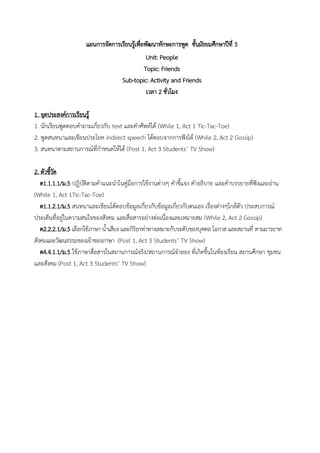
3. เนื้อหาทางภาษา
Vocabulary: photograph,volunteer, wonderful, sort out, favourite, anyway, problem,
interesting, warn
Structure: How to use “Reported Speech”
If we report what another person has said, we usually do not use the speaker’s exact
words (direct speech), but reported (indirect) speech.
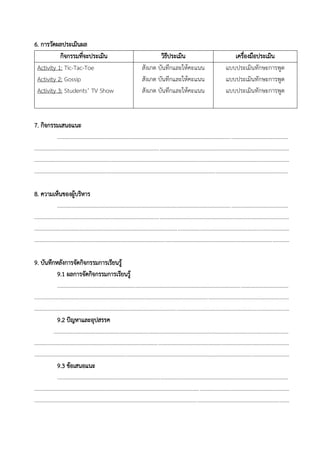
We use a 'reporting verb' like 'say' or 'tell'. If this verb is in the present tense, it's easy. We
just put 'she says' and then the sentence:
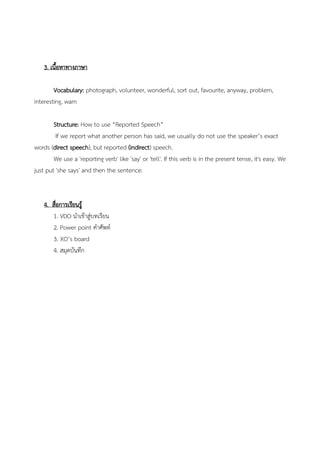
4. สื่อการเรียนรู้
1. VDO นาเข้าสู่บทเรียน
2. Power point คาศัพท์
3. XO’s board
4. สมุดบันทึก
4.
5. กิจกรรมการเรียนรู้
ครู นักเรียน
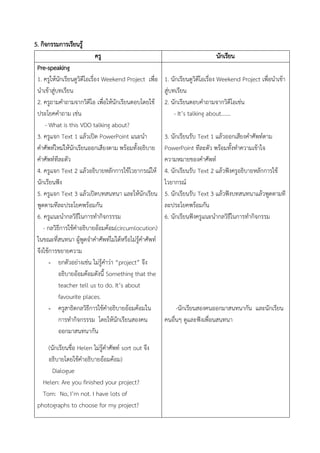
Pre-speaking
1.ครูให้นักเรียนดูวิดีโอเรื่อง Weekend Project เพื่อ
นาเข้าสู่บทเรียน
2. ครูถามคาถามจากวิดีโอ เพื่อให้นักเรียนตอบโดยใช้
ประโยคคาถาม เช่น
- What is this VDO talking about?
3. ครูแจก Text 1 แล้วเปิด PowerPoint แนะนา
คาศัพท์ใหม่ให้นักเรียนออกเสียงตาม พร้อมทั้งอธิบาย
คาศัพท์ทีละตัว
4. ครูแจก Text 2 แล้วอธิบายหลักการใช้ไวยากรณ์ให้
นักเรียนฟัง
5. ครูแจก Text 3 แล้วเปิดบทสนทนา และให้นักเรียน
พูดตามทีละประโยคพร้อมกัน
6. ครูแนะนากลวิธีในการทากิจกรรรม
- กลวิธีการใช้คาอธิบายอ้อมค้อม(circumlocution)
ในขณะที่สนทนา ผู้พูดจาคาศัพท์ไม่ได้หรือไม่รู้คาศัพท์
จึงใช้การขยายความ
- ยกตัวอย่างเช่น ไม่รู้คาว่า “project” จึง
อธิบายอ้อมค้อมดังนี้ Something that the
teacher tell us to do. It’s about
favourite places.
- ครูสาธิตกลวิธีการใช้คาอธิบายอ้อมค้อมใน
การทากิจกรรรม โดยให้นักเรียนสองคน
ออกมาสนทนากัน
(นักเรียนชื่อ Helen ไม่รู้คาศัพท์ sort out จึง
อธิบายโดยใช้คาอธิบายอ้อมค้อม)
Dialogue
Helen: Are you finished your project?
Tom: No, I’m not. I have lots of
photographs to choose for my project?
1. นักเรียนดูวิดีโอเรื่อง Weekend Project เพื่อนาเข้า
สู่บทเรียน
2. นักเรียนตอบคาถามจากวิดีโอเช่น
- It’s talking about.......
3. นักเรียนรับ Text 1 แล้วออกเสียงคาศัพท์ตาม
PowerPoint ทีละตัว พร้อมทั้งทาความเข้าใจ
ความหมายของคาศัพท์
4. นักเรียนรับ Text 2 แล้วฟังครูอธิบายหลักการใช้
ไวยากรณ์
5. นักเรียนรับ Text 3 แล้วฟังบทสนทนาแล้วพูดตามที
ละประโยคพร้อมกัน
6. นักเรียนฟังครูแนะนากลวิธีในการทากิจกรรม
-นักเรียนสองคนออกมาสนทนากัน และนักเรียน
คนอื่นๆ ดูและฟังเพื่อนสนทนา
5.
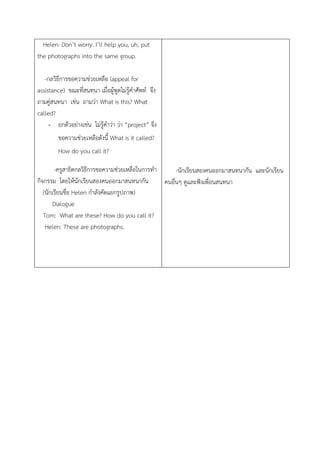
Helen: Don’t worry.I’ll help you, uh, put
the photographs into the same group.
-กลวิธีการขอความช่วยเหลือ (appeal for
assistance) ขณะที่สนทนา เมื่อผู้พูดไม่รู้คาศัพท์ จึง
ถามคู่สนทนา เช่น ถามว่า What is this? What
called?
- ยกตัวอย่างเช่น ไม่รู้คาว่า ว่า “project” จึง
ขอความช่วยเหลือดังนี้ What is it called?
How do you call it?
-ครูสาธิตกลวิธีการขอความช่วยเหลือในการทา
กิจกรรม โดยให้นักเรียนสองคนออกมาสนทนากัน
(นักเรียนชื่อ Helen กาลังคัดแยกรูปภาพ)
Dialogue
Tom: What are these? How do you call it?
Helen: These are photographs.
-นักเรียนสองคนออกมาสนทนากัน และนักเรียน
คนอื่นๆ ดูและฟังเพื่อนสนทนา
ครู นักเรียน
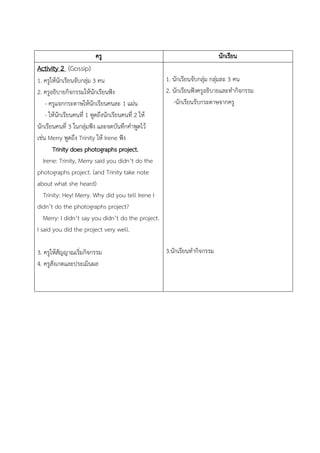
Activity 2(Gossip)
1. ครูให้นักเรียนจับกลุ่ม 3 คน
2. ครูอธิบายกิจกรรมให้นักเรียนฟัง
- ครูแจกกระดาษให้นักเรียนคนละ 1 แผ่น
- ให้นักเรียนคนที่ 1 พูดถึงนักเรียนคนที่ 2 ให้
นักเรียนคนที่ 3 ในกลุ่มฟัง และจดบันทึกคาพูดไว้
เช่น Merry พูดถึง Trinity ให้ Irene ฟัง
Trinity does photographs project.
Irene: Trinity, Merry said you didn’t do the
photographs project. (and Trinity take note
about what she heard)
Trinity: Hey! Merry. Why did you tell Irene I
didn’t do the photographs project?
Merry: I didn’t say you didn’t do the project.
I said you did the project very well.
3. ครูให้สัญญาณเริ่มกิจกรรม
4. ครูสังเกตและประเมินผล
1. นักเรียนจับกลุ่ม กลุ่มละ 3 คน
2. นักเรียนฟังครูอธิบายและทากิจกรรม
-นักเรียนรับกระดาษจากครู
3.นักเรียนทากิจกรรม
8.
ครู นักเรียน
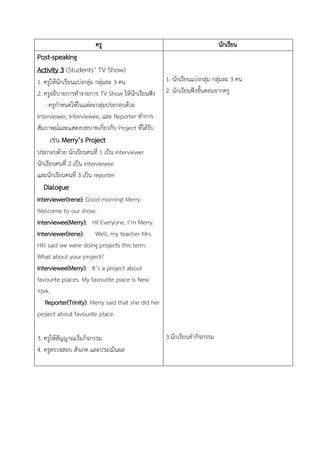
Post-speaking
Activity 3(Students’ TV Show)
1. ครูให้นักเรียนแบ่งกลุ่ม กลุ่มละ 3 คน
2. ครูอธิบายการทารายการ TV Show ให้นักเรียนฟัง
- ครูกาหนดให้ในแต่ละกลุ่มประกอบด้วย
Interviewer, Interviewee, และ Reporter ทาการ
สัมภาษณ์และแสดงบทบาทเกี่ยวกับ Project ที่ได้รับ
เช่น Merry’s Project
ประกอบด้วย นักเรียนคนที่ 1 เป็น interviewer
นักเรียนคนที่ 2 เป็น interviewee
และนักเรียนคนที่ 3 เป็น reporter
Dialogue
Interviewer(Irene): Good morning! Merry.
Welcome to our show.
Interviewee(Merry): Hi! Everyone. I’m Merry.
Interviewer(Irene): Well, my teacher Mrs.
Hill said we were doing projects this term.
What about your project?
Interviewee(Merry): It’s a project about
favourite places. My favourite place is New
York.
Reporter(Trinity): Merry said that she did her
project about favourite place.
3. ครูให้สัญญาณเริ่มกิจกรรม
4. ครูตรวจสอบ สังเกต และประเมินผล
1. นักเรียนแบ่งกลุ่ม กลุ่มละ 3 คน
2. นักเรียนฟังขั้นตอนจากครู
3.นักเรียนทากิจกรรม
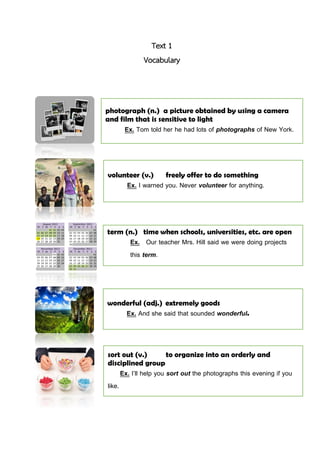
Text 1
Vocabulary
photograph (n.)a picture obtained by using a camera
and film that is sensitive to light
Ex. Tom told her he had lots of photographs of New York.
volunteer (v.) freely offer to do something
Ex. I warned you. Never volunteer for anything.
wonderful (adj.) extremely goods
Ex. And she said that sounded wonderful.
sort out (v.) to organize into an orderly and
disciplined group
Ex. I’ll help you sort out the photographs this evening if you
like.
term (n.) time when schools, universities, etc. are open
Ex. Our teacher Mrs. Hill said we were doing projects
this term.
11.
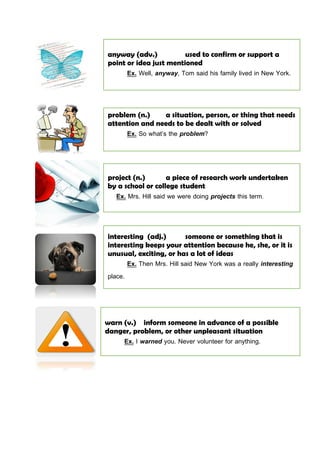
anyway (adv.) usedto confirm or support a
point or idea just mentioned
Ex. Well, anyway, Tom said his family lived in New York.
problem (n.) a situation, person, or thing that needs
attention and needs to be dealt with or solved
Ex. So what’s the problem?
interesting (adj.) someone or something that is
interesting keeps your attention because he, she, or it is
unusual, exciting, or has a lot of ideas
Ex. Then Mrs. Hill said New York was a really interesting
place.
warn (v.) inform someone in advance of a possible
danger, problem, or other unpleasant situation
Ex. I warned you. Never volunteer for anything.
project (n.) a piece of research work undertaken
by a school or college student
Ex. Mrs. Hill said we were doing projects this term.
12.
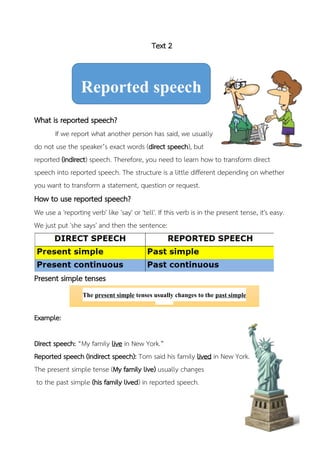
Text 2
What isreported speech?
If we report what another person has said, we usually
do not use the speaker’s exact words (direct speech), but
reported (indirect) speech. Therefore, you need to learn how to transform direct
speech into reported speech. The structure is a little different depending on whether
you want to transform a statement, question or request.
How to use reported speech?
We use a 'reporting verb' like 'say' or 'tell'. If this verb is in the present tense, it's easy.
We just put 'she says' and then the sentence:
Present simple tenses
Example:
Direct speech: “My family live in New York.”
Reported speech (Indirect speech): Tom said his family lived in New York.
The present simple tense (My family live) usually changes
to the past simple (his family lived) in reported speech.
Reported speech
The present simple tenses usually changes to the past simple
tenses.
13.
Direct speech: “Ihave lots of photographs of New York.”
Reported speech (Indirect speech): Tom told her he had lots of photographs of New
York.
The present simple tense (I have) usually changes to the past simple (he had) in
reported speech.
The present continue tenses
Example:
Direct speech: This term we are doing project.
Reported speech (Indirect speech):
Our teacher Mrs. Hill said we were doing projects this term.
The present continue tenses (we are doing) usually changes to the past continue
tenses (were doing) in reported speech.
Direct speech: New York is a really interesting place.
Reported speech (Indirect speech):
Mrs. Hill said New York was a really interesting place.
The present continue tenses (New York is) usually changes to the past continue tenses
(New York was a really interesting) in reported speech.
The present continuous usually changes to the past continuous.
14.
Text 3
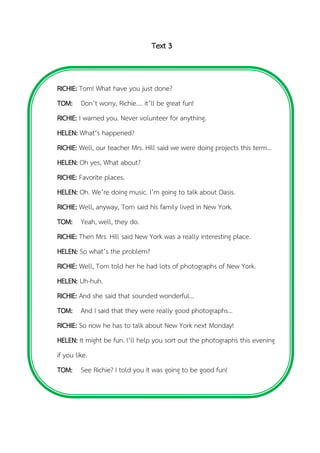
RICHIE: Tom!What have you just done?
TOM: Don’t worry, Richie…. it’ll be great fun!
RICHIE: I warned you. Never volunteer for anything.
HELEN: What‘s happened?
RICHIE: Well, our teacher Mrs. Hill said we were doing projects this term…
HELEN: Oh yes, What about?
RICHIE: Favorite places.
HELEN: Oh. We’re doing music. I’m going to talk about Oasis.
RICHIE: Well, anyway, Tom said his family lived in New York.
TOM: Yeah, well, they do.
RICHIE: Then Mrs. Hill said New York was a really interesting place.
HELEN: So what’s the problem?
RICHIE: Well, Tom told her he had lots of photographs of New York.
HELEN: Uh-huh.
RICHIE: And she said that sounded wonderful…
TOM: And I said that they were really good photographs…
RICHIE: So now he has to talk about New York next Monday!
HELEN: It might be fun. I’ll help you sort out the photographs this evening
if you like.
TOM: See Richie? I told you it was going to be good fun!
15.
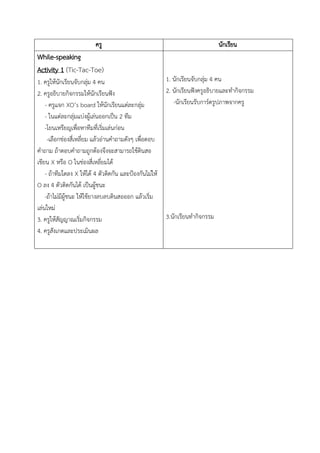
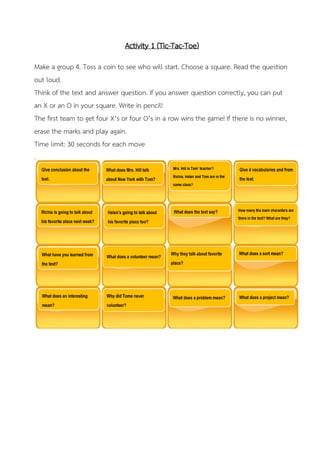
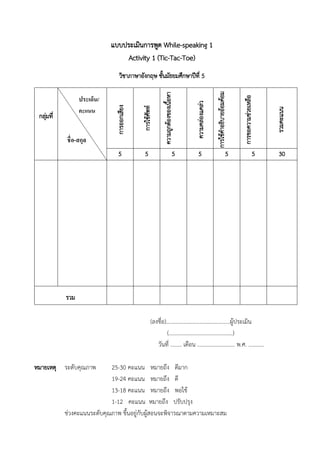
Activity 1 (Tic-Tac-Toe)
Makea group 4. Toss a coin to see who will start. Choose a square. Read the question
out loud.
Think of the text and answer question. If you answer question correctly, you can put
an X or an O in your square. Write in pencil!
The first team to get four X’s or four O’s in a row wins the game! If there is no winner,
erase the marks and play again.
Time limit: 30 seconds for each move
16.
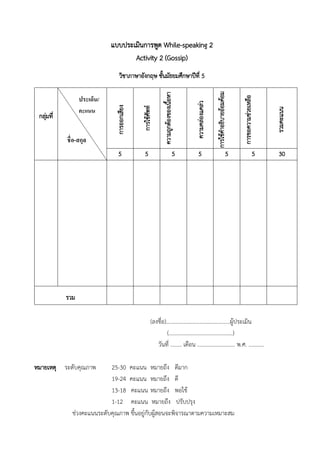
Activity 2 (Gossip)
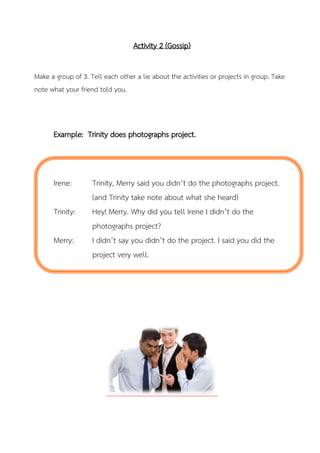
Makea group of 3. Tell each other a lie about the activities or projects in group. Take
note what your friend told you.
Example: Trinity does photographs project.
Irene: Trinity, Merry said you didn’t do the photographs project.
(and Trinity take note about what she heard)
Trinity: Hey! Merry. Why did you tell Irene I didn’t do the
photographs project?
Merry: I didn’t say you didn’t do the project. I said you did the
project very well.
17.
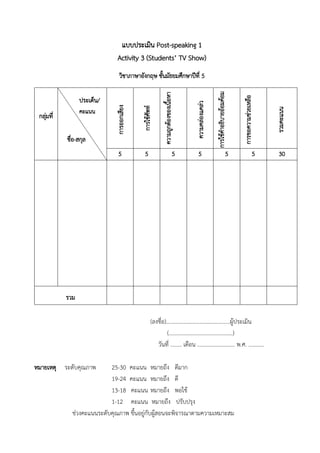
Activity 3 (Students’TV Show)
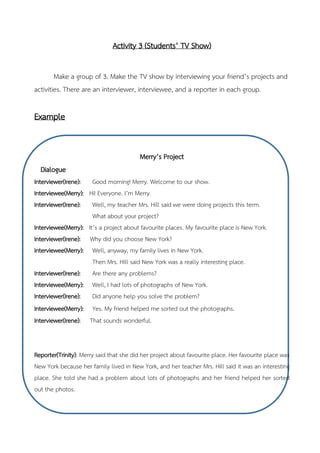
Make a group of 3. Make the TV show by interviewing your friend’s projects and
activities. There are an interviewer, interviewee, and a reporter in each group.
Example
Merry’s Project
Dialogue
Interviewer(Irene): Good morning! Merry. Welcome to our show.
Interviewee(Merry): Hi! Everyone. I’m Merry.
Interviewer(Irene): Well, my teacher Mrs. Hill said we were doing projects this term.
What about your project?
Interviewee(Merry): It’s a project about favourite places. My favourite place is New York.
Interviewer(Irene): Why did you choose New York?
Interviewee(Merry): Well, anyway, my family lives in New York.
Then Mrs. Hill said New York was a really interesting place.
Interviewer(Irene): Are there any problems?
Interviewee(Merry): Well, I had lots of photographs of New York.
Interviewer(Irene): Did anyone help you solve the problem?
Interviewee(Merry): Yes. My friend helped me sorted out the photographs.
Interviewer(Irene): That sounds wonderful.
Reporter(Trinity): Merry said that she did her project about favourite place. Her favourite place was
New York because her family lived in New York, and her teacher Mrs. Hill said it was an interesting
place. She told she had a problem about lots of photographs and her friend helped her sorted
out the photos.