INSULIN
Sana khalid
Asdc 216
Outline
• Introduction
• Diabetes mellitus
• Insulin
• chemistry
• Secretion
• Degradation
• Mechanism of action
• Classification of insulin
• Insulin administration
• Doses of insulin
• Clinical uses of insulin
• Complications of insulin therapy
• Conclusion
INTRODUCTION
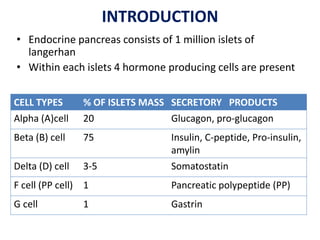
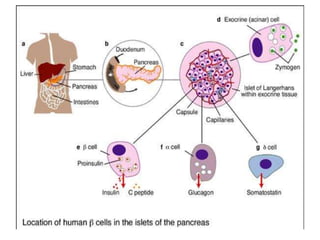
• Endocrine pancreas consists of 1 million islets of
langerhan
• Within each islets 4 hormone producing cells are present
CELL TYPES % OF ISLETS MASS SECRETORY PRODUCTS
Alpha (A)cell 20 Glucagon, pro-glucagon
Beta (B) cell 75 Insulin, C-peptide, Pro-insulin,
amylin
Delta (D) cell 3-5 Somatostatin
F cell (PP cell) 1 Pancreatic polypeptide (PP)
G cell 1 Gastrin
DIABETES MELLITUS
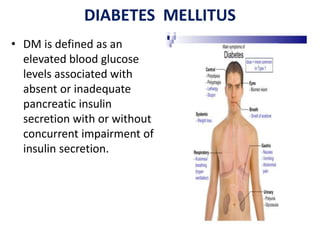
• DM is defined as an
elevated blood glucose
levels associated with
absent or inadequate
pancreatic insulin
secretion with or without
concurrent impairment of
insulin secretion.
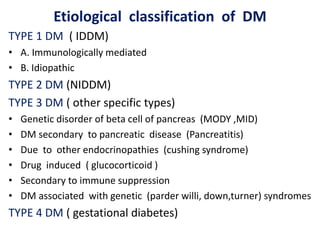
Etiological classification of DM
TYPE 1 DM ( IDDM)
• A. Immunologically mediated
• B. Idiopathic
TYPE 2 DM (NIDDM)
TYPE 3 DM ( other specific types)
• Genetic disorder of beta cell of pancreas (MODY ,MID)
• DM secondary to pancreatic disease (Pancreatitis)
• Due to other endocrinopathies (cushing syndrome)
• Drug induced ( glucocorticoid )
• Secondary to immune suppression
• DM associated with genetic (parder willi, down,turner) syndromes
TYPE 4 DM ( gestational diabetes)
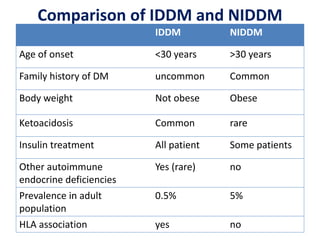
Comparison of IDDM and NIDDM
IDDM NIDDM
Age of onset <30 years >30 years
Family history of DM uncommon Common
Body weight Not obese Obese
Ketoacidosis Common rare
Insulin treatment All patient Some patients
Other autoimmune
endocrine deficiencies
Yes (rare) no
Prevalence in adult
population
0.5% 5%
HLA association yes no
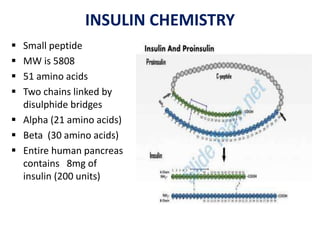
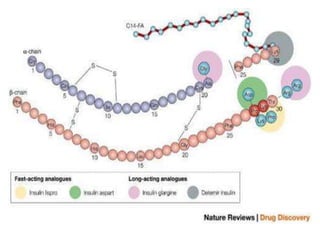
INSULIN CHEMISTRY
 Small peptide
 MW is 5808
 51 amino acids
 Two chains linked by
disulphide bridges
 Alpha (21 amino acids)
 Beta (30 amino acids)
 Entire human pancreas
contains 8mg of
insulin (200 units)
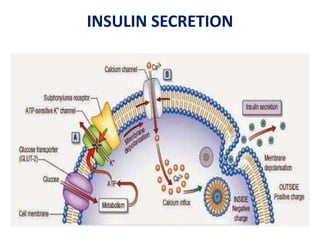
INSULIN SECRETION
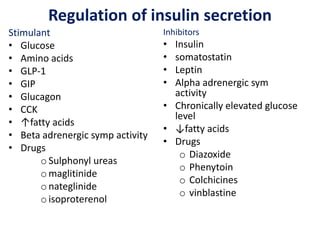
Regulation of insulin secretion
Stimulant
• Glucose
• Amino acids
• GLP-1
• GIP
• Glucagon
• CCK
• ↑fatty acids
• Beta adrenergic symp activity
• Drugs
oSulphonyl ureas
omaglitinide
onateglinide
oisoproterenol
Inhibitors
• Insulin
• somatostatin
• Leptin
• Alpha adrenergic sym
activity
• Chronically elevated glucose
level
• ↓fatty acids
• Drugs
o Diazoxide
o Phenytoin
o Colchicines
o vinblastine
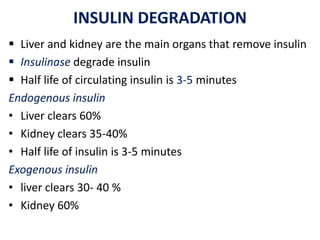
INSULIN DEGRADATION
 Liver and kidney are the main organs that remove insulin
 Insulinase degrade insulin
 Half life of circulating insulin is 3-5 minutes
Endogenous insulin
• Liver clears 60%
• Kidney clears 35-40%
• Half life of insulin is 3-5 minutes
Exogenous insulin
• liver clears 30- 40 %
• Kidney 60%
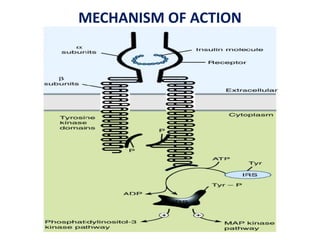
MECHANISM OF ACTION
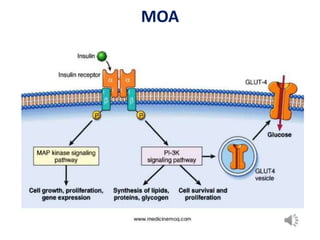
MOA
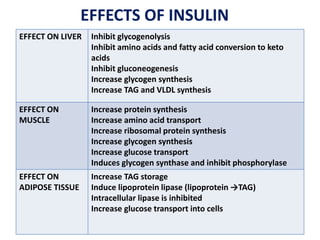
EFFECTS OF INSULIN
EFFECT ON LIVER Inhibit glycogenolysis
Inhibit amino acids and fatty acid conversion to keto
acids
Inhibit gluconeogenesis
Increase glycogen synthesis
Increase TAG and VLDL synthesis
EFFECT ON
MUSCLE
Increase protein synthesis
Increase amino acid transport
Increase ribosomal protein synthesis
Increase glycogen synthesis
Increase glucose transport
Induces glycogen synthase and inhibit phosphorylase
EFFECT ON
ADIPOSE TISSUE
Increase TAG storage
Induce lipoprotein lipase (lipoprotein →TAG)
Intracellular lipase is inhibited
Increase glucose transport into cells
CLASSIFICATION OF INSULIN
 According to source
 According to duration of action
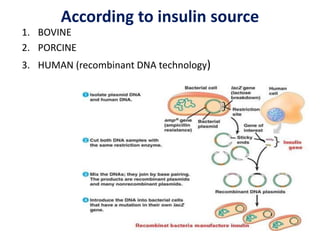
According to insulin source
1. BOVINE
2. PORCINE
3. HUMAN (recombinant DNA technology)
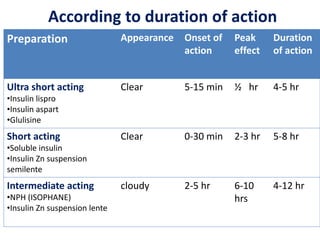
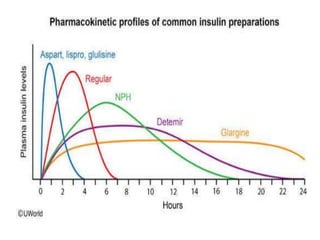
According to duration of action
Preparation Appearance Onset of
action
Peak
effect
Duration
of action
Ultra short acting
•Insulin lispro
•Insulin aspart
•Glulisine
Clear 5-15 min ½ hr 4-5 hr
Short acting
•Soluble insulin
•Insulin Zn suspension
semilente
Clear 0-30 min 2-3 hr 5-8 hr
Intermediate acting
•NPH (ISOPHANE)
•Insulin Zn suspension lente
cloudy 2-5 hr 6-10
hrs
4-12 hr
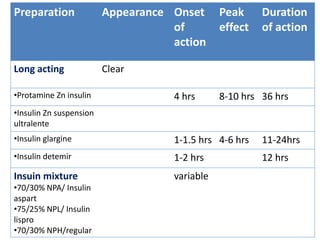
Preparation Appearance Onset
of
action
Peak
effect
Duration
of action
Long acting Clear
•Protamine Zn insulin 4 hrs 8-10 hrs 36 hrs
•Insulin Zn suspension
ultralente
•Insulin glargine 1-1.5 hrs 4-6 hrs 11-24hrs
•Insulin detemir 1-2 hrs 12 hrs
Insuin mixture
•70/30% NPA/ Insulin
aspart
•75/25% NPL/ Insulin
lispro
•70/30% NPH/regular
variable
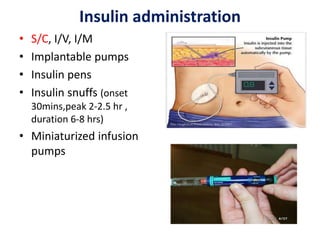
Insulin administration
• S/C, I/V, I/M
• Implantable pumps
• Insulin pens
• Insulin snuffs (onset
30mins,peak 2-2.5 hr ,
duration 6-8 hrs)
• Miniaturized infusion
pumps
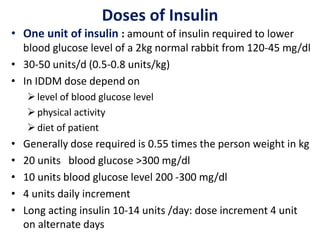
Doses of Insulin
• One unit of insulin : amount of insulin required to lower
blood glucose level of a 2kg normal rabbit from 120-45 mg/dl
• 30-50 units/d (0.5-0.8 units/kg)
• In IDDM dose depend on
level of blood glucose level
physical activity
diet of patient
• Generally dose required is 0.55 times the person weight in kg
• 20 units blood glucose >300 mg/dl
• 10 units blood glucose level 200 -300 mg/dl
• 4 units daily increment
• Long acting insulin 10-14 units /day: dose increment 4 unit
on alternate days
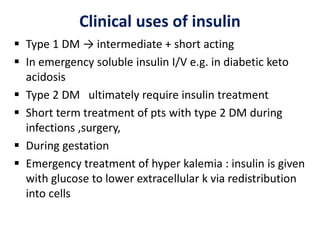
Clinical uses of insulin
 Type 1 DM → intermediate + short acting
 In emergency soluble insulin I/V e.g. in diabetic keto
acidosis
 Type 2 DM ultimately require insulin treatment
 Short term treatment of pts with type 2 DM during
infections ,surgery,
 During gestation
 Emergency treatment of hyper kalemia : insulin is given
with glucose to lower extracellular k via redistribution
into cells
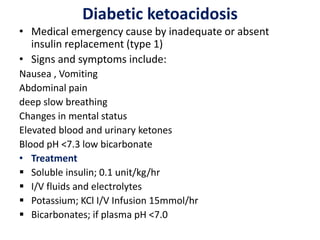
Diabetic ketoacidosis
• Medical emergency cause by inadequate or absent
insulin replacement (type 1)
• Signs and symptoms include:
Nausea , Vomiting
Abdominal pain
deep slow breathing
Changes in mental status
Elevated blood and urinary ketones
Blood pH <7.3 low bicarbonate
• Treatment
 Soluble insulin; 0.1 unit/kg/hr
 I/V fluids and electrolytes
 Potassium; KCl I/V Infusion 15mmol/hr
 Bicarbonates; if plasma pH <7.0
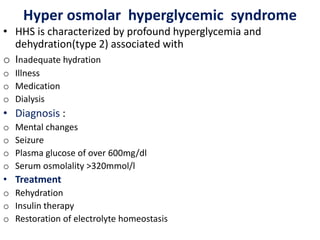
Hyper osmolar hyperglycemic syndrome
• HHS is characterized by profound hyperglycemia and
dehydration(type 2) associated with
o Inadequate hydration
o Illness
o Medication
o Dialysis
• Diagnosis :
o Mental changes
o Seizure
o Plasma glucose of over 600mg/dl
o Serum osmolality >320mmol/l
• Treatment
o Rehydration
o Insulin therapy
o Restoration of electrolyte homeostasis
Complications of insulin therapy
A. Hypoglycemia (ANS hyperactivity)
Management of hypoglycemia
• If conscious :Glucose administration preferably in liquid form , or
dextrose tab or glucose gel
• If Unconscious: 20- 50 ml of 50% glucose soln. by I/V infusion
over a period of 2-3 mins or 1mg of glucagon S/C or I/M or syrup
,honey can be inserted into buccal pouch.
B. Immunopathology of insulin therapy
1. Insulin allergy (IgE) mediated
2. Immune insulin resistance(IgG anti insulin antibody)
3. Lipodystrophy at injection site (animal insulin)
4. Increased cancer risk (ins resist & hyper insulinemia)
CONCLUSION
• Type 1 dm require insulin replacement
• Type 2 may or may not require insulin therapy
• In emergency Regular insulin I/V (only)
• Intensive insulin therapy with regular or rapid
acting and intermediate insulin mixtures
• Long acting insulin are not combined with other
insulin analogue
• Individual on insulin therapy experiencing
hypoglycemic episodes should have identification
wallet/ bracelet/ card and glucose tab with them
Insulin

Insulin

  • 1.
  • 2.
    Outline • Introduction • Diabetesmellitus • Insulin • chemistry • Secretion • Degradation • Mechanism of action • Classification of insulin • Insulin administration • Doses of insulin • Clinical uses of insulin • Complications of insulin therapy • Conclusion
  • 3.
    INTRODUCTION • Endocrine pancreasconsists of 1 million islets of langerhan • Within each islets 4 hormone producing cells are present CELL TYPES % OF ISLETS MASS SECRETORY PRODUCTS Alpha (A)cell 20 Glucagon, pro-glucagon Beta (B) cell 75 Insulin, C-peptide, Pro-insulin, amylin Delta (D) cell 3-5 Somatostatin F cell (PP cell) 1 Pancreatic polypeptide (PP) G cell 1 Gastrin
  • 5.
    DIABETES MELLITUS • DMis defined as an elevated blood glucose levels associated with absent or inadequate pancreatic insulin secretion with or without concurrent impairment of insulin secretion.
  • 6.
    Etiological classification ofDM TYPE 1 DM ( IDDM) • A. Immunologically mediated • B. Idiopathic TYPE 2 DM (NIDDM) TYPE 3 DM ( other specific types) • Genetic disorder of beta cell of pancreas (MODY ,MID) • DM secondary to pancreatic disease (Pancreatitis) • Due to other endocrinopathies (cushing syndrome) • Drug induced ( glucocorticoid ) • Secondary to immune suppression • DM associated with genetic (parder willi, down,turner) syndromes TYPE 4 DM ( gestational diabetes)
  • 7.
    Comparison of IDDMand NIDDM IDDM NIDDM Age of onset <30 years >30 years Family history of DM uncommon Common Body weight Not obese Obese Ketoacidosis Common rare Insulin treatment All patient Some patients Other autoimmune endocrine deficiencies Yes (rare) no Prevalence in adult population 0.5% 5% HLA association yes no
  • 8.
    INSULIN CHEMISTRY  Smallpeptide  MW is 5808  51 amino acids  Two chains linked by disulphide bridges  Alpha (21 amino acids)  Beta (30 amino acids)  Entire human pancreas contains 8mg of insulin (200 units)
  • 9.
  • 10.
    Regulation of insulinsecretion Stimulant • Glucose • Amino acids • GLP-1 • GIP • Glucagon • CCK • ↑fatty acids • Beta adrenergic symp activity • Drugs oSulphonyl ureas omaglitinide onateglinide oisoproterenol Inhibitors • Insulin • somatostatin • Leptin • Alpha adrenergic sym activity • Chronically elevated glucose level • ↓fatty acids • Drugs o Diazoxide o Phenytoin o Colchicines o vinblastine
  • 11.
    INSULIN DEGRADATION  Liverand kidney are the main organs that remove insulin  Insulinase degrade insulin  Half life of circulating insulin is 3-5 minutes Endogenous insulin • Liver clears 60% • Kidney clears 35-40% • Half life of insulin is 3-5 minutes Exogenous insulin • liver clears 30- 40 % • Kidney 60%
  • 12.
  • 13.
  • 14.
    EFFECTS OF INSULIN EFFECTON LIVER Inhibit glycogenolysis Inhibit amino acids and fatty acid conversion to keto acids Inhibit gluconeogenesis Increase glycogen synthesis Increase TAG and VLDL synthesis EFFECT ON MUSCLE Increase protein synthesis Increase amino acid transport Increase ribosomal protein synthesis Increase glycogen synthesis Increase glucose transport Induces glycogen synthase and inhibit phosphorylase EFFECT ON ADIPOSE TISSUE Increase TAG storage Induce lipoprotein lipase (lipoprotein →TAG) Intracellular lipase is inhibited Increase glucose transport into cells
  • 15.
    CLASSIFICATION OF INSULIN According to source  According to duration of action
  • 16.
    According to insulinsource 1. BOVINE 2. PORCINE 3. HUMAN (recombinant DNA technology)
  • 17.
    According to durationof action Preparation Appearance Onset of action Peak effect Duration of action Ultra short acting •Insulin lispro •Insulin aspart •Glulisine Clear 5-15 min ½ hr 4-5 hr Short acting •Soluble insulin •Insulin Zn suspension semilente Clear 0-30 min 2-3 hr 5-8 hr Intermediate acting •NPH (ISOPHANE) •Insulin Zn suspension lente cloudy 2-5 hr 6-10 hrs 4-12 hr
  • 18.
    Preparation Appearance Onset of action Peak effect Duration ofaction Long acting Clear •Protamine Zn insulin 4 hrs 8-10 hrs 36 hrs •Insulin Zn suspension ultralente •Insulin glargine 1-1.5 hrs 4-6 hrs 11-24hrs •Insulin detemir 1-2 hrs 12 hrs Insuin mixture •70/30% NPA/ Insulin aspart •75/25% NPL/ Insulin lispro •70/30% NPH/regular variable
  • 21.
    Insulin administration • S/C,I/V, I/M • Implantable pumps • Insulin pens • Insulin snuffs (onset 30mins,peak 2-2.5 hr , duration 6-8 hrs) • Miniaturized infusion pumps
  • 22.
    Doses of Insulin •One unit of insulin : amount of insulin required to lower blood glucose level of a 2kg normal rabbit from 120-45 mg/dl • 30-50 units/d (0.5-0.8 units/kg) • In IDDM dose depend on level of blood glucose level physical activity diet of patient • Generally dose required is 0.55 times the person weight in kg • 20 units blood glucose >300 mg/dl • 10 units blood glucose level 200 -300 mg/dl • 4 units daily increment • Long acting insulin 10-14 units /day: dose increment 4 unit on alternate days
  • 23.
    Clinical uses ofinsulin  Type 1 DM → intermediate + short acting  In emergency soluble insulin I/V e.g. in diabetic keto acidosis  Type 2 DM ultimately require insulin treatment  Short term treatment of pts with type 2 DM during infections ,surgery,  During gestation  Emergency treatment of hyper kalemia : insulin is given with glucose to lower extracellular k via redistribution into cells
  • 24.
    Diabetic ketoacidosis • Medicalemergency cause by inadequate or absent insulin replacement (type 1) • Signs and symptoms include: Nausea , Vomiting Abdominal pain deep slow breathing Changes in mental status Elevated blood and urinary ketones Blood pH <7.3 low bicarbonate • Treatment  Soluble insulin; 0.1 unit/kg/hr  I/V fluids and electrolytes  Potassium; KCl I/V Infusion 15mmol/hr  Bicarbonates; if plasma pH <7.0
  • 25.
    Hyper osmolar hyperglycemicsyndrome • HHS is characterized by profound hyperglycemia and dehydration(type 2) associated with o Inadequate hydration o Illness o Medication o Dialysis • Diagnosis : o Mental changes o Seizure o Plasma glucose of over 600mg/dl o Serum osmolality >320mmol/l • Treatment o Rehydration o Insulin therapy o Restoration of electrolyte homeostasis
  • 26.
    Complications of insulintherapy A. Hypoglycemia (ANS hyperactivity) Management of hypoglycemia • If conscious :Glucose administration preferably in liquid form , or dextrose tab or glucose gel • If Unconscious: 20- 50 ml of 50% glucose soln. by I/V infusion over a period of 2-3 mins or 1mg of glucagon S/C or I/M or syrup ,honey can be inserted into buccal pouch. B. Immunopathology of insulin therapy 1. Insulin allergy (IgE) mediated 2. Immune insulin resistance(IgG anti insulin antibody) 3. Lipodystrophy at injection site (animal insulin) 4. Increased cancer risk (ins resist & hyper insulinemia)
  • 27.
    CONCLUSION • Type 1dm require insulin replacement • Type 2 may or may not require insulin therapy • In emergency Regular insulin I/V (only) • Intensive insulin therapy with regular or rapid acting and intermediate insulin mixtures • Long acting insulin are not combined with other insulin analogue • Individual on insulin therapy experiencing hypoglycemic episodes should have identification wallet/ bracelet/ card and glucose tab with them