Power ElectronicsPower Electronics
Lecture(8)Lecture(8)
1
2
ThyristorsThyristors
 Most important type of powerMost important type of power
semiconductor device.semiconductor device.
 Have the highest power handlingHave the highest power handling
capability.they have a rating of 5000V /capability.they have a rating of 5000V /
6000A with switching frequencies ranging6000A with switching frequencies ranging
from 1KHz to 20KHz.from 1KHz to 20KHz.
3
 Is inherently a slow switching deviceIs inherently a slow switching device
compared to BJT or MOSFET.compared to BJT or MOSFET.
 Used as a latching switch that can beUsed as a latching switch that can be
turned on by the control terminal butturned on by the control terminal but
cannot be turned off by the gate.cannot be turned off by the gate.
4
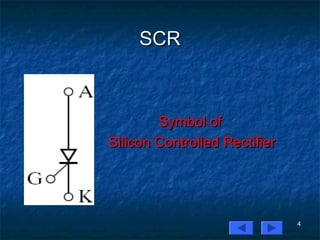
SCRSCR
Symbol ofSymbol of
Silicon Controlled RectifierSilicon Controlled Rectifier
5
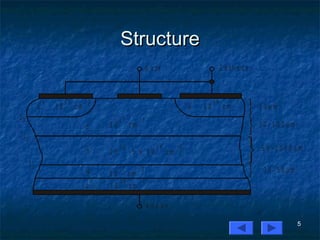
StructureStructure
}
}
}
}
G a t e C a t h o d e
J 3
J 2
J 1
A n o d e
1 0 c m
1 7 - 3
1 0 - 5 x 1 0 c m
1 3 1 4 - 3
1 0 c m
1 7 - 3
1 0 c m
1 9 - 3
1 0 c m
1 9 - 3
1 0 c m
1 9 - 3
n
+
n
+
p
-
n
–
p
p
+
1 0 mµ
3 0 - 1 0 0 mµ
5 0 - 1 0 0 0 mµ
3 0 - 5 0 mµ
6
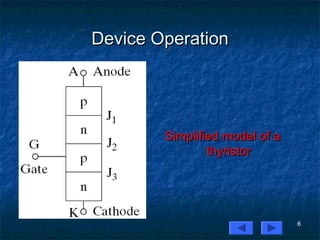
Device OperationDevice Operation
Simplified model of aSimplified model of a
thyristorthyristor
7
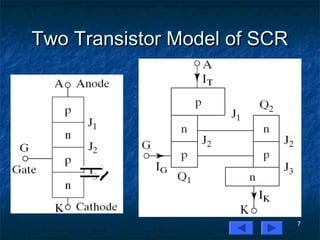
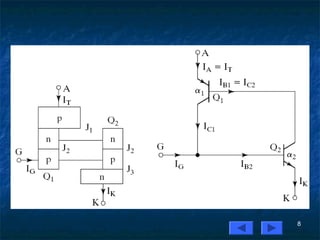
Two Transistor Model of SCRTwo Transistor Model of SCR
⇒⇒
8
9
( )
( )
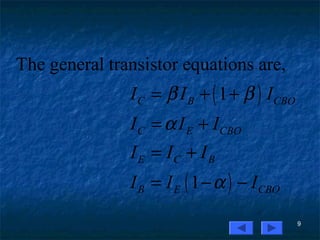
The general transistor equations are,
1
1
C B CBO
C E CBO
E C B
B E CBO
I I I
I I I
I I I
I I I
β β
α
α
= + +
= +
= +
= − −
10
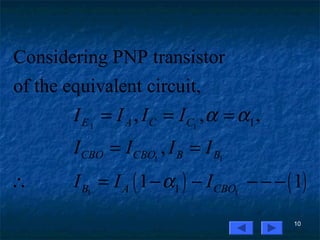
( ) ( )
1 1
1 1
1 1
1
1
Considering PNP transistor
of the equivalent circuit,
, , ,
,
1 1
E A C C
CBO CBO B B
B A CBO
I I I I
I I I I
I I I
α α
α
= = =
= =
∴ = − − − − −
11
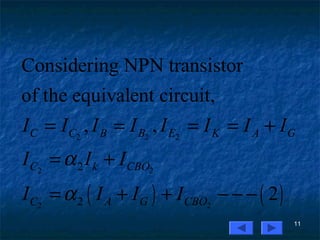
( ) ( )
2 2 2
2 2
2 2
2
2
Considering NPN transistor
of the equivalent circuit,
, ,
2
C C B B E K A G
C k CBO
C A G CBO
I I I I I I I I
I I I
I I I I
α
α
= = = = +
= +
= + + − − −
12
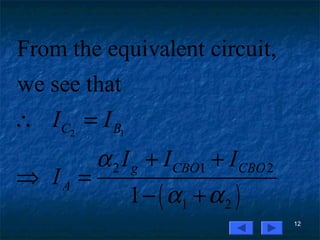
( )
2 1
2 1 2
1 2
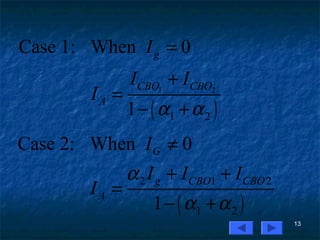
From the equivalent circuit,
we see that
1
C B
g CBO CBO
A
I I
I I I
I
α
α α
∴ =
+ +
⇒ =
− +
13
( )
1 2
1 2
Case 1: When 0
1
g
CBO CBO
A
I
I I
I
α α
=
+
=
− +
( )
2 1 2
1 2
Case 2: When 0
1
G
g CBO CBO
A
I
I I I
I
α
α α
≠
+ +
=
− +
14
V-IV-I
CharacteristicsCharacteristics
15
Effects of gate currentEffects of gate current
16
Turn-onTurn-on
CharacteristicsCharacteristics
on d rt t t= +
17
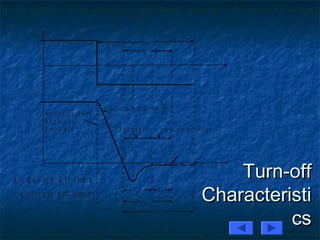
Turn-offTurn-off
CharacteristiCharacteristi
cscs
A n o d e c u r r e n t
b e g in s t o
d e c r e a s e
t C
t q
t
t
C o m m u t a t io n
d i
d t
R e c o v e r y R e c o m b i n a t i o n
t 1
t 2 t 3 t 4 t 5
t r r t g r
t q
t c
V A K
I A
t q = d e v i c e o f f t im e
t c = c ir c u it o f f t im e
18
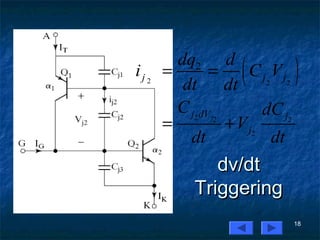
dv/dtdv/dt
TriggeringTriggering
( )2 2 2
2 2 2
2
2
j
j j j
j dV j
j
dq d
i C V
dt dt
C dC
V
dt dt
= =
= +
19
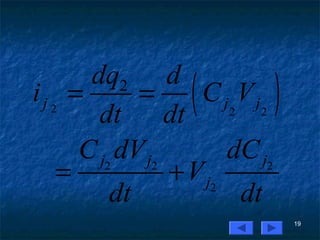
( )2 2 2
2 2 2
2
2
j j j
j j j
j
dq d
i C V
dt dt
C dV dC
V
dt dt
= =
= +
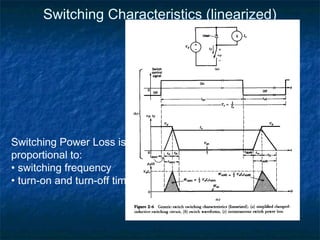
Switching Characteristics (linearized)
Switching Power Loss is
proportional to:
• switching frequency
• turn-on and turn-off times
21
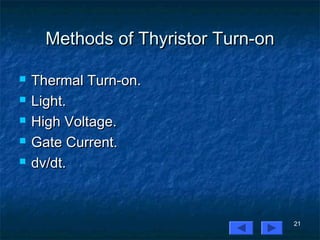
Methods of Thyristor Turn-onMethods of Thyristor Turn-on
 Thermal Turn-on.Thermal Turn-on.
 Light.Light.
 High Voltage.High Voltage.
 Gate Current.Gate Current.
 dv/dt.dv/dt.
22
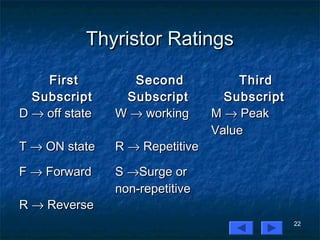
Thyristor RatingsThyristor Ratings
FirstFirst
SubscriptSubscript
SecondSecond
SubscriptSubscript
ThirdThird
SubscriptSubscript
DD →→ off stateoff state WW →→ workingworking MM →→ PeakPeak
ValueValue
TT →→ ON stateON state RR →→ RepetitiveRepetitive
FF →→ ForwardForward SS →→Surge orSurge or
non-repetitivenon-repetitive
RR →→ ReverseReverse
23
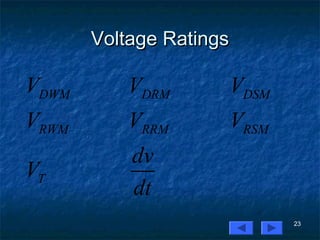
Voltage RatingsVoltage Ratings
DWM DRM DSM
RWM RRM RSM
T
V V V
V V V
dv
V
dt
24
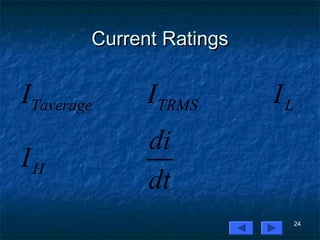
Current RatingsCurrent Ratings
Taverage TRMS L
H
I I I
di
I
dt
25
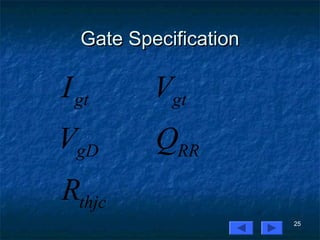
Gate SpecificationGate Specification
gt gt
gD RR
thjc
I V
V Q
R
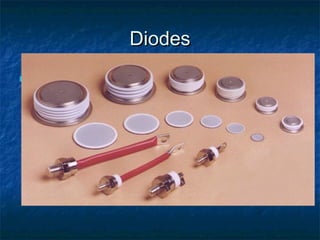
DiodesDiodes
 Diode Product RangeDiode Product Range
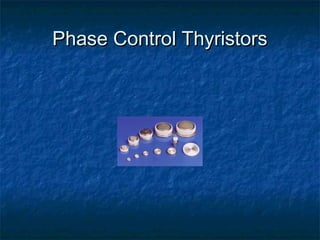
Phase Control ThyristorsPhase Control Thyristors
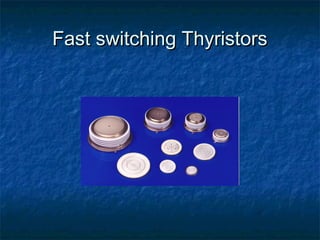
Fast switching ThyristorsFast switching Thyristors
29
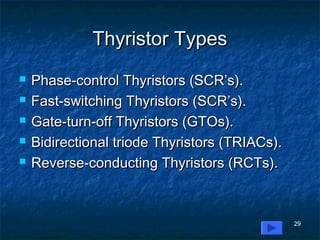
Thyristor TypesThyristor Types
 Phase-control Thyristors (SCR’s).Phase-control Thyristors (SCR’s).
 Fast-switching Thyristors (SCR’s).Fast-switching Thyristors (SCR’s).
 Gate-turn-off Thyristors (GTOs).Gate-turn-off Thyristors (GTOs).
 Bidirectional triode Thyristors (TRIACs).Bidirectional triode Thyristors (TRIACs).
 Reverse-conducting Thyristors (RCTs).Reverse-conducting Thyristors (RCTs).
30
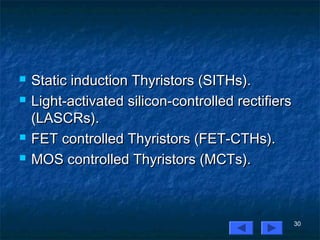
 Static induction Thyristors (SITHs).Static induction Thyristors (SITHs).
 Light-activated silicon-controlled rectifiersLight-activated silicon-controlled rectifiers
(LASCRs).(LASCRs).
 FET controlled Thyristors (FET-CTHs).FET controlled Thyristors (FET-CTHs).
 MOS controlled Thyristors (MCTs).MOS controlled Thyristors (MCTs).
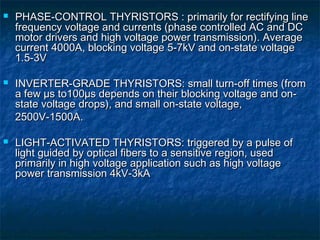
 PHASE-CONTROL THYRISTORS : primarily for rectifying linePHASE-CONTROL THYRISTORS : primarily for rectifying line
frequency voltage and currents (phase controlled AC and DCfrequency voltage and currents (phase controlled AC and DC
motor drivers and high voltage power transmission). Averagemotor drivers and high voltage power transmission). Average
current 4000A, blocking voltage 5-7kV and on-state voltagecurrent 4000A, blocking voltage 5-7kV and on-state voltage
1.5-3V1.5-3V
 INVERTER-GRADE THYRISTORS: small turn-off times (fromINVERTER-GRADE THYRISTORS: small turn-off times (from
a fewa few µµs to100s to100µµs depends on their blocking voltage and on-s depends on their blocking voltage and on-
state voltage drops), and small on-state voltage,state voltage drops), and small on-state voltage,
2500V-1500A.2500V-1500A.
 LIGHT-ACTIVATED THYRISTORS: triggered by a pulse ofLIGHT-ACTIVATED THYRISTORS: triggered by a pulse of
light guided by optical fibers to a sensitive region, usedlight guided by optical fibers to a sensitive region, used
primarily in high voltage application such as high voltageprimarily in high voltage application such as high voltage
power transmission 4kV-3kApower transmission 4kV-3kA
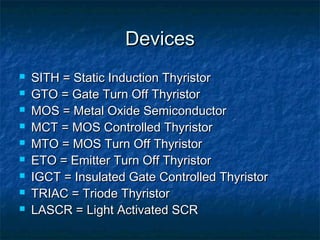
DevicesDevices
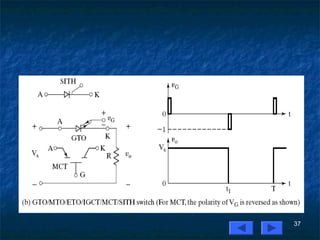
 SITH = Static Induction ThyristorSITH = Static Induction Thyristor
 GTO = Gate Turn Off ThyristorGTO = Gate Turn Off Thyristor
 MOS = Metal Oxide SemiconductorMOS = Metal Oxide Semiconductor
 MCT = MOS Controlled ThyristorMCT = MOS Controlled Thyristor
 MTO = MOS Turn Off ThyristorMTO = MOS Turn Off Thyristor
 ETO = Emitter Turn Off ThyristorETO = Emitter Turn Off Thyristor
 IGCT = Insulated Gate Controlled ThyristorIGCT = Insulated Gate Controlled Thyristor
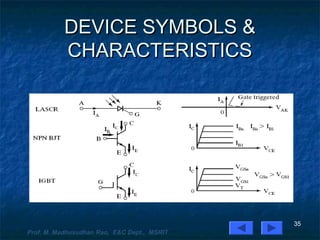
 TRIAC = Triode ThyristorTRIAC = Triode Thyristor
 LASCR = Light Activated SCRLASCR = Light Activated SCR
Devices..Devices..
 NPN BJT = NPN Bipolar JunctionNPN BJT = NPN Bipolar Junction
TransistorTransistor
 IGBT = Insulated Gate Bipolar JunctionIGBT = Insulated Gate Bipolar Junction
TransistorTransistor
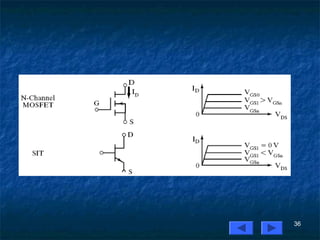
 N-Channel MOSFET = N-Channel MetalN-Channel MOSFET = N-Channel Metal
Oxide Silicon Field Effect TransistorOxide Silicon Field Effect Transistor
 SIT = Static Induction TransistorSIT = Static Induction Transistor
 RCT = Reverse Conducting ThyristorRCT = Reverse Conducting Thyristor
 GATT = Gate Assisted Turn Off ThyristorGATT = Gate Assisted Turn Off Thyristor
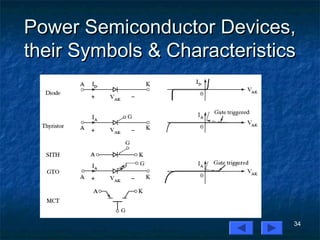
Power Semiconductor Devices,Power Semiconductor Devices,
their Symbols & Characteristicstheir Symbols & Characteristics
34
DEVICE SYMBOLS &DEVICE SYMBOLS &
CHARACTERISTICSCHARACTERISTICS
35
Prof. M. Madhusudhan Rao, E&C Dept., MSRIT
36
37
38
Phase Control ThyristorPhase Control Thyristor
 These are converter thyristors.These are converter thyristors.
 The turn-off time tThe turn-off time tqq is in the order of 50 tois in the order of 50 to
100100µµsec.sec.
 Used for low switching frequency.Used for low switching frequency.
 Commutation is natural commutationCommutation is natural commutation
 On state voltage drop is 1.15V for a 600VOn state voltage drop is 1.15V for a 600V
device.device.
39
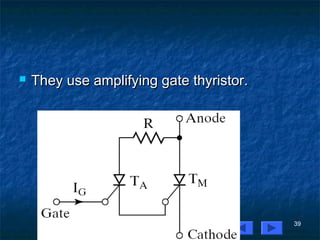
 They use amplifying gate thyristor.They use amplifying gate thyristor.
40
Fast SwitchingFast Switching
ThyristorsThyristors
 Also called inverter thyristors.Also called inverter thyristors.
 Used for high speed switchingUsed for high speed switching
applications.applications.
 Turn-off time tTurn-off time tqq in the range of 5 to 50in the range of 5 to 50µµsec.sec.
 On-state voltage drop of typically 1.7V forOn-state voltage drop of typically 1.7V for
2200A, 1800V thyristor.2200A, 1800V thyristor.
 High dv/dt and high di/dt rating.High dv/dt and high di/dt rating.
41
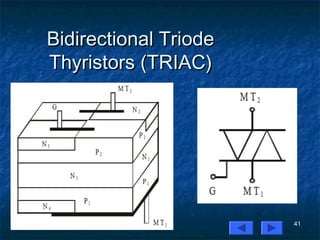
Bidirectional TriodeBidirectional Triode
Thyristors (TRIAC)Thyristors (TRIAC)
42
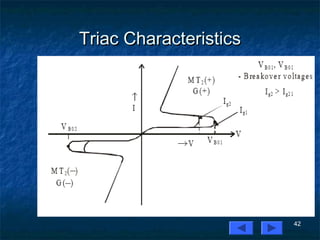
Triac CharacteristicsTriac Characteristics
43
Gate Turn-off ThyristorsGate Turn-off Thyristors
 Turned on by applying positive gateTurned on by applying positive gate
signal.signal.
 Turned off by applying negative gateTurned off by applying negative gate
signal.signal.
 On state voltage is 3.4V for 550A, 1200VOn state voltage is 3.4V for 550A, 1200V
GTO.GTO.
 Controllable peak on-state current IControllable peak on-state current ITGQTGQ isis
the peak value of on-state current whichthe peak value of on-state current which
can be turned-off by gate control.can be turned-off by gate control.
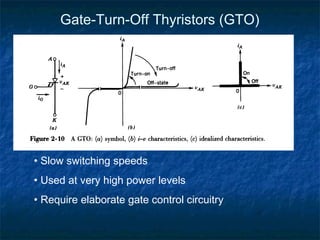
Gate-Turn-Off Thyristors (GTO)
• Slow switching speeds
• Used at very high power levels
• Require elaborate gate control circuitry
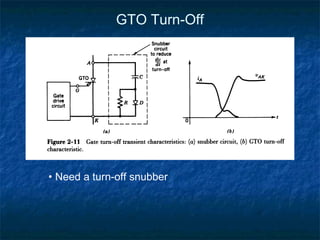
GTO Turn-Off
• Need a turn-off snubber
46
Advantages over SCRsAdvantages over SCRs
 Elimination of commutating components.Elimination of commutating components.
 Reduction in acoustic & electromagneticReduction in acoustic & electromagnetic
noise due to elimination of chokes.noise due to elimination of chokes.
 Faster turn-off, therefore can be used forFaster turn-off, therefore can be used for
higher switching frequencies.higher switching frequencies.
 Improved efficiency of converters.Improved efficiency of converters.
47
Advantages over BJTsAdvantages over BJTs
 Higher voltage blocking capabilities.Higher voltage blocking capabilities.
 High on-state gain.High on-state gain.
 High ratio of peak surge current toHigh ratio of peak surge current to
average current.average current.
 A pulsed gate signal of short duration onlyA pulsed gate signal of short duration only
is required.is required.
48
Disadvantages of GTOsDisadvantages of GTOs
 On-state voltage drop is more.On-state voltage drop is more.
 Due to multi cathode structure higher gateDue to multi cathode structure higher gate
current is required.current is required.
 Gate drive circuit losses are more.Gate drive circuit losses are more.
 Reverse blocking capability is less than itsReverse blocking capability is less than its
forward blocking capability.forward blocking capability.
49
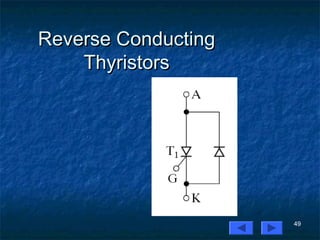
Reverse ConductingReverse Conducting
ThyristorsThyristors
50
 Anti-parallel diode connected across SCRAnti-parallel diode connected across SCR
on the same silicon chip.on the same silicon chip.
 This diode clamps the reverse blockingThis diode clamps the reverse blocking
voltage to 1 or 2V.voltage to 1 or 2V.
 RCT also called Asymmetrical ThyristorRCT also called Asymmetrical Thyristor
(ASCR).(ASCR).
 Limited applications.Limited applications.
51
Static Induction ThyristorsStatic Induction Thyristors
 Turned-on by applying positive gateTurned-on by applying positive gate
voltage.voltage.
 Turned-off by applying negative gateTurned-off by applying negative gate
voltage.voltage.
 Minority carrier device.Minority carrier device.
 Low on-state resistance & low voltageLow on-state resistance & low voltage
drop.drop.
 Fast switching speeds & high dv/dt & highFast switching speeds & high dv/dt & high
di/dt capabilities.di/dt capabilities.
52
 Switching time in order of 1 to 6Switching time in order of 1 to 6 µµsec.sec.
 The rating can go upto 2500V / 500A.The rating can go upto 2500V / 500A.
 Process sensitive.Process sensitive.
53
Light-Activated SiliconLight-Activated Silicon
Controlled RectifiersControlled Rectifiers
 Turned-on by direct light radiation onTurned-on by direct light radiation on
silicon wafer.silicon wafer.
 Gate structure is sensitive for triggeringGate structure is sensitive for triggering
from practical light sources.from practical light sources.
 Used in high voltage and high currentUsed in high voltage and high current
applications. Example: HVDCapplications. Example: HVDC
transmission, Static reactive powertransmission, Static reactive power
compensation.compensation.
54
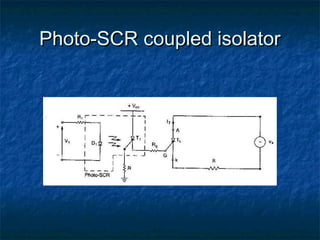
 Offers complete electrical isolationOffers complete electrical isolation
between light triggering source & powerbetween light triggering source & power
circuit.circuit.
 Rating could be has high as 4KV / 1500A.Rating could be has high as 4KV / 1500A.
 di/dt rating is 250A /di/dt rating is 250A / µµsec.sec.
 dv/dt rating is 2000V /dv/dt rating is 2000V / µµsec.sec.
Photo-SCR coupled isolatorPhoto-SCR coupled isolator
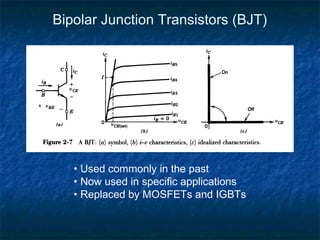
Bipolar Junction Transistors (BJT)
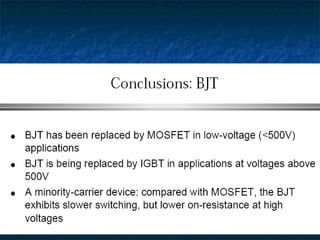
• Used commonly in the past
• Now used in specific applications
• Replaced by MOSFETs and IGBTs
58
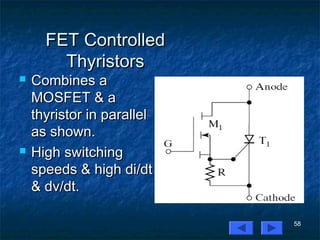
FET ControlledFET Controlled
ThyristorsThyristors
 Combines aCombines a
MOSFET & aMOSFET & a
thyristor in parallelthyristor in parallel
as shown.as shown.
 High switchingHigh switching
speeds & high di/dtspeeds & high di/dt
& dv/dt.& dv/dt.
59
 Turned on like conventional thyristors.Turned on like conventional thyristors.
 Cannot be turned off by gate control.Cannot be turned off by gate control.
 Application of these are where opticalApplication of these are where optical
firing is to be used.firing is to be used.
60
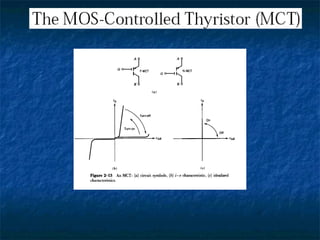
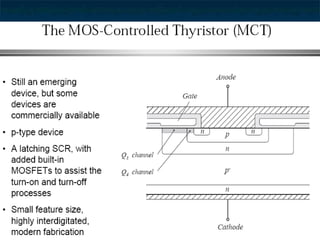
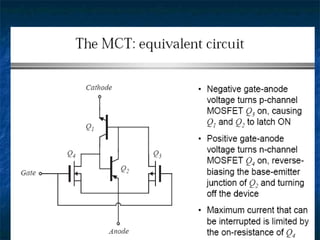
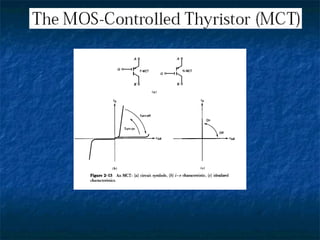
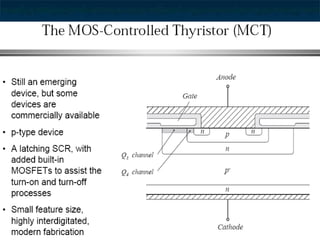
MOS-ControlledMOS-Controlled
ThyristorThyristor
 New device that has becomeNew device that has become
commercially available.commercially available.
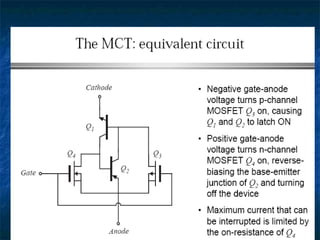
 Basically a thyristor with two MOSFETsBasically a thyristor with two MOSFETs
built in the gate structure.built in the gate structure.
 One MOSFET for turning ON the MCTOne MOSFET for turning ON the MCT
and the other to turn OFF the MCT.and the other to turn OFF the MCT.
MCT
64
FeaturesFeatures
 Low on-state losses & large currentLow on-state losses & large current
capabilities.capabilities.
 Low switching losses.Low switching losses.
 High switching speeds achieved due toHigh switching speeds achieved due to
fast turn-on & turn-off.fast turn-on & turn-off.
 Low reverse blocking capability.Low reverse blocking capability.
65
 Gate controlled possible if current is lessGate controlled possible if current is less
than peak controllable current.than peak controllable current.
 Gate pulse width not critical for smallerGate pulse width not critical for smaller
device currents.device currents.
 Gate pulse width critical for turn-off forGate pulse width critical for turn-off for
larger currents.larger currents.
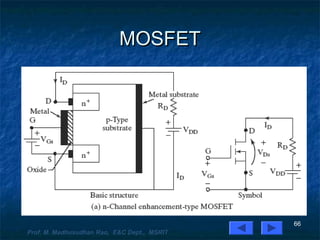
MOSFETMOSFET
66
Prof. M. Madhusudhan Rao, E&C Dept., MSRIT
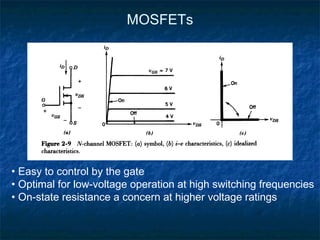
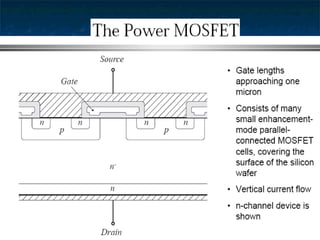
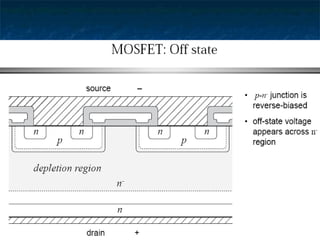
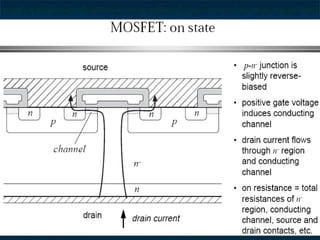
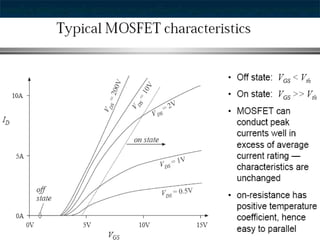
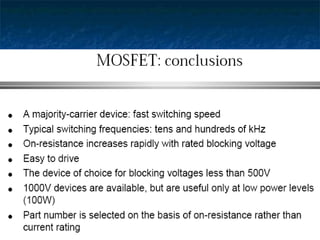
MOSFETs
• Easy to control by the gate
• Optimal for low-voltage operation at high switching frequencies
• On-state resistance a concern at higher voltage ratings
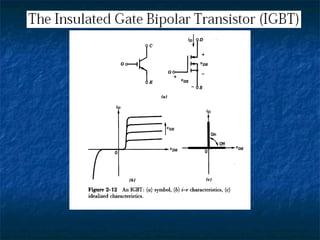
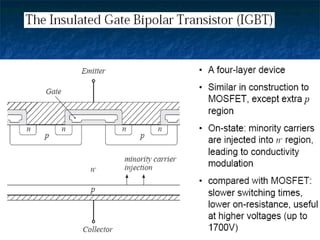
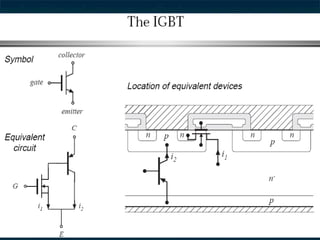
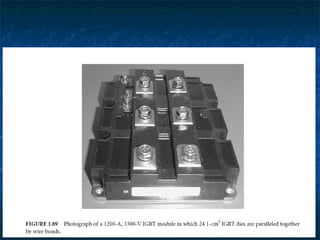
IGBT
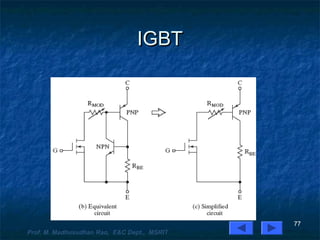
IGBTIGBT
77
Prof. M. Madhusudhan Rao, E&C Dept., MSRIT
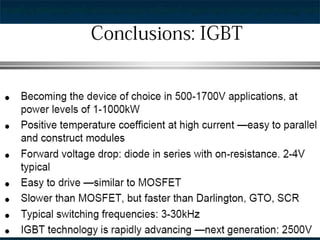
Advantages of IGBTAdvantages of IGBT
 Combines the advantages of BJT & MOSFETCombines the advantages of BJT & MOSFET
 High input impedance like MOSFETHigh input impedance like MOSFET
 Voltage controlled device like MOSFETVoltage controlled device like MOSFET
 Simple gate drive, Lower switching lossSimple gate drive, Lower switching loss
 Low on state conduction power loss like BJTLow on state conduction power loss like BJT
 Higher current capability & higher switchingHigher current capability & higher switching
speed than a BJT. ( Switching speed lower thanspeed than a BJT. ( Switching speed lower than
MOSFET)MOSFET)
78
Prof. M. Madhusudhan Rao, E&C Dept., MSRIT
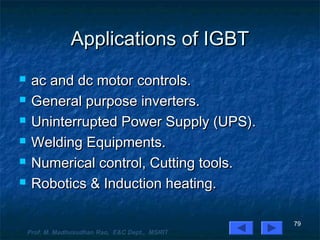
Applications of IGBTApplications of IGBT
 ac and dc motor controls.ac and dc motor controls.
 General purpose inverters.General purpose inverters.
 Uninterrupted Power Supply (UPS).Uninterrupted Power Supply (UPS).
 Welding Equipments.Welding Equipments.
 Numerical control, Cutting tools.Numerical control, Cutting tools.
 Robotics & Induction heating.Robotics & Induction heating.
79
Prof. M. Madhusudhan Rao, E&C Dept., MSRIT
MCT
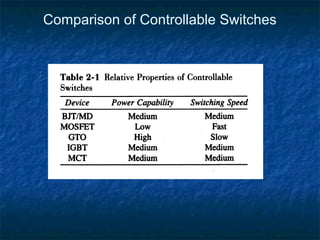
Comparison of Controllable Switches
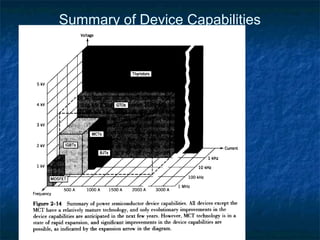
Summary of Device Capabilities
Power semi conductor devices

Power semi conductor devices

  • 1.
  • 2.
    2 ThyristorsThyristors  Most importanttype of powerMost important type of power semiconductor device.semiconductor device.  Have the highest power handlingHave the highest power handling capability.they have a rating of 5000V /capability.they have a rating of 5000V / 6000A with switching frequencies ranging6000A with switching frequencies ranging from 1KHz to 20KHz.from 1KHz to 20KHz.
  • 3.
    3  Is inherentlya slow switching deviceIs inherently a slow switching device compared to BJT or MOSFET.compared to BJT or MOSFET.  Used as a latching switch that can beUsed as a latching switch that can be turned on by the control terminal butturned on by the control terminal but cannot be turned off by the gate.cannot be turned off by the gate.
  • 4.
    4 SCRSCR Symbol ofSymbol of SiliconControlled RectifierSilicon Controlled Rectifier
  • 5.
    5 StructureStructure } } } } G a te C a t h o d e J 3 J 2 J 1 A n o d e 1 0 c m 1 7 - 3 1 0 - 5 x 1 0 c m 1 3 1 4 - 3 1 0 c m 1 7 - 3 1 0 c m 1 9 - 3 1 0 c m 1 9 - 3 1 0 c m 1 9 - 3 n + n + p - n – p p + 1 0 mµ 3 0 - 1 0 0 mµ 5 0 - 1 0 0 0 mµ 3 0 - 5 0 mµ
  • 6.
    6 Device OperationDevice Operation Simplifiedmodel of aSimplified model of a thyristorthyristor
  • 7.
    7 Two Transistor Modelof SCRTwo Transistor Model of SCR ⇒⇒
  • 8.
  • 9.
    9 ( ) ( ) Thegeneral transistor equations are, 1 1 C B CBO C E CBO E C B B E CBO I I I I I I I I I I I I β β α α = + + = + = + = − −
  • 10.
    10 ( ) () 1 1 1 1 1 1 1 1 Considering PNP transistor of the equivalent circuit, , , , , 1 1 E A C C CBO CBO B B B A CBO I I I I I I I I I I I α α α = = = = = ∴ = − − − − −
  • 11.
    11 ( ) () 2 2 2 2 2 2 2 2 2 Considering NPN transistor of the equivalent circuit, , , 2 C C B B E K A G C k CBO C A G CBO I I I I I I I I I I I I I I I α α = = = = + = + = + + − − −
  • 12.
    12 ( ) 2 1 21 2 1 2 From the equivalent circuit, we see that 1 C B g CBO CBO A I I I I I I α α α ∴ = + + ⇒ = − +
  • 13.
    13 ( ) 1 2 12 Case 1: When 0 1 g CBO CBO A I I I I α α = + = − + ( ) 2 1 2 1 2 Case 2: When 0 1 G g CBO CBO A I I I I I α α α ≠ + + = − +
  • 14.
  • 15.
    15 Effects of gatecurrentEffects of gate current
  • 16.
  • 17.
    17 Turn-offTurn-off CharacteristiCharacteristi cscs A n od e c u r r e n t b e g in s t o d e c r e a s e t C t q t t C o m m u t a t io n d i d t R e c o v e r y R e c o m b i n a t i o n t 1 t 2 t 3 t 4 t 5 t r r t g r t q t c V A K I A t q = d e v i c e o f f t im e t c = c ir c u it o f f t im e
  • 18.
    18 dv/dtdv/dt TriggeringTriggering ( )2 22 2 2 2 2 2 j j j j j dV j j dq d i C V dt dt C dC V dt dt = = = +
  • 19.
    19 ( )2 22 2 2 2 2 2 j j j j j j j dq d i C V dt dt C dV dC V dt dt = = = +
  • 20.
    Switching Characteristics (linearized) SwitchingPower Loss is proportional to: • switching frequency • turn-on and turn-off times
  • 21.
    21 Methods of ThyristorTurn-onMethods of Thyristor Turn-on  Thermal Turn-on.Thermal Turn-on.  Light.Light.  High Voltage.High Voltage.  Gate Current.Gate Current.  dv/dt.dv/dt.
  • 22.
    22 Thyristor RatingsThyristor Ratings FirstFirst SubscriptSubscript SecondSecond SubscriptSubscript ThirdThird SubscriptSubscript DD→→ off stateoff state WW →→ workingworking MM →→ PeakPeak ValueValue TT →→ ON stateON state RR →→ RepetitiveRepetitive FF →→ ForwardForward SS →→Surge orSurge or non-repetitivenon-repetitive RR →→ ReverseReverse
  • 23.
    23 Voltage RatingsVoltage Ratings DWMDRM DSM RWM RRM RSM T V V V V V V dv V dt
  • 24.
  • 25.
  • 26.
    DiodesDiodes  Diode ProductRangeDiode Product Range
  • 27.
  • 28.
    Fast switching ThyristorsFastswitching Thyristors
  • 29.
    29 Thyristor TypesThyristor Types Phase-control Thyristors (SCR’s).Phase-control Thyristors (SCR’s).  Fast-switching Thyristors (SCR’s).Fast-switching Thyristors (SCR’s).  Gate-turn-off Thyristors (GTOs).Gate-turn-off Thyristors (GTOs).  Bidirectional triode Thyristors (TRIACs).Bidirectional triode Thyristors (TRIACs).  Reverse-conducting Thyristors (RCTs).Reverse-conducting Thyristors (RCTs).
  • 30.
    30  Static inductionThyristors (SITHs).Static induction Thyristors (SITHs).  Light-activated silicon-controlled rectifiersLight-activated silicon-controlled rectifiers (LASCRs).(LASCRs).  FET controlled Thyristors (FET-CTHs).FET controlled Thyristors (FET-CTHs).  MOS controlled Thyristors (MCTs).MOS controlled Thyristors (MCTs).
  • 31.
     PHASE-CONTROL THYRISTORS: primarily for rectifying linePHASE-CONTROL THYRISTORS : primarily for rectifying line frequency voltage and currents (phase controlled AC and DCfrequency voltage and currents (phase controlled AC and DC motor drivers and high voltage power transmission). Averagemotor drivers and high voltage power transmission). Average current 4000A, blocking voltage 5-7kV and on-state voltagecurrent 4000A, blocking voltage 5-7kV and on-state voltage 1.5-3V1.5-3V  INVERTER-GRADE THYRISTORS: small turn-off times (fromINVERTER-GRADE THYRISTORS: small turn-off times (from a fewa few µµs to100s to100µµs depends on their blocking voltage and on-s depends on their blocking voltage and on- state voltage drops), and small on-state voltage,state voltage drops), and small on-state voltage, 2500V-1500A.2500V-1500A.  LIGHT-ACTIVATED THYRISTORS: triggered by a pulse ofLIGHT-ACTIVATED THYRISTORS: triggered by a pulse of light guided by optical fibers to a sensitive region, usedlight guided by optical fibers to a sensitive region, used primarily in high voltage application such as high voltageprimarily in high voltage application such as high voltage power transmission 4kV-3kApower transmission 4kV-3kA
  • 32.
    DevicesDevices  SITH =Static Induction ThyristorSITH = Static Induction Thyristor  GTO = Gate Turn Off ThyristorGTO = Gate Turn Off Thyristor  MOS = Metal Oxide SemiconductorMOS = Metal Oxide Semiconductor  MCT = MOS Controlled ThyristorMCT = MOS Controlled Thyristor  MTO = MOS Turn Off ThyristorMTO = MOS Turn Off Thyristor  ETO = Emitter Turn Off ThyristorETO = Emitter Turn Off Thyristor  IGCT = Insulated Gate Controlled ThyristorIGCT = Insulated Gate Controlled Thyristor  TRIAC = Triode ThyristorTRIAC = Triode Thyristor  LASCR = Light Activated SCRLASCR = Light Activated SCR
  • 33.
    Devices..Devices..  NPN BJT= NPN Bipolar JunctionNPN BJT = NPN Bipolar Junction TransistorTransistor  IGBT = Insulated Gate Bipolar JunctionIGBT = Insulated Gate Bipolar Junction TransistorTransistor  N-Channel MOSFET = N-Channel MetalN-Channel MOSFET = N-Channel Metal Oxide Silicon Field Effect TransistorOxide Silicon Field Effect Transistor  SIT = Static Induction TransistorSIT = Static Induction Transistor  RCT = Reverse Conducting ThyristorRCT = Reverse Conducting Thyristor  GATT = Gate Assisted Turn Off ThyristorGATT = Gate Assisted Turn Off Thyristor
  • 34.
    Power Semiconductor Devices,PowerSemiconductor Devices, their Symbols & Characteristicstheir Symbols & Characteristics 34
  • 35.
    DEVICE SYMBOLS &DEVICESYMBOLS & CHARACTERISTICSCHARACTERISTICS 35 Prof. M. Madhusudhan Rao, E&C Dept., MSRIT
  • 36.
  • 37.
  • 38.
    38 Phase Control ThyristorPhaseControl Thyristor  These are converter thyristors.These are converter thyristors.  The turn-off time tThe turn-off time tqq is in the order of 50 tois in the order of 50 to 100100µµsec.sec.  Used for low switching frequency.Used for low switching frequency.  Commutation is natural commutationCommutation is natural commutation  On state voltage drop is 1.15V for a 600VOn state voltage drop is 1.15V for a 600V device.device.
  • 39.
    39  They useamplifying gate thyristor.They use amplifying gate thyristor.
  • 40.
    40 Fast SwitchingFast Switching ThyristorsThyristors Also called inverter thyristors.Also called inverter thyristors.  Used for high speed switchingUsed for high speed switching applications.applications.  Turn-off time tTurn-off time tqq in the range of 5 to 50in the range of 5 to 50µµsec.sec.  On-state voltage drop of typically 1.7V forOn-state voltage drop of typically 1.7V for 2200A, 1800V thyristor.2200A, 1800V thyristor.  High dv/dt and high di/dt rating.High dv/dt and high di/dt rating.
  • 41.
  • 42.
  • 43.
    43 Gate Turn-off ThyristorsGateTurn-off Thyristors  Turned on by applying positive gateTurned on by applying positive gate signal.signal.  Turned off by applying negative gateTurned off by applying negative gate signal.signal.  On state voltage is 3.4V for 550A, 1200VOn state voltage is 3.4V for 550A, 1200V GTO.GTO.  Controllable peak on-state current IControllable peak on-state current ITGQTGQ isis the peak value of on-state current whichthe peak value of on-state current which can be turned-off by gate control.can be turned-off by gate control.
  • 44.
    Gate-Turn-Off Thyristors (GTO) •Slow switching speeds • Used at very high power levels • Require elaborate gate control circuitry
  • 45.
    GTO Turn-Off • Needa turn-off snubber
  • 46.
    46 Advantages over SCRsAdvantagesover SCRs  Elimination of commutating components.Elimination of commutating components.  Reduction in acoustic & electromagneticReduction in acoustic & electromagnetic noise due to elimination of chokes.noise due to elimination of chokes.  Faster turn-off, therefore can be used forFaster turn-off, therefore can be used for higher switching frequencies.higher switching frequencies.  Improved efficiency of converters.Improved efficiency of converters.
  • 47.
    47 Advantages over BJTsAdvantagesover BJTs  Higher voltage blocking capabilities.Higher voltage blocking capabilities.  High on-state gain.High on-state gain.  High ratio of peak surge current toHigh ratio of peak surge current to average current.average current.  A pulsed gate signal of short duration onlyA pulsed gate signal of short duration only is required.is required.
  • 48.
    48 Disadvantages of GTOsDisadvantagesof GTOs  On-state voltage drop is more.On-state voltage drop is more.  Due to multi cathode structure higher gateDue to multi cathode structure higher gate current is required.current is required.  Gate drive circuit losses are more.Gate drive circuit losses are more.  Reverse blocking capability is less than itsReverse blocking capability is less than its forward blocking capability.forward blocking capability.
  • 49.
  • 50.
    50  Anti-parallel diodeconnected across SCRAnti-parallel diode connected across SCR on the same silicon chip.on the same silicon chip.  This diode clamps the reverse blockingThis diode clamps the reverse blocking voltage to 1 or 2V.voltage to 1 or 2V.  RCT also called Asymmetrical ThyristorRCT also called Asymmetrical Thyristor (ASCR).(ASCR).  Limited applications.Limited applications.
  • 51.
    51 Static Induction ThyristorsStaticInduction Thyristors  Turned-on by applying positive gateTurned-on by applying positive gate voltage.voltage.  Turned-off by applying negative gateTurned-off by applying negative gate voltage.voltage.  Minority carrier device.Minority carrier device.  Low on-state resistance & low voltageLow on-state resistance & low voltage drop.drop.  Fast switching speeds & high dv/dt & highFast switching speeds & high dv/dt & high di/dt capabilities.di/dt capabilities.
  • 52.
    52  Switching timein order of 1 to 6Switching time in order of 1 to 6 µµsec.sec.  The rating can go upto 2500V / 500A.The rating can go upto 2500V / 500A.  Process sensitive.Process sensitive.
  • 53.
    53 Light-Activated SiliconLight-Activated Silicon ControlledRectifiersControlled Rectifiers  Turned-on by direct light radiation onTurned-on by direct light radiation on silicon wafer.silicon wafer.  Gate structure is sensitive for triggeringGate structure is sensitive for triggering from practical light sources.from practical light sources.  Used in high voltage and high currentUsed in high voltage and high current applications. Example: HVDCapplications. Example: HVDC transmission, Static reactive powertransmission, Static reactive power compensation.compensation.
  • 54.
    54  Offers completeelectrical isolationOffers complete electrical isolation between light triggering source & powerbetween light triggering source & power circuit.circuit.  Rating could be has high as 4KV / 1500A.Rating could be has high as 4KV / 1500A.  di/dt rating is 250A /di/dt rating is 250A / µµsec.sec.  dv/dt rating is 2000V /dv/dt rating is 2000V / µµsec.sec.
  • 55.
  • 56.
    Bipolar Junction Transistors(BJT) • Used commonly in the past • Now used in specific applications • Replaced by MOSFETs and IGBTs
  • 58.
    58 FET ControlledFET Controlled ThyristorsThyristors Combines aCombines a MOSFET & aMOSFET & a thyristor in parallelthyristor in parallel as shown.as shown.  High switchingHigh switching speeds & high di/dtspeeds & high di/dt & dv/dt.& dv/dt.
  • 59.
    59  Turned onlike conventional thyristors.Turned on like conventional thyristors.  Cannot be turned off by gate control.Cannot be turned off by gate control.  Application of these are where opticalApplication of these are where optical firing is to be used.firing is to be used.
  • 60.
    60 MOS-ControlledMOS-Controlled ThyristorThyristor  New devicethat has becomeNew device that has become commercially available.commercially available.  Basically a thyristor with two MOSFETsBasically a thyristor with two MOSFETs built in the gate structure.built in the gate structure.  One MOSFET for turning ON the MCTOne MOSFET for turning ON the MCT and the other to turn OFF the MCT.and the other to turn OFF the MCT.
  • 61.
  • 64.
    64 FeaturesFeatures  Low on-statelosses & large currentLow on-state losses & large current capabilities.capabilities.  Low switching losses.Low switching losses.  High switching speeds achieved due toHigh switching speeds achieved due to fast turn-on & turn-off.fast turn-on & turn-off.  Low reverse blocking capability.Low reverse blocking capability.
  • 65.
    65  Gate controlledpossible if current is lessGate controlled possible if current is less than peak controllable current.than peak controllable current.  Gate pulse width not critical for smallerGate pulse width not critical for smaller device currents.device currents.  Gate pulse width critical for turn-off forGate pulse width critical for turn-off for larger currents.larger currents.
  • 66.
  • 67.
    MOSFETs • Easy tocontrol by the gate • Optimal for low-voltage operation at high switching frequencies • On-state resistance a concern at higher voltage ratings
  • 73.
  • 77.
    IGBTIGBT 77 Prof. M. MadhusudhanRao, E&C Dept., MSRIT
  • 78.
    Advantages of IGBTAdvantagesof IGBT  Combines the advantages of BJT & MOSFETCombines the advantages of BJT & MOSFET  High input impedance like MOSFETHigh input impedance like MOSFET  Voltage controlled device like MOSFETVoltage controlled device like MOSFET  Simple gate drive, Lower switching lossSimple gate drive, Lower switching loss  Low on state conduction power loss like BJTLow on state conduction power loss like BJT  Higher current capability & higher switchingHigher current capability & higher switching speed than a BJT. ( Switching speed lower thanspeed than a BJT. ( Switching speed lower than MOSFET)MOSFET) 78 Prof. M. Madhusudhan Rao, E&C Dept., MSRIT
  • 79.
    Applications of IGBTApplicationsof IGBT  ac and dc motor controls.ac and dc motor controls.  General purpose inverters.General purpose inverters.  Uninterrupted Power Supply (UPS).Uninterrupted Power Supply (UPS).  Welding Equipments.Welding Equipments.  Numerical control, Cutting tools.Numerical control, Cutting tools.  Robotics & Induction heating.Robotics & Induction heating. 79 Prof. M. Madhusudhan Rao, E&C Dept., MSRIT
  • 81.
  • 85.
  • 87.
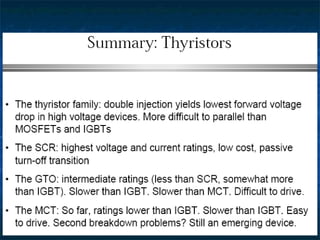
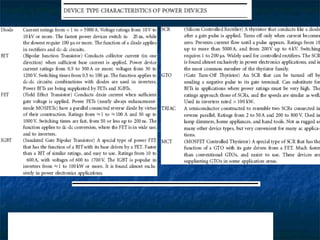
    Summary of DeviceCapabilities