SEMINAR ON
“ FAULT LOCATION OF OVERHEAD
TRANSMISSION LINES ”
Presented By
<NAME>
Regd. No. -xxxxx
Department of Electrical Engineering
Institute Logo
CONTENTS
INTRODUCTION
CURRENT METHODS OF FAULT LOCATION CALCULATION
DRAWBACKS OF CURRENT METHODS
MAGNETORESISTANCE SENSOR
FAULT LOCATION CALCULATION USING MAGNETORESISTANCE
SENSOR
CONCLUSION
REFERENCES
1
INTRODUCTION
Fault location detection and correction are important in case of any
power systems.
The traditional systems adopted for fault location are Travelling-wave-
based approach and Impedance-measurement-based approach.
The new method of locating of fault utilizes the new technology of
Magneto Sensors which are used for finding the fault in transmission
lines.
214-Nov-17
CURRENT METHODS
1. Impedance-based fault location
 In the impedance-measurement-based technique, the voltage and current
prefault and post fault are acquired and analysed
2. Travelling-wave-based fault location
 Fault occurring on a power cable will generate both voltage and current travelling
waves with wideband signals which cover the entire frequency range.
 Time Domain Reflectomery (TDR) technology is used.
314-Nov-17
DRAWBACKS OF CURRENT METHODS
The parameters of the lines are to be known.
Have to consider that the line is homogenous in nature, while in fact it is
not.
The relative location error is very large many times.
Error occur when fault reactance is there.
Performance is highly dependent on signal processing techniques.
414-Nov-17
Continuing…
Have to connect instruments to the live line, which increases the
the cost of instruments needed.
Hard to map the electrical distance to actual geographical
location.
Affected by CT saturation.
Have to assume uniform wave speed.
High cost. 514-Nov-17
MAGNETORESISTANCE SENSOR
 Magnetoresistance is the tendency of a material to change the
value of its electrical resistance in an externally applied magnetic
field.
 William Thomson (Lord Kelvin) first discovered ordinary
magnetoresistance in 1856.
614-Nov-17
MAGNETORESISTANCE SENSOR
714-Nov-17
Continuing…
Types
1) Anisotropic Magnetoresistance(AMR)
2) Giant Magnetoresistance(GMR)
3) Tunnelling Magnetoresistance(TMR)
In 2007, Albert Fert and Peter Grunberg were jointly awarded the
Nobel Prize for the discovery of Giant Magnetoresistance (GMR).
These sensors in general have high sensitivity, large temperature
range, and wide frequency bandwidth (from dc to several
megahertz).
814-Nov-17
PROPOSED METHOD
 This method of locating of fault utilizes the new technology of
magneto sensors which are used for finding the fault in
transmission lines.
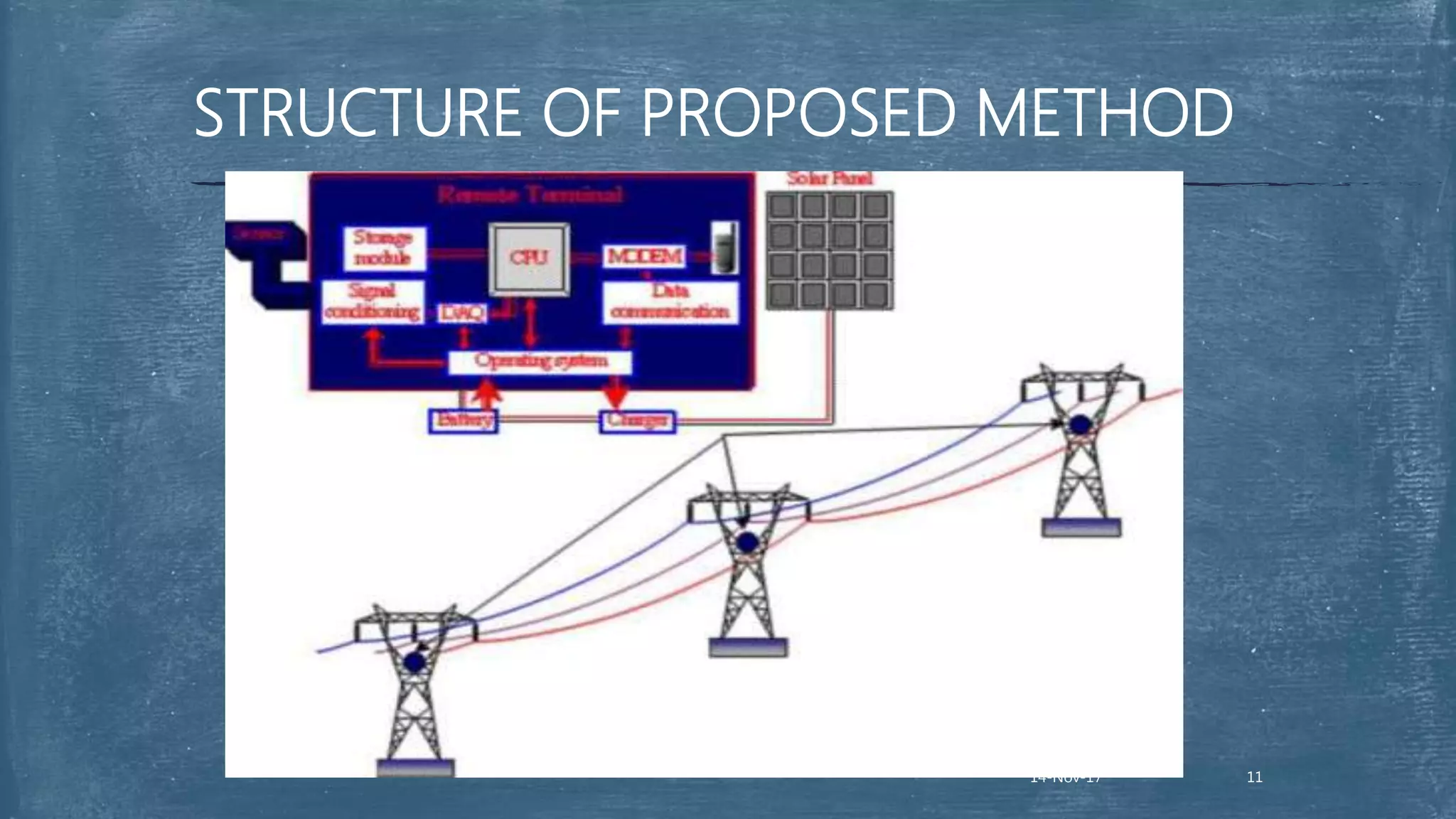
 The sensors are placed on the tower, and the data are transmitted to a
data processing centre where analysis software can determine which
the fault location belongs to.
 This method utilizes fast advancement of the microelectromechanical
systems (MEMS) packaging technology and magnetoresistance material
technology.
914-Nov-17
Continuing…
 Magnetoresistance is the property of a material to change the value of
its electrical resistance when an external magnetic field is applied to it.
 The strength, direction, and distribution of the magnetic field emanated
from the conductors contain information about the electric power
parameters, such as amplitude, frequency, and phase of the electric
current.
1014-Nov-17
STRUCTURE OF PROPOSED METHOD
1114-Nov-17
LOCATION OF FAULT
12
Distribution of the magnetic field along the transmission
line under3-φ short-circuit condition (m =100 km).
14-Nov-17
13
When the three-phase short circuit occurs, the measured magnetic field
is increased.
The ratio of the magnetic field during the fault to that during the normal
situation is the same as the ratio of the short-circuit current to the
current at normal condition, provided that the transient process is not
considered.
In the figure, the axis represents the evolution of time (during the
lifecycle of a fault, that is, prefault, fault, and postfault), the axis
represents the distribution along the transmission line (0 to the length
of the line), and the axis represents the measured 16 magnetic field.
14-Nov-17
14
System diagram of the test system in the numerical simulation (l: the total
length of the transmission line and m: distance from the sending end to the fault
location).
14-Nov-17
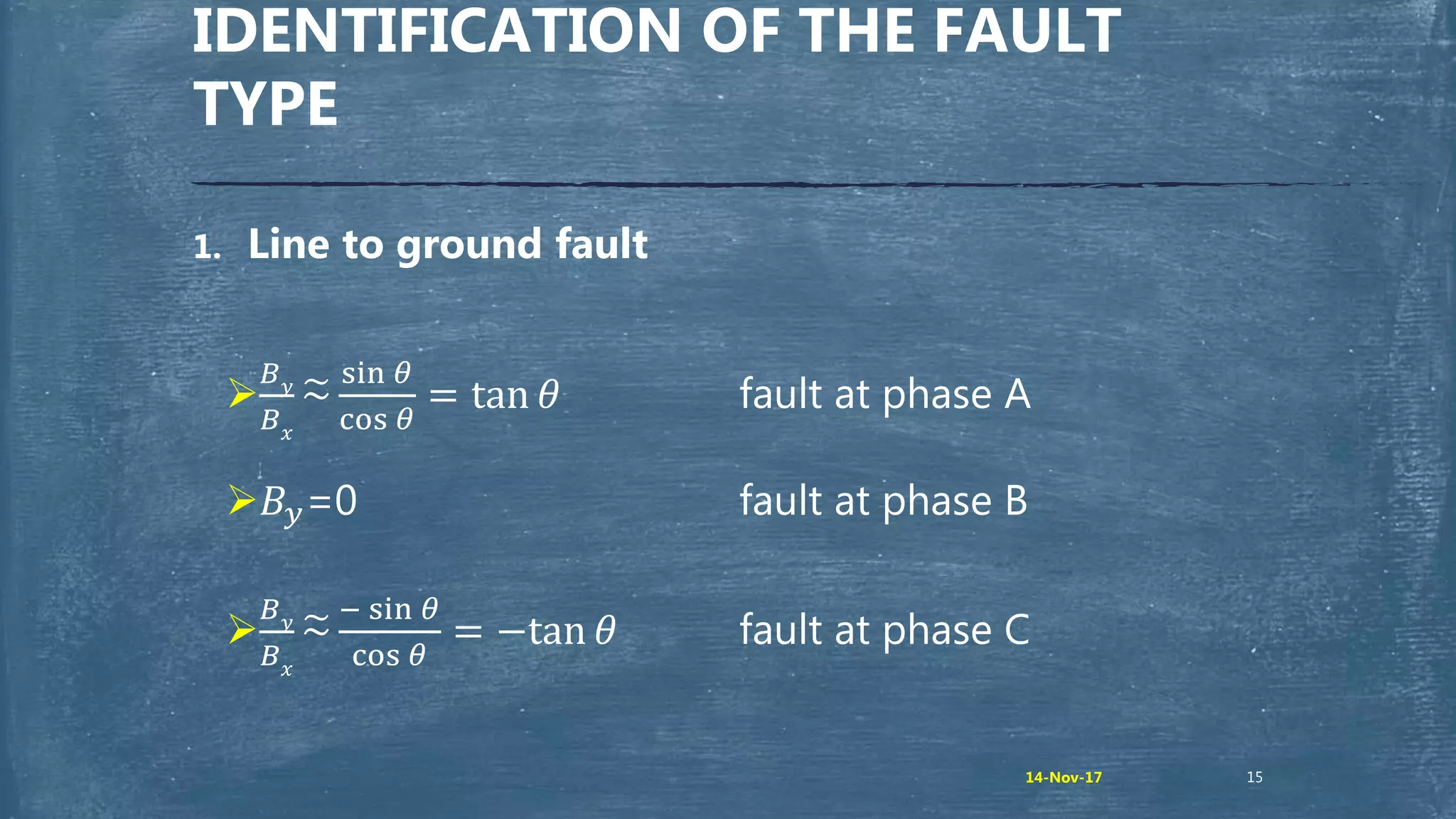
1. Line to ground fault

𝐵 𝑦
𝐵 𝑥
~
sin 𝜃
cos 𝜃
= tan 𝜃 fault at phase A
𝐵𝑦=0 fault at phase B

𝐵 𝑦
𝐵 𝑥
~
− sin 𝜃
cos 𝜃
= −tan 𝜃 fault at phase C
IDENTIFICATION OF THE FAULT
TYPE
1514-Nov-17
16
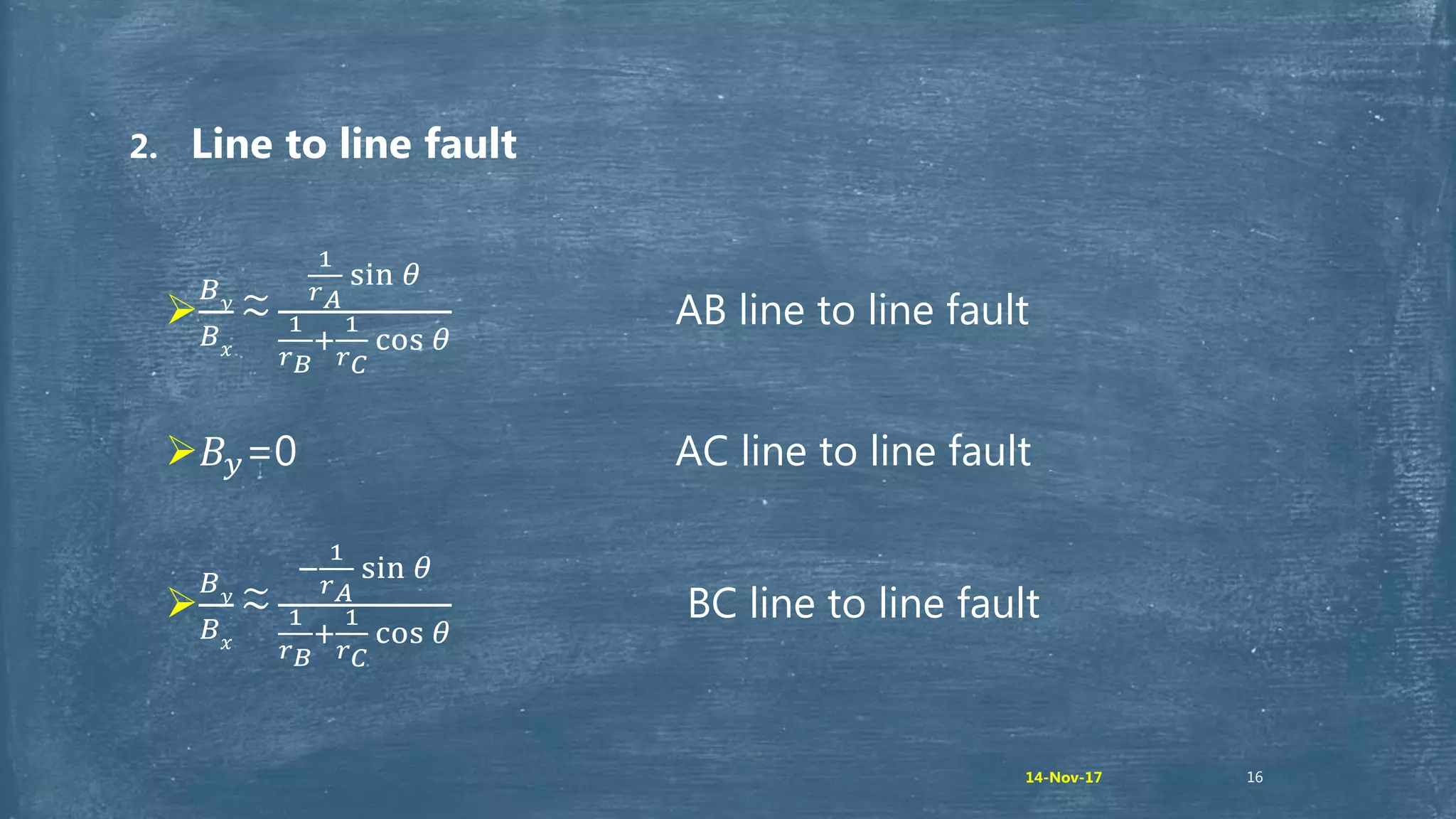
2. Line to line fault

𝐵 𝑦
𝐵 𝑥
~
1
𝑟 𝐴
sin 𝜃
1
𝑟 𝐵
+
1
𝑟 𝐶
cos 𝜃
AB line to line fault
𝐵𝑦=0 AC line to line fault

𝐵 𝑦
𝐵 𝑥
~
−
1
𝑟 𝐴
sin 𝜃
1
𝑟 𝐵
+
1
𝑟 𝐶
cos 𝜃
BC line to line fault
14-Nov-17
17
3. Double line to ground fault
AB line to ground fault - By is 1/√3 of that in three phase fault and
By/Bx> 0
AC line to ground fault - By is as large as in three phase fault
BC line to ground fault - By is 1/√3 of that in three phase fault and
By/Bx < 0
4. Three phase fault
When three phase faults occurs, there is no such simple relation
among the components. In the case of three phase fault all the magnetic
components and field strength are large.
14-Nov-17
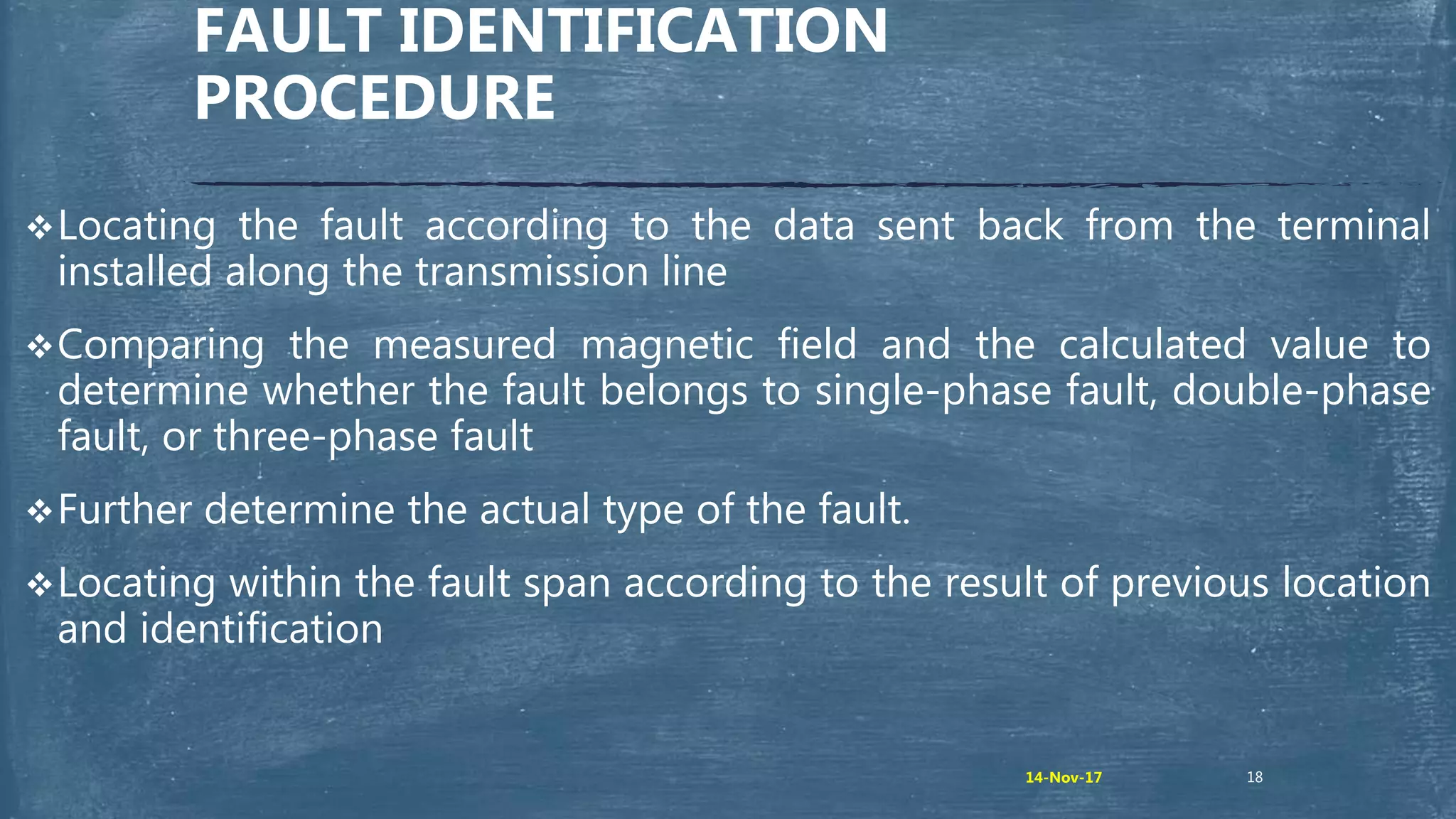
Locating the fault according to the data sent back from the terminal
installed along the transmission line
Comparing the measured magnetic field and the calculated value to
determine whether the fault belongs to single-phase fault, double-phase
fault, or three-phase fault
Further determine the actual type of the fault.
Locating within the fault span according to the result of previous location
and identification
FAULT IDENTIFICATION
PROCEDURE
1814-Nov-17
LOCATION WITHIN FAULT SPAN
19
 The sensor is installed under a faulted conductor on which a
current i(t) is flowing through at a distance of ‘a’.
14-Nov-17
20
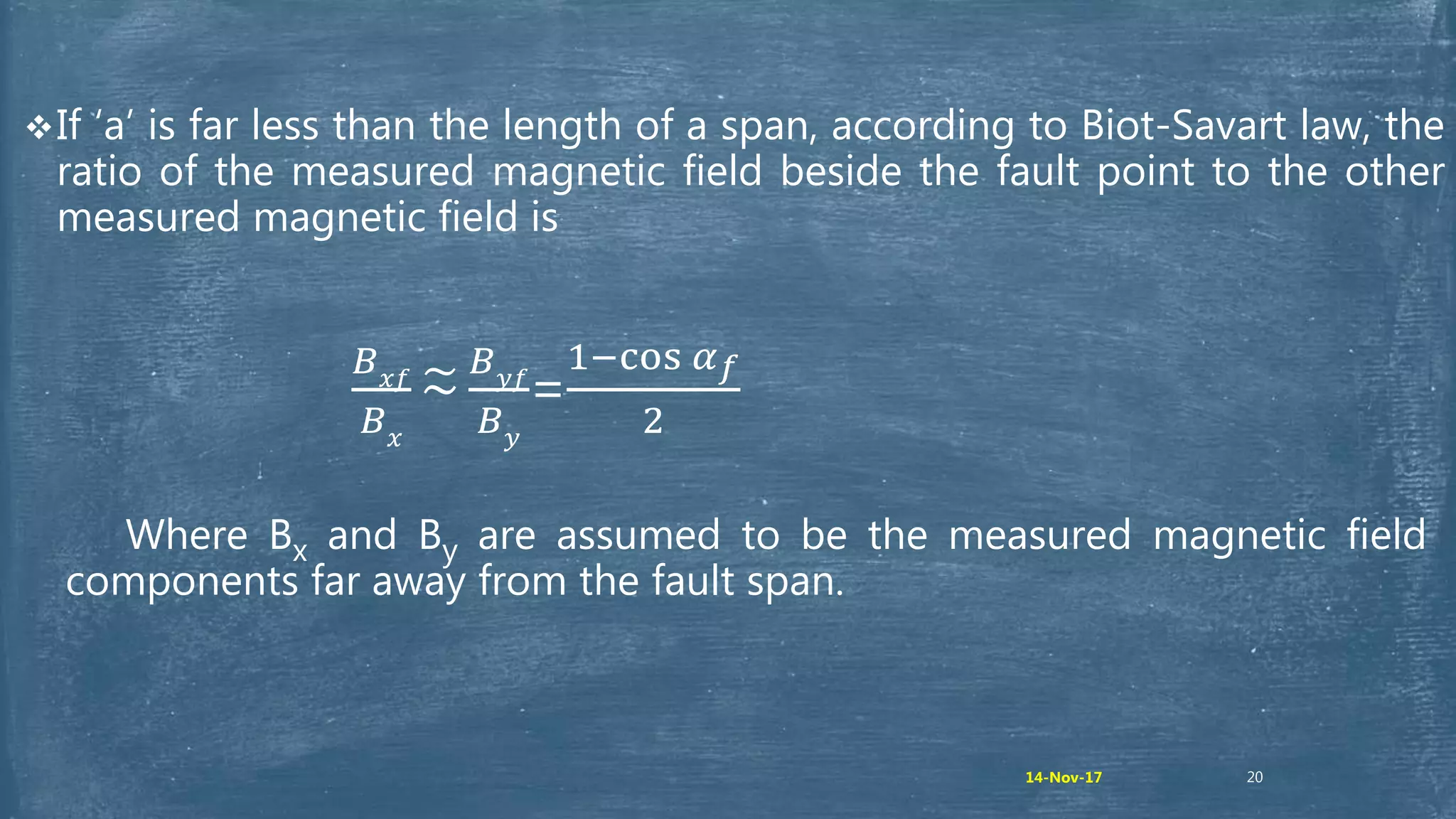
If ‘a’ is far less than the length of a span, according to Biot-Savart law, the
ratio of the measured magnetic field beside the fault point to the other
measured magnetic field is
𝐵 𝑥𝑓
𝐵 𝑥
~
𝐵 𝑦𝑓
𝐵 𝑦
=
1−cos 𝛼 𝑓
2
Where Bx and By are assumed to be the measured magnetic field
components far away from the fault span.
14-Nov-17
Low cost
Highly Sensitive
Large temperature range
Wide frequency bandwidth (from dc to several megahertz)
ADVANTAGES
2114-Nov-17
MEMS packaging technology and magnetoresistance material technology
are progressing rapidly.
 The solution is low-cost and more effective for finding the exact fault
location even for non-permanent faults .
After the fault span is located, the measured magnetic field can be used to
further identify the fault type and locate within the fault span .
Moreover, the configuration of the sensor array can be further modified
and improved in order to extend the application into the fault location for
double or multi-circuit transmission lines .
CONCLUSION
2214-Nov-17
Fast energy capture-IEEE industry applications magazine , George
roscoe , Tom papallo & Marcelo Valdes , july-aug 2011.
IEEE guide for testing medium-voltage metal-enclosed switchgear for
internal arcing faults, IEEE c37.20.7-2001.
Low-voltage switchgear and control gear, iec 60947-2004-03.
Optical engineering handbook. Ge. Mauro, j.a. 1963.
Wikipedia.
REFERENCES
2314-Nov-17
24
HAPPY TO ANSWER YOU
2525
THANK YOU

Fault Location of Overhead Transmission Line

  • 1.
    SEMINAR ON “ FAULTLOCATION OF OVERHEAD TRANSMISSION LINES ” Presented By <NAME> Regd. No. -xxxxx Department of Electrical Engineering Institute Logo
  • 2.
    CONTENTS INTRODUCTION CURRENT METHODS OFFAULT LOCATION CALCULATION DRAWBACKS OF CURRENT METHODS MAGNETORESISTANCE SENSOR FAULT LOCATION CALCULATION USING MAGNETORESISTANCE SENSOR CONCLUSION REFERENCES 1
  • 3.
    INTRODUCTION Fault location detectionand correction are important in case of any power systems. The traditional systems adopted for fault location are Travelling-wave- based approach and Impedance-measurement-based approach. The new method of locating of fault utilizes the new technology of Magneto Sensors which are used for finding the fault in transmission lines. 214-Nov-17
  • 4.
    CURRENT METHODS 1. Impedance-basedfault location  In the impedance-measurement-based technique, the voltage and current prefault and post fault are acquired and analysed 2. Travelling-wave-based fault location  Fault occurring on a power cable will generate both voltage and current travelling waves with wideband signals which cover the entire frequency range.  Time Domain Reflectomery (TDR) technology is used. 314-Nov-17
  • 5.
    DRAWBACKS OF CURRENTMETHODS The parameters of the lines are to be known. Have to consider that the line is homogenous in nature, while in fact it is not. The relative location error is very large many times. Error occur when fault reactance is there. Performance is highly dependent on signal processing techniques. 414-Nov-17
  • 6.
    Continuing… Have to connectinstruments to the live line, which increases the the cost of instruments needed. Hard to map the electrical distance to actual geographical location. Affected by CT saturation. Have to assume uniform wave speed. High cost. 514-Nov-17
  • 7.
    MAGNETORESISTANCE SENSOR  Magnetoresistanceis the tendency of a material to change the value of its electrical resistance in an externally applied magnetic field.  William Thomson (Lord Kelvin) first discovered ordinary magnetoresistance in 1856. 614-Nov-17
  • 8.
  • 9.
    Continuing… Types 1) Anisotropic Magnetoresistance(AMR) 2)Giant Magnetoresistance(GMR) 3) Tunnelling Magnetoresistance(TMR) In 2007, Albert Fert and Peter Grunberg were jointly awarded the Nobel Prize for the discovery of Giant Magnetoresistance (GMR). These sensors in general have high sensitivity, large temperature range, and wide frequency bandwidth (from dc to several megahertz). 814-Nov-17
  • 10.
    PROPOSED METHOD  Thismethod of locating of fault utilizes the new technology of magneto sensors which are used for finding the fault in transmission lines.  The sensors are placed on the tower, and the data are transmitted to a data processing centre where analysis software can determine which the fault location belongs to.  This method utilizes fast advancement of the microelectromechanical systems (MEMS) packaging technology and magnetoresistance material technology. 914-Nov-17
  • 11.
    Continuing…  Magnetoresistance isthe property of a material to change the value of its electrical resistance when an external magnetic field is applied to it.  The strength, direction, and distribution of the magnetic field emanated from the conductors contain information about the electric power parameters, such as amplitude, frequency, and phase of the electric current. 1014-Nov-17
  • 12.
    STRUCTURE OF PROPOSEDMETHOD 1114-Nov-17
  • 13.
    LOCATION OF FAULT 12 Distributionof the magnetic field along the transmission line under3-φ short-circuit condition (m =100 km). 14-Nov-17
  • 14.
    13 When the three-phaseshort circuit occurs, the measured magnetic field is increased. The ratio of the magnetic field during the fault to that during the normal situation is the same as the ratio of the short-circuit current to the current at normal condition, provided that the transient process is not considered. In the figure, the axis represents the evolution of time (during the lifecycle of a fault, that is, prefault, fault, and postfault), the axis represents the distribution along the transmission line (0 to the length of the line), and the axis represents the measured 16 magnetic field. 14-Nov-17
  • 15.
    14 System diagram ofthe test system in the numerical simulation (l: the total length of the transmission line and m: distance from the sending end to the fault location). 14-Nov-17
  • 16.
    1. Line toground fault  𝐵 𝑦 𝐵 𝑥 ~ sin 𝜃 cos 𝜃 = tan 𝜃 fault at phase A 𝐵𝑦=0 fault at phase B  𝐵 𝑦 𝐵 𝑥 ~ − sin 𝜃 cos 𝜃 = −tan 𝜃 fault at phase C IDENTIFICATION OF THE FAULT TYPE 1514-Nov-17
  • 17.
    16 2. Line toline fault  𝐵 𝑦 𝐵 𝑥 ~ 1 𝑟 𝐴 sin 𝜃 1 𝑟 𝐵 + 1 𝑟 𝐶 cos 𝜃 AB line to line fault 𝐵𝑦=0 AC line to line fault  𝐵 𝑦 𝐵 𝑥 ~ − 1 𝑟 𝐴 sin 𝜃 1 𝑟 𝐵 + 1 𝑟 𝐶 cos 𝜃 BC line to line fault 14-Nov-17
  • 18.
    17 3. Double lineto ground fault AB line to ground fault - By is 1/√3 of that in three phase fault and By/Bx> 0 AC line to ground fault - By is as large as in three phase fault BC line to ground fault - By is 1/√3 of that in three phase fault and By/Bx < 0 4. Three phase fault When three phase faults occurs, there is no such simple relation among the components. In the case of three phase fault all the magnetic components and field strength are large. 14-Nov-17
  • 19.
    Locating the faultaccording to the data sent back from the terminal installed along the transmission line Comparing the measured magnetic field and the calculated value to determine whether the fault belongs to single-phase fault, double-phase fault, or three-phase fault Further determine the actual type of the fault. Locating within the fault span according to the result of previous location and identification FAULT IDENTIFICATION PROCEDURE 1814-Nov-17
  • 20.
    LOCATION WITHIN FAULTSPAN 19  The sensor is installed under a faulted conductor on which a current i(t) is flowing through at a distance of ‘a’. 14-Nov-17
  • 21.
    20 If ‘a’ isfar less than the length of a span, according to Biot-Savart law, the ratio of the measured magnetic field beside the fault point to the other measured magnetic field is 𝐵 𝑥𝑓 𝐵 𝑥 ~ 𝐵 𝑦𝑓 𝐵 𝑦 = 1−cos 𝛼 𝑓 2 Where Bx and By are assumed to be the measured magnetic field components far away from the fault span. 14-Nov-17
  • 22.
    Low cost Highly Sensitive Largetemperature range Wide frequency bandwidth (from dc to several megahertz) ADVANTAGES 2114-Nov-17
  • 23.
    MEMS packaging technologyand magnetoresistance material technology are progressing rapidly.  The solution is low-cost and more effective for finding the exact fault location even for non-permanent faults . After the fault span is located, the measured magnetic field can be used to further identify the fault type and locate within the fault span . Moreover, the configuration of the sensor array can be further modified and improved in order to extend the application into the fault location for double or multi-circuit transmission lines . CONCLUSION 2214-Nov-17
  • 24.
    Fast energy capture-IEEEindustry applications magazine , George roscoe , Tom papallo & Marcelo Valdes , july-aug 2011. IEEE guide for testing medium-voltage metal-enclosed switchgear for internal arcing faults, IEEE c37.20.7-2001. Low-voltage switchgear and control gear, iec 60947-2004-03. Optical engineering handbook. Ge. Mauro, j.a. 1963. Wikipedia. REFERENCES 2314-Nov-17
  • 25.
  • 26.