ME8712 - TECHNICAL SEMINAR
 Powder metallurgy (PM) is a term covering a wide
range of ways in which materials or components are
made from metal powders.
 PM processes can avoid, or greatly reduce, the need to
use metal removal processes, thereby drastically
reducing yield losses in manufacture and often resulting
in lower costs.
 Powder metallurgy (PM) is a term covering a wide range of
ways in which materials or components are made from metal
powders.
 The entire material need not be melted to fuse it.
 Powder metallurgy is also used to make unique materials
impossible to get from melting or forming in other ways.
 A very important product of this type is tungsten carbide
(WC). WC is used to cut and form other metals and is made
from WC particles bonded with cobalt.
 It is very widely used in industry for tools of many types and
globally ~50,000 tonnes/year (t/y) is made by PM.
 Powder production.
 Blending or mixing.
 Powder compaction.
 Sintering.
 Finishing Operations.
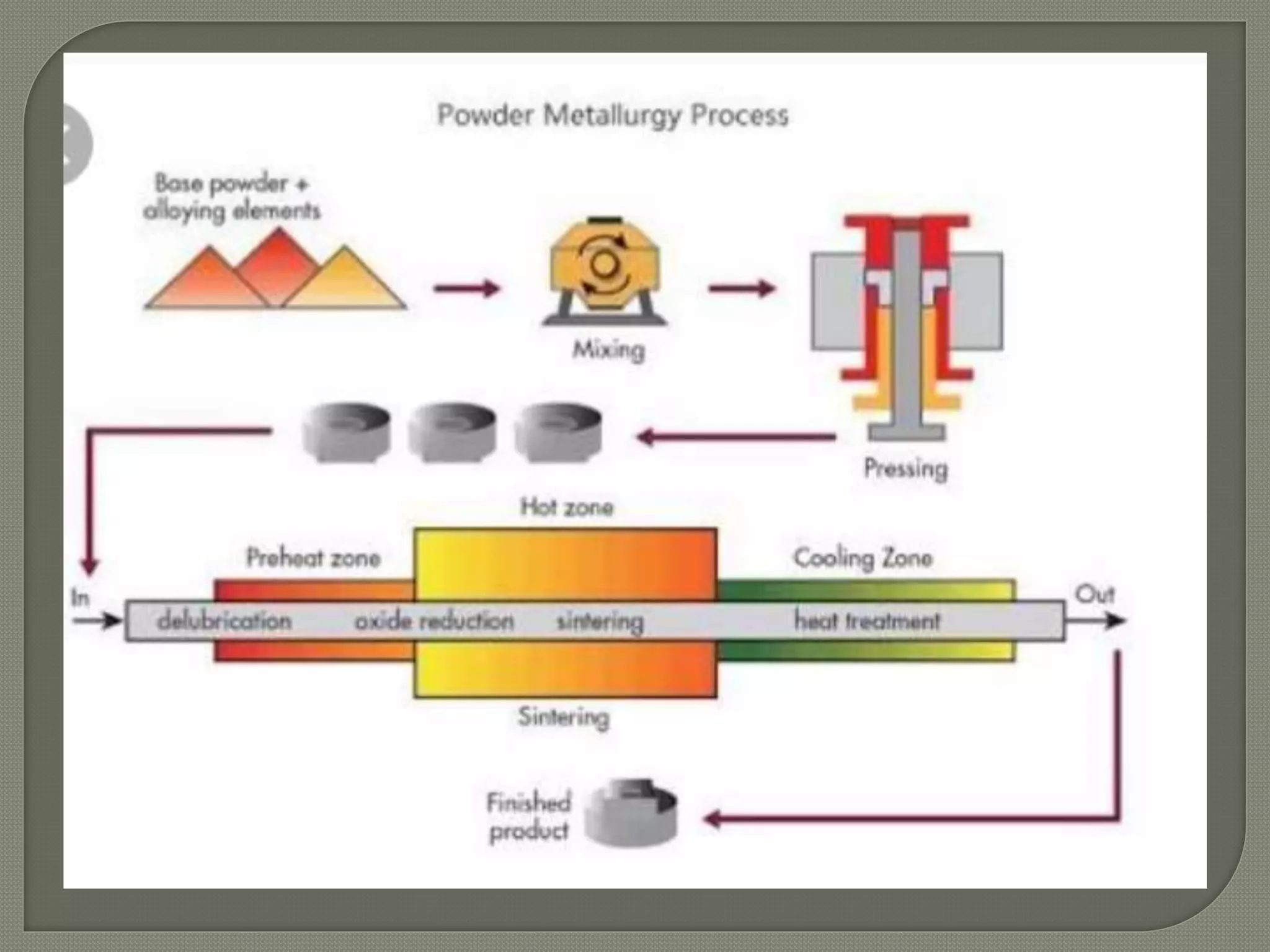
 Blending and mixing (Rotating drums, blade
and screw mixers.
 Pressing - powders are compressed into
desired shape to produce green compact
Accomplished in press using punch-and-die
tooling designed for the part.
 Sintering – green compacts are heated to
bond the particles into a hard, rigid mass.
Performed at temperatures below the melting
point of the metal
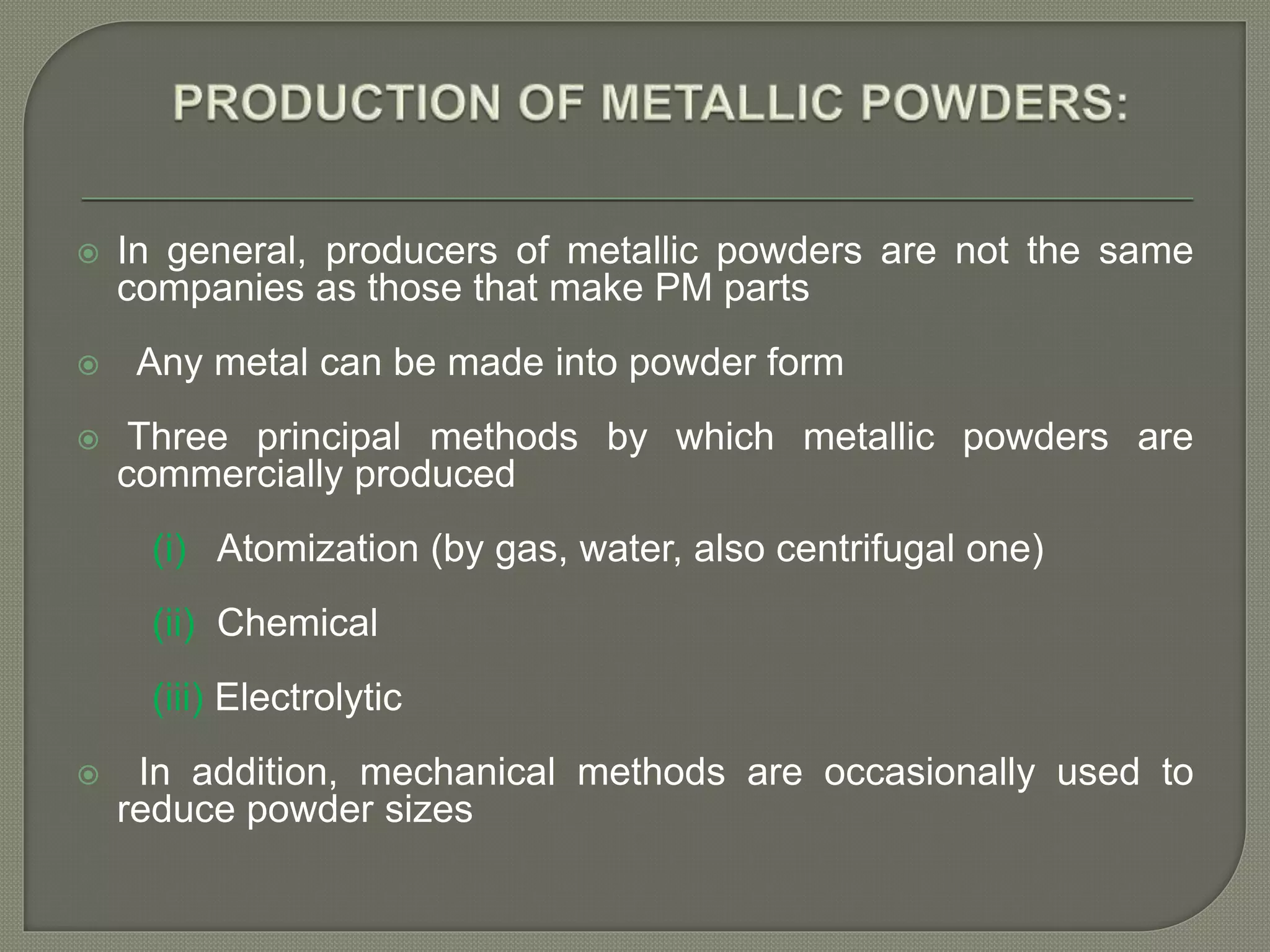
 In general, producers of metallic powders are not the same
companies as those that make PM parts
 Any metal can be made into powder form
 Three principal methods by which metallic powders are
commercially produced
(i) Atomization (by gas, water, also centrifugal one)
(ii) Chemical
(iii) Electrolytic
 In addition, mechanical methods are occasionally used to
reduce powder sizes
 Blending
 Compacting
 Sintering
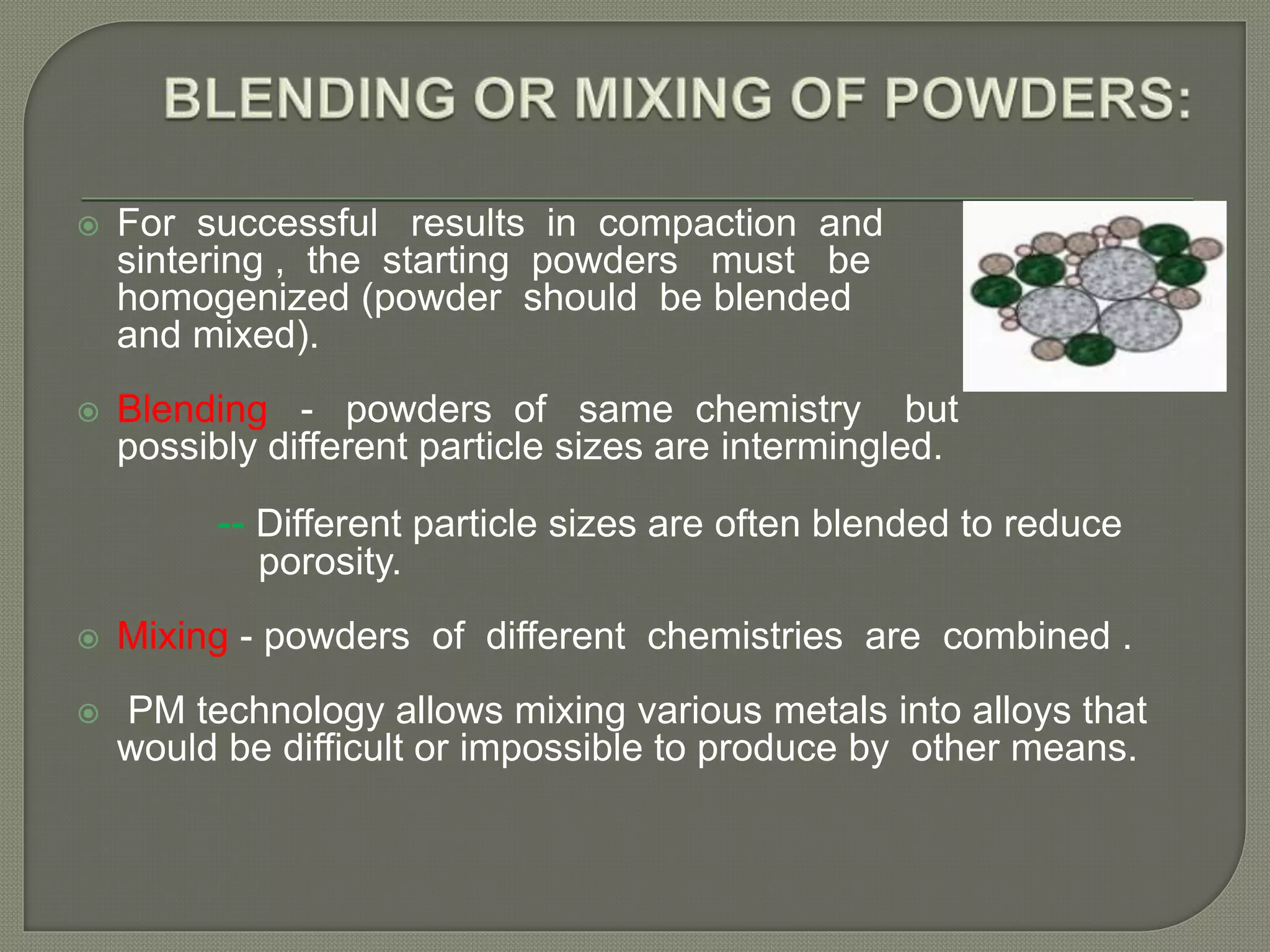
 For successful results in compaction and
sintering , the starting powders must be
homogenized (powder should be blended
and mixed).
 Blending - powders of same chemistry but
possibly different particle sizes are intermingled.
-- Different particle sizes are often blended to reduce
. porosity.
 Mixing - powders of different chemistries are combined .
 PM technology allows mixing various metals into alloys that
would be difficult or impossible to produce by other means.
 Press powder into the desired shape and size in dies using a
hydraulic or mechanical press.
 Pressed powder is known as “green compact”.
 Stages of metal powder compaction:
Compacting is usually performed at room temperature. Pressures
range from 10 tons per square inch (tons/in2) (138 MPa) to 60
tons/in2 (827 MPa), or more.
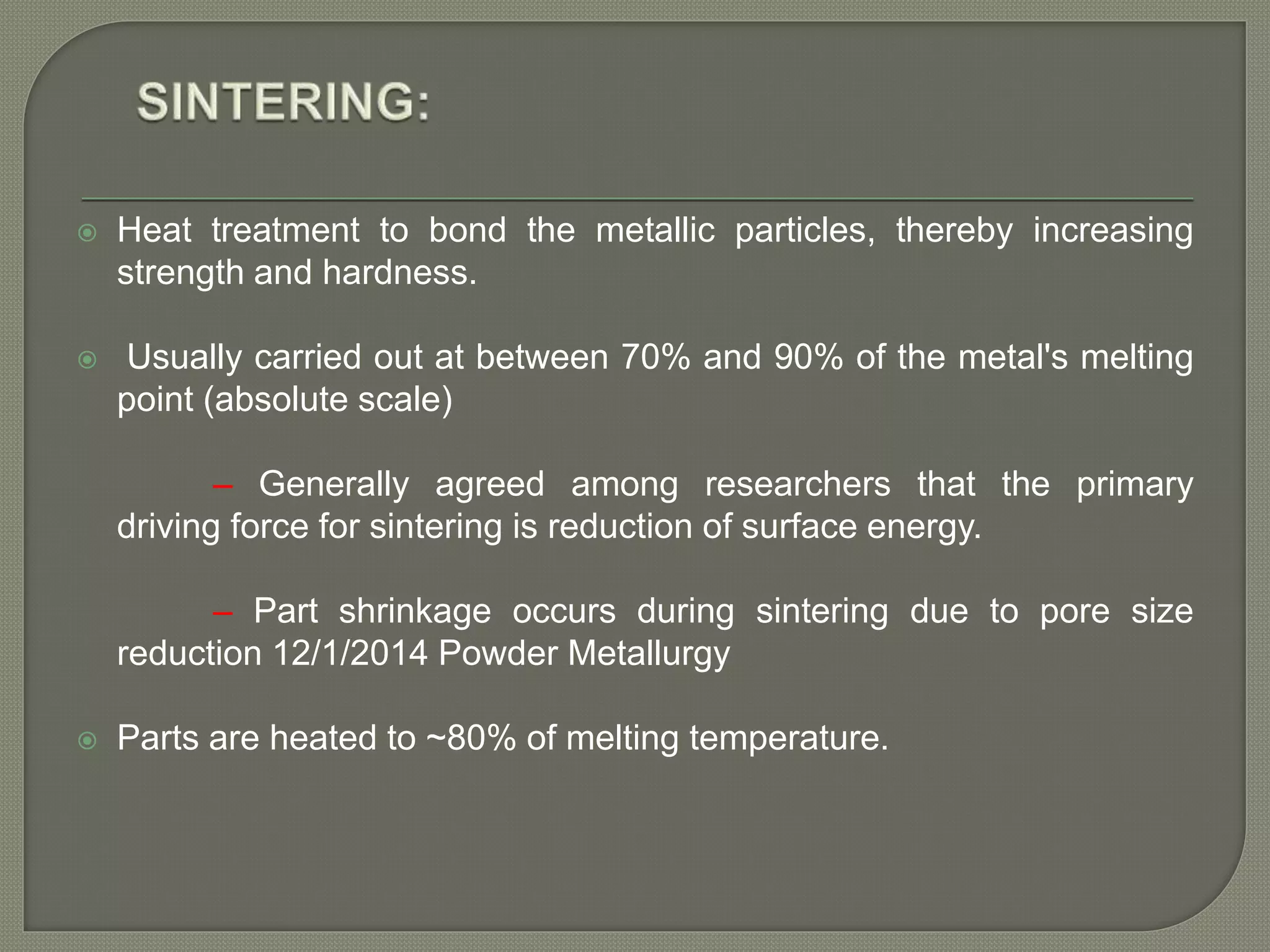
 Heat treatment to bond the metallic particles, thereby increasing
strength and hardness.
 Usually carried out at between 70% and 90% of the metal's melting
point (absolute scale)
– Generally agreed among researchers that the primary
driving force for sintering is reduction of surface energy.
– Part shrinkage occurs during sintering due to pore size
reduction 12/1/2014 Powder Metallurgy
 Parts are heated to ~80% of melting temperature.
 Transforms compacted mechanical bonds to much stronger metal
bonds.
 Many parts are done at this stage. Some will require additional
processing.
Third stage:
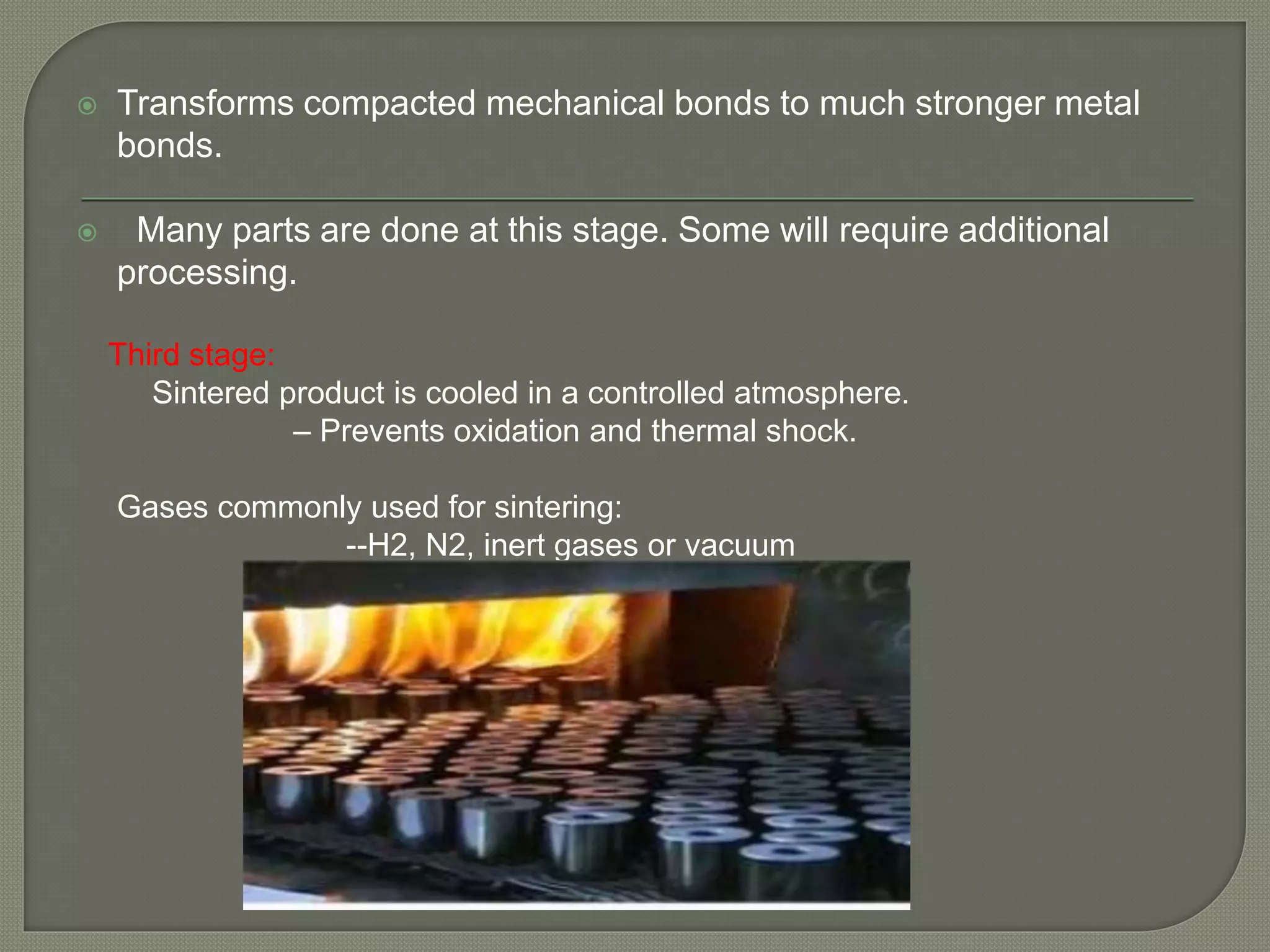
Sintered product is cooled in a controlled atmosphere.
– Prevents oxidation and thermal shock.
Gases commonly used for sintering:
--H2, N2, inert gases or vacuum
 Precision parts can be produced.
 The production can be fully automated, .
therefore,
 Mass production is possible.
 Production rate is high.
 Over-head costs are low.
 Break even point is not too large.
 Material loss is small.
 High tooling and equipment costs.
 Metallic powders are expensive.
 Problems in storing and handling metal powders.
APPLICATIONS:
 Used in the production of gears and other small machine
components.
Powder metallurgy

Powder metallurgy

  • 1.
  • 3.
     Powder metallurgy(PM) is a term covering a wide range of ways in which materials or components are made from metal powders.  PM processes can avoid, or greatly reduce, the need to use metal removal processes, thereby drastically reducing yield losses in manufacture and often resulting in lower costs.
  • 4.
     Powder metallurgy(PM) is a term covering a wide range of ways in which materials or components are made from metal powders.  The entire material need not be melted to fuse it.  Powder metallurgy is also used to make unique materials impossible to get from melting or forming in other ways.  A very important product of this type is tungsten carbide (WC). WC is used to cut and form other metals and is made from WC particles bonded with cobalt.  It is very widely used in industry for tools of many types and globally ~50,000 tonnes/year (t/y) is made by PM.
  • 5.
     Powder production. Blending or mixing.  Powder compaction.  Sintering.  Finishing Operations.
  • 7.
     Blending andmixing (Rotating drums, blade and screw mixers.  Pressing - powders are compressed into desired shape to produce green compact Accomplished in press using punch-and-die tooling designed for the part.  Sintering – green compacts are heated to bond the particles into a hard, rigid mass. Performed at temperatures below the melting point of the metal
  • 8.
     In general,producers of metallic powders are not the same companies as those that make PM parts  Any metal can be made into powder form  Three principal methods by which metallic powders are commercially produced (i) Atomization (by gas, water, also centrifugal one) (ii) Chemical (iii) Electrolytic  In addition, mechanical methods are occasionally used to reduce powder sizes
  • 9.
  • 10.
     For successfulresults in compaction and sintering , the starting powders must be homogenized (powder should be blended and mixed).  Blending - powders of same chemistry but possibly different particle sizes are intermingled. -- Different particle sizes are often blended to reduce . porosity.  Mixing - powders of different chemistries are combined .  PM technology allows mixing various metals into alloys that would be difficult or impossible to produce by other means.
  • 11.
     Press powderinto the desired shape and size in dies using a hydraulic or mechanical press.  Pressed powder is known as “green compact”.  Stages of metal powder compaction:
  • 12.
    Compacting is usuallyperformed at room temperature. Pressures range from 10 tons per square inch (tons/in2) (138 MPa) to 60 tons/in2 (827 MPa), or more.
  • 14.
     Heat treatmentto bond the metallic particles, thereby increasing strength and hardness.  Usually carried out at between 70% and 90% of the metal's melting point (absolute scale) – Generally agreed among researchers that the primary driving force for sintering is reduction of surface energy. – Part shrinkage occurs during sintering due to pore size reduction 12/1/2014 Powder Metallurgy  Parts are heated to ~80% of melting temperature.
  • 15.
     Transforms compactedmechanical bonds to much stronger metal bonds.  Many parts are done at this stage. Some will require additional processing. Third stage: Sintered product is cooled in a controlled atmosphere. – Prevents oxidation and thermal shock. Gases commonly used for sintering: --H2, N2, inert gases or vacuum
  • 18.
     Precision partscan be produced.  The production can be fully automated, . therefore,  Mass production is possible.  Production rate is high.  Over-head costs are low.  Break even point is not too large.  Material loss is small.
  • 19.
     High toolingand equipment costs.  Metallic powders are expensive.  Problems in storing and handling metal powders. APPLICATIONS:  Used in the production of gears and other small machine components.