Powder Metallurgy
Overview
• History
• Definitions
• Benefits
• Process
• Applications
Introduction
• Earliest use of iron powder dates back to 3000 BC.
Egyptians used it for making tools
• Modern era of P/M began when W lamp filaments were
developed by Edison
• Components can be made from pure metals, alloys, or
mixture of metallic and non-metallic powders
• Commonly used materials are iron, copper, aluminium,
nickel, titanium, brass, bronze, steels and refractory
metals
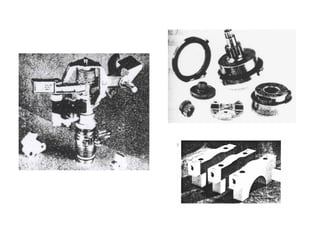
• Used widely for manufacturing gears, cams, bushings,
cutting tools, piston rings, connecting rods, impellers etc.
Powder Metallurgy
• . . . is a forming technique
Essentially, Powder Metallurgy (PM) is an art
& science of producing metal or metallic
powders, and using them to make finished or
semi-finished products. Particulate technology
is probably the oldest forming technique
known to man
• There are archeological evidences to prove that
the ancient man knew something about it
Powder Metallurgy
• Producing metal or metallic powders
• Using them to make finished or semi-finished
products.
• The Characterization of Engineering Powders
• Production of Metallic Powders
• Conventional Pressing and Sintering
• Alternative Pressing and Sintering Techniques
• Materials and Products for PM
• Design Considerations in Powder Metallurgy
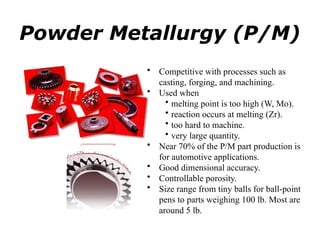
Powder Metallurgy (P/M)
• Competitive with processes such as
casting, forging, and machining.
• Used when
• melting point is too high (W, Mo).
• reaction occurs at melting (Zr).
• too hard to machine.
• very large quantity.
• Near 70% of the P/M part production is
for automotive applications.
• Good dimensional accuracy.
• Controllable porosity.
• Size range from tiny balls for ball-point
pens to parts weighing 100 lb. Most are
around 5 lb.
ME 355 Sp’06 W. Li 8
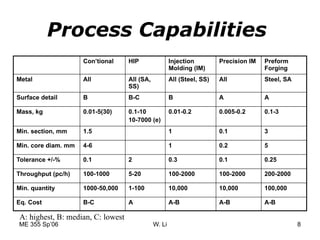
Process Capabilities
Con’tional HIP Injection
Molding (IM)
Precision IM Preform
Forging
Metal All All (SA,
SS)
All (Steel, SS) All Steel, SA
Surface detail B B-C B A A
Mass, kg 0.01-5(30) 0.1-10
10-7000 (e)
0.01-0.2 0.005-0.2 0.1-3
Min. section, mm 1.5 1 0.1 3
Min. core diam. mm 4-6 1 0.2 5
Tolerance +/-% 0.1 2 0.3 0.1 0.25
Throughput (pc/h) 100-1000 5-20 100-2000 100-2000 200-2000
Min. quantity 1000-50,000 1-100 10,000 10,000 100,000
Eq. Cost B-C A A-B A-B A-B
A: highest, B: median, C: lowest
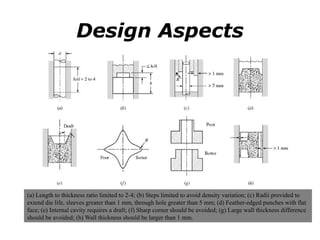
Design Aspects
(a) Length to thickness ratio limited to 2-4; (b) Steps limited to avoid density variation; (c) Radii provided to
extend die life, sleeves greater than 1 mm, through hole greater than 5 mm; (d) Feather-edged punches with flat
face; (e) Internal cavity requires a draft; (f) Sharp corner should be avoided; (g) Large wall thickness difference
should be avoided; (h) Wall thickness should be larger than 1 mm.
Advantages / Disadvantages P/M
• Virtually unlimited choice of alloys, composites, and associated
properties.
– Refractory materials are popular by this process.
• Controlled porosity for self lubrication or filtration uses.
• Can be very economical at large run sizes (100,000 parts).
• Long term reliability through close control of dimensions and
physical properties.
• Very good material utilization.
• Limited part size and complexity
• High cost of powder material.
• High cost of tooling.
• Less strong parts than wrought ones.
• Less well known process.
History of Powder
Metallurgy
• IRON Metallurgy >
• How did Man make iron in 3000 BC?
• Did he have furnaces to melt iron air blasts, and
• The reduced material, which would then be
spongy, [ DRI ], used to be hammered to a solid or
to a near solid mass.
• Example: The IRON PILLER at Delhi
• Quite unlikely, then how ???
History of P/M
• Going further back in Time . . .
• The art of pottery, (terracotta), was known to the pre-
historic man (Upper Paleolithic period, around
30,000 years ago)!
• Dough for making bread is also a powder material,
bound together by water and the inherent starch in it.
Baked bread, in all its variety, is perhaps one of the
first few types of processed food man ate.
• (Roti is a form of bread.)
12
Renaissance of P/M
• The modern renaissance of powder metallurgy
began in the early part of last century, when
technologists tried to replace the carbon filament
in the Edison lamp.
• The commercially successful method was the one
developed by William Coolidge. He described it in
1910, and got a patent for it in 1913.
• This method is still being used for manufacturing
filaments.
13
Renaissance of P/M
• The Wars and the post-war era brought about
huge leaps in science, technology and
engineering.
• New methods of melting and casting were
perfected, thereby slowly changing the
metallurgy of refractory materials.
• P/M techniques have thereafter been used only
when their special properties were needed.
P/M Applications
► Electrical Contact materials
► Heavy-duty Friction materials
► Self-Lubricating Porous bearings
► P/M filters
► Carbide, Alumina, Diamond cutting tools
► Structural parts
► P/M magnets
► Cermets
► and more, such as high tech applications
Hi-Tech Applications of P/M
Anti-friction products
Friction products
Filters
Electrical Contacts
Sliding Electrical Contacts
Very Hard Magnets
Very Soft Magnets
Refractory Material Products
Hard and Wear Resistant Tools
Ferrous & Non-ferrous Structural parts etc . . .
THESE COMPONENTS ARE USED
IN AIR & SPACE CRAFTS, HEAVY
MACHINERY, COMPUTERS,
AUTOMOBILES, etc…
Powder Metallurgy Merits
o The main constituent need not be melted
o The product is porous - [ note : the porosity can be controlled]
o Constituents that do not mix can be used to make composites, each constituent
retaining its individual property
o Near Nett Shape is possible, thereby reducing the post-production costs,
therefore:
 Precision parts can be produced
 The production can be fully automated, therefore,
 Mass production is possible
 Production rate is high
 Over-head costs are low
 Break even point is not too large
 Material loss is small
 Control can be exercised at every stage
Powder Metallurgy Disadvantages
o Porous !! Not always desired.
o Large components cannot be produced on
a large scale [Why?]
o Some shapes [such as?] are difficult to be
produced by the conventional p/m route.
• WHATEVER, THE MERITS ARE SO
MANY THAT P/M,
• AS A FORMING TECHNIQUE, IS GAINING
POPULARITY
Powder Metallurgy
• An important point that comes out :
• The entire material need not be melted to fuse it.
• The working temperature is well below the melting
point of the major constituent, making it a very
suitable method to work with refractory materials,
such as: W, Mo, Ta, Nb, oxides, carbides, etc.
• It began with Platinum technology about 4
centuries ago … in those days, Platinum, [mp =
1774°C], was "refractory", and could not be
melted.
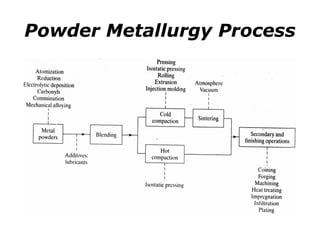
Powder Metallurgy Process
• Powder production
• Blending or mixing
• Powder compaction
• Sintering
• Finishing Operations
Powder Metallurgy Process
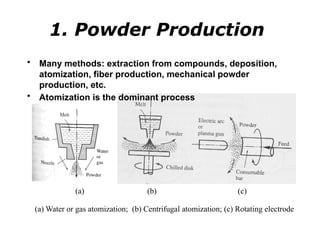
1. Powder Production
(a) (b) (c)
(a) Water or gas atomization; (b) Centrifugal atomization; (c) Rotating electrode
• Many methods: extraction from compounds, deposition,
atomization, fiber production, mechanical powder
production, etc.
• Atomization is the dominant process
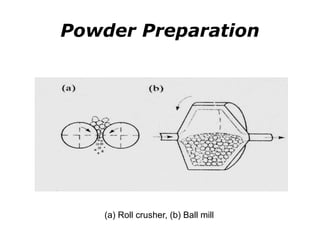
Powder Preparation
(a) Roll crusher, (b) Ball mill
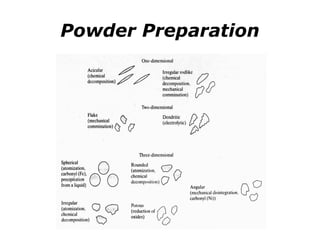
Powder Preparation
2. Blending or Mixing
• Blending a coarser fraction with a finer fraction
ensures that the interstices between large particles
will be filled out.
• Powders of different metals and other materials may
be mixed in order to impart special physical and
mechanical properties through metallic alloying.
• Lubricants may be mixed to improve the powders’
flow characteristics.
• Binders such as wax or thermoplastic polymers are
added to improve green strength.
• Sintering aids are added to accelerate densification
on heating.
Blending
• To make a homogeneous mass with uniform distribution
of particle size and composition
– Powders made by different processes have different
sizes and shapes
– Mixing powders of different metals/materials
– Add lubricants (<5%), such as graphite and stearic
acid, to improve the flow characteristics and
compressibility of mixtures
• Combining is generally carried out in
– Air or inert gases to avoid oxidation
– Liquids for better mixing, elimination of dusts and reduced
explosion hazards
• Hazards
– Metal powders, because of high surface area to volume ratio are
explosive, particularly Al, Mg, Ti, Zr, Th
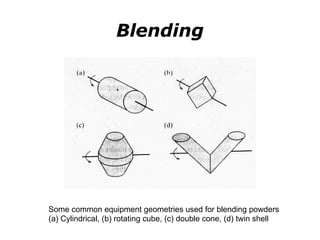
Some common equipment geometries used for blending powders
(a) Cylindrical, (b) rotating cube, (c) double cone, (d) twin shell
Blending
ME 355 Sp’06 W. Li 28
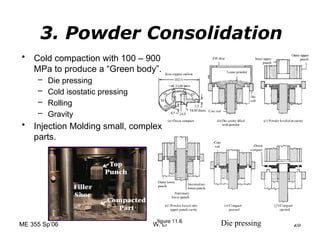
3. Powder Consolidation
Die pressing
• Cold compaction with 100 – 900
MPa to produce a “Green body”.
– Die pressing
– Cold isostatic pressing
– Rolling
– Gravity
• Injection Molding small, complex
parts.
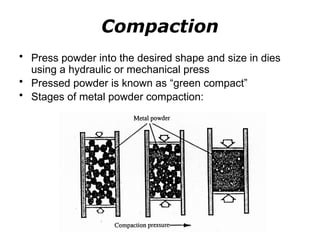
Compaction
• Press powder into the desired shape and size in dies
using a hydraulic or mechanical press
• Pressed powder is known as “green compact”
• Stages of metal powder compaction:
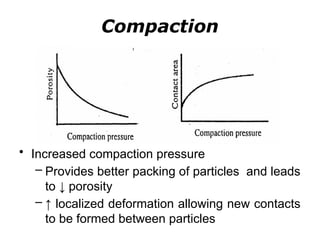
• Increased compaction pressure
– Provides better packing of particles and leads
to ↓ porosity
– ↑ localized deformation allowing new contacts
to be formed between particles
Compaction
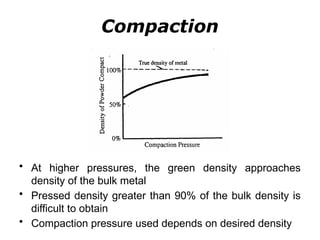
• At higher pressures, the green density approaches
density of the bulk metal
• Pressed density greater than 90% of the bulk density is
difficult to obtain
• Compaction pressure used depends on desired density
Compaction
W. Li
Friction problem in cold compaction
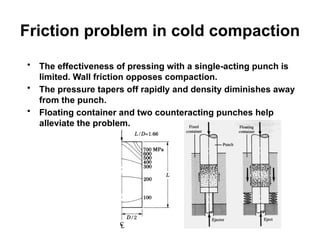
• The effectiveness of pressing with a single-acting punch is
limited. Wall friction opposes compaction.
• The pressure tapers off rapidly and density diminishes away
from the punch.
• Floating container and two counteracting punches help
alleviate the problem.
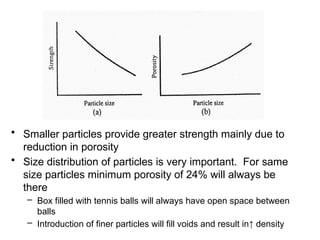
• Smaller particles provide greater strength mainly due to
reduction in porosity
• Size distribution of particles is very important. For same
size particles minimum porosity of 24% will always be
there
– Box filled with tennis balls will always have open space between
balls
– Introduction of finer particles will fill voids and result in↑ density
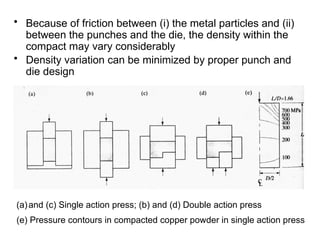
• Because of friction between (i) the metal particles and (ii)
between the punches and the die, the density within the
compact may vary considerably
• Density variation can be minimized by proper punch and
die design
(a)and (c) Single action press; (b) and (d) Double action press
(e) Pressure contours in compacted copper powder in single action press
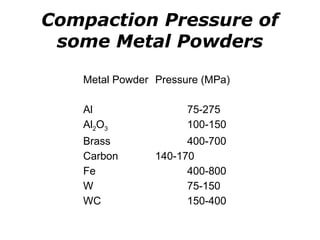
Compaction Pressure of
some Metal Powders
Metal Powder Pressure (MPa)
Al 75-275
Al2O3 100-150
Brass 400-700
Carbon 140-170
Fe 400-800
W 75-150
WC 150-400
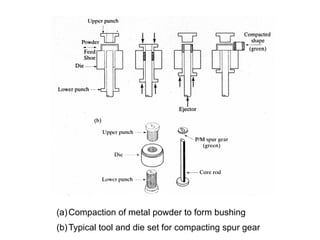
(a)Compaction of metal powder to form bushing
(b)Typical tool and die set for compacting spur gear
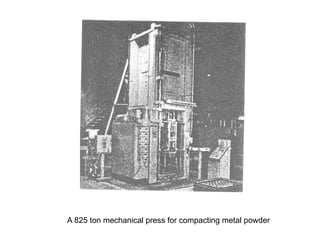
A 825 ton mechanical press for compacting metal powder
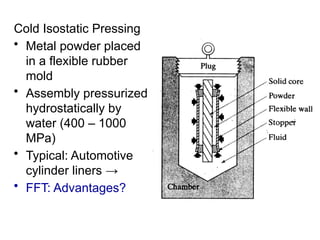
Cold Isostatic Pressing
• Metal powder placed
in a flexible rubber
mold
• Assembly pressurized
hydrostatically by
water (400 – 1000
MPa)
• Typical: Automotive
cylinder liners →
• FFT: Advantages?
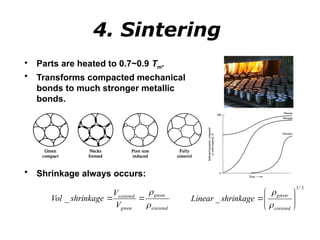
4. Sintering
• Parts are heated to 0.7~0.9 Tm.
• Transforms compacted mechanical
bonds to much stronger metallic
bonds.
• Shrinkage always occurs:
sintered
green
green
sintered
V
V
shrinkage
Vol




_
3
/
1
_ 








sintered
green
shrinkage
Linear


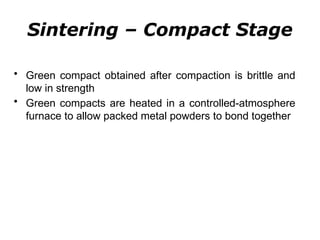
Sintering – Compact Stage
• Green compact obtained after compaction is brittle and
low in strength
• Green compacts are heated in a controlled-atmosphere
furnace to allow packed metal powders to bond together
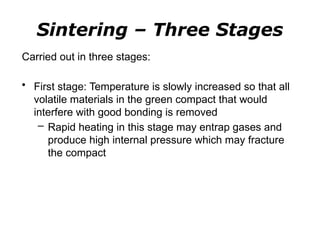
Carried out in three stages:
• First stage: Temperature is slowly increased so that all
volatile materials in the green compact that would
interfere with good bonding is removed
– Rapid heating in this stage may entrap gases and
produce high internal pressure which may fracture
the compact
Sintering – Three Stages
• Promotes solid-state
bonding by diffusion.
• Diffusion is time-
temperature sensitive.
Needs sufficient time
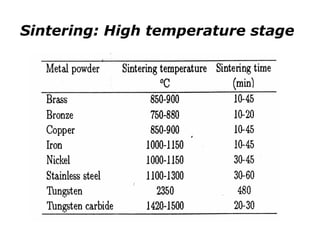
Sintering: High temperature stage
• Promotes vapor-phase
transport
• Because material heated
very close to MP, metal
atoms will be released in
the vapor phase from the
particles
• Vapor phase resolidifies
at the interface
Sintering: High temperature stage
• Third stage: Sintered product is cooled in a
controlled atmosphere
– Prevents oxidation and thermal shock
Gases commonly used for sintering:
• H2, N2, inert gases or vacuum
Sintering: High temperature stage
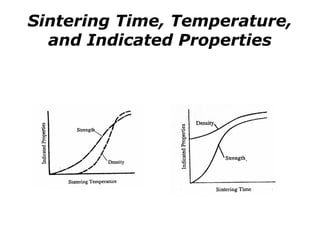
Sintering Time, Temperature,
and Indicated Properties
Liquid Phase Sintering
• During sintering a liquid phase, from the lower MP
component, may exist
• Alloying may take place at the particle-particle interface
• Molten component may surround the particle that has
not melted
• High compact density can be quickly attained
• Important variables:
– Nature of alloy, molten component/particle wetting,
capillary action of the liquid
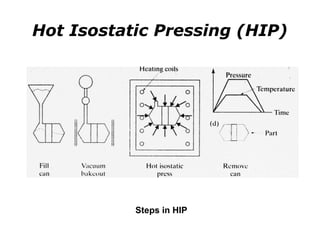
Hot Isostatic Pressing (HIP)
Steps in HIP
Combined Stages
• Simultaneous compaction + sintering
• Container: High MP sheet metal
• Container subjected to elevated
temperature and a very high vacuum to
remove air and moisture from the powder
• Pressurizing medium: Inert gas
• Operating conditions
– 100 MPa at 1100 C
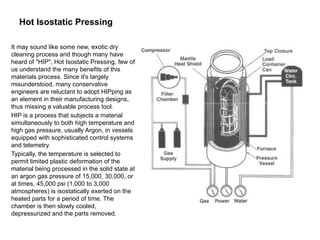
Hot Isostatic Pressing
It may sound like some new, exotic dry
cleaning process and though many have
heard of "HIP", Hot Isostatic Pressing, few of
us understand the many benefits of this
materials process. Since it's largely
misunderstood, many conservative
engineers are reluctant to adopt HIPping as
an element in their manufacturing designs,
thus missing a valuable process tool.
HIP is a process that subjects a material
simultaneously to both high temperature and
high gas pressure, usually Argon, in vessels
equipped with sophisticated control systems
and telemetry.
Typically, the temperature is selected to
permit limited plastic deformation of the
material being processed in the solid state at
an argon gas pressure of 15,000, 30,000, or
at times, 45,000 psi (1,000 to 3,000
atmospheres) is isostatically exerted on the
heated parts for a period of time. The
chamber is then slowly cooled,
depressurized and the parts removed.
• Produces compacts with almost 100%
density
• Good metallurgical bonding between
particles and good mechanical strength
• Uses
– Superalloy components for aerospace
industries
– Final densification step for WC cutting tools
and P/M tool steels
Combined Stages
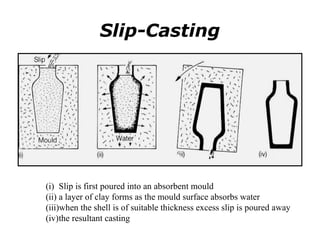
(i) Slip is first poured into an absorbent mould
(ii) a layer of clay forms as the mould surface absorbs water
(iii)when the shell is of suitable thickness excess slip is poured away
(iv)the resultant casting
Slip-Casting
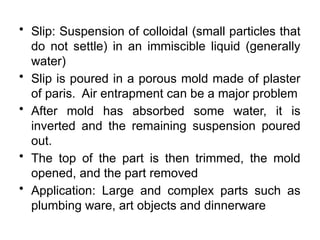
• Slip: Suspension of colloidal (small particles that
do not settle) in an immiscible liquid (generally
water)
• Slip is poured in a porous mold made of plaster
of paris. Air entrapment can be a major problem
• After mold has absorbed some water, it is
inverted and the remaining suspension poured
out.
• The top of the part is then trimmed, the mold
opened, and the part removed
• Application: Large and complex parts such as
plumbing ware, art objects and dinnerware
5. Finishing
• The porosity of a fully sintered part is still significant (4-15%).
• Density is often kept intentionally low to preserve
interconnected porosity for bearings, filters, acoustic barriers,
and battery electrodes.
• However, to improve properties, finishing processes are
needed:
– Cold restriking, resintering, and heat treatment.
– Impregnation of heated oil.
– Infiltration with metal (e.g., Cu for ferrous parts).
– Machining to tighter tolerance.
Special Process: Hot compaction
• Advantages can be gained by combining consolidation and
sintering,
• High pressure is applied at the sintering temperature to bring
the particles together and thus accelerate sintering.
• Methods include
– Hot pressing
– Spark sintering
– Hot isostatic pressing (HIP)
– Hot rolling and extrusion
– Hot forging of powder preform
– Spray deposition
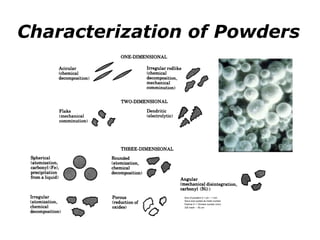
Characterization of Powders
Size of powders 0.1 um – 1 mm
Sieve size quoted as mesh number
Particle D = 15/mesh number (mm)
325 mesh 45 um
Atomization
• Produce a liquid-metal
stream by injecting
molten metal through a
small orifice
• Stream is broken by jets
of inert gas, air, or water
• The size of the particle
formed depends on the
temperature of the metal,
metal flowrate through
the orifice, nozzle size
and jet characteristics
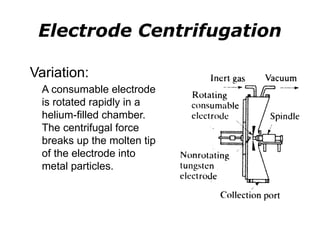
Electrode Centrifugation
Variation:
A consumable electrode
is rotated rapidly in a
helium-filled chamber.
The centrifugal force
breaks up the molten tip
of the electrode into
metal particles.
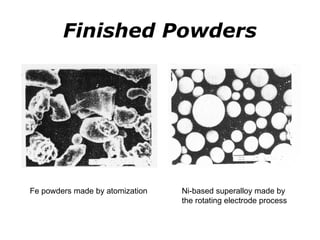
Finished Powders
Fe powders made by atomization Ni-based superalloy made by
the rotating electrode process
Reduction
• Reduce metal oxides with H2/CO
• Powders are spongy and porous and they have uniformly
sized spherical or angular shapes
Electrolytic deposition
• Metal powder deposits at the cathode from aqueous
solution
• Powders are among the purest available
Carbonyls
• React high purity Fe or Ni with CO to form gaseous
carbonyls
• Carbonyl decomposes to Fe and Ni
• Small, dense, uniformly spherical powders of high purity
P/M Process Approaches
Comminution
• Crushing
• Milling in a ball mill
• Powder produced
– Brittle: Angular
– Ductile: flaky and not particularly suitable for P/M
operations
Mechanical Alloying
• Powders of two or more metals are mixed in a ball mill
• Under the impact of hard balls, powders fracture and join
together by diffusion
P/M Summarizing:
• Powder Metallurgy is sought when -
a) It is impossible to form the metal or
material by any other technique
b) When p/m gives unique properties which
can be put to good use
c) When the p/m route is economical
• There may be over-lapping of these
three points.
Summary
• Powder metallurgy
• Metals and ceramics
• Particles and heat
• Compaction and fusion
• Interesting chemistry
References
• Wikipedia Powder Metallurgy (
http://en.wikipedia.org/wiki/Powder_metallurgy)
• Wikipedia Sintering (
http://en.wikipedia.org/wiki/Sintering)
• All about powder metallurgy http://www.mpif.org/
• Powder Metallurgy -
http://www.efunda.com/processes/metal_proces
sing/powder_metallurgy.cfm
• John Wiley and Sons – Fundamentals of Modern
Manufacturing Chapter 16 (book and handouts)
POWDER METALLURGY TEXT
Appendix 1
Powder Metallurgy (PM)
Metal processing technology in which parts
are produced from metallic powders
• In the usual PM production sequence, the
powders are compressed (pressed) into
the desired shape and then heated
(sintered) to bond the particles into a
hard, rigid mass
− Pressing is accomplished in a press-type
machine using punch-and-die tooling
designed specifically for the part to be
manufactured
− Sintering is performed at a temperature
below the melting point of the metal
Powder Metallurgy
John Wiley and Sons
Why Powder Metallurgy is Important
• PM parts can be mass produced to net
shape or near net shape, eliminating or
reducing the need for subsequent
machining
• PM process wastes very little material -
about 97% of the starting powders are
converted to product
• PM parts can be made with a specified
level of porosity, to produce porous metal
parts
− Examples: filters, oil-impregnated
bearings and gears
More Reasons Why PM is Important
• Certain metals that are difficult to
fabricate by other methods can be shaped
by powder metallurgy
− Example: Tungsten filaments for
incandescent lamp bulbs are made by PM
• Certain alloy combinations and cermets
made by PM cannot be produced in other
ways
• PM compares favorably to most casting
processes in dimensional control
• PM production methods can be
automated for economical production
Limitations and Disadvantages
with PM Processing
• High tooling and equipment costs
• Metallic powders are expensive
• Problems in storing and handling metal
powders
− Examples: degradation over time, fire
hazards with certain metals
• Limitations on part geometry because
metal powders do not readily flow laterally
in the die during pressing
• Variations in density throughout part may
be a problem, especially for complex
geometries
PM Work Materials
• Largest tonnage of metals are alloys of
iron, steel, and aluminum
• Other PM metals include copper, nickel,
and refractory metals such as molybdenum
and tungsten
• Metallic carbides such as tungsten
carbide are often included within the scope
of powder metallurgy
Engineering Powders
A powder can be defined as a finely divided
particulate solid
• Engineering powders include metals and
ceramics
• Geometric features of engineering
powders:
− Particle size and distribution
− Particle shape and internal structure
− Surface area
Measuring Particle Size
• Most common method uses screens of
different
mesh sizes
• Mesh count - refers to the number of
openings per
linear inch of screen
− A mesh count of 200 means there are
200
openings per linear inch
− Since the mesh is square, the count is
the same in
both directions, and the total number of
openings
per square inch is 2002 = 40,000
− Higher mesh count means smaller
particle size
Interparticle Friction and
Flow Characteristics
• Friction between particles affects ability of
a powder to flow readily and pack tightly
• A common test of interparticle friction is
the angle of repose, which is the angle
formed by a pile of powders as they are
poured from a narrow funnel
Observations
• Smaller particle sizes generally show
greater friction and steeper angles
• Spherical shapes have the lowest
interpartical friction
• As shape deviates from spherical, friction
between particles tends to increase
Particle Density Measures
• True density - density of the true volume
of the material
− The density of the material if the powders
were melted into a solid mass
• Bulk density - density of the powders in
the loose state after pouring
− Because of pores between particles, bulk
density is less than true density
Packing Factor = Bulk Density
divided by True Density
• Typical values for loose powders range
between 0.5 and 0.7
• If powders of various sizes are present,
smaller powders will fit into the interstices
of larger ones that would otherwise be
taken up by air, thus higher packing factor
• Packing can be increased by vibrating the
powders, causing them to settle more
tightly
• Pressure applied during compaction
greatly increases packing of powders
through rearrangement and deformation of
particles
Porosity
Ratio of the volume of the pores (empty
spaces) in the powder to the bulk volume
• In principle, Porosity + Packing factor =
1.0
• The issue is complicated by the possible
existence of closed pores in some of the
particles
• If internal pore volumes are included in
above porosity, then equation is exact
Chemistry and Surface Films
• Metallic powders are classified as either
− Elemental - consisting of a pure metal
− Pre-alloyed - each particle is an alloy
• Possible surface films include oxides,
silica, adsorbed organic materials, and
moisture
− As a general rule, these films must be
removed prior to shape processing
Production of Metallic Powders
• In general, producers of metallic powders
are not the same companies as those that
make PM parts
• Virtually any metal can be made into
powder form
• Three principal methods by which metallic
powders are commercially produced
1. Atomization
2. Chemical
3. Electrolytic
• In addition, mechanical methods are
occasionally used to reduce powder sizes
Conventional Press and Sinter
• After the metallic powders have been
produced, the conventional PM sequence
consists of three steps:
1. Blending and mixing of the powders
2. Compaction - pressing into desired part
shape
3. Sintering - heating to a temperature
below the
melting point to cause solid-state bonding
of particles and strengthening of part
• In addition, secondary operations are
sometimes performed to improve
dimensional accuracy, increase density,
and for other reasons
Blending and Mixing of Powders
• For successful results in compaction and
sintering,
the starting powders must be homogenized
• Blending - powders of the same
chemistry but
possibly different particle sizes are
intermingled
− Different particle sizes are often blended
to reduce
porosity
• Mixing - powders of different chemistries
are
combined
− PM technology allows mixing various
metals into
alloys that would be difficult or impossible
to
produce by other means
Compaction
Application of high pressure to the powders
to form them into the required shape
• The conventional compaction method is
pressing, in which opposing punches
squeeze the powders contained in a die
• The workpart after pressing is called a
green compact, the word green meaning
not yet fully processed
• The green strength of the part when
pressed is adequate for handling but far
less than after sintering
Sintering
Heat treatment to bond the metallic
particles, thereby increasing strength and
hardness
• Usually carried out at between 70% and
90% of the metal's melting point (absolute
scale)
• Generally agreed among researchers that
the primary driving force for sintering is
reduction of surface energy
• Part shrinkage occurs during sintering
due to pore size reduction
Densification and Sizing
Secondary operations are performed to
increase density, improve accuracy, or
accomplish additional shaping of the
sintered part
• Repressing - pressing the sintered part in
a closed die to increase density and
improve properties
• Sizing - pressing a sintered part to
improve dimensional accuracy
• Coining - pressworking operation on a
sintered part to press details into its
surface
• Machining - creates geometric features
that cannot be achieved by pressing, such
as threads, side holes, and other details
Impregnation and Infiltration
• Porosity is a unique and inherent
characteristic of PM technology
• It can be exploited to create special
products by filling the available pore space
with oils, polymers, or metals
• Two categories:
1. Impregnation
2. Infiltration
Impregnation
The term used when oil or other fluid is
permeated into the pores of a sintered PM
part
• Common products are oil-impregnated
bearings, gears, and similar components
• An alternative application is when parts
are impregnated with polymer resins that
seep into the pore spaces in liquid form
and then solidify to create a pressure tight
part
Infiltration
An operation in which the pores of the PM
part are filled
with a molten metal
• The melting point of the filler metal must
be below
that of the PM part
• Involves heating the filler metal in contact
with the
sintered component so capillary action
draws the filler
into the pores
• The resulting structure is relatively
nonporous, and
the infiltrated part has a more uniform
density, as well
as improved toughness and strength
Alternative Pressing and Sintering
Techniques
• The conventional press and sinter
sequence is the
most widely used shaping technology in
powder
metallurgy
• Additional methods for processing PM
parts include:
− Isostatic pressing
− Hot pressing - combined pressing and
sintering
©2002 John Wiley & Sons, Inc. M. P.
Groover, “Fundamentals of Modern
Manufacturing 2/e”
Materials and Products for PM
• Raw
Materials and Products for PM
• Raw materials for PM are more
expensive than for other metalworking
because of the additional energy
required to reduce the metal to powder
form
• Accordingly, PM is competitive only in a
certain range of applications
• What are the materials and products that
seem most suited to powder metallurgy?
PM Materials – Elemental Powders
A pure metal in particulate form
• Used in applications where high purity is
important
• Common elemental powders:
− Iron
− Aluminum
− Copper
• Elemental powders are also mixed with
other metal powders to produce special
alloys that are difficult to formulate by
conventional methods
− Example: tool steels
PM Materials – Pre-Alloyed Powders
Each particle is an alloy comprised of the
desired
chemical composition
• Used for alloys that cannot be formulated
by mixing
elemental powders
• Common pre-alloyed powders:
− Stainless steels
− Certain copper alloys
− High speed steel
PM Products
• Gears, bearings, sprockets, fasteners,
electrical contacts, cutting tools, and various
machinery parts
• Advantage of PM: parts can be made to
near net shape or net shape
− They require little or no additional shaping
after PM processing
• When produced in large quantities, gears
and bearings are ideal for PM because:
− The geometry is defined in two dimensions
− There is a need for porosity in the part to
serve as a reservoir for lubricant
PM Parts Classification System
• The Metal Powder Industries Federation
(MPIF) defines four classes of powder
metallurgy part designs, by level of
difficulty in conventional pressing
• Useful because it indicates some of the
limitations on shape that can be achieved
with conventional PM processing
Design Guidelines for PM Parts - I
• Economics usually require large
quantities to justify cost of equipment and
special tooling
− Minimum quantities of 10,000 units are
suggested
• PM is unique in its capability to fabricate
parts with a controlled level of porosity
− Porosities up to 50% are possible
• PM can be used to make parts out of
unusual metals and alloys - materials that
would be difficult if not impossible to
produce by other means
Design Guidelines for PM Parts - II
• The part geometry must permit ejection
from die after pressing
− This generally means that part must have
vertical or near-vertical sides, although
steps are allowed
− Design features such as undercuts and
holes on the part sides must be avoided
− Vertical undercuts and holes are
permissible because they do not interfere
with ejection
− Vertical holes can be of cross-sectional
shapes other than round without significant
difficulty
Design Guidelines for PM Parts - III
• Screw threads cannot be fabricated by
PM; if required, they must be machined
into the part
• Chamfers and corner radii are possible by
PM pressing, but problems arise in punch
rigidity when angles are too acute
• Wall thickness should be a minimum of
1.5 mm (0.060 in) between holes or a hole
and outside wall
• Minimum recommended hole diameter is
1.5 mm
(0.060 in)

Powder Metallurgy 1 mechanical engineering.pptx

  • 1.
  • 2.
    Overview • History • Definitions •Benefits • Process • Applications
  • 3.
    Introduction • Earliest useof iron powder dates back to 3000 BC. Egyptians used it for making tools • Modern era of P/M began when W lamp filaments were developed by Edison • Components can be made from pure metals, alloys, or mixture of metallic and non-metallic powders • Commonly used materials are iron, copper, aluminium, nickel, titanium, brass, bronze, steels and refractory metals • Used widely for manufacturing gears, cams, bushings, cutting tools, piston rings, connecting rods, impellers etc.
  • 5.
    Powder Metallurgy • .. . is a forming technique Essentially, Powder Metallurgy (PM) is an art & science of producing metal or metallic powders, and using them to make finished or semi-finished products. Particulate technology is probably the oldest forming technique known to man • There are archeological evidences to prove that the ancient man knew something about it
  • 6.
    Powder Metallurgy • Producingmetal or metallic powders • Using them to make finished or semi-finished products. • The Characterization of Engineering Powders • Production of Metallic Powders • Conventional Pressing and Sintering • Alternative Pressing and Sintering Techniques • Materials and Products for PM • Design Considerations in Powder Metallurgy
  • 7.
    Powder Metallurgy (P/M) •Competitive with processes such as casting, forging, and machining. • Used when • melting point is too high (W, Mo). • reaction occurs at melting (Zr). • too hard to machine. • very large quantity. • Near 70% of the P/M part production is for automotive applications. • Good dimensional accuracy. • Controllable porosity. • Size range from tiny balls for ball-point pens to parts weighing 100 lb. Most are around 5 lb.
  • 8.
    ME 355 Sp’06W. Li 8 Process Capabilities Con’tional HIP Injection Molding (IM) Precision IM Preform Forging Metal All All (SA, SS) All (Steel, SS) All Steel, SA Surface detail B B-C B A A Mass, kg 0.01-5(30) 0.1-10 10-7000 (e) 0.01-0.2 0.005-0.2 0.1-3 Min. section, mm 1.5 1 0.1 3 Min. core diam. mm 4-6 1 0.2 5 Tolerance +/-% 0.1 2 0.3 0.1 0.25 Throughput (pc/h) 100-1000 5-20 100-2000 100-2000 200-2000 Min. quantity 1000-50,000 1-100 10,000 10,000 100,000 Eq. Cost B-C A A-B A-B A-B A: highest, B: median, C: lowest
  • 9.
    Design Aspects (a) Lengthto thickness ratio limited to 2-4; (b) Steps limited to avoid density variation; (c) Radii provided to extend die life, sleeves greater than 1 mm, through hole greater than 5 mm; (d) Feather-edged punches with flat face; (e) Internal cavity requires a draft; (f) Sharp corner should be avoided; (g) Large wall thickness difference should be avoided; (h) Wall thickness should be larger than 1 mm.
  • 10.
    Advantages / DisadvantagesP/M • Virtually unlimited choice of alloys, composites, and associated properties. – Refractory materials are popular by this process. • Controlled porosity for self lubrication or filtration uses. • Can be very economical at large run sizes (100,000 parts). • Long term reliability through close control of dimensions and physical properties. • Very good material utilization. • Limited part size and complexity • High cost of powder material. • High cost of tooling. • Less strong parts than wrought ones. • Less well known process.
  • 11.
    History of Powder Metallurgy •IRON Metallurgy > • How did Man make iron in 3000 BC? • Did he have furnaces to melt iron air blasts, and • The reduced material, which would then be spongy, [ DRI ], used to be hammered to a solid or to a near solid mass. • Example: The IRON PILLER at Delhi • Quite unlikely, then how ???
  • 12.
    History of P/M •Going further back in Time . . . • The art of pottery, (terracotta), was known to the pre- historic man (Upper Paleolithic period, around 30,000 years ago)! • Dough for making bread is also a powder material, bound together by water and the inherent starch in it. Baked bread, in all its variety, is perhaps one of the first few types of processed food man ate. • (Roti is a form of bread.) 12
  • 13.
    Renaissance of P/M •The modern renaissance of powder metallurgy began in the early part of last century, when technologists tried to replace the carbon filament in the Edison lamp. • The commercially successful method was the one developed by William Coolidge. He described it in 1910, and got a patent for it in 1913. • This method is still being used for manufacturing filaments. 13
  • 14.
    Renaissance of P/M •The Wars and the post-war era brought about huge leaps in science, technology and engineering. • New methods of melting and casting were perfected, thereby slowly changing the metallurgy of refractory materials. • P/M techniques have thereafter been used only when their special properties were needed.
  • 15.
    P/M Applications ► ElectricalContact materials ► Heavy-duty Friction materials ► Self-Lubricating Porous bearings ► P/M filters ► Carbide, Alumina, Diamond cutting tools ► Structural parts ► P/M magnets ► Cermets ► and more, such as high tech applications
  • 16.
    Hi-Tech Applications ofP/M Anti-friction products Friction products Filters Electrical Contacts Sliding Electrical Contacts Very Hard Magnets Very Soft Magnets Refractory Material Products Hard and Wear Resistant Tools Ferrous & Non-ferrous Structural parts etc . . . THESE COMPONENTS ARE USED IN AIR & SPACE CRAFTS, HEAVY MACHINERY, COMPUTERS, AUTOMOBILES, etc…
  • 17.
    Powder Metallurgy Merits oThe main constituent need not be melted o The product is porous - [ note : the porosity can be controlled] o Constituents that do not mix can be used to make composites, each constituent retaining its individual property o Near Nett Shape is possible, thereby reducing the post-production costs, therefore:  Precision parts can be produced  The production can be fully automated, therefore,  Mass production is possible  Production rate is high  Over-head costs are low  Break even point is not too large  Material loss is small  Control can be exercised at every stage
  • 18.
    Powder Metallurgy Disadvantages oPorous !! Not always desired. o Large components cannot be produced on a large scale [Why?] o Some shapes [such as?] are difficult to be produced by the conventional p/m route. • WHATEVER, THE MERITS ARE SO MANY THAT P/M, • AS A FORMING TECHNIQUE, IS GAINING POPULARITY
  • 19.
    Powder Metallurgy • Animportant point that comes out : • The entire material need not be melted to fuse it. • The working temperature is well below the melting point of the major constituent, making it a very suitable method to work with refractory materials, such as: W, Mo, Ta, Nb, oxides, carbides, etc. • It began with Platinum technology about 4 centuries ago … in those days, Platinum, [mp = 1774°C], was "refractory", and could not be melted.
  • 20.
    Powder Metallurgy Process •Powder production • Blending or mixing • Powder compaction • Sintering • Finishing Operations
  • 21.
  • 22.
    1. Powder Production (a)(b) (c) (a) Water or gas atomization; (b) Centrifugal atomization; (c) Rotating electrode • Many methods: extraction from compounds, deposition, atomization, fiber production, mechanical powder production, etc. • Atomization is the dominant process
  • 23.
    Powder Preparation (a) Rollcrusher, (b) Ball mill
  • 24.
  • 25.
    2. Blending orMixing • Blending a coarser fraction with a finer fraction ensures that the interstices between large particles will be filled out. • Powders of different metals and other materials may be mixed in order to impart special physical and mechanical properties through metallic alloying. • Lubricants may be mixed to improve the powders’ flow characteristics. • Binders such as wax or thermoplastic polymers are added to improve green strength. • Sintering aids are added to accelerate densification on heating.
  • 26.
    Blending • To makea homogeneous mass with uniform distribution of particle size and composition – Powders made by different processes have different sizes and shapes – Mixing powders of different metals/materials – Add lubricants (<5%), such as graphite and stearic acid, to improve the flow characteristics and compressibility of mixtures • Combining is generally carried out in – Air or inert gases to avoid oxidation – Liquids for better mixing, elimination of dusts and reduced explosion hazards • Hazards – Metal powders, because of high surface area to volume ratio are explosive, particularly Al, Mg, Ti, Zr, Th
  • 27.
    Some common equipmentgeometries used for blending powders (a) Cylindrical, (b) rotating cube, (c) double cone, (d) twin shell Blending
  • 28.
    ME 355 Sp’06W. Li 28 3. Powder Consolidation Die pressing • Cold compaction with 100 – 900 MPa to produce a “Green body”. – Die pressing – Cold isostatic pressing – Rolling – Gravity • Injection Molding small, complex parts.
  • 29.
    Compaction • Press powderinto the desired shape and size in dies using a hydraulic or mechanical press • Pressed powder is known as “green compact” • Stages of metal powder compaction:
  • 30.
    • Increased compactionpressure – Provides better packing of particles and leads to ↓ porosity – ↑ localized deformation allowing new contacts to be formed between particles Compaction
  • 31.
    • At higherpressures, the green density approaches density of the bulk metal • Pressed density greater than 90% of the bulk density is difficult to obtain • Compaction pressure used depends on desired density Compaction
  • 32.
    W. Li Friction problemin cold compaction • The effectiveness of pressing with a single-acting punch is limited. Wall friction opposes compaction. • The pressure tapers off rapidly and density diminishes away from the punch. • Floating container and two counteracting punches help alleviate the problem.
  • 33.
    • Smaller particlesprovide greater strength mainly due to reduction in porosity • Size distribution of particles is very important. For same size particles minimum porosity of 24% will always be there – Box filled with tennis balls will always have open space between balls – Introduction of finer particles will fill voids and result in↑ density
  • 34.
    • Because offriction between (i) the metal particles and (ii) between the punches and the die, the density within the compact may vary considerably • Density variation can be minimized by proper punch and die design (a)and (c) Single action press; (b) and (d) Double action press (e) Pressure contours in compacted copper powder in single action press
  • 35.
    Compaction Pressure of someMetal Powders Metal Powder Pressure (MPa) Al 75-275 Al2O3 100-150 Brass 400-700 Carbon 140-170 Fe 400-800 W 75-150 WC 150-400
  • 36.
    (a)Compaction of metalpowder to form bushing (b)Typical tool and die set for compacting spur gear
  • 37.
    A 825 tonmechanical press for compacting metal powder
  • 38.
    Cold Isostatic Pressing •Metal powder placed in a flexible rubber mold • Assembly pressurized hydrostatically by water (400 – 1000 MPa) • Typical: Automotive cylinder liners → • FFT: Advantages?
  • 39.
    4. Sintering • Partsare heated to 0.7~0.9 Tm. • Transforms compacted mechanical bonds to much stronger metallic bonds. • Shrinkage always occurs: sintered green green sintered V V shrinkage Vol     _ 3 / 1 _          sintered green shrinkage Linear  
  • 40.
    Sintering – CompactStage • Green compact obtained after compaction is brittle and low in strength • Green compacts are heated in a controlled-atmosphere furnace to allow packed metal powders to bond together
  • 41.
    Carried out inthree stages: • First stage: Temperature is slowly increased so that all volatile materials in the green compact that would interfere with good bonding is removed – Rapid heating in this stage may entrap gases and produce high internal pressure which may fracture the compact Sintering – Three Stages
  • 42.
    • Promotes solid-state bondingby diffusion. • Diffusion is time- temperature sensitive. Needs sufficient time Sintering: High temperature stage
  • 43.
    • Promotes vapor-phase transport •Because material heated very close to MP, metal atoms will be released in the vapor phase from the particles • Vapor phase resolidifies at the interface Sintering: High temperature stage
  • 44.
  • 45.
    • Third stage:Sintered product is cooled in a controlled atmosphere – Prevents oxidation and thermal shock Gases commonly used for sintering: • H2, N2, inert gases or vacuum Sintering: High temperature stage
  • 46.
  • 47.
    Liquid Phase Sintering •During sintering a liquid phase, from the lower MP component, may exist • Alloying may take place at the particle-particle interface • Molten component may surround the particle that has not melted • High compact density can be quickly attained • Important variables: – Nature of alloy, molten component/particle wetting, capillary action of the liquid
  • 48.
    Hot Isostatic Pressing(HIP) Steps in HIP
  • 49.
    Combined Stages • Simultaneouscompaction + sintering • Container: High MP sheet metal • Container subjected to elevated temperature and a very high vacuum to remove air and moisture from the powder • Pressurizing medium: Inert gas • Operating conditions – 100 MPa at 1100 C
  • 50.
    Hot Isostatic Pressing Itmay sound like some new, exotic dry cleaning process and though many have heard of "HIP", Hot Isostatic Pressing, few of us understand the many benefits of this materials process. Since it's largely misunderstood, many conservative engineers are reluctant to adopt HIPping as an element in their manufacturing designs, thus missing a valuable process tool. HIP is a process that subjects a material simultaneously to both high temperature and high gas pressure, usually Argon, in vessels equipped with sophisticated control systems and telemetry. Typically, the temperature is selected to permit limited plastic deformation of the material being processed in the solid state at an argon gas pressure of 15,000, 30,000, or at times, 45,000 psi (1,000 to 3,000 atmospheres) is isostatically exerted on the heated parts for a period of time. The chamber is then slowly cooled, depressurized and the parts removed.
  • 51.
    • Produces compactswith almost 100% density • Good metallurgical bonding between particles and good mechanical strength • Uses – Superalloy components for aerospace industries – Final densification step for WC cutting tools and P/M tool steels Combined Stages
  • 52.
    (i) Slip isfirst poured into an absorbent mould (ii) a layer of clay forms as the mould surface absorbs water (iii)when the shell is of suitable thickness excess slip is poured away (iv)the resultant casting Slip-Casting
  • 53.
    • Slip: Suspensionof colloidal (small particles that do not settle) in an immiscible liquid (generally water) • Slip is poured in a porous mold made of plaster of paris. Air entrapment can be a major problem • After mold has absorbed some water, it is inverted and the remaining suspension poured out. • The top of the part is then trimmed, the mold opened, and the part removed • Application: Large and complex parts such as plumbing ware, art objects and dinnerware
  • 54.
    5. Finishing • Theporosity of a fully sintered part is still significant (4-15%). • Density is often kept intentionally low to preserve interconnected porosity for bearings, filters, acoustic barriers, and battery electrodes. • However, to improve properties, finishing processes are needed: – Cold restriking, resintering, and heat treatment. – Impregnation of heated oil. – Infiltration with metal (e.g., Cu for ferrous parts). – Machining to tighter tolerance.
  • 55.
    Special Process: Hotcompaction • Advantages can be gained by combining consolidation and sintering, • High pressure is applied at the sintering temperature to bring the particles together and thus accelerate sintering. • Methods include – Hot pressing – Spark sintering – Hot isostatic pressing (HIP) – Hot rolling and extrusion – Hot forging of powder preform – Spray deposition
  • 56.
    Characterization of Powders Sizeof powders 0.1 um – 1 mm Sieve size quoted as mesh number Particle D = 15/mesh number (mm) 325 mesh 45 um
  • 57.
    Atomization • Produce aliquid-metal stream by injecting molten metal through a small orifice • Stream is broken by jets of inert gas, air, or water • The size of the particle formed depends on the temperature of the metal, metal flowrate through the orifice, nozzle size and jet characteristics
  • 58.
    Electrode Centrifugation Variation: A consumableelectrode is rotated rapidly in a helium-filled chamber. The centrifugal force breaks up the molten tip of the electrode into metal particles.
  • 59.
    Finished Powders Fe powdersmade by atomization Ni-based superalloy made by the rotating electrode process
  • 60.
    Reduction • Reduce metaloxides with H2/CO • Powders are spongy and porous and they have uniformly sized spherical or angular shapes Electrolytic deposition • Metal powder deposits at the cathode from aqueous solution • Powders are among the purest available Carbonyls • React high purity Fe or Ni with CO to form gaseous carbonyls • Carbonyl decomposes to Fe and Ni • Small, dense, uniformly spherical powders of high purity P/M Process Approaches
  • 61.
    P/M Process Approaches Comminution •Crushing • Milling in a ball mill • Powder produced – Brittle: Angular – Ductile: flaky and not particularly suitable for P/M operations Mechanical Alloying • Powders of two or more metals are mixed in a ball mill • Under the impact of hard balls, powders fracture and join together by diffusion
  • 62.
    P/M Summarizing: • PowderMetallurgy is sought when - a) It is impossible to form the metal or material by any other technique b) When p/m gives unique properties which can be put to good use c) When the p/m route is economical • There may be over-lapping of these three points.
  • 63.
    Summary • Powder metallurgy •Metals and ceramics • Particles and heat • Compaction and fusion • Interesting chemistry
  • 64.
    References • Wikipedia PowderMetallurgy ( http://en.wikipedia.org/wiki/Powder_metallurgy) • Wikipedia Sintering ( http://en.wikipedia.org/wiki/Sintering) • All about powder metallurgy http://www.mpif.org/ • Powder Metallurgy - http://www.efunda.com/processes/metal_proces sing/powder_metallurgy.cfm • John Wiley and Sons – Fundamentals of Modern Manufacturing Chapter 16 (book and handouts)
  • 65.
  • 66.
    Powder Metallurgy (PM) Metalprocessing technology in which parts are produced from metallic powders • In the usual PM production sequence, the powders are compressed (pressed) into the desired shape and then heated (sintered) to bond the particles into a hard, rigid mass − Pressing is accomplished in a press-type machine using punch-and-die tooling designed specifically for the part to be manufactured − Sintering is performed at a temperature below the melting point of the metal Powder Metallurgy John Wiley and Sons
  • 67.
    Why Powder Metallurgyis Important • PM parts can be mass produced to net shape or near net shape, eliminating or reducing the need for subsequent machining • PM process wastes very little material - about 97% of the starting powders are converted to product • PM parts can be made with a specified level of porosity, to produce porous metal parts − Examples: filters, oil-impregnated bearings and gears
  • 68.
    More Reasons WhyPM is Important • Certain metals that are difficult to fabricate by other methods can be shaped by powder metallurgy − Example: Tungsten filaments for incandescent lamp bulbs are made by PM • Certain alloy combinations and cermets made by PM cannot be produced in other ways • PM compares favorably to most casting processes in dimensional control • PM production methods can be automated for economical production
  • 69.
    Limitations and Disadvantages withPM Processing • High tooling and equipment costs • Metallic powders are expensive • Problems in storing and handling metal powders − Examples: degradation over time, fire hazards with certain metals • Limitations on part geometry because metal powders do not readily flow laterally in the die during pressing • Variations in density throughout part may be a problem, especially for complex geometries
  • 70.
    PM Work Materials •Largest tonnage of metals are alloys of iron, steel, and aluminum • Other PM metals include copper, nickel, and refractory metals such as molybdenum and tungsten • Metallic carbides such as tungsten carbide are often included within the scope of powder metallurgy
  • 71.
    Engineering Powders A powdercan be defined as a finely divided particulate solid • Engineering powders include metals and ceramics • Geometric features of engineering powders: − Particle size and distribution − Particle shape and internal structure − Surface area
  • 72.
    Measuring Particle Size •Most common method uses screens of different mesh sizes • Mesh count - refers to the number of openings per linear inch of screen − A mesh count of 200 means there are 200 openings per linear inch − Since the mesh is square, the count is the same in both directions, and the total number of openings per square inch is 2002 = 40,000 − Higher mesh count means smaller particle size
  • 73.
    Interparticle Friction and FlowCharacteristics • Friction between particles affects ability of a powder to flow readily and pack tightly • A common test of interparticle friction is the angle of repose, which is the angle formed by a pile of powders as they are poured from a narrow funnel
  • 74.
    Observations • Smaller particlesizes generally show greater friction and steeper angles • Spherical shapes have the lowest interpartical friction • As shape deviates from spherical, friction between particles tends to increase
  • 75.
    Particle Density Measures •True density - density of the true volume of the material − The density of the material if the powders were melted into a solid mass • Bulk density - density of the powders in the loose state after pouring − Because of pores between particles, bulk density is less than true density
  • 76.
    Packing Factor =Bulk Density divided by True Density • Typical values for loose powders range between 0.5 and 0.7 • If powders of various sizes are present, smaller powders will fit into the interstices of larger ones that would otherwise be taken up by air, thus higher packing factor • Packing can be increased by vibrating the powders, causing them to settle more tightly • Pressure applied during compaction greatly increases packing of powders through rearrangement and deformation of particles
  • 77.
    Porosity Ratio of thevolume of the pores (empty spaces) in the powder to the bulk volume • In principle, Porosity + Packing factor = 1.0 • The issue is complicated by the possible existence of closed pores in some of the particles • If internal pore volumes are included in above porosity, then equation is exact
  • 78.
    Chemistry and SurfaceFilms • Metallic powders are classified as either − Elemental - consisting of a pure metal − Pre-alloyed - each particle is an alloy • Possible surface films include oxides, silica, adsorbed organic materials, and moisture − As a general rule, these films must be removed prior to shape processing
  • 79.
    Production of MetallicPowders • In general, producers of metallic powders are not the same companies as those that make PM parts • Virtually any metal can be made into powder form • Three principal methods by which metallic powders are commercially produced 1. Atomization 2. Chemical 3. Electrolytic • In addition, mechanical methods are occasionally used to reduce powder sizes
  • 80.
    Conventional Press andSinter • After the metallic powders have been produced, the conventional PM sequence consists of three steps: 1. Blending and mixing of the powders 2. Compaction - pressing into desired part shape 3. Sintering - heating to a temperature below the melting point to cause solid-state bonding of particles and strengthening of part • In addition, secondary operations are sometimes performed to improve dimensional accuracy, increase density, and for other reasons
  • 81.
    Blending and Mixingof Powders • For successful results in compaction and sintering, the starting powders must be homogenized • Blending - powders of the same chemistry but possibly different particle sizes are intermingled − Different particle sizes are often blended to reduce porosity • Mixing - powders of different chemistries are combined − PM technology allows mixing various metals into alloys that would be difficult or impossible to produce by other means
  • 82.
    Compaction Application of highpressure to the powders to form them into the required shape • The conventional compaction method is pressing, in which opposing punches squeeze the powders contained in a die • The workpart after pressing is called a green compact, the word green meaning not yet fully processed • The green strength of the part when pressed is adequate for handling but far less than after sintering
  • 83.
    Sintering Heat treatment tobond the metallic particles, thereby increasing strength and hardness • Usually carried out at between 70% and 90% of the metal's melting point (absolute scale) • Generally agreed among researchers that the primary driving force for sintering is reduction of surface energy • Part shrinkage occurs during sintering due to pore size reduction
  • 84.
    Densification and Sizing Secondaryoperations are performed to increase density, improve accuracy, or accomplish additional shaping of the sintered part • Repressing - pressing the sintered part in a closed die to increase density and improve properties • Sizing - pressing a sintered part to improve dimensional accuracy • Coining - pressworking operation on a sintered part to press details into its surface • Machining - creates geometric features that cannot be achieved by pressing, such as threads, side holes, and other details
  • 85.
    Impregnation and Infiltration •Porosity is a unique and inherent characteristic of PM technology • It can be exploited to create special products by filling the available pore space with oils, polymers, or metals • Two categories: 1. Impregnation 2. Infiltration
  • 86.
    Impregnation The term usedwhen oil or other fluid is permeated into the pores of a sintered PM part • Common products are oil-impregnated bearings, gears, and similar components • An alternative application is when parts are impregnated with polymer resins that seep into the pore spaces in liquid form and then solidify to create a pressure tight part
  • 87.
    Infiltration An operation inwhich the pores of the PM part are filled with a molten metal • The melting point of the filler metal must be below that of the PM part • Involves heating the filler metal in contact with the sintered component so capillary action draws the filler into the pores • The resulting structure is relatively nonporous, and the infiltrated part has a more uniform density, as well as improved toughness and strength
  • 88.
    Alternative Pressing andSintering Techniques • The conventional press and sinter sequence is the most widely used shaping technology in powder metallurgy • Additional methods for processing PM parts include: − Isostatic pressing − Hot pressing - combined pressing and sintering ©2002 John Wiley & Sons, Inc. M. P. Groover, “Fundamentals of Modern Manufacturing 2/e” Materials and Products for PM • Raw
  • 89.
    Materials and Productsfor PM • Raw materials for PM are more expensive than for other metalworking because of the additional energy required to reduce the metal to powder form • Accordingly, PM is competitive only in a certain range of applications • What are the materials and products that seem most suited to powder metallurgy?
  • 90.
    PM Materials –Elemental Powders A pure metal in particulate form • Used in applications where high purity is important • Common elemental powders: − Iron − Aluminum − Copper • Elemental powders are also mixed with other metal powders to produce special alloys that are difficult to formulate by conventional methods − Example: tool steels
  • 91.
    PM Materials –Pre-Alloyed Powders Each particle is an alloy comprised of the desired chemical composition • Used for alloys that cannot be formulated by mixing elemental powders • Common pre-alloyed powders: − Stainless steels − Certain copper alloys − High speed steel
  • 92.
    PM Products • Gears,bearings, sprockets, fasteners, electrical contacts, cutting tools, and various machinery parts • Advantage of PM: parts can be made to near net shape or net shape − They require little or no additional shaping after PM processing • When produced in large quantities, gears and bearings are ideal for PM because: − The geometry is defined in two dimensions − There is a need for porosity in the part to serve as a reservoir for lubricant
  • 93.
    PM Parts ClassificationSystem • The Metal Powder Industries Federation (MPIF) defines four classes of powder metallurgy part designs, by level of difficulty in conventional pressing • Useful because it indicates some of the limitations on shape that can be achieved with conventional PM processing
  • 94.
    Design Guidelines forPM Parts - I • Economics usually require large quantities to justify cost of equipment and special tooling − Minimum quantities of 10,000 units are suggested • PM is unique in its capability to fabricate parts with a controlled level of porosity − Porosities up to 50% are possible • PM can be used to make parts out of unusual metals and alloys - materials that would be difficult if not impossible to produce by other means
  • 95.
    Design Guidelines forPM Parts - II • The part geometry must permit ejection from die after pressing − This generally means that part must have vertical or near-vertical sides, although steps are allowed − Design features such as undercuts and holes on the part sides must be avoided − Vertical undercuts and holes are permissible because they do not interfere with ejection − Vertical holes can be of cross-sectional shapes other than round without significant difficulty
  • 96.
    Design Guidelines forPM Parts - III • Screw threads cannot be fabricated by PM; if required, they must be machined into the part • Chamfers and corner radii are possible by PM pressing, but problems arise in punch rigidity when angles are too acute • Wall thickness should be a minimum of 1.5 mm (0.060 in) between holes or a hole and outside wall • Minimum recommended hole diameter is 1.5 mm (0.060 in)