POWDER METALLURGY 
B Y OME R WATHIQ ALANI
OBJECTS 
• Introduction 
• Why Pm? 
• Advantages of pm 
• Materials for Pm 
• Operations of Pm 
Powder production 
 Blending and mixing of powders 
Compaction 
 Sintering 
 Finishing operations 
• Application
INTRODUCTION 
• A fabrication technique involves the compaction of 
powdered metal, followed by a heat treatment to 
produce a more dense piece. 
• Powder metallurgy is especially suitable for metals 
having low ductility's 
having high melting temperatures
WHY PM? 
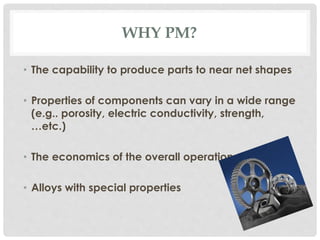
• The capability to produce parts to near net shapes 
• Properties of components can vary in a wide range 
(e.g.. porosity, electric conductivity, strength, 
…etc.) 
• The economics of the overall operation 
• Alloys with special properties
ADVANTAGES OF PM 
• PRECISE CONTROL : properties of end products can 
be suited to the demands of applications 
• CUSTOM-MADE COMPOSITION : widely different 
characteristics can be compacted 
• PHYSICAL PROPERTIES : properties can be altered 
easily by this method(e.g. density, porosity) 
• NEAR NETT SHAPING BECOMES NETT SHAPING 
eliminating the further processes (e.g. machining)
MATERIALS FOR PM 
• Metal powders (Fe, Cu, Ni, Ti, Co, W, Mo, …stb.) 
• Alloys (HSS, bronze, stainless steels, …etc.) 
• Non-metallic powders (graphite, metal carbides, 
oxides, …etc.)
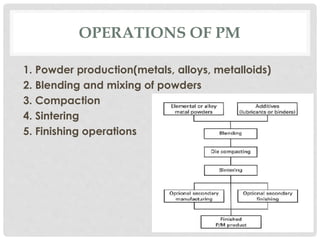
OPERATIONS OF PM 
1. Powder production(metals, alloys, metalloids) 
2. Blending and mixing of powders 
3. Compaction 
4. Sintering 
5. Finishing operations
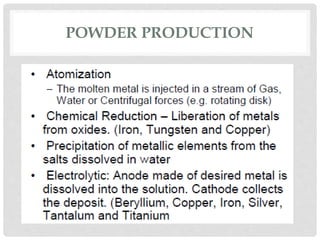
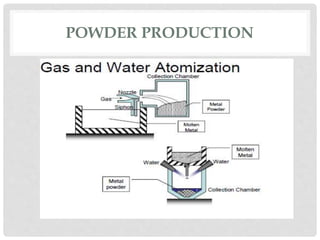
POWDER PRODUCTION
POWDER PRODUCTION
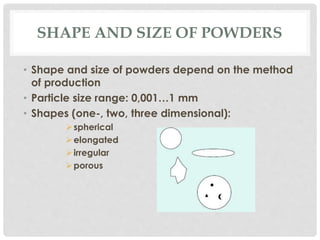
SHAPE AND SIZE OF POWDERS 
• Shape and size of powders depend on the method 
of production 
• Particle size range: 0,001…1 mm 
• Shapes (one-, two, three dimensional): 
spherical 
elongated 
 irregular 
porous
BLENDING AND MIXING OF 
POWDERS 
• For successful results in compaction and sintering, 
the starting powders must be homogenized 
• Blending - powders of the same chemistry but 
possibly different particle sizes are intermingled 
• Mixing - powders of different chemistries are 
combined 
• PM technology allows mixing various metals into 
alloys that would be difficult or impossible to 
produce by other means
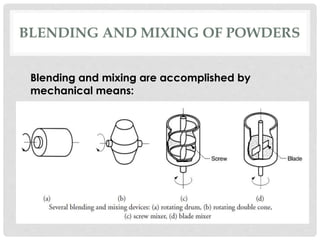
BLENDING AND MIXING OF POWDERS 
Blending and mixing are accomplished by 
mechanical means:
COMPACTION 
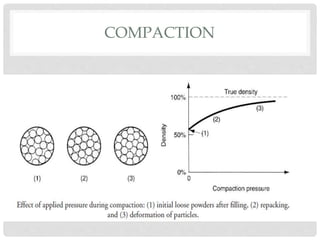
• Application of high pressure to the powders to form 
them into the required shape 
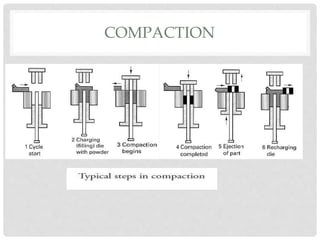
• The conventional compaction method is pressing, in 
which opposing punches squeeze the powders 
contained in a die 
• The work part after pressing is called a green 
compact, the word green meaning not yet fully 
processed 
• The green strength of the part when pressed is 
adequate for handling but far less than after 
sintering
COMPACTION
COMPACTION
COMPACTION 
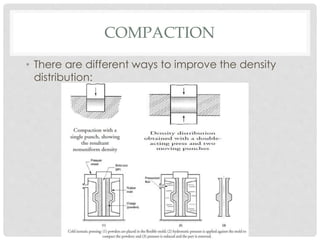
• There are different ways to improve the density 
distribution:
SINTERING 
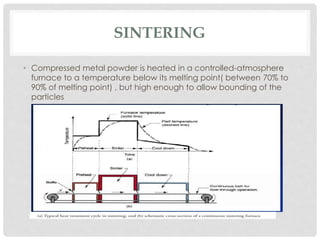
• Compressed metal powder is heated in a controlled-atmosphere 
furnace to a temperature below its melting point( between 70% to 
90% of melting point) , but high enough to allow bounding of the 
particles
SINTERING 
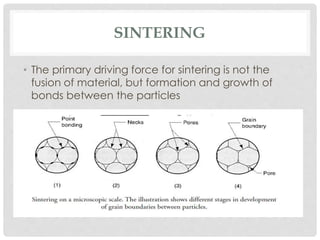
• The primary driving force for sintering is not the 
fusion of material, but formation and growth of 
bonds between the particles
FINISHING OPERATIONS 
• Coining and sizing: improve dimensional accuracy, 
strength and surface finish 
• Cold forging, upsetting: modify shape, increase 
strength 
• Impregnating with fluid: bearings and bushes 
• Infiltration: molten metal infiltrates the pores
APPLICATION 
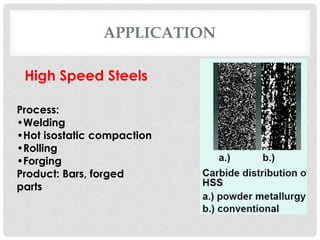
High Speed Steels 
Process: 
•Welding 
•Hot isostatic compaction 
•Rolling 
•Forging 
Product: Bars, forged 
parts
APPLICATION 
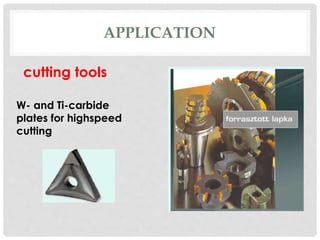
cutting tools 
W- and Ti-carbide 
plates for highspeed 
cutting
APPLICATION
APPLICATION
Thank you!

Powder metallurgy

  • 1.
    POWDER METALLURGY BY OME R WATHIQ ALANI
  • 2.
    OBJECTS • Introduction • Why Pm? • Advantages of pm • Materials for Pm • Operations of Pm Powder production  Blending and mixing of powders Compaction  Sintering  Finishing operations • Application
  • 3.
    INTRODUCTION • Afabrication technique involves the compaction of powdered metal, followed by a heat treatment to produce a more dense piece. • Powder metallurgy is especially suitable for metals having low ductility's having high melting temperatures
  • 4.
    WHY PM? •The capability to produce parts to near net shapes • Properties of components can vary in a wide range (e.g.. porosity, electric conductivity, strength, …etc.) • The economics of the overall operation • Alloys with special properties
  • 5.
    ADVANTAGES OF PM • PRECISE CONTROL : properties of end products can be suited to the demands of applications • CUSTOM-MADE COMPOSITION : widely different characteristics can be compacted • PHYSICAL PROPERTIES : properties can be altered easily by this method(e.g. density, porosity) • NEAR NETT SHAPING BECOMES NETT SHAPING eliminating the further processes (e.g. machining)
  • 6.
    MATERIALS FOR PM • Metal powders (Fe, Cu, Ni, Ti, Co, W, Mo, …stb.) • Alloys (HSS, bronze, stainless steels, …etc.) • Non-metallic powders (graphite, metal carbides, oxides, …etc.)
  • 7.
    OPERATIONS OF PM 1. Powder production(metals, alloys, metalloids) 2. Blending and mixing of powders 3. Compaction 4. Sintering 5. Finishing operations
  • 8.
  • 9.
  • 10.
    SHAPE AND SIZEOF POWDERS • Shape and size of powders depend on the method of production • Particle size range: 0,001…1 mm • Shapes (one-, two, three dimensional): spherical elongated  irregular porous
  • 11.
    BLENDING AND MIXINGOF POWDERS • For successful results in compaction and sintering, the starting powders must be homogenized • Blending - powders of the same chemistry but possibly different particle sizes are intermingled • Mixing - powders of different chemistries are combined • PM technology allows mixing various metals into alloys that would be difficult or impossible to produce by other means
  • 12.
    BLENDING AND MIXINGOF POWDERS Blending and mixing are accomplished by mechanical means:
  • 13.
    COMPACTION • Applicationof high pressure to the powders to form them into the required shape • The conventional compaction method is pressing, in which opposing punches squeeze the powders contained in a die • The work part after pressing is called a green compact, the word green meaning not yet fully processed • The green strength of the part when pressed is adequate for handling but far less than after sintering
  • 14.
  • 15.
  • 16.
    COMPACTION • Thereare different ways to improve the density distribution:
  • 17.
    SINTERING • Compressedmetal powder is heated in a controlled-atmosphere furnace to a temperature below its melting point( between 70% to 90% of melting point) , but high enough to allow bounding of the particles
  • 18.
    SINTERING • Theprimary driving force for sintering is not the fusion of material, but formation and growth of bonds between the particles
  • 19.
    FINISHING OPERATIONS •Coining and sizing: improve dimensional accuracy, strength and surface finish • Cold forging, upsetting: modify shape, increase strength • Impregnating with fluid: bearings and bushes • Infiltration: molten metal infiltrates the pores
  • 20.
    APPLICATION High SpeedSteels Process: •Welding •Hot isostatic compaction •Rolling •Forging Product: Bars, forged parts
  • 21.
    APPLICATION cutting tools W- and Ti-carbide plates for highspeed cutting
  • 22.
  • 23.
  • 25.