
Name of students Roll No.
Akash Gupta 3119
SNEHA CHAUDHARI 3107
ABHISHEK LAGISHETTY 3130
Ashwini Phaneskar 3143
Prince Pandey 3140
As motorists, the pothole is one of the
most notorious foes we
encounter. Fabricated from nothing and
created by no one, the elusive pothole
manifests itself with a certain subtlety
wherever it pleases and wreaks havoc
indiscriminately on those unfortunate
enough to cross its path.
Potholes are a major factor in
causing axle & suspension failure,
which counts for a third of
mechanical issues on Mumbai roads
and costs motorists an estimated
Rs.2.8 million every year. Authorities
currently pay out more than Rs.50
million in compensation claims due
to poor roads. The Brihan Mumbai
Municipal Corporation (BMC) attends
to the potholes repeatedly even
though they are expected to get the
job done in just one or two attempts.
Cont...
Out of the 18,843 potholes filled by BMC,
nearly 14% (2,544) were reassigned to
contractors by civic engineers. In a majority of
these cases, the contractors filled the same
potholes more than twice.
1. Mechanical stress
•First, there's the stress from cars, trucks, etc going over the road. This is not a static,
unchanging pressure, but one which moves around.
•Second, the road surface flexes slightly as vehicles travel over it: asphalt a bit more,
concrete a bit less. Where there are cracks, these are expanded by the changes in
pressure.
"Potholes form because asphalt road surfaces eventually crack under the heat of the day and
the constant stresses of traffic. These cracks allow snow and rainwater to seep into the
underlying dirt and gravel. During cold winter nights, this water freezes and expands. Some of
the dirt and gravel is pushed out as a result, leaving a hole when the water eventually melts.
Drivers continue to drive over these unseen holes, putting even more stress on the thin asphalt
layer covering them.
•Asphalt consists of a very stiff mixture of tar and gravel. Like most materials, it shrinks in cold and
expands in heat. Further, asphalt is slightly fluid; it actually flows a little when heavy things are placed on
it. When it is laid, considerable attention is paid to making sure it is sufficiently elastic to withstand the
shrinking and expanding caused by temperature and the weight of traffic on it.
Yearly BMC spent money on filling potholes
Year Cost
2006 19.07
2007 20.54
2008 32.59
2009 75.05
2010 62.80
2011 65.38
2012 60.00
2013 58(till now)
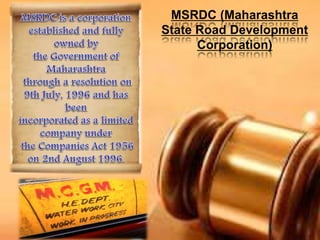
MSRDC (Maharashtra
State Road Development
Corporation)
Major functions of the MSRDC
To promote
and operate
- road
projects
To plan,
investigate,
design, construct
and manage
identified road
projects and their
area development
To enter
into a
contract in
respects
of the
works
To invite
tenders,
bids,
offers and
enter into
contracts
To promote
participation of
any person or
body or
association of
individuals
other
activities
entrusted by
the state
government
Where Does Your Toll Money Go?
The Illinois State Toll Highway Authority receives approximately
Rs.8cr. a day in toll money from the toll ways' 1.2 million daily
users, according to officials. The almost Rs.300 million a year
accounted for 87 percent of the authority's revenue in 2000.
Last year the bulk of the Rs.344.1 million earned in revenue by the
authority paid for operations and major and capital improvement
projects ranging from plaza renovations to maintaining or expanding
the roads. Revenue bonds are sold for major construction projects,
such as the planned I-355 extension scheduled to begin this
summer, and toll revenue gradually pays off the debt.
Amount spend by PWD,MMRDA and MSRDC to
repair a few roads under their jurisdiction
Agency MMRDA MSRDC PWD
Road/flyovers Andheri –
kurla link
road, JP
road
Wadala to
Jacob circle
monorail
corridor
31 flyovers and few
bridges
Western & eastern
express highway, sion -
panvel highway
Expenses
incurred(Rs.)
12lakh 9lakh(approx) 45lakh 4.88crore
Who pays MMRDA L&T, the
contractor for
the monorail
corridor
MEPL PWD and sion panvel
tollways Pvt Ltd
complaints 90 27 36
Strengthen
well-
maintained
highways
Public Opinion
Surveys
Prevention
is better
than Cure
Strengthen well-maintainedhighways
Well-maintained Highways (W-MH) should
be revised and strengthened to include all
recommendations of this review which are
relevant to local highway authorities the
review of W-MH is currently being
commissioned by the dft. This work was put
on hold whilst the department awaited the
outcome of the Spending Review 2013. This
review assimilates all complimentary
guidance published since 2005, together with
more substantial changes as a result of the
recent release of the Highway infrastructure
asset management Guidance and other HMEP
documents.
Local highway authorities should
monitor public satisfaction with road,
footway and cycle way condition and
repair annually through the National
Highways and Transport (NHT) Public
Satisfaction Surveys or their own
surveys. The findings can be used to
benchmark performance and be taken
into consideration in local highway
maintenance policies.
QUESTIONNAIRE
Mr. Dhanaji Thombre
Senior Traffic Police Officer
•CASE STUDY
From Leicestershire county council
Right First Time
•Quality of repairs & reinstatements
•Guidance on repair techniques-
•Inspection & training –
•Technology-
•Permanent repairs Policy-
•Research & Innovation- •Public communications
•Public Opinion Surveys-
•Definition of Potholes-
Conclusion
After the study on potholes we conclude that the
all the activity taken by government is ethically
and morally correct but on some extend the
contractor or road developer’s are not paying that
much of attention against this serious issue.
Which create a problem to common man?
Although the presence of excessive water is the
primary cause of potholes in roads, the formation
of potholes differs somewhat depending on the
environmental conditions, traffic loading, road
pavement structure and materials used.
Thank You

Potholes

  • 3.
    Name of studentsRoll No. Akash Gupta 3119 SNEHA CHAUDHARI 3107 ABHISHEK LAGISHETTY 3130 Ashwini Phaneskar 3143 Prince Pandey 3140
  • 4.
    As motorists, thepothole is one of the most notorious foes we encounter. Fabricated from nothing and created by no one, the elusive pothole manifests itself with a certain subtlety wherever it pleases and wreaks havoc indiscriminately on those unfortunate enough to cross its path.
  • 5.
    Potholes are amajor factor in causing axle & suspension failure, which counts for a third of mechanical issues on Mumbai roads and costs motorists an estimated Rs.2.8 million every year. Authorities currently pay out more than Rs.50 million in compensation claims due to poor roads. The Brihan Mumbai Municipal Corporation (BMC) attends to the potholes repeatedly even though they are expected to get the job done in just one or two attempts.
  • 6.
    Cont... Out of the18,843 potholes filled by BMC, nearly 14% (2,544) were reassigned to contractors by civic engineers. In a majority of these cases, the contractors filled the same potholes more than twice.
  • 8.
    1. Mechanical stress •First,there's the stress from cars, trucks, etc going over the road. This is not a static, unchanging pressure, but one which moves around. •Second, the road surface flexes slightly as vehicles travel over it: asphalt a bit more, concrete a bit less. Where there are cracks, these are expanded by the changes in pressure. "Potholes form because asphalt road surfaces eventually crack under the heat of the day and the constant stresses of traffic. These cracks allow snow and rainwater to seep into the underlying dirt and gravel. During cold winter nights, this water freezes and expands. Some of the dirt and gravel is pushed out as a result, leaving a hole when the water eventually melts. Drivers continue to drive over these unseen holes, putting even more stress on the thin asphalt layer covering them. •Asphalt consists of a very stiff mixture of tar and gravel. Like most materials, it shrinks in cold and expands in heat. Further, asphalt is slightly fluid; it actually flows a little when heavy things are placed on it. When it is laid, considerable attention is paid to making sure it is sufficiently elastic to withstand the shrinking and expanding caused by temperature and the weight of traffic on it.
  • 11.
    Yearly BMC spentmoney on filling potholes Year Cost 2006 19.07 2007 20.54 2008 32.59 2009 75.05 2010 62.80 2011 65.38 2012 60.00 2013 58(till now)
  • 13.
    MSRDC (Maharashtra State RoadDevelopment Corporation)
  • 15.
    Major functions ofthe MSRDC To promote and operate - road projects To plan, investigate, design, construct and manage identified road projects and their area development To enter into a contract in respects of the works To invite tenders, bids, offers and enter into contracts To promote participation of any person or body or association of individuals other activities entrusted by the state government
  • 16.
    Where Does YourToll Money Go? The Illinois State Toll Highway Authority receives approximately Rs.8cr. a day in toll money from the toll ways' 1.2 million daily users, according to officials. The almost Rs.300 million a year accounted for 87 percent of the authority's revenue in 2000. Last year the bulk of the Rs.344.1 million earned in revenue by the authority paid for operations and major and capital improvement projects ranging from plaza renovations to maintaining or expanding the roads. Revenue bonds are sold for major construction projects, such as the planned I-355 extension scheduled to begin this summer, and toll revenue gradually pays off the debt.
  • 17.
    Amount spend byPWD,MMRDA and MSRDC to repair a few roads under their jurisdiction Agency MMRDA MSRDC PWD Road/flyovers Andheri – kurla link road, JP road Wadala to Jacob circle monorail corridor 31 flyovers and few bridges Western & eastern express highway, sion - panvel highway Expenses incurred(Rs.) 12lakh 9lakh(approx) 45lakh 4.88crore Who pays MMRDA L&T, the contractor for the monorail corridor MEPL PWD and sion panvel tollways Pvt Ltd complaints 90 27 36
  • 19.
  • 20.
    Strengthen well-maintainedhighways Well-maintained Highways(W-MH) should be revised and strengthened to include all recommendations of this review which are relevant to local highway authorities the review of W-MH is currently being commissioned by the dft. This work was put on hold whilst the department awaited the outcome of the Spending Review 2013. This review assimilates all complimentary guidance published since 2005, together with more substantial changes as a result of the recent release of the Highway infrastructure asset management Guidance and other HMEP documents.
  • 21.
    Local highway authoritiesshould monitor public satisfaction with road, footway and cycle way condition and repair annually through the National Highways and Transport (NHT) Public Satisfaction Surveys or their own surveys. The findings can be used to benchmark performance and be taken into consideration in local highway maintenance policies.
  • 23.
  • 24.
  • 25.
    Right First Time •Qualityof repairs & reinstatements •Guidance on repair techniques- •Inspection & training – •Technology-
  • 26.
    •Permanent repairs Policy- •Research& Innovation- •Public communications •Public Opinion Surveys- •Definition of Potholes-
  • 27.
    Conclusion After the studyon potholes we conclude that the all the activity taken by government is ethically and morally correct but on some extend the contractor or road developer’s are not paying that much of attention against this serious issue. Which create a problem to common man? Although the presence of excessive water is the primary cause of potholes in roads, the formation of potholes differs somewhat depending on the environmental conditions, traffic loading, road pavement structure and materials used.
  • 28.