Traffic Impact
Assessment
STANDARD
DEFINITIONS
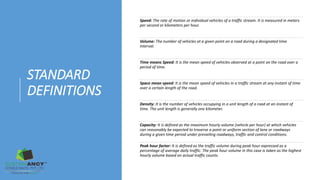
Speed: The rate of motion or individual vehicles of a traffic stream. It is measured in meters
per second or kilometers per hour.
Volume: The number of vehicles at a given point on a road during a designated time
interval.
Time means Speed: It is the mean speed of vehicles observed at a point on the road over a
period of time.
Space mean speed: It is the mean speed of vehicles in a traffic stream at any instant of time
over a certain length of the road.
Density: It is the number of vehicles occupying in a unit length of a road at an instant of
time. The unit length is generally one kilometer.
Capacity: It is defined as the maximum hourly volume (vehicle per hour) at which vehicles
can reasonably be expected to traverse a point or uniform section of lane or roadways
during a given time period under prevailing roadways, traffic and control conditions.
Peak hour factor: It is defined as the traffic volume during peak hour expressed as a
percentage of average daily traffic. The peak hour volume in this case is taken as the highest
hourly volume based on actual traffic counts.
Important Terms
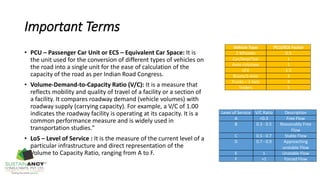
• PCU – Passenger Car Unit or ECS – Equivalent Car Space: It is
the unit used for the conversion of different types of vehicles on
the road into a single unit for the ease of calculation of the
capacity of the road as per Indian Road Congress.
• Volume-Demand-to-Capacity Ratio (V/C): It is a measure that
reflects mobility and quality of travel of a facility or a section of
a facility. It compares roadway demand (vehicle volumes) with
roadway supply (carrying capacity). For example, a V/C of 1.00
indicates the roadway facility is operating at its capacity. It is a
common performance measure and is widely used in
transportation studies."
• LoS – Level of Service : It is the measure of the current level of a
particular infrastructure and direct representation of the
Volume to Capacity Ratio, ranging from A to F.
Vehicle Type PCU/ECS Factor
2 Wheeler 0.5
Car/Jeep/Taxi 1
Auto rickshaw 1
LCV 1.5
Buses/2-Axle 3
Trucks – 3 Axle 4
Trailers 5
Level of Service V/C Ratio Description
A <0.3 Free Flow
B 0.3 - 0.5 Reasonably Free
Flow
C 0.5 - 0.7 Stable Flow
D 0.7 - 0.9 Approaching
unstable Flow
E 1 Unstable Flow
F >1 Forced Flow
INTRODUCTION
Traffic Impact Assessment or Traffic Impact Analysis (TIA) is the
process of understanding the effect of the proposed project traffic
on the existing surrounding and roads.
This study is helpful in suggesting possibilities for linking the
proposed project traffic to external roads with minimum
interruption. With the rise in the number of private vehicles over
the number of years in Indian Cities, it has become essential to
understand the impact of any new development on its
surroundings.
The term ‘Traffic Management’ represents the process of adjusting
or adapting the use of an existing road system to meet specified
objectives without resorting to substantial new road construction.
TRAFFIC
CONGESTION
AND IMPACT
ASSESSMENT
Urban traffic congestion is a significant and growing problem in many parts of
the world. Moreover, as congestion continues to increase, the conventional
approach of "building more roads" doesn't always work for a variety of
political, financial, and environmental reasons. Against this backdrop of
serious existing and growing congestion traffic control techniques and
information systems are needed that can substantially increase capacity and
improve traffic flow efficiency.
Road traffic control involves directing vehicular and pedestrian traffic around a
construction zone, accident or other road disruption, thus ensuring the safety of
emergency response teams construction workers and the general public Traffic
control also includes the use of CCTV and other means of monitoring traffic by
local or State roadways authorities to manage traffic flows and providing advice
concerning traffic congestion.
Traffic congestion and the cost of providing mobility are compelling issues to
planners, decision makers and members of both the business community and
the general public transportation and the degree of efficiency with which it is
accomplished, affects everyone. Therefore, planners are constantly in search
of solutions to the transportation problems that will give not only increased
mobility, but also greater economic productivity and a cleaner environment.
While new road construction can temporarily relieve congestion in the long
term it simply encourages further growth in car traffic through increased
travel and a switch away from public transport. Beside this, suitable corridors
in our cities for major roadwork’s is becoming more and more difficult, and
many of the recent major projects involve turrets to minimize environmental
disruption and community opposition, thereby raising costs.
The purpose of this Analysis is to analyze the effect of generated traffic due to
the proposed developments on to the external roads.
Part 1: IDENTIFICATION OF SITE CONTEXT AND ROAD INVENTORY
Site Name Distance from the proposed project
Nearest Arterial Road
Nearest Sub Arterial Road
Nearest Railway Station
Nearest Bus Station
• The hierarchy in terms of the network of roads is to ensure scale and efficient circulation of traffic. To achieve this,
through traffic routes are not be used for direct access to buildings or even to minor roads serving the buildings, because
in that case not only the capacity of the through routes will be reduced but the intersections will also be unsafe.
• The principal factors considered in designation roads into appropriate classifications are the existing and proposed land
uses, overall travel demand, pattern of movement by various modes of transportation safety of traffic, environmental
considerations etc.
• The major Arterial, Sub-arterial and Collector Roads need to be identified in order to calculate the exact traffic impact of
the project.
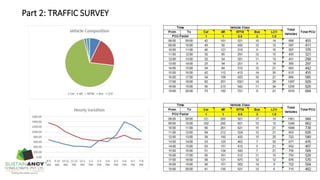
Part 2: TRAFFIC SURVEY
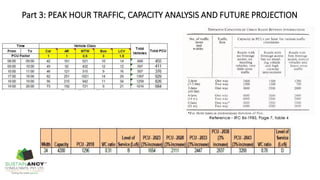
Part 3: PEAK HOUR TRAFFIC, CAPACITY ANALYSIS AND FUTURE PROJECTION
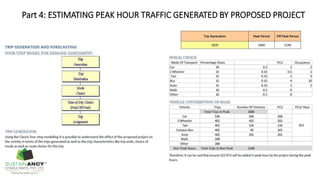
Part 4: ESTIMATING PEAK HOUR TRAFFIC GENERATED BY PROPOSED PROJECT
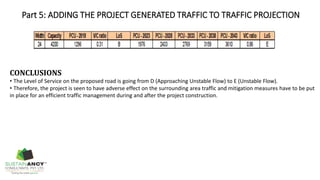
Part 5: ADDING THE PROJECT GENERATED TRAFFIC TO TRAFFIC PROJECTION
CONCLUSIONS
• The Level of Service on the proposed road is going from D (Approaching Unstable Flow) to E (Unstable Flow).
• Therefore, the project is seen to have adverse effect on the surrounding area traffic and mitigation measures have to be put
in place for an efficient traffic management during and after the project construction.

Traffic impact assessment

  • 1.
  • 2.
    STANDARD DEFINITIONS Speed: The rateof motion or individual vehicles of a traffic stream. It is measured in meters per second or kilometers per hour. Volume: The number of vehicles at a given point on a road during a designated time interval. Time means Speed: It is the mean speed of vehicles observed at a point on the road over a period of time. Space mean speed: It is the mean speed of vehicles in a traffic stream at any instant of time over a certain length of the road. Density: It is the number of vehicles occupying in a unit length of a road at an instant of time. The unit length is generally one kilometer. Capacity: It is defined as the maximum hourly volume (vehicle per hour) at which vehicles can reasonably be expected to traverse a point or uniform section of lane or roadways during a given time period under prevailing roadways, traffic and control conditions. Peak hour factor: It is defined as the traffic volume during peak hour expressed as a percentage of average daily traffic. The peak hour volume in this case is taken as the highest hourly volume based on actual traffic counts.
  • 3.
    Important Terms • PCU– Passenger Car Unit or ECS – Equivalent Car Space: It is the unit used for the conversion of different types of vehicles on the road into a single unit for the ease of calculation of the capacity of the road as per Indian Road Congress. • Volume-Demand-to-Capacity Ratio (V/C): It is a measure that reflects mobility and quality of travel of a facility or a section of a facility. It compares roadway demand (vehicle volumes) with roadway supply (carrying capacity). For example, a V/C of 1.00 indicates the roadway facility is operating at its capacity. It is a common performance measure and is widely used in transportation studies." • LoS – Level of Service : It is the measure of the current level of a particular infrastructure and direct representation of the Volume to Capacity Ratio, ranging from A to F. Vehicle Type PCU/ECS Factor 2 Wheeler 0.5 Car/Jeep/Taxi 1 Auto rickshaw 1 LCV 1.5 Buses/2-Axle 3 Trucks – 3 Axle 4 Trailers 5 Level of Service V/C Ratio Description A <0.3 Free Flow B 0.3 - 0.5 Reasonably Free Flow C 0.5 - 0.7 Stable Flow D 0.7 - 0.9 Approaching unstable Flow E 1 Unstable Flow F >1 Forced Flow
  • 4.
    INTRODUCTION Traffic Impact Assessmentor Traffic Impact Analysis (TIA) is the process of understanding the effect of the proposed project traffic on the existing surrounding and roads. This study is helpful in suggesting possibilities for linking the proposed project traffic to external roads with minimum interruption. With the rise in the number of private vehicles over the number of years in Indian Cities, it has become essential to understand the impact of any new development on its surroundings. The term ‘Traffic Management’ represents the process of adjusting or adapting the use of an existing road system to meet specified objectives without resorting to substantial new road construction.
  • 5.
    TRAFFIC CONGESTION AND IMPACT ASSESSMENT Urban trafficcongestion is a significant and growing problem in many parts of the world. Moreover, as congestion continues to increase, the conventional approach of "building more roads" doesn't always work for a variety of political, financial, and environmental reasons. Against this backdrop of serious existing and growing congestion traffic control techniques and information systems are needed that can substantially increase capacity and improve traffic flow efficiency. Road traffic control involves directing vehicular and pedestrian traffic around a construction zone, accident or other road disruption, thus ensuring the safety of emergency response teams construction workers and the general public Traffic control also includes the use of CCTV and other means of monitoring traffic by local or State roadways authorities to manage traffic flows and providing advice concerning traffic congestion. Traffic congestion and the cost of providing mobility are compelling issues to planners, decision makers and members of both the business community and the general public transportation and the degree of efficiency with which it is accomplished, affects everyone. Therefore, planners are constantly in search of solutions to the transportation problems that will give not only increased mobility, but also greater economic productivity and a cleaner environment. While new road construction can temporarily relieve congestion in the long term it simply encourages further growth in car traffic through increased travel and a switch away from public transport. Beside this, suitable corridors in our cities for major roadwork’s is becoming more and more difficult, and many of the recent major projects involve turrets to minimize environmental disruption and community opposition, thereby raising costs. The purpose of this Analysis is to analyze the effect of generated traffic due to the proposed developments on to the external roads.
  • 6.
    Part 1: IDENTIFICATIONOF SITE CONTEXT AND ROAD INVENTORY Site Name Distance from the proposed project Nearest Arterial Road Nearest Sub Arterial Road Nearest Railway Station Nearest Bus Station • The hierarchy in terms of the network of roads is to ensure scale and efficient circulation of traffic. To achieve this, through traffic routes are not be used for direct access to buildings or even to minor roads serving the buildings, because in that case not only the capacity of the through routes will be reduced but the intersections will also be unsafe. • The principal factors considered in designation roads into appropriate classifications are the existing and proposed land uses, overall travel demand, pattern of movement by various modes of transportation safety of traffic, environmental considerations etc. • The major Arterial, Sub-arterial and Collector Roads need to be identified in order to calculate the exact traffic impact of the project.
  • 7.
  • 8.
    Part 3: PEAKHOUR TRAFFIC, CAPACITY ANALYSIS AND FUTURE PROJECTION
  • 9.
    Part 4: ESTIMATINGPEAK HOUR TRAFFIC GENERATED BY PROPOSED PROJECT
  • 10.
    Part 5: ADDINGTHE PROJECT GENERATED TRAFFIC TO TRAFFIC PROJECTION CONCLUSIONS • The Level of Service on the proposed road is going from D (Approaching Unstable Flow) to E (Unstable Flow). • Therefore, the project is seen to have adverse effect on the surrounding area traffic and mitigation measures have to be put in place for an efficient traffic management during and after the project construction.