DATTA MEGHE COLLEGE OF ENGINEERING
AIROLI,NAVI MUMBAI.
(Department of Civil Engineering)
2021-2022
Mini Project
Title : QUICK AND DURABLE POTHOLE REPAIRS IN BITUMINOUS
ROAD
Guided : Prof. R.K.Kolisetty Project By :
CL-B-50 Mayuresh Patil
CL-B-56 Nishant Phadke
CL-B-73 Rampravesh Yadav
OVERVIEW
Introduction
Aim and Objectives
Literature Survey
Pothole
Formation of Potholes
Crocodile Crack
Effects of Potholes
Repairing of Potholes
Repair Techniques
Throw and Roll
Spray Injection repair
Edge Seal
Comparison of repairing
method
FUTURE SCOPE
CONCLUSION
REFERENCE
INTRODUCTION
Potholes are an annoyance to drivers and potentially a dangerous
hazard on the roadways.
The repair of pothole distresses in asphalt pavement is often considered
low on a road agency’s agenda; however their repair consumes a large
portion of time and funds.
Many road crews are ill-informed on the proper materials and methods
for pothole repair.
Correct selection of pothole patching materials and proper application of
repair procedures can greatly increase the longevity of pothole repairs,
lead to fewer driver frustrations, and lower road maintenance budget
Aim : To Understand Quick and Durable Potholes repairs
Objective :
To know term Potholes
To identify formation and causes of potholes.
To identify effects of potholes
To understand the various conventional methods in
Repairing of potholes and its procedure
Literature Survey
 Infrared heating repair
 The traditional method to repair potholes is to fill them with
boiling asphalt. However, if the weather is cold, the
temperature of the asphalt mixture falls significantly causing
weaker bonds with the existing material. Thus, the repair is
not reliable and has a high possibility of failure in the next
months.
 To address this issue, engineers at Brunel University of
London have developed the Controlled Pothole Repair
System (CPRS). This system utilizes infrared heating to
warm the road surface before making the repair. It is
designed as to be portable and easily transported to sites.
The teams states that their method can provide repairs that
last longer and eventually make the road network safer than
it is today.
 Inssta Road Pachr a Special Purpose Vehicle
(SPV) is a unique dispensing mechanism
conceived and innovated first in India for Machine
Repaired Potholes based on World's no.1
American Pressure Sensitive Technology for
instant pothole repairs.
 InsstaPattch premix asphalt is indigenously
developed with a track record of 15 years and
made in India on pressure sensitive technology
(PST) and also technically evaluated and
accredited by Central Road Research Institute
(CRRI), IRC, MoRTH, BRO, Railways, PWD and
many local bodies.
Inssta Road Pachr
 The salient features of PST technology is environmental
friendly, no emissions and no heating. Scientific formulated
ingredients are coated on 6mm and 20mm aggregates for
guaranteed interlock bonding of material in pothole after
compaction.
 Inssta Road Pachr SPV is a revolutionary concept with
InsstaPattch PST premix asphalt material and manufactured on
state of art facilities by Grams Infratech (I) Private Limited
Nagpur after consistent research and technological innovation
visualizing # POTHOLE FREE INDIA and also to present a
model of Integrated Pothole Solution to support global
infrastructure development and maintenance of potholes on
roads.
 Inssta Road Pachr SPV has an advantage to control
conversions of small pothole into big pothole. Machine
Repaired Potholes with latest PST technology has the potential
to repair even small pothole by discharging less quantity of
InsstaPattch asphalt and allow traffic to free flow immediately
after repairs.
Potholes
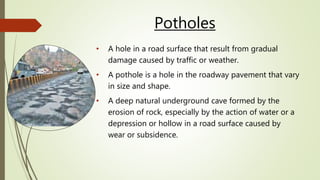
• A hole in a road surface that result from gradual
damage caused by traffic or weather.
• A pothole is a hole in the roadway pavement that vary
in size and shape.
• A deep natural underground cave formed by the
erosion of rock, especially by the action of water or a
depression or hollow in a road surface caused by
wear or subsidence.
Causes of Potholes
• Asphalt
• Cracking of asphalt surfacing
• Water penetration into the asphalt
• Traffic loading
• Thin bituminous-surfacing seals
• Loss of surfacing
• Cracking
• Poor repairs
• Poor adhesion between base and
seal
• Unusual forms of pothole
development
• Reinstated service trenches
• Failure of existing patches
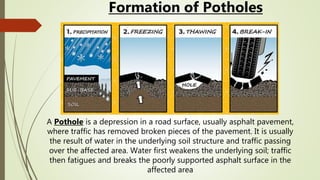
A Pothole is a depression in a road surface, usually asphalt pavement,
where traffic has removed broken pieces of the pavement. It is usually
the result of water in the underlying soil structure and traffic passing
over the affected area. Water first weakens the underlying soil; traffic
then fatigues and breaks the poorly supported asphalt surface in the
affected area
Formation of Potholes
Crocodile crack
Potholes are surrounded by cracks; these
cracks are called Crocodile Cracks. This is
the initial stage of asphalt pavement failure.
These cracks, when subjected to heavy
loads, tear apart and create a small hole.
This hole becomes larger and larger with
heavy traffic and stops growing until the
whole water-weakened region is turned into
a Potholes.
Effects of
Potholes
The accident rate are increased
The appearance of road is affected
Speed of vehicle will decrease so the travel
time will increase
Flat tire or damage to your tires
Bent or damaged rims
Steering damage and even damage to the
body of the car
Repairing of Potholes
 Potholes repairs can be divided into two distinct periods
• The First period is winter repairs - when tempratures are low, base
material is frozen and additional moisture and freeze thaw cycles are
expected.
• The Second period is spring repairs- when base material is wet and soft
and few additional thaw cycles are expected.
Many maintenance agencies use the throw-and-go method for repairing
potholes. Although not considered the best way to patch potholes, it is the
most commonly used method because of its high rate of production.
Throw and Roll
• Throw-and-roll method is one of the
oldest and simplest pothole repairing
method.
• It is a temporary repair
• Performed on wet potholes
• Used very commonly in India
• Throw-and-roll method is cost
effective and quick
• But it doesn’t provide a longlasting
repair.
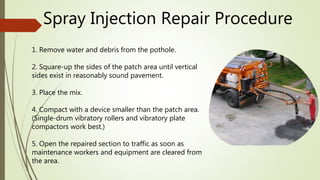
Spray Injection Repair
• Spray-injection repair is a semi-permanent
repair.
• It uses a spray gun to fill potholes.
• It is one of the best methods to repair a
pothole.
• It requires more workers and equipment
and has a lower productivity rate than the
throw-and-roll method.
Spray Injection Repair Procedure
1. Remove water and debris from the pothole.
2. Square-up the sides of the patch area until vertical
sides exist in reasonably sound pavement.
3. Place the mix.
4. Compact with a device smaller than the patch area.
(Single-drum vibratory rollers and vibratory plate
compactors work best.)
5. Open the repaired section to traffic as soon as
maintenance workers and equipment are cleared from
the area.
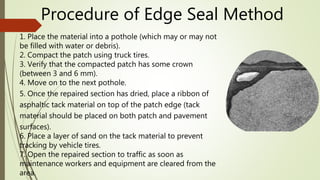
Edge Seal Repair
• This method involves using the throw-and-
roll repair and then filling the pothole.
• It is involves using throw & repair and then
filling potholes. Further it is compacted by
heavy duty truck.
• It is fast and productive.
• It is cost effective.
• Mostly used to fill up the Crocodile Cracks.
Procedure of Edge Seal Method
1. Place the material into a pothole (which may or may not
be filled with water or debris).
2. Compact the patch using truck tires.
3. Verify that the compacted patch has some crown
(between 3 and 6 mm).
4. Move on to the next pothole.
5. Once the repaired section has dried, place a ribbon of
asphaltic tack material on top of the patch edge (tack
material should be placed on both patch and pavement
surfaces).
6. Place a layer of sand on the tack material to prevent
tracking by vehicle tires.
7. Open the repaired section to traffic as soon as
maintenance workers and equipment are cleared from the
area.
Comparing the methods
THROW & ROLL SPRAY INJECTION EDGE SEAL
It is most basic method of filling
conventional pothole by placing
materials pothole and driving
heavy truck overit.
In this method asphalt and
aggregate are sprayed into the
pothole before being covered with
another layer of
aggregate.
It is involves using throw & repair
and then filling potholes. Further it
is compacted by heavy duty truck.
It provides temporary pothole
relief.
It is similar to semi-permanent one
but requires special equipment.
In this method after compaction
asphalt ribbon is placed along the
edge so it overlaps patch and
pavement.
It has high failure rate and only
used in case of absence of other
choices.
Once the solution is applied no
need to compact the materials.
It can be open to traffic as soon as
it is done and equipments are
cleared.
Future Scope
1. Researching New Ideas of Filling And Repairing Potholes
2. Prevention of Potholes Formation on Roads.
3. Studying Potholes Repairs in Mumbai Metropolitan Region
4. Making a Real Life Pothole Model for Better understaing of
repairing techniques
Conclusion
 Pothole on road cannot be neglected it can lead to serious issues in future
to both road as well as the traffic flow on the road hence immediate action
and suitable repair methods should be performed.
 In India, the method which is using to repair the potholes does not give
durability, because, the portion which is repaired gets seepage through the
base and top surface gets water entry from sources like rain, ice which will
again damage the work and bonding would reduce thus durability will
reduce and again we have to apply same method to repair it.
 Spray Injection and Edge repair method of repairing potholes should be
used in big cities as it provides longer durability than throw and go method
References
1. https://www.psymbolic.com/8-different-types-of-pothole-
repair-
methods/#:~:text=Using%20Edge%20Seal%20to%20Repair,t
he%20patch%20and%20the%20pavement.
2. Matthew_Sainz_IAPA_Research_2016_Bradley_University.pdf
3. https://www.nuphalt.com/the-most-innovative-pothole-
solution-ever/
4. https://en.wikipedia.org/wiki/Pothole
5. https://www.potholerepairindia.com/
THANK YOU

pothole repairs

  • 1.
    DATTA MEGHE COLLEGEOF ENGINEERING AIROLI,NAVI MUMBAI. (Department of Civil Engineering) 2021-2022 Mini Project Title : QUICK AND DURABLE POTHOLE REPAIRS IN BITUMINOUS ROAD Guided : Prof. R.K.Kolisetty Project By : CL-B-50 Mayuresh Patil CL-B-56 Nishant Phadke CL-B-73 Rampravesh Yadav
  • 2.
    OVERVIEW Introduction Aim and Objectives LiteratureSurvey Pothole Formation of Potholes Crocodile Crack Effects of Potholes Repairing of Potholes Repair Techniques Throw and Roll Spray Injection repair Edge Seal Comparison of repairing method FUTURE SCOPE CONCLUSION REFERENCE
  • 3.
    INTRODUCTION Potholes are anannoyance to drivers and potentially a dangerous hazard on the roadways. The repair of pothole distresses in asphalt pavement is often considered low on a road agency’s agenda; however their repair consumes a large portion of time and funds. Many road crews are ill-informed on the proper materials and methods for pothole repair. Correct selection of pothole patching materials and proper application of repair procedures can greatly increase the longevity of pothole repairs, lead to fewer driver frustrations, and lower road maintenance budget
  • 4.
    Aim : ToUnderstand Quick and Durable Potholes repairs Objective : To know term Potholes To identify formation and causes of potholes. To identify effects of potholes To understand the various conventional methods in Repairing of potholes and its procedure
  • 5.
    Literature Survey  Infraredheating repair  The traditional method to repair potholes is to fill them with boiling asphalt. However, if the weather is cold, the temperature of the asphalt mixture falls significantly causing weaker bonds with the existing material. Thus, the repair is not reliable and has a high possibility of failure in the next months.  To address this issue, engineers at Brunel University of London have developed the Controlled Pothole Repair System (CPRS). This system utilizes infrared heating to warm the road surface before making the repair. It is designed as to be portable and easily transported to sites. The teams states that their method can provide repairs that last longer and eventually make the road network safer than it is today.
  • 6.
     Inssta RoadPachr a Special Purpose Vehicle (SPV) is a unique dispensing mechanism conceived and innovated first in India for Machine Repaired Potholes based on World's no.1 American Pressure Sensitive Technology for instant pothole repairs.  InsstaPattch premix asphalt is indigenously developed with a track record of 15 years and made in India on pressure sensitive technology (PST) and also technically evaluated and accredited by Central Road Research Institute (CRRI), IRC, MoRTH, BRO, Railways, PWD and many local bodies. Inssta Road Pachr
  • 7.
     The salientfeatures of PST technology is environmental friendly, no emissions and no heating. Scientific formulated ingredients are coated on 6mm and 20mm aggregates for guaranteed interlock bonding of material in pothole after compaction.  Inssta Road Pachr SPV is a revolutionary concept with InsstaPattch PST premix asphalt material and manufactured on state of art facilities by Grams Infratech (I) Private Limited Nagpur after consistent research and technological innovation visualizing # POTHOLE FREE INDIA and also to present a model of Integrated Pothole Solution to support global infrastructure development and maintenance of potholes on roads.  Inssta Road Pachr SPV has an advantage to control conversions of small pothole into big pothole. Machine Repaired Potholes with latest PST technology has the potential to repair even small pothole by discharging less quantity of InsstaPattch asphalt and allow traffic to free flow immediately after repairs.
  • 8.
    Potholes • A holein a road surface that result from gradual damage caused by traffic or weather. • A pothole is a hole in the roadway pavement that vary in size and shape. • A deep natural underground cave formed by the erosion of rock, especially by the action of water or a depression or hollow in a road surface caused by wear or subsidence.
  • 9.
    Causes of Potholes •Asphalt • Cracking of asphalt surfacing • Water penetration into the asphalt • Traffic loading • Thin bituminous-surfacing seals • Loss of surfacing • Cracking • Poor repairs • Poor adhesion between base and seal • Unusual forms of pothole development • Reinstated service trenches • Failure of existing patches
  • 10.
    A Pothole isa depression in a road surface, usually asphalt pavement, where traffic has removed broken pieces of the pavement. It is usually the result of water in the underlying soil structure and traffic passing over the affected area. Water first weakens the underlying soil; traffic then fatigues and breaks the poorly supported asphalt surface in the affected area Formation of Potholes
  • 11.
    Crocodile crack Potholes aresurrounded by cracks; these cracks are called Crocodile Cracks. This is the initial stage of asphalt pavement failure. These cracks, when subjected to heavy loads, tear apart and create a small hole. This hole becomes larger and larger with heavy traffic and stops growing until the whole water-weakened region is turned into a Potholes.
  • 12.
    Effects of Potholes The accidentrate are increased The appearance of road is affected Speed of vehicle will decrease so the travel time will increase Flat tire or damage to your tires Bent or damaged rims Steering damage and even damage to the body of the car
  • 13.
    Repairing of Potholes Potholes repairs can be divided into two distinct periods • The First period is winter repairs - when tempratures are low, base material is frozen and additional moisture and freeze thaw cycles are expected. • The Second period is spring repairs- when base material is wet and soft and few additional thaw cycles are expected. Many maintenance agencies use the throw-and-go method for repairing potholes. Although not considered the best way to patch potholes, it is the most commonly used method because of its high rate of production.
  • 14.
    Throw and Roll •Throw-and-roll method is one of the oldest and simplest pothole repairing method. • It is a temporary repair • Performed on wet potholes • Used very commonly in India • Throw-and-roll method is cost effective and quick • But it doesn’t provide a longlasting repair.
  • 15.
    Spray Injection Repair •Spray-injection repair is a semi-permanent repair. • It uses a spray gun to fill potholes. • It is one of the best methods to repair a pothole. • It requires more workers and equipment and has a lower productivity rate than the throw-and-roll method.
  • 16.
    Spray Injection RepairProcedure 1. Remove water and debris from the pothole. 2. Square-up the sides of the patch area until vertical sides exist in reasonably sound pavement. 3. Place the mix. 4. Compact with a device smaller than the patch area. (Single-drum vibratory rollers and vibratory plate compactors work best.) 5. Open the repaired section to traffic as soon as maintenance workers and equipment are cleared from the area.
  • 17.
    Edge Seal Repair •This method involves using the throw-and- roll repair and then filling the pothole. • It is involves using throw & repair and then filling potholes. Further it is compacted by heavy duty truck. • It is fast and productive. • It is cost effective. • Mostly used to fill up the Crocodile Cracks.
  • 18.
    Procedure of EdgeSeal Method 1. Place the material into a pothole (which may or may not be filled with water or debris). 2. Compact the patch using truck tires. 3. Verify that the compacted patch has some crown (between 3 and 6 mm). 4. Move on to the next pothole. 5. Once the repaired section has dried, place a ribbon of asphaltic tack material on top of the patch edge (tack material should be placed on both patch and pavement surfaces). 6. Place a layer of sand on the tack material to prevent tracking by vehicle tires. 7. Open the repaired section to traffic as soon as maintenance workers and equipment are cleared from the area.
  • 19.
    Comparing the methods THROW& ROLL SPRAY INJECTION EDGE SEAL It is most basic method of filling conventional pothole by placing materials pothole and driving heavy truck overit. In this method asphalt and aggregate are sprayed into the pothole before being covered with another layer of aggregate. It is involves using throw & repair and then filling potholes. Further it is compacted by heavy duty truck. It provides temporary pothole relief. It is similar to semi-permanent one but requires special equipment. In this method after compaction asphalt ribbon is placed along the edge so it overlaps patch and pavement. It has high failure rate and only used in case of absence of other choices. Once the solution is applied no need to compact the materials. It can be open to traffic as soon as it is done and equipments are cleared.
  • 20.
    Future Scope 1. ResearchingNew Ideas of Filling And Repairing Potholes 2. Prevention of Potholes Formation on Roads. 3. Studying Potholes Repairs in Mumbai Metropolitan Region 4. Making a Real Life Pothole Model for Better understaing of repairing techniques
  • 21.
    Conclusion  Pothole onroad cannot be neglected it can lead to serious issues in future to both road as well as the traffic flow on the road hence immediate action and suitable repair methods should be performed.  In India, the method which is using to repair the potholes does not give durability, because, the portion which is repaired gets seepage through the base and top surface gets water entry from sources like rain, ice which will again damage the work and bonding would reduce thus durability will reduce and again we have to apply same method to repair it.  Spray Injection and Edge repair method of repairing potholes should be used in big cities as it provides longer durability than throw and go method
  • 22.
  • 23.