About Us
 Incorporated as wholly owned Firm as “LION ENGINEERING
CONSULTANTS” under Section 58(1) of Indian Partnership Act
1932, in 2002. Now, it is converted into “LION ENGINEERING
CONSULTANTS PRIVATE LIMITED”.
 LECPL deals with DPRs, Techno-Economic Feasibility, Safety
Consultant, Urban Planning & Development, Authority Engineer,
Independent Engineer, PMC, Supervision Consultant, Proof
Checking, Pre-bid Advisory Services, Lenders Engineer, Operation
& Maintenance, Road Asset Management, PPP Advisory Services,
Technical and Operational Evaluation of Toll Plaza.
About Us
 LECPL is currently working with National Highways Authority of
India (NHAI), Ministry of Road Transport and Highways (MORTH),
National Highways and Infrastructure Development and
Corporation Limited (NHIDCL), Public Works Department (MP,
MH, AP, Assam, Orissa, CG, Haryana, UP, Rajasthan), MSRDC,
MPRDC, UPSHA, SHAJ, NRDA, BRO, NTPC, HSRDC, CGRDC,
MPUDC, Dedicated Freight Corridor Corporation of India, IRCON;
to name a few on various BOT (Toll/Annuity), EPC, Hybrid
Annuity, TOT and SQC projects.
 Working with a team of dedicated work force of more than 945
employees having specialization in various infrastructure
disciplines placed at 55 no. of offices across India.
 Group Net Worth is in Excess of Rs. 100 Crore.
OUR SECTORS
Feasibility Studies
& Detailed
Engineering Project
Report
Master Plans
Project
Management
Consultancy
Road Safety
Technical and
Operational
Evaluation of Toll
Plaza
Road Asset
Management
System
PPP Advisory
Services
Operation &
Management
Consultancy
Transaction
Advisory
Services
Supervision
Consultancy
Services &
Quality Control
Electrical &
Electronic
Services
IT &
Technology
Services
OUR BUSINESS AREA
Multimodal
Transportation
Railways, Roads,
Tunnels, Building
& Structures
Smart City, Urban
Planning and
Transportation
Waste Water Treatment
/ Underground
Sewerage System
Urban and
Environmental
Planning
Geotechnical
Engineering & Soil
Mechanics
Smart Toll
Management
System
IT enabled
Integrated Border
Check Posts
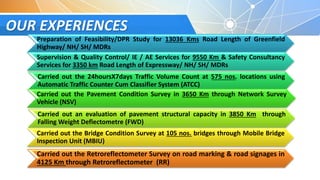
OUR EXPERIENCES
Preparation of Feasibility/DPR Study for 13036 Kms Road Length of Greenfield
Highway/ NH/ SH/ MDRs
Supervision & Quality Control/ IE / AE Services for 9550 Km & Safety Consultancy
Services for 3350 km Road Length of Expressway/ NH/ SH/ MDRs
Carried out the 24hoursX7days Traffic Volume Count at 575 nos. locations using
Automatic Traffic Counter Cum Classifier System (ATCC)
Carried out the Pavement Condition Survey in 3650 Km through Network Survey
Vehicle (NSV)
Carried out an evaluation of pavement structural capacity in 3850 Km through
Falling Weight Deflectometre (FWD)
Carried out the Bridge Condition Survey at 105 nos. bridges through Mobile Bridge
Inspection Unit (MBIU)
Carried out the Retroreflectometer Survey on road marking & road signages in
4125 Km through Retroreflectometer (RR)
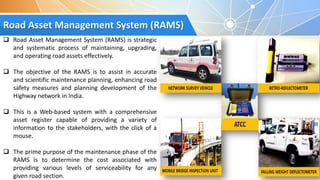
Road Asset Management System (RAMS)
 Road Asset Management System (RAMS) is strategic
and systematic process of maintaining, upgrading,
and operating road assets effectively.
 The objective of the RAMS is to assist in accurate
and scientific maintenance planning, enhancing road
safety measures and planning development of the
Highway network in India.
 This is a Web-based system with a comprehensive
asset register capable of providing a variety of
information to the stakeholders, with the click of a
mouse.
 The prime purpose of the maintenance phase of the
RAMS is to determine the cost associated with
providing various levels of serviceability for any
given road section.
Automatic Traffic Counter Cum Classifier
System (ATCC)
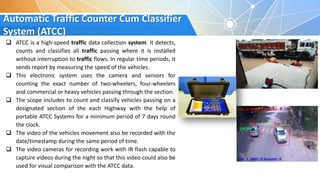
 ATCC is a high-speed traffic data collection system. It detects,
counts and classifies all traffic passing where it is installed
without interruption to traffic flows. In regular time periods, it
sends report by measuring the speed of the vehicles.
 This electronic system uses the camera and sensors for
counting the exact number of two-wheelers, four-wheelers
and commercial or heavy vehicles passing through the section.
 The scope includes to count and classify vehicles passing on a
designated section of the each Highway with the help of
portable ATCC Systems for a minimum period of 7 days round
the clock.
 The video of the vehicles movement also be recorded with the
date/timestamp during the same period of time.
 The video cameras for recording work with IR flash capable to
capture videos during the night so that this video could also be
used for visual comparison with the ATCC data.
Network Survey Vehicle (NSV)
for Road Asset Management (RAMS)
 MORTH has been mandated to conduct Road
Inventory & Condition Survey using NSV vide Circular
no. RW/NH-33044/32/2019-S&R (P&B) dt.
13.11.2019.
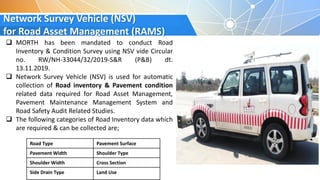
 Network Survey Vehicle (NSV) is used for automatic
collection of Road inventory & Pavement condition
related data required for Road Asset Management,
Pavement Maintenance Management System and
Road Safety Audit Related Studies.
 The following categories of Road Inventory data which
are required & can be collected are;
Road Type Pavement Surface
Pavement Width Shoulder Type
Shoulder Width Cross Section
Side Drain Type Land Use
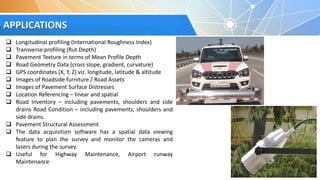
APPLICATIONS
 Longitudinal profiling (International Roughness Index)
 Transverse profiling (Rut Depth)
 Pavement Texture in terms of Mean Profile Depth
 Road Geometry Data (cross slope, gradient, curvature)
 GPS coordinates (X, Y, Z) viz. longitude, latitude & altitude
 Images of Roadside furniture / Road Assets
 Images of Pavement Surface Distresses
 Location Referencing – linear and spatial
 Road Inventory – including pavements, shoulders and side
drains Road Condition – including pavements, shoulders and
side drains.
 Pavement Structural Assessment
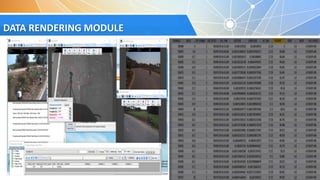
 The data acquisition software has a spatial data viewing
feature to plan the survey and monitor the cameras and
lasers during the survey.
 Useful for Highway Maintenance, Airport runway
Maintenance
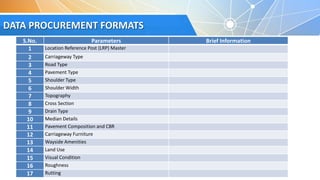
DATA PROCUREMENT FORMATS
S.No. Parameters Brief Information
1 Location Reference Post (LRP) Master
2 Carriageway Type
3 Road Type
4 Pavement Type
5 Shoulder Type
6 Shoulder Width
7 Topography
8 Cross Section
9 Drain Type
10 Median Details
11 Pavement Composition and CBR
12 Carriageway Furniture
13 Wayside Amenities
14 Land Use
15 Visual Condition
16 Roughness
17 Rutting
DATA PROCUREMENT FORMATS
DATA RENDERING MODULE
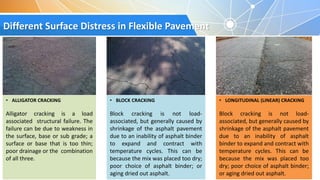
Different Surface Distress in Flexible Pavement
• ALLIGATOR CRACKING
Alligator cracking is a load
associated structural failure. The
failure can be due to weakness in
the surface, base or sub grade; a
surface or base that is too thin;
poor drainage or the combination
of all three.
• BLOCK CRACKING
Block cracking is not load-
associated, but generally caused by
shrinkage of the asphalt pavement
due to an inability of asphalt binder
to expand and contract with
temperature cycles. This can be
because the mix was placed too dry;
poor choice of asphalt binder; or
aging dried out asphalt.
• LONGITUDINAL (LINEAR) CRACKING
Block cracking is not load-
associated, but generally caused by
shrinkage of the asphalt pavement
due to an inability of asphalt
binder to expand and contract with
temperature cycles. This can be
because the mix was placed too
dry; poor choice of asphalt binder;
or aging dried out asphalt.
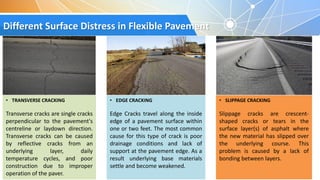
Different Surface Distress in Flexible Pavement
• TRANSVERSE CRACKING
Transverse cracks are single cracks
perpendicular to the pavement's
centreline or laydown direction.
Transverse cracks can be caused
by reflective cracks from an
underlying layer, daily
temperature cycles, and poor
construction due to improper
operation of the paver.
• EDGE CRACKING
Edge Cracks travel along the inside
edge of a pavement surface within
one or two feet. The most common
cause for this type of crack is poor
drainage conditions and lack of
support at the pavement edge. As a
result underlying base materials
settle and become weakened.
• SLIPPAGE CRACKING
Slippage cracks are crescent-
shaped cracks or tears in the
surface layer(s) of asphalt where
the new material has slipped over
the underlying course. This
problem is caused by a lack of
bonding between layers.
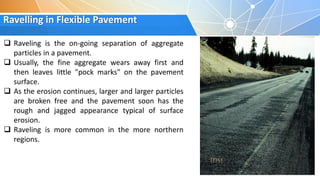
Ravelling in Flexible Pavement
 Raveling is the on-going separation of aggregate
particles in a pavement.
 Usually, the fine aggregate wears away first and
then leaves little "pock marks" on the pavement
surface.
 As the erosion continues, larger and larger particles
are broken free and the pavement soon has the
rough and jagged appearance typical of surface
erosion.
 Raveling is more common in the more northern
regions.
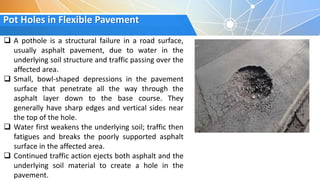
Pot Holes in Flexible Pavement
 A pothole is a structural failure in a road surface,
usually asphalt pavement, due to water in the
underlying soil structure and traffic passing over the
affected area.
 Small, bowl-shaped depressions in the pavement
surface that penetrate all the way through the
asphalt layer down to the base course. They
generally have sharp edges and vertical sides near
the top of the hole.
 Water first weakens the underlying soil; traffic then
fatigues and breaks the poorly supported asphalt
surface in the affected area.
 Continued traffic action ejects both asphalt and the
underlying soil material to create a hole in the
pavement.
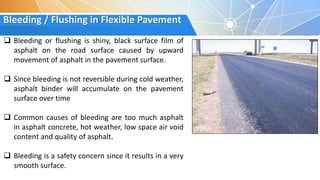
Bleeding / Flushing in Flexible Pavement
 Bleeding or flushing is shiny, black surface film of
asphalt on the road surface caused by upward
movement of asphalt in the pavement surface.
 Since bleeding is not reversible during cold weather,
asphalt binder will accumulate on the pavement
surface over time
 Common causes of bleeding are too much asphalt
in asphalt concrete, hot weather, low space air void
content and quality of asphalt.
 Bleeding is a safety concern since it results in a very
smooth surface.
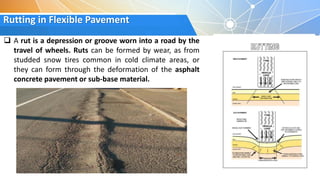
Rutting in Flexible Pavement
 A rut is a depression or groove worn into a road by the
travel of wheels. Ruts can be formed by wear, as from
studded snow tires common in cold climate areas, or
they can form through the deformation of the asphalt
concrete pavement or sub-base material.
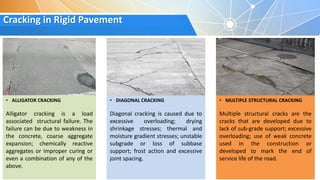
Cracking in Rigid Pavement
• ALLIGATOR CRACKING
Alligator cracking is a load
associated structural failure. The
failure can be due to weakness in
the concrete, coarse aggregate
expansion; chemically reactive
aggregates or improper curing or
even a combination of any of the
above.
• DIAGONAL CRACKING
Diagonal cracking is caused due to
excessive overloading; drying
shrinkage stresses; thermal and
moisture gradient stresses; unstable
subgrade or loss of subbase
support; frost action and excessive
joint spacing.
• MULTIPLE STRUCTURAL CRACKING
Multiple structural cracks are the
cracks that are developed due to
lack of sub-grade support; excessive
overloading; use of weak concrete
used in the construction or
developed to mark the end of
service life of the road.
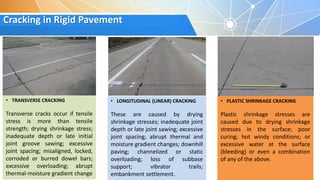
Cracking in Rigid Pavement
• TRANSVERSE CRACKING
Transverse cracks occur if tensile
stress is more than tensile
strength; drying shrinkage stress;
inadequate depth or late initial
joint groove sawing; excessive
joint spacing; misaligned, locked,
corroded or burred dowel bars;
excessive overloading; abrupt
thermal-moisture gradient change
• PLASTIC SHRINKAGE CRACKING
Plastic shrinkage stresses are
caused due to drying shrinkage
stresses in the surface; poor
curing; hot windy conditions; or
excessive water at the surface
(bleeding) or even a combination
of any of the above.
• LONGITUDINAL (LINEAR) CRACKING
These are caused by drying
shrinkage stresses; inadequate joint
depth or late joint sawing; excessive
joint spacing; abrupt thermal and
moisture gradient changes; downhill
paving; channelized or static
overloading; loss of subbase
support; vibrator trails;
embankment settlement.
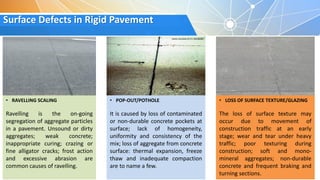
Surface Defects in Rigid Pavement
• RAVELLING SCALING
Ravelling is the on-going
segregation of aggregate particles
in a pavement. Unsound or dirty
aggregates; weak concrete;
inappropriate curing; crazing or
fine alligator cracks; frost action
and excessive abrasion are
common causes of ravelling.
• POP-OUT/POTHOLE
It is caused by loss of contaminated
or non-durable concrete pockets at
surface; lack of homogeneity,
uniformity and consistency of the
mix; loss of aggregate from concrete
surface: thermal expansion, freeze
thaw and inadequate compaction
are to name a few.
• LOSS OF SURFACE TEXTURE/GLAZING
The loss of surface texture may
occur due to movement of
construction traffic at an early
stage; wear and tear under heavy
traffic; poor texturing during
construction; soft and mono-
mineral aggregates; non-durable
concrete and frequent braking and
turning sections.
Joint Defects in Rigid Pavement
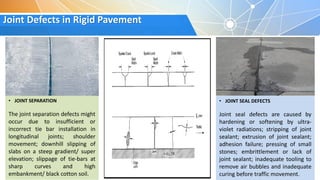
• JOINT SEPARATION
The joint separation defects might
occur due to insufficient or
incorrect tie bar installation in
longitudinal joints; shoulder
movement; downhill slipping of
slabs on a steep gradient/ super
elevation; slippage of tie-bars at
sharp curves and high
embankment/ black cotton soil.
• JOINT SEAL DEFECTS
Joint seal defects are caused by
hardening or softening by ultra-
violet radiations; stripping of joint
sealant; extrusion of joint sealant;
adhesion failure; pressing of small
stones; embrittlement or lack of
joint sealant; inadequate tooling to
remove air bubbles and inadequate
curing before traffic movement.
Joint Defects in Rigid Pavement
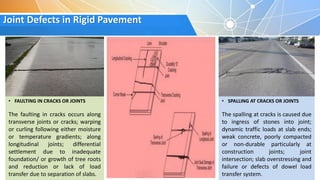
• SPALLING AT CRACKS OR JOINTS
The spalling at cracks is caused due
to ingress of stones into joint;
dynamic traffic loads at slab ends;
weak concrete, poorly compacted
or non-durable particularly at
construction joints; joint
intersection; slab overstressing and
failure or defects of dowel load
transfer system.
• FAULTING IN CRACKS OR JOINTS
The faulting in cracks occurs along
transverse joints or cracks; warping
or curling following either moisture
or temperature gradients; along
longitudinal joints; differential
settlement due to inadequate
foundation/ or growth of tree roots
and reduction or lack of load
transfer due to separation of slabs.
Deformation in Rigid Pavement
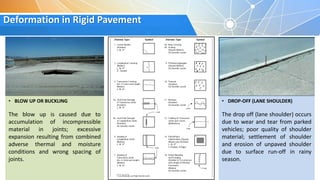
• DROP-OFF (LANE SHOULDER)
The drop off (lane shoulder) occurs
due to wear and tear from parked
vehicles; poor quality of shoulder
material; settlement of shoulder
and erosion of unpaved shoulder
due to surface run-off in rainy
season.
• BLOW UP OR BUCKLING
The blow up is caused due to
accumulation of incompressible
material in joints; excessive
expansion resulting from combined
adverse thermal and moisture
conditions and wrong spacing of
joints.
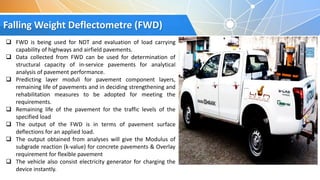
Falling Weight Deflectometre (FWD)
 FWD is being used for NDT and evaluation of load carrying
capability of highways and airfield pavements.
 Data collected from FWD can be used for determination of
structural capacity of in-service pavements for analytical
analysis of pavement performance.
 Predicting layer moduli for pavement component layers,
remaining life of pavements and in deciding strengthening and
rehabilitation measures to be adopted for meeting the
requirements.
 Remaining life of the pavement for the traffic levels of the
specified load
 The output of the FWD is in terms of pavement surface
deflections for an applied load.
 The output obtained from analyses will give the Modulus of
subgrade reaction (k-value) for concrete pavements & Overlay
requirement for flexible pavement
 The vehicle also consist electricity generator for charging the
device instantly.
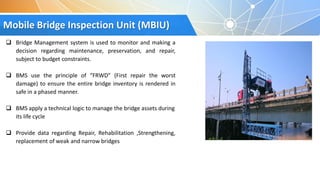
Mobile Bridge Inspection Unit (MBIU)
 Bridge Management system is used to monitor and making a
decision regarding maintenance, preservation, and repair,
subject to budget constraints.
 BMS use the principle of “FRWD” (First repair the worst
damage) to ensure the entire bridge inventory is rendered in
safe in a phased manner.
 BMS apply a technical logic to manage the bridge assets during
its life cycle
 Provide data regarding Repair, Rehabilitation ,Strengthening,
replacement of weak and narrow bridges
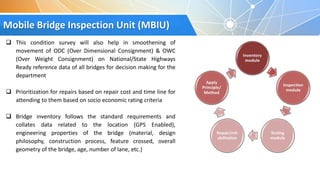
Mobile Bridge Inspection Unit (MBIU)
 This condition survey will also help in smoothening of
movement of ODC (Over Dimensional Consignment) & OWC
(Over Weight Consignment) on National/State Highways
Ready reference data of all bridges for decision making for the
department
 Prioritization for repairs based on repair cost and time line for
attending to them based on socio economic rating criteria
 Bridge inventory follows the standard requirements and
collates data related to the location (GPS Enabled),
engineering properties of the bridge (material, design
philosophy, construction process, feature crossed, overall
geometry of the bridge, age, number of lane, etc.)
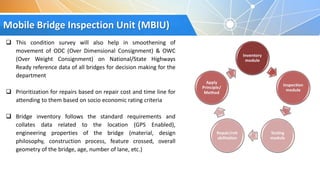
Mobile Bridge Inspection Unit (MBIU)
 This condition survey will also help in smoothening of
movement of ODC (Over Dimensional Consignment) & OWC
(Over Weight Consignment) on National/State Highways
Ready reference data of all bridges for decision making for the
department
 Prioritization for repairs based on repair cost and time line for
attending to them based on socio economic rating criteria
 Bridge inventory follows the standard requirements and
collates data related to the location (GPS Enabled),
engineering properties of the bridge (material, design
philosophy, construction process, feature crossed, overall
geometry of the bridge, age, number of lane, etc.)
Retro Reflectometer (RR)
 This tool is used for measuring pavement marking
retroreflectivity. It measures or determines how bright the
markings appear at night to motorists.
 This instrument is also capable of accurately and reliably
measuring the retroreflection properties of road signs and
retroreflective sheeting materials.
 Real life scenario of different entrance and observation angles
are created in the instrument for the matrix angles given in
the standards.
 Coefficient of retro reflection of sign sheets for different
standard angles can be measured.
Thank You !!
LION ENGINEERING
CONSULTANTS PVT. LTD.
(Road Asset Management System Solutions)
Mr. VIKAS DIXIT
General Manager (Technical & Business Development)
M: +91 98263 65123, P: +91 755 2879499
Address: Plot No. 97, LION TOWER, Elegant Estate, Near
Mother Teresa School, Kolar Road, Bhopal - 462042.
Website : www.liongroup.in
Email : vikas.dixit@liongroup.in
design@liongroup.in

road-asset-management-survey-services.pdf

  • 2.
    About Us  Incorporatedas wholly owned Firm as “LION ENGINEERING CONSULTANTS” under Section 58(1) of Indian Partnership Act 1932, in 2002. Now, it is converted into “LION ENGINEERING CONSULTANTS PRIVATE LIMITED”.  LECPL deals with DPRs, Techno-Economic Feasibility, Safety Consultant, Urban Planning & Development, Authority Engineer, Independent Engineer, PMC, Supervision Consultant, Proof Checking, Pre-bid Advisory Services, Lenders Engineer, Operation & Maintenance, Road Asset Management, PPP Advisory Services, Technical and Operational Evaluation of Toll Plaza.
  • 3.
    About Us  LECPLis currently working with National Highways Authority of India (NHAI), Ministry of Road Transport and Highways (MORTH), National Highways and Infrastructure Development and Corporation Limited (NHIDCL), Public Works Department (MP, MH, AP, Assam, Orissa, CG, Haryana, UP, Rajasthan), MSRDC, MPRDC, UPSHA, SHAJ, NRDA, BRO, NTPC, HSRDC, CGRDC, MPUDC, Dedicated Freight Corridor Corporation of India, IRCON; to name a few on various BOT (Toll/Annuity), EPC, Hybrid Annuity, TOT and SQC projects.  Working with a team of dedicated work force of more than 945 employees having specialization in various infrastructure disciplines placed at 55 no. of offices across India.  Group Net Worth is in Excess of Rs. 100 Crore.
  • 4.
    OUR SECTORS Feasibility Studies &Detailed Engineering Project Report Master Plans Project Management Consultancy Road Safety Technical and Operational Evaluation of Toll Plaza Road Asset Management System PPP Advisory Services Operation & Management Consultancy Transaction Advisory Services Supervision Consultancy Services & Quality Control Electrical & Electronic Services IT & Technology Services
  • 5.
    OUR BUSINESS AREA Multimodal Transportation Railways,Roads, Tunnels, Building & Structures Smart City, Urban Planning and Transportation Waste Water Treatment / Underground Sewerage System Urban and Environmental Planning Geotechnical Engineering & Soil Mechanics Smart Toll Management System IT enabled Integrated Border Check Posts
  • 6.
    OUR EXPERIENCES Preparation ofFeasibility/DPR Study for 13036 Kms Road Length of Greenfield Highway/ NH/ SH/ MDRs Supervision & Quality Control/ IE / AE Services for 9550 Km & Safety Consultancy Services for 3350 km Road Length of Expressway/ NH/ SH/ MDRs Carried out the 24hoursX7days Traffic Volume Count at 575 nos. locations using Automatic Traffic Counter Cum Classifier System (ATCC) Carried out the Pavement Condition Survey in 3650 Km through Network Survey Vehicle (NSV) Carried out an evaluation of pavement structural capacity in 3850 Km through Falling Weight Deflectometre (FWD) Carried out the Bridge Condition Survey at 105 nos. bridges through Mobile Bridge Inspection Unit (MBIU) Carried out the Retroreflectometer Survey on road marking & road signages in 4125 Km through Retroreflectometer (RR)
  • 7.
    Road Asset ManagementSystem (RAMS)  Road Asset Management System (RAMS) is strategic and systematic process of maintaining, upgrading, and operating road assets effectively.  The objective of the RAMS is to assist in accurate and scientific maintenance planning, enhancing road safety measures and planning development of the Highway network in India.  This is a Web-based system with a comprehensive asset register capable of providing a variety of information to the stakeholders, with the click of a mouse.  The prime purpose of the maintenance phase of the RAMS is to determine the cost associated with providing various levels of serviceability for any given road section.
  • 8.
    Automatic Traffic CounterCum Classifier System (ATCC)  ATCC is a high-speed traffic data collection system. It detects, counts and classifies all traffic passing where it is installed without interruption to traffic flows. In regular time periods, it sends report by measuring the speed of the vehicles.  This electronic system uses the camera and sensors for counting the exact number of two-wheelers, four-wheelers and commercial or heavy vehicles passing through the section.  The scope includes to count and classify vehicles passing on a designated section of the each Highway with the help of portable ATCC Systems for a minimum period of 7 days round the clock.  The video of the vehicles movement also be recorded with the date/timestamp during the same period of time.  The video cameras for recording work with IR flash capable to capture videos during the night so that this video could also be used for visual comparison with the ATCC data.
  • 9.
    Network Survey Vehicle(NSV) for Road Asset Management (RAMS)  MORTH has been mandated to conduct Road Inventory & Condition Survey using NSV vide Circular no. RW/NH-33044/32/2019-S&R (P&B) dt. 13.11.2019.  Network Survey Vehicle (NSV) is used for automatic collection of Road inventory & Pavement condition related data required for Road Asset Management, Pavement Maintenance Management System and Road Safety Audit Related Studies.  The following categories of Road Inventory data which are required & can be collected are; Road Type Pavement Surface Pavement Width Shoulder Type Shoulder Width Cross Section Side Drain Type Land Use
  • 10.
    APPLICATIONS  Longitudinal profiling(International Roughness Index)  Transverse profiling (Rut Depth)  Pavement Texture in terms of Mean Profile Depth  Road Geometry Data (cross slope, gradient, curvature)  GPS coordinates (X, Y, Z) viz. longitude, latitude & altitude  Images of Roadside furniture / Road Assets  Images of Pavement Surface Distresses  Location Referencing – linear and spatial  Road Inventory – including pavements, shoulders and side drains Road Condition – including pavements, shoulders and side drains.  Pavement Structural Assessment  The data acquisition software has a spatial data viewing feature to plan the survey and monitor the cameras and lasers during the survey.  Useful for Highway Maintenance, Airport runway Maintenance
  • 11.
    DATA PROCUREMENT FORMATS S.No.Parameters Brief Information 1 Location Reference Post (LRP) Master 2 Carriageway Type 3 Road Type 4 Pavement Type 5 Shoulder Type 6 Shoulder Width 7 Topography 8 Cross Section 9 Drain Type 10 Median Details 11 Pavement Composition and CBR 12 Carriageway Furniture 13 Wayside Amenities 14 Land Use 15 Visual Condition 16 Roughness 17 Rutting DATA PROCUREMENT FORMATS
  • 12.
  • 13.
    Different Surface Distressin Flexible Pavement • ALLIGATOR CRACKING Alligator cracking is a load associated structural failure. The failure can be due to weakness in the surface, base or sub grade; a surface or base that is too thin; poor drainage or the combination of all three. • BLOCK CRACKING Block cracking is not load- associated, but generally caused by shrinkage of the asphalt pavement due to an inability of asphalt binder to expand and contract with temperature cycles. This can be because the mix was placed too dry; poor choice of asphalt binder; or aging dried out asphalt. • LONGITUDINAL (LINEAR) CRACKING Block cracking is not load- associated, but generally caused by shrinkage of the asphalt pavement due to an inability of asphalt binder to expand and contract with temperature cycles. This can be because the mix was placed too dry; poor choice of asphalt binder; or aging dried out asphalt.
  • 14.
    Different Surface Distressin Flexible Pavement • TRANSVERSE CRACKING Transverse cracks are single cracks perpendicular to the pavement's centreline or laydown direction. Transverse cracks can be caused by reflective cracks from an underlying layer, daily temperature cycles, and poor construction due to improper operation of the paver. • EDGE CRACKING Edge Cracks travel along the inside edge of a pavement surface within one or two feet. The most common cause for this type of crack is poor drainage conditions and lack of support at the pavement edge. As a result underlying base materials settle and become weakened. • SLIPPAGE CRACKING Slippage cracks are crescent- shaped cracks or tears in the surface layer(s) of asphalt where the new material has slipped over the underlying course. This problem is caused by a lack of bonding between layers.
  • 15.
    Ravelling in FlexiblePavement  Raveling is the on-going separation of aggregate particles in a pavement.  Usually, the fine aggregate wears away first and then leaves little "pock marks" on the pavement surface.  As the erosion continues, larger and larger particles are broken free and the pavement soon has the rough and jagged appearance typical of surface erosion.  Raveling is more common in the more northern regions.
  • 16.
    Pot Holes inFlexible Pavement  A pothole is a structural failure in a road surface, usually asphalt pavement, due to water in the underlying soil structure and traffic passing over the affected area.  Small, bowl-shaped depressions in the pavement surface that penetrate all the way through the asphalt layer down to the base course. They generally have sharp edges and vertical sides near the top of the hole.  Water first weakens the underlying soil; traffic then fatigues and breaks the poorly supported asphalt surface in the affected area.  Continued traffic action ejects both asphalt and the underlying soil material to create a hole in the pavement.
  • 17.
    Bleeding / Flushingin Flexible Pavement  Bleeding or flushing is shiny, black surface film of asphalt on the road surface caused by upward movement of asphalt in the pavement surface.  Since bleeding is not reversible during cold weather, asphalt binder will accumulate on the pavement surface over time  Common causes of bleeding are too much asphalt in asphalt concrete, hot weather, low space air void content and quality of asphalt.  Bleeding is a safety concern since it results in a very smooth surface.
  • 18.
    Rutting in FlexiblePavement  A rut is a depression or groove worn into a road by the travel of wheels. Ruts can be formed by wear, as from studded snow tires common in cold climate areas, or they can form through the deformation of the asphalt concrete pavement or sub-base material.
  • 19.
    Cracking in RigidPavement • ALLIGATOR CRACKING Alligator cracking is a load associated structural failure. The failure can be due to weakness in the concrete, coarse aggregate expansion; chemically reactive aggregates or improper curing or even a combination of any of the above. • DIAGONAL CRACKING Diagonal cracking is caused due to excessive overloading; drying shrinkage stresses; thermal and moisture gradient stresses; unstable subgrade or loss of subbase support; frost action and excessive joint spacing. • MULTIPLE STRUCTURAL CRACKING Multiple structural cracks are the cracks that are developed due to lack of sub-grade support; excessive overloading; use of weak concrete used in the construction or developed to mark the end of service life of the road.
  • 20.
    Cracking in RigidPavement • TRANSVERSE CRACKING Transverse cracks occur if tensile stress is more than tensile strength; drying shrinkage stress; inadequate depth or late initial joint groove sawing; excessive joint spacing; misaligned, locked, corroded or burred dowel bars; excessive overloading; abrupt thermal-moisture gradient change • PLASTIC SHRINKAGE CRACKING Plastic shrinkage stresses are caused due to drying shrinkage stresses in the surface; poor curing; hot windy conditions; or excessive water at the surface (bleeding) or even a combination of any of the above. • LONGITUDINAL (LINEAR) CRACKING These are caused by drying shrinkage stresses; inadequate joint depth or late joint sawing; excessive joint spacing; abrupt thermal and moisture gradient changes; downhill paving; channelized or static overloading; loss of subbase support; vibrator trails; embankment settlement.
  • 21.
    Surface Defects inRigid Pavement • RAVELLING SCALING Ravelling is the on-going segregation of aggregate particles in a pavement. Unsound or dirty aggregates; weak concrete; inappropriate curing; crazing or fine alligator cracks; frost action and excessive abrasion are common causes of ravelling. • POP-OUT/POTHOLE It is caused by loss of contaminated or non-durable concrete pockets at surface; lack of homogeneity, uniformity and consistency of the mix; loss of aggregate from concrete surface: thermal expansion, freeze thaw and inadequate compaction are to name a few. • LOSS OF SURFACE TEXTURE/GLAZING The loss of surface texture may occur due to movement of construction traffic at an early stage; wear and tear under heavy traffic; poor texturing during construction; soft and mono- mineral aggregates; non-durable concrete and frequent braking and turning sections.
  • 22.
    Joint Defects inRigid Pavement • JOINT SEPARATION The joint separation defects might occur due to insufficient or incorrect tie bar installation in longitudinal joints; shoulder movement; downhill slipping of slabs on a steep gradient/ super elevation; slippage of tie-bars at sharp curves and high embankment/ black cotton soil. • JOINT SEAL DEFECTS Joint seal defects are caused by hardening or softening by ultra- violet radiations; stripping of joint sealant; extrusion of joint sealant; adhesion failure; pressing of small stones; embrittlement or lack of joint sealant; inadequate tooling to remove air bubbles and inadequate curing before traffic movement.
  • 23.
    Joint Defects inRigid Pavement • SPALLING AT CRACKS OR JOINTS The spalling at cracks is caused due to ingress of stones into joint; dynamic traffic loads at slab ends; weak concrete, poorly compacted or non-durable particularly at construction joints; joint intersection; slab overstressing and failure or defects of dowel load transfer system. • FAULTING IN CRACKS OR JOINTS The faulting in cracks occurs along transverse joints or cracks; warping or curling following either moisture or temperature gradients; along longitudinal joints; differential settlement due to inadequate foundation/ or growth of tree roots and reduction or lack of load transfer due to separation of slabs.
  • 24.
    Deformation in RigidPavement • DROP-OFF (LANE SHOULDER) The drop off (lane shoulder) occurs due to wear and tear from parked vehicles; poor quality of shoulder material; settlement of shoulder and erosion of unpaved shoulder due to surface run-off in rainy season. • BLOW UP OR BUCKLING The blow up is caused due to accumulation of incompressible material in joints; excessive expansion resulting from combined adverse thermal and moisture conditions and wrong spacing of joints.
  • 25.
    Falling Weight Deflectometre(FWD)  FWD is being used for NDT and evaluation of load carrying capability of highways and airfield pavements.  Data collected from FWD can be used for determination of structural capacity of in-service pavements for analytical analysis of pavement performance.  Predicting layer moduli for pavement component layers, remaining life of pavements and in deciding strengthening and rehabilitation measures to be adopted for meeting the requirements.  Remaining life of the pavement for the traffic levels of the specified load  The output of the FWD is in terms of pavement surface deflections for an applied load.  The output obtained from analyses will give the Modulus of subgrade reaction (k-value) for concrete pavements & Overlay requirement for flexible pavement  The vehicle also consist electricity generator for charging the device instantly.
  • 26.
    Mobile Bridge InspectionUnit (MBIU)  Bridge Management system is used to monitor and making a decision regarding maintenance, preservation, and repair, subject to budget constraints.  BMS use the principle of “FRWD” (First repair the worst damage) to ensure the entire bridge inventory is rendered in safe in a phased manner.  BMS apply a technical logic to manage the bridge assets during its life cycle  Provide data regarding Repair, Rehabilitation ,Strengthening, replacement of weak and narrow bridges
  • 27.
    Mobile Bridge InspectionUnit (MBIU)  This condition survey will also help in smoothening of movement of ODC (Over Dimensional Consignment) & OWC (Over Weight Consignment) on National/State Highways Ready reference data of all bridges for decision making for the department  Prioritization for repairs based on repair cost and time line for attending to them based on socio economic rating criteria  Bridge inventory follows the standard requirements and collates data related to the location (GPS Enabled), engineering properties of the bridge (material, design philosophy, construction process, feature crossed, overall geometry of the bridge, age, number of lane, etc.)
  • 28.
    Mobile Bridge InspectionUnit (MBIU)  This condition survey will also help in smoothening of movement of ODC (Over Dimensional Consignment) & OWC (Over Weight Consignment) on National/State Highways Ready reference data of all bridges for decision making for the department  Prioritization for repairs based on repair cost and time line for attending to them based on socio economic rating criteria  Bridge inventory follows the standard requirements and collates data related to the location (GPS Enabled), engineering properties of the bridge (material, design philosophy, construction process, feature crossed, overall geometry of the bridge, age, number of lane, etc.)
  • 29.
    Retro Reflectometer (RR) This tool is used for measuring pavement marking retroreflectivity. It measures or determines how bright the markings appear at night to motorists.  This instrument is also capable of accurately and reliably measuring the retroreflection properties of road signs and retroreflective sheeting materials.  Real life scenario of different entrance and observation angles are created in the instrument for the matrix angles given in the standards.  Coefficient of retro reflection of sign sheets for different standard angles can be measured.
  • 30.
    Thank You !! LIONENGINEERING CONSULTANTS PVT. LTD. (Road Asset Management System Solutions) Mr. VIKAS DIXIT General Manager (Technical & Business Development) M: +91 98263 65123, P: +91 755 2879499 Address: Plot No. 97, LION TOWER, Elegant Estate, Near Mother Teresa School, Kolar Road, Bhopal - 462042. Website : www.liongroup.in Email : vikas.dixit@liongroup.in design@liongroup.in