SYNTHETIC BIOMATERIALS
AND POLYMERS IN MEDICINE
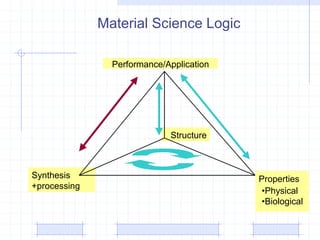
Material Science Logic
Synthesis
+processing
Structure
Performance/Application
Properties
•Physical
•Biological
Biomaterials
• Biomaterials are materials that are designed for
in-vivo use
• The study of biomaterials focuses on
controlling/understanding the performance and
interaction of synthetic or modified biological
materials in biological systems, especially at the
interface between synthetic and biological
materials (biocompatibility)
A biomaterial is "any substance (other than drugs)
or combination of substances synthetic or natural
in origin, which can be used for any period of time,
as a whole or as a part of a system which treats,
augments, or replaces any tissue, organ, or
function of the body".
Biocompatibility — The ability of a material to
perform with an appropriate host response in a
specific application
Host Response — The response of the host
organism (local and systemic) to the implanted
material or device.
Definitions
• Biomaterial - Material for in-vivo use
• Biocompatible - No adverse affects on
biological system
• Bioinert - No interaction with biological system
• Bioerodable - Dissolves in biological system
over time
Keywords
 Metallic/glass/Polymeric/Ceramic/Composite
 Fracture/fatigue/creep/corrosion/degradation
 Tissue response/healing/biocompatibility/host
response/carcinogenicity
 Hard/soft tissue implants
 Vascular/Breast/Urological/Art. Organ
 Mucosal contacting …
Biomaterial Selection Parameters
Mechanical
Thermal/Electrical Conductivity
Diffusion
Water Absorption
Biostability
Biocompatibility
Biomaterial Selection Criteria
• Specific Surface Interactions
• Blood Contact
• Need to Bear a Load
• Structural Applications
• Degradation Propensity
• Permeability Responsiveness
• Solubility under Physiological Conditions
• Transparency Need
• Bioenvironmental Responsiveness
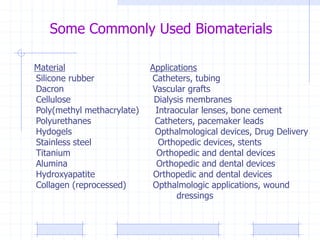
Some Commonly Used Biomaterials
Material Applications
Silicone rubber Catheters, tubing
Dacron Vascular grafts
Cellulose Dialysis membranes
Poly(methyl methacrylate) Intraocular lenses, bone cement
Polyurethanes Catheters, pacemaker leads
Hydogels Opthalmological devices, Drug Delivery
Stainless steel Orthopedic devices, stents
Titanium Orthopedic and dental devices
Alumina Orthopedic and dental devices
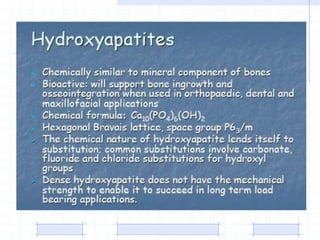
Hydroxyapatite Orthopedic and dental devices
Collagen (reprocessed) Opthalmologic applications, wound
dressings
Journals
 Biomaterials
 Biomaterials World News
 Materials Today
 Nature
 Journal of Biomedical Materials Research
 Cells and Materials
 Journal of Biomaterials Science
 Artificial Organs
 ASAIO Transactions
 Tissue Engineering
 Annals of Biomedical Engineering
 Medical Device Link
 … see: http://www.biomat.net/biomatnet.asp?group=1_5
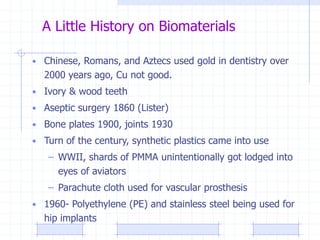
A Little History on Biomaterials
• Chinese, Romans, and Aztecs used gold in dentistry over
2000 years ago, Cu not good.
• Ivory & wood teeth
• Aseptic surgery 1860 (Lister)
• Bone plates 1900, joints 1930
• Turn of the century, synthetic plastics came into use
– WWII, shards of PMMA unintentionally got lodged into
eyes of aviators
– Parachute cloth used for vascular prosthesis
• 1960- Polyethylene (PE) and stainless steel being used for
hip implants
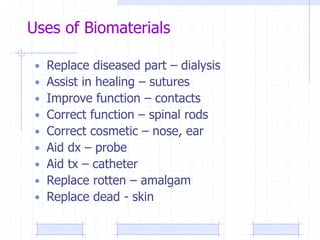
Uses of Biomaterials
• Replace diseased part – dialysis
• Assist in healing – sutures
• Improve function – contacts
• Correct function – spinal rods
• Correct cosmetic – nose, ear
• Aid dx – probe
• Aid tx – catheter
• Replace rotten – amalgam
• Replace dead - skin
Problems/test for w Biomaterials
• Acute toxicity (cytotoxicity) arsenic
• Sub chronic/chronic Pb
• Sensitization Ni, Cu
• Genotoxicity
• Carcinogenicity
• Reproductive &/or developmental Pb
• Neurotoxicity
• Immunotoxicity
• Pyrogen, endotoxins
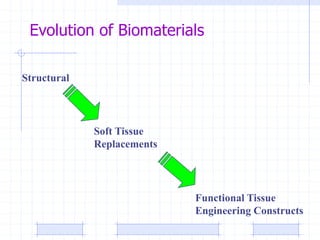
Evolution of Biomaterials
Structural
Functional Tissue
Engineering Constructs
Soft Tissue
Replacements
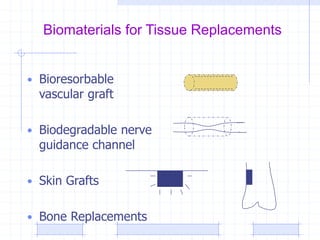
Biomaterials for Tissue Replacements
• Bioresorbable
vascular graft
• Biodegradable nerve
guidance channel
• Skin Grafts
• Bone Replacements
Biomaterials - An Emerging Industry
• Next generation of medical implants and
therapeutic modalities
• Interface of biotechnology and traditional
engineering
• Significant industrial growth in the next 15
years -- potential of a multi-billion dollar
industry
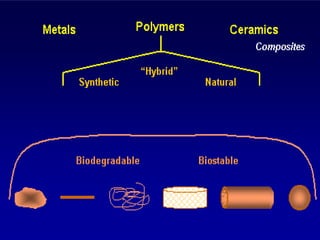
Synthetic Biomaterial Classes
• METALS: Co-Cr alloys, Stainless steels, Gold, Titanium
alloys, Vitallium, Nitinol (shape memory alloys) Uses:
orthopedics, fracture fixation,dental and facial
reconstruction,stents
• CERAMICS: Alumina, Zirconia, Calcium Phosphate,
Pyrolitic Carbon Uses: orthopedics, heart valves, dental
reconstruction
• COATINGS: Bioglasses, Hydroxyapatite, Diamond-like
carbon Uses: orthopedics, in-growth
Synthetic Biomaterial Classes cont.
• POLYMERS: Silicones, Gore-tex (ePTFE),
Polyethylenes(LDPE,HDPE,UHMWPE,) Polyurethanes,
Polymethylmethacrylate,Polysulfone, Delrin
Uses:orthopedics, artificial tendons,catheters, vascular
grafts, facial and soft tissue reconstruction
• COMPOSITES: CFRC, self reinforced, hybrids
Uses:orthopedics, scaffolds
• HYDROGELS: Cellulose, Acrylic co-polymers Uses:drug
delivery, vitreous implants,wound healing
• RESORBABLES: Polyglycolic Acid, Polylactic acid, polyesters
Uses: sutures,drug delivery, in-growth, tissue engineering
Metals
• Metals are (mostly) crystalline solids composed of
elemental, positively charged ions in a cloud of electrons
– Properties are a function of grain size, imperfections in
crystal structure
– Metals comprised of more than one element are alloys
– The surface of metals are often oxides, if inert leads to
protection, if active is corrosion
• Typical metal properties include:
– High melting points
– High stiffness and strength
– High conductivities
– isotropic properties
Why Use Metals as Biomaterials
• Properties and fabrication well known
• Stiff and strong
• Bioinert
• Joining technologies known
• Metals commonly used
– Titanium
– Stainless steel
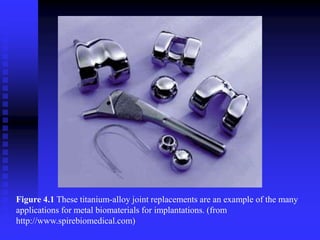
Figure 4.1 These titanium-alloy joint replacements are an example of the many
applications for metal biomaterials for implantations. (from
http://www.spirebiomedical.com)
Ceramics
• Ceramics are compounds characterized by ionic or
covalent bonding
• Ceramics are generally crystalline, crystalline SiO2 is
quartz
• Glasses are the amorphous “ceramics” common glass is
amorphous SiO2
• Properties
– Properties function of grain size, imperfections in
crystal structure
– Many ceramics comprised of more than one compound
– Low conductivities (semi-conductors, insulators)
– Stiff and Brittle
Why Use Ceramics as Biomaterials
• Properties and fabrication well known
• Stiff and strong
• Bioinert
• Obvious fix for teeth and bones
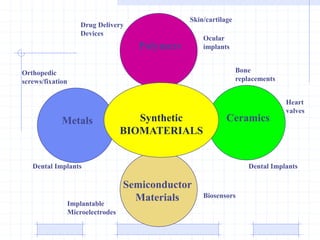
Metals
Semiconductor
Materials
Ceramics
Polymers
Synthetic
BIOMATERIALS
Orthopedic
screws/fixation
Dental Implants Dental Implants
Heart
valves
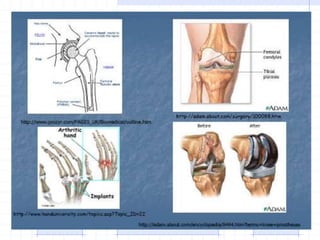
Bone
replacements
Biosensors
Implantable
Microelectrodes
Skin/cartilage
Drug Delivery
Devices
Ocular
implants
Issues
• Understanding and controlling performance
– Physical
– Chemical
– Biological
• Relevant material performance is under biological
conditions
– 37 C, aqueous, saline, extracelluar matrix (ECM)
– Material properties as a function of time
• Initial negative biological response - toxicity
• Long term biological response – rejection
• Biology is a science of surfaces and interfaces
– Seldom (never) at equilibrium
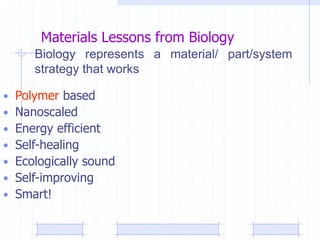
Materials Lessons from Biology
• Polymer based
• Nanoscaled
• Energy efficient
• Self-healing
• Ecologically sound
• Self-improving
• Smart!
Biology represents a material/ part/system
strategy that works
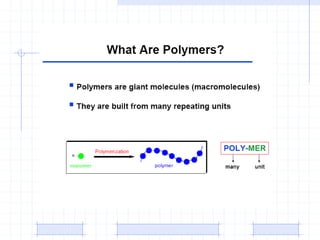
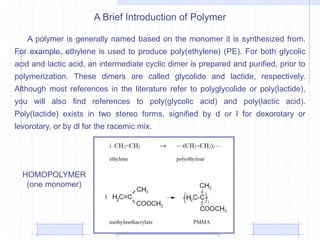
A Brief Introduction of Polymer
A polymer is generally named based on the monomer it is synthesized from.
For example, ethylene is used to produce poly(ethylene) (PE). For both glycolic
acid and lactic acid, an intermediate cyclic dimer is prepared and purified, prior to
polymerization. These dimers are called glycolide and lactide, respectively.
Although most references in the literature refer to polyglycolide or poly(lactide),
you will also find references to poly(glycolic acid) and poly(lactic acid).
Poly(lactide) exists in two stereo forms, signified by d or l for dexorotary or
levorotary, or by dl for the racemic mix.
HOMOPOLYMER
(one monomer)
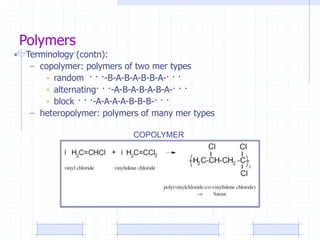
Polymers
• Terminology (contn):
– copolymer: polymers of two mer types
• random · · ·-B-A-B-A-B-B-A-· · ·
• alternating· · ·-A-B-A-B-A-B-A-· · ·
• block · · ·-A-A-A-A-B-B-B-· · ·
– heteropolymer: polymers of many mer types
COPOLYMER
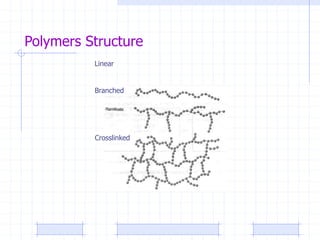
Polymers Structure
Linear
Branched
Crosslinked
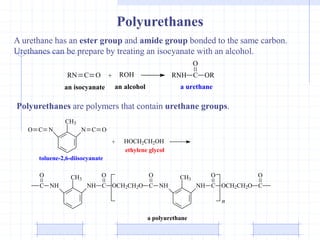
Polyurethanes
A urethane has an ester group and amide group bonded to the same carbon.
Urethanes can be prepare by treating an isocyanate with an alcohol.
RN C O ROH RNH C
O
OR
+
an isocyanate an alcohol a urethane
Polyurethanes are polymers that contain urethane groups.
O C N
CH3
N C O
toluene-2,6-diisocyanate
+ HOCH2CH2OH
ethylene glycol
C
O
NH
CH3
NH C
O
OCH2CH2O C
O
NH NH C
O
OCH2CH2O C
O
CH3
n
a polyurethane
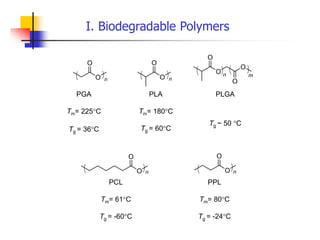
I. Biodegradable Polymers
O
O
n O
O
n
O
O
O
O
n m
PGA
Tm= 225C
Tg = 36C
PPL
Tm= 80C
Tg = -24C
PCL
Tm= 61C
Tg = -60C
PLA
Tm= 180C
Tg = 60C
PLGA
Tg ~ 50 C
O
O
n
O
O
n
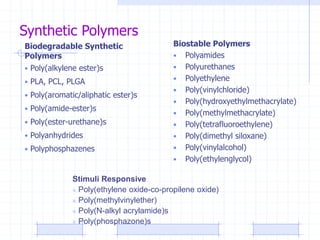
Synthetic Polymers
Biodegradable Synthetic
Polymers
• Poly(alkylene ester)s
• PLA, PCL, PLGA
• Poly(aromatic/aliphatic ester)s
• Poly(amide-ester)s
• Poly(ester-urethane)s
• Polyanhydrides
• Polyphosphazenes
Biostable Polymers
• Polyamides
• Polyurethanes
• Polyethylene
• Poly(vinylchloride)
• Poly(hydroxyethylmethacrylate)
• Poly(methylmethacrylate)
• Poly(tetrafluoroethylene)
• Poly(dimethyl siloxane)
• Poly(vinylalcohol)
• Poly(ethylenglycol)
Stimuli Responsive
 Poly(ethylene oxide-co-propilene oxide)
 Poly(methylvinylether)
 Poly(N-alkyl acrylamide)s
 Poly(phosphazone)s
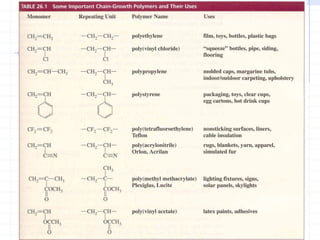
Polymers: Biomedical Applications
• Polyethylene (PE)
– five density grades: ultrahigh, high, low, linear low and
very low density
– UHMWPE and HDPE more crystalline
– UHMWPE has better mechanical properties, stability
and lower cost
– UHMWPE can be sterilized
Polymers: Biomedical Applications
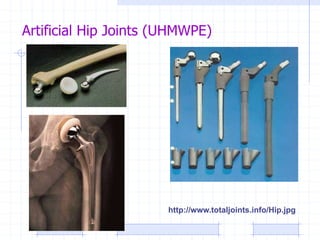
• UHMWPE: acetabular caps in hip implants and
patellar surface of knee joints
• HDPE used as pharmaceutical bottles, fabrics
• Others used as bags, pouches, tubes etc.
Artificial Hip Joints (UHMWPE)
http://www.totaljoints.info/Hip.jpg
Polymers: Biomedical Applications
• Polymethylmethacrylate (PMMA, lucite, acrylic,plexiglas)
– acrylics
– transparency
– tough
– biocompatible
• Used in dental restorations, membrane for dialysis, ocular
lenses, contact lenses, bone cements
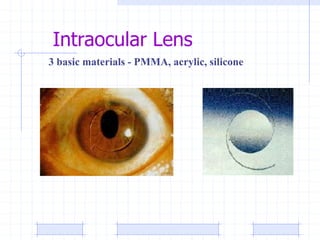
Intraocular Lens
3 basic materials - PMMA, acrylic, silicone
Polymers: Biomedical Applications
• Polyamides (PA, nylon)
– high degree of crystallinity
– interchain hydrogen bonds provide superior mechanical
strength (Kevlar fibers stronger than metals)
– plasticized by water, not good in physiological
environment
• Used as sutures
Polymers: Biomedical Applications
• Polyvinylchloride (PVC) (monomer residue must be very
low)
– Cl side chains
– amorphous, hard and brittle due to Cl
– metallic additives prevent thermal degradation
• Used as blood and solution bags, packaging, IV sets,
dialysis devices, catheter, bottles, cannulae
Polymers: Biomedical Applications
• Polypropylene (PP)
– properties similar to HDPE
– good fatigue resistance
• Used as syringes, oxygenator membranes, sutures, fabrics, vascular
grafts
• Polyesters (PET)
– hydrophobic (beverage container PET)
– molded into complex shapes
• Used as vascular grafts, sutures, heart valves, catheter housings
Polymers: Biomedical Applications
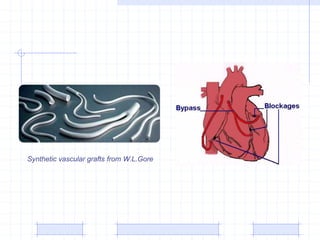
• Polytetrafluoroethylene (PTFE, teflon)
– low coefficient of friction (low interfacial forces
between its surface and another material)
– very low surface energy
– high crystallinity
– low modulus and strength
– difficult to process
• catheters, artificial vascular grafts
Synthetic vascular grafts from W.L.Gore
Polymers: Biomedical Applications
• Rubbers
– latex, silicone
– good biocompatibility
• Used as maxillofacial prosthetics
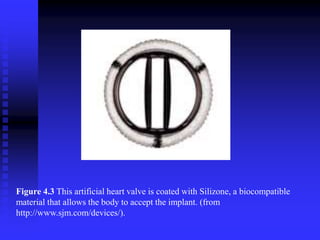
Figure 4.3 This artificial heart valve is coated with Silizone, a biocompatible
material that allows the body to accept the implant. (from
http://www.sjm.com/devices/).
Polymers: Biomedical Applications
• Polyurethanes
– block copolymer structure
– good mechanical properties
– good biocompatibility
• tubing, vascular grafts, pacemaker lead insulation, heart assist
balloon pumps
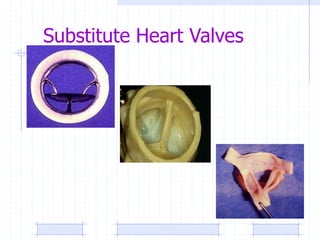
Substitute Heart Valves
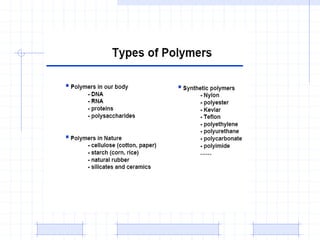
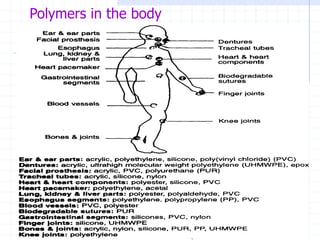
Polymers in the body

Polymers and Biomedical Applications.ppt

  • 1.
  • 2.
  • 4.
    Biomaterials • Biomaterials arematerials that are designed for in-vivo use • The study of biomaterials focuses on controlling/understanding the performance and interaction of synthetic or modified biological materials in biological systems, especially at the interface between synthetic and biological materials (biocompatibility)
  • 5.
    A biomaterial is"any substance (other than drugs) or combination of substances synthetic or natural in origin, which can be used for any period of time, as a whole or as a part of a system which treats, augments, or replaces any tissue, organ, or function of the body". Biocompatibility — The ability of a material to perform with an appropriate host response in a specific application Host Response — The response of the host organism (local and systemic) to the implanted material or device.
  • 6.
    Definitions • Biomaterial -Material for in-vivo use • Biocompatible - No adverse affects on biological system • Bioinert - No interaction with biological system • Bioerodable - Dissolves in biological system over time
  • 7.
    Keywords  Metallic/glass/Polymeric/Ceramic/Composite  Fracture/fatigue/creep/corrosion/degradation Tissue response/healing/biocompatibility/host response/carcinogenicity  Hard/soft tissue implants  Vascular/Breast/Urological/Art. Organ  Mucosal contacting …
  • 8.
    Biomaterial Selection Parameters Mechanical Thermal/ElectricalConductivity Diffusion Water Absorption Biostability Biocompatibility
  • 9.
    Biomaterial Selection Criteria •Specific Surface Interactions • Blood Contact • Need to Bear a Load • Structural Applications • Degradation Propensity • Permeability Responsiveness • Solubility under Physiological Conditions • Transparency Need • Bioenvironmental Responsiveness
  • 10.
    Some Commonly UsedBiomaterials Material Applications Silicone rubber Catheters, tubing Dacron Vascular grafts Cellulose Dialysis membranes Poly(methyl methacrylate) Intraocular lenses, bone cement Polyurethanes Catheters, pacemaker leads Hydogels Opthalmological devices, Drug Delivery Stainless steel Orthopedic devices, stents Titanium Orthopedic and dental devices Alumina Orthopedic and dental devices Hydroxyapatite Orthopedic and dental devices Collagen (reprocessed) Opthalmologic applications, wound dressings
  • 11.
    Journals  Biomaterials  BiomaterialsWorld News  Materials Today  Nature  Journal of Biomedical Materials Research  Cells and Materials  Journal of Biomaterials Science  Artificial Organs  ASAIO Transactions  Tissue Engineering  Annals of Biomedical Engineering  Medical Device Link  … see: http://www.biomat.net/biomatnet.asp?group=1_5
  • 12.
    A Little Historyon Biomaterials • Chinese, Romans, and Aztecs used gold in dentistry over 2000 years ago, Cu not good. • Ivory & wood teeth • Aseptic surgery 1860 (Lister) • Bone plates 1900, joints 1930 • Turn of the century, synthetic plastics came into use – WWII, shards of PMMA unintentionally got lodged into eyes of aviators – Parachute cloth used for vascular prosthesis • 1960- Polyethylene (PE) and stainless steel being used for hip implants
  • 13.
    Uses of Biomaterials •Replace diseased part – dialysis • Assist in healing – sutures • Improve function – contacts • Correct function – spinal rods • Correct cosmetic – nose, ear • Aid dx – probe • Aid tx – catheter • Replace rotten – amalgam • Replace dead - skin
  • 14.
    Problems/test for wBiomaterials • Acute toxicity (cytotoxicity) arsenic • Sub chronic/chronic Pb • Sensitization Ni, Cu • Genotoxicity • Carcinogenicity • Reproductive &/or developmental Pb • Neurotoxicity • Immunotoxicity • Pyrogen, endotoxins
  • 15.
    Evolution of Biomaterials Structural FunctionalTissue Engineering Constructs Soft Tissue Replacements
  • 16.
    Biomaterials for TissueReplacements • Bioresorbable vascular graft • Biodegradable nerve guidance channel • Skin Grafts • Bone Replacements
  • 17.
    Biomaterials - AnEmerging Industry • Next generation of medical implants and therapeutic modalities • Interface of biotechnology and traditional engineering • Significant industrial growth in the next 15 years -- potential of a multi-billion dollar industry
  • 18.
    Synthetic Biomaterial Classes •METALS: Co-Cr alloys, Stainless steels, Gold, Titanium alloys, Vitallium, Nitinol (shape memory alloys) Uses: orthopedics, fracture fixation,dental and facial reconstruction,stents • CERAMICS: Alumina, Zirconia, Calcium Phosphate, Pyrolitic Carbon Uses: orthopedics, heart valves, dental reconstruction • COATINGS: Bioglasses, Hydroxyapatite, Diamond-like carbon Uses: orthopedics, in-growth
  • 19.
    Synthetic Biomaterial Classescont. • POLYMERS: Silicones, Gore-tex (ePTFE), Polyethylenes(LDPE,HDPE,UHMWPE,) Polyurethanes, Polymethylmethacrylate,Polysulfone, Delrin Uses:orthopedics, artificial tendons,catheters, vascular grafts, facial and soft tissue reconstruction • COMPOSITES: CFRC, self reinforced, hybrids Uses:orthopedics, scaffolds • HYDROGELS: Cellulose, Acrylic co-polymers Uses:drug delivery, vitreous implants,wound healing • RESORBABLES: Polyglycolic Acid, Polylactic acid, polyesters Uses: sutures,drug delivery, in-growth, tissue engineering
  • 20.
    Metals • Metals are(mostly) crystalline solids composed of elemental, positively charged ions in a cloud of electrons – Properties are a function of grain size, imperfections in crystal structure – Metals comprised of more than one element are alloys – The surface of metals are often oxides, if inert leads to protection, if active is corrosion • Typical metal properties include: – High melting points – High stiffness and strength – High conductivities – isotropic properties
  • 21.
    Why Use Metalsas Biomaterials • Properties and fabrication well known • Stiff and strong • Bioinert • Joining technologies known • Metals commonly used – Titanium – Stainless steel
  • 22.
    Figure 4.1 Thesetitanium-alloy joint replacements are an example of the many applications for metal biomaterials for implantations. (from http://www.spirebiomedical.com)
  • 23.
    Ceramics • Ceramics arecompounds characterized by ionic or covalent bonding • Ceramics are generally crystalline, crystalline SiO2 is quartz • Glasses are the amorphous “ceramics” common glass is amorphous SiO2 • Properties – Properties function of grain size, imperfections in crystal structure – Many ceramics comprised of more than one compound – Low conductivities (semi-conductors, insulators) – Stiff and Brittle
  • 24.
    Why Use Ceramicsas Biomaterials • Properties and fabrication well known • Stiff and strong • Bioinert • Obvious fix for teeth and bones
  • 28.
    Metals Semiconductor Materials Ceramics Polymers Synthetic BIOMATERIALS Orthopedic screws/fixation Dental Implants DentalImplants Heart valves Bone replacements Biosensors Implantable Microelectrodes Skin/cartilage Drug Delivery Devices Ocular implants
  • 29.
    Issues • Understanding andcontrolling performance – Physical – Chemical – Biological • Relevant material performance is under biological conditions – 37 C, aqueous, saline, extracelluar matrix (ECM) – Material properties as a function of time • Initial negative biological response - toxicity • Long term biological response – rejection • Biology is a science of surfaces and interfaces – Seldom (never) at equilibrium
  • 30.
    Materials Lessons fromBiology • Polymer based • Nanoscaled • Energy efficient • Self-healing • Ecologically sound • Self-improving • Smart! Biology represents a material/ part/system strategy that works
  • 33.
    A Brief Introductionof Polymer A polymer is generally named based on the monomer it is synthesized from. For example, ethylene is used to produce poly(ethylene) (PE). For both glycolic acid and lactic acid, an intermediate cyclic dimer is prepared and purified, prior to polymerization. These dimers are called glycolide and lactide, respectively. Although most references in the literature refer to polyglycolide or poly(lactide), you will also find references to poly(glycolic acid) and poly(lactic acid). Poly(lactide) exists in two stereo forms, signified by d or l for dexorotary or levorotary, or by dl for the racemic mix. HOMOPOLYMER (one monomer)
  • 34.
    Polymers • Terminology (contn): –copolymer: polymers of two mer types • random · · ·-B-A-B-A-B-B-A-· · · • alternating· · ·-A-B-A-B-A-B-A-· · · • block · · ·-A-A-A-A-B-B-B-· · · – heteropolymer: polymers of many mer types COPOLYMER
  • 35.
  • 37.
    Polyurethanes A urethane hasan ester group and amide group bonded to the same carbon. Urethanes can be prepare by treating an isocyanate with an alcohol. RN C O ROH RNH C O OR + an isocyanate an alcohol a urethane Polyurethanes are polymers that contain urethane groups. O C N CH3 N C O toluene-2,6-diisocyanate + HOCH2CH2OH ethylene glycol C O NH CH3 NH C O OCH2CH2O C O NH NH C O OCH2CH2O C O CH3 n a polyurethane
  • 39.
    I. Biodegradable Polymers O O nO O n O O O O n m PGA Tm= 225C Tg = 36C PPL Tm= 80C Tg = -24C PCL Tm= 61C Tg = -60C PLA Tm= 180C Tg = 60C PLGA Tg ~ 50 C O O n O O n
  • 41.
    Synthetic Polymers Biodegradable Synthetic Polymers •Poly(alkylene ester)s • PLA, PCL, PLGA • Poly(aromatic/aliphatic ester)s • Poly(amide-ester)s • Poly(ester-urethane)s • Polyanhydrides • Polyphosphazenes Biostable Polymers • Polyamides • Polyurethanes • Polyethylene • Poly(vinylchloride) • Poly(hydroxyethylmethacrylate) • Poly(methylmethacrylate) • Poly(tetrafluoroethylene) • Poly(dimethyl siloxane) • Poly(vinylalcohol) • Poly(ethylenglycol) Stimuli Responsive  Poly(ethylene oxide-co-propilene oxide)  Poly(methylvinylether)  Poly(N-alkyl acrylamide)s  Poly(phosphazone)s
  • 52.
    Polymers: Biomedical Applications •Polyethylene (PE) – five density grades: ultrahigh, high, low, linear low and very low density – UHMWPE and HDPE more crystalline – UHMWPE has better mechanical properties, stability and lower cost – UHMWPE can be sterilized
  • 53.
    Polymers: Biomedical Applications •UHMWPE: acetabular caps in hip implants and patellar surface of knee joints • HDPE used as pharmaceutical bottles, fabrics • Others used as bags, pouches, tubes etc.
  • 54.
    Artificial Hip Joints(UHMWPE) http://www.totaljoints.info/Hip.jpg
  • 55.
    Polymers: Biomedical Applications •Polymethylmethacrylate (PMMA, lucite, acrylic,plexiglas) – acrylics – transparency – tough – biocompatible • Used in dental restorations, membrane for dialysis, ocular lenses, contact lenses, bone cements
  • 56.
    Intraocular Lens 3 basicmaterials - PMMA, acrylic, silicone
  • 57.
    Polymers: Biomedical Applications •Polyamides (PA, nylon) – high degree of crystallinity – interchain hydrogen bonds provide superior mechanical strength (Kevlar fibers stronger than metals) – plasticized by water, not good in physiological environment • Used as sutures
  • 58.
    Polymers: Biomedical Applications •Polyvinylchloride (PVC) (monomer residue must be very low) – Cl side chains – amorphous, hard and brittle due to Cl – metallic additives prevent thermal degradation • Used as blood and solution bags, packaging, IV sets, dialysis devices, catheter, bottles, cannulae
  • 59.
    Polymers: Biomedical Applications •Polypropylene (PP) – properties similar to HDPE – good fatigue resistance • Used as syringes, oxygenator membranes, sutures, fabrics, vascular grafts • Polyesters (PET) – hydrophobic (beverage container PET) – molded into complex shapes • Used as vascular grafts, sutures, heart valves, catheter housings
  • 60.
    Polymers: Biomedical Applications •Polytetrafluoroethylene (PTFE, teflon) – low coefficient of friction (low interfacial forces between its surface and another material) – very low surface energy – high crystallinity – low modulus and strength – difficult to process • catheters, artificial vascular grafts
  • 61.
  • 62.
    Polymers: Biomedical Applications •Rubbers – latex, silicone – good biocompatibility • Used as maxillofacial prosthetics
  • 63.
    Figure 4.3 Thisartificial heart valve is coated with Silizone, a biocompatible material that allows the body to accept the implant. (from http://www.sjm.com/devices/).
  • 64.
    Polymers: Biomedical Applications •Polyurethanes – block copolymer structure – good mechanical properties – good biocompatibility • tubing, vascular grafts, pacemaker lead insulation, heart assist balloon pumps
  • 65.
  • 66.