Group Transfer
Polymerization
(GTP)
Sujoy Saha (20101095)
Nikhil Y. L. K. (2009004)
Brief Overview
• Introduction
• Discovery of Method
• Synthetic Routes
• Mechanisms:
Then and Now
• Applications
• Pros and Cons
• Paper (2)
• Conclusion
Introduction
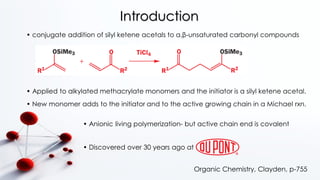
• conjugate addition of silyl ketene acetals to α,β‐unsaturated carbonyl compounds
Organic Chemistry, Clayden, p-755
• Applied to alkylated methacrylate monomers and the initiator is a silyl ketene acetal.
• New monomer adds to the initiator and to the active growing chain in a Michael rxn.
• Discovered over 30 years ago at
• Anionic living polymerization- but active chain end is covalent
Discovery- A Story
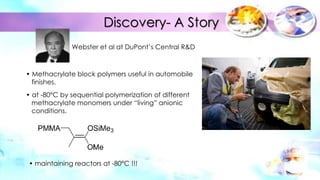
Webster et al at DuPont’s Central R&D
• Methacrylate block polymers useful in automobile
finishes.
• at -80°C by sequential polymerization of different
methacrylate monomers under “living” anionic
conditions.
• maintaining reactors at -80°C !!!
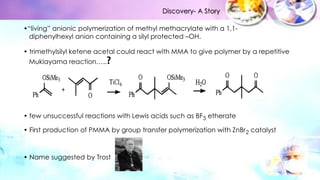
•“living” anionic polymerization of methyl methacrylate with a 1,1-
diphenylhexyl anion containing a silyl protected –OH.
• trimethylsilyl ketene acetal could react with MMA to give polymer by a repetitive
Mukiayama reaction…..
• few unsuccessful reactions with Lewis acids such as BF3 etherate
• First production of PMMA by group transfer polymerization with ZnBr2 catalyst
• Name suggested by Trost
Discovery- A Story
Synthetic Routes
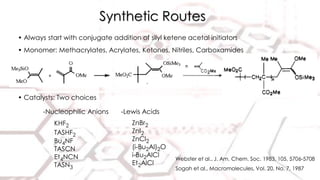
• Always start with conjugate addition of silyl ketene acetal initiators
• Monomer: Methacrylates, Acrylates, Ketones, Nitriles, Carboxamides
-Nucleophilic Anions
KHF2
TASHF2
Bu4NF
TASCN
Et4NCN
TASN3
-Lewis Acids
ZnBr2
ZnI2
ZnCl2
(i-Bu2Al)2O
i-Bu2AlCl
Et2AlCl
Webster et al., J. Am. Chem. Soc. 1983, 105, 5706-5708
Sogah et al., Macromolecules, Vol. 20, No. 7, 1987
• Catalysts: Two choices
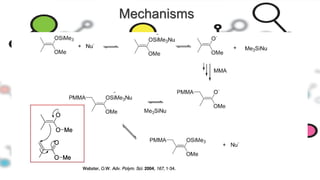
Mechanisms
Pros and Cons
• Advantages
1. Good for making blocks of
acrylates and methacrylates
2. Can be done at RT and
elevated T
3. Excellent architectural control
(stars, blocks, etc.)
4. Low PDIs (can get down to
1.03!)
5. No metallic or halide impurities
left over
6. No bad odors!
• Disadvantages
1. Cannot be done in presence of
water
2. Initiator still costly
3. Cannot use monomers with
acidic or active hydrogen
functional groups
Spinelli, H.J. Prog. Org. Coat. 1996, 27, 255-260
Applications
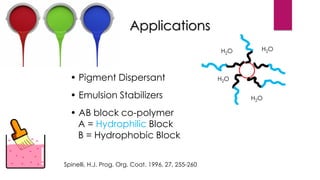
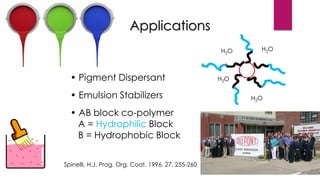
• Pigment Dispersant
• Emulsion Stabilizers
• AB block co-polymer
A = Hydrophilic Block
B = Hydrophobic Block
H2O
H2O
H2O
H2O
Spinelli, H.J. Prog. Org. Coat. 1996, 27, 255-260
Applications
• Pigment Dispersant
• Emulsion Stabilizers
• AB block co-polymer
A = Hydrophilic Block
B = Hydrophobic Block
H2O
H2O
H2O
H2O
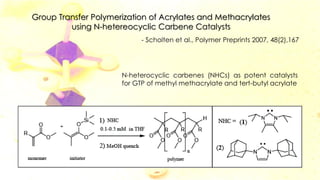
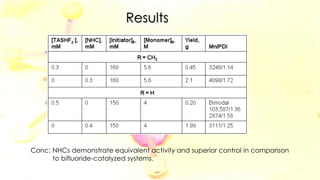
Group Transfer Polymerization of Acrylates and Methacrylates
using N-hetereocyclic Carbene Catalysts
- Scholten et al., Polymer Preprints 2007, 48(2),167
N-heterocyclic carbenes (NHCs) as potent catalysts
for GTP of methyl methacrylate and tert-butyl acrylate
Conc: NHCs demonstrate equivalent activity and superior control in comparison
to bifluoride-catalyzed systems.
Results
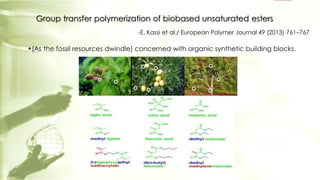
Group transfer polymerization of biobased unsaturated esters
-E. Kassi et al./ European Polymer Journal 49 (2013) 761–767
•(As the fossil resources dwindle) concerned with organic synthetic building blocks.
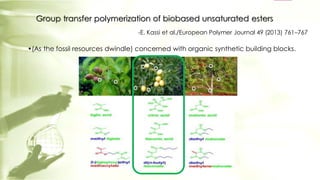
Group transfer polymerization of biobased unsaturated esters
-E. Kassi et al./European Polymer Journal 49 (2013) 761–767
•(As the fossil resources dwindle) concerned with organic synthetic building blocks.
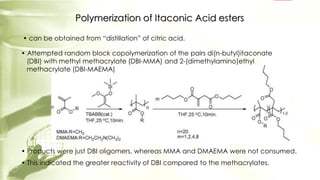
Polymerization of Itaconic Acid esters
• can be obtained from “distillation” of citric acid.
• Attempted random block copolymerization of the pairs di(n-butyl)itaconate
(DBI) with methyl methacrylate (DBI-MMA) and 2-(dimethylamino)ethyl
methacrylate (DBI-MAEMA)
• Products were just DBI oligomers, whereas MMA and DMAEMA were not consumed.
• This indicated the greater reactivity of DBI compared to the methacrylates.
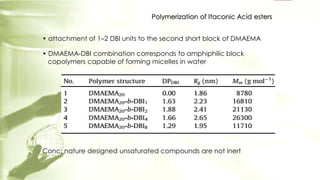
• attachment of 1–2 DBI units to the second short block of DMAEMA
• DMAEMA-DBI combination corresponds to amphiphilic block
copolymers capable of forming micelles in water
Conc: nature designed unsaturated compounds are not inert
Polymerization of Itaconic Acid esters
Conclusion
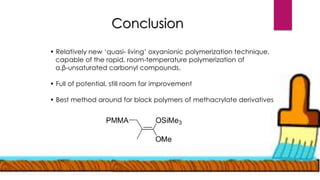
• Relatively new ‘quasi- living’ oxyanionic polymerization technique,
capable of the rapid, room-temperature polymerization of
α,β-unsaturated carbonyl compounds.
• Full of potential, still room for improvement
• Best method around for block polymers of methacrylate derivatives

Group Transfer Polymerisation (GTP)

  • 1.
    Group Transfer Polymerization (GTP) Sujoy Saha(20101095) Nikhil Y. L. K. (2009004)
  • 2.
    Brief Overview • Introduction •Discovery of Method • Synthetic Routes • Mechanisms: Then and Now • Applications • Pros and Cons • Paper (2) • Conclusion
  • 3.
    Introduction • conjugate additionof silyl ketene acetals to α,β‐unsaturated carbonyl compounds Organic Chemistry, Clayden, p-755 • Applied to alkylated methacrylate monomers and the initiator is a silyl ketene acetal. • New monomer adds to the initiator and to the active growing chain in a Michael rxn. • Discovered over 30 years ago at • Anionic living polymerization- but active chain end is covalent
  • 4.
    Discovery- A Story Websteret al at DuPont’s Central R&D • Methacrylate block polymers useful in automobile finishes. • at -80°C by sequential polymerization of different methacrylate monomers under “living” anionic conditions. • maintaining reactors at -80°C !!!
  • 5.
    •“living” anionic polymerizationof methyl methacrylate with a 1,1- diphenylhexyl anion containing a silyl protected –OH. • trimethylsilyl ketene acetal could react with MMA to give polymer by a repetitive Mukiayama reaction….. • few unsuccessful reactions with Lewis acids such as BF3 etherate • First production of PMMA by group transfer polymerization with ZnBr2 catalyst • Name suggested by Trost Discovery- A Story
  • 6.
    Synthetic Routes • Alwaysstart with conjugate addition of silyl ketene acetal initiators • Monomer: Methacrylates, Acrylates, Ketones, Nitriles, Carboxamides -Nucleophilic Anions KHF2 TASHF2 Bu4NF TASCN Et4NCN TASN3 -Lewis Acids ZnBr2 ZnI2 ZnCl2 (i-Bu2Al)2O i-Bu2AlCl Et2AlCl Webster et al., J. Am. Chem. Soc. 1983, 105, 5706-5708 Sogah et al., Macromolecules, Vol. 20, No. 7, 1987 • Catalysts: Two choices
  • 7.
  • 8.
    Pros and Cons •Advantages 1. Good for making blocks of acrylates and methacrylates 2. Can be done at RT and elevated T 3. Excellent architectural control (stars, blocks, etc.) 4. Low PDIs (can get down to 1.03!) 5. No metallic or halide impurities left over 6. No bad odors! • Disadvantages 1. Cannot be done in presence of water 2. Initiator still costly 3. Cannot use monomers with acidic or active hydrogen functional groups
  • 9.
    Spinelli, H.J. Prog.Org. Coat. 1996, 27, 255-260 Applications • Pigment Dispersant • Emulsion Stabilizers • AB block co-polymer A = Hydrophilic Block B = Hydrophobic Block H2O H2O H2O H2O
  • 10.
    Spinelli, H.J. Prog.Org. Coat. 1996, 27, 255-260 Applications • Pigment Dispersant • Emulsion Stabilizers • AB block co-polymer A = Hydrophilic Block B = Hydrophobic Block H2O H2O H2O H2O
  • 11.
    Group Transfer Polymerizationof Acrylates and Methacrylates using N-hetereocyclic Carbene Catalysts - Scholten et al., Polymer Preprints 2007, 48(2),167 N-heterocyclic carbenes (NHCs) as potent catalysts for GTP of methyl methacrylate and tert-butyl acrylate
  • 12.
    Conc: NHCs demonstrateequivalent activity and superior control in comparison to bifluoride-catalyzed systems. Results
  • 13.
    Group transfer polymerizationof biobased unsaturated esters -E. Kassi et al./ European Polymer Journal 49 (2013) 761–767 •(As the fossil resources dwindle) concerned with organic synthetic building blocks.
  • 14.
    Group transfer polymerizationof biobased unsaturated esters -E. Kassi et al./European Polymer Journal 49 (2013) 761–767 •(As the fossil resources dwindle) concerned with organic synthetic building blocks.
  • 15.
    Polymerization of ItaconicAcid esters • can be obtained from “distillation” of citric acid. • Attempted random block copolymerization of the pairs di(n-butyl)itaconate (DBI) with methyl methacrylate (DBI-MMA) and 2-(dimethylamino)ethyl methacrylate (DBI-MAEMA) • Products were just DBI oligomers, whereas MMA and DMAEMA were not consumed. • This indicated the greater reactivity of DBI compared to the methacrylates.
  • 16.
    • attachment of1–2 DBI units to the second short block of DMAEMA • DMAEMA-DBI combination corresponds to amphiphilic block copolymers capable of forming micelles in water Conc: nature designed unsaturated compounds are not inert Polymerization of Itaconic Acid esters
  • 17.
    Conclusion • Relatively new‘quasi- living’ oxyanionic polymerization technique, capable of the rapid, room-temperature polymerization of α,β-unsaturated carbonyl compounds. • Full of potential, still room for improvement • Best method around for block polymers of methacrylate derivatives