Polymeric Biomaterials Presented by: Ikhwan Hidayat ( 이흐완 히다얏  )
Contents Introduction Natural Polymers Collagen, Chitosan, Alginate Synthetic Polymers Polymerization & Structural Modification Synthetic Polymers Used as Biomaterials PVC, PP, PMMA, PS Surface Modification
Natural Polymers Polymers derived from living creatures “ Scaffolds” grow cells to replace damaged tissue Desirable properties:  Biodegradable Non-toxic Mechanically similar to the replaced tissue Capable of attachment with other molecules Natural polymers used as biomaterials Collagen, Chitosan and Alginate
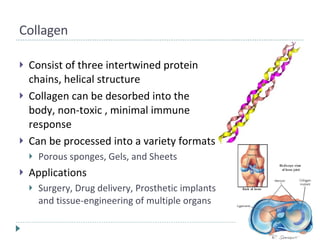
Collagen Consist of three intertwined protein chains, helical structure Collagen can be desorbed into the body, non-toxic , minimal immune response Can be processed into a variety formats Porous sponges, Gels, and Sheets Applications Surgery, Drug delivery, Prosthetic implants and tissue-engineering of multiple organs
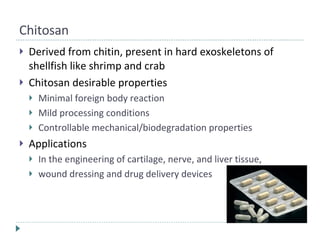
Chitosan Derived from chitin, present in hard exoskeletons of shellfish like shrimp and crab Chitosan desirable properties  Minimal foreign body reaction Mild processing conditions Controllable mechanical/biodegradation properties Applications In the engineering of cartilage, nerve, and liver tissue, wound dressing and drug delivery devices
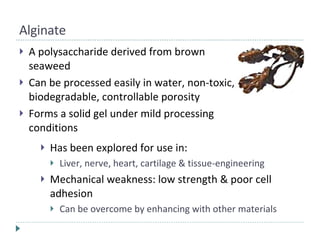
Alginate A polysaccharide derived from brown seaweed Can be processed easily in water, non-toxic, biodegradable, controllable porosity Forms a solid gel under mild processing conditions Has been explored for use in: Liver, nerve, heart, cartilage & tissue-engineering Mechanical weakness: low strength & poor cell adhesion Can be overcome by enhancing with other materials
Synthetic Polymers Advantages of Synthetic Polymers Ease of manufacturability, process ability and reasonable cost The Required Properties Biocompatibility Sterilizability Physical Property Manufacturability Applications Medical disposable supplies, Prosthetic materials, Dental materials, implants, dressings, polymeric drug delivery, tissue engineering products
Polymerization Process of reacting monomer molecules together in a chemical reaction to form three-dimensional networks or polymer chains Addition Polymerization Condensation Polymerization Molecular Weight Cross-linking Effect of Temperature Structural Modification
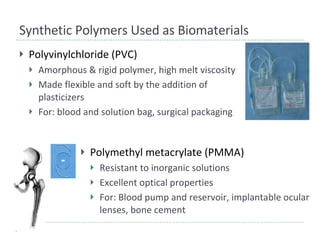
Synthetic Polymers Used as Biomaterials Polyvinylchloride (PVC) Amorphous & rigid polymer, high melt viscosity Made flexible and soft by the addition of plasticizers For: blood and solution bag, surgical packaging Polymethyl metacrylate (PMMA) Resistant to inorganic solutions Excellent optical properties For: Blood pump and reservoir, implantable ocular lenses, bone cement
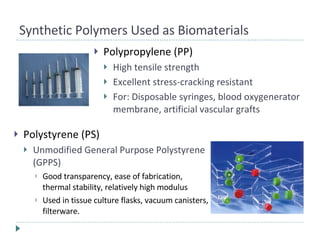
Polypropylene (PP) High tensile strength Excellent stress-cracking resistant For: Disposable syringes, blood oxygenerator membrane, artificial vascular grafts Synthetic Polymers Used as Biomaterials Polystyrene (PS) Unmodified General Purpose Polystyrene (GPPS) Good transparency, ease of fabrication, thermal stability, relatively high modulus Used in tissue culture flasks, vacuum canisters, filterware.
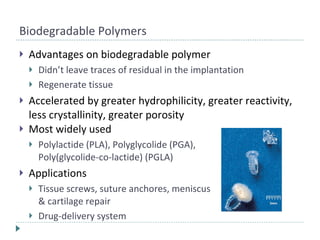
Biodegradable Polymers Advantages on biodegradable polymer Didn’t leave traces of residual in the implantation Regenerate tissue Accelerated by greater hydrophilicity, greater reactivity, less crystallinity, greater porosity Most widely used Polylactide (PLA), Polyglycolide (PGA), Poly(glycolide-co-lactide) (PGLA) Applications Tissue screws, suture anchores, meniscus & cartilage repair Drug-delivery system
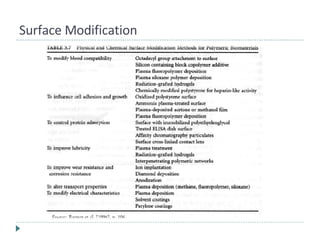
Surface Modification
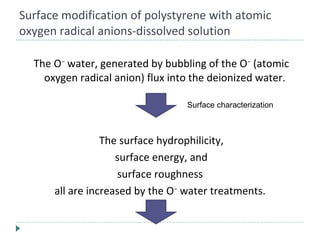
Surface modification of polystyrene with atomic oxygen radical anions-dissolved solution The O −  water, generated by bubbling of the O −  (atomic oxygen radical anion) flux into the deionized water.  The surface hydrophilicity, surface energy, and surface roughness  all are increased by the O −  water treatments.  Surface characterization
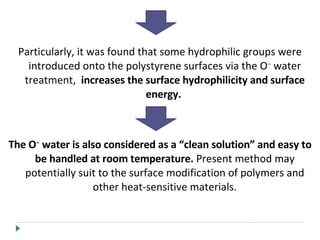
Particularly, it was found that some hydrophilic groups were introduced onto the polystyrene surfaces via the O −  water treatment,  increases the surface hydrophilicity and surface energy.  The O −  water is also considered as a “clean solution” and easy to be handled at room temperature.  Present method may potentially suit to the surface modification of polymers and other heat-sensitive materials.
감사합니다 Thank you for your attention…. - Questions & Discussion - [back to index of contents] mail to: ikhwan4ever@gmail.com

Polymeric Biomaterials by 이흐완 히다얏

  • 1.
    Polymeric Biomaterials Presentedby: Ikhwan Hidayat ( 이흐완 히다얏 )
  • 2.
    Contents Introduction NaturalPolymers Collagen, Chitosan, Alginate Synthetic Polymers Polymerization & Structural Modification Synthetic Polymers Used as Biomaterials PVC, PP, PMMA, PS Surface Modification
  • 3.
    Natural Polymers Polymersderived from living creatures “ Scaffolds” grow cells to replace damaged tissue Desirable properties: Biodegradable Non-toxic Mechanically similar to the replaced tissue Capable of attachment with other molecules Natural polymers used as biomaterials Collagen, Chitosan and Alginate
  • 4.
    Collagen Consist ofthree intertwined protein chains, helical structure Collagen can be desorbed into the body, non-toxic , minimal immune response Can be processed into a variety formats Porous sponges, Gels, and Sheets Applications Surgery, Drug delivery, Prosthetic implants and tissue-engineering of multiple organs
  • 5.
    Chitosan Derived fromchitin, present in hard exoskeletons of shellfish like shrimp and crab Chitosan desirable properties Minimal foreign body reaction Mild processing conditions Controllable mechanical/biodegradation properties Applications In the engineering of cartilage, nerve, and liver tissue, wound dressing and drug delivery devices
  • 6.
    Alginate A polysaccharidederived from brown seaweed Can be processed easily in water, non-toxic, biodegradable, controllable porosity Forms a solid gel under mild processing conditions Has been explored for use in: Liver, nerve, heart, cartilage & tissue-engineering Mechanical weakness: low strength & poor cell adhesion Can be overcome by enhancing with other materials
  • 7.
    Synthetic Polymers Advantagesof Synthetic Polymers Ease of manufacturability, process ability and reasonable cost The Required Properties Biocompatibility Sterilizability Physical Property Manufacturability Applications Medical disposable supplies, Prosthetic materials, Dental materials, implants, dressings, polymeric drug delivery, tissue engineering products
  • 8.
    Polymerization Process ofreacting monomer molecules together in a chemical reaction to form three-dimensional networks or polymer chains Addition Polymerization Condensation Polymerization Molecular Weight Cross-linking Effect of Temperature Structural Modification
  • 9.
    Synthetic Polymers Usedas Biomaterials Polyvinylchloride (PVC) Amorphous & rigid polymer, high melt viscosity Made flexible and soft by the addition of plasticizers For: blood and solution bag, surgical packaging Polymethyl metacrylate (PMMA) Resistant to inorganic solutions Excellent optical properties For: Blood pump and reservoir, implantable ocular lenses, bone cement
  • 10.
    Polypropylene (PP) Hightensile strength Excellent stress-cracking resistant For: Disposable syringes, blood oxygenerator membrane, artificial vascular grafts Synthetic Polymers Used as Biomaterials Polystyrene (PS) Unmodified General Purpose Polystyrene (GPPS) Good transparency, ease of fabrication, thermal stability, relatively high modulus Used in tissue culture flasks, vacuum canisters, filterware.
  • 11.
    Biodegradable Polymers Advantageson biodegradable polymer Didn’t leave traces of residual in the implantation Regenerate tissue Accelerated by greater hydrophilicity, greater reactivity, less crystallinity, greater porosity Most widely used Polylactide (PLA), Polyglycolide (PGA), Poly(glycolide-co-lactide) (PGLA) Applications Tissue screws, suture anchores, meniscus & cartilage repair Drug-delivery system
  • 12.
  • 13.
    Surface modification ofpolystyrene with atomic oxygen radical anions-dissolved solution The O − water, generated by bubbling of the O − (atomic oxygen radical anion) flux into the deionized water. The surface hydrophilicity, surface energy, and surface roughness all are increased by the O − water treatments. Surface characterization
  • 14.
    Particularly, it wasfound that some hydrophilic groups were introduced onto the polystyrene surfaces via the O − water treatment, increases the surface hydrophilicity and surface energy. The O − water is also considered as a “clean solution” and easy to be handled at room temperature. Present method may potentially suit to the surface modification of polymers and other heat-sensitive materials.
  • 15.
    감사합니다 Thank youfor your attention…. - Questions & Discussion - [back to index of contents] mail to: ikhwan4ever@gmail.com