Umme Salma Mst. Mahmuda
Lecturer
Dept. of MSE, RUET
MSE 4241
Biomaterials Engineering
Topic:
Soft Tissue Applications
Soft tissues
Soft tissues are the tissues that connect, support, or surround other
structures and organs of the body, not being hard tissues such as bone. Soft
tissue includes tendons, ligaments, fascia, skin, fibrous tissues, fat,
and synovial membranes (which are connective tissue),
and muscles, nerves and blood vessels (which are not connective tissue).
Minimal Requirements for Soft Tissue Implant Materials
• Close approximation to physical properties
• Should not deteriorate
• If degradation intended, rate and mode as per planned
• No adverse tissue reaction
• Non-carcinogenic, non-toxic,non-allergenic or non immunogenic
• Sterilizable
• Low cost
Design dependent requirements:
• Mimic function of organ without interfering with surrounding anatomical
structures
• Suitable size and weight.
Implants in soft tissues can be grouped into five categories depending on
their function:
1. Shunts for fluid transport in the body
2. Percutaneous devices which pass from the outside through the
epidermis into the body.
3. Space fillers for some defect
4. Load carriers or scaffolds for tissue growth including sutures and wound
dressings.
5. Electrodes for neuromuscular stimulation
Performance of an implant device depends upon:
• Materials used
• Design of the device or implant
• skill of surgeon
• Prior condition of patient
Bulk space fillers:
 Bulk implants are used to restore defects, atrophy or hypoplasty to an
aesthetically satisfactory condition.
 Space fillers are used augmentation of mammary tissue, cartilage and
facial tissue.
 Most of the bulk implants used are placed either in the head and
neck region or in the female breast.
 The artificial penis, testicles and also vagina fall into this category.
• These materials should elicit no inflammatory reaction in tissues and
they should remain in place retaining form and resiliency.
• Silicone polymers , polyethylene and Teflon are commonly used
materials for this application.
• For augmentation of breast, saline filled implants remain the only
viable device as silicone gel-filled implants have been removed from
the market due to risks associated with implant leakage.
• The material to be used as a replacement for articular cartilage must
be hydrophilic with controlled water content, with smooth surface
and sufficient strength. Poly (vinyl alcohol) is the most accepted
candidate for articular cartilage augmentation. Hydrophilic
polyurethane is another candidate for this replacement.
Functional load-carrying and supporting implants:
• Artificial implant materials must be made into forms that provide mechanical
support, such as meshes for hernia repair, framework for support of tissue
patches, velour for the attachment of tissues, sutures and materials for artificial
tendons.
• Velours – a means of attaining a viable mechanical bond to soft tissues. Tissue
ingrowth into the filaments of the velour results in intermeshing of collageneous
fibrous tissue and the plastic fibers. Rayon, Nylon , Dacron – used as fibrous
velours.
• Meshes – another form of materials that are used for supporting healing tissues
or for providing a support or scaffolding for tissue patches.
• Tendon support – biomaterials may totally replace the tendon or they may be
used to hold a damaged tendon in proper alignment or as interpositional
materials to isolate tendon from the surrounding tissue in order to minimize
adhesions. Silicone materials have been demonstrated to prevent tendon
adhesion.
Sutures materials:
• Sutures are sterile surgical threads used to repair cuts. They are also
commonly used to close incisions from surgery.
• Sutures and fibrin sealant are important surgical aids for facilitating wound
closure and creating an optimal setting for wound healing. Most
commonly, sutures are used to close wounds because suture material
provides the mechanical support necessary to sustain closure
Classification of suture materials:
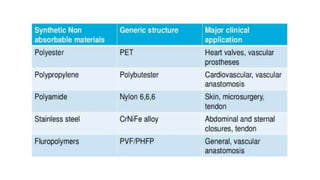
According to their origin
Natural
Synthetic
According to their absorption ability
Absorbable
Non-absorbable
According to their configuration
Monofilaments or multi-filaments
Composite sutures are those that combine the configuration and properties of both mono-
and multifilaments.
• Single strand (Monofilaments) and suture containing multifilaments may be braided or
twisted.
• Monofilament sutures have a smooth surface, which provide easy passage through the
tissues and prevent harboring of microorganisms , thus decreasing risk of inflammation.
• Braided sutures generally have higher flexibility, lower memory and can be handled more
easily than monofilament suture of the same size.
• The most prominent absorbable sutures in use today are natural and
chromic treated catgut, collagen ,synthetic polyglycolic acid (PGA),
polydioxanone (PDS) and polymethylene carbonate.
• Most absorbable synthetic sutures are made up of PGA and its
copolymer with PLLA to control absorption and flexibility of handling.
• Absorbable sutures are those that lose most of their tensile strength
in less than 60 days in contrast to the non-absorbable suture , which
is partially degraded within 3 weeks after implantation and loses most
of its tensile strength after 6 months.
• Loose suturing is recommended because it lessens pain and reduces
cutting of soft tissues.
Wound Dressings:
• Dressings are used primarily for the treatment of superficial wounds
created as a result of ulceration, burns, mechanical trauma, skin
grafting, cancer excision or other surgical procedures.
• These dressings consisting of natural or synthetic material prevent the
moisture and heat loss from the skin and bacterial infection from the
environment. Thus they assist in restoration of normal skin structure
and physiology.
• Temporary synthetic dressings- a number of dressings have been used
to act as a barrier between external and internal wound environment.
Barrier dressings are designed to adhere either tightly by providing a
porous or roughened surface or loosely with smooth surface .
Category of temporary skin dressings-- --
• Vapor permeable membranes - polyurethanes, silastic, polyvinyl chloride,
hydroxyl ethyl methacrylate-PEG-400 copolymer, polylactide polyurethane
copolymer, polypeptide elastomer. Polyurethanes are most commonly used.
• Hydrogels skin covering – homo and copolymers of hydroxyalkyl methacrylate,
acrylamide-agar-agar copolymer and polyvinyl alcohol. The most widely used
materials are crosslinked polyethylene glycols and hydrophilic polyurethane.
• Hydrocolloids – presented in the bilayer form consisting of an outer protective
layer and an inner adhesive layer. The inner layer contains hydrophilic polymers
embedded in a matrix of an inert, hydrophoboic elastomer. The absorbing
particles are made from natural or semisynthetic polysaccharides such as pectin,
xanthan gum, guar gum, agar-agar or carboxymethyl cellulose.
• Multiple layered dressings –
• The outer layer is designed for durability and elasticity, whereas, the
inner layer produces adherence and tensile strength. The basic
concept of these dressings is to provide, in burn patients with severe
skin loss, a long-term wound covering without removal and with
good control of infection and fluid loss.
• A thick film of silicone elastomer (silastic) or polyurethane makes up
the top layer of these membranes. The nner layer may be synthetic
or natural. Among synthetic materials, knitted fabrics of Nylon and
Dacron have been used.
Tissue Adhesives
• Tissue adhesion is to attach two pieces of tissue together with
adequate mechanical strength to assist in wound healing process.
Tissue adhesives represent a group of compounds that can be applied
locally for a variety of indications including hemostasis, wound
closure and fistula repair.
Used for tissue welding-- --
as hemostatic agents
as fluid and gas barriers, as drug delivery systems
as tissue scaffolds.
Requisites for good tissue adhesion
• Able to wet and bond to tissue
• Adequate bond strength
• Capable to rapid polymerization
• Restorable as wound heal
• Not interferable with normal healing
• Sterilizable
• Adequate shelf life
Functions by forming covalent bonds between amine, carboxylic acid
and hydroxyl group of tissue and functional groups on adhesives.
Percutaneous Devices
• Percutaneous medical devices are inserted into inner organs or other tissues by piercing
through the skin through a needle puncture, and then positioning the device into
position by trespassing multiple layers of tissue. Percutaneous needles are used in
several cardiovascular, diagnostic, anesthetic, and cancer treatment tasks.
• Percutaneous devices penetrate the body through a surgically created defect in the skin
to provide a conduit between an implanted medical device or artificial organ and the
extracorporeal .Percutaneous devices include catheters (i.e., peritoneal dialysis,
intravascular), prosthetic attachments, dental implants, feeding and tracheal tubes, and
needle-type glucose sensors. However, breaking the skin barrier provides a route to
infection and increases complications associated with wound non-closure
• Percutaneous devices also fail from mechanical irritation (avulsion) or epithelial down
growth that forms a pocket around the implant (marsupialization). Acute mechanical
interfacial stresses tear the device from its implantation bed, while chronic, small
mechanical stresses cause localized injury, resulting in inflammation and increased
susceptibility to infection
• Percutaneous implants – to allow orpolonged injection of drugs and nutrients.
• Percutaneous devices enable the transfer of fluids, energy, and forces through
the skin. The permit access to tissues, internal organs, internal compartments,
vessels and the nervous and skeletal systems.
Biosensors
• A biosensor is an analytical device, used for the detection of a chemical
substance, that combines a biological component with a physicochemical
detector.
• Biosensors are employed in applications such as disease monitoring, drug
discovery, and detection of pollutants, disease-causing micro-organisms and
markers that are indicators of a disease in bodily fluids (blood, urine, saliva,
sweat).
• Biosensors are operated based on the principle of signal transduction. These
components include a bio-recognition element, a biotransducer and an electronic
system composed of a display, processor and amplifier. The bio-recognition
element, essentially a bioreceptor, is allowed to interact with a specific analyte.
• Examples – pinprick glucose monitoring devices and urine pregnancy detection
kits.
Important Parts of a Biosensor
Biomaterials in Urological Practice
Silicone is the most preferred biomaterial for urological application.
• Catheters made of silicone rubber are well tolerated with little chance of crystal
deposition on their smooth lumens, allowing prolonged use for indwelling
drainage systems. Disposable PVC and latex catheters are also available.
• Indwelling urethral stents are used after renal surgery to provide internal
splintage for facilitating healing of the operated area (pelvis and ureter) as well as
allowing uninterrupted urine drainage from kidney to the bladder. The most
common biomaterial used for this purpose is silicone. Stents are also made of
polyurethane , nylon, and polyethylene. These are manufactured in several
shapes such as pigtail, double j, coiled etc.
• The effective treatment of certain types of urinary incontinence (uncontrolled
leakage of urine) has remained one of the most challenging problems in urology.
Again majority of prostheses for this purpose are fabricated from silicone
material.
Thanks to All

Soft Tissue.pptx

  • 1.
    Umme Salma Mst.Mahmuda Lecturer Dept. of MSE, RUET MSE 4241 Biomaterials Engineering
  • 2.
  • 3.
    Soft tissues Soft tissuesare the tissues that connect, support, or surround other structures and organs of the body, not being hard tissues such as bone. Soft tissue includes tendons, ligaments, fascia, skin, fibrous tissues, fat, and synovial membranes (which are connective tissue), and muscles, nerves and blood vessels (which are not connective tissue). Minimal Requirements for Soft Tissue Implant Materials • Close approximation to physical properties • Should not deteriorate • If degradation intended, rate and mode as per planned • No adverse tissue reaction • Non-carcinogenic, non-toxic,non-allergenic or non immunogenic • Sterilizable • Low cost
  • 4.
    Design dependent requirements: •Mimic function of organ without interfering with surrounding anatomical structures • Suitable size and weight. Implants in soft tissues can be grouped into five categories depending on their function: 1. Shunts for fluid transport in the body 2. Percutaneous devices which pass from the outside through the epidermis into the body. 3. Space fillers for some defect 4. Load carriers or scaffolds for tissue growth including sutures and wound dressings. 5. Electrodes for neuromuscular stimulation
  • 5.
    Performance of animplant device depends upon: • Materials used • Design of the device or implant • skill of surgeon • Prior condition of patient Bulk space fillers:  Bulk implants are used to restore defects, atrophy or hypoplasty to an aesthetically satisfactory condition.  Space fillers are used augmentation of mammary tissue, cartilage and facial tissue.  Most of the bulk implants used are placed either in the head and neck region or in the female breast.  The artificial penis, testicles and also vagina fall into this category.
  • 6.
    • These materialsshould elicit no inflammatory reaction in tissues and they should remain in place retaining form and resiliency. • Silicone polymers , polyethylene and Teflon are commonly used materials for this application. • For augmentation of breast, saline filled implants remain the only viable device as silicone gel-filled implants have been removed from the market due to risks associated with implant leakage. • The material to be used as a replacement for articular cartilage must be hydrophilic with controlled water content, with smooth surface and sufficient strength. Poly (vinyl alcohol) is the most accepted candidate for articular cartilage augmentation. Hydrophilic polyurethane is another candidate for this replacement.
  • 7.
    Functional load-carrying andsupporting implants: • Artificial implant materials must be made into forms that provide mechanical support, such as meshes for hernia repair, framework for support of tissue patches, velour for the attachment of tissues, sutures and materials for artificial tendons. • Velours – a means of attaining a viable mechanical bond to soft tissues. Tissue ingrowth into the filaments of the velour results in intermeshing of collageneous fibrous tissue and the plastic fibers. Rayon, Nylon , Dacron – used as fibrous velours. • Meshes – another form of materials that are used for supporting healing tissues or for providing a support or scaffolding for tissue patches. • Tendon support – biomaterials may totally replace the tendon or they may be used to hold a damaged tendon in proper alignment or as interpositional materials to isolate tendon from the surrounding tissue in order to minimize adhesions. Silicone materials have been demonstrated to prevent tendon adhesion.
  • 8.
    Sutures materials: • Suturesare sterile surgical threads used to repair cuts. They are also commonly used to close incisions from surgery. • Sutures and fibrin sealant are important surgical aids for facilitating wound closure and creating an optimal setting for wound healing. Most commonly, sutures are used to close wounds because suture material provides the mechanical support necessary to sustain closure Classification of suture materials: According to their origin Natural Synthetic
  • 9.
    According to theirabsorption ability Absorbable Non-absorbable According to their configuration Monofilaments or multi-filaments Composite sutures are those that combine the configuration and properties of both mono- and multifilaments. • Single strand (Monofilaments) and suture containing multifilaments may be braided or twisted. • Monofilament sutures have a smooth surface, which provide easy passage through the tissues and prevent harboring of microorganisms , thus decreasing risk of inflammation. • Braided sutures generally have higher flexibility, lower memory and can be handled more easily than monofilament suture of the same size.
  • 12.
    • The mostprominent absorbable sutures in use today are natural and chromic treated catgut, collagen ,synthetic polyglycolic acid (PGA), polydioxanone (PDS) and polymethylene carbonate. • Most absorbable synthetic sutures are made up of PGA and its copolymer with PLLA to control absorption and flexibility of handling. • Absorbable sutures are those that lose most of their tensile strength in less than 60 days in contrast to the non-absorbable suture , which is partially degraded within 3 weeks after implantation and loses most of its tensile strength after 6 months. • Loose suturing is recommended because it lessens pain and reduces cutting of soft tissues.
  • 13.
    Wound Dressings: • Dressingsare used primarily for the treatment of superficial wounds created as a result of ulceration, burns, mechanical trauma, skin grafting, cancer excision or other surgical procedures. • These dressings consisting of natural or synthetic material prevent the moisture and heat loss from the skin and bacterial infection from the environment. Thus they assist in restoration of normal skin structure and physiology. • Temporary synthetic dressings- a number of dressings have been used to act as a barrier between external and internal wound environment. Barrier dressings are designed to adhere either tightly by providing a porous or roughened surface or loosely with smooth surface .
  • 14.
    Category of temporaryskin dressings-- -- • Vapor permeable membranes - polyurethanes, silastic, polyvinyl chloride, hydroxyl ethyl methacrylate-PEG-400 copolymer, polylactide polyurethane copolymer, polypeptide elastomer. Polyurethanes are most commonly used. • Hydrogels skin covering – homo and copolymers of hydroxyalkyl methacrylate, acrylamide-agar-agar copolymer and polyvinyl alcohol. The most widely used materials are crosslinked polyethylene glycols and hydrophilic polyurethane. • Hydrocolloids – presented in the bilayer form consisting of an outer protective layer and an inner adhesive layer. The inner layer contains hydrophilic polymers embedded in a matrix of an inert, hydrophoboic elastomer. The absorbing particles are made from natural or semisynthetic polysaccharides such as pectin, xanthan gum, guar gum, agar-agar or carboxymethyl cellulose.
  • 15.
    • Multiple layereddressings – • The outer layer is designed for durability and elasticity, whereas, the inner layer produces adherence and tensile strength. The basic concept of these dressings is to provide, in burn patients with severe skin loss, a long-term wound covering without removal and with good control of infection and fluid loss. • A thick film of silicone elastomer (silastic) or polyurethane makes up the top layer of these membranes. The nner layer may be synthetic or natural. Among synthetic materials, knitted fabrics of Nylon and Dacron have been used.
  • 16.
    Tissue Adhesives • Tissueadhesion is to attach two pieces of tissue together with adequate mechanical strength to assist in wound healing process. Tissue adhesives represent a group of compounds that can be applied locally for a variety of indications including hemostasis, wound closure and fistula repair. Used for tissue welding-- -- as hemostatic agents as fluid and gas barriers, as drug delivery systems as tissue scaffolds.
  • 17.
    Requisites for goodtissue adhesion • Able to wet and bond to tissue • Adequate bond strength • Capable to rapid polymerization • Restorable as wound heal • Not interferable with normal healing • Sterilizable • Adequate shelf life Functions by forming covalent bonds between amine, carboxylic acid and hydroxyl group of tissue and functional groups on adhesives.
  • 20.
    Percutaneous Devices • Percutaneousmedical devices are inserted into inner organs or other tissues by piercing through the skin through a needle puncture, and then positioning the device into position by trespassing multiple layers of tissue. Percutaneous needles are used in several cardiovascular, diagnostic, anesthetic, and cancer treatment tasks. • Percutaneous devices penetrate the body through a surgically created defect in the skin to provide a conduit between an implanted medical device or artificial organ and the extracorporeal .Percutaneous devices include catheters (i.e., peritoneal dialysis, intravascular), prosthetic attachments, dental implants, feeding and tracheal tubes, and needle-type glucose sensors. However, breaking the skin barrier provides a route to infection and increases complications associated with wound non-closure • Percutaneous devices also fail from mechanical irritation (avulsion) or epithelial down growth that forms a pocket around the implant (marsupialization). Acute mechanical interfacial stresses tear the device from its implantation bed, while chronic, small mechanical stresses cause localized injury, resulting in inflammation and increased susceptibility to infection
  • 22.
    • Percutaneous implants– to allow orpolonged injection of drugs and nutrients. • Percutaneous devices enable the transfer of fluids, energy, and forces through the skin. The permit access to tissues, internal organs, internal compartments, vessels and the nervous and skeletal systems.
  • 23.
    Biosensors • A biosensoris an analytical device, used for the detection of a chemical substance, that combines a biological component with a physicochemical detector. • Biosensors are employed in applications such as disease monitoring, drug discovery, and detection of pollutants, disease-causing micro-organisms and markers that are indicators of a disease in bodily fluids (blood, urine, saliva, sweat). • Biosensors are operated based on the principle of signal transduction. These components include a bio-recognition element, a biotransducer and an electronic system composed of a display, processor and amplifier. The bio-recognition element, essentially a bioreceptor, is allowed to interact with a specific analyte. • Examples – pinprick glucose monitoring devices and urine pregnancy detection kits.
  • 24.
    Important Parts ofa Biosensor
  • 25.
    Biomaterials in UrologicalPractice Silicone is the most preferred biomaterial for urological application. • Catheters made of silicone rubber are well tolerated with little chance of crystal deposition on their smooth lumens, allowing prolonged use for indwelling drainage systems. Disposable PVC and latex catheters are also available. • Indwelling urethral stents are used after renal surgery to provide internal splintage for facilitating healing of the operated area (pelvis and ureter) as well as allowing uninterrupted urine drainage from kidney to the bladder. The most common biomaterial used for this purpose is silicone. Stents are also made of polyurethane , nylon, and polyethylene. These are manufactured in several shapes such as pigtail, double j, coiled etc. • The effective treatment of certain types of urinary incontinence (uncontrolled leakage of urine) has remained one of the most challenging problems in urology. Again majority of prostheses for this purpose are fabricated from silicone material.
  • 26.