By
Miss. Laxmi S. Deshamukh
Under the Guidance of
Prof. Nandkishor B. Deshmukh
M.Pharm (Department of Pharmaceutics)
SHRADDHA NSTITUTE OF PHARMACY, KONDALA ZAMBRE WASHIM 444505
2023-2024
POLYMER USED IN PHARMACEUTICAL FORMULATION
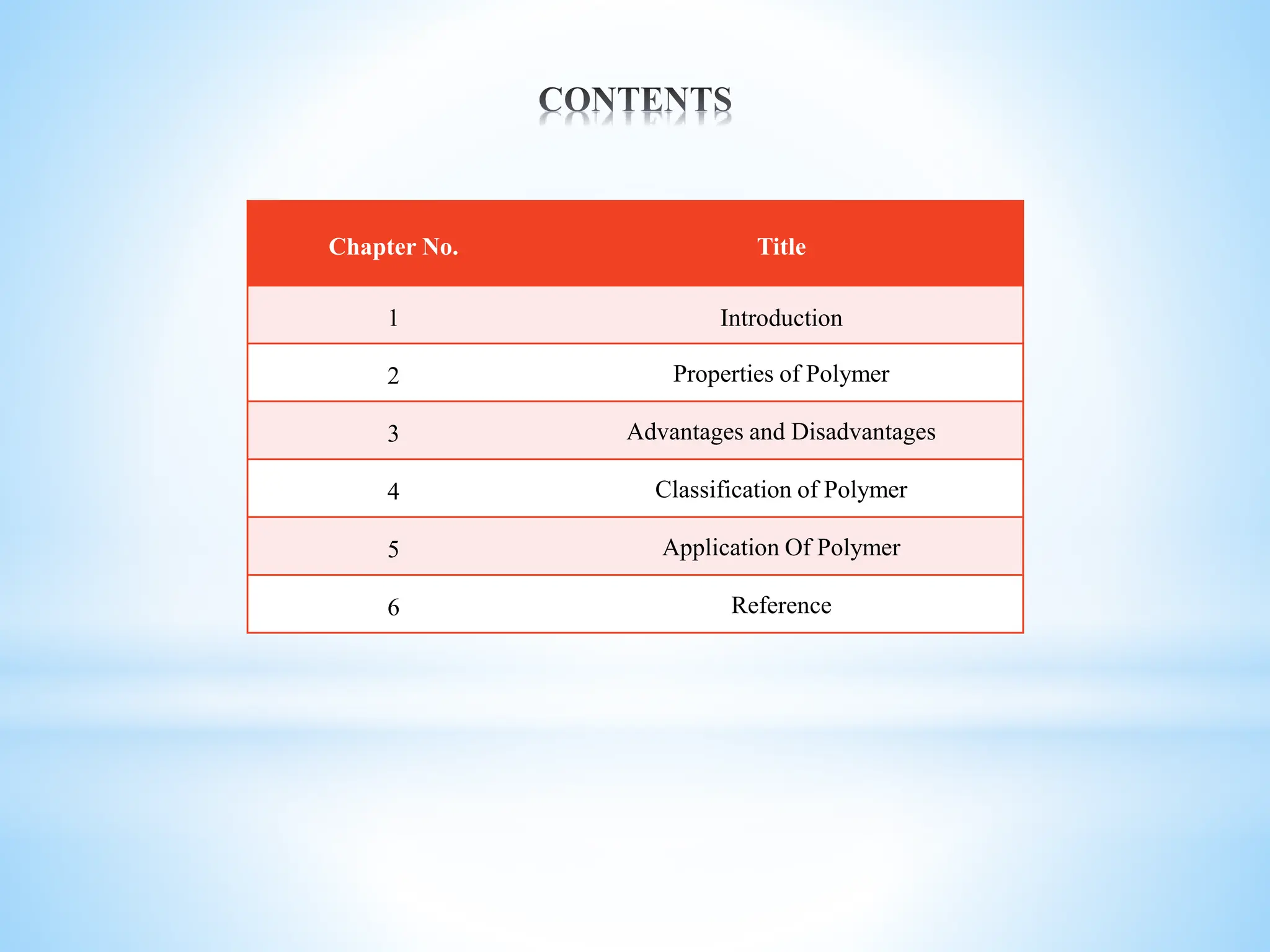
Chapter No. Title
1 Introduction
2 Properties of Polymer
3 Advantages and Disadvantages
4 Classification of Polymer
5 Application Of Polymer
6 Reference
Definition of polymer “Polymers are long chain organic molecules
assembled from many smaller molecules called as monomer. The
polymer have been synthesized for specific need and to solve problems
related with development of drug delivery system
Polymers have been mainly used to control the drug release rate from the
formulations. They are also used as taste masking agent, stabilizer and
protective agent in oral drug deliver
Eg. Xanthan gum, Acacia.
2. PROPERTIES OF POLYMERPROPERTIES OF POLYMER
1) It should be inert and compatible with the environment.
2) It should be non- toxic and physiologically inert.
3) It should be easily administrable.
4) It should be easy to fabricate and must be inexpensive.
5) It should have good mechanical strength.
6) It must have compatibility with most of the drugs.
7) It must not adversely affect the rate of release of the drug.
8) It must not have tendency to retain in tissue and must be a good
biodegradable material.
9) It should be inert and compatible with the environment.
10)It should be non- toxic and physiologically inert.
ADVANTAGES
1) Polymer parts do not require post-treatment finishing efforts, unlike
metal.
2) Polymer and composite materials are up to ten times lighter than
typical metals.
3) Polymer materials handle far better than metals in chemically harsh
environments.
4) Polymers are naturally radar absorbent as well as thermally and
electrically insulating.
5) In medical Facilities polymer and composite materials are easier to
clean and sterilize than metal.
DISADVANTAGES
1) Cannot withstand very high temperature as all plastics melt down very
soon as compared to metals.
2) The strength to size ratio of polymer is less while for metals is more.
3) Heavy structure cannot be made by polymer as the structural rigidity is
very less.
4) The disposal becomes an issue as some polymer cannot be recycled but all
metals can be recycled.
CLASSIFICATION OF POLYMER
 Polymers can be classified as:
1. Natural polymers : eg. Hemicelluloses, Agar, Starch.
2. Synthetic polymers : eg. Silicone
3. Semi-synthetic polymer : eg. Nylon, Polyester
NATURAL POLYMERS
 The polymers obtained from nature (plants and animals) are called
natural polymers. These polymers are very essential for life.
 Starch It is a polymer of glucose and it is a food reserve of plants.
 Cellulose It is also a polymer of glucose. It is a chief structural material
of starch and cellulose made from glucose of plants and is produced
during photosynthesis.
 Eg. Hemicelluloses, Agar, Starch.
 These polymers are mainly derived from naturally occurring
polymers by chemical modifications. For example, cellulose is
naturally occurring polymers, cellulose on acetylation with acetic
anhydride in the presence of sulphuric acid forms cellulose diacetate
polymers.
 It is used in making thread and materials like films glasses etc.
Vulcanized rubber is also an example of semi synthetic polymers
used in making tyres etc.
 Eg. Silicone
SEMI SYNTHETIC POLYMERS
The polymers which are prepared in the laboratories are called synthetic
polymers. These are also known as man made polymers.
For example polyethene , PVC nylon, teflon , Bakelite ethylene ,
synthetic rubber etc
SYNTHETIC POLYMERS
APPLICATION OF POLYMER
In Parenteral the various polymer like Meth acrylic acid act as an
Interferon inductor which induce to the interferon in cancer like disease.
Some Vaccines are transpired by using polymer because which
disintegrate in GIT tract, example Methyl meth acrylate .
Various synthetic and natural hydrophilic polymers are extensively used
to enhance the physical stability of pharmaceutical disperse systems.
Examples of these include alginates.
REFERENCE
1) Denis L, Gilles P and Christin V. Biomedical and Pharmaceutical
Polymer. published by Pharmaceutical press. 2011: 1-148.
2) Bhaskar B, Namdeo S, Sunil D, Birudev K. Natural polymers in drug
delivery development. Research Journal of Pharmaceutical Dosage
Forms and Technology 2014; 6 (1): 54-57.
POLYMER USED IN PHARMACEUTICAL FORMULATION.pptx

POLYMER USED IN PHARMACEUTICAL FORMULATION.pptx

  • 1.
    By Miss. Laxmi S.Deshamukh Under the Guidance of Prof. Nandkishor B. Deshmukh M.Pharm (Department of Pharmaceutics) SHRADDHA NSTITUTE OF PHARMACY, KONDALA ZAMBRE WASHIM 444505 2023-2024 POLYMER USED IN PHARMACEUTICAL FORMULATION
  • 2.
    Chapter No. Title 1Introduction 2 Properties of Polymer 3 Advantages and Disadvantages 4 Classification of Polymer 5 Application Of Polymer 6 Reference
  • 3.
    Definition of polymer“Polymers are long chain organic molecules assembled from many smaller molecules called as monomer. The polymer have been synthesized for specific need and to solve problems related with development of drug delivery system Polymers have been mainly used to control the drug release rate from the formulations. They are also used as taste masking agent, stabilizer and protective agent in oral drug deliver Eg. Xanthan gum, Acacia.
  • 4.
    2. PROPERTIES OFPOLYMERPROPERTIES OF POLYMER 1) It should be inert and compatible with the environment. 2) It should be non- toxic and physiologically inert. 3) It should be easily administrable. 4) It should be easy to fabricate and must be inexpensive. 5) It should have good mechanical strength. 6) It must have compatibility with most of the drugs. 7) It must not adversely affect the rate of release of the drug. 8) It must not have tendency to retain in tissue and must be a good biodegradable material. 9) It should be inert and compatible with the environment. 10)It should be non- toxic and physiologically inert.
  • 5.
    ADVANTAGES 1) Polymer partsdo not require post-treatment finishing efforts, unlike metal. 2) Polymer and composite materials are up to ten times lighter than typical metals. 3) Polymer materials handle far better than metals in chemically harsh environments. 4) Polymers are naturally radar absorbent as well as thermally and electrically insulating. 5) In medical Facilities polymer and composite materials are easier to clean and sterilize than metal.
  • 6.
    DISADVANTAGES 1) Cannot withstandvery high temperature as all plastics melt down very soon as compared to metals. 2) The strength to size ratio of polymer is less while for metals is more. 3) Heavy structure cannot be made by polymer as the structural rigidity is very less. 4) The disposal becomes an issue as some polymer cannot be recycled but all metals can be recycled.
  • 7.
    CLASSIFICATION OF POLYMER Polymers can be classified as: 1. Natural polymers : eg. Hemicelluloses, Agar, Starch. 2. Synthetic polymers : eg. Silicone 3. Semi-synthetic polymer : eg. Nylon, Polyester
  • 8.
    NATURAL POLYMERS  Thepolymers obtained from nature (plants and animals) are called natural polymers. These polymers are very essential for life.  Starch It is a polymer of glucose and it is a food reserve of plants.  Cellulose It is also a polymer of glucose. It is a chief structural material of starch and cellulose made from glucose of plants and is produced during photosynthesis.  Eg. Hemicelluloses, Agar, Starch.
  • 9.
     These polymersare mainly derived from naturally occurring polymers by chemical modifications. For example, cellulose is naturally occurring polymers, cellulose on acetylation with acetic anhydride in the presence of sulphuric acid forms cellulose diacetate polymers.  It is used in making thread and materials like films glasses etc. Vulcanized rubber is also an example of semi synthetic polymers used in making tyres etc.  Eg. Silicone SEMI SYNTHETIC POLYMERS
  • 10.
    The polymers whichare prepared in the laboratories are called synthetic polymers. These are also known as man made polymers. For example polyethene , PVC nylon, teflon , Bakelite ethylene , synthetic rubber etc SYNTHETIC POLYMERS
  • 11.
    APPLICATION OF POLYMER InParenteral the various polymer like Meth acrylic acid act as an Interferon inductor which induce to the interferon in cancer like disease. Some Vaccines are transpired by using polymer because which disintegrate in GIT tract, example Methyl meth acrylate . Various synthetic and natural hydrophilic polymers are extensively used to enhance the physical stability of pharmaceutical disperse systems. Examples of these include alginates.
  • 12.
    REFERENCE 1) Denis L,Gilles P and Christin V. Biomedical and Pharmaceutical Polymer. published by Pharmaceutical press. 2011: 1-148. 2) Bhaskar B, Namdeo S, Sunil D, Birudev K. Natural polymers in drug delivery development. Research Journal of Pharmaceutical Dosage Forms and Technology 2014; 6 (1): 54-57.