Polyamides
• A polyamide is macromolecule with repeating
units linked by amide bonds
• Polyamides occur both naturally and artificially.
• Examples of naturally occurring polyamides
are proteins, such as wool and silk.
• Artificially made polyamides can be made
through step-growth polymerization or solid-
phase synthesis yielding materials such
as nylons, aramids, and sodium poly(aspartate).
• Synthetic polyamides are commonly used in
textiles, automotive applications, carpets and
sportswear due to their high durability and
strength. The transportation manufacturing
industry is the major consumer, accounting for
35% of polyamide (PA) consumption.
Chemical structure
Amino caproic acid
n
)
( CH2 CO
NH ( )5
CH2
( )5
COOH
H2N CH2
( )5
COOH
H2N
+
H2O
+
Caprolactam
Poly(caprolactam)
Nylon 6 or PA-6
NH
( CH2 CO
NH
n
)
CH2 CO
( )
4
6
( )
CH2
( )6
NH2
H2N CH2
4
( )
HOOC COOH
+
+ H2O
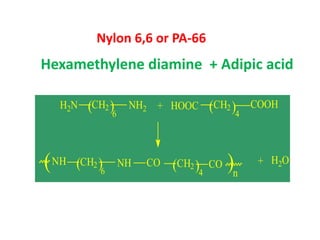
Hexamethylene diamine + Adipic acid
Nylon 6,6 or PA-66
Production of Polyamide 6
The ketone - alcohol mixture (KA) produced from benzene is first converted to
pure cyclohexanone, which is then used to make caprolactam, the monomer
used to make PA6.
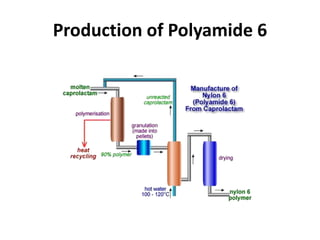
Production of Polyamide 6
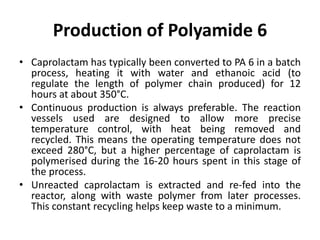
• Caprolactam has typically been converted to PA 6 in a batch
process, heating it with water and ethanoic acid (to
regulate the length of polymer chain produced) for 12
hours at about 350°C.
• Continuous production is always preferable. The reaction
vessels used are designed to allow more precise
temperature control, with heat being removed and
recycled. This means the operating temperature does not
exceed 280°C, but a higher percentage of caprolactam is
polymerised during the 16-20 hours spent in this stage of
the process.
• Unreacted caprolactam is extracted and re-fed into the
reactor, along with waste polymer from later processes.
This constant recycling helps keep waste to a minimum.
Production of Polyamide 6
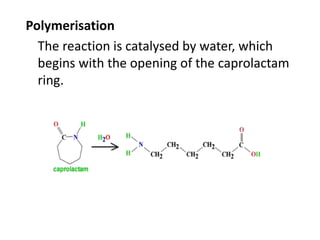
Polymerisation
The reaction is catalysed by water, which
begins with the opening of the caprolactam
ring.
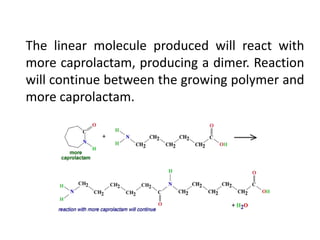
The linear molecule produced will react with
more caprolactam, producing a dimer. Reaction
will continue between the growing polymer and
more caprolactam.
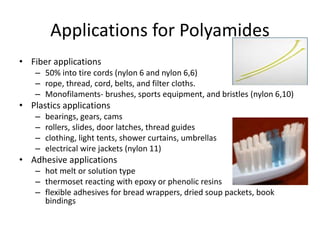
Applications for Polyamides
• Fiber applications
– 50% into tire cords (nylon 6 and nylon 6,6)
– rope, thread, cord, belts, and filter cloths.
– Monofilaments- brushes, sports equipment, and bristles (nylon 6,10)
• Plastics applications
– bearings, gears, cams
– rollers, slides, door latches, thread guides
– clothing, light tents, shower curtains, umbrellas
– electrical wire jackets (nylon 11)
• Adhesive applications
– hot melt or solution type
– thermoset reacting with epoxy or phenolic resins
– flexible adhesives for bread wrappers, dried soup packets, book
bindings
• Major Uses
– Structural parts!! (i.e. replacement for cast
aluminum 380 series)
– Electrical Connectors
– Gears
– Bearings
– Cables, Ties, Rope
– Fishing Line
– Automotive Valve Covers/Oil Pans
– Sports/Exercise Equipment
– Tools
• Why would you want to use it?
– High Strength – among the highest of all
engineering plastics
– Good candidate for structural parts
– Good Heat Resistance (continuous use up to 260 F,
bonded to rubber in molds up to 350 F)
– Good Chemical Resistance
– Excellent Wear Resistance
– Good Fatigue Resistance
Advantages and Disadvantages of
Polyamide
• Advantages
– Tough, strong, impact resistant
– Low coefficient of friction
– Abrasion resistance
– High temperature resistance
– Processable by thermopalstic methods
– Good solvent resistance
– Resistant to bases
• Disadvantages
– High moisture absorption with dimensional instability
• loss of up to 30 % of tensile strength and 50% of tensile modulus
– Subject to attack by strong acids and oxidizing agents
– Requires UV stabilization
– High shrinkage in molded sections
– Electrical and mechanical properties influenced by moisture content
– Dissolved by phenols
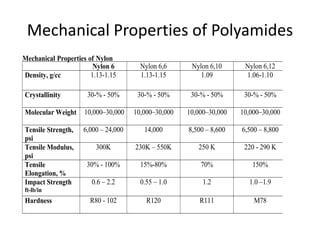
Mechanical Properties of Polyamides
Mechanical Properties of Nylon
Nylon 6 Nylon 6,6 Nylon 6,10 Nylon 6,12
Density, g/cc 1.13-1.15 1.13-1.15 1.09 1.06-1.10
Crystallinity 30-% - 50% 30-% - 50% 30-% - 50% 30-% - 50%
Molecular Weight 10,000–30,000 10,000–30,000 10,000–30,000 10,000–30,000
Tensile Strength,
psi
6,000 – 24,000 14,000 8,500 – 8,600 6,500 – 8,800
Tensile Modulus,
psi
300K 230K – 550K 250 K 220 - 290 K
Tensile
Elongation, %
30% - 100% 15%-80% 70% 150%
Impact Strength
ft-lb/in
0.6 – 2.2 0.55 – 1.0 1.2 1.0 –1.9
Hardness R80 - 102 R120 R111 M78
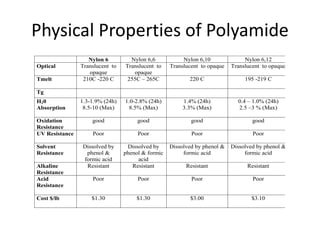
Physical Properties of Polyamide
Nylon 6 Nylon 6,6 Nylon 6,10 Nylon 6,12
Optical Translucent to
opaque
Translucent to
opaque
Translucent to opaque Translucent to opaque
Tmelt 210C -220 C 255C – 265C 220 C 195 -219 C
Tg
H20
Absorption
1.3-1.9% (24h)
8.5-10 (Max)
1.0-2.8% (24h)
8.5% (Max)
1.4% (24h)
3.3% (Max)
0.4 – 1.0% (24h)
2.5 –3 % (Max)
Oxidation
Resistance
good good good good
UV Resistance Poor Poor Poor Poor
Solvent
Resistance
Dissolved by
phenol &
formic acid
Dissolved by
phenol & formic
acid
Dissolved by phenol &
formic acid
Dissolved by phenol &
formic acid
Alkaline
Resistance
Resistant Resistant Resistant Resistant
Acid
Resistance
Poor Poor Poor Poor
Cost $/lb $1.30 $1.30 $3.00 $3.10
• Processes
– Injection Molding
– Extrusion
– Blow Molding
– Rotational Molding
– Thermoforming
Compounding ingredients
• Moulding material
– Heat and light stabilizers
– Plastisizers
– Lubricants
– Reinforcing fillers
– Pigments
– Fungicides
– Nucleating agents
– Flame retardants
– Impact modifiers
Additives and Reinforcements to PA
• Additives- antioxidants, UV stabilizers, colorants,
lubricants
• Fillers
– Talc
– Calcium carbonate
• Reinforcements
– Glass fiber- short fiber (1/8” or long fiber 1/4”)
– Mineral fiber (wolastonite)
– carbon fibers
– graphite fibers
– metallic flakes
– steel fibers
• http://www.essentialchemicalindustry.org/pol
ymers/polyamides.html
• http://www.essentialchemicalindustry.org/pol
ymers/polyamides.html

3 PolyamidesPPT.pptx

  • 1.
  • 2.
    • A polyamideis macromolecule with repeating units linked by amide bonds • Polyamides occur both naturally and artificially. • Examples of naturally occurring polyamides are proteins, such as wool and silk. • Artificially made polyamides can be made through step-growth polymerization or solid- phase synthesis yielding materials such as nylons, aramids, and sodium poly(aspartate). • Synthetic polyamides are commonly used in textiles, automotive applications, carpets and sportswear due to their high durability and strength. The transportation manufacturing industry is the major consumer, accounting for 35% of polyamide (PA) consumption.
  • 4.
    Chemical structure Amino caproicacid n ) ( CH2 CO NH ( )5 CH2 ( )5 COOH H2N CH2 ( )5 COOH H2N + H2O + Caprolactam Poly(caprolactam) Nylon 6 or PA-6
  • 5.
    NH ( CH2 CO NH n ) CH2CO ( ) 4 6 ( ) CH2 ( )6 NH2 H2N CH2 4 ( ) HOOC COOH + + H2O Hexamethylene diamine + Adipic acid Nylon 6,6 or PA-66
  • 6.
    Production of Polyamide6 The ketone - alcohol mixture (KA) produced from benzene is first converted to pure cyclohexanone, which is then used to make caprolactam, the monomer used to make PA6.
  • 7.
    Production of Polyamide6 • Caprolactam has typically been converted to PA 6 in a batch process, heating it with water and ethanoic acid (to regulate the length of polymer chain produced) for 12 hours at about 350°C. • Continuous production is always preferable. The reaction vessels used are designed to allow more precise temperature control, with heat being removed and recycled. This means the operating temperature does not exceed 280°C, but a higher percentage of caprolactam is polymerised during the 16-20 hours spent in this stage of the process. • Unreacted caprolactam is extracted and re-fed into the reactor, along with waste polymer from later processes. This constant recycling helps keep waste to a minimum.
  • 8.
  • 9.
    Polymerisation The reaction iscatalysed by water, which begins with the opening of the caprolactam ring.
  • 10.
    The linear moleculeproduced will react with more caprolactam, producing a dimer. Reaction will continue between the growing polymer and more caprolactam.
  • 11.
    Applications for Polyamides •Fiber applications – 50% into tire cords (nylon 6 and nylon 6,6) – rope, thread, cord, belts, and filter cloths. – Monofilaments- brushes, sports equipment, and bristles (nylon 6,10) • Plastics applications – bearings, gears, cams – rollers, slides, door latches, thread guides – clothing, light tents, shower curtains, umbrellas – electrical wire jackets (nylon 11) • Adhesive applications – hot melt or solution type – thermoset reacting with epoxy or phenolic resins – flexible adhesives for bread wrappers, dried soup packets, book bindings
  • 12.
    • Major Uses –Structural parts!! (i.e. replacement for cast aluminum 380 series) – Electrical Connectors – Gears – Bearings – Cables, Ties, Rope – Fishing Line – Automotive Valve Covers/Oil Pans – Sports/Exercise Equipment – Tools
  • 15.
    • Why wouldyou want to use it? – High Strength – among the highest of all engineering plastics – Good candidate for structural parts – Good Heat Resistance (continuous use up to 260 F, bonded to rubber in molds up to 350 F) – Good Chemical Resistance – Excellent Wear Resistance – Good Fatigue Resistance
  • 16.
    Advantages and Disadvantagesof Polyamide • Advantages – Tough, strong, impact resistant – Low coefficient of friction – Abrasion resistance – High temperature resistance – Processable by thermopalstic methods – Good solvent resistance – Resistant to bases • Disadvantages – High moisture absorption with dimensional instability • loss of up to 30 % of tensile strength and 50% of tensile modulus – Subject to attack by strong acids and oxidizing agents – Requires UV stabilization – High shrinkage in molded sections – Electrical and mechanical properties influenced by moisture content – Dissolved by phenols
  • 17.
    Mechanical Properties ofPolyamides Mechanical Properties of Nylon Nylon 6 Nylon 6,6 Nylon 6,10 Nylon 6,12 Density, g/cc 1.13-1.15 1.13-1.15 1.09 1.06-1.10 Crystallinity 30-% - 50% 30-% - 50% 30-% - 50% 30-% - 50% Molecular Weight 10,000–30,000 10,000–30,000 10,000–30,000 10,000–30,000 Tensile Strength, psi 6,000 – 24,000 14,000 8,500 – 8,600 6,500 – 8,800 Tensile Modulus, psi 300K 230K – 550K 250 K 220 - 290 K Tensile Elongation, % 30% - 100% 15%-80% 70% 150% Impact Strength ft-lb/in 0.6 – 2.2 0.55 – 1.0 1.2 1.0 –1.9 Hardness R80 - 102 R120 R111 M78
  • 18.
    Physical Properties ofPolyamide Nylon 6 Nylon 6,6 Nylon 6,10 Nylon 6,12 Optical Translucent to opaque Translucent to opaque Translucent to opaque Translucent to opaque Tmelt 210C -220 C 255C – 265C 220 C 195 -219 C Tg H20 Absorption 1.3-1.9% (24h) 8.5-10 (Max) 1.0-2.8% (24h) 8.5% (Max) 1.4% (24h) 3.3% (Max) 0.4 – 1.0% (24h) 2.5 –3 % (Max) Oxidation Resistance good good good good UV Resistance Poor Poor Poor Poor Solvent Resistance Dissolved by phenol & formic acid Dissolved by phenol & formic acid Dissolved by phenol & formic acid Dissolved by phenol & formic acid Alkaline Resistance Resistant Resistant Resistant Resistant Acid Resistance Poor Poor Poor Poor Cost $/lb $1.30 $1.30 $3.00 $3.10
  • 19.
    • Processes – InjectionMolding – Extrusion – Blow Molding – Rotational Molding – Thermoforming
  • 20.
    Compounding ingredients • Mouldingmaterial – Heat and light stabilizers – Plastisizers – Lubricants – Reinforcing fillers – Pigments – Fungicides – Nucleating agents – Flame retardants – Impact modifiers
  • 21.
    Additives and Reinforcementsto PA • Additives- antioxidants, UV stabilizers, colorants, lubricants • Fillers – Talc – Calcium carbonate • Reinforcements – Glass fiber- short fiber (1/8” or long fiber 1/4”) – Mineral fiber (wolastonite) – carbon fibers – graphite fibers – metallic flakes – steel fibers
  • 22.