DECONSTRUCTIO
N “Poststructuralism”
Rose Katherine H. Javier
DISCUSSANT
January 2015
The National Teachers College
School of Advanced Studies
ENG 302: Literary Theory & Criticism
Prof. Gene Alfred U. Paras
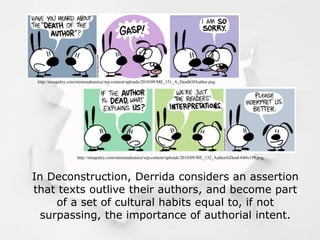
History of Deconstruction
 Rene Descartes (1596-1650) and Fredrick
Nietzsche (1844-1900) were pioneers in
deconstruction.
 They began to question the objective truth of
language.
 This is also known as Poststructuralist, this
criticism came after structuralism.
Structuralism
 This is the prelude to Deconstruction.
 It is a science that seeks to understand
how a system works, In this case,
Language.
 The structure of language comes from
the human mind.
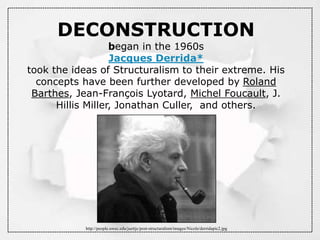
DECONSTRUCTION
began in the 1960s
Jacques Derrida*
took the ideas of Structuralism to their extreme. His
concepts have been further developed by Roland
Barthes, Jean-François Lyotard, Michel Foucault, J.
Hillis Miller, Jonathan Culler, and others.
http://people.uwec.edu/juettjc/post-structuralism/images/Nicole/derridapic2.jpg
DECONSTRUCTION
 “Deconstruction seems to center around
the idea that language and meaning are
often inadequate in trying to convey the
message or idea a communicator is trying
to express. Since the confusion stems
from the language and not the object then
one should break down or deconstruct the
language to see if we can better
understand where the confusion stems.”
- Derrida
Article Source: http://EzineArticles.com/84192
"Deconstruction refers to all of the
techniques and strategies used by
Derrida in order to destabilize, crack
open and displace texts that are
explicitly or invisibly idealistic“
(Hottois, 1998)
- Language is a collection of signs;
meaning is transient, arbitrary, &
uncertain
- Concepts are contained in their
opposites
- Texts are full of contradictions and lack
unity/ coherence
- There can be no final interpretation of
the text
- We live in a universe of radical
uncertainty
MAIN IDEAS
-
MAIN IDEAS
•Deconstructionists look for the ways
the elements in literature contradict
each other.
Premises:
Words cannot express
meaning.
Every utterance contains a lie
by omitting all other possible
utterances.
•Interpretations are sometimes
bizarre and contradictory.
http://ninapaley.com/mimiandeunice/wp-content/uploads/2010/09/ME_131_A_DeathOfAuthor.png
http://ninapaley.com/mimiandeunice/wp-content/uploads/2010/09/ME_132_AuthorIsDead-640x199.png
In Deconstruction, Derrida considers an assertion
that texts outlive their authors, and become part
of a set of cultural habits equal to, if not
surpassing, the importance of authorial intent.
ONE MAIN QUESTION:
How does
this text
undermine
itself?
http://image.spreadshirt.com/image-server/image/product/2581251/view/1/type/png/width/190/height/190/i-m-a-bit-unstable-white-text-junior-s-t-shirt.png
However, to deconstruct is not to destroy, and
deconstruction is achieved in two steps:
1. A reversal phase: Since the pair was hierarchically
ranked, we must first extinguish the power struggle.
During this first phase, then, writing must dominate
speech, other must prevail over self, absence over
presence, perception over understanding, and so on.
2. A neutralization phase: The term favoured during
the first phase must be uprooted from binary logic,
binary opposition**. In this way, we leave behind all
of the previous significations anchored in dualistic
thinking. This phase gives rise to androgyny, super-
speech, and arche-writing. The deconstructed term
thus becomes undecidable (Hottois, 1998, 306).
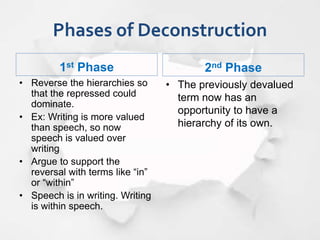
Phases of Deconstruction
1st Phase
• Reverse the hierarchies so
that the repressed could
dominate.
• Ex: Writing is more valued
than speech, so now
speech is valued over
writing
• Argue to support the
reversal with terms like “in”
or “within”
• Speech is in writing. Writing
is within speech.
2nd Phase
• The previously devalued
term now has an
opportunity to have a
hierarchy of its own.
How is it used in Literary
Analysis?
• Used as a tool in narrative analysis
• Starts with a very careful reading that looks
for inconsistency and contradictions in
the text
• The results often uncovering of a that is
difficult to make sense of deeply complex
foundation
• This is one of the many criticism of
Deconstruction, that it nihilistic and
unproductive because it leads to
uncertainty.
SampleTexts Analyzed Using
Deconstruction:
JAPAYUKISAN ****
Snow by Frederick Seidel ***
Sources
Barry, Peter. Beginning Theory: An Introduction to Literary and
Cultural Theory. 2nd edition. NY: Manchester UP, 2002. Print.
Brizee , Allen, and J. Case Tompkins. “Literary Theory and
Schools of Criticism.” Copyright ©1995-2011 by The Writing
Lab & The OWL at Purdue and Purdue University. Web. 13
Sept. 2011.
Morner, Kathleen and Ralph Rausch. NTC's Dictionary of Literary
Terms. Chicago: NTC, 1991. Print.
https://www.google.com.ph/?gfe_rd=cr&ei=SJy_VJLTD4yK8Qe5u
oDwCg&gws_rd=ssl#q=literary+deconstruction+reversal+ph
ase
http://www.signosemio.com/derrida/deconstruction-and-
differance.asp

Literary Criticism Lens: Deconstructionism

  • 1.
    DECONSTRUCTIO N “Poststructuralism” Rose KatherineH. Javier DISCUSSANT January 2015 The National Teachers College School of Advanced Studies ENG 302: Literary Theory & Criticism Prof. Gene Alfred U. Paras
  • 2.
    History of Deconstruction Rene Descartes (1596-1650) and Fredrick Nietzsche (1844-1900) were pioneers in deconstruction.  They began to question the objective truth of language.  This is also known as Poststructuralist, this criticism came after structuralism.
  • 3.
    Structuralism  This isthe prelude to Deconstruction.  It is a science that seeks to understand how a system works, In this case, Language.  The structure of language comes from the human mind.
  • 4.
    DECONSTRUCTION began in the1960s Jacques Derrida* took the ideas of Structuralism to their extreme. His concepts have been further developed by Roland Barthes, Jean-François Lyotard, Michel Foucault, J. Hillis Miller, Jonathan Culler, and others. http://people.uwec.edu/juettjc/post-structuralism/images/Nicole/derridapic2.jpg
  • 5.
    DECONSTRUCTION  “Deconstruction seemsto center around the idea that language and meaning are often inadequate in trying to convey the message or idea a communicator is trying to express. Since the confusion stems from the language and not the object then one should break down or deconstruct the language to see if we can better understand where the confusion stems.” - Derrida Article Source: http://EzineArticles.com/84192
  • 6.
    "Deconstruction refers toall of the techniques and strategies used by Derrida in order to destabilize, crack open and displace texts that are explicitly or invisibly idealistic“ (Hottois, 1998)
  • 7.
    - Language isa collection of signs; meaning is transient, arbitrary, & uncertain - Concepts are contained in their opposites - Texts are full of contradictions and lack unity/ coherence - There can be no final interpretation of the text - We live in a universe of radical uncertainty MAIN IDEAS
  • 8.
    - MAIN IDEAS •Deconstructionists lookfor the ways the elements in literature contradict each other. Premises: Words cannot express meaning. Every utterance contains a lie by omitting all other possible utterances. •Interpretations are sometimes bizarre and contradictory.
  • 9.
    http://ninapaley.com/mimiandeunice/wp-content/uploads/2010/09/ME_131_A_DeathOfAuthor.png http://ninapaley.com/mimiandeunice/wp-content/uploads/2010/09/ME_132_AuthorIsDead-640x199.png In Deconstruction, Derridaconsiders an assertion that texts outlive their authors, and become part of a set of cultural habits equal to, if not surpassing, the importance of authorial intent.
  • 10.
    ONE MAIN QUESTION: Howdoes this text undermine itself? http://image.spreadshirt.com/image-server/image/product/2581251/view/1/type/png/width/190/height/190/i-m-a-bit-unstable-white-text-junior-s-t-shirt.png
  • 11.
    However, to deconstructis not to destroy, and deconstruction is achieved in two steps: 1. A reversal phase: Since the pair was hierarchically ranked, we must first extinguish the power struggle. During this first phase, then, writing must dominate speech, other must prevail over self, absence over presence, perception over understanding, and so on. 2. A neutralization phase: The term favoured during the first phase must be uprooted from binary logic, binary opposition**. In this way, we leave behind all of the previous significations anchored in dualistic thinking. This phase gives rise to androgyny, super- speech, and arche-writing. The deconstructed term thus becomes undecidable (Hottois, 1998, 306).
  • 12.
    Phases of Deconstruction 1stPhase • Reverse the hierarchies so that the repressed could dominate. • Ex: Writing is more valued than speech, so now speech is valued over writing • Argue to support the reversal with terms like “in” or “within” • Speech is in writing. Writing is within speech. 2nd Phase • The previously devalued term now has an opportunity to have a hierarchy of its own.
  • 13.
    How is itused in Literary Analysis? • Used as a tool in narrative analysis • Starts with a very careful reading that looks for inconsistency and contradictions in the text • The results often uncovering of a that is difficult to make sense of deeply complex foundation • This is one of the many criticism of Deconstruction, that it nihilistic and unproductive because it leads to uncertainty.
  • 14.
  • 15.
    Sources Barry, Peter. BeginningTheory: An Introduction to Literary and Cultural Theory. 2nd edition. NY: Manchester UP, 2002. Print. Brizee , Allen, and J. Case Tompkins. “Literary Theory and Schools of Criticism.” Copyright ©1995-2011 by The Writing Lab & The OWL at Purdue and Purdue University. Web. 13 Sept. 2011. Morner, Kathleen and Ralph Rausch. NTC's Dictionary of Literary Terms. Chicago: NTC, 1991. Print. https://www.google.com.ph/?gfe_rd=cr&ei=SJy_VJLTD4yK8Qe5u oDwCg&gws_rd=ssl#q=literary+deconstruction+reversal+ph ase http://www.signosemio.com/derrida/deconstruction-and- differance.asp