POST-STRUCTURALISM AND
POSTMODERNISM
(WITH CONCEPTS OF FRENCH WRITERS OF 60S AND 80S)
Prepared by,
AMITH V.AJITH
The term postmodern is used rather
loosely to refer to a number of
theoretical approaches developed
since the late 1960s.
The term post-structuralism is
generally used to refer to a quintet of
French theorists whose major
influence on structuralism as occurs in
the 80s -- Jacques Derrida, Michel
Foucault, Jacques Lacan, Julia Kristeva,
and Roland Barthes
If structuralism relies upon
the logic of language, post-
structuralism reveals
rhetoric as the subversive,
poetic sub-conscious of
that logic. These writers
are post- structuralist in
the sense that they
demonstrate the
dependence of all
structures on that which
they try to eliminate from
their systems.
These writers all have in
common an attempt to
uncover the unquestioned
metaphors that undergird
social and disciplinary norms,
particularly as manifested in
philosophy (Derrida),
historical writing and the
professions (Foucault),
psychoanalysis (Lacan), and
literary studies (Kristeva and
Barthes).
The fundamentals of the post-
structuralists perspective can
be found in the literary
theories of Roland Barthes
and Jacques Derrida.
Barthes’ concept of inter-textuality
and Derrida’s difference provided
the basis for a radical epistemology
that addressed how language and
abstract concepts stand in the way
of ever gaining knowledge of the
“real world”.
Derrida proved that the conventional link
between signifier and signified is slippery and
fragile, thus meaning is more else than
structuralists had supposed.
Metaphysics – a phrase coined by Derrida and a
thought propagated by Western philosophy that full
meaning of a word is ‘present’ in the speaker’s
mind, such that it can be transmitted without a
significant slipping.
Derrida also provided post-
structuralism with a critical
perspective on how logo
centric claims can be
made and justified. He argued
that one way users of
language attempt
to overcome the limitations
and circularity of signification,
is to define concepts not in
terms of what they are, but
through their difference from
other things.
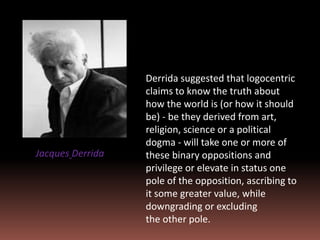
Derrida suggested that logocentric
claims to know the truth about
how the world is (or how it should
be) - be they derived from art,
religion, science or a political
dogma - will take one or more of
these binary oppositions and
privilege or elevate in status one
pole of the opposition, ascribing to
it some greater value, while
downgrading or excluding
the other pole.
Jacques Derrida
The broader terrain of Postmodern
theory often includes three
theorists influenced by but not
within poststructuralism: Gilles
Deleuze and Felix Guattari, Jean-
Francois Lyotard, and Jean
Baudrillard.
Postmodernists and
poststructuralists can only be
spoken of in the plural. They do not
constitute a single school and there
is as much disagreement among
them as between them and other
types of theory.
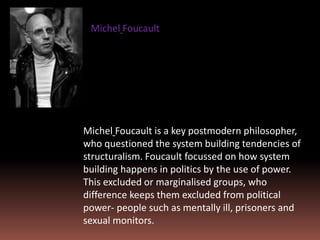
Michel Foucault is a key postmodern philosopher,
who questioned the system building tendencies of
structuralism. Foucault focussed on how system
building happens in politics by the use of power.
This excluded or marginalised groups, who
difference keeps them excluded from political
power- people such as mentally ill, prisoners and
sexual monitors.
Michel Foucault
The emergence of post-structuralist
critical approaches within the
humanities, sciences and social sciences
led Lyotard (1984) to announce the
“postmodern condition” affecting
scholarship in the latter part of the 20th
century. This was defined by a suspicion
of all grandeur meta-narratives in
science, social science and culture that
made absolute claims to truth. Instead,
the postmodern condition was marked
by doubts over the validity of truth-
claims and a willingness to entertain
multiple parallel explanations of the
social world It was reflected in a rejection
of over-arching social models including
Marxism and psychoanalysis, pessimism
about progress through scientific
advances, and in critiques of colonialism,
racism, heteronormativity and patriarchy.
Post- structuralist and postmodernist
theories within the social sciences
criticise the truth-seeking aspirations
of post-Enlightenment modernism,
which apply rationalist methodologies,
including humanism and science. They
are suspicious of claims to truth made
by scientific disciplines in the physical
and biological sciences, social sciences
such as economics and politics, and by
professional groupings such as law,
medicine and education that ground
their practice in these bodies
of scientific knowledge.
The postmodern turn in social theory is
characterized by reflexivity concerning
the production of academic texts, a
willingness to allow multiple voices to
speak in these texts (including those of
research “subjects”) and an emphasis on
empowering the dispossessed or
silenced in societies.
Deleuze and Guattari (1988) assess
the nexus of power relations
between objects, bodies and ideas
that shape the limits on human
action and the subject positions
that these make possible.
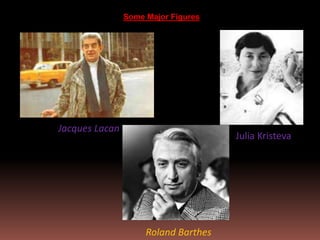
Some Major Figures
Julia Kristeva
Jacques Lacan
Roland Barthes

Post structuralism and postmodernism

  • 1.
    POST-STRUCTURALISM AND POSTMODERNISM (WITH CONCEPTSOF FRENCH WRITERS OF 60S AND 80S) Prepared by, AMITH V.AJITH
  • 2.
    The term postmodernis used rather loosely to refer to a number of theoretical approaches developed since the late 1960s. The term post-structuralism is generally used to refer to a quintet of French theorists whose major influence on structuralism as occurs in the 80s -- Jacques Derrida, Michel Foucault, Jacques Lacan, Julia Kristeva, and Roland Barthes
  • 3.
    If structuralism reliesupon the logic of language, post- structuralism reveals rhetoric as the subversive, poetic sub-conscious of that logic. These writers are post- structuralist in the sense that they demonstrate the dependence of all structures on that which they try to eliminate from their systems.
  • 4.
    These writers allhave in common an attempt to uncover the unquestioned metaphors that undergird social and disciplinary norms, particularly as manifested in philosophy (Derrida), historical writing and the professions (Foucault), psychoanalysis (Lacan), and literary studies (Kristeva and Barthes).
  • 5.
    The fundamentals ofthe post- structuralists perspective can be found in the literary theories of Roland Barthes and Jacques Derrida. Barthes’ concept of inter-textuality and Derrida’s difference provided the basis for a radical epistemology that addressed how language and abstract concepts stand in the way of ever gaining knowledge of the “real world”.
  • 6.
    Derrida proved thatthe conventional link between signifier and signified is slippery and fragile, thus meaning is more else than structuralists had supposed. Metaphysics – a phrase coined by Derrida and a thought propagated by Western philosophy that full meaning of a word is ‘present’ in the speaker’s mind, such that it can be transmitted without a significant slipping.
  • 7.
    Derrida also providedpost- structuralism with a critical perspective on how logo centric claims can be made and justified. He argued that one way users of language attempt to overcome the limitations and circularity of signification, is to define concepts not in terms of what they are, but through their difference from other things.
  • 8.
    Derrida suggested thatlogocentric claims to know the truth about how the world is (or how it should be) - be they derived from art, religion, science or a political dogma - will take one or more of these binary oppositions and privilege or elevate in status one pole of the opposition, ascribing to it some greater value, while downgrading or excluding the other pole. Jacques Derrida
  • 9.
    The broader terrainof Postmodern theory often includes three theorists influenced by but not within poststructuralism: Gilles Deleuze and Felix Guattari, Jean- Francois Lyotard, and Jean Baudrillard. Postmodernists and poststructuralists can only be spoken of in the plural. They do not constitute a single school and there is as much disagreement among them as between them and other types of theory.
  • 10.
    Michel Foucault isa key postmodern philosopher, who questioned the system building tendencies of structuralism. Foucault focussed on how system building happens in politics by the use of power. This excluded or marginalised groups, who difference keeps them excluded from political power- people such as mentally ill, prisoners and sexual monitors. Michel Foucault
  • 11.
    The emergence ofpost-structuralist critical approaches within the humanities, sciences and social sciences led Lyotard (1984) to announce the “postmodern condition” affecting scholarship in the latter part of the 20th century. This was defined by a suspicion of all grandeur meta-narratives in science, social science and culture that made absolute claims to truth. Instead, the postmodern condition was marked by doubts over the validity of truth- claims and a willingness to entertain multiple parallel explanations of the social world It was reflected in a rejection of over-arching social models including Marxism and psychoanalysis, pessimism about progress through scientific advances, and in critiques of colonialism, racism, heteronormativity and patriarchy.
  • 12.
    Post- structuralist andpostmodernist theories within the social sciences criticise the truth-seeking aspirations of post-Enlightenment modernism, which apply rationalist methodologies, including humanism and science. They are suspicious of claims to truth made by scientific disciplines in the physical and biological sciences, social sciences such as economics and politics, and by professional groupings such as law, medicine and education that ground their practice in these bodies of scientific knowledge.
  • 13.
    The postmodern turnin social theory is characterized by reflexivity concerning the production of academic texts, a willingness to allow multiple voices to speak in these texts (including those of research “subjects”) and an emphasis on empowering the dispossessed or silenced in societies. Deleuze and Guattari (1988) assess the nexus of power relations between objects, bodies and ideas that shape the limits on human action and the subject positions that these make possible.
  • 14.
    Some Major Figures JuliaKristeva Jacques Lacan Roland Barthes