Vocabulary
Population Vocabulary
   Demography              Population Pyramid
   Population              Replacement Rate
    Distribution            Dependency Ratio
   Population Density
   Birth Rate
   Death Rate
   Life Expectancy
   Demographic
    Transition Model


                                                  3
Demography
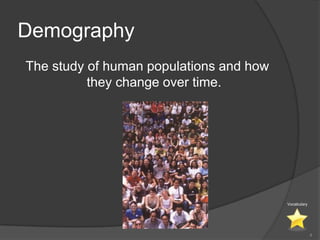
The study of human populations and how
          they change over time.


                                         Vocabulary


                                                      4
Population Distribution
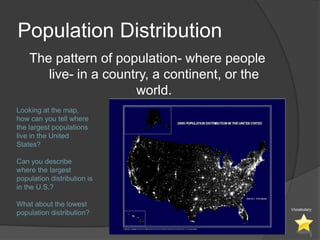
    The pattern of population- where people
       live- in a country, a continent, or the
                       world.
Looking at the map,
how can you tell where
the largest populations
live in the United
States?

Can you describe
where the largest
population distribution is
in the U.S.?

What about the lowest
                                                 Vocabulary
population distribution?


                                                          5
Population Distribution
   Sparsely populated- contain few
    people
     Tend to be difficult places to live
     Example: Antarctica
   Densely populated- contain many
    people
     Tend to be livable environments
     Example: Europe


                                            6
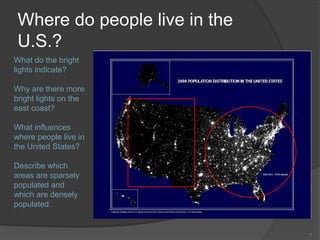
Where do people live in the
 U.S.?
What do the bright
lights indicate?

Why are there more
bright lights on the
east coast?

What influences
where people live in
the United States?

Describe which
areas are sparsely
populated and
which are densely
populated.


                               7
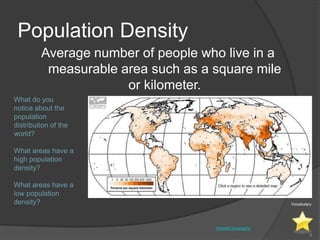
Population Density
         Average number of people who live in a
          measurable area such as a square mile
                      or kilometer.
What do you
notice about the
population
distribution of the
world?

What areas have a
high population
density?

What areas have a
low population
density?                                                 Vocabulary


                                    Internet Geography
                                                                  8
Population Density


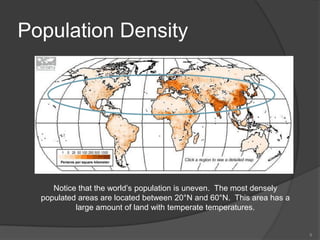
     Notice that the world’s population is uneven. The most densely
  populated areas are located between 20°N and 60°N. This area has a
           large amount of land with temperate temperatures.


                                                                       9
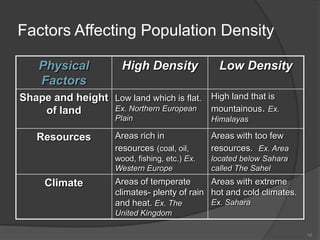
Factors Affecting Population Density

    Physical           High Density               Low Density
    Factors
Shape and height Low land which is flat. High land that is
    of land      Ex. Northern European   mountainous. Ex.
                     Plain                      Himalayas

   Resources         Areas rich in              Areas with too few
                     resources (coal, oil,      resources. Ex. Area
                     wood, fishing, etc.) Ex.   located below Sahara
                     Western Europe             called The Sahel
     Climate         Areas of temperate       Areas with extreme
                     climates- plenty of rain hot and cold climates.
                     and heat. Ex. The        Ex. Sahara
                     United Kingdom

                                                                       10
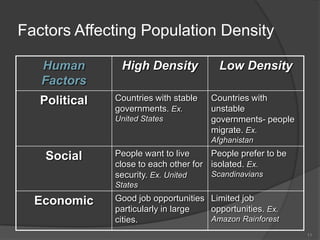
Factors Affecting Population Density

   Human        High Density             Low Density
   Factors
   Political   Countries with stable   Countries with
               governments. Ex.        unstable
               United States           governments- people
                                       migrate. Ex.
                                       Afghanistan

    Social     People want to live     People prefer to be
               close to each other for isolated. Ex.
               security. Ex. United    Scandinavians
               States

  Economic     Good job opportunities Limited job
               particularly in large  opportunities. Ex.
               cities.                Amazon Rainforest
                                                             11
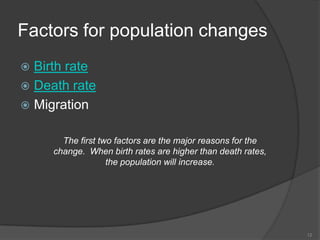
Factors for population changes
 Birth rate
 Death rate
 Migration


       The first two factors are the major reasons for the
     change. When birth rates are higher than death rates,
                   the population will increase.


                                                             12
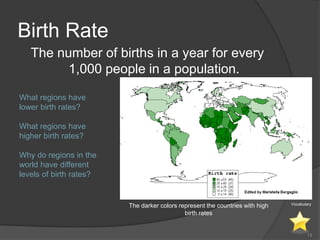
Birth Rate
   The number of births in a year for every
         1,000 people in a population.

What regions have
lower birth rates?

What regions have
higher birth rates?

Why do regions in the
world have different
levels of birth rates?


                                                                               Vocabulary
                         The darker colors represent the countries with high
                                             birth rates


                                                                                      13
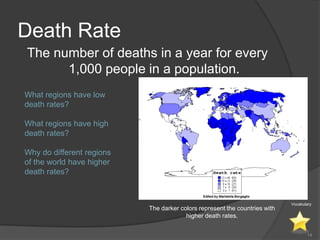
Death Rate
The number of deaths in a year for every
      1,000 people in a population.
What regions have low
death rates?

What regions have high
death rates?

Why do different regions
of the world have higher
death rates?


                                                                            Vocabulary
                           The darker colors represent the countries with
                                        higher death rates.


                                                                                   14
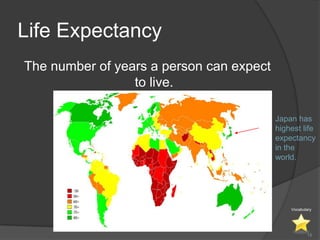
Life Expectancy
The number of years a person can expect
                 to live.

                                          Japan has
                                          highest life
                                          expectancy
                                          in the
                                          world.


                                              Vocabulary


                                                     15
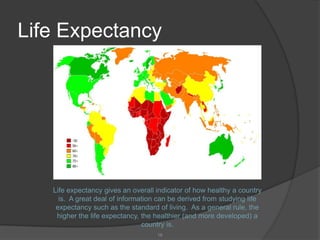
Life Expectancy


   Life expectancy gives an overall indicator of how healthy a country
     is. A great deal of information can be derived from studying life
    expectancy such as the standard of living. As a general rule, the
    higher the life expectancy, the healthier (and more developed) a
                                country is.
                                    16
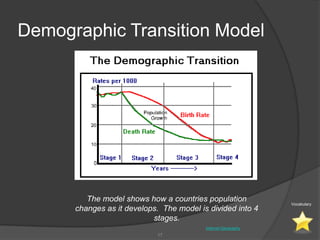
Demographic Transition Model


         The model shows how a countries population
                                                               Vocabulary
      changes as it develops. The model is divided into 4
                           stages.
                                          Internet Geography
                            17
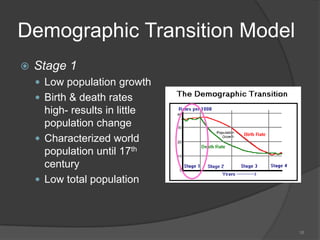
Demographic Transition Model
   Stage 1
     Low population growth
     Birth & death rates
      high- results in little
      population change
     Characterized world
      population until 17th
      century
     Low total population


                                18
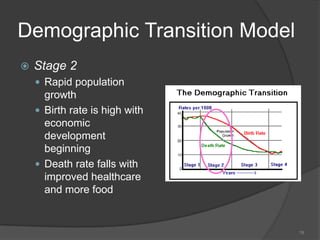
Demographic Transition Model
   Stage 2
     Rapid population
      growth
     Birth rate is high with
      economic
      development
      beginning
     Death rate falls with
      improved healthcare
      and more food


                                19
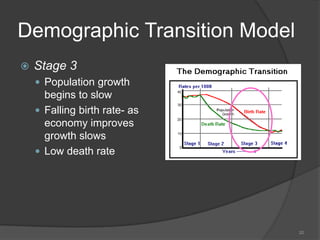
Demographic Transition Model
   Stage 3
     Population growth
      begins to slow
     Falling birth rate- as
      economy improves
      growth slows
     Low death rate


                               20
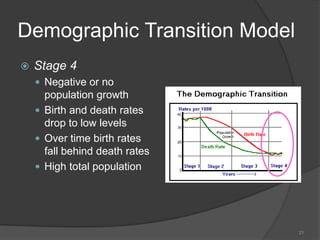
Demographic Transition Model
   Stage 4
     Negative or no
      population growth
     Birth and death rates
      drop to low levels
     Over time birth rates
      fall behind death rates
     High total population


                                21
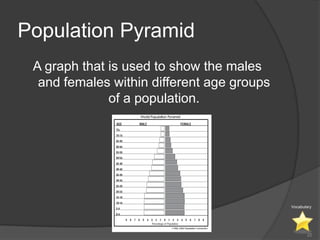
Population Pyramid
 A graph that is used to show the males
  and females within different age groups
              of a population.


                                            Vocabulary


                                                   22
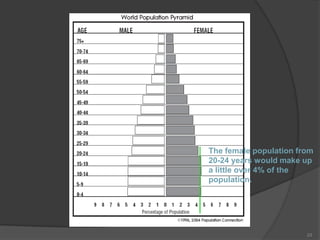
The female population from
20-24 years would make up
a little over 4% of the
population.


                        23
24
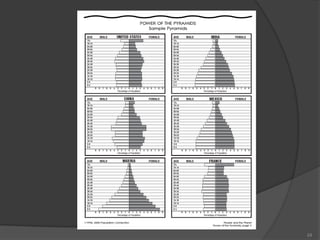
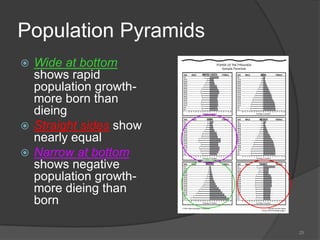
Population Pyramids
 Wide at bottom
  shows rapid
  population growth-
  more born than
  dieing
 Straight sides show
  nearly equal
 Narrow at bottom
  shows negative
  population growth-
  more dieing than
  born

                        25
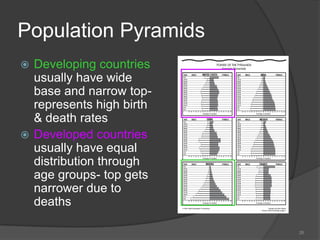
Population Pyramids
 Developing countries
  usually have wide
  base and narrow top-
  represents high birth
  & death rates
 Developed countries
  usually have equal
  distribution through
  age groups- top gets
  narrower due to
  deaths

                          26
Replacement Rate
When enough babies are born to replace
    those people who die each year.


                                         Vocabulary


                                                  27
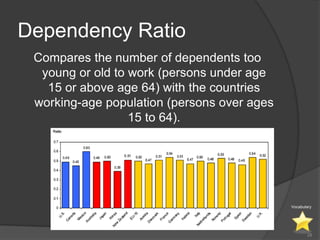
Dependency Ratio
 Compares the number of dependents too
  young or old to work (persons under age
   15 or above age 64) with the countries
 working-age population (persons over ages
                  15 to 64).


                                             Vocabulary


                                                    28
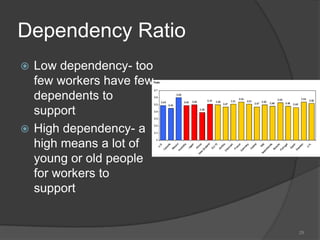
Dependency Ratio
 Low dependency- too
  few workers have few
  dependents to
  support
 High dependency- a
  high means a lot of
  young or old people
  for workers to
  support


                         29

Population geography vocabulary

  • 1.
  • 3.
    Population Vocabulary  Demography  Population Pyramid  Population  Replacement Rate Distribution  Dependency Ratio  Population Density  Birth Rate  Death Rate  Life Expectancy  Demographic Transition Model 3
  • 4.
    Demography The study ofhuman populations and how they change over time. Vocabulary 4
  • 5.
    Population Distribution The pattern of population- where people live- in a country, a continent, or the world. Looking at the map, how can you tell where the largest populations live in the United States? Can you describe where the largest population distribution is in the U.S.? What about the lowest Vocabulary population distribution? 5
  • 6.
    Population Distribution  Sparsely populated- contain few people  Tend to be difficult places to live  Example: Antarctica  Densely populated- contain many people  Tend to be livable environments  Example: Europe 6
  • 7.
    Where do peoplelive in the U.S.? What do the bright lights indicate? Why are there more bright lights on the east coast? What influences where people live in the United States? Describe which areas are sparsely populated and which are densely populated. 7
  • 8.
    Population Density Average number of people who live in a measurable area such as a square mile or kilometer. What do you notice about the population distribution of the world? What areas have a high population density? What areas have a low population density? Vocabulary Internet Geography 8
  • 9.
    Population Density Notice that the world’s population is uneven. The most densely populated areas are located between 20°N and 60°N. This area has a large amount of land with temperate temperatures. 9
  • 10.
    Factors Affecting PopulationDensity Physical High Density Low Density Factors Shape and height Low land which is flat. High land that is of land Ex. Northern European mountainous. Ex. Plain Himalayas Resources Areas rich in Areas with too few resources (coal, oil, resources. Ex. Area wood, fishing, etc.) Ex. located below Sahara Western Europe called The Sahel Climate Areas of temperate Areas with extreme climates- plenty of rain hot and cold climates. and heat. Ex. The Ex. Sahara United Kingdom 10
  • 11.
    Factors Affecting PopulationDensity Human High Density Low Density Factors Political Countries with stable Countries with governments. Ex. unstable United States governments- people migrate. Ex. Afghanistan Social People want to live People prefer to be close to each other for isolated. Ex. security. Ex. United Scandinavians States Economic Good job opportunities Limited job particularly in large opportunities. Ex. cities. Amazon Rainforest 11
  • 12.
    Factors for populationchanges  Birth rate  Death rate  Migration The first two factors are the major reasons for the change. When birth rates are higher than death rates, the population will increase. 12
  • 13.
    Birth Rate The number of births in a year for every 1,000 people in a population. What regions have lower birth rates? What regions have higher birth rates? Why do regions in the world have different levels of birth rates? Vocabulary The darker colors represent the countries with high birth rates 13
  • 14.
    Death Rate The numberof deaths in a year for every 1,000 people in a population. What regions have low death rates? What regions have high death rates? Why do different regions of the world have higher death rates? Vocabulary The darker colors represent the countries with higher death rates. 14
  • 15.
    Life Expectancy The numberof years a person can expect to live. Japan has highest life expectancy in the world. Vocabulary 15
  • 16.
    Life Expectancy Life expectancy gives an overall indicator of how healthy a country is. A great deal of information can be derived from studying life expectancy such as the standard of living. As a general rule, the higher the life expectancy, the healthier (and more developed) a country is. 16
  • 17.
    Demographic Transition Model The model shows how a countries population Vocabulary changes as it develops. The model is divided into 4 stages. Internet Geography 17
  • 18.
    Demographic Transition Model  Stage 1  Low population growth  Birth & death rates high- results in little population change  Characterized world population until 17th century  Low total population 18
  • 19.
    Demographic Transition Model  Stage 2  Rapid population growth  Birth rate is high with economic development beginning  Death rate falls with improved healthcare and more food 19
  • 20.
    Demographic Transition Model  Stage 3  Population growth begins to slow  Falling birth rate- as economy improves growth slows  Low death rate 20
  • 21.
    Demographic Transition Model  Stage 4  Negative or no population growth  Birth and death rates drop to low levels  Over time birth rates fall behind death rates  High total population 21
  • 22.
    Population Pyramid Agraph that is used to show the males and females within different age groups of a population. Vocabulary 22
  • 23.
    The female populationfrom 20-24 years would make up a little over 4% of the population. 23
  • 24.
  • 25.
    Population Pyramids  Wideat bottom shows rapid population growth- more born than dieing  Straight sides show nearly equal  Narrow at bottom shows negative population growth- more dieing than born 25
  • 26.
    Population Pyramids  Developingcountries usually have wide base and narrow top- represents high birth & death rates  Developed countries usually have equal distribution through age groups- top gets narrower due to deaths 26
  • 27.
    Replacement Rate When enoughbabies are born to replace those people who die each year. Vocabulary 27
  • 28.
    Dependency Ratio Comparesthe number of dependents too young or old to work (persons under age 15 or above age 64) with the countries working-age population (persons over ages 15 to 64). Vocabulary 28
  • 29.
    Dependency Ratio  Lowdependency- too few workers have few dependents to support  High dependency- a high means a lot of young or old people for workers to support 29