EPOXY COATING
WHAT IS EPOXY?
• An epoxy coating is the use of epoxy compounds as
coatings or paints.
• It is generally two parts, which are mixed prior to
application and consist of an epoxy resin that is cross-
linked with a co-reactant or hardener.
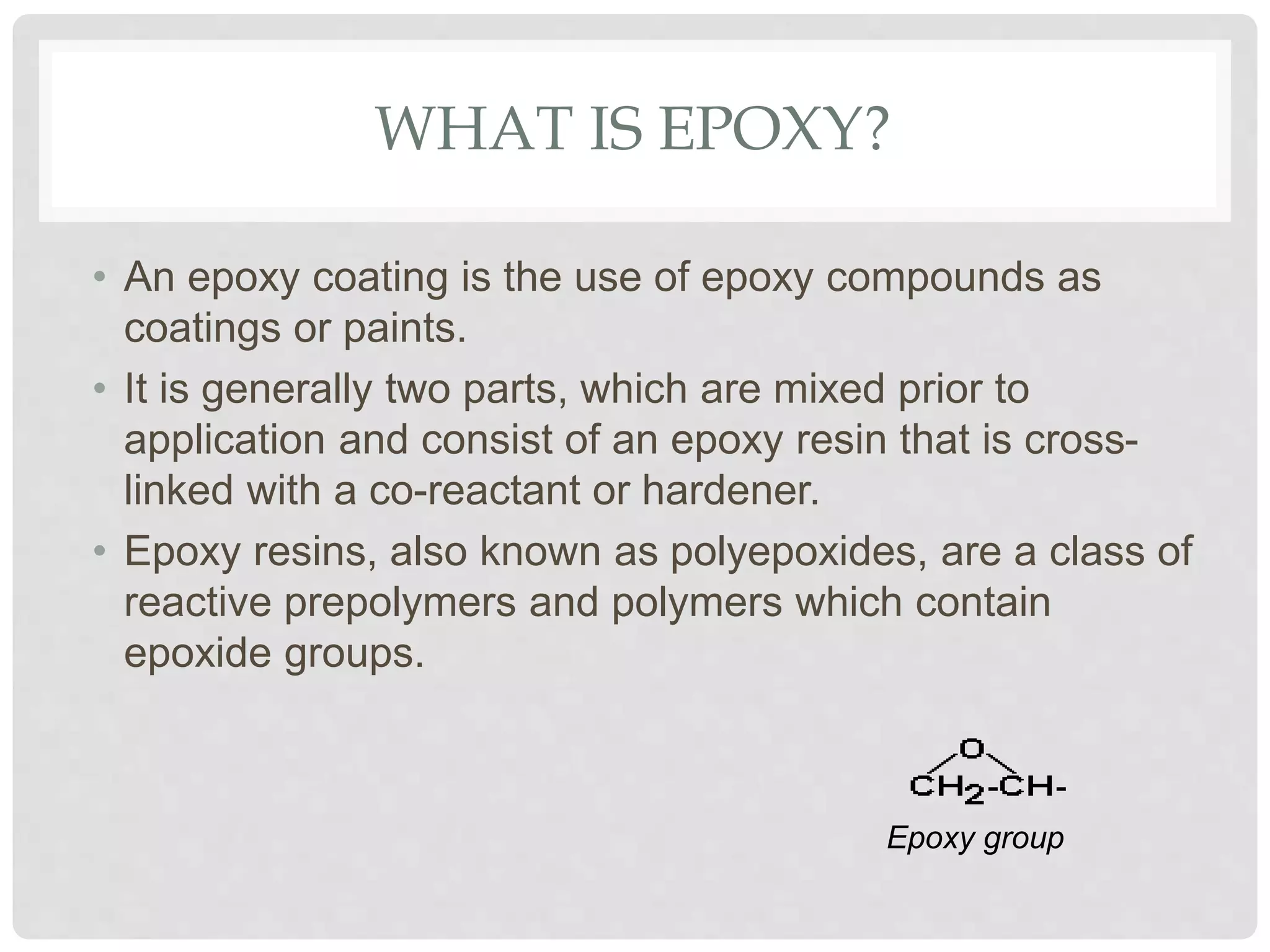
• Epoxy resins, also known as polyepoxides, are a class of
reactive prepolymers and polymers which contain
epoxide groups.
Epoxy group
CHEMISTRY
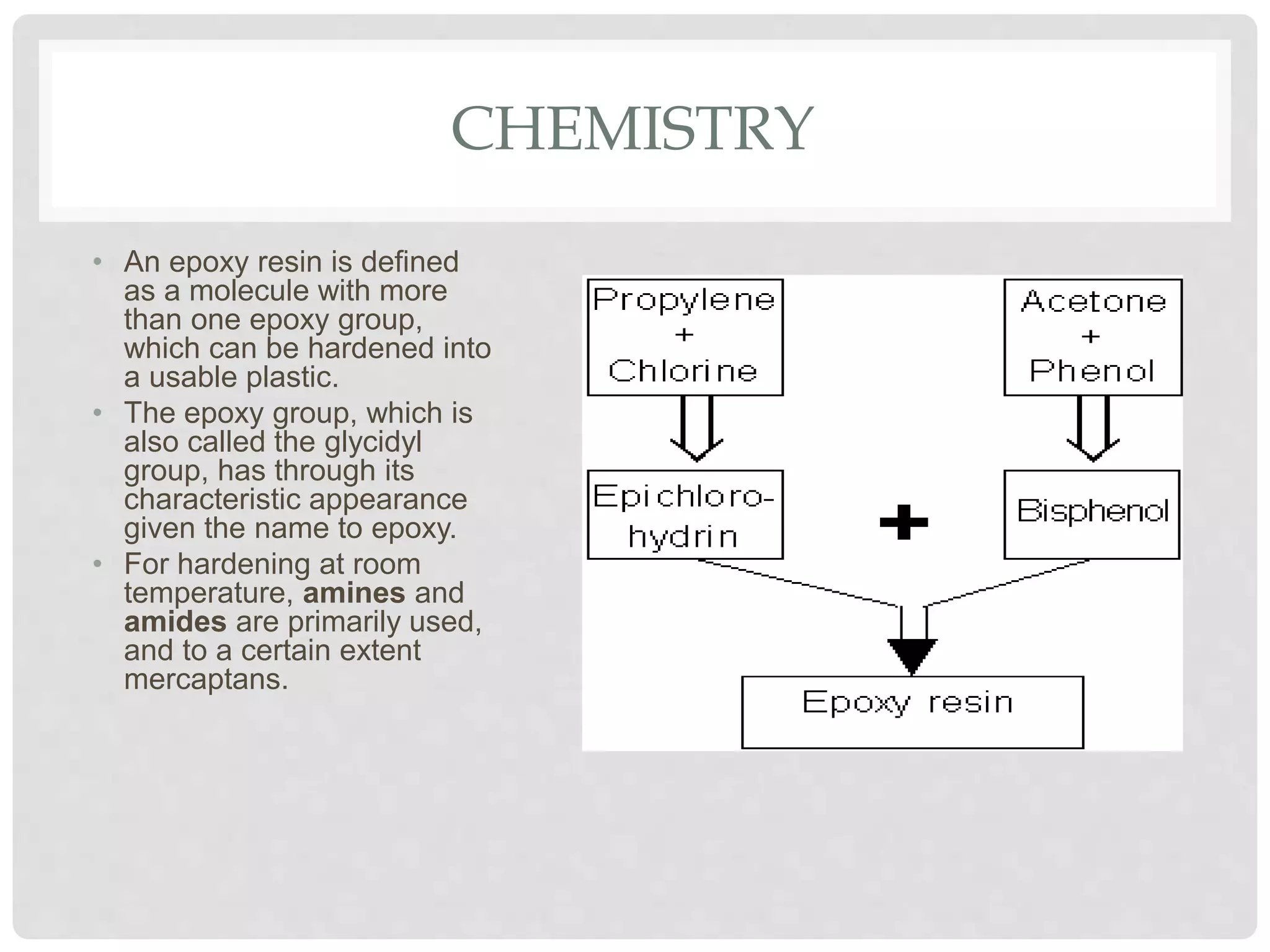
• An epoxy resin is defined
as a molecule with more
than one epoxy group,
which can be hardened into
a usable plastic.
• The epoxy group, which is
also called the glycidyl
group, has through its
characteristic appearance
given the name to epoxy.
• For hardening at room
temperature, amines and
amides are primarily used,
and to a certain extent
mercaptans.
CHEMISTRY
1. The primary amino
group NH2 contains as
seen, two hydrogen atoms
and one nitrogen atom. It is
the hydrogen that
constitutes the reactive part,
and the reaction occurs with
the oxygen in the epoxy
group.
2. The next large group of
hardeners is the amides, or
more correctly expressed,
the polyaminoamides. An
amide is formed when a
polyamine reacts with a fatty
acid.
Primary amine + Epoxy group gives Secondary amino group
CURING
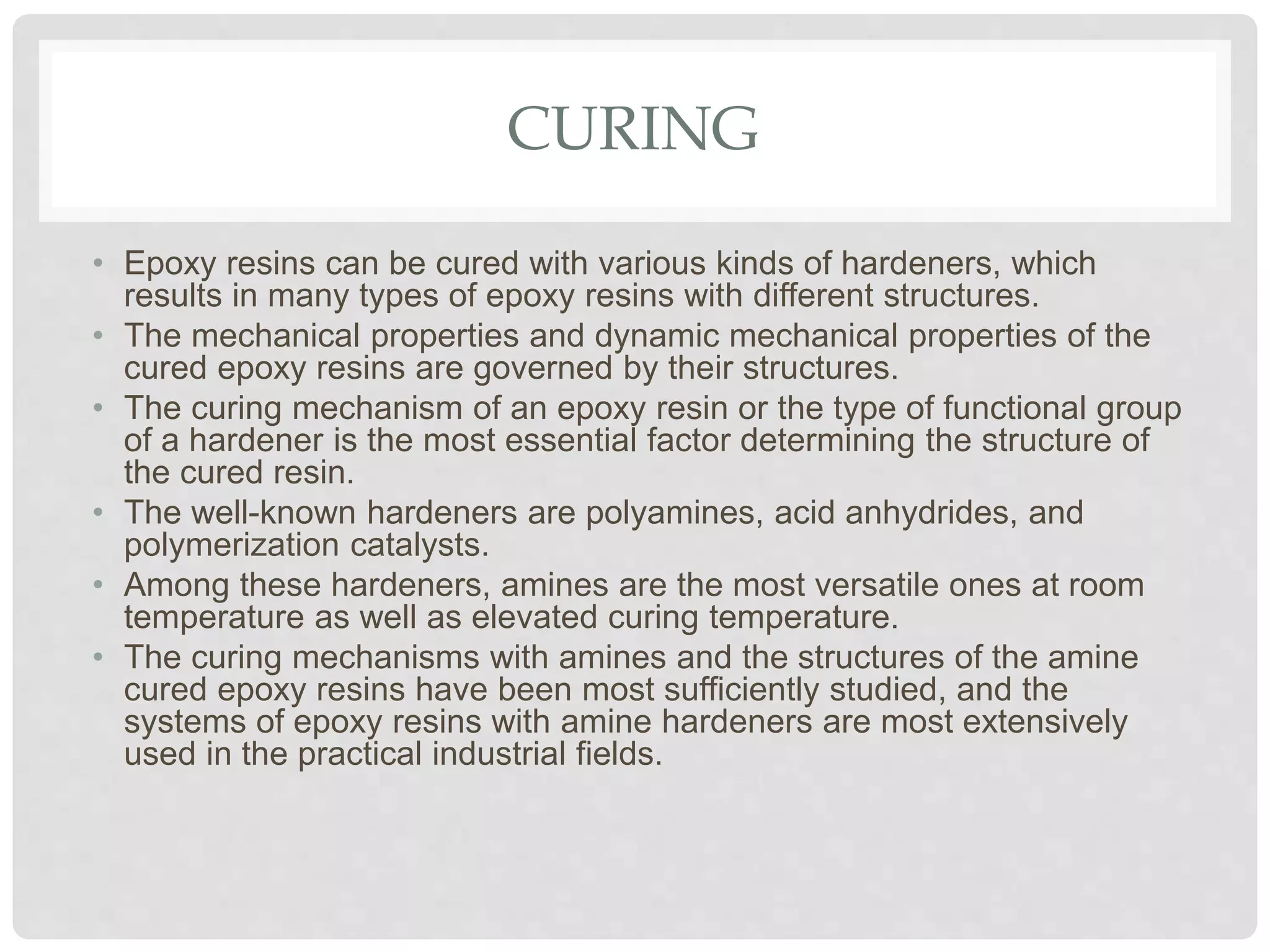
• Epoxy resins can be cured with various kinds of hardeners, which
results in many types of epoxy resins with different structures.
• The mechanical properties and dynamic mechanical properties of the
cured epoxy resins are governed by their structures.
• The curing mechanism of an epoxy resin or the type of functional group
of a hardener is the most essential factor determining the structure of
the cured resin.
• The well-known hardeners are polyamines, acid anhydrides, and
polymerization catalysts.
• Among these hardeners, amines are the most versatile ones at room
temperature as well as elevated curing temperature.
• The curing mechanisms with amines and the structures of the amine
cured epoxy resins have been most sufficiently studied, and the
systems of epoxy resins with amine hardeners are most extensively
used in the practical industrial fields.
PROPERTIES
• It has excellent gap filling properties.
• Epoxy is resistant to cold, radiation, and
steam.
• The superior performance of epoxy remains
when exposed to adverse environmental
conditions
• The advantages of 2K epoxy outweigh the
disadvantages. 2K epoxy resins cure easily
at room temperature. They do not require
heat of any sort.
• 1K epoxy does require heat.
• 2K epoxy provides excellent chemical
resistance.
Performance properties held by epoxy are:
• Biocompatibility
• Environmentally friendly
• Flame resistant
• Food Safe
• Epoxy is used first as it has
excellent adhesion and corrosion
resistance.
• The epoxy blankets the metal, which
does not allow any oxygen reach
the metal.
• Epoxy also adheres (sticks) good to
the metal or other substrate and top
coats adhere good to the
epoxy. Therefore, epoxy is a good
choice to use on repair areas where
there is exposed metal or body filler.
• Epoxy does not have high build or
fill imperfections well. Therefore,
epoxy is not designed to be applied
and block sanded.
APPLICATION PROCEDURE IN
AUTOMOTIVE INDUSTRY
1. Wipe the body/substrate clean with
wax and grease remover.
2. Clean with tack cloth – A used one
will work fine.
3. Always Used Proper PPE When
Using Paint Products
4. Mix the 2K Epoxy paint before
application–Spray coats onto the
body/substrate achieving film
thickness as per standard.
5. Allow To Flash (dry) for 15 minutes
between coats.
6. Bake if required (for fast drying) or
air dry for given time period.
7. Clean the spray gun and hose with
paint thinner.
QUALITY CONTROL
Some of characteristics that are tested include the
• Specific gravity
• Viscosity
• Thickness
• Appearance
• Color
• Odor
• Dry time
• Film thickness
• Hardness
• Gloss
USES
• Construction and civil
engineering works
• Electrical and
electronics
• Aircraft
• Automotive
• Marine constructions
• Powder
• Packaging and
strapping
• Miscellaneous

Epoxy coatings

  • 1.
  • 2.
    WHAT IS EPOXY? •An epoxy coating is the use of epoxy compounds as coatings or paints. • It is generally two parts, which are mixed prior to application and consist of an epoxy resin that is cross- linked with a co-reactant or hardener. • Epoxy resins, also known as polyepoxides, are a class of reactive prepolymers and polymers which contain epoxide groups. Epoxy group
  • 3.
    CHEMISTRY • An epoxyresin is defined as a molecule with more than one epoxy group, which can be hardened into a usable plastic. • The epoxy group, which is also called the glycidyl group, has through its characteristic appearance given the name to epoxy. • For hardening at room temperature, amines and amides are primarily used, and to a certain extent mercaptans.
  • 4.
    CHEMISTRY 1. The primaryamino group NH2 contains as seen, two hydrogen atoms and one nitrogen atom. It is the hydrogen that constitutes the reactive part, and the reaction occurs with the oxygen in the epoxy group. 2. The next large group of hardeners is the amides, or more correctly expressed, the polyaminoamides. An amide is formed when a polyamine reacts with a fatty acid. Primary amine + Epoxy group gives Secondary amino group
  • 5.
    CURING • Epoxy resinscan be cured with various kinds of hardeners, which results in many types of epoxy resins with different structures. • The mechanical properties and dynamic mechanical properties of the cured epoxy resins are governed by their structures. • The curing mechanism of an epoxy resin or the type of functional group of a hardener is the most essential factor determining the structure of the cured resin. • The well-known hardeners are polyamines, acid anhydrides, and polymerization catalysts. • Among these hardeners, amines are the most versatile ones at room temperature as well as elevated curing temperature. • The curing mechanisms with amines and the structures of the amine cured epoxy resins have been most sufficiently studied, and the systems of epoxy resins with amine hardeners are most extensively used in the practical industrial fields.
  • 6.
    PROPERTIES • It hasexcellent gap filling properties. • Epoxy is resistant to cold, radiation, and steam. • The superior performance of epoxy remains when exposed to adverse environmental conditions • The advantages of 2K epoxy outweigh the disadvantages. 2K epoxy resins cure easily at room temperature. They do not require heat of any sort. • 1K epoxy does require heat. • 2K epoxy provides excellent chemical resistance. Performance properties held by epoxy are: • Biocompatibility • Environmentally friendly • Flame resistant • Food Safe • Epoxy is used first as it has excellent adhesion and corrosion resistance. • The epoxy blankets the metal, which does not allow any oxygen reach the metal. • Epoxy also adheres (sticks) good to the metal or other substrate and top coats adhere good to the epoxy. Therefore, epoxy is a good choice to use on repair areas where there is exposed metal or body filler. • Epoxy does not have high build or fill imperfections well. Therefore, epoxy is not designed to be applied and block sanded.
  • 7.
    APPLICATION PROCEDURE IN AUTOMOTIVEINDUSTRY 1. Wipe the body/substrate clean with wax and grease remover. 2. Clean with tack cloth – A used one will work fine. 3. Always Used Proper PPE When Using Paint Products 4. Mix the 2K Epoxy paint before application–Spray coats onto the body/substrate achieving film thickness as per standard. 5. Allow To Flash (dry) for 15 minutes between coats. 6. Bake if required (for fast drying) or air dry for given time period. 7. Clean the spray gun and hose with paint thinner.
  • 8.
    QUALITY CONTROL Some ofcharacteristics that are tested include the • Specific gravity • Viscosity • Thickness • Appearance • Color • Odor • Dry time • Film thickness • Hardness • Gloss
  • 9.
    USES • Construction andcivil engineering works • Electrical and electronics • Aircraft • Automotive • Marine constructions • Powder • Packaging and strapping • Miscellaneous