Seminar on
elastomeric polymers: properties
and applications
By seblewongel petros
Introduction
prehistory
types of elastomers
properties
manufacturing process
applications
future possible trends
Pictures, graphs, tables
Introduction
 Elastomers, or rubbers, are high polymers that typically contain chemical and/or
physical crosslinks.
 The predominant property of elastomers is elastic recovery after deformation in
compression or tension.
 Besides, elastomers are characterized by
 great toughness under static or dynamic stresses
 better abrasion resistance than that of steel,
 impermeability to air and water and in many cases
 high resistance to swelling in solvents and attack by chemicals.
Pre history
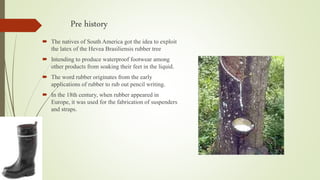
 The natives of South America got the idea to exploit
the latex of the Hevea Brasiliensis rubber tree
 Intending to produce waterproof footwear among
other products from soaking their feet in the liquid.
 The word rubber originates from the early
applications of rubber to rub out pencil writing.
 In the 18th century, when rubber appeared in
Europe, it was used for the fabrication of suspenders
and straps.
Prior to World War II, hevea rubber accounted for
over 99% of all elastomers used, but synthetic
elastomers account for more than 70% of all rubber
used today.
Over 5.5 billion pounds of synthetic rubber is
produced annually in the United States.
Types of elastomers
 based on nature
Natural rubbers
Synthetic rubbers
Elastomers have been classified
in groups according to similarity
of properties and applications.
• Based on origin
• Based on the set of temperature
Natural rubbers
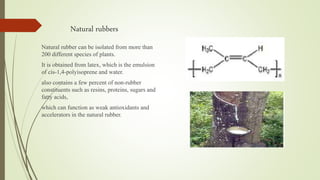
Natural rubber can be isolated from more than
200 different species of plants.
It is obtained from latex, which is the emulsion
of cis-1,4-polyisoprene and water.
also contains a few percent of non-rubber
constituents such as resins, proteins, sugars and
fatty acids,
which can function as weak antioxidants and
accelerators in the natural rubber.
features
Applications
 tires (60 - 70%)
 Tubes, conveyor belts and V-belts
 Coatings
 Gaskets
 Latex products
 Footwear
 Adhesives
Advantage
 Good process ability
 Excellent elastic properties
 Good tensile strength
 High elongation
 Good tear and wear resistance
 Excellent cold resistance
 Good electrical insulator
 Disadvantages of Natural Rubber:
 Poor weather and ozone resistance
 Restricted high temperature resistance
(short-time maximum temperature 100°C)
 Swelling in oils and fuels: low oil and fuel
resistance
Synthetic rubbers
 DIENE-BASED ELASTOMERS
 ETHYLENE–PROPYLENE RUBBERS
 POLYURETHANES
 SILICONE ELASTOMERS
Synthetic fibers have many
types based on the building
monomers.
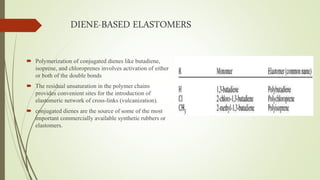
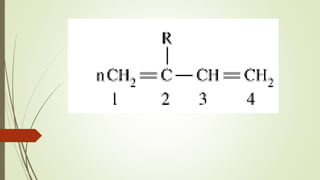
DIENE-BASED ELASTOMERS
 Polymerization of conjugated dienes like butadiene,
isoprene, and chloroprenes involves activation of either
or both of the double bonds
 The residual unsaturation in the polymer chains
provides convenient sites for the introduction of
elastomeric network of cross-links (vulcanization).
 conjugated dienes are the source of some of the most
important commercially available synthetic rubbers or
elastomers.
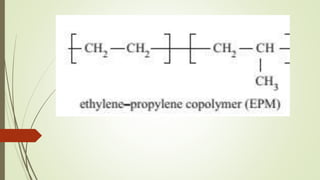
ETHYLENE–PROPYLENE RUBBERS
 Copolymerization of ethylene with propylene results in a random, noncrystalline
copolymer that is a chemically inert and rubbery material.
 To incorporate sites for vulcanization, an unsaturated terpolymer can be prepared
from ethylene, propylene, and a small amount (3 to 9%) of a nonconjugated diene
(EPDM).
 Ethylene–propylene elastomers are made by solution polymerization of ethylene
and propylene in a solvent such as hexane using catalysts.
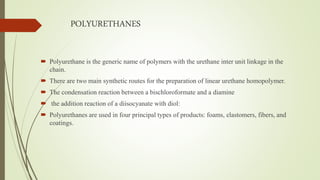
POLYURETHANES
 Polyurethane is the generic name of polymers with the urethane inter unit linkage in the
chain.
 There are two main synthetic routes for the preparation of linear urethane homopolymer.
 The condensation reaction between a bischloroformate and a diamine
 the addition reaction of a diisocyanate with diol:
 Polyurethanes are used in four principal types of products: foams, elastomers, fibers, and
coatings.
 Polyurethane elastomers have
 high strength;
 extremely good abrasion resistance;
 good resistance to gas, greases, oils, and
hydrocarbons;
 and excellent resistance to oxygen and ozone.
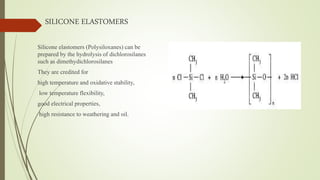
SILICONE ELASTOMERS
Silicone elastomers (Polysiloxanes) can be
prepared by the hydrolysis of dichlorosilanes
such as dimethydichlorosilanes
They are credited for
high temperature and oxidative stability,
low temperature flexibility,
good electrical properties,
high resistance to weathering and oil.
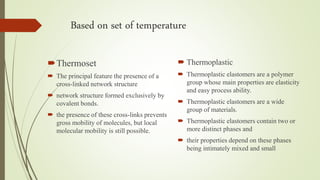
Based on set of temperature
Thermoset
 The principal feature the presence of a
cross-linked network structure
 network structure formed exclusively by
covalent bonds.
 the presence of these cross-links prevents
gross mobility of molecules, but local
molecular mobility is still possible.
 Thermoplastic
 Thermoplastic elastomers are a polymer
group whose main properties are elasticity
and easy process ability.
 Thermoplastic elastomers are a wide
group of materials.
 Thermoplastic elastomers contain two or
more distinct phases and
 their properties depend on these phases
being intimately mixed and small
Properties of thermoplastics
 In order that the material be a
thermoplastic elastomer at least
 one phase must be soft or flexible under the
operating conditions and
 at least one phase is hard with the hard
phase(s) becoming soft (or fluid) at higher
temperatures.
 Often the hard segments or phases are
crystalline thermoplastics
 while the soft segments or phases are
amorphous.
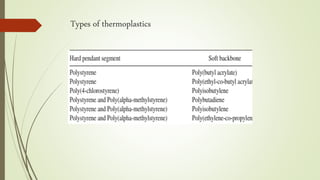
Types of thermoplastics
Thermosets
 the major commercial thermosets
include
 epoxies,
 polyesters, and
 polymers based on formaldehyde.
Thermosets, on the other hand,
have a network structure formed
exclusively by covalent bonds.
Formaldehyde-based resins,
which are the most widely used
thermosets
General properties of elastomers
 Thermal expansion
 the linear thermal expansion coefficient of elastomeric materials is five 5 to 20 -fold
compared with e.g. that of steels. Consequently, the heat shrinkage of molded elastomer
products can be several percent.
 Hardness
 Hardness is commonly quantified using the IRHD or Shore 0 to 100 scale. The hardness of
a conventional elastomeric product is around 50 to 70 IRHD.
 Electrical property
 Most general-purpose elastomers, like natural rubber and a variety of synthetic elastomers
exhibit very low electrical conductivity and are therefore suitable as electrical insulating
materials.
 Dynamic properties
 Elastomers are viscoelastic materials. It means that part of the deformation is recovered
after the load is removed and part of the deformation is permanent.
 depend on temperature, type frequency of loading and amplitude of deformation.
 Abrasion resistance
 Most rubbers have exceptionally good abrasion resistance, which is a consequence of the
ability of rubbers to creep over the irregularities of the wearing counterpart in sliding.
 Buthyl and ethylene-propylene rubbers, on the other hand, have the best abrasion resistance
at elevated temperatures.
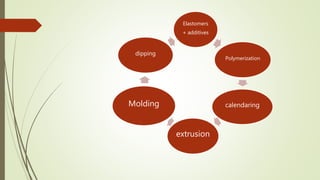
Manufacturing processes of elastomers
 The raw rubber will be build up from
different polymers and go through
polymerization
The manufacturing process of
synthetic rubber starts with
the manufacturing raw
rubber.
Elastomers
+ additives
Polymerization
calendaring
extrusion
Molding
dipping
Applications of elastomers
 Elastomers have varieties of applications
 Apparel, most of the time under wears
and leggings
 Protective clothings
 Tyres
 Bushings
 Mounts
 gaskets
 latex products
 footwear
 adhesives
Future possible applications
Magnetorheological (MR) elastomer
electrorheological (ER) elastomer
Thank you

elastomeric fibers: properties and applications

  • 1.
    Seminar on elastomeric polymers:properties and applications By seblewongel petros
  • 2.
    Introduction prehistory types of elastomers properties manufacturingprocess applications future possible trends Pictures, graphs, tables
  • 3.
    Introduction  Elastomers, orrubbers, are high polymers that typically contain chemical and/or physical crosslinks.  The predominant property of elastomers is elastic recovery after deformation in compression or tension.  Besides, elastomers are characterized by  great toughness under static or dynamic stresses  better abrasion resistance than that of steel,  impermeability to air and water and in many cases  high resistance to swelling in solvents and attack by chemicals.
  • 4.
    Pre history  Thenatives of South America got the idea to exploit the latex of the Hevea Brasiliensis rubber tree  Intending to produce waterproof footwear among other products from soaking their feet in the liquid.  The word rubber originates from the early applications of rubber to rub out pencil writing.  In the 18th century, when rubber appeared in Europe, it was used for the fabrication of suspenders and straps.
  • 5.
    Prior to WorldWar II, hevea rubber accounted for over 99% of all elastomers used, but synthetic elastomers account for more than 70% of all rubber used today. Over 5.5 billion pounds of synthetic rubber is produced annually in the United States.
  • 6.
    Types of elastomers based on nature Natural rubbers Synthetic rubbers Elastomers have been classified in groups according to similarity of properties and applications. • Based on origin • Based on the set of temperature
  • 7.
    Natural rubbers Natural rubbercan be isolated from more than 200 different species of plants. It is obtained from latex, which is the emulsion of cis-1,4-polyisoprene and water. also contains a few percent of non-rubber constituents such as resins, proteins, sugars and fatty acids, which can function as weak antioxidants and accelerators in the natural rubber.
  • 8.
    features Applications  tires (60- 70%)  Tubes, conveyor belts and V-belts  Coatings  Gaskets  Latex products  Footwear  Adhesives Advantage  Good process ability  Excellent elastic properties  Good tensile strength  High elongation  Good tear and wear resistance  Excellent cold resistance  Good electrical insulator
  • 9.
     Disadvantages ofNatural Rubber:  Poor weather and ozone resistance  Restricted high temperature resistance (short-time maximum temperature 100°C)  Swelling in oils and fuels: low oil and fuel resistance
  • 10.
    Synthetic rubbers  DIENE-BASEDELASTOMERS  ETHYLENE–PROPYLENE RUBBERS  POLYURETHANES  SILICONE ELASTOMERS Synthetic fibers have many types based on the building monomers.
  • 11.
    DIENE-BASED ELASTOMERS  Polymerizationof conjugated dienes like butadiene, isoprene, and chloroprenes involves activation of either or both of the double bonds  The residual unsaturation in the polymer chains provides convenient sites for the introduction of elastomeric network of cross-links (vulcanization).  conjugated dienes are the source of some of the most important commercially available synthetic rubbers or elastomers.

  • 13.
    ETHYLENE–PROPYLENE RUBBERS  Copolymerizationof ethylene with propylene results in a random, noncrystalline copolymer that is a chemically inert and rubbery material.  To incorporate sites for vulcanization, an unsaturated terpolymer can be prepared from ethylene, propylene, and a small amount (3 to 9%) of a nonconjugated diene (EPDM).  Ethylene–propylene elastomers are made by solution polymerization of ethylene and propylene in a solvent such as hexane using catalysts.
  • 15.
    POLYURETHANES  Polyurethane isthe generic name of polymers with the urethane inter unit linkage in the chain.  There are two main synthetic routes for the preparation of linear urethane homopolymer.  The condensation reaction between a bischloroformate and a diamine  the addition reaction of a diisocyanate with diol:  Polyurethanes are used in four principal types of products: foams, elastomers, fibers, and coatings.
  • 16.
     Polyurethane elastomershave  high strength;  extremely good abrasion resistance;  good resistance to gas, greases, oils, and hydrocarbons;  and excellent resistance to oxygen and ozone.
  • 17.
    SILICONE ELASTOMERS Silicone elastomers(Polysiloxanes) can be prepared by the hydrolysis of dichlorosilanes such as dimethydichlorosilanes They are credited for high temperature and oxidative stability, low temperature flexibility, good electrical properties, high resistance to weathering and oil.
  • 18.
    Based on setof temperature Thermoset  The principal feature the presence of a cross-linked network structure  network structure formed exclusively by covalent bonds.  the presence of these cross-links prevents gross mobility of molecules, but local molecular mobility is still possible.  Thermoplastic  Thermoplastic elastomers are a polymer group whose main properties are elasticity and easy process ability.  Thermoplastic elastomers are a wide group of materials.  Thermoplastic elastomers contain two or more distinct phases and  their properties depend on these phases being intimately mixed and small
  • 19.
    Properties of thermoplastics In order that the material be a thermoplastic elastomer at least  one phase must be soft or flexible under the operating conditions and  at least one phase is hard with the hard phase(s) becoming soft (or fluid) at higher temperatures.  Often the hard segments or phases are crystalline thermoplastics  while the soft segments or phases are amorphous.
  • 20.
  • 21.
    Thermosets  the majorcommercial thermosets include  epoxies,  polyesters, and  polymers based on formaldehyde. Thermosets, on the other hand, have a network structure formed exclusively by covalent bonds. Formaldehyde-based resins, which are the most widely used thermosets
  • 22.
    General properties ofelastomers  Thermal expansion  the linear thermal expansion coefficient of elastomeric materials is five 5 to 20 -fold compared with e.g. that of steels. Consequently, the heat shrinkage of molded elastomer products can be several percent.  Hardness  Hardness is commonly quantified using the IRHD or Shore 0 to 100 scale. The hardness of a conventional elastomeric product is around 50 to 70 IRHD.  Electrical property  Most general-purpose elastomers, like natural rubber and a variety of synthetic elastomers exhibit very low electrical conductivity and are therefore suitable as electrical insulating materials.
  • 23.
     Dynamic properties Elastomers are viscoelastic materials. It means that part of the deformation is recovered after the load is removed and part of the deformation is permanent.  depend on temperature, type frequency of loading and amplitude of deformation.  Abrasion resistance  Most rubbers have exceptionally good abrasion resistance, which is a consequence of the ability of rubbers to creep over the irregularities of the wearing counterpart in sliding.  Buthyl and ethylene-propylene rubbers, on the other hand, have the best abrasion resistance at elevated temperatures.
  • 24.
    Manufacturing processes ofelastomers  The raw rubber will be build up from different polymers and go through polymerization The manufacturing process of synthetic rubber starts with the manufacturing raw rubber.
  • 25.
  • 26.
    Applications of elastomers Elastomers have varieties of applications  Apparel, most of the time under wears and leggings  Protective clothings  Tyres  Bushings  Mounts  gaskets  latex products  footwear  adhesives
  • 27.
    Future possible applications Magnetorheological(MR) elastomer electrorheological (ER) elastomer
  • 28.