Chromosomes and
Genetics
.
.
Basic review:
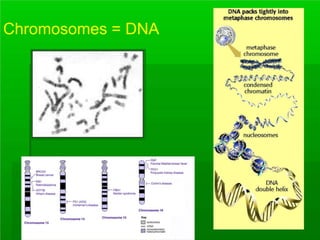
Chromosomes are long pieces of DNA, with
supporting proteins.
. Genes are short regions of this DNA that
hold the information needed to build and
maintain the body
.
.
Genes have fixed locations: each gene is in
a particular place on a particular chromosome
Diploids have 2 copies of each
chromosome, one from each parent. This
means 2 copies of each gene.
. The interactions between the 2 copies of
each gene give rise to the various forms of
dominance.
By
Dr. Priti D.Diwan
Assistant Professor
Department of Zoology
J.D.PatilSangludkarMahavidyalay Daryapur.
Chromosomes
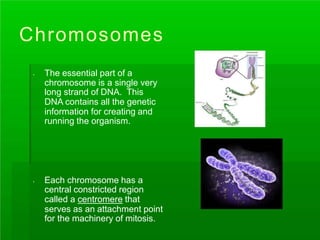
. The essential part of a
chromosome is a single very
long strand of DNA. This
DNA contains all the genetic
information for creating and
running the organism.
. Each chromosome has a
central constricted region
called a centromere that
serves as an attachment point
for the machinery of mitosis.
Chromosomes
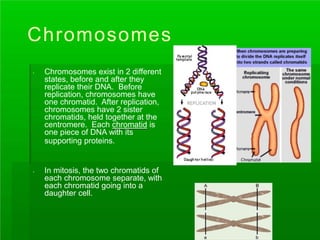
. Chromosomes exist in 2 different
states, before and after they
replicate their DNA. Before
replication, chromosomes have
one chromatid. After replication,
chromosomes have 2 sister
chromatids, held together at the
centromere. Each chromatid is
one piece of DNA with its
supporting proteins.
. In mitosis, the two chromatids of
each chromosome separate, with
each chromatid going into a
daughter cell.
Chromosomes = DNA
Eukaryotic chromosomal
organization
. 2 main groups of proteins involved in
folding/packaging eukaryotic
chromosomes
. Histones = positively charged proteins filled
with amino acids lysine and arginine that
bond
. Nonhistones = less positive
Model for Chromatin
Structure
. Chromatin is linked together every 200
bps (nuclease digestion)
.
.
.
.
Chromatin arranged like
“String onBeads” (electron microscope)
8 histones in each nucleosome
147 bps per nucleosome core particle
with 53 bps for linker DNA (H1)
. Left-handed superhelix
Eukaryotic chromosomal
organization
. Histone proteins
.
.
Abundant
Histone protein sequence is highly
conserved among eukaryotes
.
.
Provide the first level of packaging for the
chromosome
DNA is wound around histone proteins to
produce nucleosomes; stretch of unwound
DNA between each nucleosome
Eukaryotic chromosomal
organization
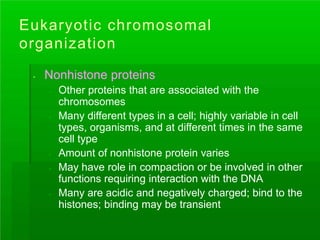
. Nonhistone proteins
. Other proteins that are associated with the
chromosomes
. Many different types in a cell; highly variable in cell
types, organisms, and at different times in the same
cell type
.
.
Amount of nonhistone protein varies
May have role in compaction or be involved in other
functions requiring interaction with the DNA
. Many are acidic and negatively charged; bind to the
histones; binding may be transient
Eukaryotic chromosomal
organization
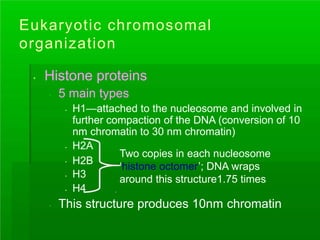
. Histone proteins
. 5 main types
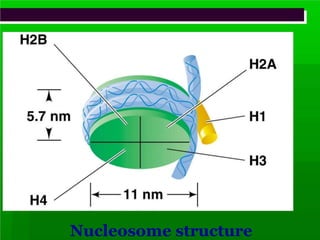
. H1—attached to the nucleosome and involved in
further compaction of the DNA (conversion of 10
nm chromatin to 30 nm chromatin)
.
.
.
.
H2A
Two copies in each nucleosome
H2B
‘histone octomer’; DNA wraps
H3 around this structure1.75 times
H4
. This structure produces 10nm chromatin
Nucleosome structure
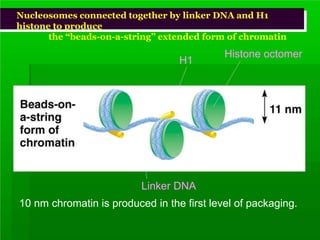
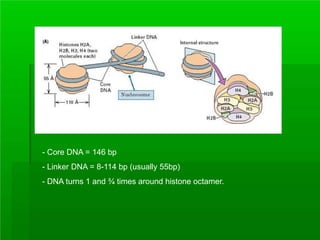
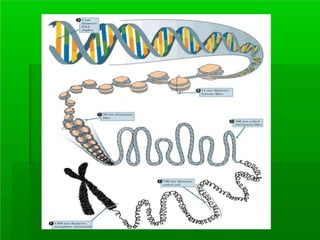
Nucleosomes connected together by linker DNA and H1
histone to produce
the “beads-on-a-string” extended form of chromatin
Histone octomer
H1
Linker DNA
10 nm chromatin is produced in the first level of packaging.
.
- Core DNA = 146 bp
- Linker DNA = 8-114 bp (usually 55bp)
- DNA turns 1 and ¾ times around histone octamer.
What is a giant chromosome?
Giant
chromosome
 Chromosomes are decondensed during interphase.
 Some exception are lampbrush chromosomes of
vertebrate & polytene chromosome of insect.
 In both these chromosome The region that are actively
synthesizing RNA are least condensed.
 Giant chromosome are very long & thick (200 times)
during metaphase.
 Hence they are know as “Giant chromosomes”.
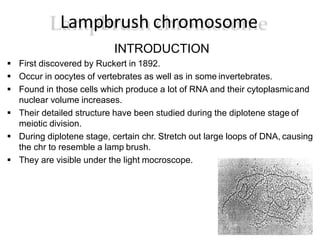
Lampbrush chromosome
INTRODUCTION
 First discovered by Ruckert in 1892.
 Occur in oocytes of vertebrates as well as in some invertebrates.
 Found in those cells which produce a lot of RNA and their cytoplasmicand
nuclear volume increases.
 Their detailed structure have been studied during the diplotene stage of
meiotic division.
 During diplotene stage, certain chr. Stretch out large loops of DNA, causing
the chr to resemble a lamp brush.
 They are visible under the light mocroscope.
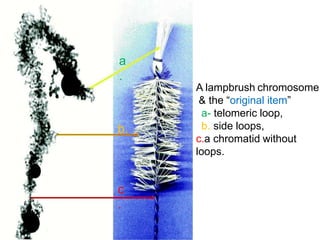
A lampbrush chromosome
& the “original item”
a- telomeric loop,
b. side loops,
c.a chromatid without
loops.
a
.
b.
c
.
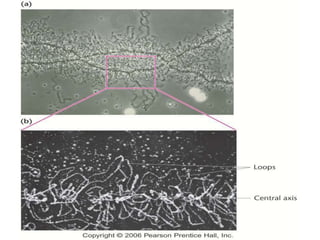
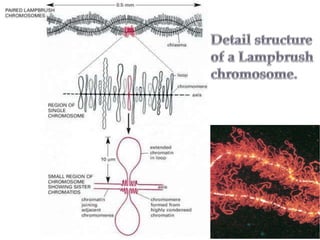
Morphology
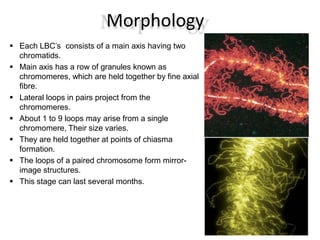
 Each LBC’s consists of a main axis having two
chromatids.
 Main axis has a row of granules known as
chromomeres, which are held together by fine axial
fibre.
 Lateral loops in pairs project from the
chromomeres.
 About 1 to 9 loops may arise from a single
chromomere, Their size varies.
 They are held together at points of chiasma
formation.
 The loops of a paired chromosome form mirror-
image structures.
 This stage can last several months.
 Lamp brush chromosomes are involved in the synthesis of RNA&
proteins.
 Each loop is believed to represent one long operon consisting of
repetitive cistrons.
 Each locus codes for RNA.
 The loop is supposed to synthesis at a high rate because of repetitive
gene sequence.
 There are also reports that the LBC help in the formation of yolk material
in the egg.
Function
LBC transcription
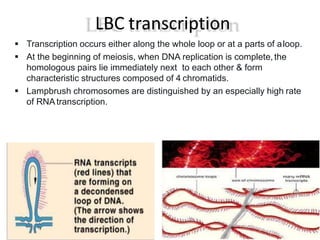
 Transcription occurs either along the whole loop or at a parts of aloop.
 At the beginning of meiosis, when DNA replication is complete,the
homologous pairs lie immediately next to each other & form
characteristic structures composed of 4 chromatids.
 Lampbrush chromosomes are distinguished by an especially high rate
of RNAtranscription.
Polytene
chromosomes
INTRODUCTION
 First discovered by E.G Balbiani in 188, in squash of salivary cells of
Chironomous.
 They also occur in rectal epithelium & Malphigian tubules.
 They are many times larger than the normal chromosomes reaching a
length of 200µm and are visible even under a compound microscope.
 The enormous size is due to the duplication of chromonema which do
not separate.
 According to an estimate, the polytene chromosomes have 1000 times
more DNA than the normal somaticchromosomes.
 Because of these chromosomes actually consist of many strands,they
are called as Polytene chromosome.
Morphology
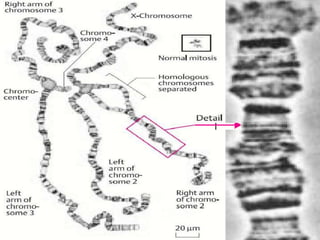
 Contain 5 long & 1 short arm radiating from a central point called
chromocentre, formed by the fusion of centromeres all the 8
chromosomes found in the cell.
 Of the 6 arms, the short arm represents the fused IV chromosome & the
longest represents the fused sex chr.
 About 80% of the DNA is located in bands, & about 15% ininterbands.
 The chromatin in Darkly stained band is more condensed than chromatin
in interbands.
 Intensely stained chromosomal segments correspond to high degree of
packing & are genetically inactive (heterochromatin).
 Less tightly packed segments stain less distinctly & correspond to
segment with genetic activity (euchromatin).
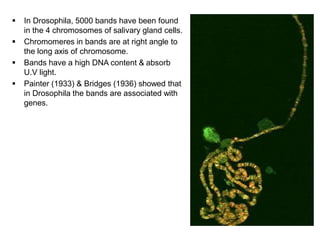
 In Drosophila, 5000 bands have been found
in the 4 chromosomes of salivary gland cells.
 Chromomeres in bands are at right angle to
the long axis of chromosome.
 Bands have a high DNA content & absorb
U.V light.
 Painter (1933) & Bridges (1936) showed that
in Drosophila the bands are associated with
genes.
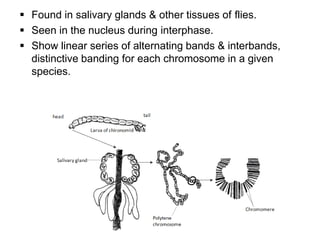
 Found in salivary glands & other tissues of flies.
 Seen in the nucleus during interphase.
 Show linear series of alternating bands & interbands,
distinctive banding for each chromosome in a given
species.
Functional stages in polytene
chromosomes
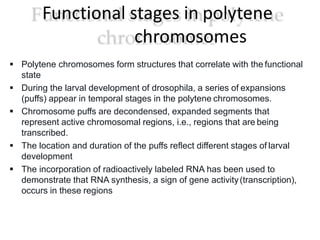
 Polytene chromosomes form structures that correlate with the functional
state
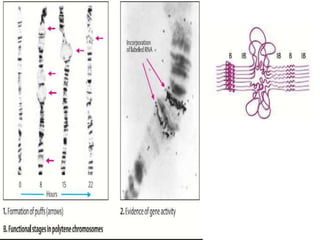
 During the larval development of drosophila, a series of expansions
(puffs) appear in temporal stages in the polytene chromosomes.
 Chromosome puffs are decondensed, expanded segments that
represent active chromosomal regions, i.e., regions that are being
transcribed.
 The location and duration of the puffs reflect different stages of larval
development
 The incorporation of radioactively labeled RNA has been used to
demonstrate that RNA synthesis, a sign of gene activity(transcription),
occurs in these regions
Chromosome puffs
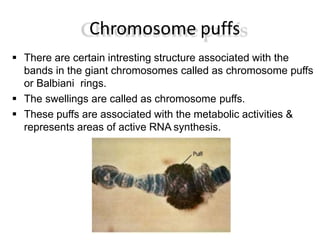
 There are certain intresting structure associated with the
bands in the giant chromosomes called as chromosome puffs
or Balbiani rings.
 The swellings are called as chromosome puffs.
 These puffs are associated with the metabolic activities &
represents areas of active RNA synthesis.
Function
 Increasing the volume of the cells' nuclei and causing cell
expansion.
 Metabolic advantage as multiple copies of genes permits a
high level of gene expression.
 In Drosophila melanogaster, the chromosomes undergo
many rounds of endoreduplication, to produce large amounts
of glue before pupation.
 There is tandem duplication of various polytene bands
located near the centromere of the X chromosome which
results in the Bar phenotype of kidney-shaped eyes.
Reference
CYTOLOGY & GENETICS BY SUMITRASEN
 www.biotechnologia-journal.pl
www.wikipedia.org/wiki/Lampbrush_chro
mosome
 www.wikipedia.org/wiki/Polytene_chromosome
 http://en.wikipedia.org/wiki/Chromosome_…
 www.sciencedirect.com
 www.tutorvista.com
chromosome and genetics

chromosome and genetics

  • 1.
    Chromosomes and Genetics . . Basic review: Chromosomesare long pieces of DNA, with supporting proteins. . Genes are short regions of this DNA that hold the information needed to build and maintain the body . . Genes have fixed locations: each gene is in a particular place on a particular chromosome Diploids have 2 copies of each chromosome, one from each parent. This means 2 copies of each gene. . The interactions between the 2 copies of each gene give rise to the various forms of dominance. By Dr. Priti D.Diwan Assistant Professor Department of Zoology J.D.PatilSangludkarMahavidyalay Daryapur.
  • 2.
    Chromosomes . The essentialpart of a chromosome is a single very long strand of DNA. This DNA contains all the genetic information for creating and running the organism. . Each chromosome has a central constricted region called a centromere that serves as an attachment point for the machinery of mitosis.
  • 3.
    Chromosomes . Chromosomes existin 2 different states, before and after they replicate their DNA. Before replication, chromosomes have one chromatid. After replication, chromosomes have 2 sister chromatids, held together at the centromere. Each chromatid is one piece of DNA with its supporting proteins. . In mitosis, the two chromatids of each chromosome separate, with each chromatid going into a daughter cell.
  • 4.
  • 5.
    Eukaryotic chromosomal organization . 2main groups of proteins involved in folding/packaging eukaryotic chromosomes . Histones = positively charged proteins filled with amino acids lysine and arginine that bond . Nonhistones = less positive
  • 6.
    Model for Chromatin Structure .Chromatin is linked together every 200 bps (nuclease digestion) . . . . Chromatin arranged like “String onBeads” (electron microscope) 8 histones in each nucleosome 147 bps per nucleosome core particle with 53 bps for linker DNA (H1) . Left-handed superhelix
  • 7.
    Eukaryotic chromosomal organization . Histoneproteins . . Abundant Histone protein sequence is highly conserved among eukaryotes . . Provide the first level of packaging for the chromosome DNA is wound around histone proteins to produce nucleosomes; stretch of unwound DNA between each nucleosome
  • 8.
    Eukaryotic chromosomal organization . Nonhistoneproteins . Other proteins that are associated with the chromosomes . Many different types in a cell; highly variable in cell types, organisms, and at different times in the same cell type . . Amount of nonhistone protein varies May have role in compaction or be involved in other functions requiring interaction with the DNA . Many are acidic and negatively charged; bind to the histones; binding may be transient
  • 9.
    Eukaryotic chromosomal organization . Histoneproteins . 5 main types . H1—attached to the nucleosome and involved in further compaction of the DNA (conversion of 10 nm chromatin to 30 nm chromatin) . . . . H2A Two copies in each nucleosome H2B ‘histone octomer’; DNA wraps H3 around this structure1.75 times H4 . This structure produces 10nm chromatin
  • 10.
  • 11.
    Nucleosomes connected togetherby linker DNA and H1 histone to produce the “beads-on-a-string” extended form of chromatin Histone octomer H1 Linker DNA 10 nm chromatin is produced in the first level of packaging. .
  • 12.
    - Core DNA= 146 bp - Linker DNA = 8-114 bp (usually 55bp) - DNA turns 1 and ¾ times around histone octamer.
  • 16.
    What is agiant chromosome?
  • 17.
    Giant chromosome  Chromosomes aredecondensed during interphase.  Some exception are lampbrush chromosomes of vertebrate & polytene chromosome of insect.  In both these chromosome The region that are actively synthesizing RNA are least condensed.  Giant chromosome are very long & thick (200 times) during metaphase.  Hence they are know as “Giant chromosomes”.
  • 18.
    Lampbrush chromosome INTRODUCTION  Firstdiscovered by Ruckert in 1892.  Occur in oocytes of vertebrates as well as in some invertebrates.  Found in those cells which produce a lot of RNA and their cytoplasmicand nuclear volume increases.  Their detailed structure have been studied during the diplotene stage of meiotic division.  During diplotene stage, certain chr. Stretch out large loops of DNA, causing the chr to resemble a lamp brush.  They are visible under the light mocroscope.
  • 19.
    A lampbrush chromosome &the “original item” a- telomeric loop, b. side loops, c.a chromatid without loops. a . b. c .
  • 20.
    Morphology  Each LBC’sconsists of a main axis having two chromatids.  Main axis has a row of granules known as chromomeres, which are held together by fine axial fibre.  Lateral loops in pairs project from the chromomeres.  About 1 to 9 loops may arise from a single chromomere, Their size varies.  They are held together at points of chiasma formation.  The loops of a paired chromosome form mirror- image structures.  This stage can last several months.
  • 23.
     Lamp brushchromosomes are involved in the synthesis of RNA& proteins.  Each loop is believed to represent one long operon consisting of repetitive cistrons.  Each locus codes for RNA.  The loop is supposed to synthesis at a high rate because of repetitive gene sequence.  There are also reports that the LBC help in the formation of yolk material in the egg. Function
  • 24.
    LBC transcription  Transcriptionoccurs either along the whole loop or at a parts of aloop.  At the beginning of meiosis, when DNA replication is complete,the homologous pairs lie immediately next to each other & form characteristic structures composed of 4 chromatids.  Lampbrush chromosomes are distinguished by an especially high rate of RNAtranscription.
  • 25.
    Polytene chromosomes INTRODUCTION  First discoveredby E.G Balbiani in 188, in squash of salivary cells of Chironomous.  They also occur in rectal epithelium & Malphigian tubules.  They are many times larger than the normal chromosomes reaching a length of 200µm and are visible even under a compound microscope.  The enormous size is due to the duplication of chromonema which do not separate.  According to an estimate, the polytene chromosomes have 1000 times more DNA than the normal somaticchromosomes.  Because of these chromosomes actually consist of many strands,they are called as Polytene chromosome.
  • 26.
    Morphology  Contain 5long & 1 short arm radiating from a central point called chromocentre, formed by the fusion of centromeres all the 8 chromosomes found in the cell.  Of the 6 arms, the short arm represents the fused IV chromosome & the longest represents the fused sex chr.  About 80% of the DNA is located in bands, & about 15% ininterbands.  The chromatin in Darkly stained band is more condensed than chromatin in interbands.  Intensely stained chromosomal segments correspond to high degree of packing & are genetically inactive (heterochromatin).  Less tightly packed segments stain less distinctly & correspond to segment with genetic activity (euchromatin).
  • 27.
     In Drosophila,5000 bands have been found in the 4 chromosomes of salivary gland cells.  Chromomeres in bands are at right angle to the long axis of chromosome.  Bands have a high DNA content & absorb U.V light.  Painter (1933) & Bridges (1936) showed that in Drosophila the bands are associated with genes.
  • 28.
     Found insalivary glands & other tissues of flies.  Seen in the nucleus during interphase.  Show linear series of alternating bands & interbands, distinctive banding for each chromosome in a given species.
  • 30.
    Functional stages inpolytene chromosomes  Polytene chromosomes form structures that correlate with the functional state  During the larval development of drosophila, a series of expansions (puffs) appear in temporal stages in the polytene chromosomes.  Chromosome puffs are decondensed, expanded segments that represent active chromosomal regions, i.e., regions that are being transcribed.  The location and duration of the puffs reflect different stages of larval development  The incorporation of radioactively labeled RNA has been used to demonstrate that RNA synthesis, a sign of gene activity(transcription), occurs in these regions
  • 31.
    Chromosome puffs  Thereare certain intresting structure associated with the bands in the giant chromosomes called as chromosome puffs or Balbiani rings.  The swellings are called as chromosome puffs.  These puffs are associated with the metabolic activities & represents areas of active RNA synthesis.
  • 33.
    Function  Increasing thevolume of the cells' nuclei and causing cell expansion.  Metabolic advantage as multiple copies of genes permits a high level of gene expression.  In Drosophila melanogaster, the chromosomes undergo many rounds of endoreduplication, to produce large amounts of glue before pupation.  There is tandem duplication of various polytene bands located near the centromere of the X chromosome which results in the Bar phenotype of kidney-shaped eyes.
  • 34.
    Reference CYTOLOGY & GENETICSBY SUMITRASEN  www.biotechnologia-journal.pl www.wikipedia.org/wiki/Lampbrush_chro mosome  www.wikipedia.org/wiki/Polytene_chromosome  http://en.wikipedia.org/wiki/Chromosome_…  www.sciencedirect.com  www.tutorvista.com