What Are ChironomusLarvae?
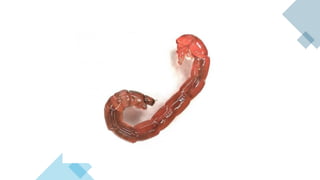
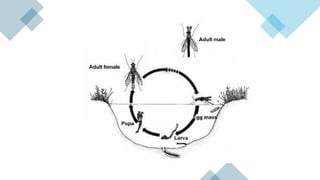
• Chironomus larvae are the immature stages of non-biting
midges belonging to the family Chironomidae.
• These larvae are commonly found in freshwater habitats
such as ponds, lakes, and streams.
• They are often referred to as "bloodworms" due to their red
coloration, which results from the presence of hemoglobin-
like proteins that allow them to thrive in low-oxygen
environments.
5.
• These larvaeare significant in ecological studies and
are also utilized in cytogenetic research because
their salivary gland cells contain polytene
chromosomes, which are exceptionally large and
easily observable under a light microscope.
6.
What Are PolyteneChromosomes?
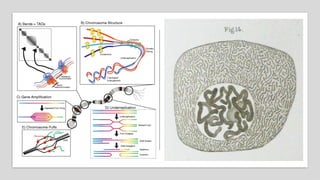
Polytene chromosomes are oversized chromosomes that
arise from repeated rounds of DNA replication without
subsequent cell division, a process known as
endoreplication.
This results in chromosomes composed of many parallel DNA
strands aligned side by side, making them much larger than
typical chromosomes.
They were first observed in the salivary glands of Chironomus
larvae by Édouard-Gérard Balbiani in 1881.
9.
Key Features:
• Sizeand Structure: Polytene chromosomes are significantly
larger than standard chromosomes, often hundreds of
times longer, due to the accumulation of multiple DNA
strands.
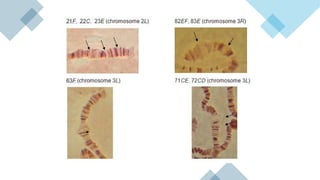
• Banding Patterns: They exhibit distinct alternating dark
and light bands, which correspond to regions of tightly and
loosely packed DNA, respectively. These patterns are
consistent and can be used to identify specific chromosomal
regions.
10.
•Puffs and BalbianiRings: Certain regions of polytene
chromsomes, known as "puffs," appear as swollen areas
indicating active transcription.
•Larger puffs, called Balbiani rings, are sites of intense gene
activity and are particularly prominent in Chironomus
species.
•Functional Significance: The amplified DNA content
allows for increased transcriptional activity, which is
essential for the high metabolic demands of certain tissues,
such as the salivary glands in larvae.
•Understanding polytene chromosomes in Chironomus larvae
provides valuable insights into chromosome structure, gene
expression, and the regulation of genetic activity during
development.
11.
Objectives
• Understand thestructure and significance of polytene
chromosomes.
• Learn the dissection and preparation techniques for
observing polytene chromosomes in Chironomus larvae.
• Identify chromosomal features such as banding patterns,
puffs, and Balbiani rings.
• Appreciate the role of polytene chromosomes in gene
expression studies
12.
Materials Required
• Latethird instar Chironomus larvae
• Poels' salt solution or 0.7% NaCl
• Fixatives: 45% acetic acid; 1:2:3 mixture of lactic acid:glacial acetic acid:water
• Stains: 2% Aceto-orcein or Aceto-carmine
• 50% acetic acid
• Glass slides and coverslips (preferably siliconized)
• Fine forceps and dissecting needles
• Filter blotting paper
• Transparent nail polish (for sealing)
• Compound microscope with 40x objective
13.
Procedure
1. Larval Dissection
•Place a larva in a drop of Poels' salt solution on a clean slide.
• Using fine forceps, hold the larva at the anterior and
posterior ends and gently pull to extrude internal organs.
• Identify and isolate the salivary glands, which appear as
translucent elongated structures.
• Carefully remove adhering fat bodies to avoid obscuring the
chromosomes.
14.
2. Fixation
• Transferthe salivary glands to a drop of 45% acetic acid for
30 seconds.
• Then, move them to a 1:2:3 mixture of lactic acid:glacial
acetic acid:water for 5 minutes to enhance chromosome
spreading
15.
3. Staining
• Placethe glands in a drop of 2% Aceto-orcein or Aceto-
carmine stain on a clean slide.
• Cover with a watch glass to prevent drying and allow
staining for about 5 minutes.
• Rinse with 50% acetic acid to remove excess stain
16.
4. Slide Preparation
•Place a drop of fresh 50% acetic acid on the stained glands
and cover with a clean coverslip.
• Gently tap the coverslip with the blunt end of a needle or
pencil to squash the glands, spreading the chromosomes
into a single plane.
• Seal the edges of the coverslip with transparent nail polish
to prevent drying
17.
5. Microscopic Observation
•Examine the slide under a compound microscope using a
40x objective.
• Identify the characteristic banding patterns of polytene
chromosomes.
• Look for puffed regions indicating active transcription sites
and Balbiani rings, which are large puffs associated with
high levels of gene activity
18.
Observations and Analysis
•Banding Patterns: Alternating dark and light bands
represent regions of condensed and less condensed
chromatin, respectively.
• Puffs: Localized swellings indicating active transcription;
their presence and size can vary depending on
developmental stage and environmental factors.
• Balbiani Rings: Prominent puffs associated with high
transcriptional activity, often observed in specific
chromosome regions
19.
Discussion Points
• Therole of polytene chromosomes in facilitating the study
of gene expression due to their large size and distinct
banding patterns.
• The significance of puffing as an indicator of gene activity
and its regulation by hormones like ecdysone and juvenile
hormone .
• Comparative analysis of polytene chromosomes in
Chironomus and other dipteran species.