Polynomials
Made by:-
Anushka verma
Ix-D
Polynomial comes
from poly- (meaning "many") and -
nomial (in this case meaning "term") ...
so it says "many terms"
A polynomial can have:
constants (like 3, -20, or ½)
variables (like x and y)
exponents (like the 2 in y2), but only 0,
1, 2, 3, ... etc are allowed
Polynomial or Not?
These are polynomials
• 3x
• x - 2
• -6y2 - (7/9)x
• 3xyz + 3xy2z - 0.1xz - 200y + 0.5
• 512v5+ 99w5
• 5
(Yes, even "5" is a polynomial, one term is
allowed, and it can even be just a constant!)
And these
are not polynomials
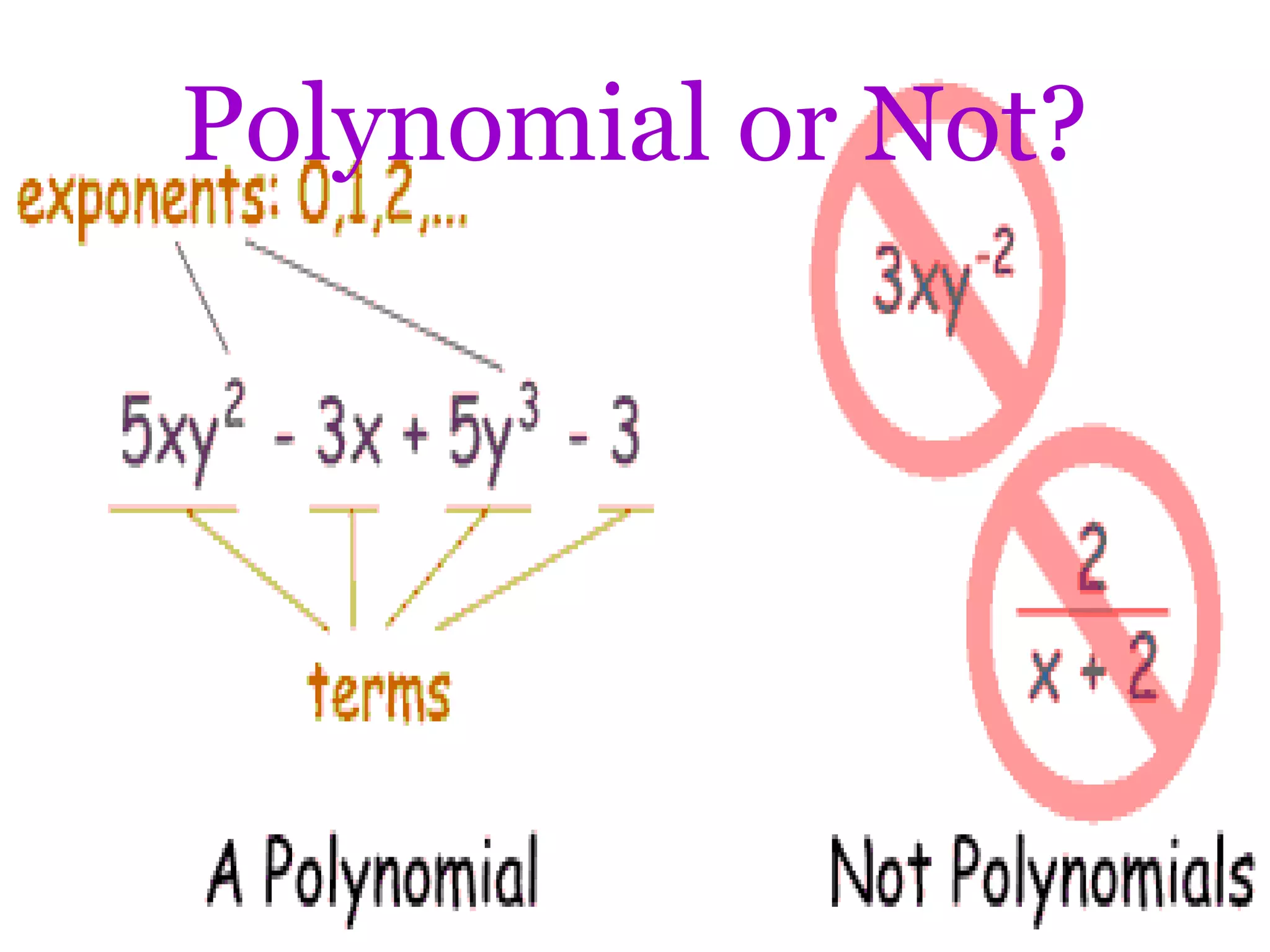
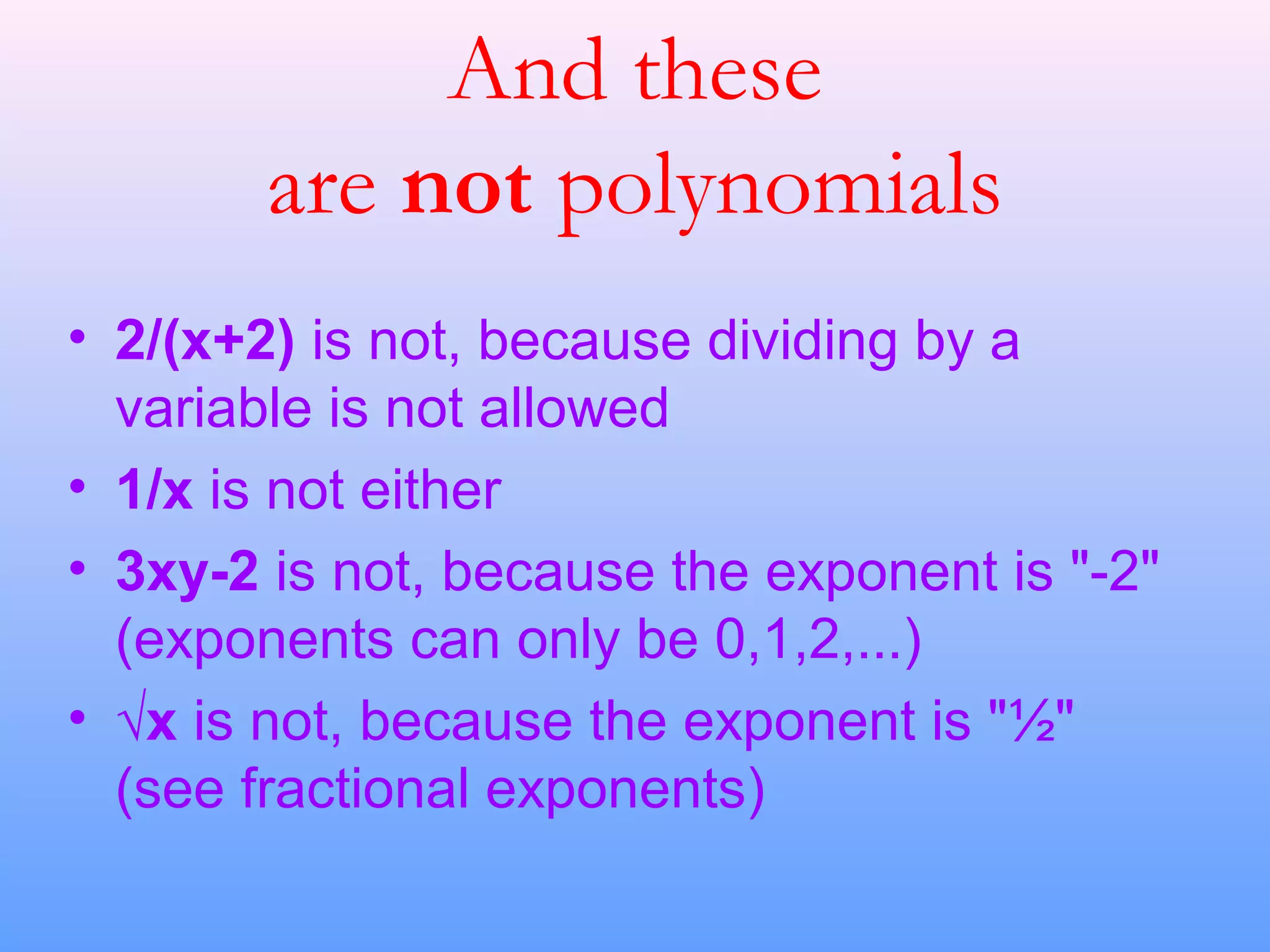
• 2/(x+2) is not, because dividing by a
variable is not allowed
• 1/x is not either
• 3xy-2 is not, because the exponent is "-2"
(exponents can only be 0,1,2,...)
• √x is not, because the exponent is "½"
(see fractional exponents)
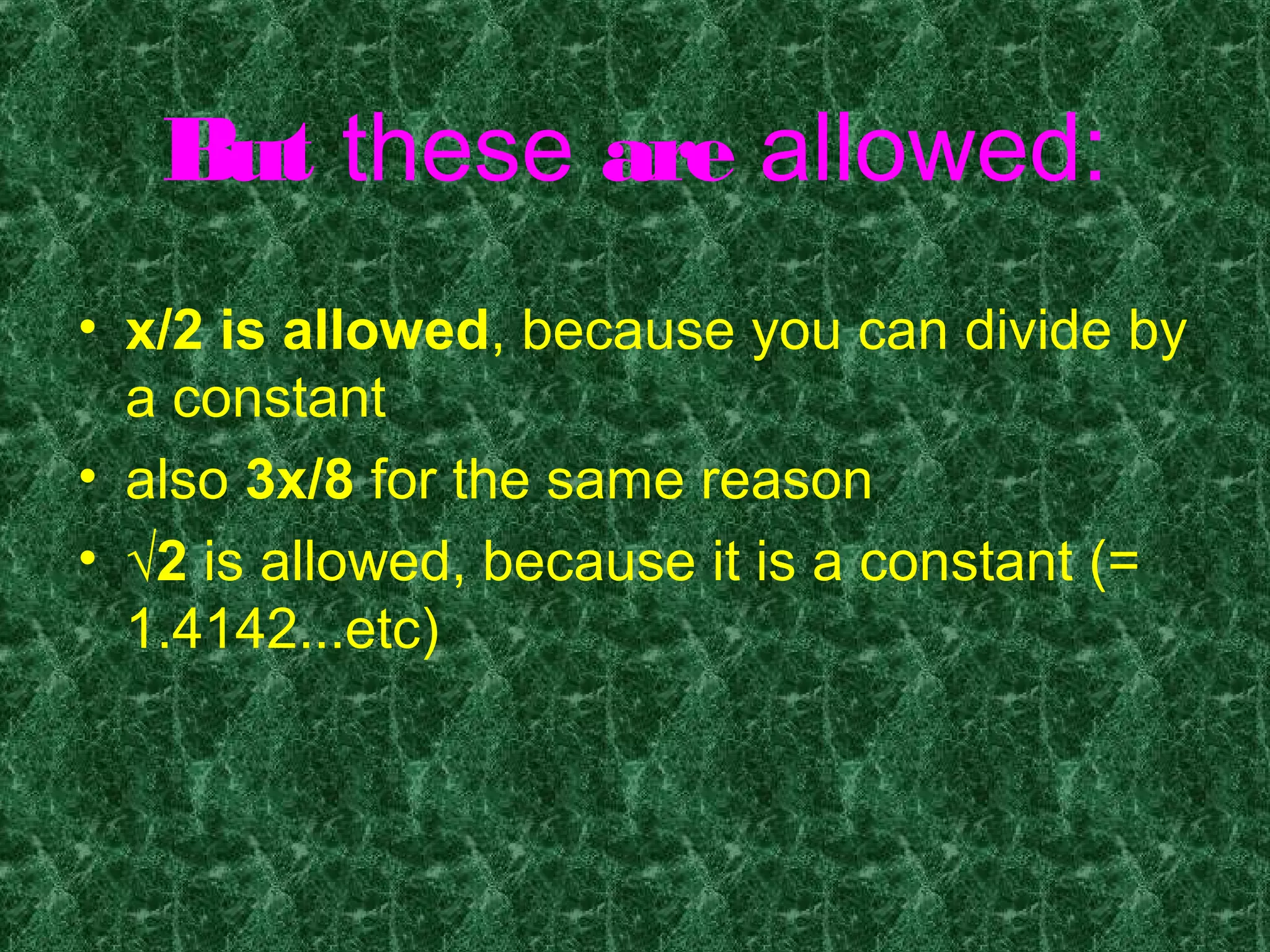
• x/2 is allowed, because you can divide by
a constant
• also 3x/8 for the same reason
• √2 is allowed, because it is a constant (=
1.4142...etc)
But these are allowed:
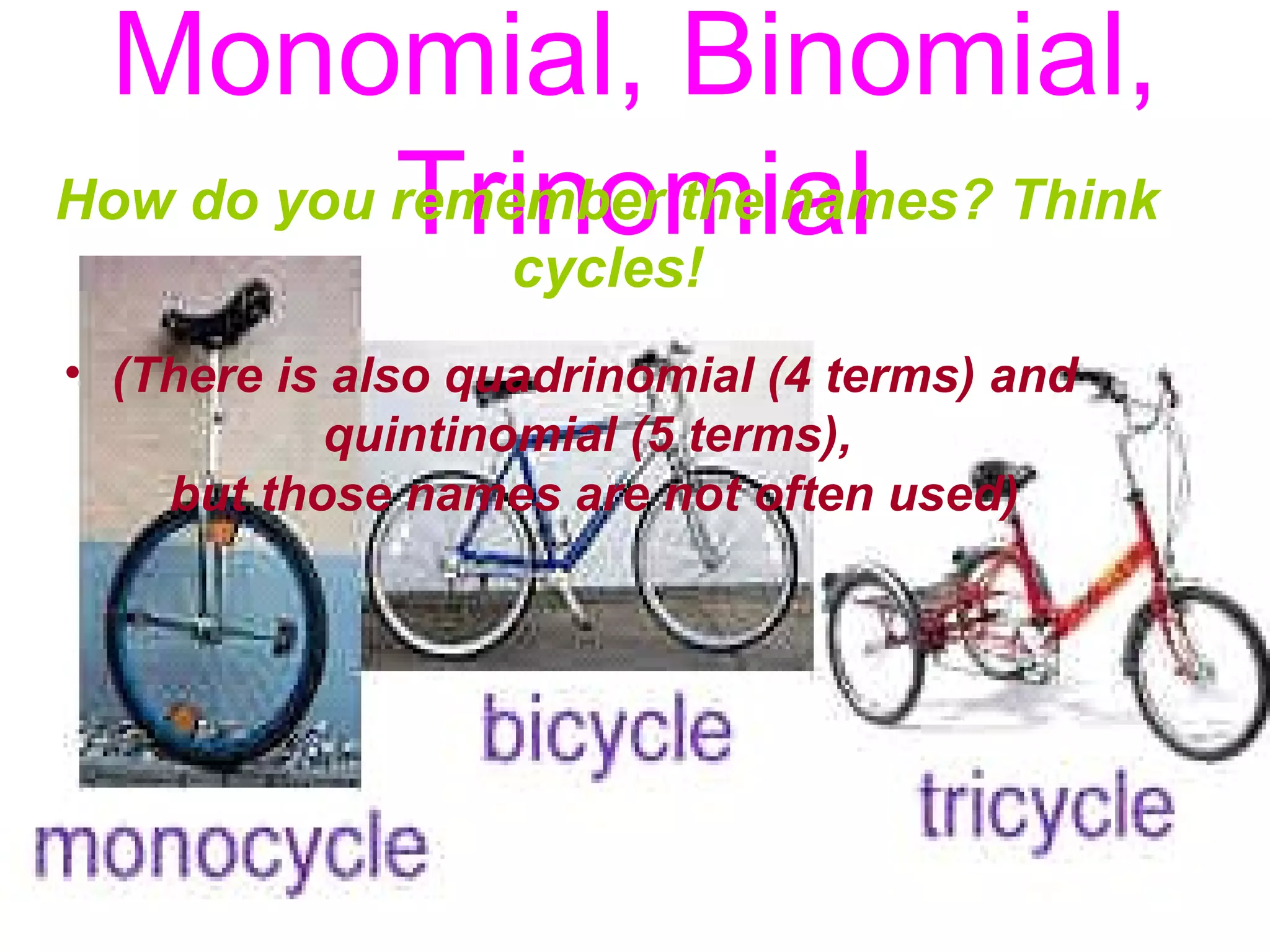
Monomial, Binomial,
Trinomial
• (There is also quadrinomial (4 terms) and
quintinomial (5 terms),
but those names are not often used)
How do you remember the names? Think
cycles!
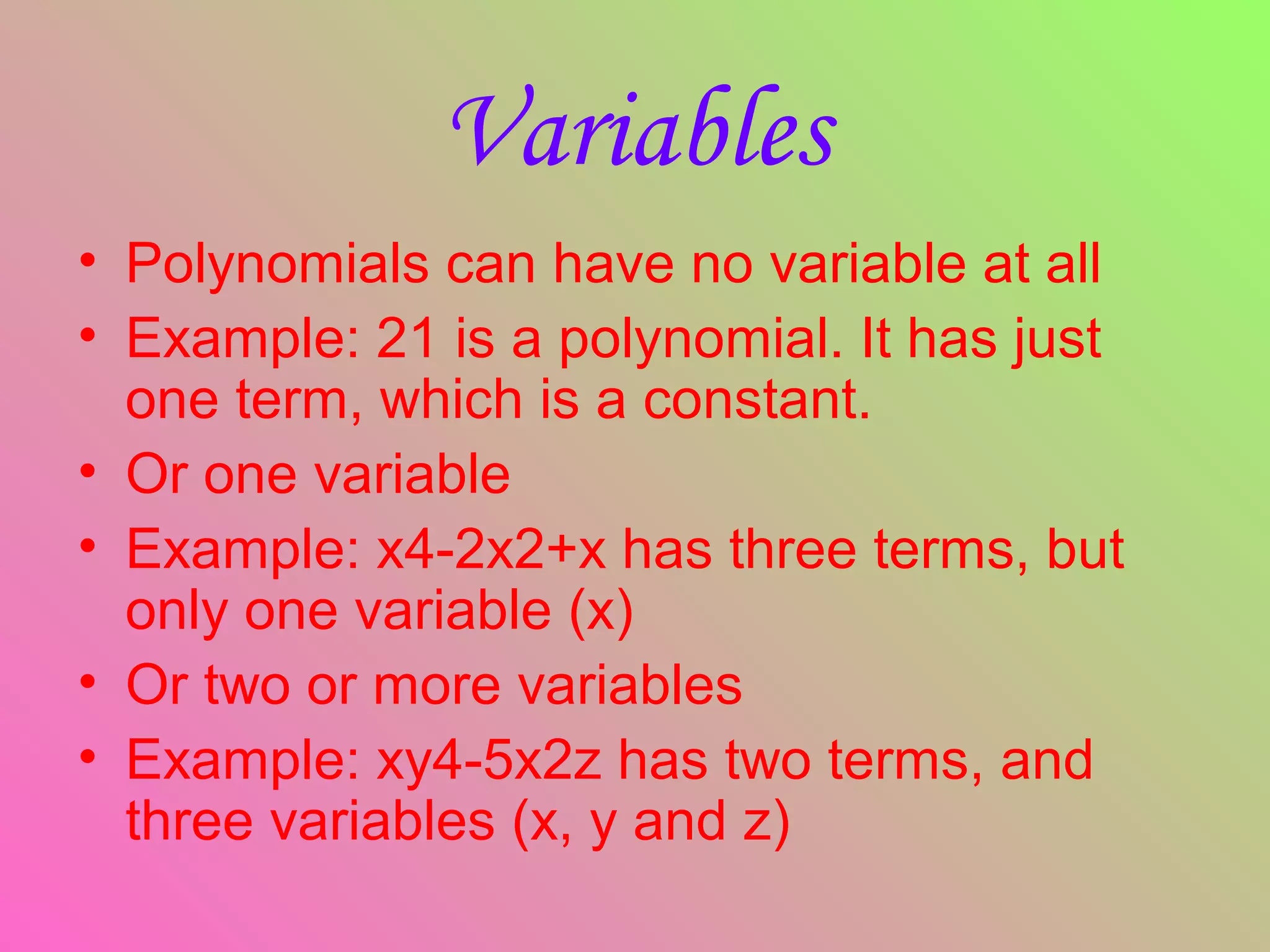
• Polynomials can have no variable at all
• Example: 21 is a polynomial. It has just
one term, which is a constant.
• Or one variable
• Example: x4-2x2+x has three terms, but
only one variable (x)
• Or two or more variables
• Example: xy4-5x2z has two terms, and
three variables (x, y and z)
Variables
• Because of the strict definition, polynomials
are easy to work with.
• For example we know that:
• If you add polynomials you get a polynomial
• If you multiply polynomials you get a
polynomial
• So you can do lots of additions and
multiplications, and still have a polynomial
as the result.
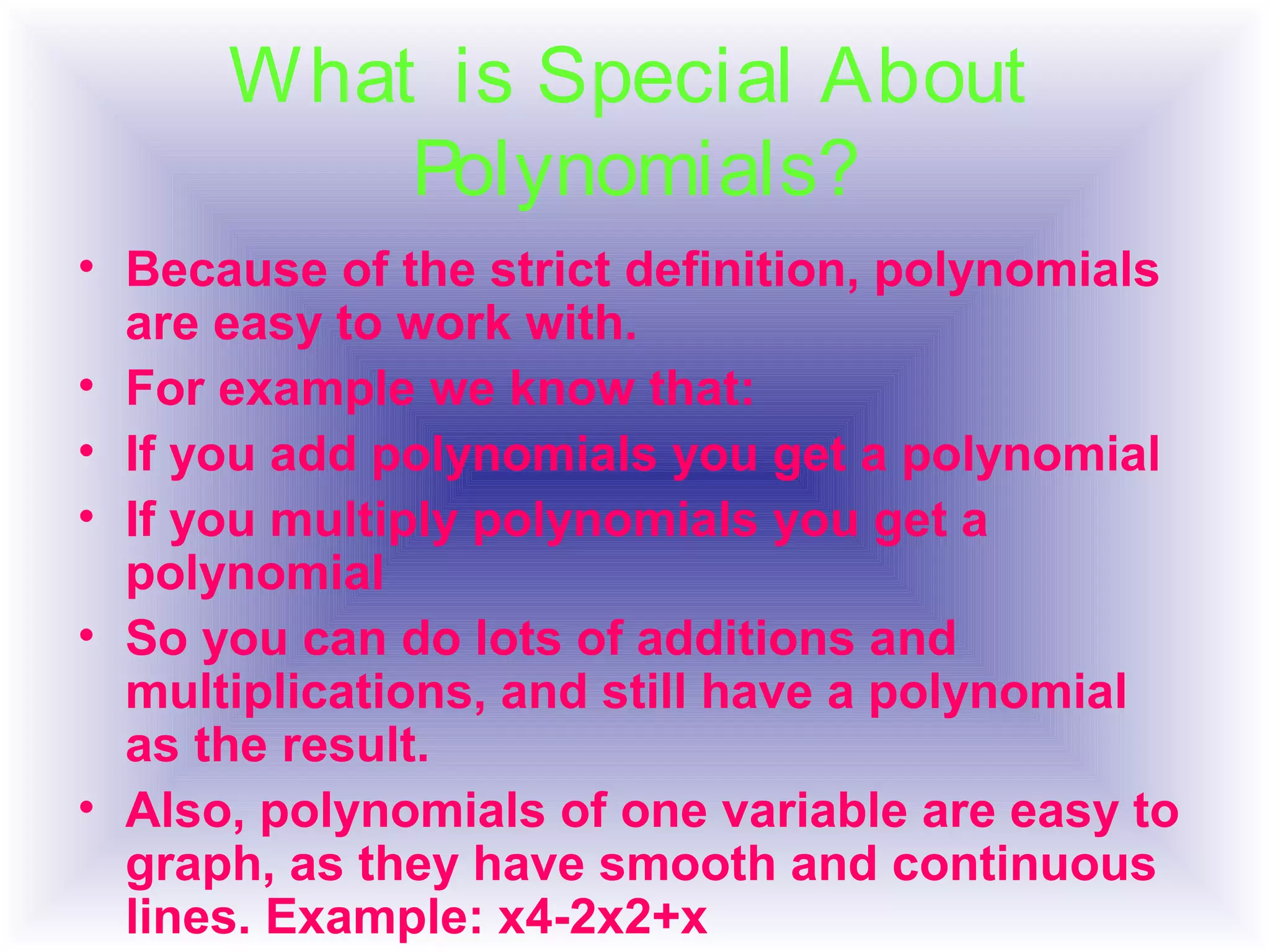
• Also, polynomials of one variable are easy to
graph, as they have smooth and continuous
lines. Example: x4-2x2+x
What is Special About
Polynomials?
Degree
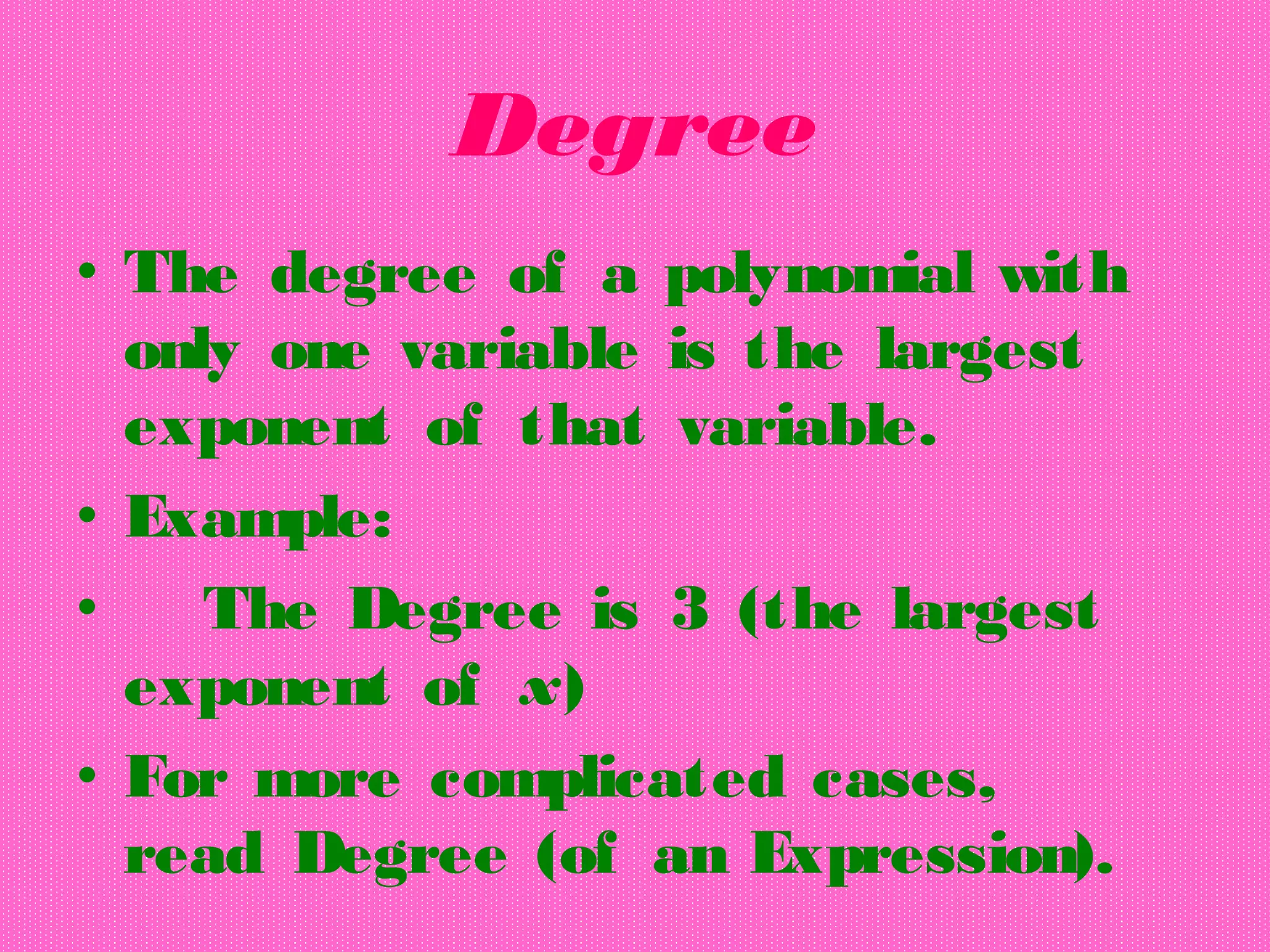
• The degree of a polynomial with
only one variable is the largest
exponent of that variable.
• Example:
• The Degree is 3 (the largest
exponent of  x)
• For more complicated cases,
read Degree (of an Expression).
Standard Form
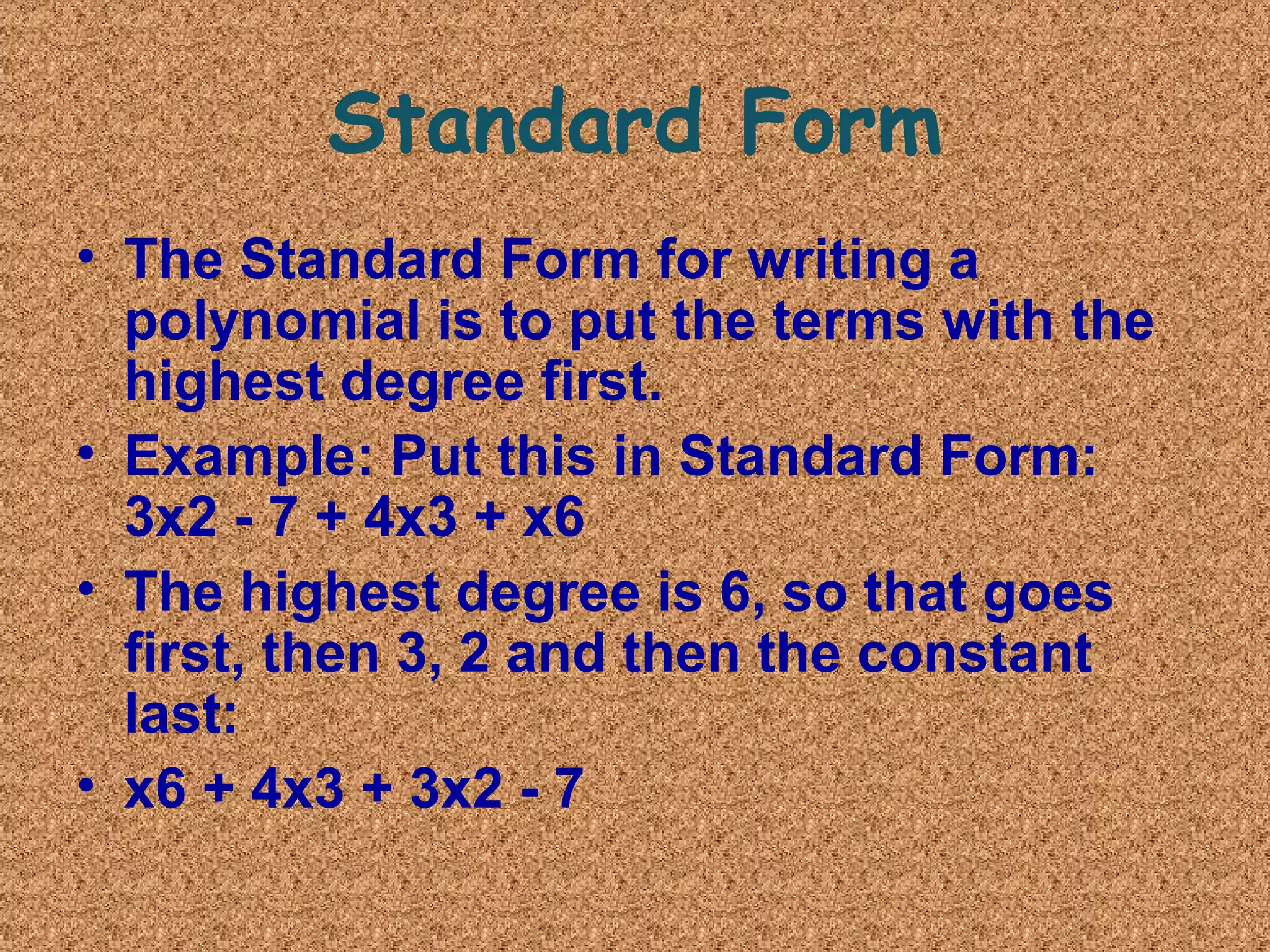
• The Standard Form for writing a 
polynomial is to put the terms with the 
highest degree first.
• Example: Put this in Standard Form: 
3x2 - 7 + 4x3 + x6
• The highest degree is 6, so that goes 
first, then 3, 2 and then the constant 
last:
• x6 + 4x3 + 3x2 - 7
Like Terms
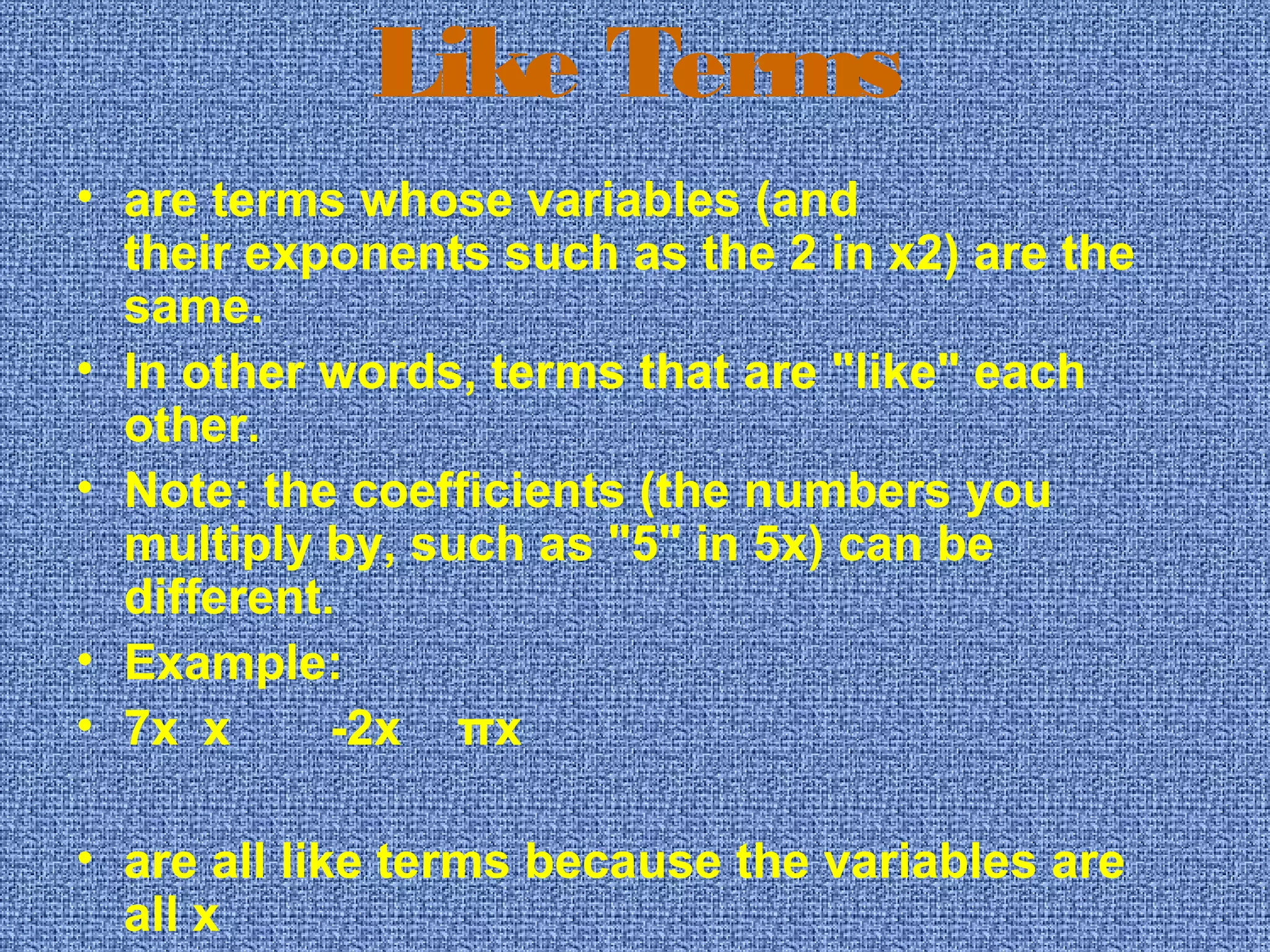
• are terms whose variables (and 
their exponents such as the 2 in x2) are the 
same.
• In other words, terms that are "like" each 
other.
• Note: the coefficients (the numbers you 
multiply by, such as "5" in 5x) can be 
different.
• Example:
• 7x x -2x πx
• are all like terms because the variables are 
all x
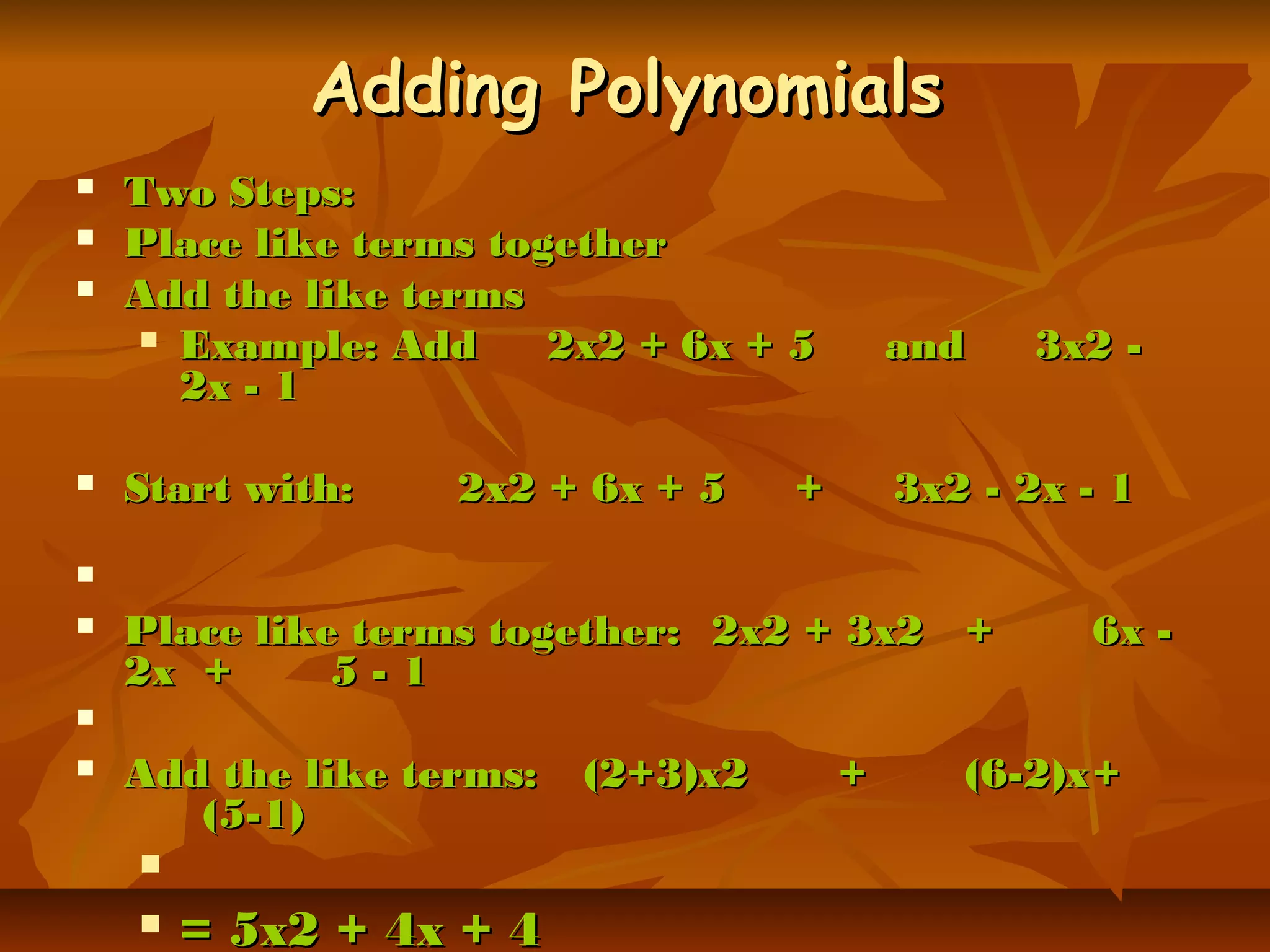
Adding PolynomialsAdding Polynomials
 Two Steps:Two Steps:
 Place like terms togetherPlace like terms together
 Add the like termsAdd the like terms
 Example: Add     2x2 + 6x + 5     and     3x2 -Example: Add     2x2 + 6x + 5     and     3x2 -
2x - 12x - 1
 Start with:Start with: 2x2 + 6x + 5     +     3x2 - 2x - 12x2 + 6x + 5     +     3x2 - 2x - 1
                  
 Place like terms together:Place like terms together: 2x2 + 3x22x2 + 3x2 ++ 6x -6x -
2x2x ++ 5 - 15 - 1
                  
 Add the like terms:Add the like terms: (2+3)x2(2+3)x2 ++ (6-2)x(6-2)x++
(5-1)(5-1)
   
 = 5x2 + 4x + 4= 5x2 + 4x + 4
Here is an example to show you:
•
• (Note: there was no "like term" for the -7 in the other
polynomial, so we didn't have to add anything to it.)
• Adding in Columns
• You could also add them in columns like this:
•
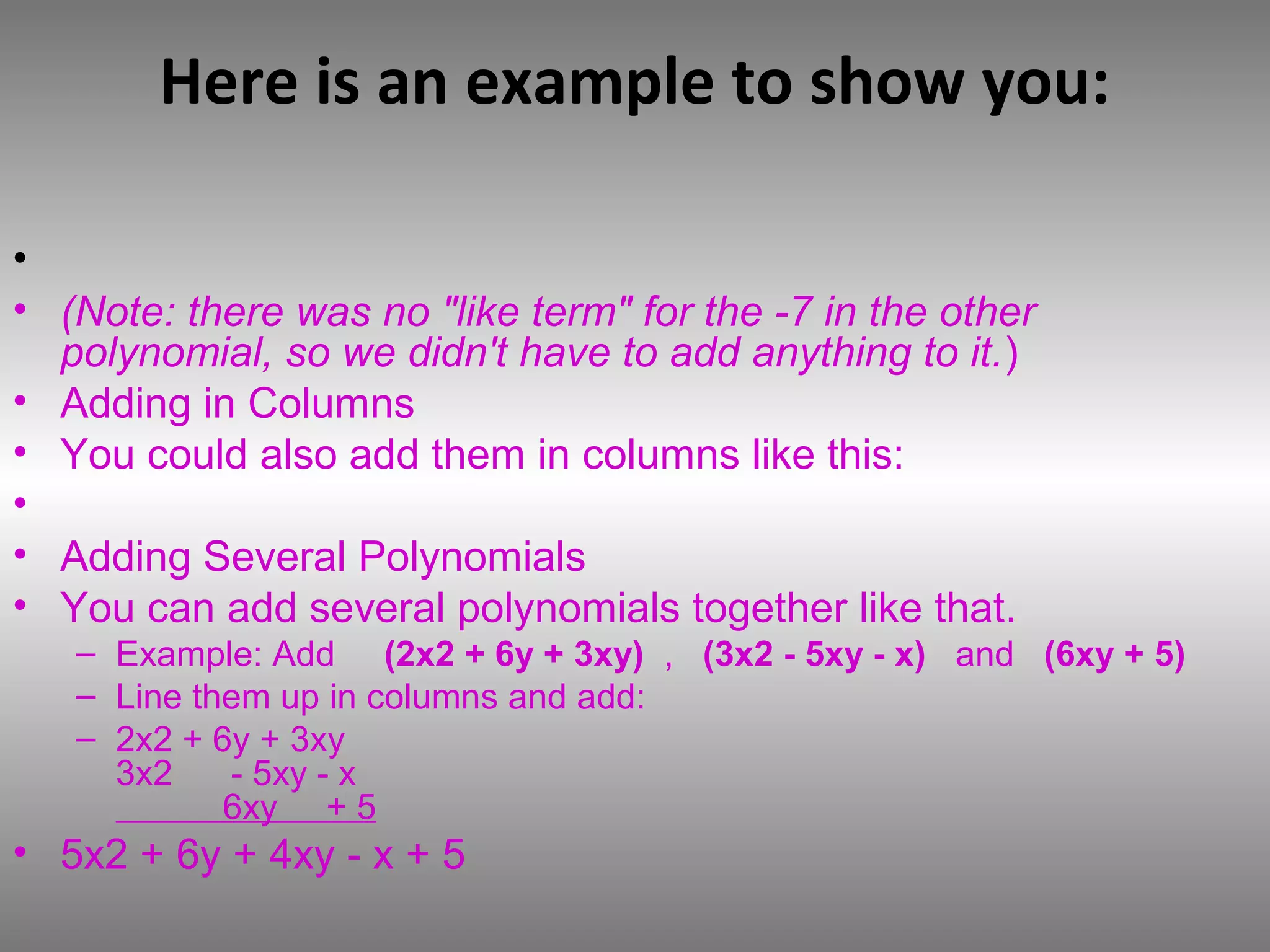
• Adding Several Polynomials
• You can add several polynomials together like that.
– Example: Add (2x2 + 6y + 3xy) , (3x2 - 5xy - x) and (6xy + 5)
– Line them up in columns and add:
– 2x2 + 6y + 3xy
3x2 - 5xy - x
6xy + 5
• 5x2 + 6y + 4xy - x + 5
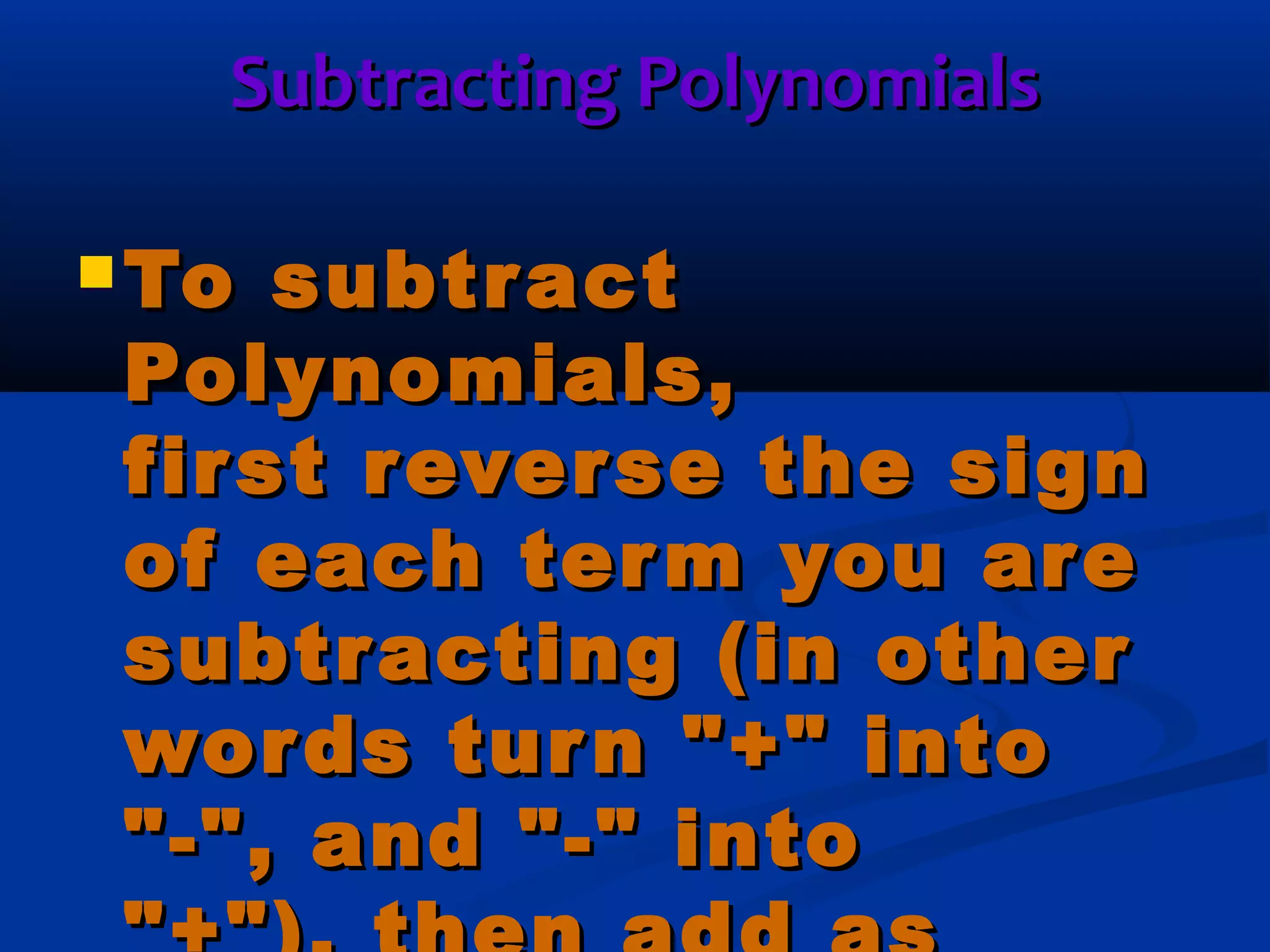
Subtracting PolynomialsSubtracting Polynomials
 To subtractTo subtract
Polynomials,Polynomials,
first reverse the signfirst reverse the sign
of each term you areof each term you are
subtracting (in othersubtracting (in other
words turn "+" intowords turn "+" into
"-", and "-" into"-", and "-" into
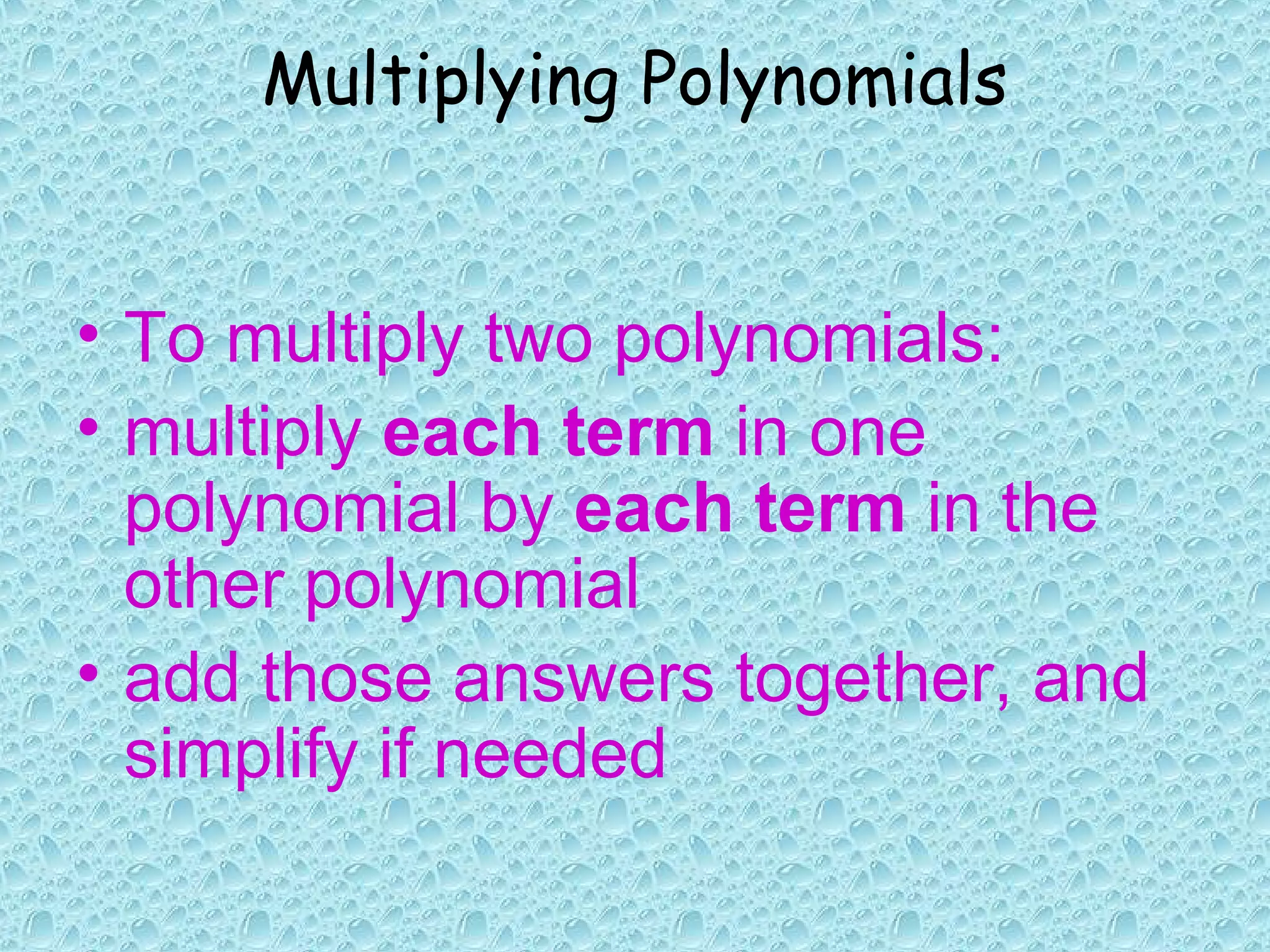
Multiplying Polynomials
• To multiply two polynomials:
• multiply each term in one
polynomial by each term in the
other polynomial
• add those answers together, and
simplify if needed
Thank you

Polynomial 

  • 1.
  • 2.
    Polynomial comes from poly-(meaning "many") and - nomial (in this case meaning "term") ... so it says "many terms" A polynomial can have: constants (like 3, -20, or ½) variables (like x and y) exponents (like the 2 in y2), but only 0, 1, 2, 3, ... etc are allowed
  • 3.
  • 4.
    These are polynomials • 3x • x- 2 • -6y2 - (7/9)x • 3xyz + 3xy2z - 0.1xz - 200y + 0.5 • 512v5+ 99w5 • 5 (Yes, even "5" is a polynomial, one term is allowed, and it can even be just a constant!)
  • 5.
    And these are not polynomials • 2/(x+2)is not, because dividing by a variable is not allowed • 1/x is not either • 3xy-2 is not, because the exponent is "-2" (exponents can only be 0,1,2,...) • √x is not, because the exponent is "½" (see fractional exponents)
  • 6.
    • x/2 isallowed, because you can divide by a constant • also 3x/8 for the same reason • √2 is allowed, because it is a constant (= 1.4142...etc) But these are allowed:
  • 7.
    Monomial, Binomial, Trinomial • (Thereis also quadrinomial (4 terms) and quintinomial (5 terms), but those names are not often used) How do you remember the names? Think cycles!
  • 8.
    • Polynomials canhave no variable at all • Example: 21 is a polynomial. It has just one term, which is a constant. • Or one variable • Example: x4-2x2+x has three terms, but only one variable (x) • Or two or more variables • Example: xy4-5x2z has two terms, and three variables (x, y and z) Variables
  • 9.
    • Because ofthe strict definition, polynomials are easy to work with. • For example we know that: • If you add polynomials you get a polynomial • If you multiply polynomials you get a polynomial • So you can do lots of additions and multiplications, and still have a polynomial as the result. • Also, polynomials of one variable are easy to graph, as they have smooth and continuous lines. Example: x4-2x2+x What is Special About Polynomials?
  • 10.
    Degree • The degree of apolynomial with only one variable is the largest exponent of that variable. • Example: • The Degree is 3 (the largest exponent of  x) • For more complicated cases, read Degree (of an Expression).
  • 11.
    Standard Form • The Standard Form for writing a  polynomial is to put the terms with the  highest degree first. •Example: Put this in Standard Form:  3x2 - 7 + 4x3 + x6 • The highest degree is 6, so that goes  first, then 3, 2 and then the constant  last: • x6 + 4x3 + 3x2 - 7
  • 12.
    Like Terms • are terms whose variables (and  their exponents such as the 2 in x2) are the  same. •In other words, terms that are "like" each  other. • Note: the coefficients (the numbers you  multiply by, such as "5" in 5x) can be  different. • Example: • 7x x -2x πx • are all like terms because the variables are  all x
  • 13.
    Adding PolynomialsAdding Polynomials Two Steps:Two Steps:  Place like terms togetherPlace like terms together  Add the like termsAdd the like terms  Example: Add     2x2 + 6x + 5     and     3x2 -Example: Add     2x2 + 6x + 5     and     3x2 - 2x - 12x - 1  Start with:Start with: 2x2 + 6x + 5     +     3x2 - 2x - 12x2 + 6x + 5     +     3x2 - 2x - 1                     Place like terms together:Place like terms together: 2x2 + 3x22x2 + 3x2 ++ 6x -6x - 2x2x ++ 5 - 15 - 1                     Add the like terms:Add the like terms: (2+3)x2(2+3)x2 ++ (6-2)x(6-2)x++ (5-1)(5-1)      = 5x2 + 4x + 4= 5x2 + 4x + 4
  • 14.
    Here is anexample to show you: • • (Note: there was no "like term" for the -7 in the other polynomial, so we didn't have to add anything to it.) • Adding in Columns • You could also add them in columns like this: • • Adding Several Polynomials • You can add several polynomials together like that. – Example: Add (2x2 + 6y + 3xy) , (3x2 - 5xy - x) and (6xy + 5) – Line them up in columns and add: – 2x2 + 6y + 3xy 3x2 - 5xy - x 6xy + 5 • 5x2 + 6y + 4xy - x + 5
  • 15.
    Subtracting PolynomialsSubtracting Polynomials To subtractTo subtract Polynomials,Polynomials, first reverse the signfirst reverse the sign of each term you areof each term you are subtracting (in othersubtracting (in other words turn "+" intowords turn "+" into "-", and "-" into"-", and "-" into
  • 16.
    Multiplying Polynomials • Tomultiply two polynomials: • multiply each term in one polynomial by each term in the other polynomial • add those answers together, and simplify if needed
  • 17.