 A polynomial is an expression made with
constants, variable and exponent which are
combined using addition, subtraction and
multiplication but not division.
 The exponents can only be 0,1,2,3……etc.
 Degree of polynomial- The highest power
of x in p(x) is called the degree of the
polynomial p(x).
 EXAMPLE –
 f(x) = 3x +½ is a polynomial in the
variable x of degree 1.
 g(y) = 2y²  ⅜ y +7 is a polynomial in the
variable y of degree 2 .
On the basic of number of term.
1. Monomial : Polynomial having only one term
e.g.= 4x, 8x etc.
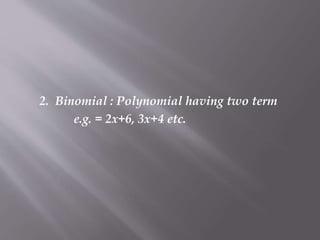
2. Binomial : Polynomial having two term
e.g. = 2x+6, 3x+4 etc.
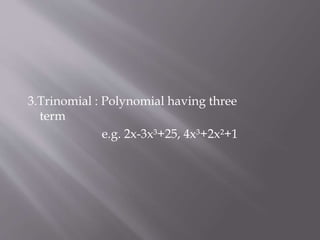
3.Trinomial : Polynomial having three
term
e.g. 2x-3x³+25, 4x³+2x²+1
 On the basic of degree.
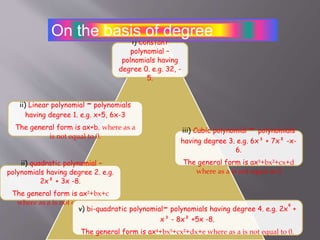
i) Constant
polynomial –
polnomials having
degree 0. e.g. 32, -
5.
ii) Linear polynomial – polynomials
having degree 1. e.g. x+5, 6x-3
The general form is ax+b. where as a
is not equal to 0.
ii) quadratic polynomial –
polynomials having degree 2. e.g.
2x² + 3x -8.
The general form is ax²+bx+c
where as a is not equal to 0.
iii) Cubic polynomial – polynomials
having degree 3. e.g. 6x³ + 7x² -x-
6.
The general form is ax³+bx²+cx+d
where as a is not equal to 0
v) bi-quadratic polynomial- polynomials having degree 4. e.g. 2x
4
+
x³ - 8x² +5x -8.
The general form is ax +bx³+cx²+dx+e where as a is not equal to 0.
On the basis of degree
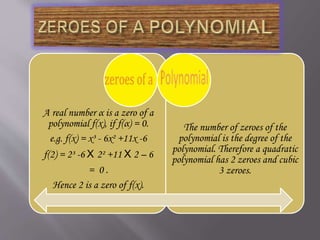
A real number α is a zero of a
polynomial f(x), if f(α) = 0.
e.g. f(x) = x³ - 6x² +11x -6
f(2) = 2³ -6 X 2² +11 X 2 – 6
= 0 .
Hence 2 is a zero of f(x).
The number of zeroes of the
polynomial is the degree of the
polynomial. Therefore a quadratic
polynomial has 2 zeroes and cubic
3 zeroes.
Ankit maths ppt
Ankit maths ppt
Ankit maths ppt
Ankit maths ppt

Ankit maths ppt

  • 2.
     A polynomialis an expression made with constants, variable and exponent which are combined using addition, subtraction and multiplication but not division.  The exponents can only be 0,1,2,3……etc.
  • 3.
     Degree ofpolynomial- The highest power of x in p(x) is called the degree of the polynomial p(x).  EXAMPLE –  f(x) = 3x +½ is a polynomial in the variable x of degree 1.  g(y) = 2y²  ⅜ y +7 is a polynomial in the variable y of degree 2 .
  • 4.
    On the basicof number of term.
  • 5.
    1. Monomial :Polynomial having only one term e.g.= 4x, 8x etc.
  • 6.
    2. Binomial :Polynomial having two term e.g. = 2x+6, 3x+4 etc.
  • 7.
    3.Trinomial : Polynomialhaving three term e.g. 2x-3x³+25, 4x³+2x²+1
  • 8.
     On thebasic of degree.
  • 9.
    i) Constant polynomial – polnomialshaving degree 0. e.g. 32, - 5. ii) Linear polynomial – polynomials having degree 1. e.g. x+5, 6x-3 The general form is ax+b. where as a is not equal to 0. ii) quadratic polynomial – polynomials having degree 2. e.g. 2x² + 3x -8. The general form is ax²+bx+c where as a is not equal to 0. iii) Cubic polynomial – polynomials having degree 3. e.g. 6x³ + 7x² -x- 6. The general form is ax³+bx²+cx+d where as a is not equal to 0 v) bi-quadratic polynomial- polynomials having degree 4. e.g. 2x 4 + x³ - 8x² +5x -8. The general form is ax +bx³+cx²+dx+e where as a is not equal to 0. On the basis of degree
  • 10.
    A real numberα is a zero of a polynomial f(x), if f(α) = 0. e.g. f(x) = x³ - 6x² +11x -6 f(2) = 2³ -6 X 2² +11 X 2 – 6 = 0 . Hence 2 is a zero of f(x). The number of zeroes of the polynomial is the degree of the polynomial. Therefore a quadratic polynomial has 2 zeroes and cubic 3 zeroes.