Conditions that cause Generalized
Weakness
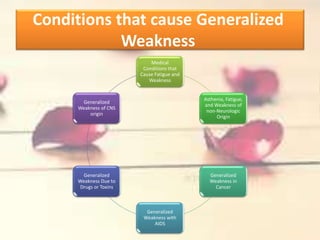
Medical
Conditions that
Cause Fatigue and
Weakness
Asthenia, Fatigue,
and Weakness of
non-Neurologic
Origin
Generalized
Weakness in
Cancer
Generalized
Weakness with
AIDS
Generalized
Weakness Due to
Drugs or Toxins
Generalized
Weakness of CNS
origin
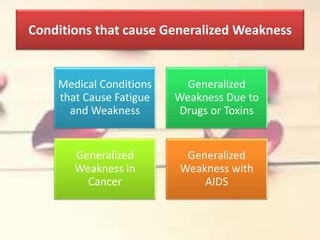
Conditions that cause Generalized Weakness
Medical Conditions
that Cause Fatigue
and Weakness
Generalized
Weakness Due to
Drugs or Toxins
Generalized
Weakness in
Cancer
Generalized
Weakness with
AIDS
Weakness of non-Neurologic Origin
Psychiatric illness
– Patients with depression and
other illnesses may interpret
their fatigue and lack of
motivation as global
weakness
– They may present with
functional weakness
(preferred term instead of
"psychogenic weakness")
– There is often a mental,
affective, or "psychic"
component accompanying
the weakness
– Don't let a strong psychiatric
history pre-empt investigation
of neurologic symptoms
– It is entirely reasonable to
consult Neurology if you are
unsure!
_Cardiovascular: congestive heart failure
– * Hematologic: anemia, leukemia,
lymphoma
– * Renal: uremia, electrolyte
abnormalities
– * Pulmonary: COPD
– * Endocrine (may cause true
neuromuscular weakness as well):
hypothyroidism, hyperthyroidism,
hyperparathyroidism, hypogonadism,
Addison disease, aldosterone deficiency,
Cushing disease, hypercalcemia......and
many, many more !
Medical Conditions that Cause Fatigue and
Weakness
– * Erythrocyte sedimentation rate (ESR)
– * Complete blood cell count (CBC)
– *"Complete metabolic panel" (electrolytes including
Ca2+, Mg2+, PO4
3-, glucose, creatinine, urea)
– * Liver function tests and liver enzymes
– * Thyroid function tests
– * Creatine kinase (CK) level
– * Chest x-ray
WeaknessRoutine laboratory evaluation for fatigue
Generalized Weakness Due to Drugs
or Toxins
• Muscle is very sensitive to drugs and toxins because of its high
metabolic activity
– a daunting list of medications may produce muscle toxicity
– they can interfere with muscle metabolism at many different
sites
– it is not useful to remember all of the drugs that can cause
myopathy
– but there are a few common offenders:
• steroids
• alcohol
• statins
• colchicine
• Symptoms range from cramps and myalgias to rhabdomyolysis with
severe muscle weakness and renal failure
• Patients less able to clear drugs are at greater risk
– Elderly, infants, ICU patients, liver and renal failure
Statin Myopathy
• Statins cause a toxic necrotizing myopathy
• Symptoms of toxic necrotizing myopathy:
– myalgias
– weakness
– hyper CK-emia
– myoglobinuria
• The mechanism of toxicity is unknown
• Muscle toxicity is rare with statin use
– myalgias in 2% to 7% of statin users
– elevated transaminases (assumed to come from muscle
breakdown) in 0.5% to 2%
– weakness and hyper CK-emia in 0.1% to 1%
– severe myopathies in 0.08%
– fatal rhabdomyolysis - 0.15 deaths per million prescriptions
• There is a newly-described immune myopathy
associated with statin use
– Immune-mediated necrotizing myopathy
(INEM)
– Statin somehow triggers an immune-
mediated myopathy
– It appears to be rare
– Patients develop proximal muscle weakness
and hyper CK-emia that persists after statin
discontinuation
Steroid Myopathy
• Caused by endogenous (Cushing's) or exogenous chronic
excess corticosteroid
– risk increased with doses of prednisone >30 mg/day
– risk seems greater with fluorinated glucocorticoids
(triamcinolone > betamethasone > dexamethasone)
• Unknown mechanism of toxicity
• Causes proximal limb weakness and atrophy (spares
cranial muscles)
• Sometimes called a "bland myopathy":
– CK level is usually normal
– EMG studies tend to be normal
– Muscle biopsy tends to be normal or have only mild
non-specific abnormalities (e.g. type IIb fibre atrophy)
Alcoholic Myopathy
• Alcohol more often causes neuropathy than myopathy
• It causes several distinct muscle disorders:
– acute necrotizing myopathy
– acute hypokalemic myopathy
– chronic alcoholic myopathy
– asymptomatic alcoholic myopathy
– alcoholic cardiomyopathy
• Pathologic mechanisms are unknown
• What you need to know:
– alcohol can cause acute or chronic myopathy
– the CK may be elevated, or normal
– there is often a co-existing neuropathy
– alcoholics have many other reasons to be weak (nutritional,
metabolic, etc)
Colchicine Neuromyopathy
• Colchicine inhibits polymerization of tubulin into
microtubular structures
• It is toxic to nerves and muscle (neuromyopathy)
• Neuromyopathy can develop with acute
intoxication, or long-term use at normal doses
– patients with chronic renal failure are at higher risk of
toxicity
• Symptoms improve with discontinuation of
colchicine
– but may take 4 to 6 months to recover
Inflammatory Myopathies
• Many myopathies have an inflammatory component,
secondary to...
– toxic (e.g. immune-mediated necrotizing myopathy)
– metabolic abnormalities
– other connective tissue diseases (scleroderma, Sjögren
syndrome, RA, SLE, mixed CTD)
– ...PMR is not a myopathy (it is a vasculitis), but it produces
muscle pain and weakness
• Three "primary" inflammatory myopathies
– Dermatomyositis
– Polymyositis
– Inclusion Body Myositis
• They are pathologically distinct
– DM is not "PM with a rash"
– IBM is not "PM with inclusion bodies and rimmed vacuoles"
– They differ in their response to treatment and prognosis
Polymyositis
• PM probably isn't a single disease entity
• PM is better defined by what it isn't, than what it is
• Clinical presentation:
– Symmetric weakness, proximal > distal
– Tender, aching muscles may be present, but usually pain
isn't severe
• "the more severe the pain, the less likely the diagnosis of
polymyositis" -- Bradley's NICP
– Cranial muscles are usually spared
• ocular muscles are not involved
• bulbar muscles may be involved in severe cases (dysphagia,
dysarthria)
– Tendon reflexes diminished in proportion to muscle
weakness
• which means that even patients with severe weakness should have
DTRs
• areflexia is more suggestive of neuropathy
• Associated features:
– all of these occur in DM, too
– Cardiomyopathy
– Interstitial Lung Disease
– Polyarthritis
– Malignancy
• PM and DM both may develop as a paraneoplastic
syndrome
• association with malingnancy may be stronger in DM
Polymyositis
Dermatomyositis
• More than just "PM with a rash"
• Clinical presentation:
– Symmetric weakness, proximal > distal
– Unlike PM, DM occurs in children
– Unique skin manifestations in DM
– Heliotrope (violet-colored) rash and periorbital edema
– Gottron's papules
– Photosensitivity rash (shawl sign, V sign, etc)
– Dilate nail bed capillary loops
– Cutaneous calcinosis (more common in children)
• skin manifestations usually accompany, or precede the onset of
weakness
• except when they lag behind the onset of weakness by months, or
don't occur at all!
• DM can still be diagnosed in the absence of rash, because of
distinct findings on muscle biopsy
• Associated features:
– (as previous)
Inclusion Body Myositis
• Pathology is uncertain, but seems to be an inflammatory myopathy
• More common in men than women, tends to occur after 50 years
• Unique clinical features:
• Patients progress slowly over months/years
– Most patients remain ambulatory
– May become wheelchair or bed-bound
• Doesn't respond to typical immunomodulatory therapy
– some cases of "refractory" PM turn out to be IBM
• Associated features
– Not associated with cardiomyopathy, ILD, or malignancy
– Autoimmune disorders coexist in up to 15% of IBM patients
• SLE
• Sjören syndrome
• Scleroderma
• Thrombocytopenia
• Sarcoidosis

weakness

  • 2.
    Conditions that causeGeneralized Weakness Medical Conditions that Cause Fatigue and Weakness Asthenia, Fatigue, and Weakness of non-Neurologic Origin Generalized Weakness in Cancer Generalized Weakness with AIDS Generalized Weakness Due to Drugs or Toxins Generalized Weakness of CNS origin
  • 3.
    Conditions that causeGeneralized Weakness Medical Conditions that Cause Fatigue and Weakness Generalized Weakness Due to Drugs or Toxins Generalized Weakness in Cancer Generalized Weakness with AIDS
  • 4.
    Weakness of non-NeurologicOrigin Psychiatric illness – Patients with depression and other illnesses may interpret their fatigue and lack of motivation as global weakness – They may present with functional weakness (preferred term instead of "psychogenic weakness") – There is often a mental, affective, or "psychic" component accompanying the weakness – Don't let a strong psychiatric history pre-empt investigation of neurologic symptoms – It is entirely reasonable to consult Neurology if you are unsure!
  • 6.
    _Cardiovascular: congestive heartfailure – * Hematologic: anemia, leukemia, lymphoma – * Renal: uremia, electrolyte abnormalities – * Pulmonary: COPD – * Endocrine (may cause true neuromuscular weakness as well): hypothyroidism, hyperthyroidism, hyperparathyroidism, hypogonadism, Addison disease, aldosterone deficiency, Cushing disease, hypercalcemia......and many, many more ! Medical Conditions that Cause Fatigue and Weakness
  • 7.
    – * Erythrocytesedimentation rate (ESR) – * Complete blood cell count (CBC) – *"Complete metabolic panel" (electrolytes including Ca2+, Mg2+, PO4 3-, glucose, creatinine, urea) – * Liver function tests and liver enzymes – * Thyroid function tests – * Creatine kinase (CK) level – * Chest x-ray WeaknessRoutine laboratory evaluation for fatigue
  • 8.
    Generalized Weakness Dueto Drugs or Toxins • Muscle is very sensitive to drugs and toxins because of its high metabolic activity – a daunting list of medications may produce muscle toxicity – they can interfere with muscle metabolism at many different sites – it is not useful to remember all of the drugs that can cause myopathy – but there are a few common offenders: • steroids • alcohol • statins • colchicine • Symptoms range from cramps and myalgias to rhabdomyolysis with severe muscle weakness and renal failure • Patients less able to clear drugs are at greater risk – Elderly, infants, ICU patients, liver and renal failure
  • 9.
    Statin Myopathy • Statinscause a toxic necrotizing myopathy • Symptoms of toxic necrotizing myopathy: – myalgias – weakness – hyper CK-emia – myoglobinuria • The mechanism of toxicity is unknown • Muscle toxicity is rare with statin use – myalgias in 2% to 7% of statin users – elevated transaminases (assumed to come from muscle breakdown) in 0.5% to 2% – weakness and hyper CK-emia in 0.1% to 1% – severe myopathies in 0.08% – fatal rhabdomyolysis - 0.15 deaths per million prescriptions
  • 10.
    • There isa newly-described immune myopathy associated with statin use – Immune-mediated necrotizing myopathy (INEM) – Statin somehow triggers an immune- mediated myopathy – It appears to be rare – Patients develop proximal muscle weakness and hyper CK-emia that persists after statin discontinuation
  • 11.
    Steroid Myopathy • Causedby endogenous (Cushing's) or exogenous chronic excess corticosteroid – risk increased with doses of prednisone >30 mg/day – risk seems greater with fluorinated glucocorticoids (triamcinolone > betamethasone > dexamethasone) • Unknown mechanism of toxicity • Causes proximal limb weakness and atrophy (spares cranial muscles) • Sometimes called a "bland myopathy": – CK level is usually normal – EMG studies tend to be normal – Muscle biopsy tends to be normal or have only mild non-specific abnormalities (e.g. type IIb fibre atrophy)
  • 12.
    Alcoholic Myopathy • Alcoholmore often causes neuropathy than myopathy • It causes several distinct muscle disorders: – acute necrotizing myopathy – acute hypokalemic myopathy – chronic alcoholic myopathy – asymptomatic alcoholic myopathy – alcoholic cardiomyopathy • Pathologic mechanisms are unknown • What you need to know: – alcohol can cause acute or chronic myopathy – the CK may be elevated, or normal – there is often a co-existing neuropathy – alcoholics have many other reasons to be weak (nutritional, metabolic, etc)
  • 13.
    Colchicine Neuromyopathy • Colchicineinhibits polymerization of tubulin into microtubular structures • It is toxic to nerves and muscle (neuromyopathy) • Neuromyopathy can develop with acute intoxication, or long-term use at normal doses – patients with chronic renal failure are at higher risk of toxicity • Symptoms improve with discontinuation of colchicine – but may take 4 to 6 months to recover
  • 14.
    Inflammatory Myopathies • Manymyopathies have an inflammatory component, secondary to... – toxic (e.g. immune-mediated necrotizing myopathy) – metabolic abnormalities – other connective tissue diseases (scleroderma, Sjögren syndrome, RA, SLE, mixed CTD) – ...PMR is not a myopathy (it is a vasculitis), but it produces muscle pain and weakness • Three "primary" inflammatory myopathies – Dermatomyositis – Polymyositis – Inclusion Body Myositis • They are pathologically distinct – DM is not "PM with a rash" – IBM is not "PM with inclusion bodies and rimmed vacuoles" – They differ in their response to treatment and prognosis
  • 15.
    Polymyositis • PM probablyisn't a single disease entity • PM is better defined by what it isn't, than what it is • Clinical presentation: – Symmetric weakness, proximal > distal – Tender, aching muscles may be present, but usually pain isn't severe • "the more severe the pain, the less likely the diagnosis of polymyositis" -- Bradley's NICP – Cranial muscles are usually spared • ocular muscles are not involved • bulbar muscles may be involved in severe cases (dysphagia, dysarthria) – Tendon reflexes diminished in proportion to muscle weakness • which means that even patients with severe weakness should have DTRs • areflexia is more suggestive of neuropathy
  • 16.
    • Associated features: –all of these occur in DM, too – Cardiomyopathy – Interstitial Lung Disease – Polyarthritis – Malignancy • PM and DM both may develop as a paraneoplastic syndrome • association with malingnancy may be stronger in DM Polymyositis
  • 17.
    Dermatomyositis • More thanjust "PM with a rash" • Clinical presentation: – Symmetric weakness, proximal > distal – Unlike PM, DM occurs in children – Unique skin manifestations in DM – Heliotrope (violet-colored) rash and periorbital edema – Gottron's papules – Photosensitivity rash (shawl sign, V sign, etc) – Dilate nail bed capillary loops – Cutaneous calcinosis (more common in children) • skin manifestations usually accompany, or precede the onset of weakness • except when they lag behind the onset of weakness by months, or don't occur at all! • DM can still be diagnosed in the absence of rash, because of distinct findings on muscle biopsy • Associated features: – (as previous)
  • 18.
    Inclusion Body Myositis •Pathology is uncertain, but seems to be an inflammatory myopathy • More common in men than women, tends to occur after 50 years • Unique clinical features: • Patients progress slowly over months/years – Most patients remain ambulatory – May become wheelchair or bed-bound • Doesn't respond to typical immunomodulatory therapy – some cases of "refractory" PM turn out to be IBM • Associated features – Not associated with cardiomyopathy, ILD, or malignancy – Autoimmune disorders coexist in up to 15% of IBM patients • SLE • Sjören syndrome • Scleroderma • Thrombocytopenia • Sarcoidosis