Dr. Y. SAVITHRI M.Sc.,Ph.D
Govt. College for Men (A), Kadapa
Email. Id : drysavithri@gmail.com
ZOOLOGY
LEARNING OUTCOMES
 DEFINITION
 TYPES OF INDIVIDUALS
 PATTERNS OF POLYMORPHISM
 TYPES ZOOIDS
 NOTABLE POLYMORPHIC COLONIES
 ORIGIN OF POLYMORPHISM
 SIGNIFICANCE OF POLYMORPHISM
(GR: POLYS = MANY, MORPHE = FORM)
 Occurrence in the same species of more than one type of individual, which
differ in form and function is known as Polymorphism. Polymorphism denotes
division of labor among the zooids of the individual.
 Polymorphism is one of the characteristics feature of Coelenterate animals.
 In coelenterata or in hydrozoa which may be single or colonial, here occur two
main types of individuals or zooids-Polyp and medusae.
 Polymorphism (Gr., poly = many; morphe = form) is the occurrence of several
different types of individuals or zooids in a single species during its life cycle or as
members of the colony, the members perform different functions so that there is a
division of labour amongst the members.
 Coelenterata are noted for their polymorphism, but the various types are reducible
to either a polypoid or medusoid type. The polyp and medusa occur in a number of
morphological variations. However, polymorphism may be defined as the
representation of a single organism by more than one kind of individuals or zooids
which differ in their form and function.
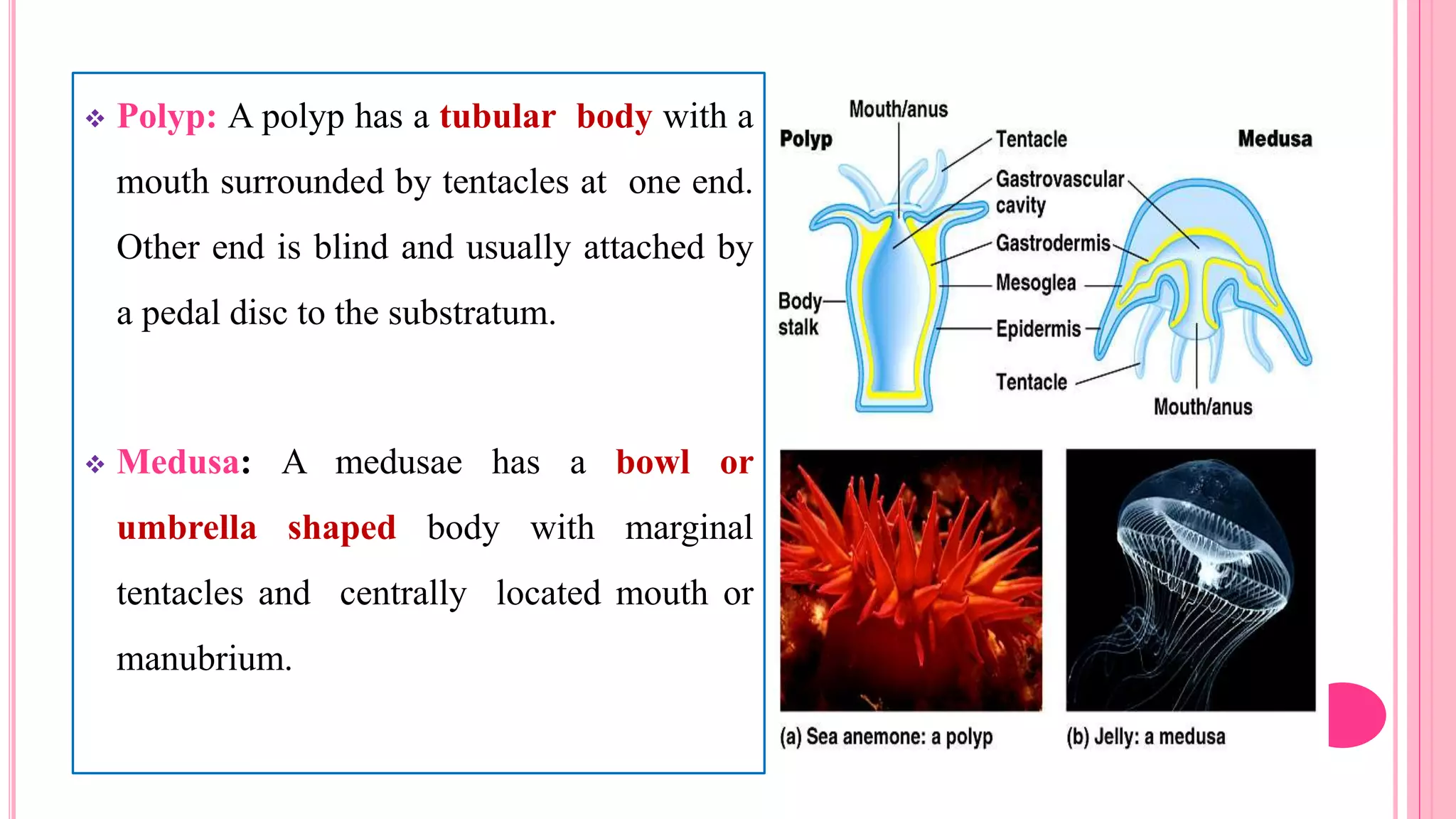
 Polyp: A polyp has a tubular body with a
mouth surrounded by tentacles at one end.
Other end is blind and usually attached by
a pedal disc to the substratum.
 Medusa: A medusae has a bowl or
umbrella shaped body with marginal
tentacles and centrally located mouth or
manubrium.
PATTERNS OF POLYMORPHISM:
Degree of polymorphism varies greatly in different groups of hydrozoa.
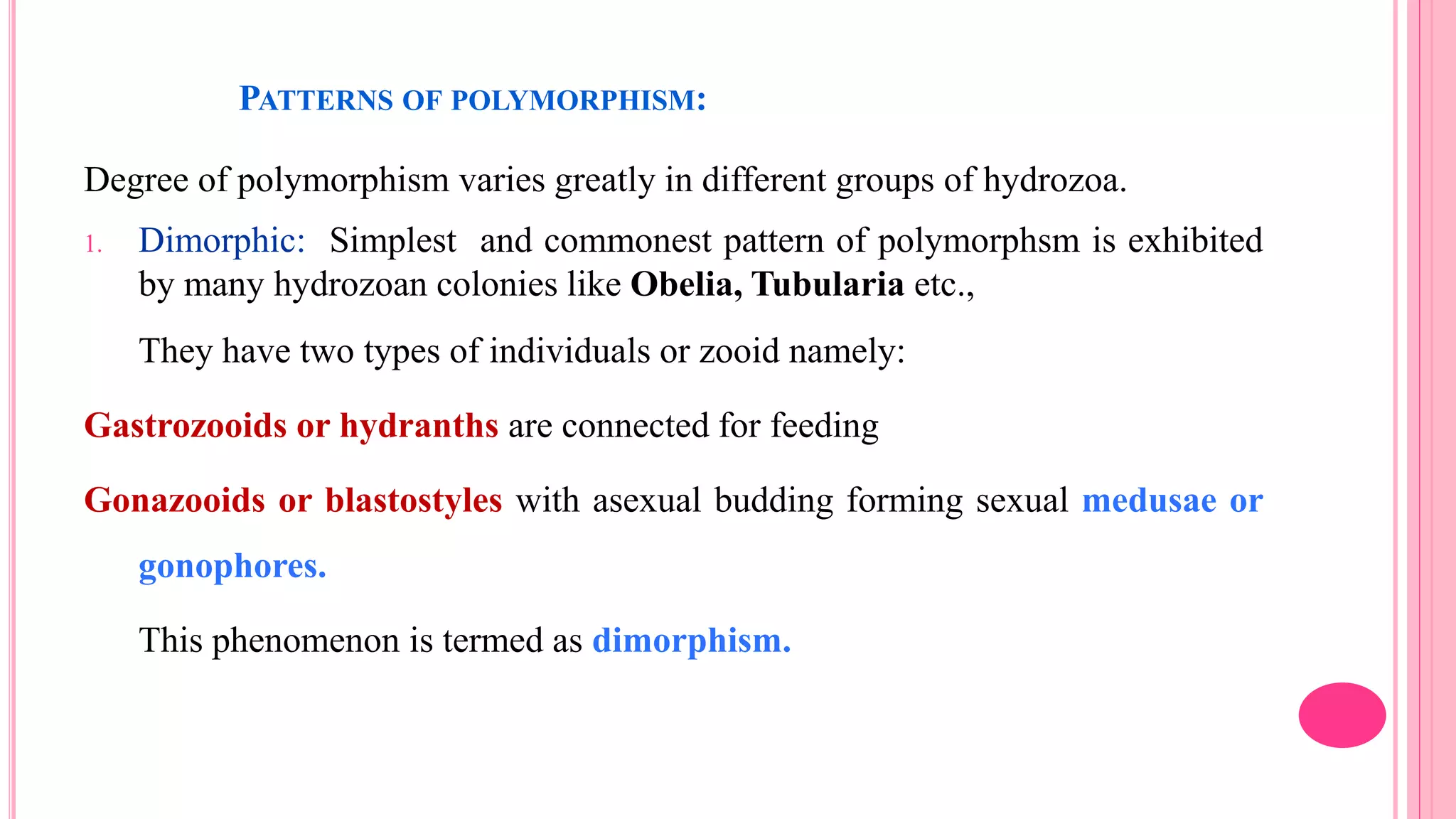
1. Dimorphic: Simplest and commonest pattern of polymorphsm is exhibited
by many hydrozoan colonies like Obelia, Tubularia etc.,
They have two types of individuals or zooid namely:
Gastrozooids or hydranths are connected for feeding
Gonazooids or blastostyles with asexual budding forming sexual medusae or
gonophores.
This phenomenon is termed as dimorphism.
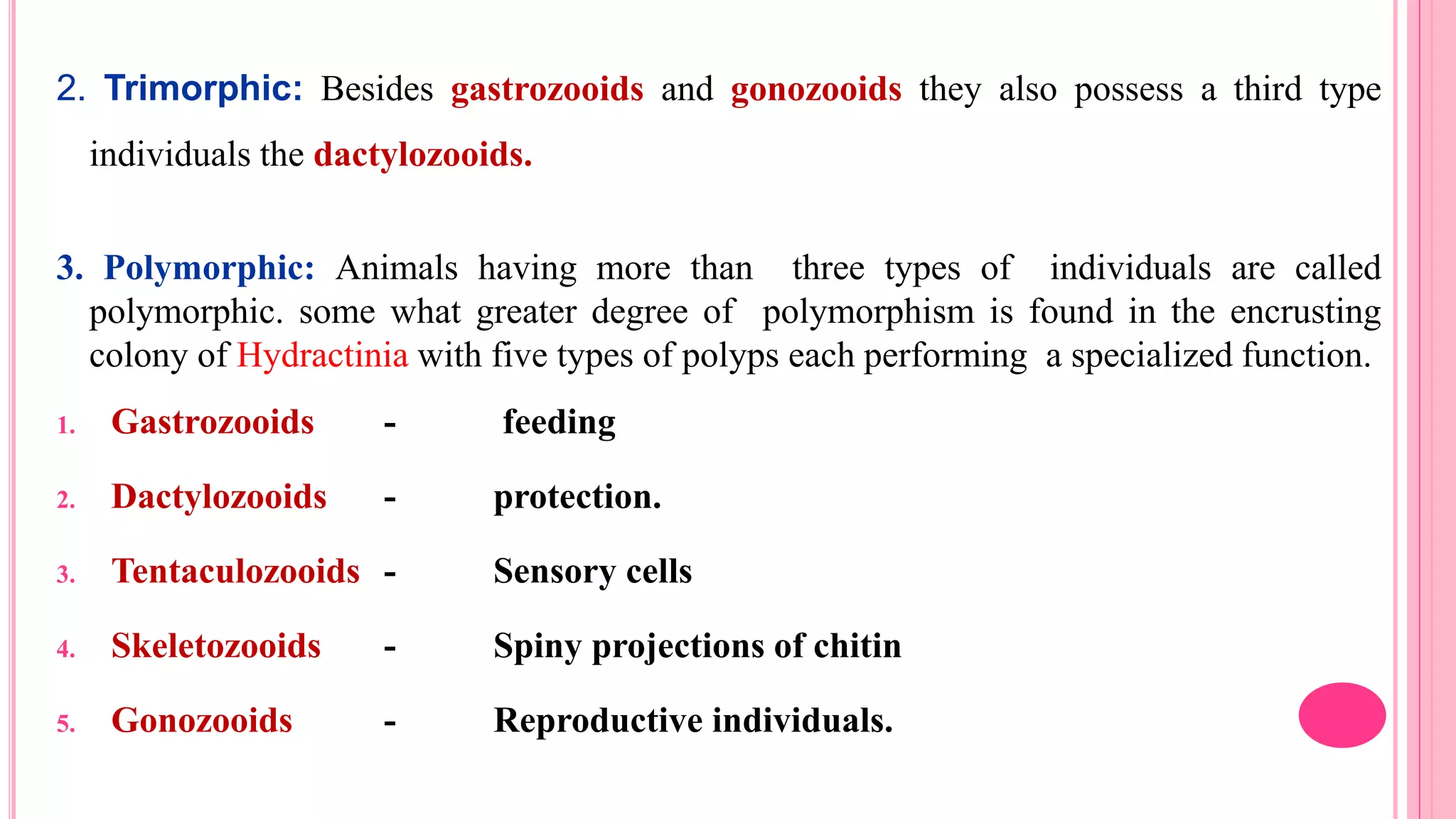
2. Trimorphic: Besides gastrozooids and gonozooids they also possess a third type
individuals the dactylozooids.
3. Polymorphic: Animals having more than three types of individuals are called
polymorphic. some what greater degree of polymorphism is found in the encrusting
colony of Hydractinia with five types of polyps each performing a specialized function.
1. Gastrozooids - feeding
2. Dactylozooids - protection.
3. Tentaculozooids - Sensory cells
4. Skeletozooids - Spiny projections of chitin
5. Gonozooids - Reproductive individuals.
POLYPOID ZOOIDS ARE :
1. Gastro zooids
2. Dactylo zooids
3. Gono zooids
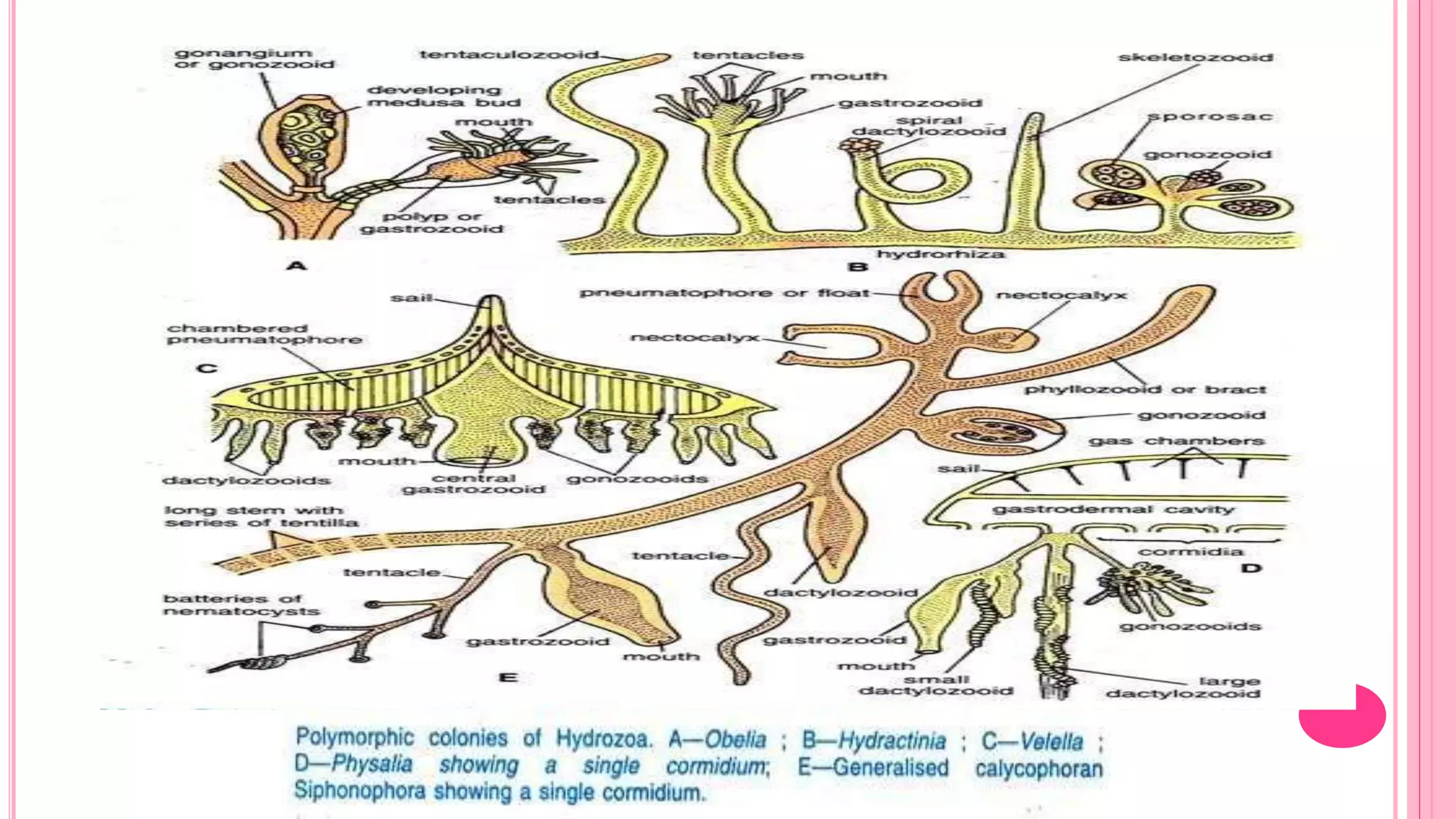
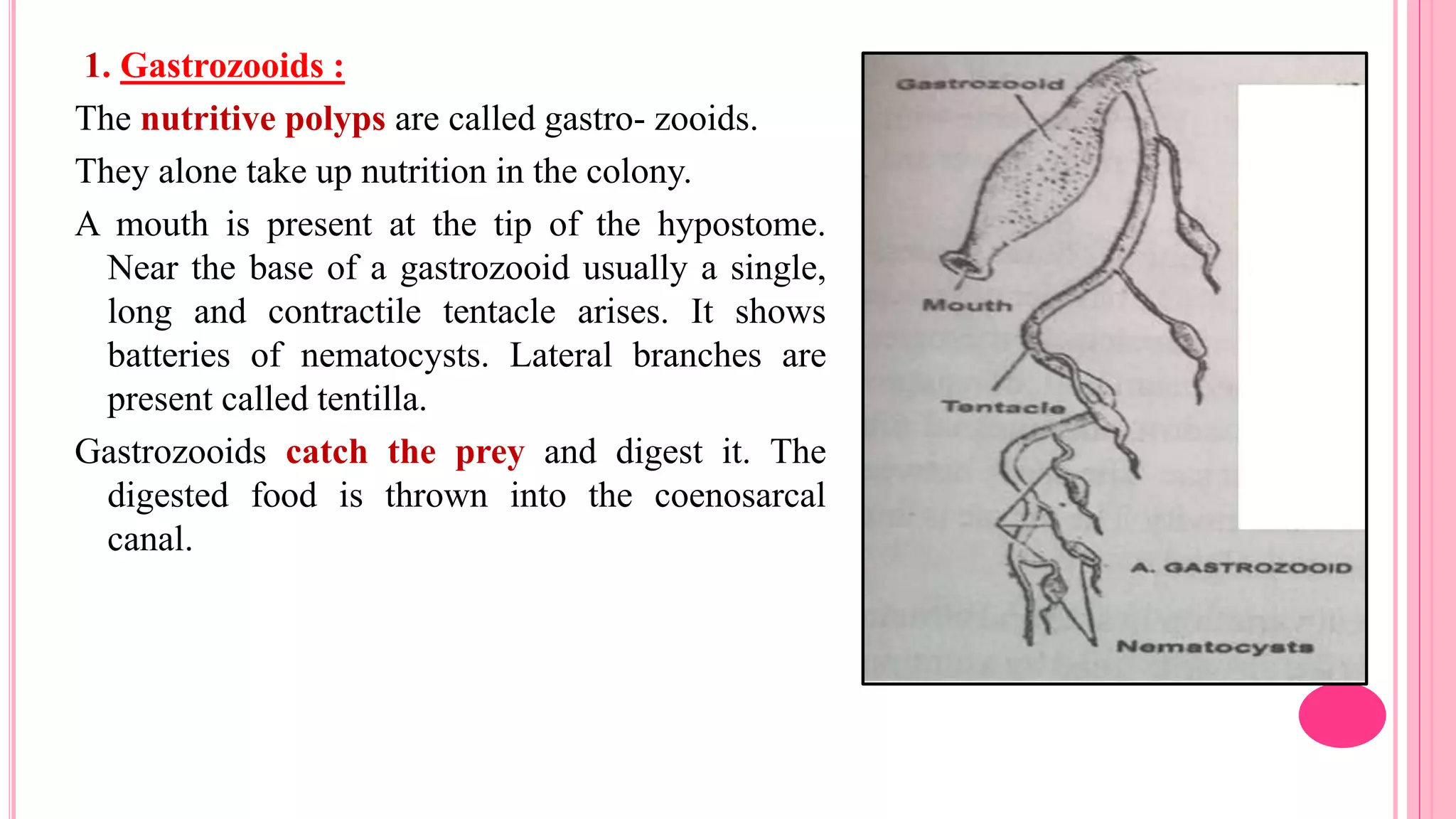
1. Gastrozooids :
The nutritive polyps are called gastro- zooids.
They alone take up nutrition in the colony.
A mouth is present at the tip of the hypostome.
Near the base of a gastrozooid usually a single,
long and contractile tentacle arises. It shows
batteries of nematocysts. Lateral branches are
present called tentilla.
Gastrozooids catch the prey and digest it. The
digested food is thrown into the coenosarcal
canal.
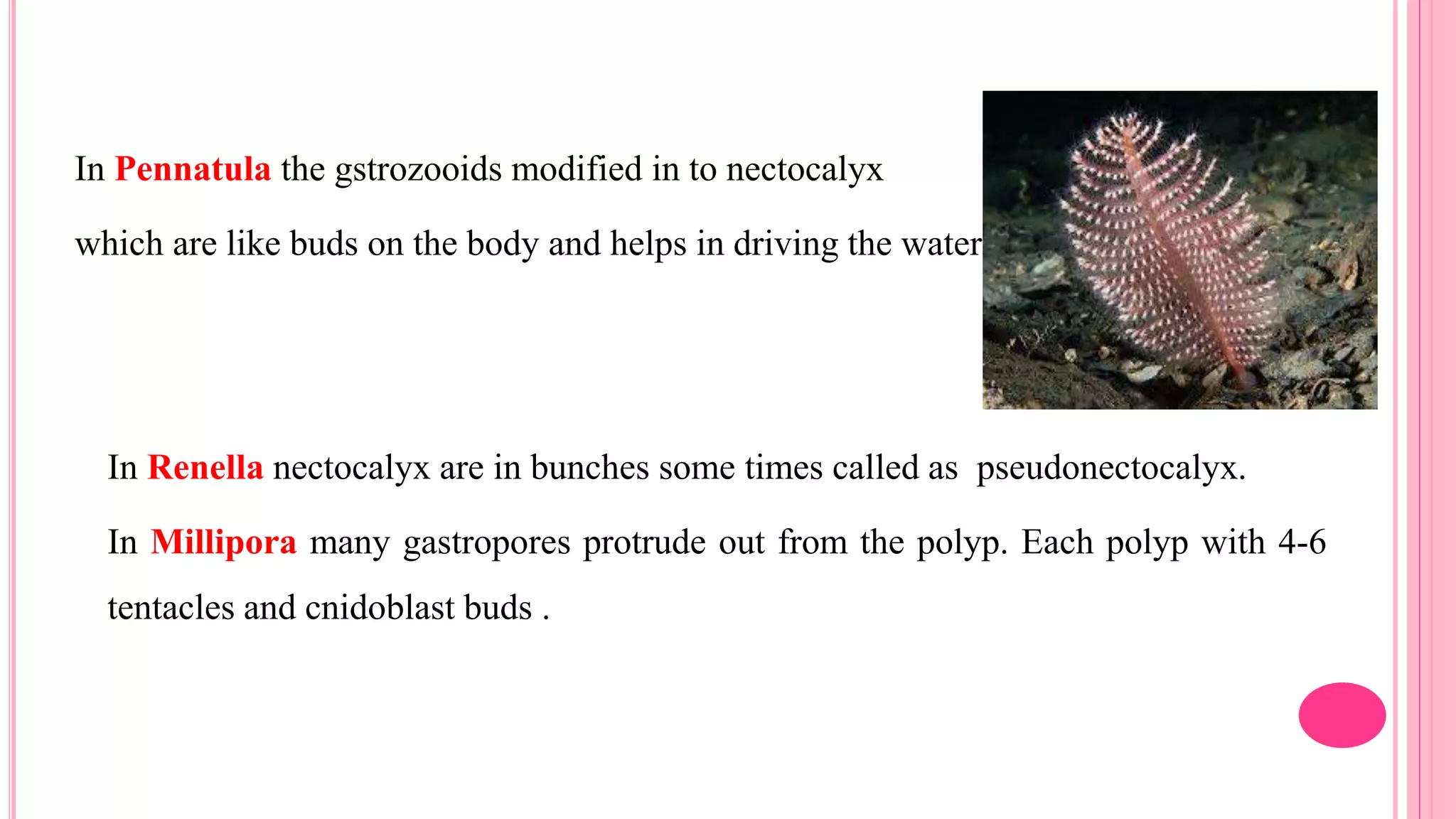
In Pennatula the gstrozooids modified in to nectocalyx
which are like buds on the body and helps in driving the water.
In Renella nectocalyx are in bunches some times called as pseudonectocalyx.
In Millipora many gastropores protrude out from the polyp. Each polyp with 4-6
tentacles and cnidoblast buds .
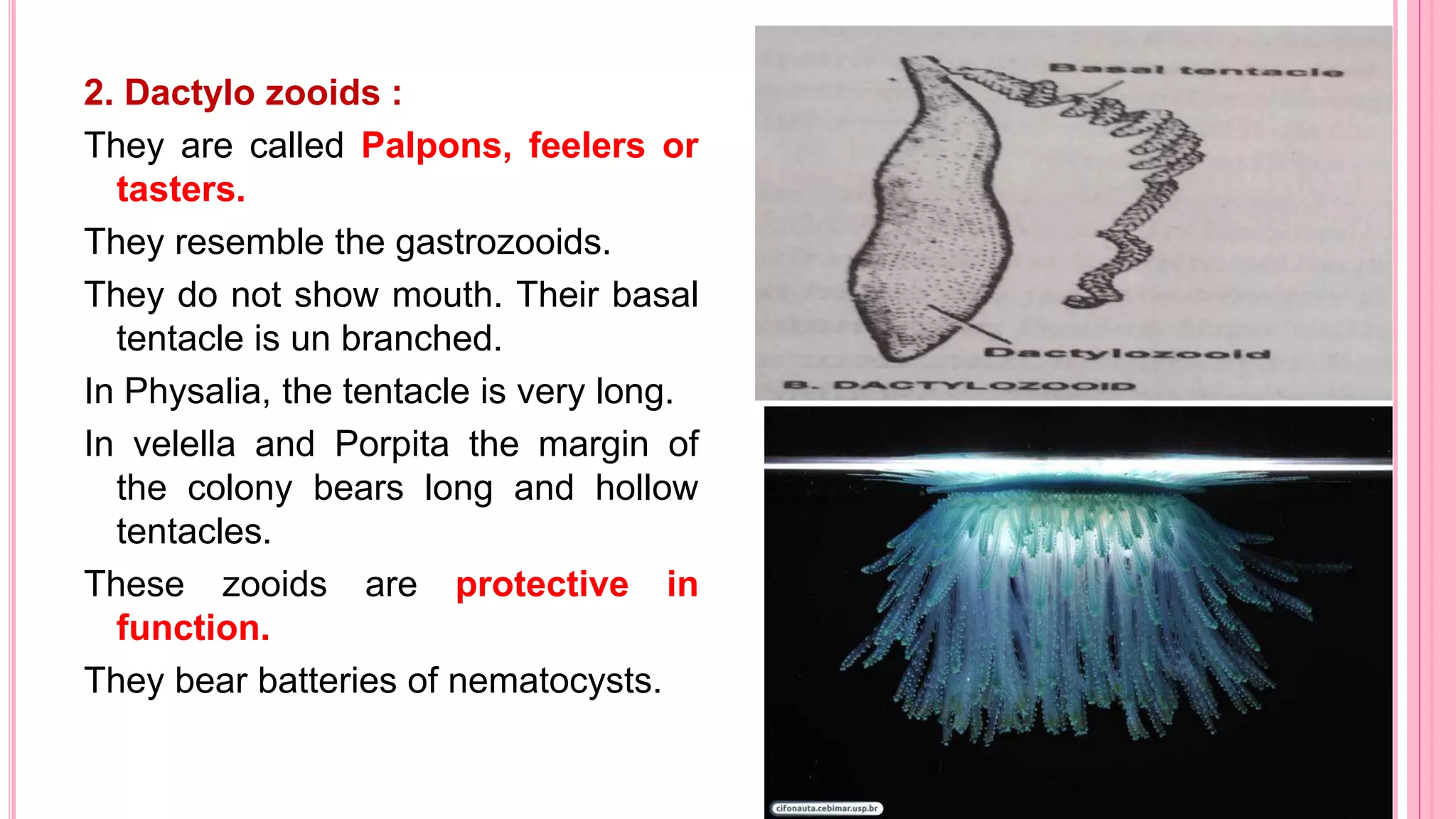
2. Dactylo zooids :
They are called Palpons, feelers or
tasters.
They resemble the gastrozooids.
They do not show mouth. Their basal
tentacle is un branched.
In Physalia, the tentacle is very long.
In velella and Porpita the margin of
the colony bears long and hollow
tentacles.
These zooids are protective in
function.
They bear batteries of nematocysts.
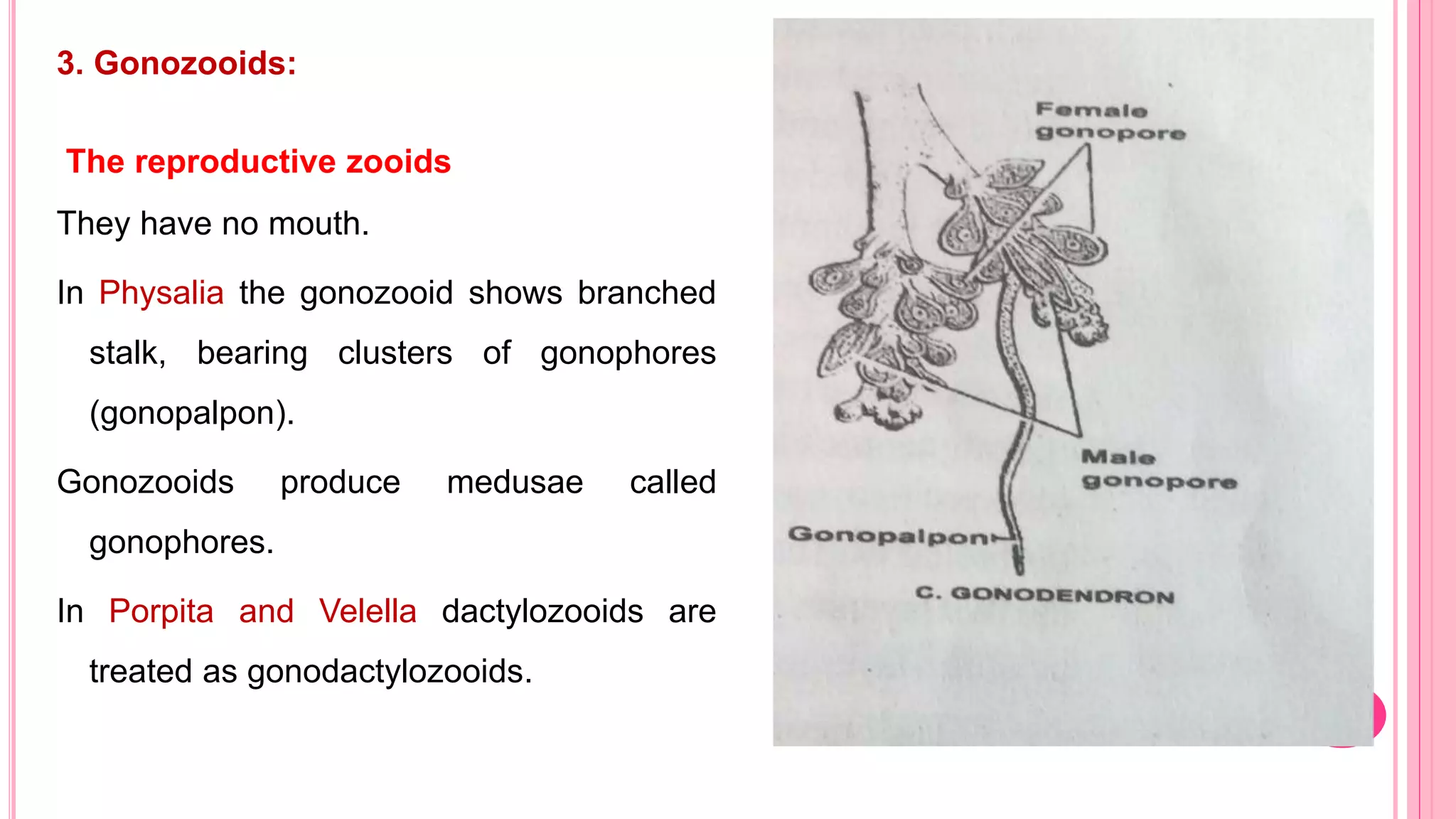
3. Gonozooids:
The reproductive zooids
They have no mouth.
In Physalia the gonozooid shows branched
stalk, bearing clusters of gonophores
(gonopalpon).
Gonozooids produce medusae called
gonophores.
In Porpita and Velella dactylozooids are
treated as gonodactylozooids.
MEDUSOID FORMS :
 Pneumatophores :
 Nectopore or Nectocalyx or swimming zooid:
 Bracts :
 Gonophores :
MEDUSOID FORMS :
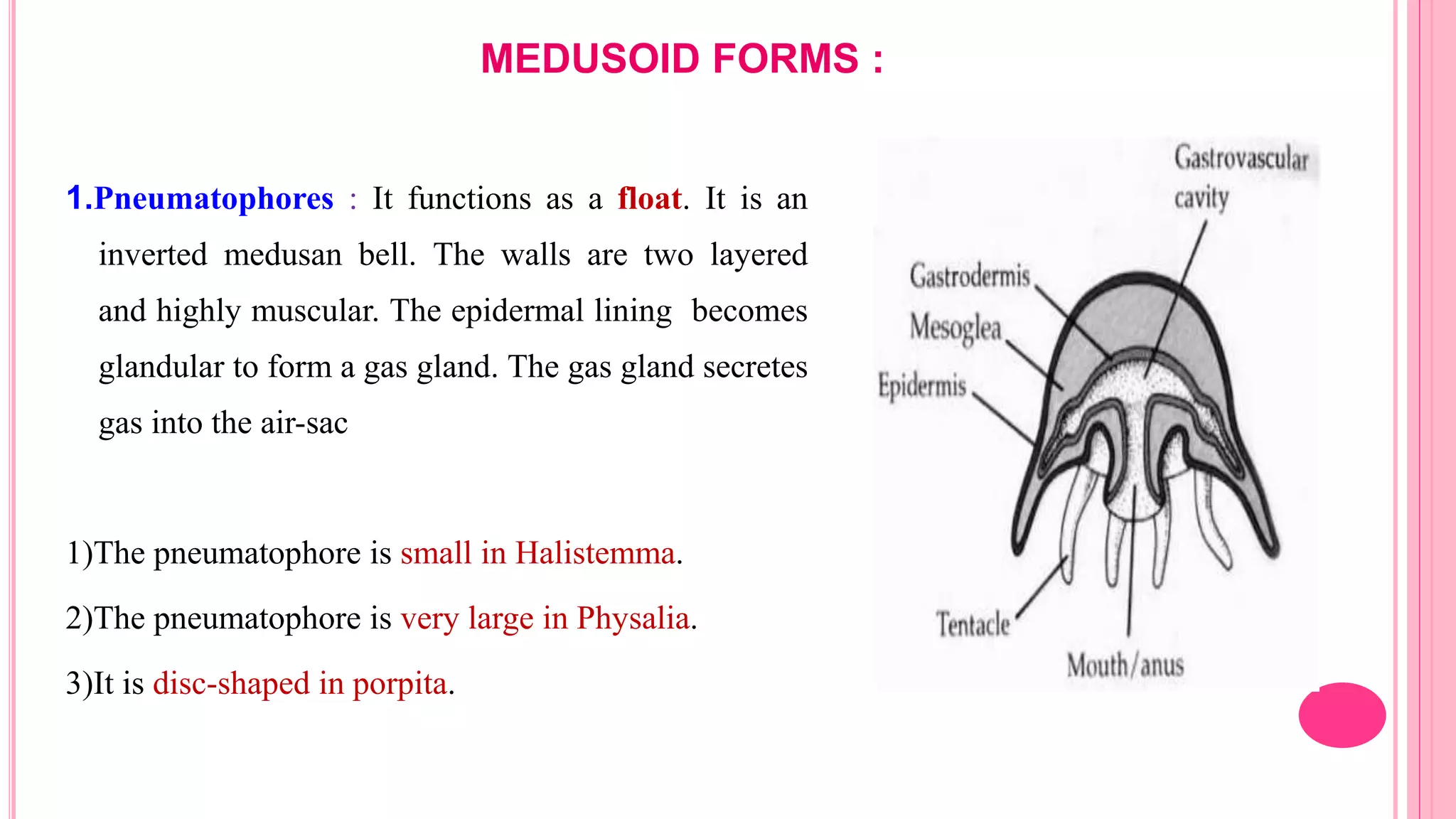
1.Pneumatophores : It functions as a float. It is an
inverted medusan bell. The walls are two layered
and highly muscular. The epidermal lining becomes
glandular to form a gas gland. The gas gland secretes
gas into the air-sac
1)The pneumatophore is small in Halistemma.
2)The pneumatophore is very large in Physalia.
3)It is disc-shaped in porpita.
Fig: Nectocalyx
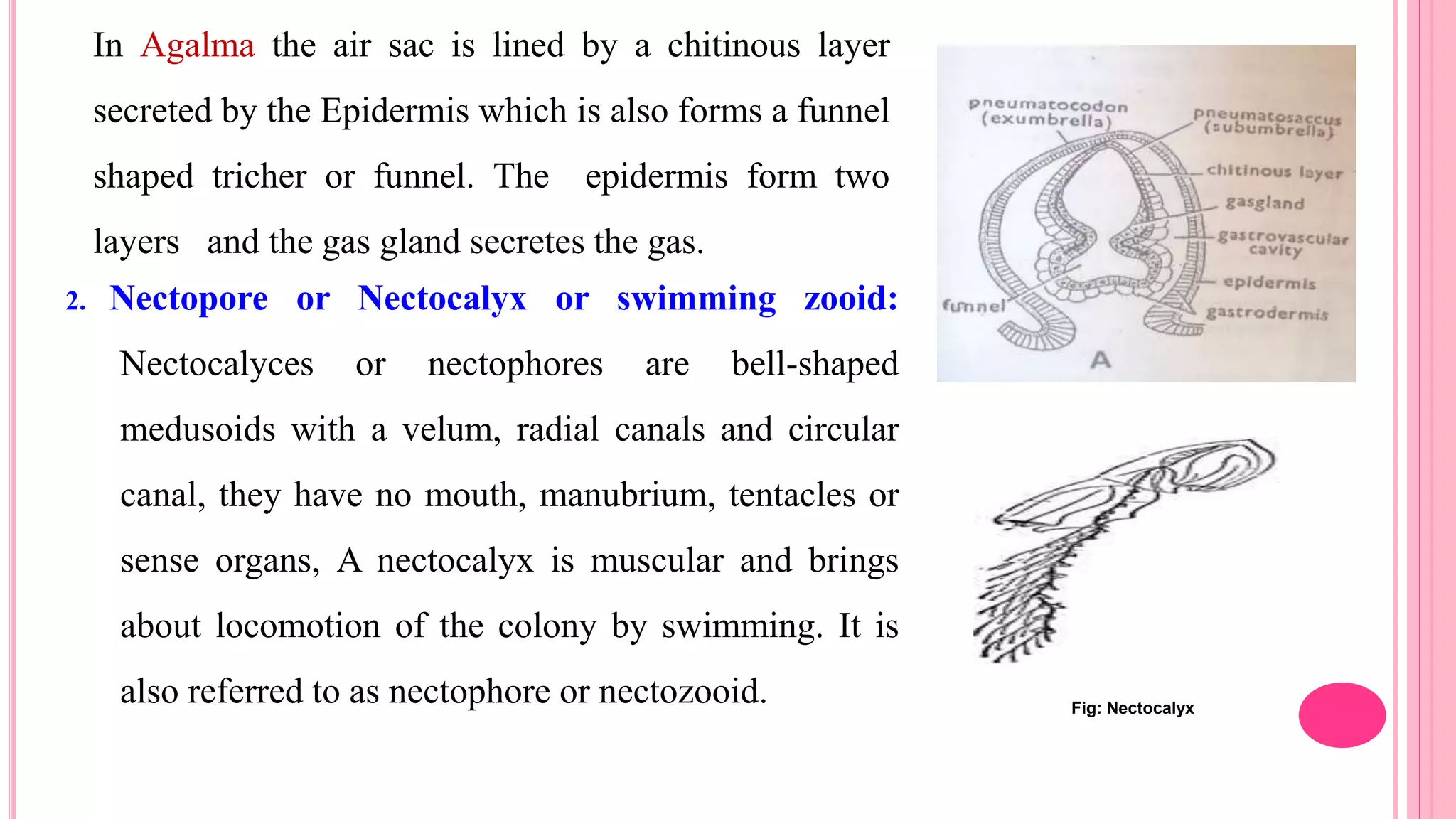
In Agalma the air sac is lined by a chitinous layer
secreted by the Epidermis which is also forms a funnel
shaped tricher or funnel. The epidermis form two
layers and the gas gland secretes the gas.
2. Nectopore or Nectocalyx or swimming zooid:
Nectocalyces or nectophores are bell-shaped
medusoids with a velum, radial canals and circular
canal, they have no mouth, manubrium, tentacles or
sense organs, A nectocalyx is muscular and brings
about locomotion of the colony by swimming. It is
also referred to as nectophore or nectozooid.
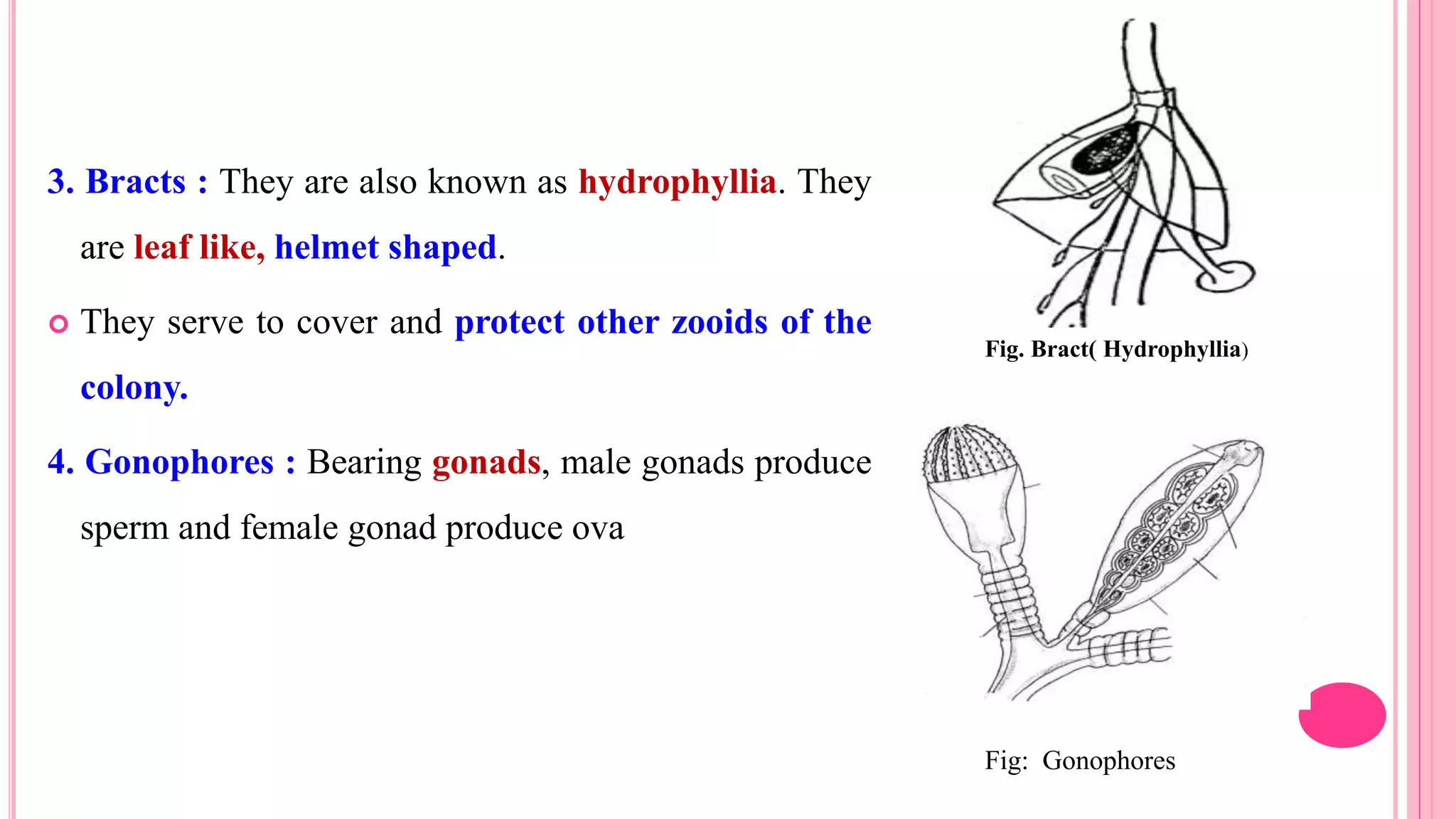
3. Bracts : They are also known as hydrophyllia. They
are leaf like, helmet shaped.
 They serve to cover and protect other zooids of the
colony.
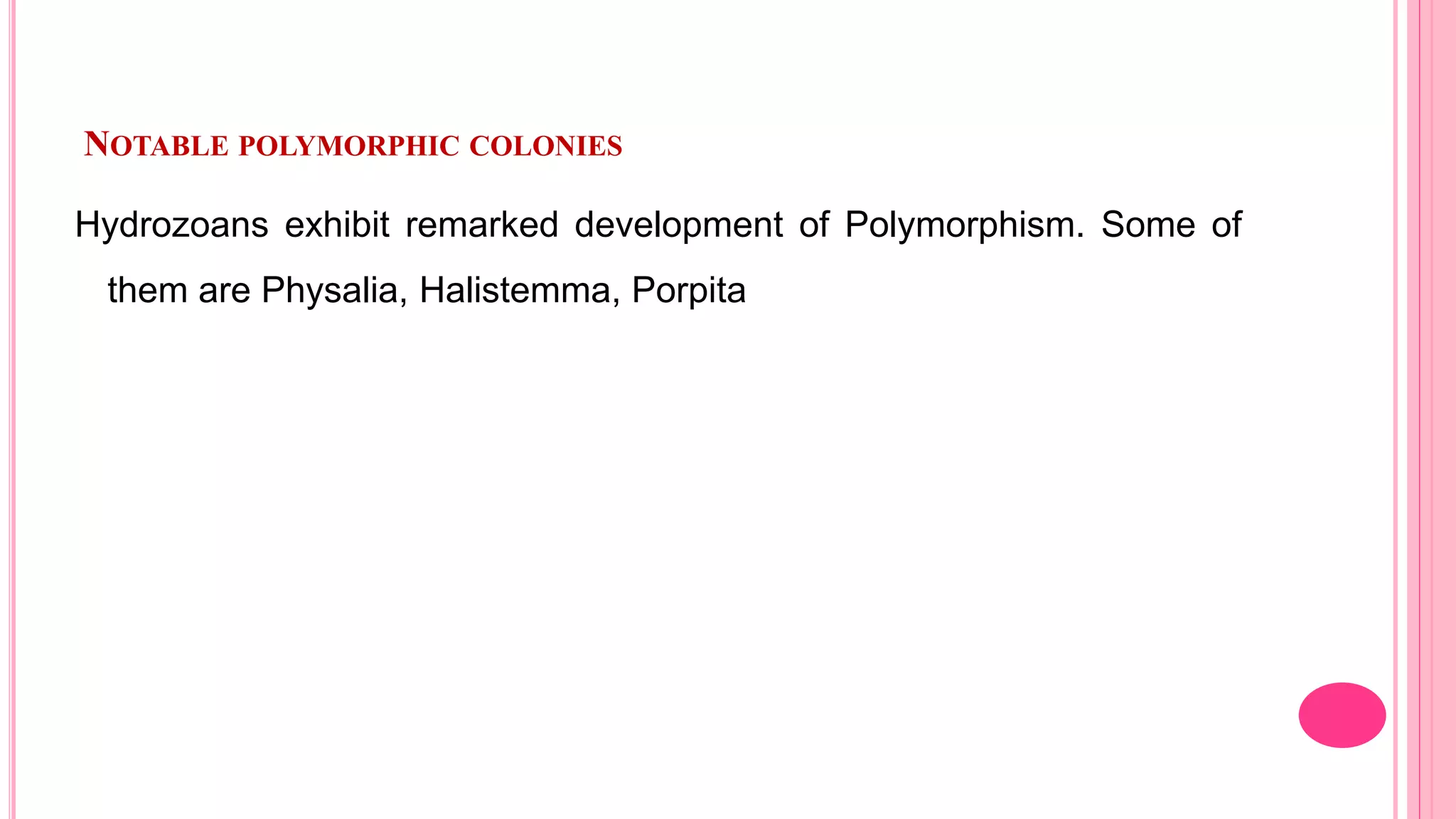
4. Gonophores : Bearing gonads, male gonads produce
sperm and female gonad produce ova
Fig: Gonophores
Fig. Bract( Hydrophyllia)
Hydrozoans exhibit remarked development of Polymorphism. Some of
them are Physalia, Halistemma, Porpita
NOTABLE POLYMORPHIC COLONIES
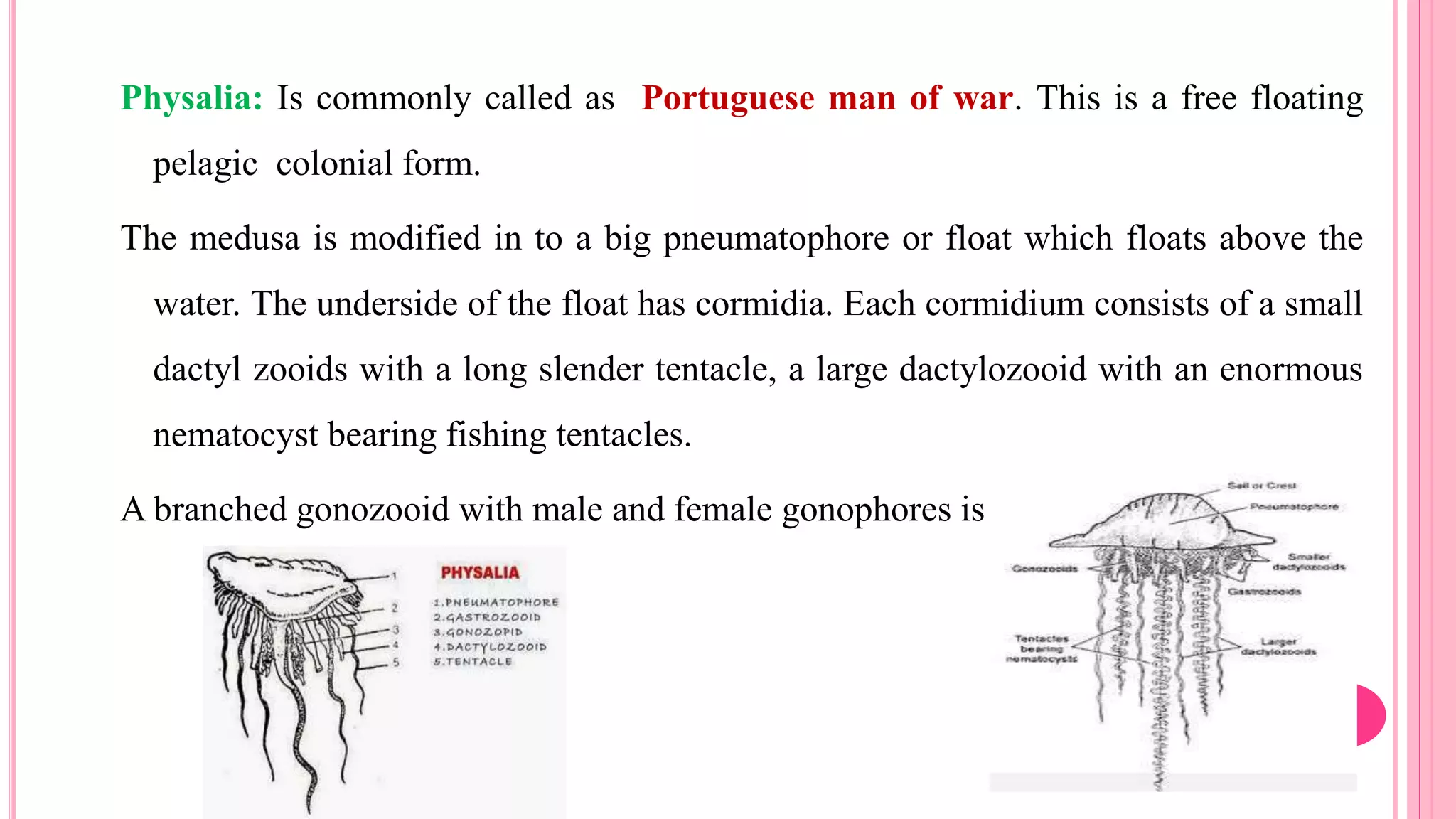
Physalia: Is commonly called as Portuguese man of war. This is a free floating
pelagic colonial form.
The medusa is modified in to a big pneumatophore or float which floats above the
water. The underside of the float has cormidia. Each cormidium consists of a small
dactyl zooids with a long slender tentacle, a large dactylozooid with an enormous
nematocyst bearing fishing tentacles.
A branched gonozooid with male and female gonophores is present.
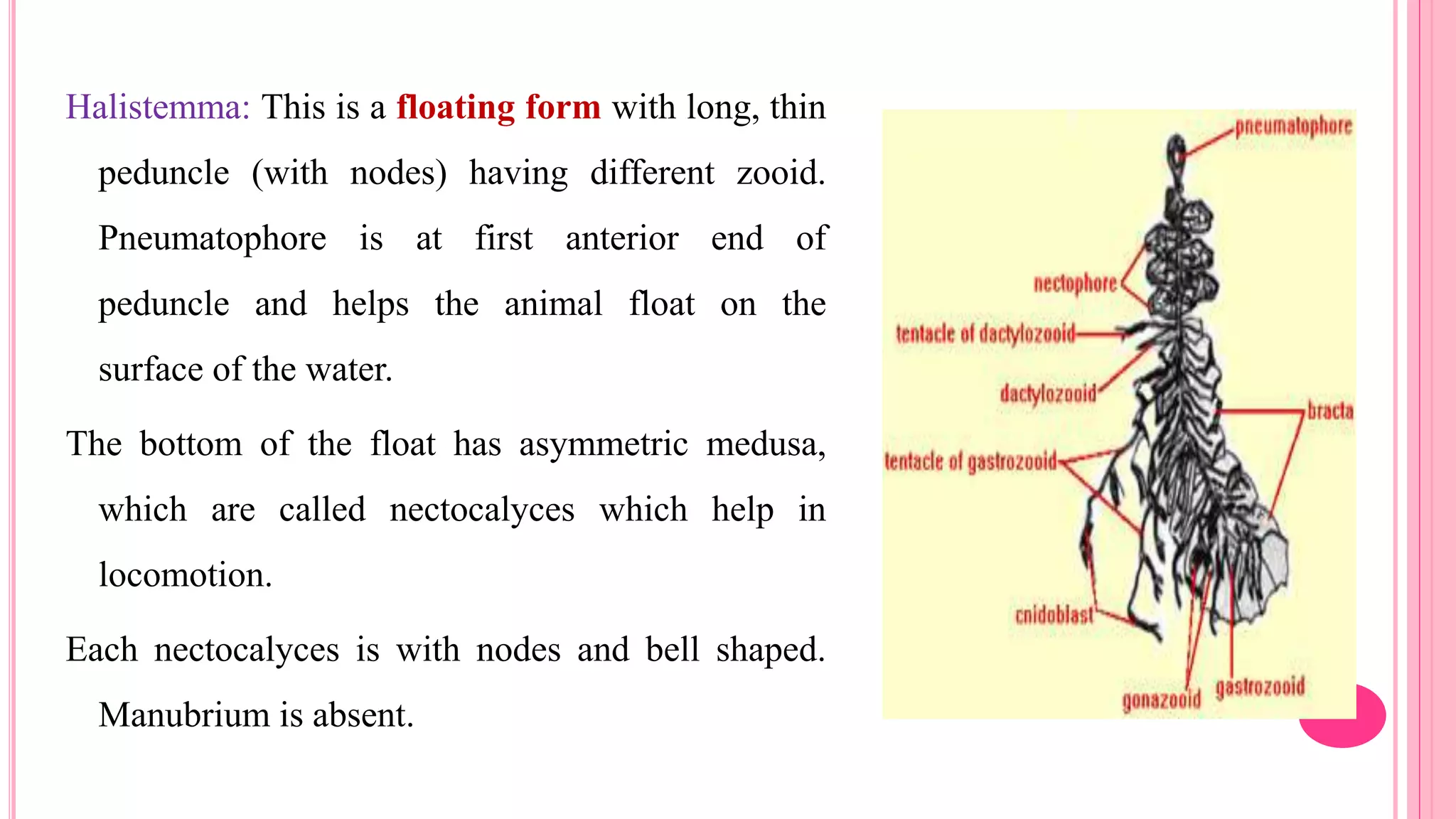
Halistemma: This is a floating form with long, thin
peduncle (with nodes) having different zooid.
Pneumatophore is at first anterior end of
peduncle and helps the animal float on the
surface of the water.
The bottom of the float has asymmetric medusa,
which are called nectocalyces which help in
locomotion.
Each nectocalyces is with nodes and bell shaped.
Manubrium is absent.
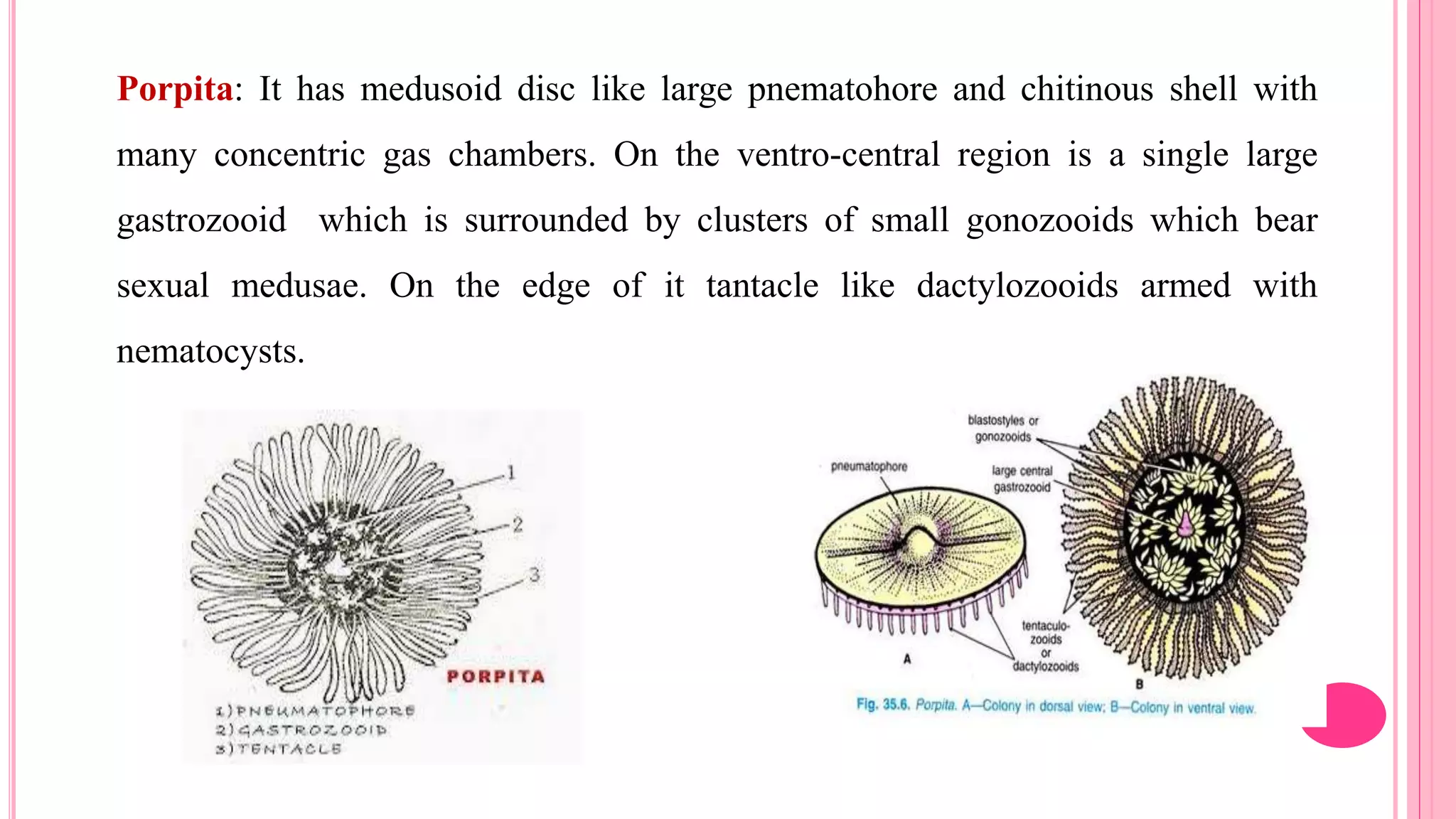
Porpita: It has medusoid disc like large pnematohore and chitinous shell with
many concentric gas chambers. On the ventro-central region is a single large
gastrozooid which is surrounded by clusters of small gonozooids which bear
sexual medusae. On the edge of it tantacle like dactylozooids armed with
nematocysts.
ORIGIN OF POLYMORPHISM
There are many theories to explain the origin of polymorphism in
coelenterates.
Poly-organ theory: This theory was proposed by Huxley (1859), Eschscholtz
(1829), E. Metschnikoff (1874) and Muller (1871).
According to this theory, a polymorphic colony is supposed to be a single
medusoid zooid; its various components are regarded to be the modified organs
of this medusoid zooid. The various parts of the zooid, i.e., manubrium,
tentacles, umbrella, etc., multiply independently from one another and they have
assumed different forms to perform different functions.
Poly-person theory: This theory was first proposed by Leuckart (1851), Vogt
(1848), Gegenbaur (1854), Kolliker (1853), Claus (1863) and later strongly
supported by E. Haeckel (1888), Balfour (1885) and Sedgewick (1888).
According to this theory colony is not a single individual but various parts of the
colony are modified individuals which have changed their structure due to
division of labor.
They have all modified from the primitive zooid which was a polyp.
Medusa theory:
This theory was proposed by Haeckel (1888) as a compromise between the
above theories. The theory says that the siphonophores formed from gastrula was
a medusoid individual, from which zooids or persons appeared by budding from
the subumbrella.
SIGNIFICANCE OF POLYMORPHISM
 The phenomenon of polymorphism is essentially one of division of labour in
which specific functions are assigned to different individuals.
 Different types of Modifications.
 Polyps are modified for feeding, protection and asexual reproduction,
while medusa are concerned with sexual reproduction.
 This distribution of functions among diversified individuals and their
subsequent modifications in coelenterates may have resulted from their initial
simple organization and lack of organ specialization.
 Polymorphism gave the colonies competitive edge in protection and food
gathering and eventual survival. polymorphism: colonies of some species
have morphologically differing individuals each specialized for certain roles
e.g. feeding, reproduction & defense etc.
SUMMARY
 Polymorphism denotes division of labor among the zooids of the individual.
 Patterns of Polymorphism
 Degree of polymorphism varies greatly in different groups of hydrozoa.
 Hydrozoans exhibit remarked development of Polymorphism. Some of them
are Physalia, Halistemma, Porpita
POLYMORPHISM   (EM).pptx

POLYMORPHISM (EM).pptx

  • 1.
    Dr. Y. SAVITHRIM.Sc.,Ph.D Govt. College for Men (A), Kadapa Email. Id : drysavithri@gmail.com ZOOLOGY
  • 2.
    LEARNING OUTCOMES  DEFINITION TYPES OF INDIVIDUALS  PATTERNS OF POLYMORPHISM  TYPES ZOOIDS  NOTABLE POLYMORPHIC COLONIES  ORIGIN OF POLYMORPHISM  SIGNIFICANCE OF POLYMORPHISM
  • 3.
    (GR: POLYS =MANY, MORPHE = FORM)  Occurrence in the same species of more than one type of individual, which differ in form and function is known as Polymorphism. Polymorphism denotes division of labor among the zooids of the individual.  Polymorphism is one of the characteristics feature of Coelenterate animals.  In coelenterata or in hydrozoa which may be single or colonial, here occur two main types of individuals or zooids-Polyp and medusae.
  • 4.
     Polymorphism (Gr.,poly = many; morphe = form) is the occurrence of several different types of individuals or zooids in a single species during its life cycle or as members of the colony, the members perform different functions so that there is a division of labour amongst the members.  Coelenterata are noted for their polymorphism, but the various types are reducible to either a polypoid or medusoid type. The polyp and medusa occur in a number of morphological variations. However, polymorphism may be defined as the representation of a single organism by more than one kind of individuals or zooids which differ in their form and function.
  • 6.
     Polyp: Apolyp has a tubular body with a mouth surrounded by tentacles at one end. Other end is blind and usually attached by a pedal disc to the substratum.  Medusa: A medusae has a bowl or umbrella shaped body with marginal tentacles and centrally located mouth or manubrium.
  • 7.
    PATTERNS OF POLYMORPHISM: Degreeof polymorphism varies greatly in different groups of hydrozoa. 1. Dimorphic: Simplest and commonest pattern of polymorphsm is exhibited by many hydrozoan colonies like Obelia, Tubularia etc., They have two types of individuals or zooid namely: Gastrozooids or hydranths are connected for feeding Gonazooids or blastostyles with asexual budding forming sexual medusae or gonophores. This phenomenon is termed as dimorphism.
  • 8.
    2. Trimorphic: Besidesgastrozooids and gonozooids they also possess a third type individuals the dactylozooids. 3. Polymorphic: Animals having more than three types of individuals are called polymorphic. some what greater degree of polymorphism is found in the encrusting colony of Hydractinia with five types of polyps each performing a specialized function. 1. Gastrozooids - feeding 2. Dactylozooids - protection. 3. Tentaculozooids - Sensory cells 4. Skeletozooids - Spiny projections of chitin 5. Gonozooids - Reproductive individuals.
  • 9.
    POLYPOID ZOOIDS ARE: 1. Gastro zooids 2. Dactylo zooids 3. Gono zooids
  • 10.
    1. Gastrozooids : Thenutritive polyps are called gastro- zooids. They alone take up nutrition in the colony. A mouth is present at the tip of the hypostome. Near the base of a gastrozooid usually a single, long and contractile tentacle arises. It shows batteries of nematocysts. Lateral branches are present called tentilla. Gastrozooids catch the prey and digest it. The digested food is thrown into the coenosarcal canal.
  • 11.
    In Pennatula thegstrozooids modified in to nectocalyx which are like buds on the body and helps in driving the water. In Renella nectocalyx are in bunches some times called as pseudonectocalyx. In Millipora many gastropores protrude out from the polyp. Each polyp with 4-6 tentacles and cnidoblast buds .
  • 12.
    2. Dactylo zooids: They are called Palpons, feelers or tasters. They resemble the gastrozooids. They do not show mouth. Their basal tentacle is un branched. In Physalia, the tentacle is very long. In velella and Porpita the margin of the colony bears long and hollow tentacles. These zooids are protective in function. They bear batteries of nematocysts.
  • 13.
    3. Gonozooids: The reproductivezooids They have no mouth. In Physalia the gonozooid shows branched stalk, bearing clusters of gonophores (gonopalpon). Gonozooids produce medusae called gonophores. In Porpita and Velella dactylozooids are treated as gonodactylozooids.
  • 14.
    MEDUSOID FORMS : Pneumatophores :  Nectopore or Nectocalyx or swimming zooid:  Bracts :  Gonophores :
  • 15.
    MEDUSOID FORMS : 1.Pneumatophores: It functions as a float. It is an inverted medusan bell. The walls are two layered and highly muscular. The epidermal lining becomes glandular to form a gas gland. The gas gland secretes gas into the air-sac 1)The pneumatophore is small in Halistemma. 2)The pneumatophore is very large in Physalia. 3)It is disc-shaped in porpita.
  • 16.
    Fig: Nectocalyx In Agalmathe air sac is lined by a chitinous layer secreted by the Epidermis which is also forms a funnel shaped tricher or funnel. The epidermis form two layers and the gas gland secretes the gas. 2. Nectopore or Nectocalyx or swimming zooid: Nectocalyces or nectophores are bell-shaped medusoids with a velum, radial canals and circular canal, they have no mouth, manubrium, tentacles or sense organs, A nectocalyx is muscular and brings about locomotion of the colony by swimming. It is also referred to as nectophore or nectozooid.
  • 17.
    3. Bracts :They are also known as hydrophyllia. They are leaf like, helmet shaped.  They serve to cover and protect other zooids of the colony. 4. Gonophores : Bearing gonads, male gonads produce sperm and female gonad produce ova Fig: Gonophores Fig. Bract( Hydrophyllia)
  • 18.
    Hydrozoans exhibit remarkeddevelopment of Polymorphism. Some of them are Physalia, Halistemma, Porpita NOTABLE POLYMORPHIC COLONIES
  • 19.
    Physalia: Is commonlycalled as Portuguese man of war. This is a free floating pelagic colonial form. The medusa is modified in to a big pneumatophore or float which floats above the water. The underside of the float has cormidia. Each cormidium consists of a small dactyl zooids with a long slender tentacle, a large dactylozooid with an enormous nematocyst bearing fishing tentacles. A branched gonozooid with male and female gonophores is present.
  • 20.
    Halistemma: This isa floating form with long, thin peduncle (with nodes) having different zooid. Pneumatophore is at first anterior end of peduncle and helps the animal float on the surface of the water. The bottom of the float has asymmetric medusa, which are called nectocalyces which help in locomotion. Each nectocalyces is with nodes and bell shaped. Manubrium is absent.
  • 21.
    Porpita: It hasmedusoid disc like large pnematohore and chitinous shell with many concentric gas chambers. On the ventro-central region is a single large gastrozooid which is surrounded by clusters of small gonozooids which bear sexual medusae. On the edge of it tantacle like dactylozooids armed with nematocysts.
  • 22.
    ORIGIN OF POLYMORPHISM Thereare many theories to explain the origin of polymorphism in coelenterates. Poly-organ theory: This theory was proposed by Huxley (1859), Eschscholtz (1829), E. Metschnikoff (1874) and Muller (1871). According to this theory, a polymorphic colony is supposed to be a single medusoid zooid; its various components are regarded to be the modified organs of this medusoid zooid. The various parts of the zooid, i.e., manubrium, tentacles, umbrella, etc., multiply independently from one another and they have assumed different forms to perform different functions.
  • 23.
    Poly-person theory: Thistheory was first proposed by Leuckart (1851), Vogt (1848), Gegenbaur (1854), Kolliker (1853), Claus (1863) and later strongly supported by E. Haeckel (1888), Balfour (1885) and Sedgewick (1888). According to this theory colony is not a single individual but various parts of the colony are modified individuals which have changed their structure due to division of labor. They have all modified from the primitive zooid which was a polyp.
  • 24.
    Medusa theory: This theorywas proposed by Haeckel (1888) as a compromise between the above theories. The theory says that the siphonophores formed from gastrula was a medusoid individual, from which zooids or persons appeared by budding from the subumbrella.
  • 25.
    SIGNIFICANCE OF POLYMORPHISM The phenomenon of polymorphism is essentially one of division of labour in which specific functions are assigned to different individuals.  Different types of Modifications.  Polyps are modified for feeding, protection and asexual reproduction, while medusa are concerned with sexual reproduction.  This distribution of functions among diversified individuals and their subsequent modifications in coelenterates may have resulted from their initial simple organization and lack of organ specialization.
  • 26.
     Polymorphism gavethe colonies competitive edge in protection and food gathering and eventual survival. polymorphism: colonies of some species have morphologically differing individuals each specialized for certain roles e.g. feeding, reproduction & defense etc.
  • 27.
    SUMMARY  Polymorphism denotesdivision of labor among the zooids of the individual.  Patterns of Polymorphism  Degree of polymorphism varies greatly in different groups of hydrozoa.  Hydrozoans exhibit remarked development of Polymorphism. Some of them are Physalia, Halistemma, Porpita

Editor's Notes

  • #24 Poly-person theory: This theory was first proposed by Leuckart (1851), Vogt (1848), Gegenbaur (1854), Kolliker (1853), Claus (1863) and later strongly supported by E. Haeckel (1888), Balfour (1885) and Sedgewick (1888). According to this theory colony is not a single individual but various parts of the colony are modified individuals which have changed their structure due to division of labour. They have all modified from the primitive zooid which was a polyp.