1) Omkar Rane - Roll No: 422
2) Vishal Tiwari - Roll No: 424
3) Ishwar Parade -Roll No: 420
4) Sumedh Shinde - Roll No: 421
5) Pranav Bhaskar -Roll No : 423
Definition of electroluminescent polymer.
Construction and working.
Structure of Poly(Paraphenlylenevinylene) PPV.
Poly(Paraphenlylenevinylene) PPV Preparations.
Applications of poly (Paraphenlylenevinylene).
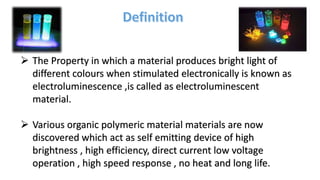
 The Property in which a material produces bright light of
different colours when stimulated electronically is known as
electroluminescence ,is called as electroluminescent
material.
 Various organic polymeric material materials are now
discovered which act as self emitting device of high
brightness , high efficiency, direct current low voltage
operation , high speed response , no heat and long life.
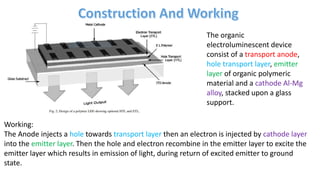
The organic
electroluminescent device
consist of a transport anode,
hole transport layer, emitter
layer of organic polymeric
material and a cathode Al-Mg
alloy, stacked upon a glass
support.
Working:
The Anode injects a hole towards transport layer then an electron is injected by cathode layer
into the emitter layer. Then the hole and electron recombine in the emitter layer to excite the
emitter layer which results in emission of light, during return of excited emitter to ground
state.
 Poly(p-phenylene vinylene) (PPV, or polyphenylene vinylene) is
a conducting polymer of the rigid-rod polymer family.
 PPV is the only polymer of this type that can be processed into a
highly ordered crystalline thin film.
 PPV and its derivatives are electrically conducting upon doping.
Although insoluble in water, its precursors can be manipulated in
aqueous solution.
 small optical band gap and its bright yellow fluorescence makes PPV
a candidate in applications such as light-emitting diodes (LED) and
photovoltaic devices.
 Moreover, PPV can be doped to form electrically conductive
materials. Its physical and electronic properties can be altered by the
inclusion of functional side groups.
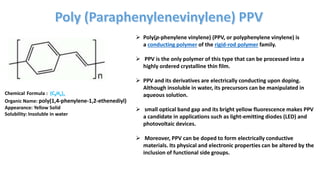
Chemical Formula : (C8H6)n
Organic Name: poly(1,4-phenylene-1,2-ethenediyl)
Appearance: Yellow Solid
Solubility: Insoluble in water
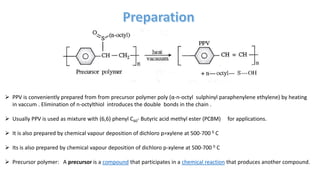
 PPV is conveniently prepared from from precursor polymer poly (α-n-octyl sulphinyl paraphenylene ethylene) by heating
in vaccum . Elimination of n-octylthiol introduces the double bonds in the chain .
 Usually PPV is used as mixture with (6,6) phenyl C60- Butyric acid methyl ester (PCBM) for applications.
 It is also prepared by chemical vapour deposition of dichloro p=xylene at 500-700 0 C
 Its is also prepared by chemical vapour deposition of dichloro p-xylene at 500-700 0 C
 Precursor polymer: A precursor is a compound that participates in a chemical reaction that produces another compound.
1) In the form of thin films for information displays
2) Automotive instrument panel background
3) Backlight for liquid crystal displays
4) Electroluminescence night lamp
5) Long life , full colour displays
6) flat panel displays
7) Photovoltaic cells
8) Theatre , assembly hall decoration
9) Arrow light decoration
10) Light stripes for decorating building and vehicle safety presentation.
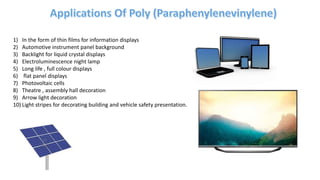
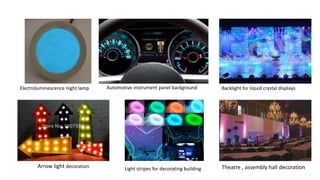
Electroluminescence night lamp Automotive instrument panel background Backlight for liquid crystal displays
Arrow light decoration Light stripes for decorating building Theatre , assembly hall decoration

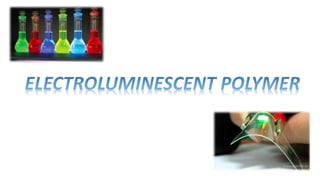
Electroluminesccent polymer

  • 2.
    1) Omkar Rane- Roll No: 422 2) Vishal Tiwari - Roll No: 424 3) Ishwar Parade -Roll No: 420 4) Sumedh Shinde - Roll No: 421 5) Pranav Bhaskar -Roll No : 423
  • 3.
    Definition of electroluminescentpolymer. Construction and working. Structure of Poly(Paraphenlylenevinylene) PPV. Poly(Paraphenlylenevinylene) PPV Preparations. Applications of poly (Paraphenlylenevinylene).
  • 4.
     The Propertyin which a material produces bright light of different colours when stimulated electronically is known as electroluminescence ,is called as electroluminescent material.  Various organic polymeric material materials are now discovered which act as self emitting device of high brightness , high efficiency, direct current low voltage operation , high speed response , no heat and long life.
  • 5.
    The organic electroluminescent device consistof a transport anode, hole transport layer, emitter layer of organic polymeric material and a cathode Al-Mg alloy, stacked upon a glass support. Working: The Anode injects a hole towards transport layer then an electron is injected by cathode layer into the emitter layer. Then the hole and electron recombine in the emitter layer to excite the emitter layer which results in emission of light, during return of excited emitter to ground state.
  • 6.
     Poly(p-phenylene vinylene)(PPV, or polyphenylene vinylene) is a conducting polymer of the rigid-rod polymer family.  PPV is the only polymer of this type that can be processed into a highly ordered crystalline thin film.  PPV and its derivatives are electrically conducting upon doping. Although insoluble in water, its precursors can be manipulated in aqueous solution.  small optical band gap and its bright yellow fluorescence makes PPV a candidate in applications such as light-emitting diodes (LED) and photovoltaic devices.  Moreover, PPV can be doped to form electrically conductive materials. Its physical and electronic properties can be altered by the inclusion of functional side groups. Chemical Formula : (C8H6)n Organic Name: poly(1,4-phenylene-1,2-ethenediyl) Appearance: Yellow Solid Solubility: Insoluble in water
  • 7.
     PPV isconveniently prepared from from precursor polymer poly (α-n-octyl sulphinyl paraphenylene ethylene) by heating in vaccum . Elimination of n-octylthiol introduces the double bonds in the chain .  Usually PPV is used as mixture with (6,6) phenyl C60- Butyric acid methyl ester (PCBM) for applications.  It is also prepared by chemical vapour deposition of dichloro p=xylene at 500-700 0 C  Its is also prepared by chemical vapour deposition of dichloro p-xylene at 500-700 0 C  Precursor polymer: A precursor is a compound that participates in a chemical reaction that produces another compound.
  • 8.
    1) In theform of thin films for information displays 2) Automotive instrument panel background 3) Backlight for liquid crystal displays 4) Electroluminescence night lamp 5) Long life , full colour displays 6) flat panel displays 7) Photovoltaic cells 8) Theatre , assembly hall decoration 9) Arrow light decoration 10) Light stripes for decorating building and vehicle safety presentation.
  • 9.
    Electroluminescence night lampAutomotive instrument panel background Backlight for liquid crystal displays Arrow light decoration Light stripes for decorating building Theatre , assembly hall decoration