OLED
(OPTICAL LIGHT EMITTING DIODE)
SUBMITTED BY
SOURABH KANT
HISTORY
The first observations of electroluminescence in organic materials were in
the early 1950s in France.
In 1960s, some scientists at New York university developed ac-driven
electroluminescent cells using doped anthracene
In 1977 they reported high conductivity similarly in oxidized and iodine-
doped polyacetylene
In 1987 Chin Tang and Van Slyke introduced the first light emitting diode
from thin organic layers.
Research into polymer electroluminescence culminated in 1990 in
Cambridge reporting a high efficiency green light-emitting polymer based
device using 100 nm thick films.
WHAT IS AN OLED ??
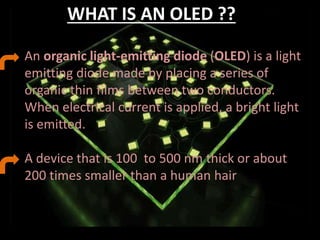
An organic light-emitting diode (OLED) is a light
emitting diode made by placing a series of
organic thin films between two conductors.
When electrical current is applied, a bright light
is emitted.
A device that is 100 to 500 nm thick or about
200 times smaller than a human hair
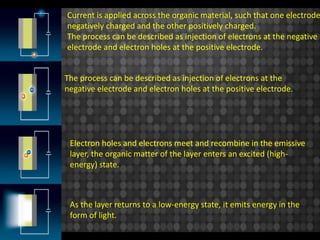
The process can be described as injection of electrons at the
negative electrode and electron holes at the positive electrode.
Current is applied across the organic material, such that one electrode
negatively charged and the other positively charged.
The process can be described as injection of electrons at the negative
electrode and electron holes at the positive electrode.
Electron holes and electrons meet and recombine in the emissive
layer, the organic matter of the layer enters an excited (high-
energy) state.
As the layer returns to a low-energy state, it emits energy in the
form of light.
TYPES OF OLED
Passive-matrix OLED
Active-matrix OLED
Transparent OLED
Top-emitting OLED
Foldable OLED
White OLED
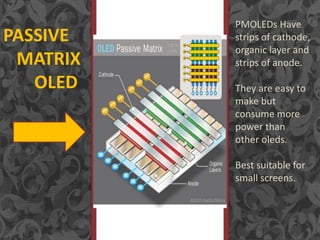
PASSIVE
MATRIX
OLED
PMOLEDs Have
strips of cathode,
organic layer and
strips of anode.
They are easy to
make but
consume more
power than
other oleds.
Best suitable for
small screens.
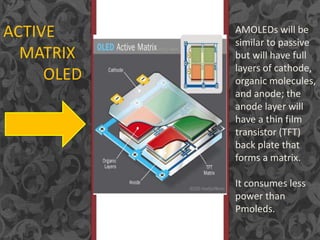
ACTIVE
MATRIX
OLED
AMOLEDs will be
similar to passive
but will have full
layers of cathode,
organic molecules,
and anode; the
anode layer will
have a thin film
transistor (TFT)
back plate that
forms a matrix.
It consumes less
power than
Pmoleds.
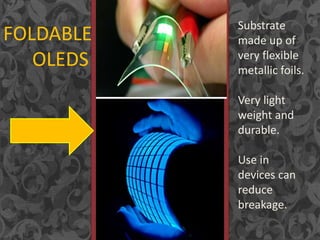
FOLDABLE
OLEDS
Substrate
made up of
very flexible
metallic foils.
Very light
weight and
durable.
Use in
devices can
reduce
breakage.
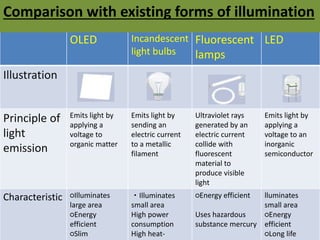
OLED Incandescent
light bulbs
Fluorescent
lamps
LED
Illustration
Principle of
light
emission
Emits light by
applying a
voltage to
organic matter
Emits light by
sending an
electric current
to a metallic
filament
Ultraviolet rays
generated by an
electric current
collide with
fluorescent
material to
produce visible
light
Emits light by
applying a
voltage to an
inorganic
semiconductor
Characteristic ○Illuminates
large area
○Energy
efficient
○Slim
・Illuminates
small area
High power
consumption
High heat-
○Energy efficient
Uses hazardous
substance mercury
lluminates
small area
○Energy
efficient
○Long life
Comparison with existing forms of illumination
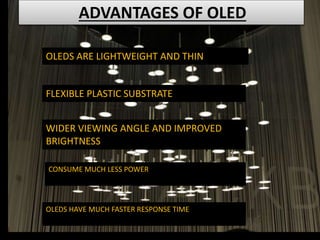
ADVANTAGES OF OLED
OLEDS ARE LIGHTWEIGHT AND THIN
FLEXIBLE PLASTIC SUBSTRATE
WIDER VIEWING ANGLE AND IMPROVED
BRIGHTNESS
CONSUME MUCH LESS POWER
OLEDS HAVE MUCH FASTER RESPONSE TIME
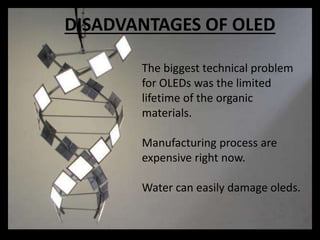
DISADVANTAGES OF OLED
The biggest technical problem
for OLEDs was the limited
lifetime of the organic
materials.
Manufacturing process are
expensive right now.
Water can easily damage oleds.
OLED APPLICATIONS
Universal Display Corporation (UDC) is a
leader in researching, developing and
delivering OLED technologies.
OLED technology is used in commercial
applications such as displays and lightning.
OLEDs have been used in most Motorola
and Samsung color cell phones, as well as
some HTC, LG and Sony Ericsson models. Nokia
has also introduced some OLED products
including the N85 and the N86 8MP, both of
which feature an AMOLED display.
OLED displays were used in watches made by
Fossil (JR-9465) and Diesel (DZ-7086)
Organic Light Emitting Diode televisions are the
newest technology in the TV world. They deliver
the best picture quality available today.
OLED lighting is the future!
Organic light-emitting diodes (OLEDs) are
efficient light sources with new exciting
features.
Since almost 20% of the world’s electrical power
consumption is due to lighting, there is a
tremendous energy saving potential when efficient
OLEDs are used instead of conventional light
sources.
thank
you

Oled

  • 1.
    OLED (OPTICAL LIGHT EMITTINGDIODE) SUBMITTED BY SOURABH KANT
  • 2.
    HISTORY The first observationsof electroluminescence in organic materials were in the early 1950s in France. In 1960s, some scientists at New York university developed ac-driven electroluminescent cells using doped anthracene In 1977 they reported high conductivity similarly in oxidized and iodine- doped polyacetylene In 1987 Chin Tang and Van Slyke introduced the first light emitting diode from thin organic layers. Research into polymer electroluminescence culminated in 1990 in Cambridge reporting a high efficiency green light-emitting polymer based device using 100 nm thick films.
  • 3.
    WHAT IS ANOLED ?? An organic light-emitting diode (OLED) is a light emitting diode made by placing a series of organic thin films between two conductors. When electrical current is applied, a bright light is emitted. A device that is 100 to 500 nm thick or about 200 times smaller than a human hair
  • 4.
    The process canbe described as injection of electrons at the negative electrode and electron holes at the positive electrode. Current is applied across the organic material, such that one electrode negatively charged and the other positively charged. The process can be described as injection of electrons at the negative electrode and electron holes at the positive electrode. Electron holes and electrons meet and recombine in the emissive layer, the organic matter of the layer enters an excited (high- energy) state. As the layer returns to a low-energy state, it emits energy in the form of light.
  • 5.
    TYPES OF OLED Passive-matrixOLED Active-matrix OLED Transparent OLED Top-emitting OLED Foldable OLED White OLED
  • 6.
    PASSIVE MATRIX OLED PMOLEDs Have strips ofcathode, organic layer and strips of anode. They are easy to make but consume more power than other oleds. Best suitable for small screens.
  • 7.
    ACTIVE MATRIX OLED AMOLEDs will be similarto passive but will have full layers of cathode, organic molecules, and anode; the anode layer will have a thin film transistor (TFT) back plate that forms a matrix. It consumes less power than Pmoleds.
  • 8.
    FOLDABLE OLEDS Substrate made up of veryflexible metallic foils. Very light weight and durable. Use in devices can reduce breakage.
  • 9.
    OLED Incandescent light bulbs Fluorescent lamps LED Illustration Principleof light emission Emits light by applying a voltage to organic matter Emits light by sending an electric current to a metallic filament Ultraviolet rays generated by an electric current collide with fluorescent material to produce visible light Emits light by applying a voltage to an inorganic semiconductor Characteristic ○Illuminates large area ○Energy efficient ○Slim ・Illuminates small area High power consumption High heat- ○Energy efficient Uses hazardous substance mercury lluminates small area ○Energy efficient ○Long life Comparison with existing forms of illumination
  • 10.
    ADVANTAGES OF OLED OLEDSARE LIGHTWEIGHT AND THIN FLEXIBLE PLASTIC SUBSTRATE WIDER VIEWING ANGLE AND IMPROVED BRIGHTNESS CONSUME MUCH LESS POWER OLEDS HAVE MUCH FASTER RESPONSE TIME
  • 11.
    DISADVANTAGES OF OLED Thebiggest technical problem for OLEDs was the limited lifetime of the organic materials. Manufacturing process are expensive right now. Water can easily damage oleds.
  • 12.
    OLED APPLICATIONS Universal DisplayCorporation (UDC) is a leader in researching, developing and delivering OLED technologies. OLED technology is used in commercial applications such as displays and lightning. OLEDs have been used in most Motorola and Samsung color cell phones, as well as some HTC, LG and Sony Ericsson models. Nokia has also introduced some OLED products including the N85 and the N86 8MP, both of which feature an AMOLED display.
  • 13.
    OLED displays wereused in watches made by Fossil (JR-9465) and Diesel (DZ-7086) Organic Light Emitting Diode televisions are the newest technology in the TV world. They deliver the best picture quality available today.
  • 14.
    OLED lighting isthe future! Organic light-emitting diodes (OLEDs) are efficient light sources with new exciting features. Since almost 20% of the world’s electrical power consumption is due to lighting, there is a tremendous energy saving potential when efficient OLEDs are used instead of conventional light sources.
  • 15.