This document discusses the principal types of party systems: one-party systems, two-party systems, and multi-party systems. One-party systems are found in authoritarian countries and are characterized by a lack of opposition parties. Two-party systems, like in the US and UK, are dominated by two major parties. Multi-party systems have more than two viable parties and can be unstable, like in India, or stable if power alternates between a small set of parties. The document also compares the advantages and disadvantages of two-party versus multi-party systems.
PRINCIPAL TYPES OFPARTY
SYSTEMS
As political parties represent various opinions in a democracy, a
variety of political parties should characterise democratic system. In
reality, however, number of viable parties differ from country to
country in accordance with legal requirements and peculiar
circumstances obtaining in a particular country. In Great Britain and
the United States, for example, a two-party system prevails, while in
majority of countries including India and France, multi-party system
has come in to existence. On the other hand, in authoritarian and
Communist countries like China one-party system operates
3.
Duverger broadly dividedall the party systems into two.These are :-
1. Pluralistic party systems
2. One party systems and dominant party systems.
In the first category , Duverger included :-
1. Multi party system
2. Two party system
in the second category Duverger included :-
1. One party systems
2. The dominant party systems
4.
Keeping in viewthese four and some other classifications , we
may be broadly classify all the parties as
1. two party systems
2. multi party system
3. one party systems.
A reference should be made to the one party dominant
system also
5.
One Party Systems
Theone party or single party system is found upon the
assumption that the sovereign will of the state reposes in the
leader and the political elite. This authoritarian principle found
expression first in monarchies, later in dictatorships and more
recently in some democracies. As the dictatorship needs a
monopoly of power for its survival, it abolishes all political
parties. Though elections are conducted even in such a regime
if only to show the facade of popular support, the voter's choice
is limited to only one candidate.
6.
One Party Systems
Theremay be some variations in the single party system prevailing in
different countries, but some of the common features of dictatorial parties in
these countries make them unique. These features are :
(1) Such party is an official party in the sense that it has a monopoly and is
led by the same persons who rule;
(2) membership of such a party is usually made an essential requirement for
acquiring at least important governmental jobs;
(3) this kind of party supervises the governmental efforts to ideologically
indoctrinate peoples; and
(4) it is characterized by its elite personality.
7.
One Party Systems
Obviously,therefore, a one-party system becomes necessarily
totalitarian. As the sole operator of a political system, the party
extends its authority everywhere. The general policy is decided by the
dictates of thee party. The source of all laws is the party, and no aspect
of individual and social life is immune from its potential control. Not
surprisingly, a single-party system involves the abolition of freedom of
speech and expression, press and association. This type of party
system was found in Fascist Italy under Mussolini , assumed power in
1922 and systematically destroyed all parties except his own Fascist
Party. In Germany, Hitler came to power in 1933 and destroyed all
opposition.
8.
One Party Systems
Singlemass parties have, of course, come to power
in some of the Afro-Asian states in the post-colonial
era These countries include Ghana, Kenya, Tanzania,
Turkey and Mexico, etc. One can, therefore, divide
one-party system into two sub types :
(I) authoritarian one-party systems
(II)non-authoritarian one-party systems.
9.
Conclusion of OneParty Systems
Generally , in liberal democratic analysis
One party system is against democracy
This system is similar to dictatorship
This system does not allow the existence of any opposition party
Parties other than the ruling party are either constitutionally debarred , or
they are crushed by the ruler.
This system prevents the personality development of people
This system is disharmonious with democratic system
10.
Two Party Systems
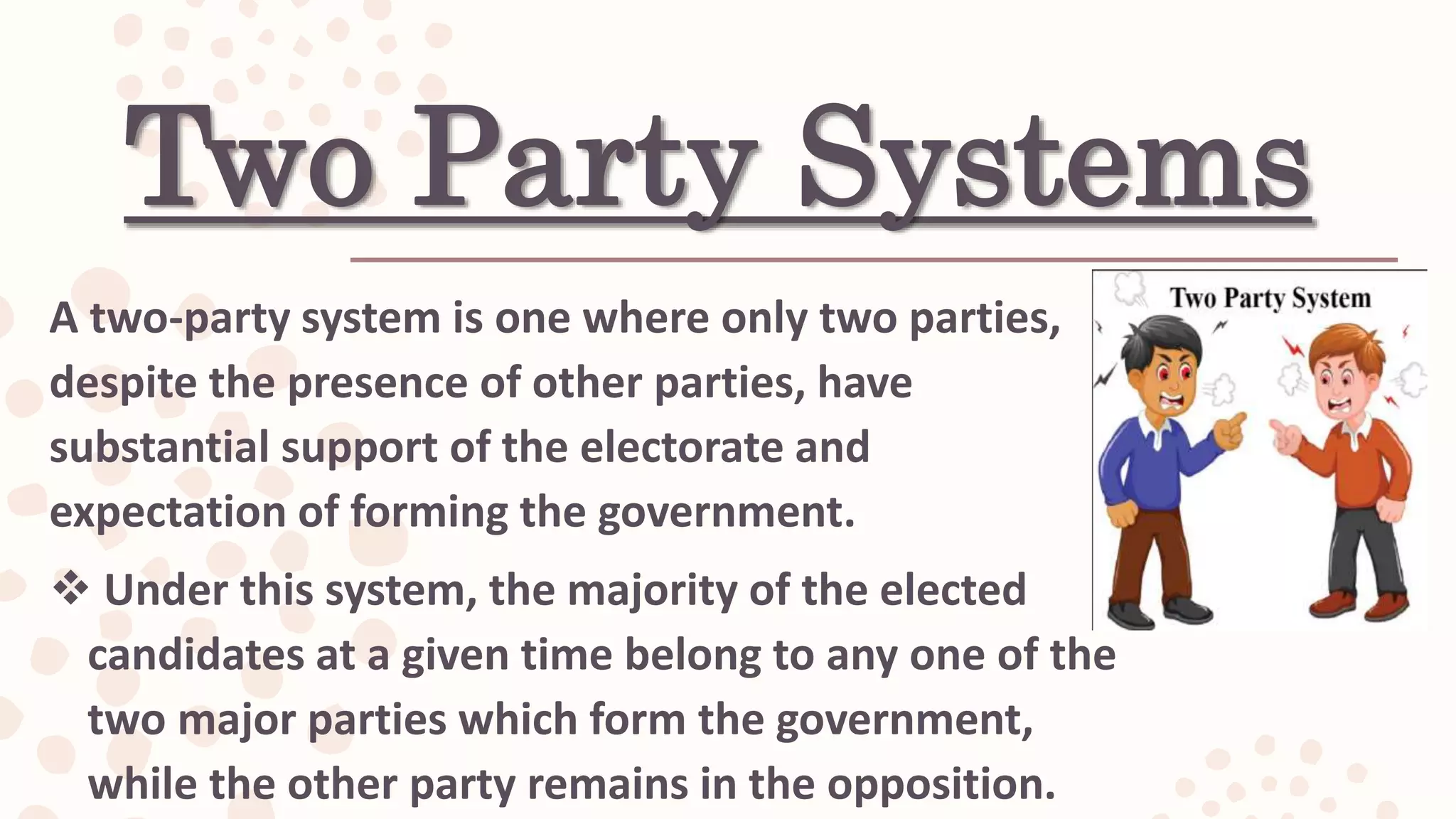
Atwo-party system is one where only two parties,
despite the presence of other parties, have
substantial support of the electorate and
expectation of forming the government.
Under this system, the majority of the elected
candidates at a given time belong to any one of the
two major parties which form the government,
while the other party remains in the opposition.
11.
Two Party Systems
TheUnited States and the United Kingdom
provide good examples of two-party system. In
the former, the Democratic and Republican
parties are two giant parties. In the UK, the
transfer of power takes place between the two
major parties, the Labour and the
Conservative.
12.
Multi Party Systems
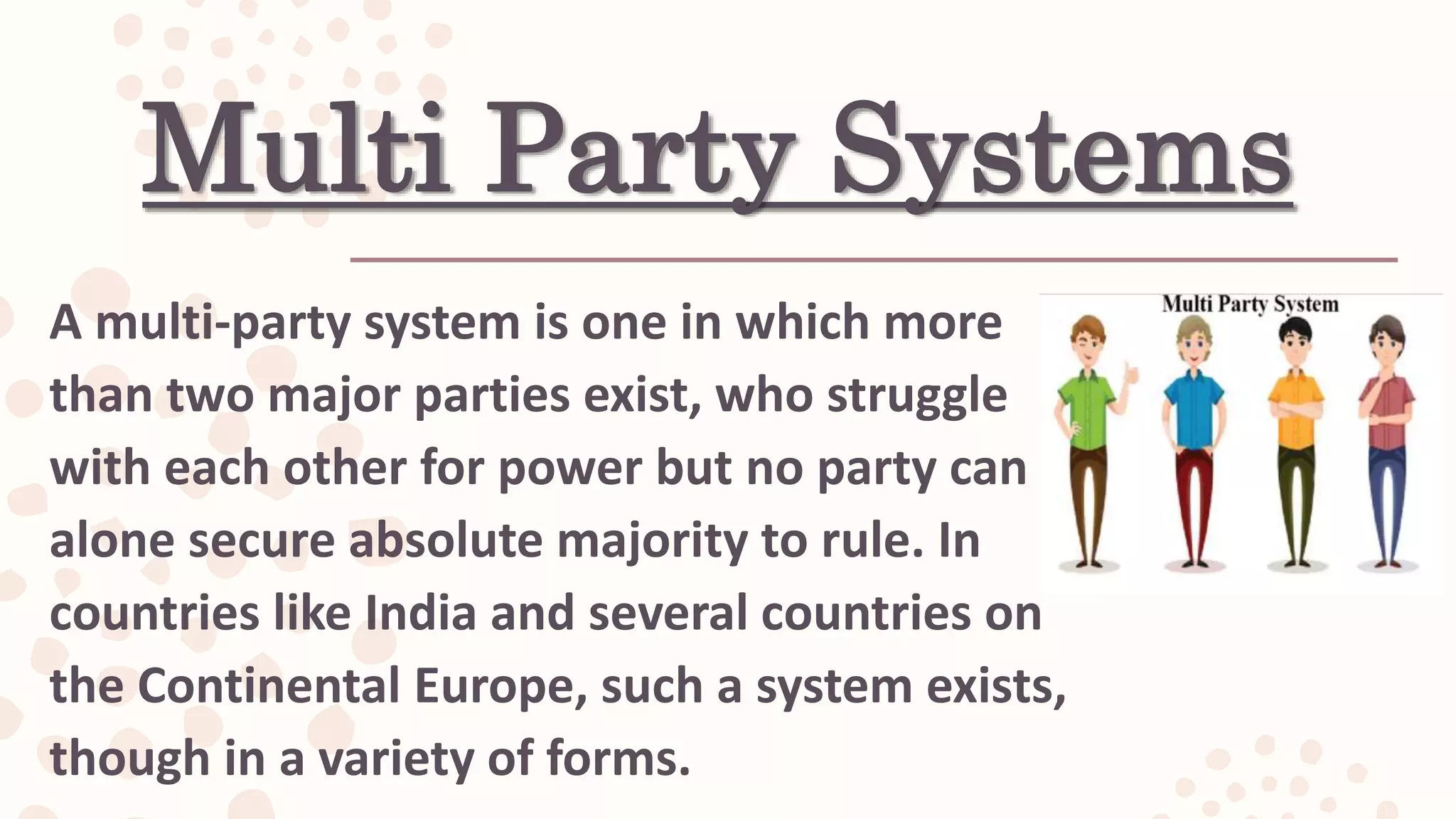
Amulti-party system is one in which more
than two major parties exist, who struggle
with each other for power but no party can
alone secure absolute majority to rule. In
countries like India and several countries on
the Continental Europe, such a system exists,
though in a variety of forms.
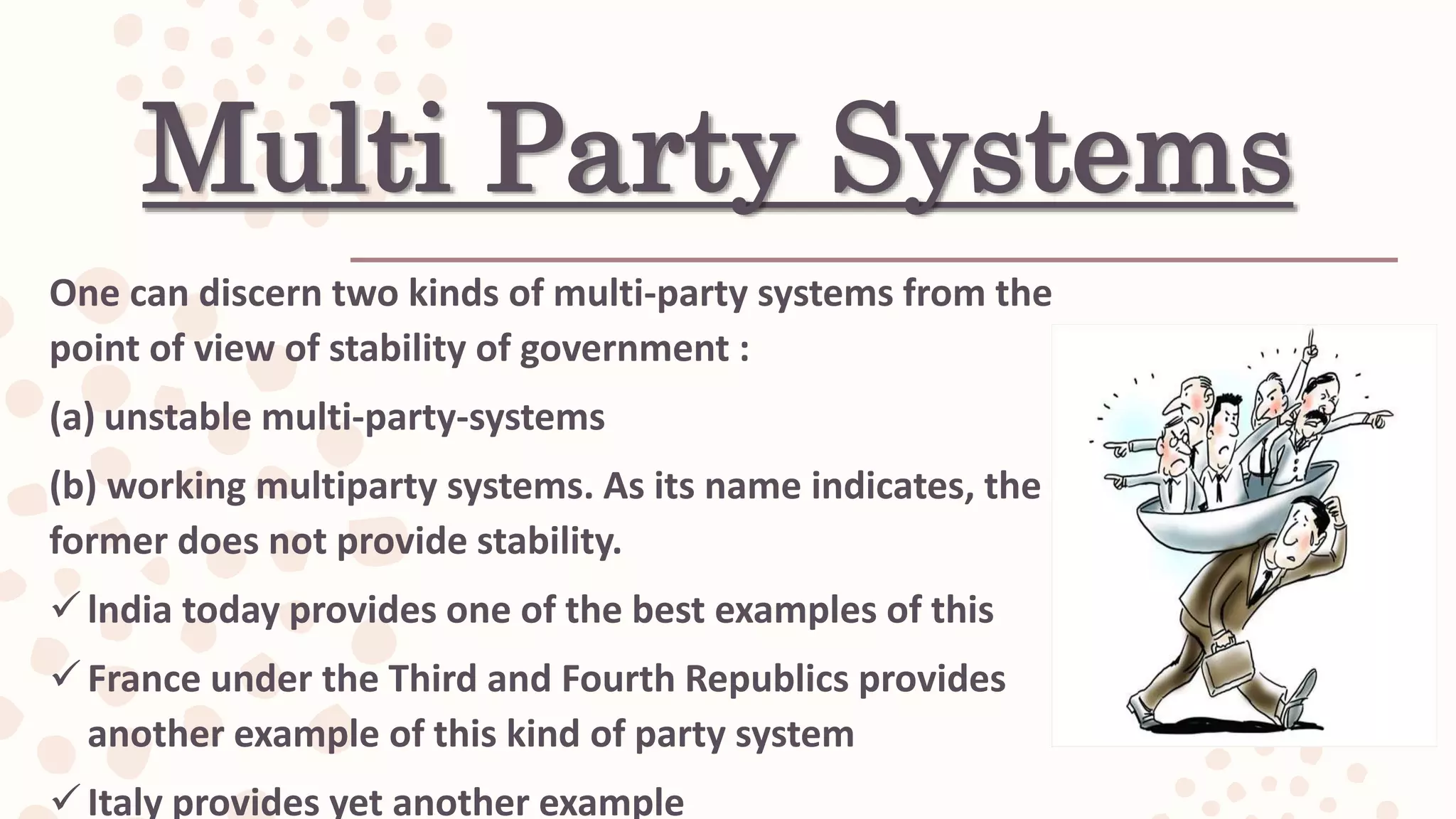
13.
Multi Party Systems
Onecan discern two kinds of multi-party systems from the
point of view of stability of government :
(a) unstable multi-party-systems
(b) working multiparty systems. As its name indicates, the
former does not provide stability.
lndia today provides one of the best examples of this
France under the Third and Fourth Republics provides
another example of this kind of party system
Italy provides yet another example
14.
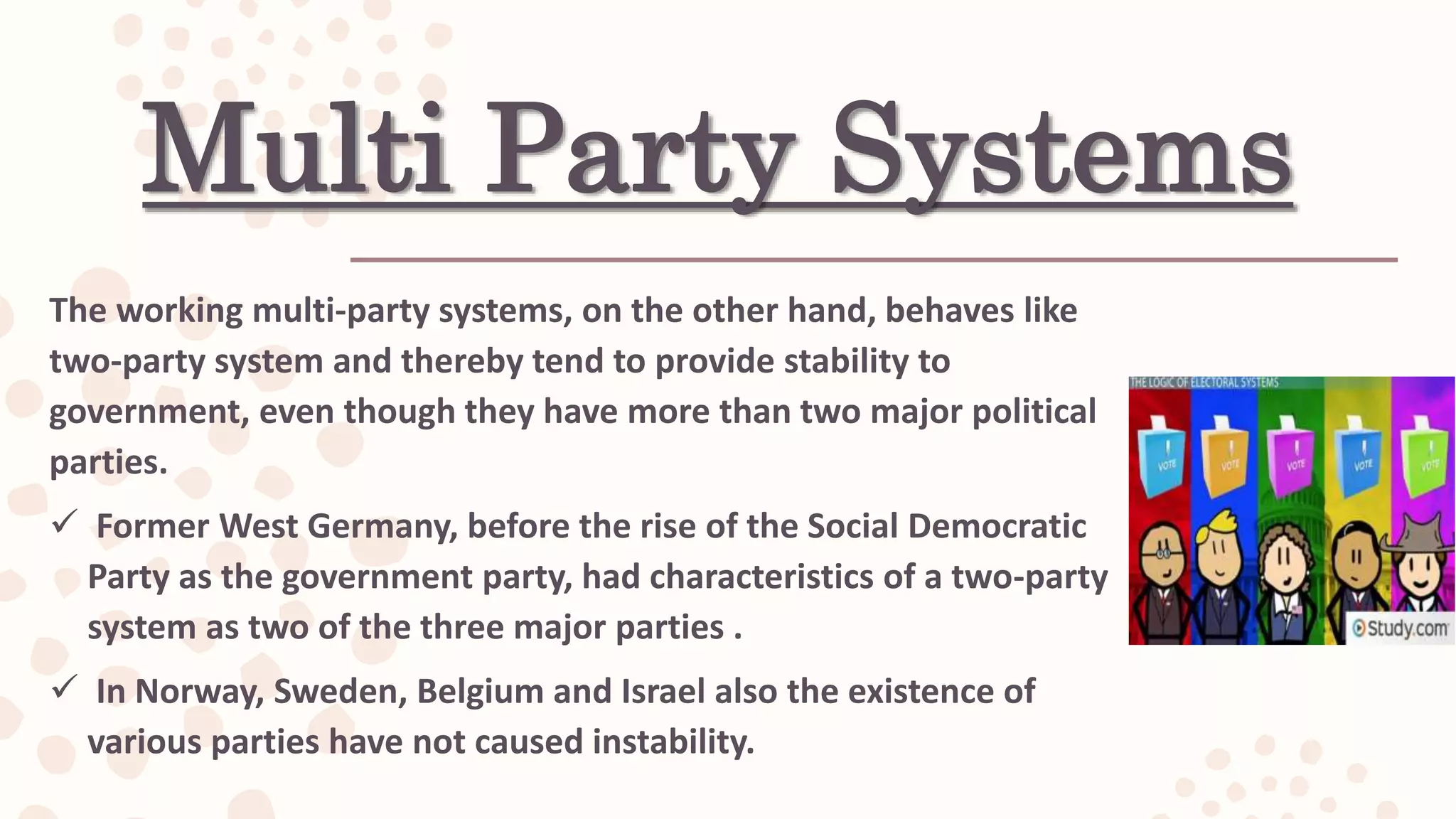
Multi Party Systems
Theworking multi-party systems, on the other hand, behaves like
two-party system and thereby tend to provide stability to
government, even though they have more than two major political
parties.
Former West Germany, before the rise of the Social Democratic
Party as the government party, had characteristics of a two-party
system as two of the three major parties .
In Norway, Sweden, Belgium and Israel also the existence of
various parties have not caused instability.
15.
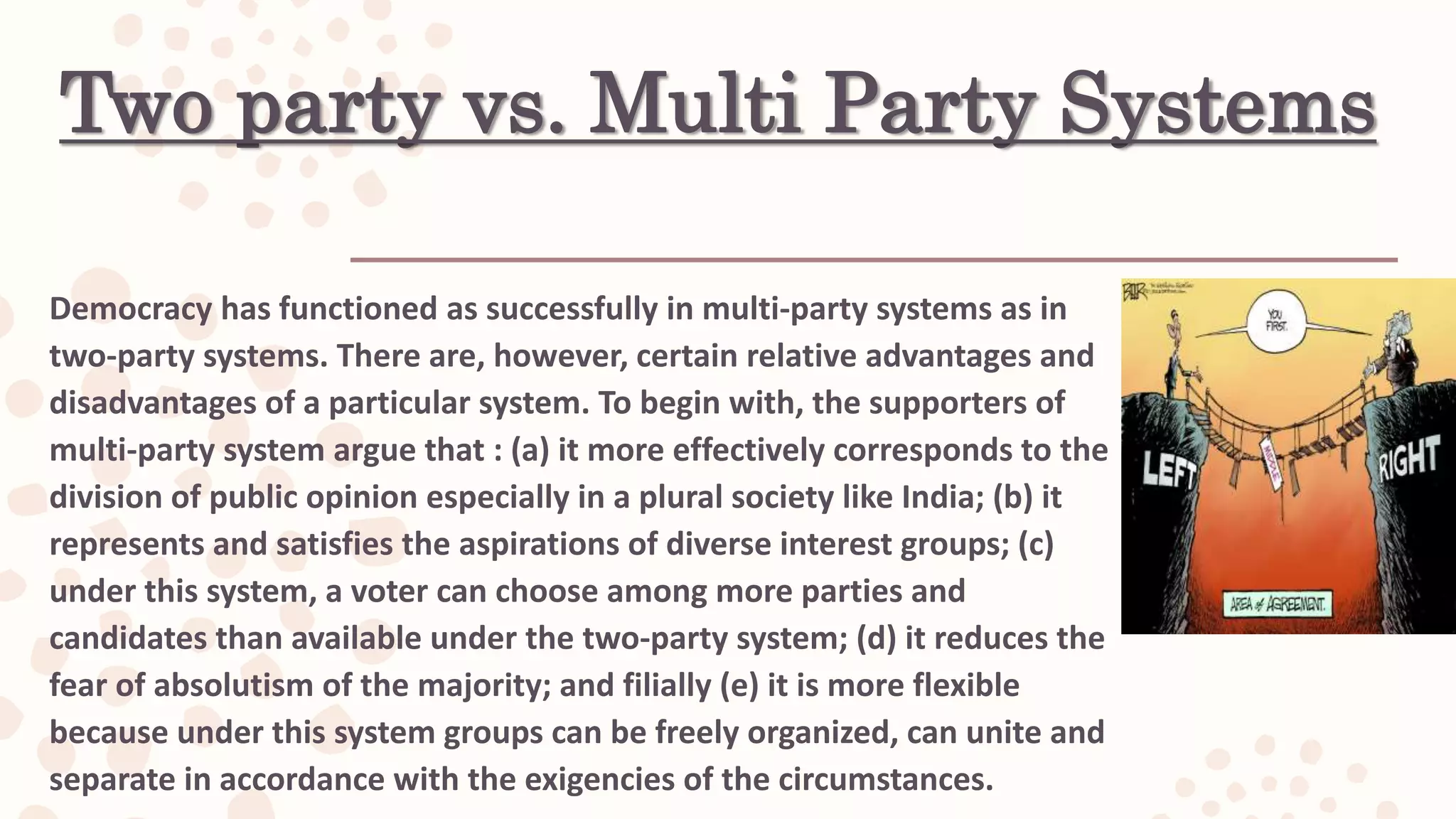
Two party vs.Multi Party Systems
Democracy has functioned as successfully in multi-party systems as in
two-party systems. There are, however, certain relative advantages and
disadvantages of a particular system. To begin with, the supporters of
multi-party system argue that : (a) it more effectively corresponds to the
division of public opinion especially in a plural society like India; (b) it
represents and satisfies the aspirations of diverse interest groups; (c)
under this system, a voter can choose among more parties and
candidates than available under the two-party system; (d) it reduces the
fear of absolutism of the majority; and filially (e) it is more flexible
because under this system groups can be freely organized, can unite and
separate in accordance with the exigencies of the circumstances.
16.
Two party vs.Multi Party Systems
In theory the multi-party system, has much in its favour, in practice not so much. As we see in lndia today,
inability of any single party to command absolute majority and consequent inevitability of forming coalition
government led to the crisis of stable Government in India.
The members of the Council of Ministers instead of working instead of working under the leadership of the Prime
Minister.
seek guidance from their party bosses and even a single member of the Parliament to blackmail the government by
threatening to withdraw its support.
Not surprisingly, the government does not find enough time to devote attention to the task of governance as it
remains busy with keeping its partners in good humour even at the cost of national interest.
The major party is also forced to abandon its electoral pledges to cobble a majority in the lower house of legislature.
The Cabinet in consequence comes to represent, not a general body of opinions, but a patchwork of doctrines leading
to a gap between the electorate arid the government.
17.
Two party vs.Multi Party Systems
On the other hand, the supporters of two-party system argue that it enables the people
to Choose their government directly at the polls as voter is not perplexed by a
multiplicity of candidates and he can simply opt between the two.
Secondly, it provides unity of policy in the government since the party in power does not
have to depend upon ally other. This facilitates effectiveness of the government.
Thirdly, two parties hold each other in check and prevent either from being too extreme,
since each party shall try to win over the supporters of the other and to appeal to
independent voters.
Fourthly, as democracy is supposed to be guided by the public opinion, the two-party
system provides an ideal condition for debating the issues between two opposite camps.
18.
Conclusion
however, there isalways a variety of opinions and ideas present
in process of political thought and discussion. This is seldom
recognized in a two-party system. In view of the above-
mentioned advantages and disadvantages of the multi-party
and two-party systems, it is not prudent to lay down a general
rule concerning the desirability of a particular type of party
system in all countries. As such the merits and demerits of the
various party systems need to be seen in the context of various
social, economic and historical forces at work in a given country