INTERNATIONAL
RELATIONS
COURSE SCHEDULE
 CHAPTER 1: INTERNATIONAL RELATIONS
INTRODUCTION AND STATES
 CHAPTER 2: NON-STATES
 CHAPTER 3: INTERGOVERNMENTAL ORGANIZATIONS
(IGOs)
 CHAPTER 4: PROBLEMS AND CHALLENGES
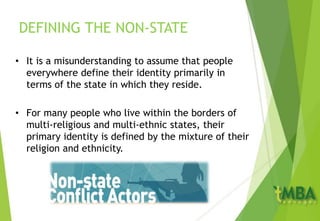
DEFINING THE NON-STATE
• It is a misunderstanding to assume that people
everywhere define their identity primarily in
terms of the state in which they reside.
• For many people who live within the borders of
multi-religious and multi-ethnic states, their
primary identity is defined by the mixture of their
religion and ethnicity.
They are organizations with sufficient power to
influence and cause a change even though they do not
belong to any established institution of a state.
TYPES OF NON-STATE ACTORS
1. Non-Governmental Organizations (NGOs):
Typically considered as a part of civil society. They
operate independently from any form of government.
2. Multinational Corporations (MNCs):
For-profit organizations that operate in multiple
sovereign states. They can choose to locate their
operations in countries where it is most profitable.
They provide overseas investment to the host country.
3. Nationalism:
The modern European political doctrines and
movements of nationalism crystallized with French
revolution.
Once defined in terms of the entire population
within a given territory, nationalism asserts that the
nation should become the fundamental unit of
political oranization.
TYPES OF NON-STATE ACTORS
There are two major nationalist movements:
 Cultural-linguistic nationalism:
It is impossible to eliminate the linguistic and
cultural identity and solidarity of an ethnic group.
 Anti-colonial nationalism in the Third World:
Although nationalism was a European political
doctrine, it developed in the Third World as a by-
product of colonial experience.
TYPES OF NON-STATE ACTORS
4. Violent Non-State Actors:
These actors include armed groups, including groups
such as Al-Qaeda or criminal organizations, for
example drug cartels.
TYPES OF NON-STATE ACTORS
Violent Non-State Actors can be divided into two
groups:
 Guerillas and Insurgents:
Guerilla warfare is the natural weapon of the
strategically weaker side in a conflict. In most cases,
it has been linked to a struggle between a non-state
movement and a government.
 Terrorist Groups and Networks:
Terrorism is the systematic use of coercive
intimidation, usually for political reasons. It can be
employed by desperate minorities or by states as a
tool of policy.
TYPES OF NON-STATE ACTORS
5. Religious Groups:
Quakers and other religious sects are quite active in
their international advocacy efforts. For example,
Christianity was the major influence in the shaping of
the European nation-state and the state system
generally.
6. Humanitarian and Human Right Organizations:
Religious groups have in part founded other non-state
actors such as Amnesty International, Greenpeace,
and OXFAM.
TYPES OF NON-STATE ACTORS
There is an impressive array of humanitarian
organizations and charities which operate
internationally and bring great dedication, skill and
experience to bear in order to save lives.
Among the best known of these organizations are the
International Red Cross, Medecins Sans Frontieres,
Save the Children Fund and many others.
GREENPEACE
Greenpeace is a non-profit
organization which operates in
40 countries in Europe, America
and Asia. It has been struggling
acutely against the
environmental massacres all
around the world since 1971.
Greenpeace does not accept
grants or sponsorship from
states, firms or political parties
in order to sustain its efforts
independently.
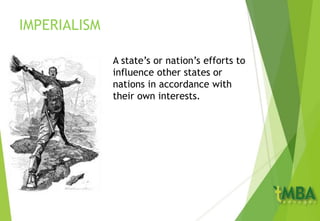
IMPERIALISM
A state’s or nation’s efforts to
influence other states or
nations in accordance with
their own interests.
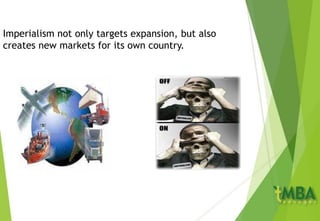
Imperialism not only targets expansion, but also
creates new markets for its own country.
Globalization is the increase in inter-communal
integration and solidarity in terms of economic,
social, technological, cultural and political
development.
GLOBALIZATION
THINK GLOBALLY, BEHAVE LOCALLY!
McDonald’s introduces new products in accordance
with country tastes and eating cultures although it is
an international firm.
ADVANTAGES OF GLOBALIZATION
As a result of globalization capital, knowledge, goods
and services have started to roam more freely all
around the world. This process increases the economic
dependence between countries.
However, the rules of the game in globalization is
unjust and designed to be useful to developed
countries. So, some people oppose this idea like the
ones in Seattle on 30 November 1999.

International relations chapter 2 non-states

  • 1.
  • 2.
    COURSE SCHEDULE  CHAPTER1: INTERNATIONAL RELATIONS INTRODUCTION AND STATES  CHAPTER 2: NON-STATES  CHAPTER 3: INTERGOVERNMENTAL ORGANIZATIONS (IGOs)  CHAPTER 4: PROBLEMS AND CHALLENGES
  • 3.
    DEFINING THE NON-STATE •It is a misunderstanding to assume that people everywhere define their identity primarily in terms of the state in which they reside. • For many people who live within the borders of multi-religious and multi-ethnic states, their primary identity is defined by the mixture of their religion and ethnicity.
  • 4.
    They are organizationswith sufficient power to influence and cause a change even though they do not belong to any established institution of a state.
  • 5.
    TYPES OF NON-STATEACTORS 1. Non-Governmental Organizations (NGOs): Typically considered as a part of civil society. They operate independently from any form of government. 2. Multinational Corporations (MNCs): For-profit organizations that operate in multiple sovereign states. They can choose to locate their operations in countries where it is most profitable. They provide overseas investment to the host country.
  • 6.
    3. Nationalism: The modernEuropean political doctrines and movements of nationalism crystallized with French revolution. Once defined in terms of the entire population within a given territory, nationalism asserts that the nation should become the fundamental unit of political oranization. TYPES OF NON-STATE ACTORS
  • 7.
    There are twomajor nationalist movements:  Cultural-linguistic nationalism: It is impossible to eliminate the linguistic and cultural identity and solidarity of an ethnic group.  Anti-colonial nationalism in the Third World: Although nationalism was a European political doctrine, it developed in the Third World as a by- product of colonial experience. TYPES OF NON-STATE ACTORS
  • 8.
    4. Violent Non-StateActors: These actors include armed groups, including groups such as Al-Qaeda or criminal organizations, for example drug cartels. TYPES OF NON-STATE ACTORS
  • 9.
    Violent Non-State Actorscan be divided into two groups:  Guerillas and Insurgents: Guerilla warfare is the natural weapon of the strategically weaker side in a conflict. In most cases, it has been linked to a struggle between a non-state movement and a government.  Terrorist Groups and Networks: Terrorism is the systematic use of coercive intimidation, usually for political reasons. It can be employed by desperate minorities or by states as a tool of policy. TYPES OF NON-STATE ACTORS
  • 10.
    5. Religious Groups: Quakersand other religious sects are quite active in their international advocacy efforts. For example, Christianity was the major influence in the shaping of the European nation-state and the state system generally. 6. Humanitarian and Human Right Organizations: Religious groups have in part founded other non-state actors such as Amnesty International, Greenpeace, and OXFAM. TYPES OF NON-STATE ACTORS
  • 11.
    There is animpressive array of humanitarian organizations and charities which operate internationally and bring great dedication, skill and experience to bear in order to save lives. Among the best known of these organizations are the International Red Cross, Medecins Sans Frontieres, Save the Children Fund and many others.
  • 12.
    GREENPEACE Greenpeace is anon-profit organization which operates in 40 countries in Europe, America and Asia. It has been struggling acutely against the environmental massacres all around the world since 1971. Greenpeace does not accept grants or sponsorship from states, firms or political parties in order to sustain its efforts independently.
  • 13.
    IMPERIALISM A state’s ornation’s efforts to influence other states or nations in accordance with their own interests.
  • 14.
    Imperialism not onlytargets expansion, but also creates new markets for its own country.
  • 15.
    Globalization is theincrease in inter-communal integration and solidarity in terms of economic, social, technological, cultural and political development. GLOBALIZATION
  • 16.
    THINK GLOBALLY, BEHAVELOCALLY! McDonald’s introduces new products in accordance with country tastes and eating cultures although it is an international firm.
  • 17.
    ADVANTAGES OF GLOBALIZATION Asa result of globalization capital, knowledge, goods and services have started to roam more freely all around the world. This process increases the economic dependence between countries. However, the rules of the game in globalization is unjust and designed to be useful to developed countries. So, some people oppose this idea like the ones in Seattle on 30 November 1999.