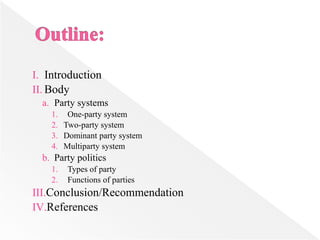
I. Introduction
II. Body
a. Party systems
1. One-party system
2. Two-party system
3. Dominant party system
4. Multiparty system
b. Party politics
1. Types of party
2. Functions of parties
III.Conclusion/Recommendation
IV.References
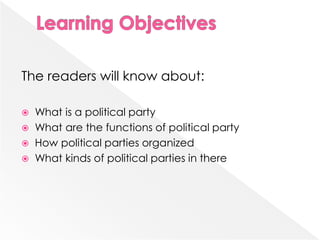
The readers will know about:
 What is a political party
 What are the functions of political party
 How political parties organized
 What kinds of political parties in there
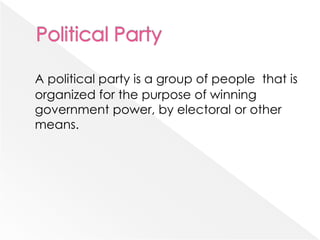
A political party is a group of people that is
organized for the purpose of winning
government power, by electoral or other
means.
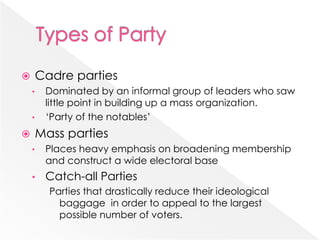
 Cadre parties
• Dominated by an informal group of leaders who saw
little point in building up a mass organization.
• ‘Party of the notables’
 Mass parties
• Places heavy emphasis on broadening membership
and construct a wide electoral base
• Catch-all Parties
Parties that drastically reduce their ideological
baggage in order to appeal to the largest
possible number of voters.
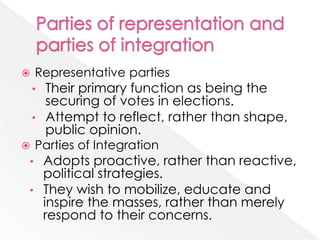
 Representative parties
• Their primary function as being the
securing of votes in elections.
• Attempt to reflect, rather than shape,
public opinion.
 Parties of Integration
• Adopts proactive, rather than reactive,
political strategies.
• They wish to mobilize, educate and
inspire the masses, rather than merely
respond to their concerns.
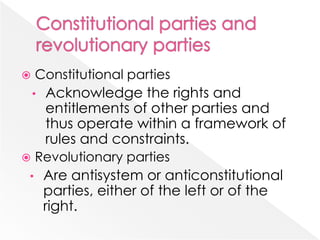
 Constitutional parties
• Acknowledge the rights and
entitlements of other parties and
thus operate within a framework of
rules and constraints.
 Revolutionary parties
• Are antisystem or anticonstitutional
parties, either of the left or of the
right.
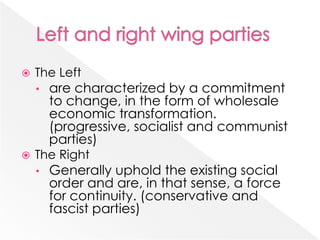
 The Left
• are characterized by a commitment
to change, in the form of wholesale
economic transformation.
(progressive, socialist and communist
parties)
 The Right
• Generally uphold the existing social
order and are, in that sense, a force
for continuity. (conservative and
fascist parties)
 Representation
 Elite formation and recruitment
 Goal formation
 Interest articulation and aggregation
 Socialization and mobilization
 Organization of government
 Representation
The capacity of parties to respond to and
articulate the views of both members and the
voters.
 Elite formation and recruitment
Parties are responsible for providing states with their
political leaders.
Parties provide a training ground for politicians;
equipping them with skills, knowledge and
experience.
 Goal formation
They formulate programs of government (through
conferences, conventions, election manifestos and
so on) with a view to attracting popular support.
 Interest articulation and aggregation
Parties help to articulate and aggregate the
various interests found in society.
 Socialization and mobilization
Through internal debate and discussion, as well as
campaigning and electoral competition, parties
are important agent of political education and
socialization.
 Organization of government
Parties help with the formation of governments.
 One-party Systems
 Two-party Systems
 Dominant party systems
 Multiparty Systems
 One-party Systems
A single-party state, one-party state, one-party system,
or single-party system is a type of state in which a
single political party has the right to form the
government, usually based on the existing constitution.
 Two-party Systems
A two-party system is a system where two major
political parties dominate politics within a government.
One of the two parties typically holds a majority in the
legislature and is usually referred to as the
majority party while the other is the minority party.
 Dominant party systems
A dominant-party system or one-party dominant system, is
a system where there is "a category of parties/political
organizations that have successively won election victories
and whose future defeat cannot be envisaged or is unlikely
for the foreseeable future."
 Multiparty Systems
A multi-party system is a system in which multiple
political parties have the capacity to gain control of
government offices, separately or in coalition.
Party system is one of the many factors of a healthy
democratic process. It enables the people to be
represented to the government.
Highlights their participation in the political process
of the state provided that their claims are
considered by the party politicians in concocting
their platforms, and in the long run, will be a guide
in framing policies.
Print
Heywood, A. (2013). Politics (fourth ed.). United Kingdom: Palgrave
Macmillan.
Non-print
One party systems
http://en.wikipedia.org/wiki/Single-party_state
Two party systems
http://en.wikipedia.org/wiki/Two-party_system
Dominant party
http://en.wikipedia.org/wiki/Dominant-party_system
Multiparty
http://en.wikipedia.org/wiki/Multi-party_system

Parties and party system

  • 2.
    I. Introduction II. Body a.Party systems 1. One-party system 2. Two-party system 3. Dominant party system 4. Multiparty system b. Party politics 1. Types of party 2. Functions of parties III.Conclusion/Recommendation IV.References
  • 3.
    The readers willknow about:  What is a political party  What are the functions of political party  How political parties organized  What kinds of political parties in there
  • 4.
    A political partyis a group of people that is organized for the purpose of winning government power, by electoral or other means.
  • 5.
     Cadre parties •Dominated by an informal group of leaders who saw little point in building up a mass organization. • ‘Party of the notables’  Mass parties • Places heavy emphasis on broadening membership and construct a wide electoral base • Catch-all Parties Parties that drastically reduce their ideological baggage in order to appeal to the largest possible number of voters.
  • 6.
     Representative parties •Their primary function as being the securing of votes in elections. • Attempt to reflect, rather than shape, public opinion.  Parties of Integration • Adopts proactive, rather than reactive, political strategies. • They wish to mobilize, educate and inspire the masses, rather than merely respond to their concerns.
  • 7.
     Constitutional parties •Acknowledge the rights and entitlements of other parties and thus operate within a framework of rules and constraints.  Revolutionary parties • Are antisystem or anticonstitutional parties, either of the left or of the right.
  • 8.
     The Left •are characterized by a commitment to change, in the form of wholesale economic transformation. (progressive, socialist and communist parties)  The Right • Generally uphold the existing social order and are, in that sense, a force for continuity. (conservative and fascist parties)
  • 9.
     Representation  Eliteformation and recruitment  Goal formation  Interest articulation and aggregation  Socialization and mobilization  Organization of government
  • 10.
     Representation The capacityof parties to respond to and articulate the views of both members and the voters.  Elite formation and recruitment Parties are responsible for providing states with their political leaders. Parties provide a training ground for politicians; equipping them with skills, knowledge and experience.
  • 11.
     Goal formation Theyformulate programs of government (through conferences, conventions, election manifestos and so on) with a view to attracting popular support.  Interest articulation and aggregation Parties help to articulate and aggregate the various interests found in society.
  • 12.
     Socialization andmobilization Through internal debate and discussion, as well as campaigning and electoral competition, parties are important agent of political education and socialization.  Organization of government Parties help with the formation of governments.
  • 13.
     One-party Systems Two-party Systems  Dominant party systems  Multiparty Systems
  • 14.
     One-party Systems Asingle-party state, one-party state, one-party system, or single-party system is a type of state in which a single political party has the right to form the government, usually based on the existing constitution.  Two-party Systems A two-party system is a system where two major political parties dominate politics within a government. One of the two parties typically holds a majority in the legislature and is usually referred to as the majority party while the other is the minority party.
  • 15.
     Dominant partysystems A dominant-party system or one-party dominant system, is a system where there is "a category of parties/political organizations that have successively won election victories and whose future defeat cannot be envisaged or is unlikely for the foreseeable future."  Multiparty Systems A multi-party system is a system in which multiple political parties have the capacity to gain control of government offices, separately or in coalition.
  • 16.
    Party system isone of the many factors of a healthy democratic process. It enables the people to be represented to the government. Highlights their participation in the political process of the state provided that their claims are considered by the party politicians in concocting their platforms, and in the long run, will be a guide in framing policies.
  • 17.
    Print Heywood, A. (2013).Politics (fourth ed.). United Kingdom: Palgrave Macmillan. Non-print One party systems http://en.wikipedia.org/wiki/Single-party_state Two party systems http://en.wikipedia.org/wiki/Two-party_system Dominant party http://en.wikipedia.org/wiki/Dominant-party_system Multiparty http://en.wikipedia.org/wiki/Multi-party_system