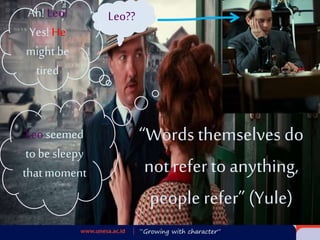
Leo seemed
to be sleepy
thatmoment
Leo??Ah! Leo!
Yes! He
might be
tired
“Words themselves do
notrefer to anything,
people refer” (Yule)
Pragmatics
Reference & Inference
REFERENCE
• Referenceisthe words we use to identify things are
in some direct relationshipto those things.
• It isan act in which a speaker, or writer, uses linguistic
forms to enable a listener, or reader, to identify
something (Yule)
• Linguisticforms = referringexpressions.
REFERRING EXPRESSION
• Referringexpressionisany expressionused in
utterance to refer to something or someone
• The choice of expressiondepends onwhat the speaker
assumesthe listeneralreadyknows (Yule)
• Referenceis clearlytied to thespeaker’s goals
and beliefs in theuse of language.
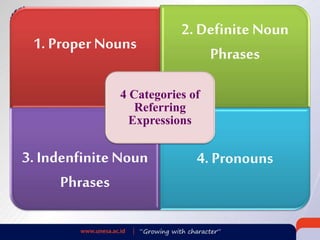
1. Proper Nouns
2. Definite Noun
Phrases
3. IndenfiniteNoun
Phrases
4. Pronouns
4 Categories of
Referring
Expressions
1. Proper Nouns
Raja Ampat Zahraa
2. Definite Noun Phrases
The Archipelago The student
3. IndenfiniteNoun Phrases
A place A women
It
4. Pronouns
She, her
• IndefiniteNP = ‘a’ can be replaced by ‘any’
Examples:
a) There's a man waitingforyou
(a man=anyman)
b) He wants to marry a woman withlots of money
(a woman=anywoman)
c) We'd love to finda nine-foot-tallbasketball player
(a = any)
Yule: "not allreferring expressions have identifiable physical referents. ".
ATTRIBUTIVEAND REFERENTIALUSES
a physicallypresent entity
exist but unknown
doesn’t exist
• ‘whoever/whatever fits the description’
• Definite nounphrase= ‘the’ is assumed toexist, butcannot
be ensure yet.
e.g. There was nosign of the killer
The killer= Whoever did the killing
(A reporter is reportinga mysteriousdeath)
ATTRIBUTIVEUSE
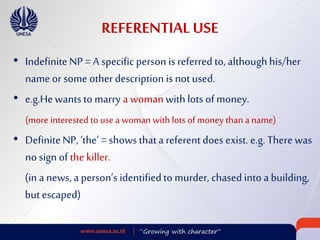
REFERENTIAL USE
• IndefiniteNP = A specific person is referred to, althoughhis/her
nameor some otherdescription is not used.
• e.g.Hewants to marry a womanwith lots of money.
(more interested to use a woman with lots of money than a name)
• DefiniteNP,‘the’ = shows thata referent does exist. e.g. There was
no sign of the killer.
(in a news, a person’s identifiedto murder, chased into a building,
but escaped)
For successful reference to
occur, we must also
recognize the role of
inference.
INFERENCE
• Inferringisconnecting priorknowledge to text based
informationto create meaning beyond what is directly
stated.
• An inferenceis any additionalinformationused by the
listenerto connect whatis saidto whatmust be meant.
(Yule)
• The role of inference in communicationis toallow
the listenerto identifycorrectly whichparticularentity
the speaker is referring to.
REFERENCE & INFERENCE
Reference
• “Mr. Kawasaki.”
• Used to refer to a manwho
always rode loud and fastin
his motorcycle.
• A brand nameis used to
refer to a person
Inference
• “I enjoylisteningto
Mozart.”
• the hearer has to infer that
thenameof Musician
’Mozart’ can be used to
identifySong
NAME& REFERENTS
• Pragmatic connectionbetweenproper namesand objects
thatwill be conventionallyassociated withina socio culturally
defined communitywiththose names.
• It is conventionbetweenall members of a communitywho
share common language/culture
• Conventions may differ from one social group to another
Name = Word = Reference Referent=Entity= Object
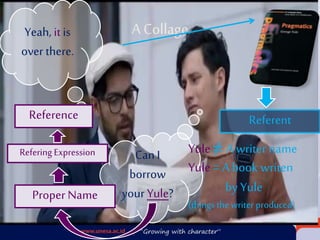
A Collage
Can I
borrow
your Yule?
Yeah, it is
over there.
Reference
Proper Name
Refering Expression
Referent
Yule ≠ A writer name
Yule = A book writen
by Yule
(things the writer produced)
ReferenceVsReferent
• Referenceisthe words we use to identify things are
in some direct relationship to those things.
• Referentis whata word or symbol standsfor.
• It isthe concrete thing (the personor thing) thata
word or expressionrefers to.
–An actualchair would be the referentof theword chair.
Speakers ----- reference ----- intention
(intention-to-identify)
THREE-DIMENSIONALDIAGRAM
Listeners ----- inference -----interpret
(recognition-of-intention)
words/phrases
Germanywins World Cup
A soccer team
A Country
A Government
A number of possiblereferents
(Yule)
• The abilityto identifyintendedreferents depend on
two environments:
–The linguisticmaterial of the environment (Co-
text)
–The Physicalenvironment (Context)
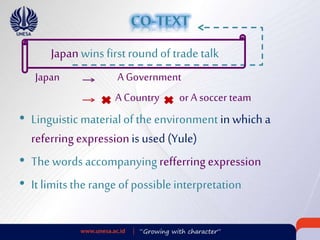
Japan A Government
A Country or A soccer team
• Linguisticmaterialofthe environment in which a
referring expressionis used (Yule)
• The words accompanyingrefferring expression
• It limitsthe range of possibleinterpretation
Japanwins firstroundof trade talk
• It is aphysical environment or (speech) conventions
–The heart-attackmustn’t bemoved
–The heart-attack= thepatientsufferedheart-attack
• The context must be ‘a hospital’ in which the nurses
identified patient by the name of the illness.
• The convention may differ from one social group to
another.
• Thus, reference is also about social act
An illness
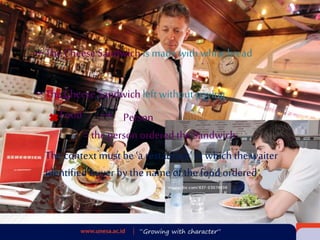
–The CheeseSandwich is made with whitebread
–The CheeseSandwichleftwithoutpaying
Food
= theperson ordered theSandwich
The context mustbe ‘a restaurant’ in which thewaiter
identifiedbuyer by thename of thefood ordered
Person
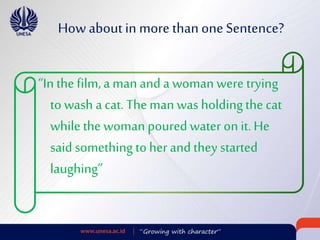
How about in more than one Sentence?
“In the film,a man and a woman were trying
to wash a cat. The man was holdingthe cat
while the woman pouredwater on it. He
said something to her and they started
laughing”
• “In thefilm,a manand a womanwere trying to wash a cat.
Initial/Introductory Reference= ANTECEDENT
The manwas holdingthe cat whilethe woman poured water on
it. Hesaid somethingto her and theystarted laughing”
• It is a process of continuingto identify exactly the same entityas
denoted by ANTECEDENT.(Yule)
ANTECEDENT&ANAPHORA/ANAPHOR
a man;a woman;a cat
ANTECEDENT
oftenIndefiniteNP
the man;the woman;the cat
he; her; it; they
 ANAPHORA
oftendefinite NP or Pronoun
Subsequent
Reference
InitialReference
• It is subsequent reference to already introduced
referents.
• It needsnot be exactly identicalto antecedent.
“Peel andslice sixpotatoes.Putthem in cold salted
water”
Them= the six peeledand sliced potatoes
• The reversal of antecedent-anaphorapattern
• If an anaphora(in thiscase = it)come firstand
antecedentcome next.
• Butitis much lesscommon than ANAPHORA
“I turnedthe corner and almost stepped on it.
There was a large snakes in the middle of the path”.
Cook ?   = was omitted=[the slices/them]
Ellipsis = Cook [the peeled onionslices]
• When the interpretationrequires us to identifyan entity,
and nolinguistic expressionispresented.
• It frequently uses verbal anaphora
“Peel an Onionand Sliceit. Drop the slices intohot
oil.Cook for three minutes”
• The connectionbetween referent antecedentand
anaphoramay notalwaysbe direct
• e.g. The busCame on time, buthe didn’tstop.
(The bus and he are notgramaticalagreement)
But(The bus has a driver)
‘he’ refers to the bus driver
Rizaln Syifa
Pragmatic reference is
more being
Communicated than
said

Reference: Pragmatics

  • 1.
    Leo seemed to besleepy thatmoment Leo??Ah! Leo! Yes! He might be tired “Words themselves do notrefer to anything, people refer” (Yule)
  • 2.
  • 3.
    REFERENCE • Referenceisthe wordswe use to identify things are in some direct relationshipto those things. • It isan act in which a speaker, or writer, uses linguistic forms to enable a listener, or reader, to identify something (Yule) • Linguisticforms = referringexpressions.
  • 4.
    REFERRING EXPRESSION • Referringexpressionisanyexpressionused in utterance to refer to something or someone • The choice of expressiondepends onwhat the speaker assumesthe listeneralreadyknows (Yule) • Referenceis clearlytied to thespeaker’s goals and beliefs in theuse of language.
  • 5.
    1. Proper Nouns 2.Definite Noun Phrases 3. IndenfiniteNoun Phrases 4. Pronouns 4 Categories of Referring Expressions
  • 6.
    1. Proper Nouns RajaAmpat Zahraa 2. Definite Noun Phrases The Archipelago The student
  • 7.
    3. IndenfiniteNoun Phrases Aplace A women It 4. Pronouns She, her
  • 8.
    • IndefiniteNP =‘a’ can be replaced by ‘any’ Examples: a) There's a man waitingforyou (a man=anyman) b) He wants to marry a woman withlots of money (a woman=anywoman) c) We'd love to finda nine-foot-tallbasketball player (a = any) Yule: "not allreferring expressions have identifiable physical referents. ". ATTRIBUTIVEAND REFERENTIALUSES a physicallypresent entity exist but unknown doesn’t exist
  • 9.
    • ‘whoever/whatever fitsthe description’ • Definite nounphrase= ‘the’ is assumed toexist, butcannot be ensure yet. e.g. There was nosign of the killer The killer= Whoever did the killing (A reporter is reportinga mysteriousdeath) ATTRIBUTIVEUSE
  • 10.
    REFERENTIAL USE • IndefiniteNP= A specific person is referred to, althoughhis/her nameor some otherdescription is not used. • e.g.Hewants to marry a womanwith lots of money. (more interested to use a woman with lots of money than a name) • DefiniteNP,‘the’ = shows thata referent does exist. e.g. There was no sign of the killer. (in a news, a person’s identifiedto murder, chased into a building, but escaped)
  • 11.
    For successful referenceto occur, we must also recognize the role of inference.
  • 12.
    INFERENCE • Inferringisconnecting priorknowledgeto text based informationto create meaning beyond what is directly stated. • An inferenceis any additionalinformationused by the listenerto connect whatis saidto whatmust be meant. (Yule) • The role of inference in communicationis toallow the listenerto identifycorrectly whichparticularentity the speaker is referring to.
  • 13.
    REFERENCE & INFERENCE Reference •“Mr. Kawasaki.” • Used to refer to a manwho always rode loud and fastin his motorcycle. • A brand nameis used to refer to a person Inference • “I enjoylisteningto Mozart.” • the hearer has to infer that thenameof Musician ’Mozart’ can be used to identifySong
  • 14.
    NAME& REFERENTS • Pragmaticconnectionbetweenproper namesand objects thatwill be conventionallyassociated withina socio culturally defined communitywiththose names. • It is conventionbetweenall members of a communitywho share common language/culture • Conventions may differ from one social group to another Name = Word = Reference Referent=Entity= Object
  • 15.
    A Collage Can I borrow yourYule? Yeah, it is over there. Reference Proper Name Refering Expression Referent Yule ≠ A writer name Yule = A book writen by Yule (things the writer produced)
  • 16.
    ReferenceVsReferent • Referenceisthe wordswe use to identify things are in some direct relationship to those things. • Referentis whata word or symbol standsfor. • It isthe concrete thing (the personor thing) thata word or expressionrefers to. –An actualchair would be the referentof theword chair.
  • 17.
    Speakers ----- reference----- intention (intention-to-identify) THREE-DIMENSIONALDIAGRAM Listeners ----- inference -----interpret (recognition-of-intention) words/phrases
  • 18.
    Germanywins World Cup Asoccer team A Country A Government A number of possiblereferents (Yule)
  • 19.
    • The abilitytoidentifyintendedreferents depend on two environments: –The linguisticmaterial of the environment (Co- text) –The Physicalenvironment (Context)
  • 20.
    Japan A Government ACountry or A soccer team • Linguisticmaterialofthe environment in which a referring expressionis used (Yule) • The words accompanyingrefferring expression • It limitsthe range of possibleinterpretation Japanwins firstroundof trade talk
  • 21.
    • It isaphysical environment or (speech) conventions –The heart-attackmustn’t bemoved –The heart-attack= thepatientsufferedheart-attack • The context must be ‘a hospital’ in which the nurses identified patient by the name of the illness. • The convention may differ from one social group to another. • Thus, reference is also about social act An illness
  • 22.
    –The CheeseSandwich ismade with whitebread –The CheeseSandwichleftwithoutpaying Food = theperson ordered theSandwich The context mustbe ‘a restaurant’ in which thewaiter identifiedbuyer by thename of thefood ordered Person
  • 23.
    How about inmore than one Sentence? “In the film,a man and a woman were trying to wash a cat. The man was holdingthe cat while the woman pouredwater on it. He said something to her and they started laughing”
  • 24.
    • “In thefilm,amanand a womanwere trying to wash a cat. Initial/Introductory Reference= ANTECEDENT The manwas holdingthe cat whilethe woman poured water on it. Hesaid somethingto her and theystarted laughing” • It is a process of continuingto identify exactly the same entityas denoted by ANTECEDENT.(Yule)
  • 25.
    ANTECEDENT&ANAPHORA/ANAPHOR a man;a woman;acat ANTECEDENT oftenIndefiniteNP the man;the woman;the cat he; her; it; they  ANAPHORA oftendefinite NP or Pronoun Subsequent Reference InitialReference
  • 26.
    • It issubsequent reference to already introduced referents. • It needsnot be exactly identicalto antecedent. “Peel andslice sixpotatoes.Putthem in cold salted water” Them= the six peeledand sliced potatoes
  • 27.
    • The reversalof antecedent-anaphorapattern • If an anaphora(in thiscase = it)come firstand antecedentcome next. • Butitis much lesscommon than ANAPHORA “I turnedthe corner and almost stepped on it. There was a large snakes in the middle of the path”.
  • 28.
    Cook ?  = was omitted=[the slices/them] Ellipsis = Cook [the peeled onionslices] • When the interpretationrequires us to identifyan entity, and nolinguistic expressionispresented. • It frequently uses verbal anaphora “Peel an Onionand Sliceit. Drop the slices intohot oil.Cook for three minutes”
  • 29.
    • The connectionbetweenreferent antecedentand anaphoramay notalwaysbe direct • e.g. The busCame on time, buthe didn’tstop. (The bus and he are notgramaticalagreement) But(The bus has a driver) ‘he’ refers to the bus driver
  • 30.
    Rizaln Syifa Pragmatic referenceis more being Communicated than said