DEIXIS
Email : tenry.colle@gmail.com
IG : rymari.translation17
Facebook : rymari id
YouTube : rymari belajar
LinkedIn : Andi Tenry Lawangen Aspat Colle
PRAGMATICS
Deixis ….
• Deixis is a technical term (from Greek) for one of the most
basic things we do with utterances (Yule, 1996, p. 9). It means
“pointing via” language. Any linguistic form used to
accomplish this “pointing” is called a deictic expression.
Deictic expressions are also sometimes called indexical.
• It is the ability to situate the speaker and hearer in relation to
one another and to the world around them. Levinson (1983, p.
55) says that deixis belongs within the domain of pragmatics,
because it directly concerns the relationship between the
structure of languages and contexts in which they are used.
• Within linguistic view, deixis refers to the phenomenon where
in understanding the meaning of certain words and phrases in
an utterance requires contextual information. Then, deixis can
give interpretation to the context of the utterance, such as who
is speaking, the time or place of speaking, the gesture of the
speaker, the current location in the discourse and the topic of
the discourse.
Types of Deixis
Spatial Deixis
The concept of distance is clearly relevant to spatial deixis or
place deixis, where the relative location of people and things is
being indicated. Levinson (1983, p.62) states:
“Place deixis concerns with the encoding of spatial locations
relative to the location of the participants in the speech event.
Probably most languages grammaticalize at least a distinction
between proximal (or close to speaker) and distal (or non-
proximal, sometimes close to addressee), but many make
much more elaborate distinctions so we shall see. Such
distinctions are commonly encoded in demonstratives (as in
English this vs. that) and in deictic adverbs of place (like
English here vs. there)”
• Spatial deixis show itself principally in the form of location
adverbs such as here and there, and demonstrative such as this
and that.
For example:
Emma is talking to Harriet: “Come here, please!”
Emma request to Mr. Kneithly: “Go there to Randalls!”
In closing, spatial deixis is important to remember that location
from the speaker’s perspective can be fixed mentally as well as
physically. It may be that the truly pragmatic basis of spatial
deixis is distance.
Temporal Deixis
Temporal deixis is commonly grammatical zed in deictic adverb
of time (like English now and then, yesterday and this year) but
above all in tense. English has two basic forms of tenses there are
present and past tense.
• I live here now.
• I lived there then.
When somebody uttered (a), it means that the deictic center is
close to him because he is still involved in a current situation at
which he uttered the utterance or the situation is still in a
progress, while (b) is considered distal as the situation does not
exist anymore.
Person Deixis
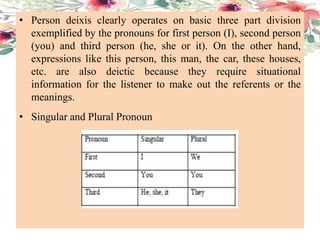
• Person deixis clearly operates on a basic three part division
exemplified by the pronouns for first person (I), second
person (you), and third person (he, she or it).
• According to Yule (1996, p.10), “The choice of one form will
certainly communicative something (not directly said) about
the speaker’s view of his or her relationship with the
addressee.”
• Levinson (1983, p. 62) states:
Person deixis concerns with the encoding of the role of
participants in the speech event, in which the utterance in
question is delivered: the category first person is the
grammaticalization of the speaker’s reference to himself,
second person the encoding of reference to one or more
addresses and third person the encoding of reference to
persons and entities which are neither speakers nor
addresses of the utterance in question.
• Person deixis clearly operates on basic three part division
exemplified by the pronouns for first person (I), second person
(you) and third person (he, she or it). On the other hand,
expressions like this person, this man, the car, these houses,
etc. are also deictic because they require situational
information for the listener to make out the referents or the
meanings.
• Singular and Plural Pronoun
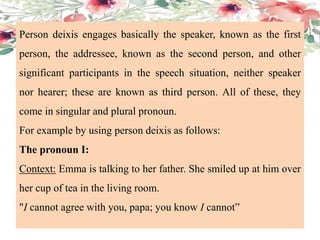
Person deixis engages basically the speaker, known as the first
person, the addressee, known as the second person, and other
significant participants in the speech situation, neither speaker
nor hearer; these are known as third person. All of these, they
come in singular and plural pronoun.
For example by using person deixis as follows:
The pronoun I:
Context: Emma is talking to her father. She smiled up at him over
her cup of tea in the living room.
"I cannot agree with you, papa; you know I cannot”
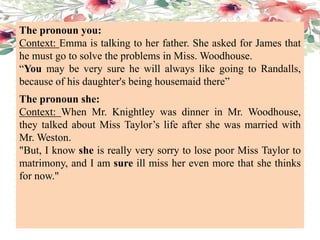
The pronoun you:
Context: Emma is talking to her father. She asked for James that
he must go to solve the problems in Miss. Woodhouse.
“You may be very sure he will always like going to Randalls,
because of his daughter's being housemaid there”
The pronoun she:
Context: When Mr. Knightley was dinner in Mr. Woodhouse,
they talked about Miss Taylor’s life after she was married with
Mr. Weston.
"But, I know she is really very sorry to lose poor Miss Taylor to
matrimony, and I am sure ill miss her even more that she thinks
for now."
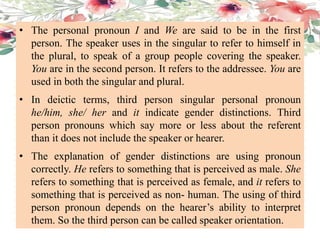
• The personal pronoun I and We are said to be in the first
person. The speaker uses in the singular to refer to himself in
the plural, to speak of a group people covering the speaker.
You are in the second person. It refers to the addressee. You are
used in both the singular and plural.
• In deictic terms, third person singular personal pronoun
he/him, she/ her and it indicate gender distinctions. Third
person pronouns which say more or less about the referent
than it does not include the speaker or hearer.
• The explanation of gender distinctions are using pronoun
correctly. He refers to something that is perceived as male. She
refers to something that is perceived as female, and it refers to
something that is perceived as non- human. The using of third
person pronoun depends on the hearer’s ability to interpret
them. So the third person can be called speaker orientation.
Discourse Deixis
• According Levinson (1983, p.85) “Discourse or text deixis
concerns the use of expressions within some utterance to refer
to some portion of the discourse that contains that the
utterance (including the utterance itself).
• The deictic word used here are the demonstratives this and
that. Demonstrative article divided into four types there are
this, that, these and those (Fromkin, Rodman, and Hyams,
2007, p. 202-203).
For example:
• This is a great poetry.
“This” refers to an upcoming portion of the discourse.
• That was an amazing month.
“That” refers to a prior portion of the discourse.
Social deixis
• It is concerned with direct or oblique reference to the social
status and role of the participants in the speech event.
• Linguistic encodings of social deixis include honorifics,
kinship terms (mother, mum) terms of endearment (My dear,
darling, Billy), insults etc.
• Social deixis falls into two categories
1. absolute (reference to some social characteristics of a
referent apart from any relative ranking of referents e.g.
royal we, editorial we for authorized speakers and Your
Honour, Your Majesty, Mr. President.
2. relational social deixis (reference to the social relationship
between the speaker and the addressee).
References and Recommended Readings
• Fromkin, V., Rodman, R. & Hyams, N. (2007). An
introduction to language (8th ed.). Boston: Thomson
Wadsworth
• Levinson, J. (1983). Pragmatics. New York: Cambridge
University Press.
• Yule, G. (1996). Pragmatics. New York: Oxford University
Press.

Pragmatics: Deixis

  • 1.
    DEIXIS Email : tenry.colle@gmail.com IG: rymari.translation17 Facebook : rymari id YouTube : rymari belajar LinkedIn : Andi Tenry Lawangen Aspat Colle PRAGMATICS
  • 2.
    Deixis …. • Deixisis a technical term (from Greek) for one of the most basic things we do with utterances (Yule, 1996, p. 9). It means “pointing via” language. Any linguistic form used to accomplish this “pointing” is called a deictic expression. Deictic expressions are also sometimes called indexical. • It is the ability to situate the speaker and hearer in relation to one another and to the world around them. Levinson (1983, p. 55) says that deixis belongs within the domain of pragmatics, because it directly concerns the relationship between the structure of languages and contexts in which they are used.
  • 3.
    • Within linguisticview, deixis refers to the phenomenon where in understanding the meaning of certain words and phrases in an utterance requires contextual information. Then, deixis can give interpretation to the context of the utterance, such as who is speaking, the time or place of speaking, the gesture of the speaker, the current location in the discourse and the topic of the discourse.
  • 4.
    Types of Deixis SpatialDeixis The concept of distance is clearly relevant to spatial deixis or place deixis, where the relative location of people and things is being indicated. Levinson (1983, p.62) states: “Place deixis concerns with the encoding of spatial locations relative to the location of the participants in the speech event. Probably most languages grammaticalize at least a distinction between proximal (or close to speaker) and distal (or non- proximal, sometimes close to addressee), but many make much more elaborate distinctions so we shall see. Such distinctions are commonly encoded in demonstratives (as in English this vs. that) and in deictic adverbs of place (like English here vs. there)”
  • 5.
    • Spatial deixisshow itself principally in the form of location adverbs such as here and there, and demonstrative such as this and that. For example: Emma is talking to Harriet: “Come here, please!” Emma request to Mr. Kneithly: “Go there to Randalls!” In closing, spatial deixis is important to remember that location from the speaker’s perspective can be fixed mentally as well as physically. It may be that the truly pragmatic basis of spatial deixis is distance.
  • 6.
    Temporal Deixis Temporal deixisis commonly grammatical zed in deictic adverb of time (like English now and then, yesterday and this year) but above all in tense. English has two basic forms of tenses there are present and past tense. • I live here now. • I lived there then. When somebody uttered (a), it means that the deictic center is close to him because he is still involved in a current situation at which he uttered the utterance or the situation is still in a progress, while (b) is considered distal as the situation does not exist anymore.
  • 7.
    Person Deixis • Persondeixis clearly operates on a basic three part division exemplified by the pronouns for first person (I), second person (you), and third person (he, she or it). • According to Yule (1996, p.10), “The choice of one form will certainly communicative something (not directly said) about the speaker’s view of his or her relationship with the addressee.” • Levinson (1983, p. 62) states: Person deixis concerns with the encoding of the role of participants in the speech event, in which the utterance in question is delivered: the category first person is the grammaticalization of the speaker’s reference to himself, second person the encoding of reference to one or more addresses and third person the encoding of reference to persons and entities which are neither speakers nor addresses of the utterance in question.
  • 8.
    • Person deixisclearly operates on basic three part division exemplified by the pronouns for first person (I), second person (you) and third person (he, she or it). On the other hand, expressions like this person, this man, the car, these houses, etc. are also deictic because they require situational information for the listener to make out the referents or the meanings. • Singular and Plural Pronoun
  • 9.
    Person deixis engagesbasically the speaker, known as the first person, the addressee, known as the second person, and other significant participants in the speech situation, neither speaker nor hearer; these are known as third person. All of these, they come in singular and plural pronoun. For example by using person deixis as follows: The pronoun I: Context: Emma is talking to her father. She smiled up at him over her cup of tea in the living room. "I cannot agree with you, papa; you know I cannot”
  • 10.
    The pronoun you: Context:Emma is talking to her father. She asked for James that he must go to solve the problems in Miss. Woodhouse. “You may be very sure he will always like going to Randalls, because of his daughter's being housemaid there” The pronoun she: Context: When Mr. Knightley was dinner in Mr. Woodhouse, they talked about Miss Taylor’s life after she was married with Mr. Weston. "But, I know she is really very sorry to lose poor Miss Taylor to matrimony, and I am sure ill miss her even more that she thinks for now."
  • 11.
    • The personalpronoun I and We are said to be in the first person. The speaker uses in the singular to refer to himself in the plural, to speak of a group people covering the speaker. You are in the second person. It refers to the addressee. You are used in both the singular and plural. • In deictic terms, third person singular personal pronoun he/him, she/ her and it indicate gender distinctions. Third person pronouns which say more or less about the referent than it does not include the speaker or hearer. • The explanation of gender distinctions are using pronoun correctly. He refers to something that is perceived as male. She refers to something that is perceived as female, and it refers to something that is perceived as non- human. The using of third person pronoun depends on the hearer’s ability to interpret them. So the third person can be called speaker orientation.
  • 12.
    Discourse Deixis • AccordingLevinson (1983, p.85) “Discourse or text deixis concerns the use of expressions within some utterance to refer to some portion of the discourse that contains that the utterance (including the utterance itself). • The deictic word used here are the demonstratives this and that. Demonstrative article divided into four types there are this, that, these and those (Fromkin, Rodman, and Hyams, 2007, p. 202-203). For example: • This is a great poetry. “This” refers to an upcoming portion of the discourse. • That was an amazing month. “That” refers to a prior portion of the discourse.
  • 13.
    Social deixis • Itis concerned with direct or oblique reference to the social status and role of the participants in the speech event. • Linguistic encodings of social deixis include honorifics, kinship terms (mother, mum) terms of endearment (My dear, darling, Billy), insults etc. • Social deixis falls into two categories 1. absolute (reference to some social characteristics of a referent apart from any relative ranking of referents e.g. royal we, editorial we for authorized speakers and Your Honour, Your Majesty, Mr. President. 2. relational social deixis (reference to the social relationship between the speaker and the addressee).
  • 14.
    References and RecommendedReadings • Fromkin, V., Rodman, R. & Hyams, N. (2007). An introduction to language (8th ed.). Boston: Thomson Wadsworth • Levinson, J. (1983). Pragmatics. New York: Cambridge University Press. • Yule, G. (1996). Pragmatics. New York: Oxford University Press.