IMPOLITENESS
SEMANTIK PRAGMATIK
R. DIAN DIA-AN MUNIROH
“[The role of the Politeness Principle is] "to maintain the social equilibrium
and the friendly relations which enable us to assume that our
interlocutors are being cooperative in the first place." (Leech, 1983: 82)
"... politeness, like formal diplomatic protocol (for which it must surely be
the model), presupposes that potential for aggression as it seeks to
disarm it, and makes possible communication between potentially
aggressive parties." (Brown and Levinson, 1987: 1)
"Politeness can be defined as a means of minimizing confrontation in
discourse- both the possibility of confrontation occurring at all, and the
possibility that a confrontation will be perceived as threatening."
(Lakoff, 1989: 102)
The use of strategies that are designed to have the opposite
effect - that of social disruption. These strategies are oriented
towards attacking face, an emotionally sensitive concept of the
self (Goffman, 1967; Brown and Levinson, 1987)
Impoliteness (Culpeper, 1996)
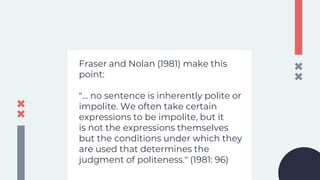
Fraser and Nolan (1981) make this
point:
"... no sentence is inherently polite or
impolite. We often take certain
expressions to be impolite, but it
is not the expressions themselves
but the conditions under which they
are used that determines the
judgment of politeness." (1981: 96)
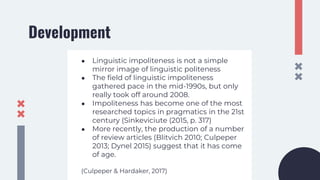
Development
● Linguistic impoliteness is not a simple
mirror image of linguistic politeness
● The field of linguistic impoliteness
gathered pace in the mid-1990s, but only
really took off around 2008.
● Impoliteness has become one of the most
researched topics in pragmatics in the 21st
century (Sinkeviciute (2015, p. 317)
● More recently, the production of a number
of review articles (Blitvich 2010; Culpeper
2013; Dynel 2015) suggest that it has come
of age.
(Culpeper & Hardaker, 2017)
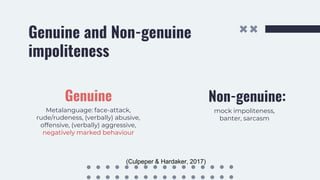
Genuine and Non-genuine
impoliteness
Genuine
Metalanguage: face-attack,
rude/rudeness, (verbally) abusive,
offensive, (verbally) aggressive,
negatively marked behaviour
Non-genuine:
mock impoliteness,
banter, sarcasm
(Culpeper & Hardaker, 2017)
Definition: Intention
Impoliteness constitutes the communication of intentionally
gratuitous and conflictive verbal face-threatening acts which are
purposefully delivered: (1) unmitigated […], and /or (ii) with
deliberate aggression […].
(Bousfield, 2008:72)
Impoliteness comes about when: (1) the speaker communicates
face-attack intentionally, or (2) the hearer perceives behaviour as
intentionally face-attacking, or a combination of (1) and (2).
(Culpeper, 2005:38)
The
speaker's
perceptions
of
intentionality
The
speaker’s
and the
hearer’s
perceptions
of
intentionality
full intentionality is not a
necessary condition of
impoliteness
Not all impoliteness is intentional because …
1. sometimes the producer of impoliteness is not aware of the
impoliteness effects they are causing (being aware is a key
part of the notion of intentionality; cf. Malle and Knobe 1997)
2. the act is considered impolite nevertheless, because the
producer is blamed for not predicting those effects (see
Ferguson and Rule 1983 on attributions of blame)
Definition: Revisited
Four prototypical features of impoliteness:
1. speaker intent/projectability;
2. speaker awareness of possible face-damaging
effects of their utterance(s);
3. hearer perception/construction of the speaker’s
intent/hurtfulness of their words, leading to;
4. hearer face actually being, or not being, damaged.
(Bousfield 2010, p. 124)
Definition: Revisited
Impoliteness is a negative attitude towards specific behaviours
occurring in specific contexts. It is sustained by expectations, desires
and /or beliefs about social organisation, including, in particular, how
one person’s or a group’s identities are mediated by others in
interaction. Situated behaviours are viewed negatively—considered
‘impolite’—when they conflict with how one expects them to be, how
one wants them to be and/or how one thinks they ought to be. Such
behaviours always have or are presumed to have emotional
consequences for at least one participant, that is, they cause or are
presumed to cause offence. (Culpeper, 2011)
Three waves in the development of impoliteness
First wave - classic politeness models
• To counter the gap in Brown & Levinson's politeness strategies that
ignored impoliteness
• The wish to counter this gap that drove a growth in studies, starting in
the mid-1990s and truly taking off around 2008, showing that
impoliteness can be strategic, systematic, sophisticated and not
uncommon
• Culpeper (1996) is among Brown and Levinson inspired model of
impoliteness
Mock Impoliteness
● Mock impoliteness or banter, is impoliteness that
remains on the surface, since it is understood that
it is not intended to cause offence.
● I once turned up late for a party, and upon
explaining to the host that I had mistaken 17.00
hours for 7 o'clock, I was greeted with a smile and
the words "You silly bugger"
Leech's (1983) Banter Principle:
"In order to show solidarity with h, say something
which is (i) obviously untrue, and (ii) obviously
impolite to h" [and this will give rise to an
interpretation such that] "what s says is impolite to h
and is clearly untrue. Therefore, what s really means
is polite to h and true." (1983: 144)
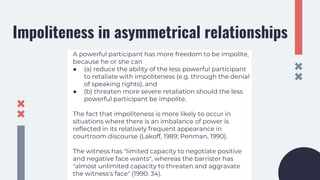
Impoliteness in asymmetrical relationships
A powerful participant has more freedom to be impolite,
because he or she can
● (a) reduce the ability of the less powerful participant
to retaliate with impoliteness (e.g. through the denial
of speaking rights), and
● (b) threaten more severe retaliation should the less
powerful participant be impolite.
The fact that impoliteness is more likely to occur in
situations where there is an imbalance of power is
reflected in its relatively frequent appearance in
courtroom discourse (Lakoff, 1989; Penman, 1990).
The witness has "limited capacity to negotiate positive
and negative face wants", whereas the barrister has
"almost unlimited capacity to threaten and aggravate
the witness's face" (1990: 34).
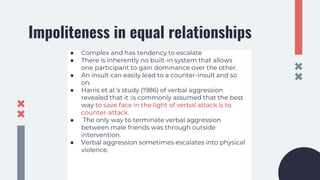
Impoliteness in equal relationships
● Complex and has tendency to escalate
● There is inherently no built-in system that allows
one participant to gain dominance over the other.
● An insult can easily lead to a counter-insult and so
on.
● Harris et al.'s study (1986) of verbal aggression
revealed that it :is commonly assumed that the best
way to save face in the light of verbal attack is to
counter-attack.
● The only way to terminate verbal aggression
between male friends was through outside
intervention.
● Verbal aggression sometimes escalates into physical
violence.
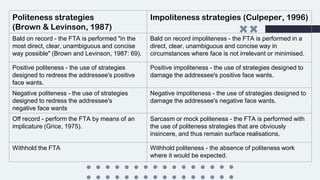
Politeness strategies
(Brown & Levinson, 1987)
Impoliteness strategies (Culpeper, 1996)
Bald on record - the FTA is performed "in the
most direct, clear, unambiguous and concise
way possible" (Brown and Levinson, 1987: 69).
Bald on record impoliteness - the FTA is performed in a
direct, clear, unambiguous and concise way in
circumstances where face is not irrelevant or minimised.
Positive politeness - the use of strategies
designed to redress the addressee's positive
face wants.
Positive impoliteness - the use of strategies designed to
damage the addressee's positive face wants.
Negative politeness - the use of strategies
designed to redress the addressee's
negative face wants
Negative impoliteness - the use of strategies designed to
damage the addressee's negative face wants.
Off record - perform the FTA by means of an
implicature (Grice, 1975).
Sarcasm or mock politeness - the FTA is performed with
the use of politeness strategies that are obviously
insincere, and thus remain surface realisations.
Withhold the FTA Withhold politeness - the absence of politeness work
where it would be expected.
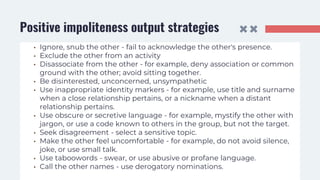
Positive impoliteness output strategies
• Ignore, snub the other - fail to acknowledge the other's presence.
• Exclude the other from an activity
• Disassociate from the other - for example, deny association or common
ground with the other; avoid sitting together.
• Be disinterested, unconcerned, unsympathetic
• Use inappropriate identity markers - for example, use title and surname
when a close relationship pertains, or a nickname when a distant
relationship pertains.
• Use obscure or secretive language - for example, mystify the other with
jargon, or use a code known to others in the group, but not the target.
• Seek disagreement - select a sensitive topic.
• Make the other feel uncomfortable - for example, do not avoid silence,
joke, or use small talk.
• Use taboowords - swear, or use abusive or profane language.
• Call the other names - use derogatory nominations.
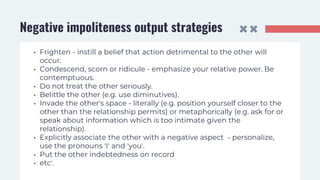
Negative impoliteness output strategies
• Frighten - instill a belief that action detrimental to the other will
occur.
• Condescend, scorn or ridicule - emphasize your relative power. Be
contemptuous.
• Do not treat the other seriously.
• Belittle the other (e.g. use diminutives).
• Invade the other's space - literally (e.g. position yourself closer to the
other than the relationship permits) or metaphorically (e.g. ask for or
speak about information which is too intimate given the
relationship).
• Explicitly associate the other with a negative aspect - personalize,
use the pronouns 'I' and 'you'.
• Put the other indebtedness on record
• etc'.
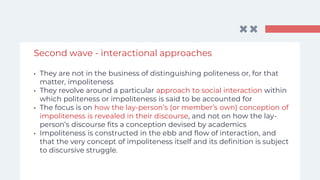
Second wave - interactional approaches
• They are not in the business of distinguishing politeness or, for that
matter, impoliteness
• They revolve around a particular approach to social interaction within
which politeness or impoliteness is said to be accounted for
• The focus is on how the lay-person’s (or member’s own) conception of
impoliteness is revealed in their discourse, and not on how the lay-
person’s discourse fits a conception devised by academics
• Impoliteness is constructed in the ebb and flow of interaction, and
that the very concept of impoliteness itself and its definition is subject
to discursive struggle.
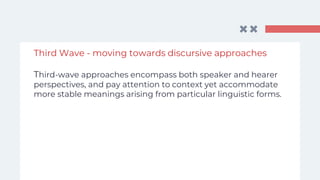
Third Wave - moving towards discursive approaches
Third-wave approaches encompass both speaker and hearer
perspectives, and pay attention to context yet accommodate
more stable meanings arising from particular linguistic forms.
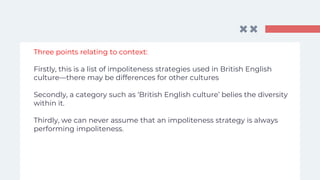
Three points relating to context:
Firstly, this is a list of impoliteness strategies used in British English
culture—there may be differences for other cultures
Secondly, a category such as ‘British English culture’ belies the diversity
within it.
Thirdly, we can never assume that an impoliteness strategy is always
performing impoliteness.
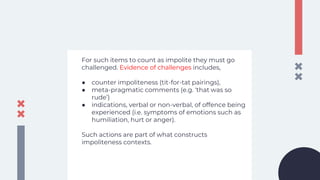
For such items to count as impolite they must go
challenged. Evidence of challenges includes,
● counter impoliteness (tit-for-tat pairings),
● meta-pragmatic comments (e.g. ‘that was so
rude’)
● indications, verbal or non-verbal, of offence being
experienced (i.e. symptoms of emotions such as
humiliation, hurt or anger).
Such actions are part of what constructs
impoliteness contexts.
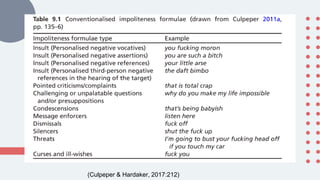
(Culpeper & Hardaker, 2017:212)
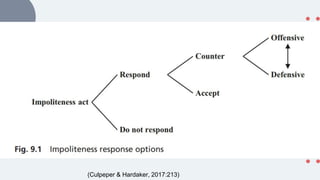
(Culpeper & Hardaker, 2017:213)
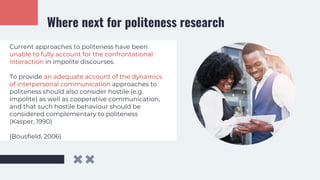
Where next for politeness research
Current approaches to politeness have been
unable to fully account for the confrontational
interaction in impolite discourses.
To provide an adequate account of the dynamics
of interpersonal communication approaches to
politeness should also consider hostile (e.g.
impolite) as well as cooperative communication,
and that such hostile behaviour should be
considered complementary to politeness
(Kasper, 1990)
(Bousfield, 2006)
Mills (2005: 270) argues, politeness and impoliteness are not to
be viewed as dichotomous
polar opposites in the contexts in which they can and do occur.
Culpeper (2005) in the development of his model of
impoliteness abandons the Brown and
Levinson (1987) dichotomy on face in favour of Spencer-Oatey's
(2002) categories.
Watts (2003), Locher (2004) and Locher and Watts (2005) reject
the pre-eminence of face by claiming that it is, in fact,
<<relationalwork>>and not <<face theory>>that lies at the heart
of politeness (understood as a discursive concept)
Thomas (1995: 176) notes the following:
Woman addressing importunate man.
'Do me a favour -piss off!'
the politeness work in the first part of the utterance (...Do me a favour...)
- putting one's indebtedness on record is face-enhancing for your
interlocutor
the latter part (.. . - piss off!) is a conventionalised impolite utterance in
British English which is a combined attack (cf. Culpeper, Bousfield and
Wichmann, 2003) upon both the intended recipient's positive face by
(amongst other things) the use of taboo language (cf. Culpeper, 1996)
and the recipient's negative face by attempting to exclude them from
the current in loco activities by insisting that they leave (cf. Culpeper,
1996), which together suggest that the recipient is not wanted and does
not belong (a Positive face attack)
Too many theories (cf. Brown and Levinson, 1987 [1978];
Lachenicht, 1980; and Leech,
1983) consider impoliteness within the context of a single turn
at talk.
They do not adequately describe, nor predict, how
(im)politeness may be used by speakers in extended, real-life
interactions.
Investigating the phenomena of impoliteness in the fuller
context of extended discourse as it is understood, schematically,
by the participants (cf. Terkourafi, 2005) has significant
contributions to make.
Slidesgo
Flaticon Freepik
CREDITS: This presentation template was
created by Slidesgo, including icons by
Flaticon, infographics & images by Freepik
Thanks
Do you have any questions?
addyouremail@freepik.com
+91 620 421 838
yourcompany.com
Please keep this slide for attribution
Impoliteness Semantic Pragmatics Language

Impoliteness Semantic Pragmatics Language

  • 1.
  • 2.
    “[The role ofthe Politeness Principle is] "to maintain the social equilibrium and the friendly relations which enable us to assume that our interlocutors are being cooperative in the first place." (Leech, 1983: 82) "... politeness, like formal diplomatic protocol (for which it must surely be the model), presupposes that potential for aggression as it seeks to disarm it, and makes possible communication between potentially aggressive parties." (Brown and Levinson, 1987: 1) "Politeness can be defined as a means of minimizing confrontation in discourse- both the possibility of confrontation occurring at all, and the possibility that a confrontation will be perceived as threatening." (Lakoff, 1989: 102)
  • 3.
    The use ofstrategies that are designed to have the opposite effect - that of social disruption. These strategies are oriented towards attacking face, an emotionally sensitive concept of the self (Goffman, 1967; Brown and Levinson, 1987) Impoliteness (Culpeper, 1996)
  • 4.
    Fraser and Nolan(1981) make this point: "... no sentence is inherently polite or impolite. We often take certain expressions to be impolite, but it is not the expressions themselves but the conditions under which they are used that determines the judgment of politeness." (1981: 96)
  • 5.
    Development ● Linguistic impolitenessis not a simple mirror image of linguistic politeness ● The field of linguistic impoliteness gathered pace in the mid-1990s, but only really took off around 2008. ● Impoliteness has become one of the most researched topics in pragmatics in the 21st century (Sinkeviciute (2015, p. 317) ● More recently, the production of a number of review articles (Blitvich 2010; Culpeper 2013; Dynel 2015) suggest that it has come of age. (Culpeper & Hardaker, 2017)
  • 6.
    Genuine and Non-genuine impoliteness Genuine Metalanguage:face-attack, rude/rudeness, (verbally) abusive, offensive, (verbally) aggressive, negatively marked behaviour Non-genuine: mock impoliteness, banter, sarcasm (Culpeper & Hardaker, 2017)
  • 7.
    Definition: Intention Impoliteness constitutesthe communication of intentionally gratuitous and conflictive verbal face-threatening acts which are purposefully delivered: (1) unmitigated […], and /or (ii) with deliberate aggression […]. (Bousfield, 2008:72) Impoliteness comes about when: (1) the speaker communicates face-attack intentionally, or (2) the hearer perceives behaviour as intentionally face-attacking, or a combination of (1) and (2). (Culpeper, 2005:38) The speaker's perceptions of intentionality The speaker’s and the hearer’s perceptions of intentionality full intentionality is not a necessary condition of impoliteness
  • 8.
    Not all impolitenessis intentional because … 1. sometimes the producer of impoliteness is not aware of the impoliteness effects they are causing (being aware is a key part of the notion of intentionality; cf. Malle and Knobe 1997) 2. the act is considered impolite nevertheless, because the producer is blamed for not predicting those effects (see Ferguson and Rule 1983 on attributions of blame)
  • 9.
    Definition: Revisited Four prototypicalfeatures of impoliteness: 1. speaker intent/projectability; 2. speaker awareness of possible face-damaging effects of their utterance(s); 3. hearer perception/construction of the speaker’s intent/hurtfulness of their words, leading to; 4. hearer face actually being, or not being, damaged. (Bousfield 2010, p. 124)
  • 10.
    Definition: Revisited Impoliteness isa negative attitude towards specific behaviours occurring in specific contexts. It is sustained by expectations, desires and /or beliefs about social organisation, including, in particular, how one person’s or a group’s identities are mediated by others in interaction. Situated behaviours are viewed negatively—considered ‘impolite’—when they conflict with how one expects them to be, how one wants them to be and/or how one thinks they ought to be. Such behaviours always have or are presumed to have emotional consequences for at least one participant, that is, they cause or are presumed to cause offence. (Culpeper, 2011)
  • 11.
    Three waves inthe development of impoliteness First wave - classic politeness models • To counter the gap in Brown & Levinson's politeness strategies that ignored impoliteness • The wish to counter this gap that drove a growth in studies, starting in the mid-1990s and truly taking off around 2008, showing that impoliteness can be strategic, systematic, sophisticated and not uncommon • Culpeper (1996) is among Brown and Levinson inspired model of impoliteness
  • 12.
    Mock Impoliteness ● Mockimpoliteness or banter, is impoliteness that remains on the surface, since it is understood that it is not intended to cause offence. ● I once turned up late for a party, and upon explaining to the host that I had mistaken 17.00 hours for 7 o'clock, I was greeted with a smile and the words "You silly bugger" Leech's (1983) Banter Principle: "In order to show solidarity with h, say something which is (i) obviously untrue, and (ii) obviously impolite to h" [and this will give rise to an interpretation such that] "what s says is impolite to h and is clearly untrue. Therefore, what s really means is polite to h and true." (1983: 144)
  • 13.
    Impoliteness in asymmetricalrelationships A powerful participant has more freedom to be impolite, because he or she can ● (a) reduce the ability of the less powerful participant to retaliate with impoliteness (e.g. through the denial of speaking rights), and ● (b) threaten more severe retaliation should the less powerful participant be impolite. The fact that impoliteness is more likely to occur in situations where there is an imbalance of power is reflected in its relatively frequent appearance in courtroom discourse (Lakoff, 1989; Penman, 1990). The witness has "limited capacity to negotiate positive and negative face wants", whereas the barrister has "almost unlimited capacity to threaten and aggravate the witness's face" (1990: 34).
  • 14.
    Impoliteness in equalrelationships ● Complex and has tendency to escalate ● There is inherently no built-in system that allows one participant to gain dominance over the other. ● An insult can easily lead to a counter-insult and so on. ● Harris et al.'s study (1986) of verbal aggression revealed that it :is commonly assumed that the best way to save face in the light of verbal attack is to counter-attack. ● The only way to terminate verbal aggression between male friends was through outside intervention. ● Verbal aggression sometimes escalates into physical violence.
  • 15.
    Politeness strategies (Brown &Levinson, 1987) Impoliteness strategies (Culpeper, 1996) Bald on record - the FTA is performed "in the most direct, clear, unambiguous and concise way possible" (Brown and Levinson, 1987: 69). Bald on record impoliteness - the FTA is performed in a direct, clear, unambiguous and concise way in circumstances where face is not irrelevant or minimised. Positive politeness - the use of strategies designed to redress the addressee's positive face wants. Positive impoliteness - the use of strategies designed to damage the addressee's positive face wants. Negative politeness - the use of strategies designed to redress the addressee's negative face wants Negative impoliteness - the use of strategies designed to damage the addressee's negative face wants. Off record - perform the FTA by means of an implicature (Grice, 1975). Sarcasm or mock politeness - the FTA is performed with the use of politeness strategies that are obviously insincere, and thus remain surface realisations. Withhold the FTA Withhold politeness - the absence of politeness work where it would be expected.
  • 16.
    Positive impoliteness outputstrategies • Ignore, snub the other - fail to acknowledge the other's presence. • Exclude the other from an activity • Disassociate from the other - for example, deny association or common ground with the other; avoid sitting together. • Be disinterested, unconcerned, unsympathetic • Use inappropriate identity markers - for example, use title and surname when a close relationship pertains, or a nickname when a distant relationship pertains. • Use obscure or secretive language - for example, mystify the other with jargon, or use a code known to others in the group, but not the target. • Seek disagreement - select a sensitive topic. • Make the other feel uncomfortable - for example, do not avoid silence, joke, or use small talk. • Use taboowords - swear, or use abusive or profane language. • Call the other names - use derogatory nominations.
  • 17.
    Negative impoliteness outputstrategies • Frighten - instill a belief that action detrimental to the other will occur. • Condescend, scorn or ridicule - emphasize your relative power. Be contemptuous. • Do not treat the other seriously. • Belittle the other (e.g. use diminutives). • Invade the other's space - literally (e.g. position yourself closer to the other than the relationship permits) or metaphorically (e.g. ask for or speak about information which is too intimate given the relationship). • Explicitly associate the other with a negative aspect - personalize, use the pronouns 'I' and 'you'. • Put the other indebtedness on record • etc'.
  • 18.
    Second wave -interactional approaches • They are not in the business of distinguishing politeness or, for that matter, impoliteness • They revolve around a particular approach to social interaction within which politeness or impoliteness is said to be accounted for • The focus is on how the lay-person’s (or member’s own) conception of impoliteness is revealed in their discourse, and not on how the lay- person’s discourse fits a conception devised by academics • Impoliteness is constructed in the ebb and flow of interaction, and that the very concept of impoliteness itself and its definition is subject to discursive struggle.
  • 19.
    Third Wave -moving towards discursive approaches Third-wave approaches encompass both speaker and hearer perspectives, and pay attention to context yet accommodate more stable meanings arising from particular linguistic forms.
  • 20.
    Three points relatingto context: Firstly, this is a list of impoliteness strategies used in British English culture—there may be differences for other cultures Secondly, a category such as ‘British English culture’ belies the diversity within it. Thirdly, we can never assume that an impoliteness strategy is always performing impoliteness.
  • 21.
    For such itemsto count as impolite they must go challenged. Evidence of challenges includes, ● counter impoliteness (tit-for-tat pairings), ● meta-pragmatic comments (e.g. ‘that was so rude’) ● indications, verbal or non-verbal, of offence being experienced (i.e. symptoms of emotions such as humiliation, hurt or anger). Such actions are part of what constructs impoliteness contexts.
  • 22.
  • 23.
  • 24.
    Where next forpoliteness research Current approaches to politeness have been unable to fully account for the confrontational interaction in impolite discourses. To provide an adequate account of the dynamics of interpersonal communication approaches to politeness should also consider hostile (e.g. impolite) as well as cooperative communication, and that such hostile behaviour should be considered complementary to politeness (Kasper, 1990) (Bousfield, 2006)
  • 25.
    Mills (2005: 270)argues, politeness and impoliteness are not to be viewed as dichotomous polar opposites in the contexts in which they can and do occur. Culpeper (2005) in the development of his model of impoliteness abandons the Brown and Levinson (1987) dichotomy on face in favour of Spencer-Oatey's (2002) categories. Watts (2003), Locher (2004) and Locher and Watts (2005) reject the pre-eminence of face by claiming that it is, in fact, <<relationalwork>>and not <<face theory>>that lies at the heart of politeness (understood as a discursive concept)
  • 26.
    Thomas (1995: 176)notes the following: Woman addressing importunate man. 'Do me a favour -piss off!' the politeness work in the first part of the utterance (...Do me a favour...) - putting one's indebtedness on record is face-enhancing for your interlocutor the latter part (.. . - piss off!) is a conventionalised impolite utterance in British English which is a combined attack (cf. Culpeper, Bousfield and Wichmann, 2003) upon both the intended recipient's positive face by (amongst other things) the use of taboo language (cf. Culpeper, 1996) and the recipient's negative face by attempting to exclude them from the current in loco activities by insisting that they leave (cf. Culpeper, 1996), which together suggest that the recipient is not wanted and does not belong (a Positive face attack)
  • 27.
    Too many theories(cf. Brown and Levinson, 1987 [1978]; Lachenicht, 1980; and Leech, 1983) consider impoliteness within the context of a single turn at talk. They do not adequately describe, nor predict, how (im)politeness may be used by speakers in extended, real-life interactions. Investigating the phenomena of impoliteness in the fuller context of extended discourse as it is understood, schematically, by the participants (cf. Terkourafi, 2005) has significant contributions to make.
  • 28.
    Slidesgo Flaticon Freepik CREDITS: Thispresentation template was created by Slidesgo, including icons by Flaticon, infographics & images by Freepik Thanks Do you have any questions? addyouremail@freepik.com +91 620 421 838 yourcompany.com Please keep this slide for attribution