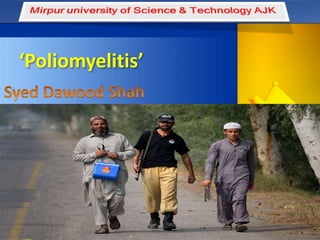

‘Poliomyelitis’
Contents
• Introduction
• Symptoms
• Historical Background
• Causative Organism
• Mode of transmission
• Types of POLIO
• Management
• Prevention
• Vaccine
• Conclusion
2
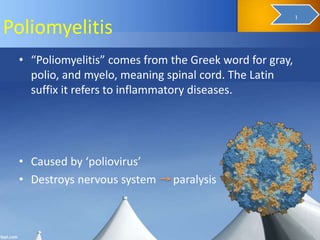
Poliomyelitis
• “Poliomyelitis” comes from the Greek word for gray,
polio, and myelo, meaning spinal cord. The Latin
suffix it refers to inflammatory diseases.
• Caused by ‘poliovirus’
• Destroys nervous system paralysis
3
1
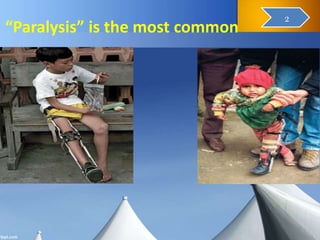
“Paralysis” is the most common
4
2
Symptoms
• General symptoms include:
• Muscle pain
• Breathing difficulty
• Swallowing difficulty
• Moderate fevers
• Vomiting
• Slight fever .
5
3
What is poliomyelitis?
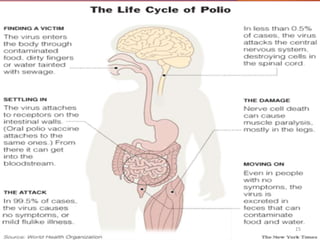
• Poliomyelitis, often referred to as Polio, is a virally
induced disease which spreads through the fecal-oral
route. In some cases it may enter the blood stream
and into the central nervous system, often causing
muscle weakness and paralysis. Children at the age
of five and under are most likely to be the victims of
this disease, due to their weak immune systems.
6
4
Historical Background
• First recorded case of polio is from a 5 year old boy
from Syria whose history was carved in stone three
thousand years ago.
• Cleaner environment after the Industrial Era led to
epidemics of polio.
• Americans believed that the Italians brought it over
since immigrants are “dirty” and live in the slums.
7
5
Historical Background
• 1789, British physician Michael Underwood provides
first clinical description of the disease.
• 1894, first outbreak of polio epidemic in the U.S.
occurs in Vermont, with 132 cases.
• 1962, the Salk vaccine(IPV) replaced by the Sabin
vaccine(OPV) for most purposes because it is easier
to administer and less expensive.
• 2005, 50th anniversary of the Salk vaccine on April
12.
8
6
Historical Background
• Polio – Then
• 1988
– Endemic in 125 countries
– Over 1000 children paralyzed per day
• Polio – Now
• In 2014 polio was spread between people
of
– Nigeria
– Pakistan
– Afghanistan
9
7
Causative Organism
• Poliovirus: belongs to “Picorna” viruses which are
small RNA-containing viruses.
• Polioviruses have three antigenically distinct types,
– Type I: “Leon”; the commonest in epidemics
– Type II: “Berlinhide”; the prevailing type in
endemic areas.
– Type III: “Lansing”; occasionally causes epidemics.
10
8
Reservoir of infection
• Man is the only reservoir of infection of poliomyelitis.
• Man is the only carrier of Poliomyelitis.
11
9
Mode of Transmission
• Infection are mostly in throat and small intestines,
poliomyelitis spreads by two routes:
– Oral-oral infection: direct droplet infection
– Faeco-oral infection:
• Through contaminated foods. Vehicles include milk,
water, or any others that may be contaminated by
handling, flies, dust…
Polio virus has the ability to survive in cold environments. Overcrowding
and poor sanitation provide opportunities for exposure to infection
12
10
Period of Communicability
• Estimated to about 2 weeks
• Cases: 7 to 10 days before and after the onset of
symptoms.
• Virus is excreted commonly for 2 to 3 weeks,
sometimes as long as 3 to 4 months in faeces.
• In polio cases, infectivity in the pharyngeal foci is
around one week, and in the intestinal foci 6-8
weeks.
Incubation Period: 7-14 days
13
11
Host factors
• Age:
– All age groups; children(6 MONTHS TO 3 YEARS
most susceptible)
– more than 95% reported in infancy and childhood
with over 50% of them in infancy.
• Gender:
– no sex ratio differences, but in some countries,
males are infected more frequently than females
in a ratio 3:1.
14
12
15
Clinical Spectrum:
1- Inapparent (Subclinical) Infection
2- Abortive polio or Minor Illness
3- Non-paralytic polio
4- Paralytic polio
16
15
Inapparent Infection
• Occurs approximately in 91-96% of poliovirus infection.
• Incidence is more than 75 to 1000 times the clinical
cases.
• May or may not have symptoms-
– Headache
– Red throat
– Slight fever
– Vomiting
17
16
Abortive polio (minor illness)
• Occurs approximately in 4-8% of the infection.
• Causes only a mild or self limiting illness due to
viraemia (virus in blood).
• Patient recovers quickly.
• Symptoms:
– Moderate fever
– Upper respiratory manifestations: sore thoart
– Gastrointestinal manifestations: vomiting.
18
17
Non paralytic polio:
• Occurs approximately in one per cent of all
infections.
• pain in neck and back.
• Disease lasts for 2-10 days.
• Recovery is rapid.
• Signs: paresthesia,paralysis.
19
18
Paralytic polio:
• Occurs in less then one per cent of infections.
• The virus enters the CNS and causes varying degree of
disability with destruction of the motor nerve cells.
• Forms: spinal, bulbar, and bulbospinal paralysis.
• Paralysis usually appears within 4 days (around 7-10 days
from onset of disease).
20
19
Management
• Treatment of pain with analgesics (such as
acetaminophen).
• Antibiotics for secondary infections (none for poliovirus).
• Bed rest (until fever is reduced)
• Adequate diet
• Minimal exertion and exercise
• Physiotherapy may be necessary.
21
20
Prevention
• The best preventive measure for poliomyelitis is ensuring
hygiene and encouraging good sanitation practices.
• But, polio prevention begins with polio vaccination. Polio
vaccine has been developed against all 3 subtypes of the
poliovirus and is very effective in producing protective
antibodies that induces immunity against the poliovirus
and provides protection from paralytic polio.
22
21
Types of Polio vaccines
• Two are available:
– An inactivated (killed) polio vaccine (IPV) and
– A live attenuated (weakened) oral polio vaccine
(OPV).
23
22
Inactive Polio Vaccine (IPV)
• School children and families were vaccinated, reducing
the incidence of polio by almost 90% within two years
(Bradford).
• +Immunization triggers an excellent immune response
and long-lasting immunity to all 3 poliovirus types
(Bradford)
• +The virus is not live, thus it is easier to manage than
OPV (Bradford)
• -The price of IPV is over 5 times that of OPV (Bradford)
• -IPV induces only little immunity in intestinal tract
(Bradford)
24
23
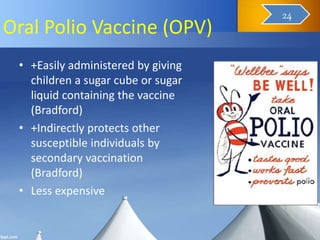
Oral Polio Vaccine (OPV)
• +Easily administered by giving
children a sugar cube or sugar
liquid containing the vaccine
(Bradford)
• +Indirectly protects other
susceptible individuals by
secondary vaccination
(Bradford)
• Less expensive
25
24
Conclusion
• Poliomyelitis is acute enteroviral illness.
• The most devastating result of poliovirus infection is
‘paralysis’.
• Poliomyelitis should be considered in the differential
diagnosis of any case of paralysis.
• Vaccination is the only effective method of
prevention.
26
25
27

‘Poliomyeliti’ or Polio

  • 1.
  • 2.
    Contents • Introduction • Symptoms •Historical Background • Causative Organism • Mode of transmission • Types of POLIO • Management • Prevention • Vaccine • Conclusion 2
  • 3.
    Poliomyelitis • “Poliomyelitis” comesfrom the Greek word for gray, polio, and myelo, meaning spinal cord. The Latin suffix it refers to inflammatory diseases. • Caused by ‘poliovirus’ • Destroys nervous system paralysis 3 1
  • 4.
    “Paralysis” is themost common 4 2
  • 5.
    Symptoms • General symptomsinclude: • Muscle pain • Breathing difficulty • Swallowing difficulty • Moderate fevers • Vomiting • Slight fever . 5 3
  • 6.
    What is poliomyelitis? •Poliomyelitis, often referred to as Polio, is a virally induced disease which spreads through the fecal-oral route. In some cases it may enter the blood stream and into the central nervous system, often causing muscle weakness and paralysis. Children at the age of five and under are most likely to be the victims of this disease, due to their weak immune systems. 6 4
  • 7.
    Historical Background • Firstrecorded case of polio is from a 5 year old boy from Syria whose history was carved in stone three thousand years ago. • Cleaner environment after the Industrial Era led to epidemics of polio. • Americans believed that the Italians brought it over since immigrants are “dirty” and live in the slums. 7 5
  • 8.
    Historical Background • 1789,British physician Michael Underwood provides first clinical description of the disease. • 1894, first outbreak of polio epidemic in the U.S. occurs in Vermont, with 132 cases. • 1962, the Salk vaccine(IPV) replaced by the Sabin vaccine(OPV) for most purposes because it is easier to administer and less expensive. • 2005, 50th anniversary of the Salk vaccine on April 12. 8 6
  • 9.
    Historical Background • Polio– Then • 1988 – Endemic in 125 countries – Over 1000 children paralyzed per day • Polio – Now • In 2014 polio was spread between people of – Nigeria – Pakistan – Afghanistan 9 7
  • 10.
    Causative Organism • Poliovirus:belongs to “Picorna” viruses which are small RNA-containing viruses. • Polioviruses have three antigenically distinct types, – Type I: “Leon”; the commonest in epidemics – Type II: “Berlinhide”; the prevailing type in endemic areas. – Type III: “Lansing”; occasionally causes epidemics. 10 8
  • 11.
    Reservoir of infection •Man is the only reservoir of infection of poliomyelitis. • Man is the only carrier of Poliomyelitis. 11 9
  • 12.
    Mode of Transmission •Infection are mostly in throat and small intestines, poliomyelitis spreads by two routes: – Oral-oral infection: direct droplet infection – Faeco-oral infection: • Through contaminated foods. Vehicles include milk, water, or any others that may be contaminated by handling, flies, dust… Polio virus has the ability to survive in cold environments. Overcrowding and poor sanitation provide opportunities for exposure to infection 12 10
  • 13.
    Period of Communicability •Estimated to about 2 weeks • Cases: 7 to 10 days before and after the onset of symptoms. • Virus is excreted commonly for 2 to 3 weeks, sometimes as long as 3 to 4 months in faeces. • In polio cases, infectivity in the pharyngeal foci is around one week, and in the intestinal foci 6-8 weeks. Incubation Period: 7-14 days 13 11
  • 14.
    Host factors • Age: –All age groups; children(6 MONTHS TO 3 YEARS most susceptible) – more than 95% reported in infancy and childhood with over 50% of them in infancy. • Gender: – no sex ratio differences, but in some countries, males are infected more frequently than females in a ratio 3:1. 14 12
  • 15.
  • 16.
    Clinical Spectrum: 1- Inapparent(Subclinical) Infection 2- Abortive polio or Minor Illness 3- Non-paralytic polio 4- Paralytic polio 16 15
  • 17.
    Inapparent Infection • Occursapproximately in 91-96% of poliovirus infection. • Incidence is more than 75 to 1000 times the clinical cases. • May or may not have symptoms- – Headache – Red throat – Slight fever – Vomiting 17 16
  • 18.
    Abortive polio (minorillness) • Occurs approximately in 4-8% of the infection. • Causes only a mild or self limiting illness due to viraemia (virus in blood). • Patient recovers quickly. • Symptoms: – Moderate fever – Upper respiratory manifestations: sore thoart – Gastrointestinal manifestations: vomiting. 18 17
  • 19.
    Non paralytic polio: •Occurs approximately in one per cent of all infections. • pain in neck and back. • Disease lasts for 2-10 days. • Recovery is rapid. • Signs: paresthesia,paralysis. 19 18
  • 20.
    Paralytic polio: • Occursin less then one per cent of infections. • The virus enters the CNS and causes varying degree of disability with destruction of the motor nerve cells. • Forms: spinal, bulbar, and bulbospinal paralysis. • Paralysis usually appears within 4 days (around 7-10 days from onset of disease). 20 19
  • 21.
    Management • Treatment ofpain with analgesics (such as acetaminophen). • Antibiotics for secondary infections (none for poliovirus). • Bed rest (until fever is reduced) • Adequate diet • Minimal exertion and exercise • Physiotherapy may be necessary. 21 20
  • 22.
    Prevention • The bestpreventive measure for poliomyelitis is ensuring hygiene and encouraging good sanitation practices. • But, polio prevention begins with polio vaccination. Polio vaccine has been developed against all 3 subtypes of the poliovirus and is very effective in producing protective antibodies that induces immunity against the poliovirus and provides protection from paralytic polio. 22 21
  • 23.
    Types of Poliovaccines • Two are available: – An inactivated (killed) polio vaccine (IPV) and – A live attenuated (weakened) oral polio vaccine (OPV). 23 22
  • 24.
    Inactive Polio Vaccine(IPV) • School children and families were vaccinated, reducing the incidence of polio by almost 90% within two years (Bradford). • +Immunization triggers an excellent immune response and long-lasting immunity to all 3 poliovirus types (Bradford) • +The virus is not live, thus it is easier to manage than OPV (Bradford) • -The price of IPV is over 5 times that of OPV (Bradford) • -IPV induces only little immunity in intestinal tract (Bradford) 24 23
  • 25.
    Oral Polio Vaccine(OPV) • +Easily administered by giving children a sugar cube or sugar liquid containing the vaccine (Bradford) • +Indirectly protects other susceptible individuals by secondary vaccination (Bradford) • Less expensive 25 24
  • 26.
    Conclusion • Poliomyelitis isacute enteroviral illness. • The most devastating result of poliovirus infection is ‘paralysis’. • Poliomyelitis should be considered in the differential diagnosis of any case of paralysis. • Vaccination is the only effective method of prevention. 26 25
  • 27.