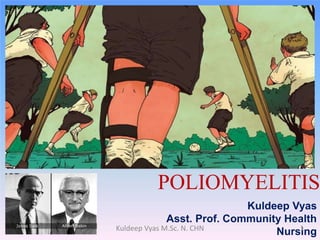

POLIOMYELITIS
Kuldeep Vyas
Asst. Prof. Community Health
Nursing1Kuldeep Vyas M.Sc. N. CHN
Introduction
 Greek poliós= "grey", myelós= marrow, and the suffix -
itis= inflammation
 First described by British physician Micheal Underwood in 1799
referring to it as "debility of the lower extremities.“
 A viral infection most often recognized by acute onset of flaccid
paralysis.
 Primarily an infection of human alimentary tract, but may infect
CNS in very small no. (i.e <1%)
 Infection results in a spectrum of clinical manifestations……
2Kuldeep Vyas M.Sc. N. CHN
3Kuldeep Vyas M.Sc. N. CHN
Problem statement
World
 A worldwide problem in pre vaccination era
 With the wide use of polio vaccine from 1954 disease
being eliminated from most of the developed countries
 In 1988 WHA resolved to eradicate the disease globally
 Since than no. of endemic countries reduced from 125 in
1988 to 3 in 2012.
 Reported cases worldwide decreased by 51% (1352 in
2010 to 650 in 2011)
4Kuldeep Vyas M.Sc. N. CHN
Cont…
India
No reported cases since January 2011 (last
case reported in 13th Jan 2011, Howrah,
West Bengal)
Considered polio-free since February 2012
Attained the status of eradication in 13th
January 2014
5Kuldeep Vyas M.Sc. N. CHN
Epidemiology
6Kuldeep Vyas M.Sc. N. CHN
Agent factors
Agent
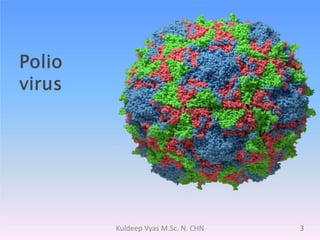
Poliovirus: belongs to “Picorna” viruses which are
small RNA-containing viruses.
Three serotypes- 1, 2 & 3 giving no cross
immunity
Long survival in environment….lives upto 4hours
in water and 6 hours in faeces in cold
enviornment.
Readily destroyed by heat (e.g. pasteurization of
milk, and chlorination of water). 7Kuldeep Vyas M.Sc. N. CHN
Reservoir of infection
 Man is the only reservoir of infection of poliomyelitis.
 Man: cases and carriers
 Cases: all clinical forms of disease
 Most of the infections are subclinical- dominant role in spread of
infection
 Estimated subclinical infection ranges from 75 to 1000 per clinical case
 No chronic cases or animal sources documented
Foci of infection
 Pharynx: the virus is found in the oropharyngeal secretions.
 Small intestine: the virus finds exit in stools.
8Kuldeep Vyas M.Sc. N. CHN
Modes of transmission
Since foci of infection are the throat and small intestines,
poliomyelitis spreads by two routes:
Oral-oral infection: direct droplet infection
Faeco-oral infection:
– Through contaminated foods. Vehicles include milk, water, or any
others that may be contaminated by handling, flies, dust….
– Hand to mouth infection.
Polio virus has the ability to survive in cold environments.
Overcrowding and poor sanitation provide opportunities for
exposure to infection
9Kuldeep Vyas M.Sc. N. CHN
Period of communicability
 Estimated to about 2 weeks
 Cases: 7 to 10 days before and after the onset of symptoms.
 Virus is excreted commonly for 2 to 3 weeks, sometimes as
long as 3 to 4 months in faeces.
 In polio cases, infectivity in the pharyngeal foci is around one
week, and in the intestinal foci 6-8 weeks.
Incubation Period: 7-14 days
10Kuldeep Vyas M.Sc. N. CHN
Host factors
Age:
 All age groups; children(6 MONTHS TO 3 YEARS most susceptible)
 more than 95% reported in infancy and childhood with over 50% of them
in infancy.
Sex:
 no sex ratio differences, but in some countries, males are infected more
frequently than females in a ratio 3:1.
Risk factors:
 Fatigue, trauma,im injections, tonsillectomy, immunizing agents like alum
containing DPT vaccine and excessive muscular exercise…
Immunity:
 Immunity by maternal antibodies till the age of 6months
 Immunity conferred by natural infection fairly solid but doesn’t protects
against the reinfection by other strains
11Kuldeep Vyas M.Sc. N. CHN
Environmental factors
Rainy season (june to september)
Environmental sources- food, flies and water
Overcrowding and poor sanitation-
oppourtinities
12Kuldeep Vyas M.Sc. N. CHN
Clinical spectrum
13Kuldeep Vyas M.Sc. N. CHN
Inapparent infection
 Occurs approximately in 91-96% of poliovirus infection.
 Incidence is more than 75 to 1000 times the clinical
cases.
 No clinical manifestations, but infection is associated
with acquired immunity.
 Recognition only by virus isolation or rising antibody titre.
14Kuldeep Vyas M.Sc. N. CHN
Clinical poliomyelitis
Abortive polio (minor illness):
 Occurs approximately in 4-8% of the infection.
 Causes only a mild or self limiting illness due to
viraemia.
 Mild systemic manifestations for 1-2 days
 Some abortive cases so mild to pass unnoticed.
 Patient recovers quickly.
 Manifestations:
 Moderate fever
 Upper respiratory manifestations: pharyngitis and sore throat
 Gastrointestinal manifestations: vomiting, abdominal pain,
and diarrhea.
15Kuldeep Vyas M.Sc. N. CHN
Cont…..
Involvement of the CNS (major illness):
 Affects a small proportion of the clinical cases
 Takes two forms: Non-paralytic and Paralytic polio.
Non paralytic polio:
 Occurs approximately in one per cent of all infections.
 Presenting features are stiffness and pain in neck and back.
 Disease lasts for 2-10 days.
 Recovery is rapid.
16Kuldeep Vyas M.Sc. N. CHN
Cont…
Paralytic polio:
 Occurs in less then one per cent of infections.
 The virus enters the CNS and causes varying degree of disability
with destruction of the motor nerve cells, but not the sensory
nerve cells.
 Forms: spinal, bulbar, and bulbospinal.
 Paralysis usually appears within 4 days (around 7-10 days from
onset of disease).
 History of fever at the time of paralysis- suggestive of polio.
 Progression of paralysis reaches maximum by 4th day (4-7 days)
17Kuldeep Vyas M.Sc. N. CHN
Cont….
 Other symptoms- malaise, anorexia, vommiting, headache, sore
throat, constipation and headache.
 Signs of meningeal irritation
 Tripod sign may be present
 Assymetrical, patchy flaccid paralysis, of descending type
affecting the proximal group of muscle the most
 Deep tendon reflexes (DTR) deminished before the the onset of
paralysis.
 Cranial nerve involvement seen in bulbar and bulbospinal
paralytic poliomyelitis
 Facial assymetry, difficulty in swallowing weakness of voice;
respiratory insuffiency may lead to death
18Kuldeep Vyas M.Sc. N. CHN
19Kuldeep Vyas M.Sc. N. CHN
Spinal polio
Different spinal nerves are involved
Injury of the anterior horn cells of the spinal cord
causing tenderness, weakness, and flaccid
paralysis of the corresponding striated muscles.
The lower limbs are the most commonly affected.
20Kuldeep Vyas M.Sc. N. CHN
Bulbar polio
Nuclei of the cranial nerves are involved, causing
weakness of the supplied muscles, and maybe
encephalitis.
Bulbar manifestations include dysphagia, nasal voice,
fluid regurgitation from the nose, difficult chewing, facial
weakness and diplopia
Paralysis of the muscles of respiration is the most
serious life-threatening manifestation.
Bulbospinal polio
 Combination of both spinal and bulbar forms
21Kuldeep Vyas M.Sc. N. CHN
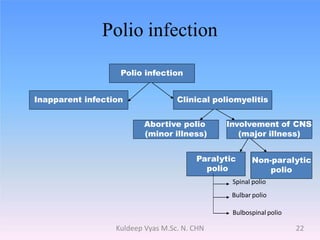
Polio infection
Polio infection
Inapparent infection Clinical poliomyelitis
Abortive polio Involvement of CNS
(minor illness) (major illness)
Paralytic
polio
Non-paralytic
polio
Spinal polio
Bulbar polio
Bulbospinal polio
22Kuldeep Vyas M.Sc. N. CHN
Complications and case fatality
 Respiratory complications: pneumonia, pulmonary edema
 Cardiovascular complications: myocarditis, cor pulmonale.
 Late complications: soft tissue and bone deformities,
osteoporosis, and chronic distension of the colon.
 Case fatality: varies from 1% to 10% according to the form
of disease (higher in bulbar), complications and age (
fatality increases with age).
23Kuldeep Vyas M.Sc. N. CHN
 Polio is caused by a virus called polio virus
24Kuldeep Vyas M.Sc. N. CHN
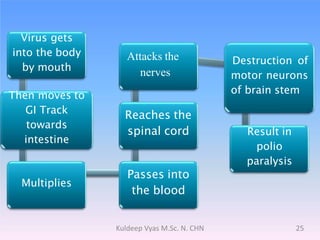
Virus gets
into the body
by mouth
Then moves to
GI Track
towards
intestine
Multiplies
Passes into
the blood
Reaches the
spinal cord
Attacks the
nerves
Destruction of
motor neurons
of brain stem
Result in
polio
paralysis
25Kuldeep Vyas M.Sc. N. CHN
Diagnosis and laboratory testing
Laboratory studies critical to rule out or confirm the
diagnosis of paralytic poliomyelitis.
 Virus isolation
 The likelihood of poliovirus isolation is highest from stool
specimens,
 Intermediate from pharyngeal swabs, and very low from blood
or spinal fluid.
 Serologic testing
A four-fold titer rise between the acute and convalescent
specimens suggests poliovirus infection.
26Kuldeep Vyas M.Sc. N. CHN
Prevention
General prevention:
Health promotion through environmental
sanitation.
Health education (modes of spread,
protective value of vaccination).
27Kuldeep Vyas M.Sc. N. CHN
Cont….
Seroprophylaxis by immunoglobulins:
Not a practical way of giving protection
because it must be given either or before or
very shortly after exposure to infection.
Dose-(0.25-0.3 ml/kg of body weight).
Immunized status after a few weeks
28Kuldeep Vyas M.Sc. N. CHN
Active immunization
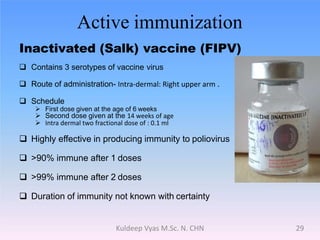
Inactivated (Salk) vaccine (FIPV)
 Contains 3 serotypes of vaccine virus
 Route of administration- Intra-dermal: Right upper arm .
 Schedule
 First dose given at the age of 6 weeks
 Second dose given at the 14 weeks of age
 Intra dermal two fractional dose of : 0.1 ml
 Highly effective in producing immunity to poliovirus
 >90% immune after 1 doses
 >99% immune after 2 doses
 Duration of immunity not known with certainty
29Kuldeep Vyas M.Sc. N. CHN
Cont…
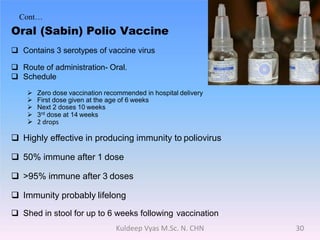
Oral (Sabin) Polio Vaccine
 Contains 3 serotypes of vaccine virus
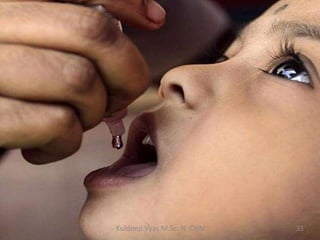
 Route of administration- Oral.
 Schedule
 Zero dose vaccination recommended in hospital delivery
 First dose given at the age of 6 weeks
 Next 2 doses 10 weeks
 3rd dose at 14 weeks
 2 drops
 Highly effective in producing immunity to poliovirus
 50% immune after 1 dose
 >95% immune after 3 doses
 Immunity probably lifelong
 Shed in stool for up to 6 weeks following vaccination
30Kuldeep Vyas M.Sc. N. CHN
31Kuldeep Vyas M.Sc. N. CHN
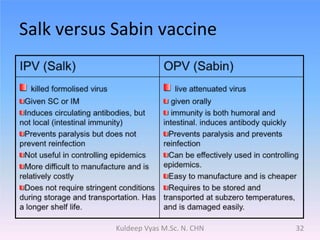
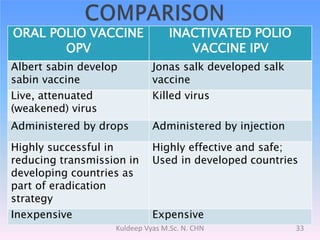
Salk versus Sabin vaccine
32Kuldeep Vyas M.Sc. N. CHN
ORAL POLIO VACCINE
OPV
INACTIVATED POLIO
VACCINE IPV
Albert sabin develop
sabin vaccine
Jonas salk developed salk
vaccine
Live, attenuated
(weakened) virus
Killed virus
Administered by drops Administered by injection
Highly successful in
reducing transmission in
developing countries as
part of eradication
strategy
Highly effective and safe;
Used in developed countries
Inexpensive Expensive
33Kuldeep Vyas M.Sc. N. CHN
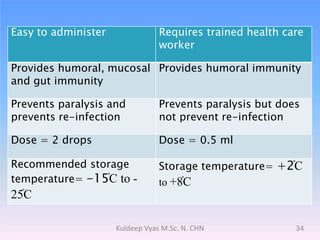
Easy to administer Requires trained health care
worker
Provides humoral, mucosal
and gut immunity
Provides humoral immunity
Prevents paralysis and
prevents re-infection
Prevents paralysis but does
not prevent re-infection
Dose = 2 drops Dose = 0.5 ml
Recommended storage
temperature= -15֯C to -
25֯C
Storage temperature= +2֯C
to +8֯C
34Kuldeep Vyas M.Sc. N. CHN
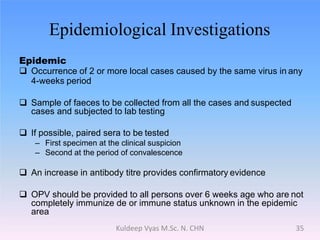
Epidemiological Investigations
Epidemic
 Occurrence of 2 or more local cases caused by the same virus in any
4-weeks period
 Sample of faeces to be collected from all the cases and suspected
cases and subjected to lab testing
 If possible, paired sera to be tested
– First specimen at the clinical suspicion
– Second at the period of convalescence
 An increase in antibody titre provides confirmatory evidence
 OPV should be provided to all persons over 6 weeks age who are not
completely immunize de or immune status unknown in the epidemic
area
35Kuldeep Vyas M.Sc. N. CHN
Thank you…
36Kuldeep Vyas M.Sc. N. CHN

Poliomyelitis

  • 1.
    POLIOMYELITIS Kuldeep Vyas Asst. Prof.Community Health Nursing1Kuldeep Vyas M.Sc. N. CHN
  • 2.
    Introduction  Greek poliós="grey", myelós= marrow, and the suffix - itis= inflammation  First described by British physician Micheal Underwood in 1799 referring to it as "debility of the lower extremities.“  A viral infection most often recognized by acute onset of flaccid paralysis.  Primarily an infection of human alimentary tract, but may infect CNS in very small no. (i.e <1%)  Infection results in a spectrum of clinical manifestations…… 2Kuldeep Vyas M.Sc. N. CHN
  • 3.
  • 4.
    Problem statement World  Aworldwide problem in pre vaccination era  With the wide use of polio vaccine from 1954 disease being eliminated from most of the developed countries  In 1988 WHA resolved to eradicate the disease globally  Since than no. of endemic countries reduced from 125 in 1988 to 3 in 2012.  Reported cases worldwide decreased by 51% (1352 in 2010 to 650 in 2011) 4Kuldeep Vyas M.Sc. N. CHN
  • 5.
    Cont… India No reported casessince January 2011 (last case reported in 13th Jan 2011, Howrah, West Bengal) Considered polio-free since February 2012 Attained the status of eradication in 13th January 2014 5Kuldeep Vyas M.Sc. N. CHN
  • 6.
  • 7.
    Agent factors Agent Poliovirus: belongsto “Picorna” viruses which are small RNA-containing viruses. Three serotypes- 1, 2 & 3 giving no cross immunity Long survival in environment….lives upto 4hours in water and 6 hours in faeces in cold enviornment. Readily destroyed by heat (e.g. pasteurization of milk, and chlorination of water). 7Kuldeep Vyas M.Sc. N. CHN
  • 8.
    Reservoir of infection Man is the only reservoir of infection of poliomyelitis.  Man: cases and carriers  Cases: all clinical forms of disease  Most of the infections are subclinical- dominant role in spread of infection  Estimated subclinical infection ranges from 75 to 1000 per clinical case  No chronic cases or animal sources documented Foci of infection  Pharynx: the virus is found in the oropharyngeal secretions.  Small intestine: the virus finds exit in stools. 8Kuldeep Vyas M.Sc. N. CHN
  • 9.
    Modes of transmission Sincefoci of infection are the throat and small intestines, poliomyelitis spreads by two routes: Oral-oral infection: direct droplet infection Faeco-oral infection: – Through contaminated foods. Vehicles include milk, water, or any others that may be contaminated by handling, flies, dust…. – Hand to mouth infection. Polio virus has the ability to survive in cold environments. Overcrowding and poor sanitation provide opportunities for exposure to infection 9Kuldeep Vyas M.Sc. N. CHN
  • 10.
    Period of communicability Estimated to about 2 weeks  Cases: 7 to 10 days before and after the onset of symptoms.  Virus is excreted commonly for 2 to 3 weeks, sometimes as long as 3 to 4 months in faeces.  In polio cases, infectivity in the pharyngeal foci is around one week, and in the intestinal foci 6-8 weeks. Incubation Period: 7-14 days 10Kuldeep Vyas M.Sc. N. CHN
  • 11.
    Host factors Age:  Allage groups; children(6 MONTHS TO 3 YEARS most susceptible)  more than 95% reported in infancy and childhood with over 50% of them in infancy. Sex:  no sex ratio differences, but in some countries, males are infected more frequently than females in a ratio 3:1. Risk factors:  Fatigue, trauma,im injections, tonsillectomy, immunizing agents like alum containing DPT vaccine and excessive muscular exercise… Immunity:  Immunity by maternal antibodies till the age of 6months  Immunity conferred by natural infection fairly solid but doesn’t protects against the reinfection by other strains 11Kuldeep Vyas M.Sc. N. CHN
  • 12.
    Environmental factors Rainy season(june to september) Environmental sources- food, flies and water Overcrowding and poor sanitation- oppourtinities 12Kuldeep Vyas M.Sc. N. CHN
  • 13.
  • 14.
    Inapparent infection  Occursapproximately in 91-96% of poliovirus infection.  Incidence is more than 75 to 1000 times the clinical cases.  No clinical manifestations, but infection is associated with acquired immunity.  Recognition only by virus isolation or rising antibody titre. 14Kuldeep Vyas M.Sc. N. CHN
  • 15.
    Clinical poliomyelitis Abortive polio(minor illness):  Occurs approximately in 4-8% of the infection.  Causes only a mild or self limiting illness due to viraemia.  Mild systemic manifestations for 1-2 days  Some abortive cases so mild to pass unnoticed.  Patient recovers quickly.  Manifestations:  Moderate fever  Upper respiratory manifestations: pharyngitis and sore throat  Gastrointestinal manifestations: vomiting, abdominal pain, and diarrhea. 15Kuldeep Vyas M.Sc. N. CHN
  • 16.
    Cont….. Involvement of theCNS (major illness):  Affects a small proportion of the clinical cases  Takes two forms: Non-paralytic and Paralytic polio. Non paralytic polio:  Occurs approximately in one per cent of all infections.  Presenting features are stiffness and pain in neck and back.  Disease lasts for 2-10 days.  Recovery is rapid. 16Kuldeep Vyas M.Sc. N. CHN
  • 17.
    Cont… Paralytic polio:  Occursin less then one per cent of infections.  The virus enters the CNS and causes varying degree of disability with destruction of the motor nerve cells, but not the sensory nerve cells.  Forms: spinal, bulbar, and bulbospinal.  Paralysis usually appears within 4 days (around 7-10 days from onset of disease).  History of fever at the time of paralysis- suggestive of polio.  Progression of paralysis reaches maximum by 4th day (4-7 days) 17Kuldeep Vyas M.Sc. N. CHN
  • 18.
    Cont….  Other symptoms-malaise, anorexia, vommiting, headache, sore throat, constipation and headache.  Signs of meningeal irritation  Tripod sign may be present  Assymetrical, patchy flaccid paralysis, of descending type affecting the proximal group of muscle the most  Deep tendon reflexes (DTR) deminished before the the onset of paralysis.  Cranial nerve involvement seen in bulbar and bulbospinal paralytic poliomyelitis  Facial assymetry, difficulty in swallowing weakness of voice; respiratory insuffiency may lead to death 18Kuldeep Vyas M.Sc. N. CHN
  • 19.
  • 20.
    Spinal polio Different spinalnerves are involved Injury of the anterior horn cells of the spinal cord causing tenderness, weakness, and flaccid paralysis of the corresponding striated muscles. The lower limbs are the most commonly affected. 20Kuldeep Vyas M.Sc. N. CHN
  • 21.
    Bulbar polio Nuclei ofthe cranial nerves are involved, causing weakness of the supplied muscles, and maybe encephalitis. Bulbar manifestations include dysphagia, nasal voice, fluid regurgitation from the nose, difficult chewing, facial weakness and diplopia Paralysis of the muscles of respiration is the most serious life-threatening manifestation. Bulbospinal polio  Combination of both spinal and bulbar forms 21Kuldeep Vyas M.Sc. N. CHN
  • 22.
    Polio infection Polio infection Inapparentinfection Clinical poliomyelitis Abortive polio Involvement of CNS (minor illness) (major illness) Paralytic polio Non-paralytic polio Spinal polio Bulbar polio Bulbospinal polio 22Kuldeep Vyas M.Sc. N. CHN
  • 23.
    Complications and casefatality  Respiratory complications: pneumonia, pulmonary edema  Cardiovascular complications: myocarditis, cor pulmonale.  Late complications: soft tissue and bone deformities, osteoporosis, and chronic distension of the colon.  Case fatality: varies from 1% to 10% according to the form of disease (higher in bulbar), complications and age ( fatality increases with age). 23Kuldeep Vyas M.Sc. N. CHN
  • 24.
     Polio iscaused by a virus called polio virus 24Kuldeep Vyas M.Sc. N. CHN
  • 25.
    Virus gets into thebody by mouth Then moves to GI Track towards intestine Multiplies Passes into the blood Reaches the spinal cord Attacks the nerves Destruction of motor neurons of brain stem Result in polio paralysis 25Kuldeep Vyas M.Sc. N. CHN
  • 26.
    Diagnosis and laboratorytesting Laboratory studies critical to rule out or confirm the diagnosis of paralytic poliomyelitis.  Virus isolation  The likelihood of poliovirus isolation is highest from stool specimens,  Intermediate from pharyngeal swabs, and very low from blood or spinal fluid.  Serologic testing A four-fold titer rise between the acute and convalescent specimens suggests poliovirus infection. 26Kuldeep Vyas M.Sc. N. CHN
  • 27.
    Prevention General prevention: Health promotionthrough environmental sanitation. Health education (modes of spread, protective value of vaccination). 27Kuldeep Vyas M.Sc. N. CHN
  • 28.
    Cont…. Seroprophylaxis by immunoglobulins: Nota practical way of giving protection because it must be given either or before or very shortly after exposure to infection. Dose-(0.25-0.3 ml/kg of body weight). Immunized status after a few weeks 28Kuldeep Vyas M.Sc. N. CHN
  • 29.
    Active immunization Inactivated (Salk)vaccine (FIPV)  Contains 3 serotypes of vaccine virus  Route of administration- Intra-dermal: Right upper arm .  Schedule  First dose given at the age of 6 weeks  Second dose given at the 14 weeks of age  Intra dermal two fractional dose of : 0.1 ml  Highly effective in producing immunity to poliovirus  >90% immune after 1 doses  >99% immune after 2 doses  Duration of immunity not known with certainty 29Kuldeep Vyas M.Sc. N. CHN
  • 30.
    Cont… Oral (Sabin) PolioVaccine  Contains 3 serotypes of vaccine virus  Route of administration- Oral.  Schedule  Zero dose vaccination recommended in hospital delivery  First dose given at the age of 6 weeks  Next 2 doses 10 weeks  3rd dose at 14 weeks  2 drops  Highly effective in producing immunity to poliovirus  50% immune after 1 dose  >95% immune after 3 doses  Immunity probably lifelong  Shed in stool for up to 6 weeks following vaccination 30Kuldeep Vyas M.Sc. N. CHN
  • 31.
  • 32.
    Salk versus Sabinvaccine 32Kuldeep Vyas M.Sc. N. CHN
  • 33.
    ORAL POLIO VACCINE OPV INACTIVATEDPOLIO VACCINE IPV Albert sabin develop sabin vaccine Jonas salk developed salk vaccine Live, attenuated (weakened) virus Killed virus Administered by drops Administered by injection Highly successful in reducing transmission in developing countries as part of eradication strategy Highly effective and safe; Used in developed countries Inexpensive Expensive 33Kuldeep Vyas M.Sc. N. CHN
  • 34.
    Easy to administerRequires trained health care worker Provides humoral, mucosal and gut immunity Provides humoral immunity Prevents paralysis and prevents re-infection Prevents paralysis but does not prevent re-infection Dose = 2 drops Dose = 0.5 ml Recommended storage temperature= -15֯C to - 25֯C Storage temperature= +2֯C to +8֯C 34Kuldeep Vyas M.Sc. N. CHN
  • 35.
    Epidemiological Investigations Epidemic  Occurrenceof 2 or more local cases caused by the same virus in any 4-weeks period  Sample of faeces to be collected from all the cases and suspected cases and subjected to lab testing  If possible, paired sera to be tested – First specimen at the clinical suspicion – Second at the period of convalescence  An increase in antibody titre provides confirmatory evidence  OPV should be provided to all persons over 6 weeks age who are not completely immunize de or immune status unknown in the epidemic area 35Kuldeep Vyas M.Sc. N. CHN
  • 36.