POLIOMYELITIS
Presented By:-
SIDRA MANZOOR
3rd year
Orthotics & Prosthetics
Rawalpindi Medical College
TOPICS
 Introduction
 History
 Epidemiology
 Pathogenesis
 Clinical Feature
 Diagnosis
 Treatment
 Prognosis
 Prevention
 Programmes
INTRODUCTION
 Synonym:
Infantile Paralysis
 Definition:
Acute viral infectious disease caused by
entero virus “ Route-feco-oral”
 Greek:
Polios’ - Gray
Myelos’ - Spinal cord
HISTORY
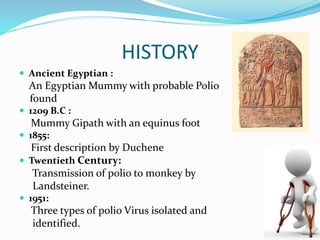
 Ancient Egyptian :
An Egyptian Mummy with probable Polio
found
 1209 B.C :
Mummy Gipath with an equinus foot
 1855:
First description by Duchene
 Twentieth Century:
Transmission of polio to monkey by
Landsteiner.
 1951:
Three types of polio Virus isolated and
identified.
EPIDEMIOLOGY
AGENTS
 POLIO VIRUS:
It have Resistance in feces at 4 degree celsius for months
& -20 degree celsius for years.
It is inactivated by heat and chlorination.
Natural infection occurs only in human.
More during rainy season.
 Mode Of Transmission:
Through inhalation ,Through mouth.
 Age Of Host:
6 months to 3 years
 Sex:
M:F is 3:1
 Sources:
Contaminated water,food,poor sanitation,Flies.
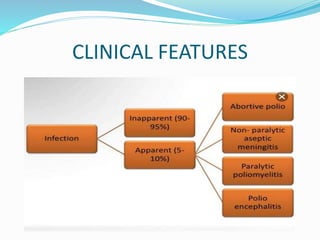
CLINICAL FEATURES
ABORTIVE POLIO
• Symptoms:
Low grade fever , sore throat, vomitting
Abdominal pain,loss of apetite.
• Treatment:
complete recovery, no paralysis.
• Symptoms:
Head ache , nausea , vomitting, pain of back and lower
legs.
Non Paralytic Aseptic Meningitis
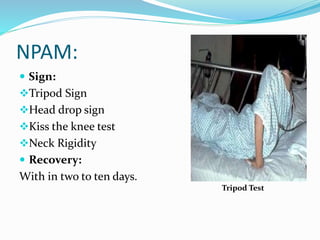
NPAM:
 Sign:
Tripod Sign
Head drop sign
Kiss the knee test
Neck Rigidity
 Recovery:
With in two to ten days.
Tripod Test
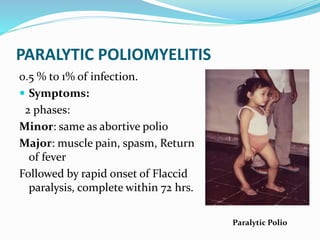
PARALYTIC POLIOMYELITIS
0.5 % to 1% of infection.
 Symptoms:
2 phases:
Minor: same as abortive polio
Major: muscle pain, spasm, Return
of fever
Followed by rapid onset of Flaccid
paralysis, complete within 72 hrs.
Paralytic Polio
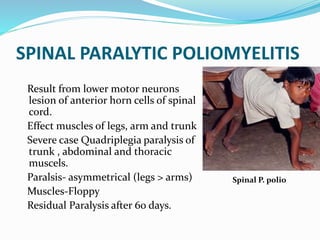
SPINAL PARALYTIC POLIOMYELITIS
Result from lower motor neurons
lesion of anterior horn cells of spinal
cord.
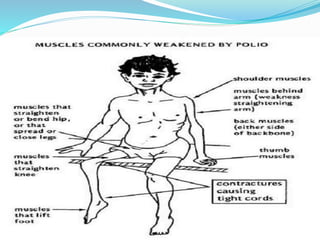
Effect muscles of legs, arm and trunk
Severe case Quadriplegia paralysis of
trunk , abdominal and thoracic
muscels.
Paralsis- asymmetrical (legs > arms)
Muscles-Floppy
Residual Paralysis after 60 days.
Spinal P. polio
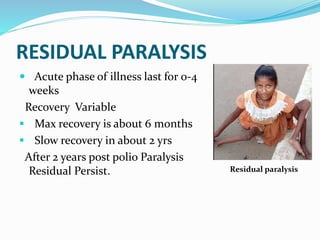
RESIDUAL PARALYSIS
 Acute phase of illness last for 0-4
weeks
Recovery Variable
 Max recovery is about 6 months
 Slow recovery in about 2 yrs
After 2 years post polio Paralysis
Residual Persist. Residual paralysis
DIAGNOSIS:
History
Clinical Examination
Stool Examination
CSF examination
SYMPTOMATIC AND SUPPORTIVE
o Rest in Bed
o Relief of pain and spasm of muscles
o Neutral positioning of the Limbs
o Physiotherapy
o Good nursing
REST IN BED:
 Physical activity and trauma increase risk of polio.
Posture changed every 2-3 hrs.
Child to be placed on stomach for short periods each
day, to prevent Pneumonia.
Optimum position for limbs:
Hip- Slight flexion
Knee-5 degree flexion
Foot-90 degree support against sole
PAIN RELIEF:
Sister Kenny’s treatment:
Hot moist packs applied to the muscle to relieve
pain and spasm.
PHYSIOTHERAPY
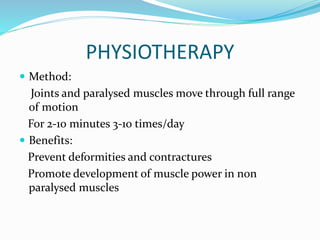
 Method:
Joints and paralysed muscles move through full range
of motion
For 2-10 minutes 3-10 times/day
 Benefits:
Prevent deformities and contractures
Promote development of muscle power in non
paralysed muscles
PHYSIOTHERAPY
TREATMENT
 Indication for Hospitalization:
 Paralysis of upper limbs <3 days duration
 Progression Of paralysis
 Bulbar involvement
 Respiratory Distress
 Marked Drowsiness
 Complications
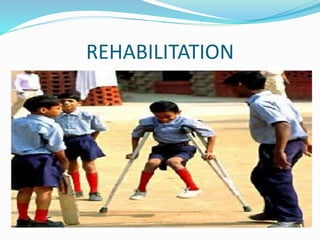
REHABILITATION
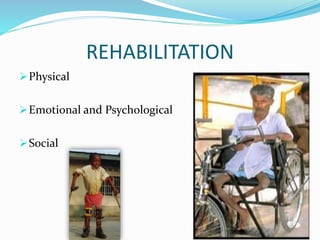
REHABILITATION
Physical
Emotional and Psychological
Social
REHABILITATIONS
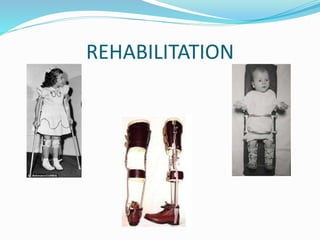
 Orthotic Treatment is applied to promote mobility.
 Orthoses should be used untill no further recovery is
anticipated
 Orthoses are given in stage of greatest paralysis.
 Appropriate orthotic appliances are Prescribed to
prevent deformities due to muscle imbalance.
 Static joint stabillity usually controlled by orthoses.
 Dynamic joint instabillity usually result in a fixed
deformity that can not controlled with orthoses.
TREATMENT:
 No specific treatment.
 Patient may be recover or not depends upon
neurological damage.
 Duties of orthopaedic teams are to prevent
deformities, to assist returning muscle power by
gradual exercises & to reduce residual disabillity in
final stage by the provision of appropriate appliances
or by operations on joint or muscles.
APPLIANCES:
In upper limbs following are commonly prescribe:
 Spine Brace:
To support a weakened spine.
 Abdominal Spine:
To check abdominal protrusion when abdominal muscles are
weak.
 Knee Calliper:
To hold the knee extended in case of severe Quadriceps
Paralysis.
 Below knee Brace:
To stabilize ankle or feet.
 Ankle Foot Orthoses:
To hold the foot up when dorsiflexion muscles are paralyzed.
KAFO HKAFO
Knee Orthosis
Ankel Foot Orhosis
SPINAL ORTHOSES:
 Milwaukee Brace are use
in three ways to treat
scoliosis.
 As a corrective apparatus
 Hold the spine in position
 A substitute of surgery.
REHABILITATION
 Emotional support to the
child help prepare
himself for better
adjustment in life
despite the handicap.
REHABILITATION
PROGNOSIS
 Non Paralytic cases-complete recovery.
 Paralytic Polio-permanent weakness in 2/3rd cases.
 Worse-older children.
Sudden onset with illness of high fever.
POST POLIO SYNDROME (PPS)
 Observed in people who have polio in their younger
age.
 Effects about 25-50 % of polio survivors.
 More common in females.
 General fatigue.
 Muscular weakness.
 Joint pain.
 And breathing problem are seen in effected.
IMMUNISATION
 The disease is preventable with
the polio vaccine. however, a number
of doses are required for it to be
effective.
CASE NO. 1
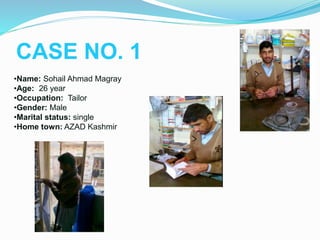
•Name: Sohail Ahmad Magray
•Age: 26 year
•Occupation: Tailor
•Gender: Male
•Marital status: single
•Home town: AZAD Kashmir
RESEARCH WORK
 History:
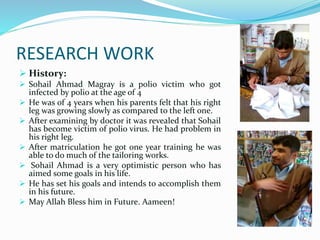
 Sohail Ahmad Magray is a polio victim who got
infected by polio at the age of 4
 He was of 4 years when his parents felt that his right
leg was growing slowly as compared to the left one.
 After examining by doctor it was revealed that Sohail
has become victim of polio virus. He had problem in
his right leg.
 After matriculation he got one year training he was
able to do much of the tailoring works.
 Sohail Ahmad is a very optimistic person who has
aimed some goals in his life.
 He has set his goals and intends to accomplish them
in his future.
 May Allah Bless him in Future. Aameen!
Poliomyelitis
Poliomyelitis
Poliomyelitis
Poliomyelitis

Poliomyelitis

  • 2.
    POLIOMYELITIS Presented By:- SIDRA MANZOOR 3rdyear Orthotics & Prosthetics Rawalpindi Medical College
  • 3.
    TOPICS  Introduction  History Epidemiology  Pathogenesis  Clinical Feature  Diagnosis  Treatment  Prognosis  Prevention  Programmes
  • 4.
    INTRODUCTION  Synonym: Infantile Paralysis Definition: Acute viral infectious disease caused by entero virus “ Route-feco-oral”  Greek: Polios’ - Gray Myelos’ - Spinal cord
  • 5.
    HISTORY  Ancient Egyptian: An Egyptian Mummy with probable Polio found  1209 B.C : Mummy Gipath with an equinus foot  1855: First description by Duchene  Twentieth Century: Transmission of polio to monkey by Landsteiner.  1951: Three types of polio Virus isolated and identified.
  • 6.
  • 7.
    AGENTS  POLIO VIRUS: Ithave Resistance in feces at 4 degree celsius for months & -20 degree celsius for years. It is inactivated by heat and chlorination. Natural infection occurs only in human. More during rainy season.  Mode Of Transmission: Through inhalation ,Through mouth.  Age Of Host: 6 months to 3 years  Sex: M:F is 3:1  Sources: Contaminated water,food,poor sanitation,Flies.
  • 8.
  • 9.
    ABORTIVE POLIO • Symptoms: Lowgrade fever , sore throat, vomitting Abdominal pain,loss of apetite. • Treatment: complete recovery, no paralysis. • Symptoms: Head ache , nausea , vomitting, pain of back and lower legs. Non Paralytic Aseptic Meningitis
  • 10.
    NPAM:  Sign: Tripod Sign Headdrop sign Kiss the knee test Neck Rigidity  Recovery: With in two to ten days. Tripod Test
  • 11.
    PARALYTIC POLIOMYELITIS 0.5 %to 1% of infection.  Symptoms: 2 phases: Minor: same as abortive polio Major: muscle pain, spasm, Return of fever Followed by rapid onset of Flaccid paralysis, complete within 72 hrs. Paralytic Polio
  • 12.
    SPINAL PARALYTIC POLIOMYELITIS Resultfrom lower motor neurons lesion of anterior horn cells of spinal cord. Effect muscles of legs, arm and trunk Severe case Quadriplegia paralysis of trunk , abdominal and thoracic muscels. Paralsis- asymmetrical (legs > arms) Muscles-Floppy Residual Paralysis after 60 days. Spinal P. polio
  • 14.
    RESIDUAL PARALYSIS  Acutephase of illness last for 0-4 weeks Recovery Variable  Max recovery is about 6 months  Slow recovery in about 2 yrs After 2 years post polio Paralysis Residual Persist. Residual paralysis
  • 15.
  • 17.
    SYMPTOMATIC AND SUPPORTIVE oRest in Bed o Relief of pain and spasm of muscles o Neutral positioning of the Limbs o Physiotherapy o Good nursing
  • 18.
    REST IN BED: Physical activity and trauma increase risk of polio. Posture changed every 2-3 hrs. Child to be placed on stomach for short periods each day, to prevent Pneumonia. Optimum position for limbs: Hip- Slight flexion Knee-5 degree flexion Foot-90 degree support against sole
  • 19.
    PAIN RELIEF: Sister Kenny’streatment: Hot moist packs applied to the muscle to relieve pain and spasm.
  • 20.
    PHYSIOTHERAPY  Method: Joints andparalysed muscles move through full range of motion For 2-10 minutes 3-10 times/day  Benefits: Prevent deformities and contractures Promote development of muscle power in non paralysed muscles
  • 21.
  • 22.
    TREATMENT  Indication forHospitalization:  Paralysis of upper limbs <3 days duration  Progression Of paralysis  Bulbar involvement  Respiratory Distress  Marked Drowsiness  Complications
  • 23.
  • 24.
  • 25.
    REHABILITATIONS  Orthotic Treatmentis applied to promote mobility.  Orthoses should be used untill no further recovery is anticipated  Orthoses are given in stage of greatest paralysis.  Appropriate orthotic appliances are Prescribed to prevent deformities due to muscle imbalance.  Static joint stabillity usually controlled by orthoses.  Dynamic joint instabillity usually result in a fixed deformity that can not controlled with orthoses.
  • 26.
    TREATMENT:  No specifictreatment.  Patient may be recover or not depends upon neurological damage.  Duties of orthopaedic teams are to prevent deformities, to assist returning muscle power by gradual exercises & to reduce residual disabillity in final stage by the provision of appropriate appliances or by operations on joint or muscles.
  • 27.
    APPLIANCES: In upper limbsfollowing are commonly prescribe:  Spine Brace: To support a weakened spine.  Abdominal Spine: To check abdominal protrusion when abdominal muscles are weak.  Knee Calliper: To hold the knee extended in case of severe Quadriceps Paralysis.  Below knee Brace: To stabilize ankle or feet.  Ankle Foot Orthoses: To hold the foot up when dorsiflexion muscles are paralyzed.
  • 29.
  • 30.
  • 31.
    SPINAL ORTHOSES:  MilwaukeeBrace are use in three ways to treat scoliosis.  As a corrective apparatus  Hold the spine in position  A substitute of surgery.
  • 32.
    REHABILITATION  Emotional supportto the child help prepare himself for better adjustment in life despite the handicap.
  • 33.
  • 34.
    PROGNOSIS  Non Paralyticcases-complete recovery.  Paralytic Polio-permanent weakness in 2/3rd cases.  Worse-older children. Sudden onset with illness of high fever.
  • 35.
    POST POLIO SYNDROME(PPS)  Observed in people who have polio in their younger age.  Effects about 25-50 % of polio survivors.  More common in females.  General fatigue.  Muscular weakness.  Joint pain.  And breathing problem are seen in effected.

  • 37.
    IMMUNISATION  The diseaseis preventable with the polio vaccine. however, a number of doses are required for it to be effective.
  • 39.
    CASE NO. 1 •Name:Sohail Ahmad Magray •Age: 26 year •Occupation: Tailor •Gender: Male •Marital status: single •Home town: AZAD Kashmir
  • 40.
    RESEARCH WORK  History: Sohail Ahmad Magray is a polio victim who got infected by polio at the age of 4  He was of 4 years when his parents felt that his right leg was growing slowly as compared to the left one.  After examining by doctor it was revealed that Sohail has become victim of polio virus. He had problem in his right leg.  After matriculation he got one year training he was able to do much of the tailoring works.  Sohail Ahmad is a very optimistic person who has aimed some goals in his life.  He has set his goals and intends to accomplish them in his future.  May Allah Bless him in Future. Aameen!