Policy Lags and
Crowding-Out Effect
Objectives
• Explain inside and outside lags for monetary and
fiscal policy.
• Define the crowding-out
• Explain the effects of crowding-out within the shortrun AD and AS model.
• Demonstrate the use of monetary policy to lessen or
reinforce the crowding-out effect.
Introduction
• Here, we discuss the lags associated with monetary
and fiscal policy making and analyze the direct and
indirect effects of government budget deficits.
• The direct effect of these deficits is an increase in
interest rates.
• When the government borrows money to finance its
deficit, this results in an increase in the demand for
money, or, alternatively, the demand for loanable
funds. This in turn results in an increase in the
interest rate.
• A higher interest rate causes decreases in
investment and other interest sensitive
components of AD.
• Crowding-out is the decrease in private
demand for funds that occurs when the
government’s demand for funds causes the
interest rate to rise:
– The demand by government for loanable funds
decreases or crowds-out the private demand for
loanable funds.
Lags Associated With Policy Making
• The inside lag consists of the time it takes for
data to be collected, policy makers to
recognize that policy action is necessary, the
decision about which policy should be taken
and the implementation of the policy.
• The outside lag is the time it takes the
economy to respond to the new policy. These
lags differ in length for monetary policy and
fiscal policy.
Monetary and Fiscal Policy
Tools of Monetary and Fiscal Policy
• Both monetary and fiscal policy can be used to
influence the inflation rate and real output.
Indicate what effect each specific policy has
on inflation and real output in the short-run (9
to 18 months).
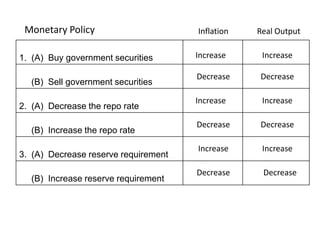
Monetary Policy
1. (A) Buy government securities
(B) Sell government securities
2. (A) Decrease the repo rate
(B) Increase the repo rate
3. (A) Decrease reserve requirement
(B) Increase reserve requirement

Inflation

Real Output

Increase

Increase

Decrease

Decrease

Increase

Increase

Decrease

Decrease

Increase

Increase

Decrease

Decrease
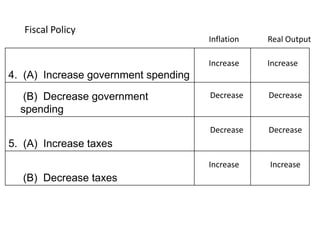
Fiscal Policy

Inflation

Real Output

Increase

Increase

Decrease

Decrease

Decrease

Decrease

Increase

Increase

4. (A) Increase government spending
(B) Decrease government
spending
5. (A) Increase taxes
(B) Decrease taxes
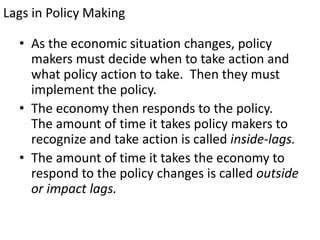
Lags in Policy Making
• As the economic situation changes, policy
makers must decide when to take action and
what policy action to take. Then they must
implement the policy.
• The economy then responds to the policy.
The amount of time it takes policy makers to
recognize and take action is called inside-lags.
• The amount of time it takes the economy to
respond to the policy changes is called outside
or impact lags.
Crowding-Out: A Graphical Representation
• Sources of government borrowing:
– Treasury Bills
– Treasury Notes
– Treasury Bonds
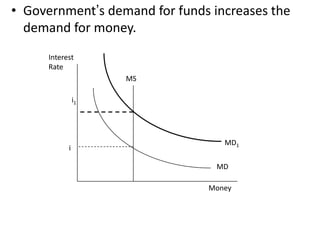
• Government’s demand for funds increases the
demand for money.
Interest
Rate

MS
i1

i

MD1
MD

Money
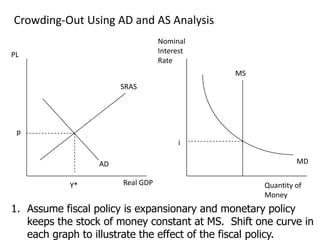
Crowding-Out Using AD and AS Analysis
Nominal
Interest
Rate

PL

MS
SRAS

p
i
MD

AD
Y*

Real GDP

Quantity of
Money

1. Assume fiscal policy is expansionary and monetary policy
keeps the stock of money constant at MS. Shift one curve in
each graph to illustrate the effect of the fiscal policy.
Nominal
Interest Rate

PL

MS
SRAS
p1
p
AD1

i
MD

AD
Y*

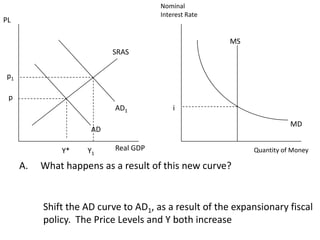
A.

Y1

Real GDP

Quantity of Money

What happens as a result of this new curve?

Shift the AD curve to AD1, as a result of the expansionary fiscal
policy. The Price Levels and Y both increase
Nominal
Interest Rate

PL

MS
SRAS
p1

i1
p
AD1

MD1
MD

AD
Y*

Y1

i

Real GDP

Quantity of
Money

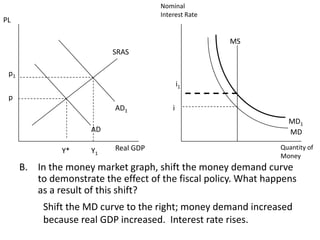
B. In the money market graph, shift the money demand curve
to demonstrate the effect of the fiscal policy. What happens
as a result of this shift?
Shift the MD curve to the right; money demand increased
because real GDP increased. Interest rate rises.
Nominal
Interest Rate

PL

MS
SRAS
p1

i1

p2
p

AD1
AD2

MD1
MD

AD
Y* Y2

C.

Y1

i

Real GDP

Quantity of
Money

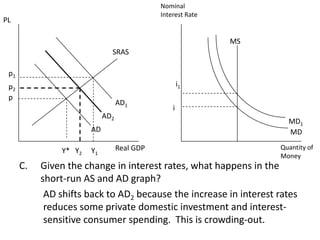
Given the change in interest rates, what happens in the
short-run AS and AD graph?
AD shifts back to AD2 because the increase in interest rates
reduces some private domestic investment and interestsensitive consumer spending. This is crowding-out.
Nominal
Interest Rate

PL

MS

MS1

SRAS
p1

i1

p2
p

AD1
AD2

MD1
MD

AD
Y* Y2
D.

Y1

i

Real GDP

Quantity of
Money

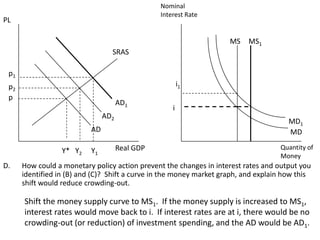
How could a monetary policy action prevent the changes in interest rates and output you
identified in (B) and (C)? Shift a curve in the money market graph, and explain how this
shift would reduce crowding-out.

Shift the money supply curve to MS1. If the money supply is increased to MS1,
interest rates would move back to i. If interest rates are at i, there would be no
crowding-out (or reduction) of investment spending, and the AD would be AD1.
Applications:
Answer the questions that follow each of the
scenarios below.
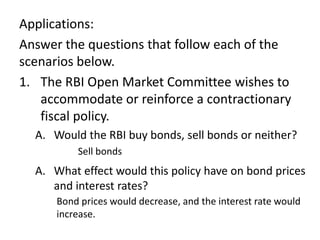
1. The RBI Open Market Committee wishes to
accommodate or reinforce a contractionary
fiscal policy.
A. Would the RBI buy bonds, sell bonds or neither?
Sell bonds

A. What effect would this policy have on bond prices
and interest rates?
Bond prices would decrease, and the interest rate would
increase.
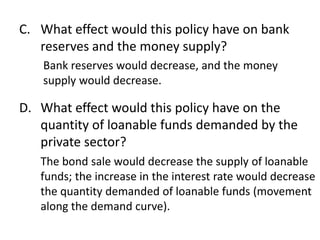
C. What effect would this policy have on bank
reserves and the money supply?
Bank reserves would decrease, and the money
supply would decrease.

D. What effect would this policy have on the
quantity of loanable funds demanded by the
private sector?
The bond sale would decrease the supply of loanable
funds; the increase in the interest rate would decrease
the quantity demanded of loanable funds (movement
along the demand curve).
E. What effect would the change in interest
rates you identified in (B) have on aggregate
demand?
AD would decrease because the higher
interest rates would curtail the interestsensitive components of consumption and
investment.
2. The RBI Open Market Committee wishes to
accommodate or reinforce an expansionary
fiscal policy.
A. Would the RBI buy bonds, sell bonds or
neither?
Buy bonds.
B. What effect would this policy have on bond
prices and interest rates?
The price of bonds would increase, and the
interest rate would decrease.
C. What effect would this policy have on bank
reserves and the money supply?
Bank Reserves would increase and the
money supply would increase.
D. What effect would this policy have on the
quantity of loanable funds demanded by the
private sector?
The quantity demanded of loanable funds
would increase.
E. What effect would the change in interest
rates you identified in (B) have on AD?
AD would increase because of the lower
interest rates and the resulting increase in
interest-sensitive components of
consumption and investment.

Policy lags and crowding out

  • 1.
  • 2.
    Objectives • Explain insideand outside lags for monetary and fiscal policy. • Define the crowding-out • Explain the effects of crowding-out within the shortrun AD and AS model. • Demonstrate the use of monetary policy to lessen or reinforce the crowding-out effect.
  • 3.
    Introduction • Here, wediscuss the lags associated with monetary and fiscal policy making and analyze the direct and indirect effects of government budget deficits. • The direct effect of these deficits is an increase in interest rates. • When the government borrows money to finance its deficit, this results in an increase in the demand for money, or, alternatively, the demand for loanable funds. This in turn results in an increase in the interest rate.
  • 4.
    • A higherinterest rate causes decreases in investment and other interest sensitive components of AD. • Crowding-out is the decrease in private demand for funds that occurs when the government’s demand for funds causes the interest rate to rise: – The demand by government for loanable funds decreases or crowds-out the private demand for loanable funds.
  • 5.
    Lags Associated WithPolicy Making • The inside lag consists of the time it takes for data to be collected, policy makers to recognize that policy action is necessary, the decision about which policy should be taken and the implementation of the policy. • The outside lag is the time it takes the economy to respond to the new policy. These lags differ in length for monetary policy and fiscal policy.
  • 6.
    Monetary and FiscalPolicy Tools of Monetary and Fiscal Policy • Both monetary and fiscal policy can be used to influence the inflation rate and real output. Indicate what effect each specific policy has on inflation and real output in the short-run (9 to 18 months).
  • 7.
    Monetary Policy 1. (A)Buy government securities (B) Sell government securities 2. (A) Decrease the repo rate (B) Increase the repo rate 3. (A) Decrease reserve requirement (B) Increase reserve requirement Inflation Real Output Increase Increase Decrease Decrease Increase Increase Decrease Decrease Increase Increase Decrease Decrease
  • 8.
    Fiscal Policy Inflation Real Output Increase Increase Decrease Decrease Decrease Decrease Increase Increase 4.(A) Increase government spending (B) Decrease government spending 5. (A) Increase taxes (B) Decrease taxes
  • 9.
    Lags in PolicyMaking • As the economic situation changes, policy makers must decide when to take action and what policy action to take. Then they must implement the policy. • The economy then responds to the policy. The amount of time it takes policy makers to recognize and take action is called inside-lags. • The amount of time it takes the economy to respond to the policy changes is called outside or impact lags.
  • 10.
    Crowding-Out: A GraphicalRepresentation • Sources of government borrowing: – Treasury Bills – Treasury Notes – Treasury Bonds
  • 11.
    • Government’s demandfor funds increases the demand for money. Interest Rate MS i1 i MD1 MD Money
  • 12.
    Crowding-Out Using ADand AS Analysis Nominal Interest Rate PL MS SRAS p i MD AD Y* Real GDP Quantity of Money 1. Assume fiscal policy is expansionary and monetary policy keeps the stock of money constant at MS. Shift one curve in each graph to illustrate the effect of the fiscal policy.
  • 13.
    Nominal Interest Rate PL MS SRAS p1 p AD1 i MD AD Y* A. Y1 Real GDP Quantityof Money What happens as a result of this new curve? Shift the AD curve to AD1, as a result of the expansionary fiscal policy. The Price Levels and Y both increase
  • 14.
    Nominal Interest Rate PL MS SRAS p1 i1 p AD1 MD1 MD AD Y* Y1 i Real GDP Quantityof Money B. In the money market graph, shift the money demand curve to demonstrate the effect of the fiscal policy. What happens as a result of this shift? Shift the MD curve to the right; money demand increased because real GDP increased. Interest rate rises.
  • 15.
    Nominal Interest Rate PL MS SRAS p1 i1 p2 p AD1 AD2 MD1 MD AD Y* Y2 C. Y1 i RealGDP Quantity of Money Given the change in interest rates, what happens in the short-run AS and AD graph? AD shifts back to AD2 because the increase in interest rates reduces some private domestic investment and interestsensitive consumer spending. This is crowding-out.
  • 16.
    Nominal Interest Rate PL MS MS1 SRAS p1 i1 p2 p AD1 AD2 MD1 MD AD Y* Y2 D. Y1 i RealGDP Quantity of Money How could a monetary policy action prevent the changes in interest rates and output you identified in (B) and (C)? Shift a curve in the money market graph, and explain how this shift would reduce crowding-out. Shift the money supply curve to MS1. If the money supply is increased to MS1, interest rates would move back to i. If interest rates are at i, there would be no crowding-out (or reduction) of investment spending, and the AD would be AD1.
  • 17.
    Applications: Answer the questionsthat follow each of the scenarios below. 1. The RBI Open Market Committee wishes to accommodate or reinforce a contractionary fiscal policy. A. Would the RBI buy bonds, sell bonds or neither? Sell bonds A. What effect would this policy have on bond prices and interest rates? Bond prices would decrease, and the interest rate would increase.
  • 18.
    C. What effectwould this policy have on bank reserves and the money supply? Bank reserves would decrease, and the money supply would decrease. D. What effect would this policy have on the quantity of loanable funds demanded by the private sector? The bond sale would decrease the supply of loanable funds; the increase in the interest rate would decrease the quantity demanded of loanable funds (movement along the demand curve).
  • 19.
    E. What effectwould the change in interest rates you identified in (B) have on aggregate demand? AD would decrease because the higher interest rates would curtail the interestsensitive components of consumption and investment.
  • 20.
    2. The RBIOpen Market Committee wishes to accommodate or reinforce an expansionary fiscal policy. A. Would the RBI buy bonds, sell bonds or neither? Buy bonds. B. What effect would this policy have on bond prices and interest rates? The price of bonds would increase, and the interest rate would decrease.
  • 21.
    C. What effectwould this policy have on bank reserves and the money supply? Bank Reserves would increase and the money supply would increase. D. What effect would this policy have on the quantity of loanable funds demanded by the private sector? The quantity demanded of loanable funds would increase.
  • 22.
    E. What effectwould the change in interest rates you identified in (B) have on AD? AD would increase because of the lower interest rates and the resulting increase in interest-sensitive components of consumption and investment.