CHAPTER FOUR Money and Inflation
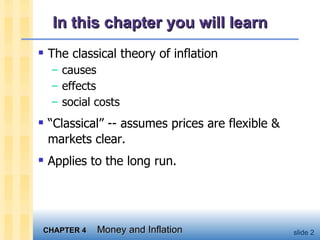
In this chapter you will learn The classical theory of inflation causes effects social costs “ Classical” -- assumes prices are flexible & markets clear. Applies to the long run.
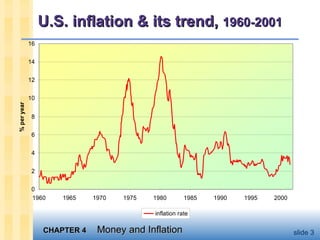
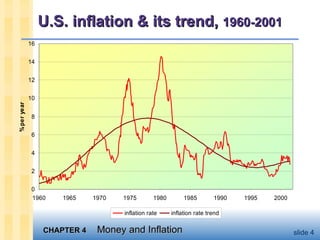
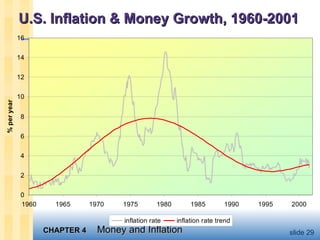
U.S. inflation & its trend,  1960-2001
The connection between  money and prices Inflation rate = the percentage increase  in the average level of prices.  price = amount of money required to  buy a good.  Because prices are defined in terms of money, we need to consider the nature of money,  the supply of money, and how it is controlled.
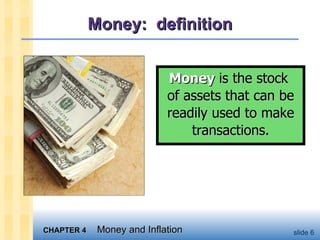
Money:  definition Money  is the stock  of assets that can be readily used to make transactions.
Money:  functions medium of exchange we use it to buy stuff store of value transfers purchasing power from the present to the future unit of account the common unit by which everyone measures prices and values
Money:  types fiat money has no intrinsic value example:  the paper currency we use commodity money has intrinsic value examples:  gold coins,  cigarettes in P.O.W. camps
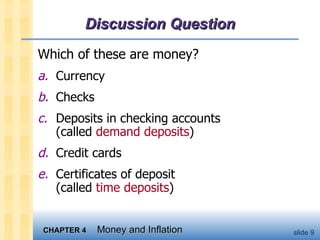
Discussion Question Which of these are money?   a. Currency b. Checks c. Deposits in checking accounts  (called  demand deposits ) d. Credit cards e. Certificates of deposit  (called  time deposits )
The money supply & monetary policy The  money supply  is the quantity of money available in the economy.  Monetary policy  is the control over the money supply.  $$$
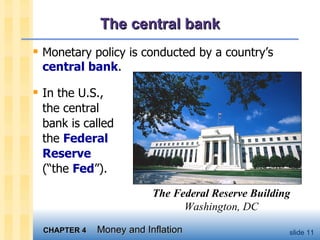
The central bank Monetary policy is conducted by a country’s  central bank .  In the U.S.,  the central bank is called the  Federal Reserve   (“the  Fed ”).  The Federal Reserve Building  Washington, DC
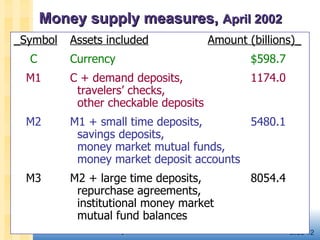
Money supply measures,  April 2002 _Symbol Assets included Amount (billions)_ C Currency $598.7 M1 C + demand deposits, 1174.0   travelers’ checks,   other checkable deposits M2 M1 + small time deposits, 5480.1   savings deposits,    money market mutual funds,    money market deposit accounts M3 M2 + large time deposits, 8054.4   repurchase agreements,    institutional money market   mutual fund balances
The Quantity Theory of Money A simple theory linking the inflation rate to the growth rate of the money supply. Begins with a concept called “ velocity ”…
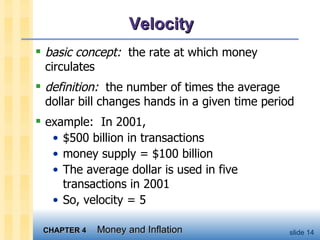
Velocity basic concept:   the rate at which money circulates definition:   the number of times the average dollar bill changes hands in a given time period example:  In 2001,  $500 billion in transactions money supply = $100 billion The average dollar is used in five transactions in 2001 So, velocity = 5
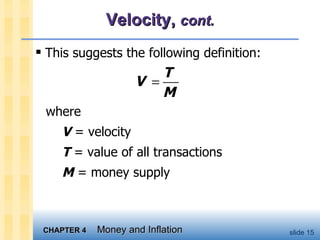
Velocity,  cont. This suggests the following definition: where  V  = velocity T  = value of all transactions M  = money supply
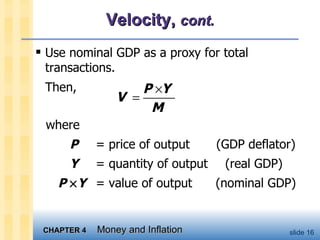
Velocity,  cont. Use nominal GDP as a proxy for total transactions.  Then,  where   P   = price of output   (GDP deflator)   Y   = quantity of output  (real GDP) P   Y   = value of output   (nominal GDP)
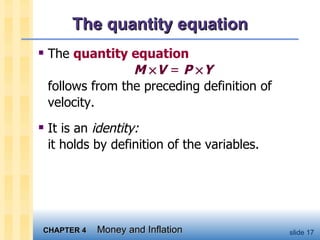
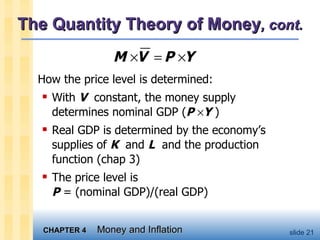
The quantity equation The  quantity equation M   V  =  P   Y follows from the preceding definition of velocity. It is an  identity:   it holds by definition of the variables.
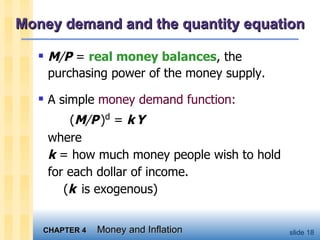
Money demand and the quantity equation M / P  =  real money balances , the purchasing power of the money supply. A simple  money demand function:   ( M / P   ) d  =  k   Y where k  = how much money people wish to hold for each dollar of income.    ( k   is exogenous)
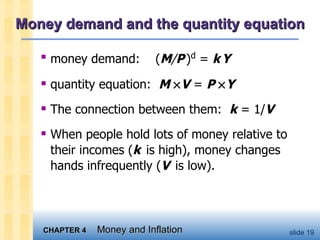
Money demand and the quantity equation money demand:  ( M / P   ) d  =  k   Y quantity equation:  M   V  =  P   Y The connection between them:  k  = 1/ V When people hold lots of money relative to their incomes ( k   is high), money changes hands infrequently ( V   is low).
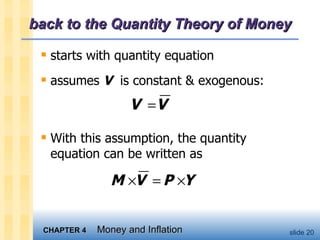
back to the Quantity Theory of Money starts with quantity equation assumes  V   is constant & exogenous: With this assumption, the quantity equation can be written as
The Quantity Theory of Money , cont. How the price level is determined: With  V   constant, the money supply determines nominal GDP ( P   Y  ) Real GDP is determined by the economy’s supplies of  K   and  L   and the production function (chap 3) The price level is  P  = (nominal GDP)/(real GDP)
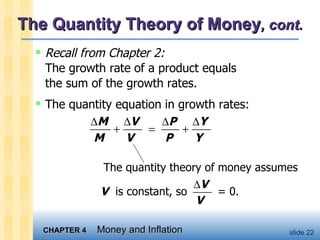
The Quantity Theory of Money , cont. Recall from Chapter 2:  The growth rate of a product equals  the sum of the growth rates.  The quantity equation in growth rates:
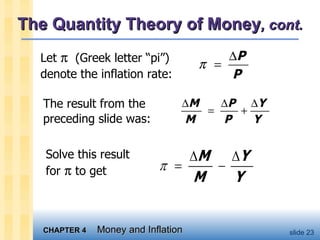
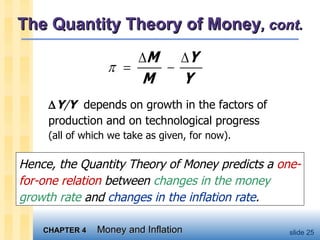
The Quantity Theory of Money , cont. Let     (Greek letter “pi”)  denote the inflation rate: The result from the  preceding slide was: Solve this result  for    to get
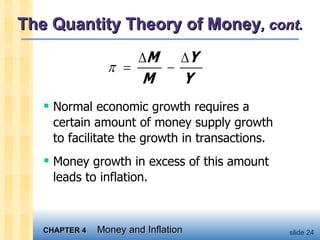
The Quantity Theory of Money , cont. Normal economic growth requires a certain amount of money supply growth to facilitate the growth in transactions.  Money growth in excess of this amount leads to inflation.
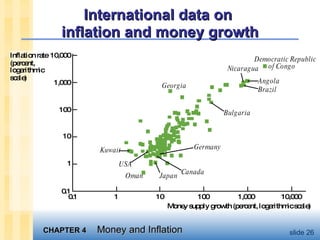
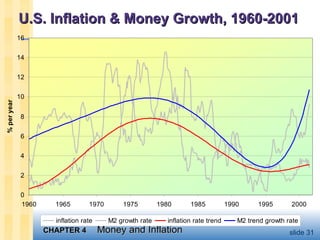
The Quantity Theory of Money , cont.  Y / Y   depends on growth in the factors of  production and on technological progress  (all of which we take as given, for now). Hence, the Quantity Theory of Money predicts a  one-for-one relation  between  changes in the money growth rate  and  changes in the inflation rate .
International data on  inflation and money growth
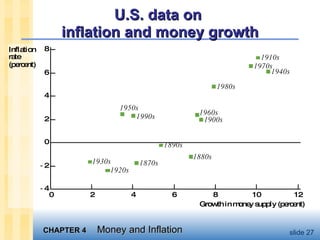
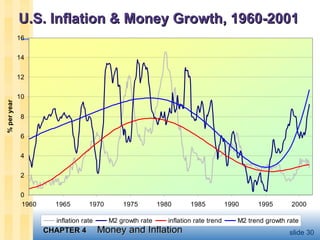
U.S. data on  inflation and money growth
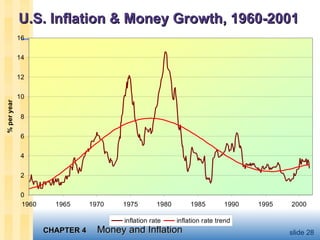
U.S. Inflation & Money Growth, 1960-2001
Seigniorage To spend more without raising taxes or selling bonds, the govt can print money. The “revenue” raised from printing money  is called  seigniorage     (pronounced SEEN-your-ige) The  inflation tax : Printing money to raise revenue causes inflation.  Inflation is like a tax on people who hold money.
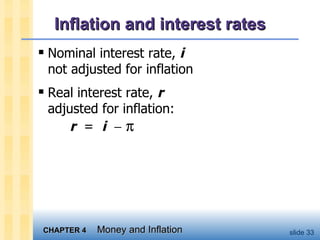
Inflation and interest rates Nominal interest rate,  i not adjusted for inflation Real interest rate,  r adjusted for inflation: r   =  i      
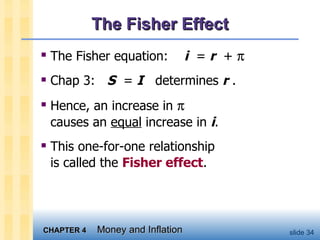
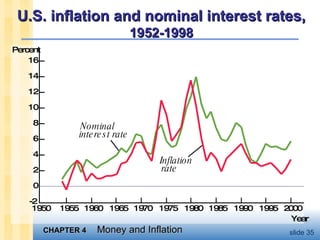
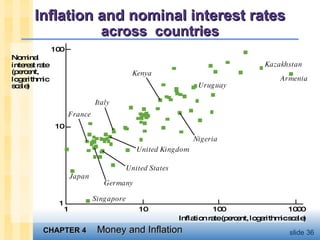
The Fisher Effect The Fisher equation:  i   =  r   +   Chap 3:  S   =  I   determines  r  .  Hence, an increase in     causes an  equal  increase in  i . This one-for-one relationship  is called the  Fisher effect .
U.S. inflation and nominal interest rates,  1952-1998 Percent 16  14  12  10  8  6  4  2  0  -2 Nominal interest rate Inflation rate 1950 1955 1960 1965 1970 Year 1975 1980 1985 1990 2000 1995
Inflation and nominal interest rates  across  countries
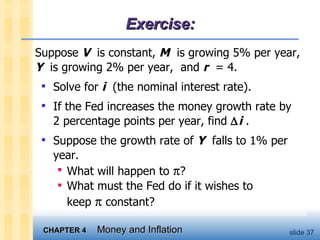
Exercise: Suppose  V   is constant,  M   is growing 5% per year,  Y   is growing 2% per year,  and  r   = 4.  Solve for  i   (the nominal interest rate).  If the Fed increases the money growth rate by  2 percentage points per year, find   i  . Suppose the growth rate of  Y   falls to 1% per year.  What will happen to   ?  What must the Fed do if it wishes to  keep    constant?
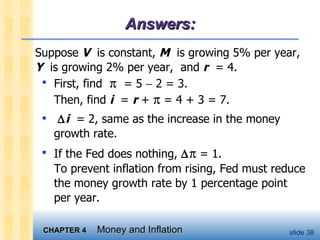
Answers: First, find     = 5    2 = 3.  Then, find  i   =  r  +    = 4 + 3 = 7.   i   = 2, same as the increase in the money growth rate.  If the Fed does nothing,     = 1.  To prevent inflation from rising, Fed must reduce the money growth rate by 1 percentage point per year.  Suppose  V   is constant,  M   is growing 5% per year,  Y   is growing 2% per year,  and  r   = 4.
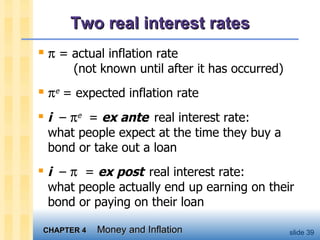
Two real interest rates    = actual inflation rate   (not known until after it has occurred)  e  = expected inflation rate i   –   e   =  ex ante   real interest rate:  what people expect at the time they buy a bond or take out a loan i   –     =  ex post   real interest rate: what people actually end up earning on their bond or paying on their loan
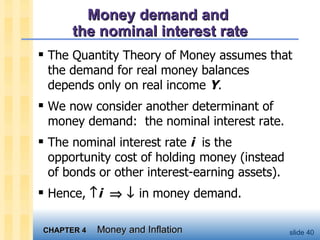
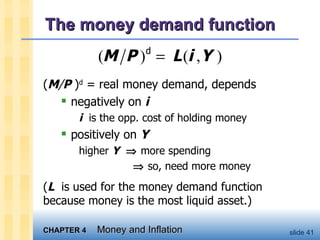
Money demand and  the nominal interest rate The Quantity Theory of Money assumes that the demand for real money balances depends only on real income  Y .  We now consider another determinant of money demand:  the nominal interest rate. The nominal interest rate  i   is the opportunity cost of holding money (instead of bonds or other interest-earning assets).  Hence,   i        in money demand.
The money demand function ( M / P  ) d  = real money demand, depends negatively on  i  i   is the opp. cost of holding money positively on  Y  higher  Y     more spending       so, need more money ( L   is used for the money demand function because money is the most liquid asset.)
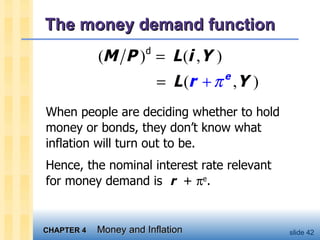
The money demand function When people are deciding whether to hold money or bonds, they don’t know what inflation will turn out to be.  Hence, the nominal interest rate relevant for money demand is  r   +   e .
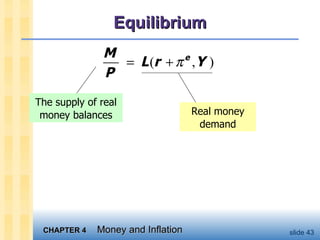
Equilibrium The supply of real money balances Real money demand
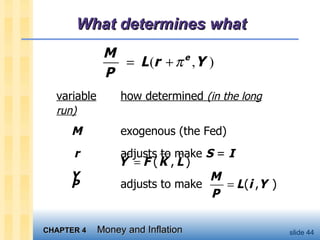
What determines what variable how determined  (in the long run) M exogenous (the Fed) r adjusts to make  S  =  I Y   P   adjusts to make
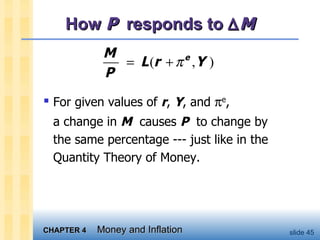
How  P   responds to   M For given values of  r ,  Y , and   e ,  a change in  M   causes  P   to change by the same percentage --- just like in the Quantity Theory of Money.
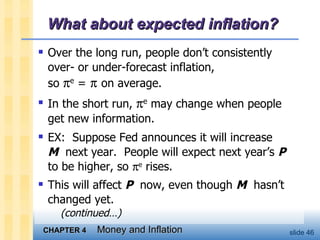
What about expected inflation? Over the long run, people don’t consistently  over- or under-forecast inflation,  so   e  =      on average.  In the short run,   e  may change when people  get new information.  EX:  Suppose Fed announces it will increase  M   next year.  People will expect next year’s  P   to be higher, so   e  rises.  This will affect  P   now, even though  M   hasn’t changed yet.    (continued…)
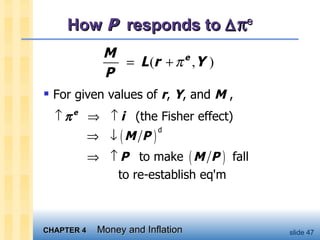
How  P   responds to    e For given values of  r ,  Y , and  M  ,
Discussion Question  Why is inflation bad?  What costs does inflation impose on society?  List all the ones you can think of. Focus on the long run. Think like an economist.
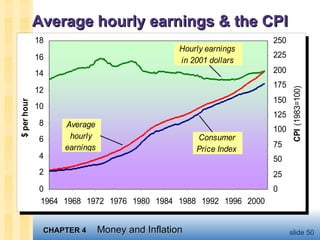
A common misperception Common misperception:  inflation reduces real wages This is true only in the short run, when nominal wages are fixed by contracts. (Chap 3)  In the long run,  the  real  wage is determined by labor supply and the marginal product of labor,  not the price level or inflation rate .  Consider the data…
Average hourly earnings & the CPI
The classical view of inflation The classical view:  A change in the price level is merely a change in the units of measurement. So why, then, is inflation a social problem?
The social costs of inflation … fall into two categories: 1.   costs when inflation is expected 2.   additional costs when inflation is  different than people had expected.
The costs of expected inflation:  1 .   shoeleather cost def:  the costs and inconveniences of reducing money balances to avoid the inflation tax.         i         real money balances Remember:  In long run, inflation doesn’t  affect real income or real spending. So, same monthly spending but lower average money holdings means more frequent trips to the bank to withdraw smaller amounts of cash.
The costs of expected inflation:    2 .   menu costs def:  The costs of changing prices. Examples: print new menus print & mail new catalogs The higher is inflation, the more frequently firms must change their prices and incur these costs.
The costs of expected inflation:  3 .   relative price distortions Firms facing menu costs change prices infrequently. Example:  Suppose a firm issues new catalog each January.  As the general price level rises throughout the year, the firm’s relative price will fall.  Different firms change their prices at different times, leading to relative price distortions… … which cause microeconomic inefficiencies  in the allocation of resources.
The costs of expected inflation:    4 .   unfair tax treatment Some taxes are not adjusted to account for inflation, such as the capital gains tax.  Example: 1/1/2001:  you bought $10,000 worth of Starbucks stock 12/31/2001:  you sold the stock for $11,000,  so your nominal capital gain was $1000 (10%).  Suppose    = 10% in 2001.  Your real capital gain is $0.  But the govt requires you to pay taxes on your $1000 nominal gain!!
The costs of expected inflation:    4 .   General inconvenience Inflation makes it harder to compare nominal values from different time periods. This complicates long-range financial planning.
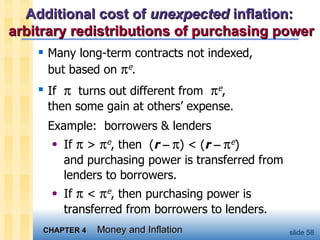
Additional cost of  unexpected  inflation:  arbitrary redistributions of purchasing power Many long-term contracts not indexed,  but based on   e . If     turns out different from   e ,  then some gain at others’ expense.  Example:  borrowers & lenders  If    >   e , then  ( r       ) < ( r       e )  and purchasing power is transferred from lenders to borrowers. If    <   e , then purchasing power is transferred from borrowers to lenders.
Additional cost of high inflation:  increased uncertainty When inflation is high, it’s more variable and unpredictable:    turns out different from   e   more often, and the differences tend to be larger  (though not systematically positive or negative)  Arbitrary redistributions of wealth  become more likely.  This creates higher uncertainty, which makes risk averse people worse off.
One benefit of inflation Nominal wages are rarely reduced, even when the equilibrium real wage falls.  Inflation allows the real wages to reach equilibrium levels without nominal wage cuts. Therefore, moderate inflation improves the functioning of labor markets.
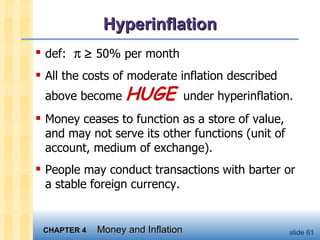
Hyperinflation def:       50% per month All the costs of moderate inflation described  above become  HUGE   under hyperinflation.  Money ceases to function as a store of value, and may not serve its other functions (unit of account, medium of exchange).  People may conduct transactions with barter or a stable foreign currency.
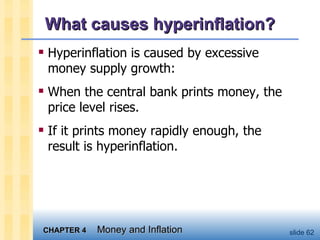
What causes hyperinflation? Hyperinflation is caused by excessive money supply growth: When the central bank prints money, the price level rises. If it prints money rapidly enough, the result is hyperinflation.
Recent episodes of hyperinflation  slide
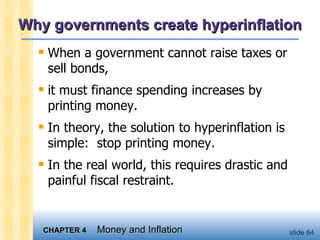
Why governments create hyperinflation When a government cannot raise taxes or sell bonds,  it must finance spending increases by printing money. In theory, the solution to hyperinflation is simple:  stop printing money. In the real world, this requires drastic and painful fiscal restraint.
The Classical Dichotomy Real variables   are measured in physical units: quantities and relative prices, e.g.  quantity of output produced real wage:  output earned per hour of work real interest rate:  output earned in the future  by lending one unit of output today Nominal variables :   measured in money units, e.g. nominal wage:  dollars per hour of work nominal interest rate:  dollars earned in future  by lending one dollar today the price level:  the amount of dollars needed  to buy a representative basket of goods slide
The Classical Dichotomy Note:  Real variables were explained in Chap 3,  nominal ones in Chap 4.  Classical Dichotomy   :  the theoretical separation of real and nominal variables in the classical model, which implies nominal variables do not affect real variables.  Neutrality of Money   :  Changes in the money supply do not affect real variables.  In the real world, money is approximately neutral in the long run.
Chapter summary Money the stock of assets used for transactions  serves as a medium of exchange, store of value, and unit of account.  Commodity money has intrinsic value, fiat money does not.  Central bank controls money supply.  Quantity theory of money assumption: velocity is stable  conclusion:  the money growth rate determines the inflation rate.
Chapter summary Nominal interest rate equals real interest rate + inflation rate.  Fisher effect:  nominal interest rate moves one-for-one w/ expected inflation.  is the opp. cost of holding money Money demand depends on income in the Quantity Theory more generally, it also depends on the nominal interest rate;  if so, then changes in expected inflation  affect the current price level.
Chapter summary Costs of inflation Expected inflation shoeleather costs, menu costs,  tax & relative price distortions,  inconvenience of correcting figures for inflation Unexpected inflation all of the above plus arbitrary redistributions of wealth between debtors and creditors
Chapter summary Hyperinflation caused by rapid money supply growth when money printed to finance  govt budget deficits stopping it requires fiscal reforms to eliminate govt’s need for printing money
Chapter summary Classical dichotomy In classical theory, money is neutral--does not affect real variables.  So, we can study how real variables are determined w/o reference to nominal ones. Then, eq’m in money market determines price level and all nominal variables.  Most economists believe the economy works this way in the long run.
 

MACROECONOMICS-CH4

  • 1.
    CHAPTER FOUR Moneyand Inflation
  • 2.
    In this chapteryou will learn The classical theory of inflation causes effects social costs “ Classical” -- assumes prices are flexible & markets clear. Applies to the long run.
  • 3.
    U.S. inflation &its trend, 1960-2001
  • 4.
    U.S. inflation &its trend, 1960-2001
  • 5.
    The connection between money and prices Inflation rate = the percentage increase in the average level of prices. price = amount of money required to buy a good. Because prices are defined in terms of money, we need to consider the nature of money, the supply of money, and how it is controlled.
  • 6.
    Money: definitionMoney is the stock of assets that can be readily used to make transactions.
  • 7.
    Money: functionsmedium of exchange we use it to buy stuff store of value transfers purchasing power from the present to the future unit of account the common unit by which everyone measures prices and values
  • 8.
    Money: typesfiat money has no intrinsic value example: the paper currency we use commodity money has intrinsic value examples: gold coins, cigarettes in P.O.W. camps
  • 9.
    Discussion Question Whichof these are money? a. Currency b. Checks c. Deposits in checking accounts (called demand deposits ) d. Credit cards e. Certificates of deposit (called time deposits )
  • 10.
    The money supply& monetary policy The money supply is the quantity of money available in the economy. Monetary policy is the control over the money supply. $$$
  • 11.
    The central bankMonetary policy is conducted by a country’s central bank . In the U.S., the central bank is called the Federal Reserve (“the Fed ”). The Federal Reserve Building Washington, DC
  • 12.
    Money supply measures, April 2002 _Symbol Assets included Amount (billions)_ C Currency $598.7 M1 C + demand deposits, 1174.0 travelers’ checks, other checkable deposits M2 M1 + small time deposits, 5480.1 savings deposits, money market mutual funds, money market deposit accounts M3 M2 + large time deposits, 8054.4 repurchase agreements, institutional money market mutual fund balances
  • 13.
    The Quantity Theoryof Money A simple theory linking the inflation rate to the growth rate of the money supply. Begins with a concept called “ velocity ”…
  • 14.
    Velocity basic concept: the rate at which money circulates definition: the number of times the average dollar bill changes hands in a given time period example: In 2001, $500 billion in transactions money supply = $100 billion The average dollar is used in five transactions in 2001 So, velocity = 5
  • 15.
    Velocity, cont.This suggests the following definition: where V = velocity T = value of all transactions M = money supply
  • 16.
    Velocity, cont.Use nominal GDP as a proxy for total transactions. Then, where P = price of output (GDP deflator) Y = quantity of output (real GDP) P  Y = value of output (nominal GDP)
  • 17.
    The quantity equationThe quantity equation M  V = P  Y follows from the preceding definition of velocity. It is an identity: it holds by definition of the variables.
  • 18.
    Money demand andthe quantity equation M / P = real money balances , the purchasing power of the money supply. A simple money demand function: ( M / P ) d = k Y where k = how much money people wish to hold for each dollar of income. ( k is exogenous)
  • 19.
    Money demand andthe quantity equation money demand: ( M / P ) d = k Y quantity equation: M  V = P  Y The connection between them: k = 1/ V When people hold lots of money relative to their incomes ( k is high), money changes hands infrequently ( V is low).
  • 20.
    back to theQuantity Theory of Money starts with quantity equation assumes V is constant & exogenous: With this assumption, the quantity equation can be written as
  • 21.
    The Quantity Theoryof Money , cont. How the price level is determined: With V constant, the money supply determines nominal GDP ( P  Y ) Real GDP is determined by the economy’s supplies of K and L and the production function (chap 3) The price level is P = (nominal GDP)/(real GDP)
  • 22.
    The Quantity Theoryof Money , cont. Recall from Chapter 2: The growth rate of a product equals the sum of the growth rates. The quantity equation in growth rates:
  • 23.
    The Quantity Theoryof Money , cont. Let  (Greek letter “pi”) denote the inflation rate: The result from the preceding slide was: Solve this result for  to get
  • 24.
    The Quantity Theoryof Money , cont. Normal economic growth requires a certain amount of money supply growth to facilitate the growth in transactions. Money growth in excess of this amount leads to inflation.
  • 25.
    The Quantity Theoryof Money , cont.  Y / Y depends on growth in the factors of production and on technological progress (all of which we take as given, for now). Hence, the Quantity Theory of Money predicts a one-for-one relation between changes in the money growth rate and changes in the inflation rate .
  • 26.
    International data on inflation and money growth
  • 27.
    U.S. data on inflation and money growth
  • 28.
    U.S. Inflation &Money Growth, 1960-2001
  • 29.
    U.S. Inflation &Money Growth, 1960-2001
  • 30.
    U.S. Inflation &Money Growth, 1960-2001
  • 31.
    U.S. Inflation &Money Growth, 1960-2001
  • 32.
    Seigniorage To spendmore without raising taxes or selling bonds, the govt can print money. The “revenue” raised from printing money is called seigniorage (pronounced SEEN-your-ige) The inflation tax : Printing money to raise revenue causes inflation. Inflation is like a tax on people who hold money.
  • 33.
    Inflation and interestrates Nominal interest rate, i not adjusted for inflation Real interest rate, r adjusted for inflation: r = i  
  • 34.
    The Fisher EffectThe Fisher equation: i = r +  Chap 3: S = I determines r . Hence, an increase in  causes an equal increase in i . This one-for-one relationship is called the Fisher effect .
  • 35.
    U.S. inflation andnominal interest rates, 1952-1998 Percent 16 14 12 10 8 6 4 2 0 -2 Nominal interest rate Inflation rate 1950 1955 1960 1965 1970 Year 1975 1980 1985 1990 2000 1995
  • 36.
    Inflation and nominalinterest rates across countries
  • 37.
    Exercise: Suppose V is constant, M is growing 5% per year, Y is growing 2% per year, and r = 4. Solve for i (the nominal interest rate). If the Fed increases the money growth rate by 2 percentage points per year, find  i . Suppose the growth rate of Y falls to 1% per year. What will happen to  ? What must the Fed do if it wishes to keep  constant?
  • 38.
    Answers: First, find  = 5  2 = 3. Then, find i = r +  = 4 + 3 = 7.  i = 2, same as the increase in the money growth rate. If the Fed does nothing,   = 1. To prevent inflation from rising, Fed must reduce the money growth rate by 1 percentage point per year. Suppose V is constant, M is growing 5% per year, Y is growing 2% per year, and r = 4.
  • 39.
    Two real interestrates  = actual inflation rate (not known until after it has occurred)  e = expected inflation rate i –  e = ex ante real interest rate: what people expect at the time they buy a bond or take out a loan i –  = ex post real interest rate: what people actually end up earning on their bond or paying on their loan
  • 40.
    Money demand and the nominal interest rate The Quantity Theory of Money assumes that the demand for real money balances depends only on real income Y . We now consider another determinant of money demand: the nominal interest rate. The nominal interest rate i is the opportunity cost of holding money (instead of bonds or other interest-earning assets). Hence,  i   in money demand.
  • 41.
    The money demandfunction ( M / P ) d = real money demand, depends negatively on i i is the opp. cost of holding money positively on Y higher Y  more spending  so, need more money ( L is used for the money demand function because money is the most liquid asset.)
  • 42.
    The money demandfunction When people are deciding whether to hold money or bonds, they don’t know what inflation will turn out to be. Hence, the nominal interest rate relevant for money demand is r +  e .
  • 43.
    Equilibrium The supplyof real money balances Real money demand
  • 44.
    What determines whatvariable how determined (in the long run) M exogenous (the Fed) r adjusts to make S = I Y P adjusts to make
  • 45.
    How P responds to  M For given values of r , Y , and  e , a change in M causes P to change by the same percentage --- just like in the Quantity Theory of Money.
  • 46.
    What about expectedinflation? Over the long run, people don’t consistently over- or under-forecast inflation, so  e =  on average. In the short run,  e may change when people get new information. EX: Suppose Fed announces it will increase M next year. People will expect next year’s P to be higher, so  e rises. This will affect P now, even though M hasn’t changed yet. (continued…)
  • 47.
    How P responds to   e For given values of r , Y , and M ,
  • 48.
    Discussion Question Why is inflation bad? What costs does inflation impose on society? List all the ones you can think of. Focus on the long run. Think like an economist.
  • 49.
    A common misperceptionCommon misperception: inflation reduces real wages This is true only in the short run, when nominal wages are fixed by contracts. (Chap 3) In the long run, the real wage is determined by labor supply and the marginal product of labor, not the price level or inflation rate . Consider the data…
  • 50.
  • 51.
    The classical viewof inflation The classical view: A change in the price level is merely a change in the units of measurement. So why, then, is inflation a social problem?
  • 52.
    The social costsof inflation … fall into two categories: 1. costs when inflation is expected 2. additional costs when inflation is different than people had expected.
  • 53.
    The costs ofexpected inflation: 1 . shoeleather cost def: the costs and inconveniences of reducing money balances to avoid the inflation tax.     i   real money balances Remember: In long run, inflation doesn’t affect real income or real spending. So, same monthly spending but lower average money holdings means more frequent trips to the bank to withdraw smaller amounts of cash.
  • 54.
    The costs ofexpected inflation: 2 . menu costs def: The costs of changing prices. Examples: print new menus print & mail new catalogs The higher is inflation, the more frequently firms must change their prices and incur these costs.
  • 55.
    The costs ofexpected inflation: 3 . relative price distortions Firms facing menu costs change prices infrequently. Example: Suppose a firm issues new catalog each January. As the general price level rises throughout the year, the firm’s relative price will fall. Different firms change their prices at different times, leading to relative price distortions… … which cause microeconomic inefficiencies in the allocation of resources.
  • 56.
    The costs ofexpected inflation: 4 . unfair tax treatment Some taxes are not adjusted to account for inflation, such as the capital gains tax. Example: 1/1/2001: you bought $10,000 worth of Starbucks stock 12/31/2001: you sold the stock for $11,000, so your nominal capital gain was $1000 (10%). Suppose  = 10% in 2001. Your real capital gain is $0. But the govt requires you to pay taxes on your $1000 nominal gain!!
  • 57.
    The costs ofexpected inflation: 4 . General inconvenience Inflation makes it harder to compare nominal values from different time periods. This complicates long-range financial planning.
  • 58.
    Additional cost of unexpected inflation: arbitrary redistributions of purchasing power Many long-term contracts not indexed, but based on  e . If  turns out different from  e , then some gain at others’ expense. Example: borrowers & lenders If  >  e , then ( r   ) < ( r   e ) and purchasing power is transferred from lenders to borrowers. If  <  e , then purchasing power is transferred from borrowers to lenders.
  • 59.
    Additional cost ofhigh inflation: increased uncertainty When inflation is high, it’s more variable and unpredictable:  turns out different from  e more often, and the differences tend to be larger (though not systematically positive or negative) Arbitrary redistributions of wealth become more likely. This creates higher uncertainty, which makes risk averse people worse off.
  • 60.
    One benefit ofinflation Nominal wages are rarely reduced, even when the equilibrium real wage falls. Inflation allows the real wages to reach equilibrium levels without nominal wage cuts. Therefore, moderate inflation improves the functioning of labor markets.
  • 61.
    Hyperinflation def:   50% per month All the costs of moderate inflation described above become HUGE under hyperinflation. Money ceases to function as a store of value, and may not serve its other functions (unit of account, medium of exchange). People may conduct transactions with barter or a stable foreign currency.
  • 62.
    What causes hyperinflation?Hyperinflation is caused by excessive money supply growth: When the central bank prints money, the price level rises. If it prints money rapidly enough, the result is hyperinflation.
  • 63.
    Recent episodes ofhyperinflation slide
  • 64.
    Why governments createhyperinflation When a government cannot raise taxes or sell bonds, it must finance spending increases by printing money. In theory, the solution to hyperinflation is simple: stop printing money. In the real world, this requires drastic and painful fiscal restraint.
  • 65.
    The Classical DichotomyReal variables are measured in physical units: quantities and relative prices, e.g. quantity of output produced real wage: output earned per hour of work real interest rate: output earned in the future by lending one unit of output today Nominal variables : measured in money units, e.g. nominal wage: dollars per hour of work nominal interest rate: dollars earned in future by lending one dollar today the price level: the amount of dollars needed to buy a representative basket of goods slide
  • 66.
    The Classical DichotomyNote: Real variables were explained in Chap 3, nominal ones in Chap 4. Classical Dichotomy : the theoretical separation of real and nominal variables in the classical model, which implies nominal variables do not affect real variables. Neutrality of Money : Changes in the money supply do not affect real variables. In the real world, money is approximately neutral in the long run.
  • 67.
    Chapter summary Moneythe stock of assets used for transactions serves as a medium of exchange, store of value, and unit of account. Commodity money has intrinsic value, fiat money does not. Central bank controls money supply. Quantity theory of money assumption: velocity is stable conclusion: the money growth rate determines the inflation rate.
  • 68.
    Chapter summary Nominalinterest rate equals real interest rate + inflation rate. Fisher effect: nominal interest rate moves one-for-one w/ expected inflation. is the opp. cost of holding money Money demand depends on income in the Quantity Theory more generally, it also depends on the nominal interest rate; if so, then changes in expected inflation affect the current price level.
  • 69.
    Chapter summary Costsof inflation Expected inflation shoeleather costs, menu costs, tax & relative price distortions, inconvenience of correcting figures for inflation Unexpected inflation all of the above plus arbitrary redistributions of wealth between debtors and creditors
  • 70.
    Chapter summary Hyperinflationcaused by rapid money supply growth when money printed to finance govt budget deficits stopping it requires fiscal reforms to eliminate govt’s need for printing money
  • 71.
    Chapter summary Classicaldichotomy In classical theory, money is neutral--does not affect real variables. So, we can study how real variables are determined w/o reference to nominal ones. Then, eq’m in money market determines price level and all nominal variables. Most economists believe the economy works this way in the long run.
  • 72.

Editor's Notes

  • #2 I’ve included a graph that unfolds over slides 27-31 that tells the same story as Figure 4-1 on p.86 of the text. If you prefer to show Figure 4-1, you can “hide” slides 27-31 and “unhide” slide 26.