Final Exam 2008

                                               Monetary and Fiscal Policy,


Name___________________________________

Attention: It is a violation of the USD integrity policy to copy or allow your work to be copied. Those in violation
will receive the maximum penalty. Sign that you understand this policy and will uphold it:


____________________________________________

Signature

                                                     Good Luck!

MULTIPLE CHOICE. Choose the one alternative that best completes the statement or answers the question.
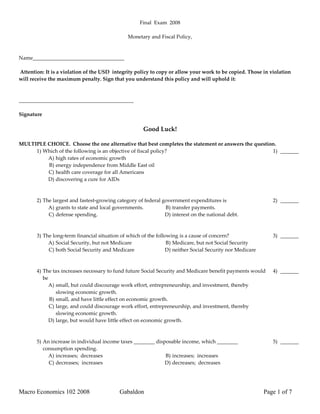
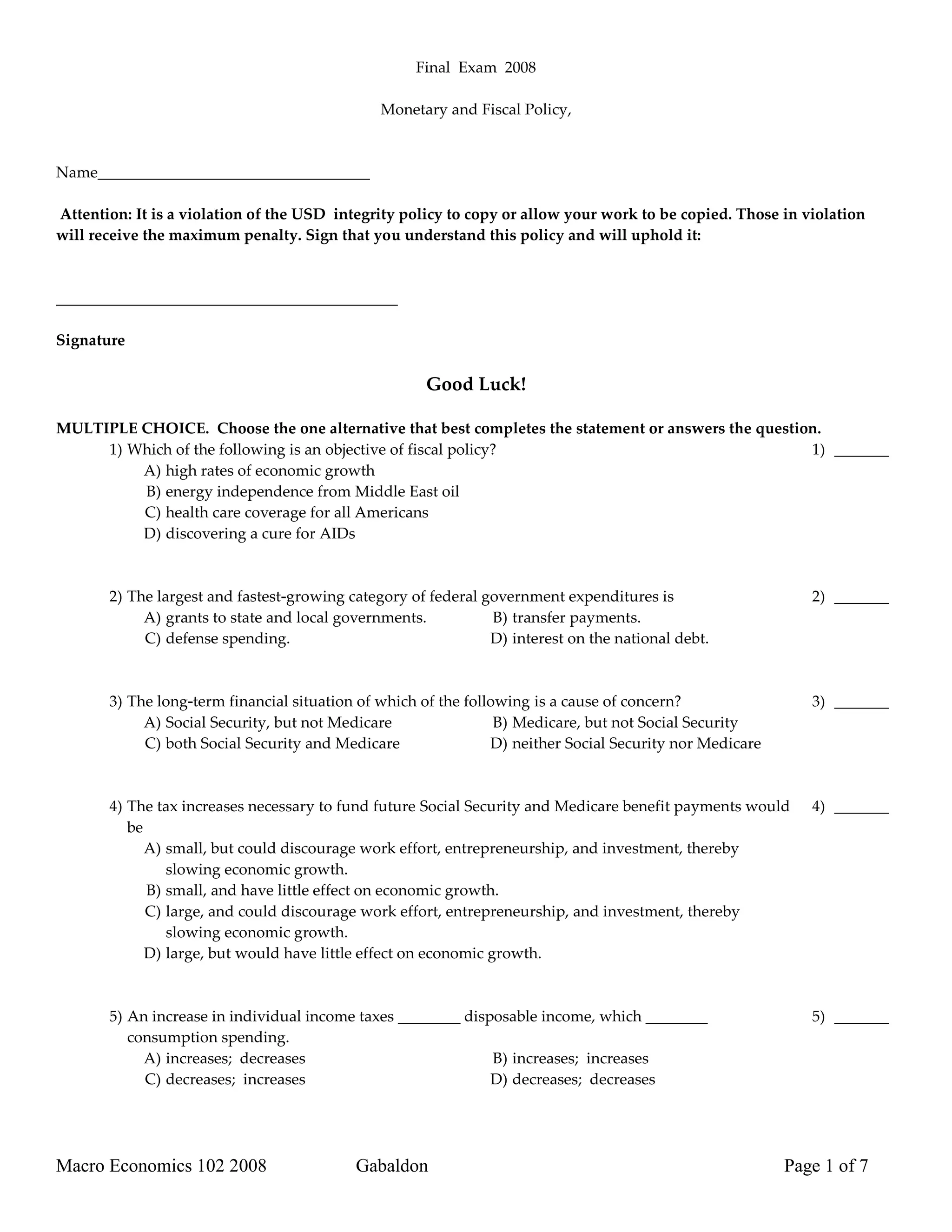
     1) Which of the following is an objective of fiscal policy?                                    1) _______
         A) high rates of economic growth
         B) energy independence from Middle East oil
         C) health care coverage for all Americans
         D) discovering a cure for AIDs


       2) The largest and fastest-growing category of federal government expenditures is                     2) _______
            A) grants to state and local governments.          B) transfer payments.
            C) defense spending.                               D) interest on the national debt.


       3) The long-term financial situation of which of the following is a cause of concern?                 3) _______
            A) Social Security, but not Medicare                 B) Medicare, but not Social Security
            C) both Social Security and Medicare                D) neither Social Security nor Medicare


       4) The tax increases necessary to fund future Social Security and Medicare benefit payments would     4) _______
          be
             A) small, but could discourage work effort, entrepreneurship, and investment, thereby
                slowing economic growth.
             B) small, and have little effect on economic growth.
             C) large, and could discourage work effort, entrepreneurship, and investment, thereby
                slowing economic growth.
             D) large, but would have little effect on economic growth.


       5) An increase in individual income taxes ________ disposable income, which ________                  5) _______
          consumption spending.
            A) increases; decreases                           B) increases; increases
            C) decreases; increases                           D) decreases; decreases


Macro Economics 102 2008                   Gabaldon                                                       Page 1 of 7
6) Tax cuts on business income increase aggregate demand by increasing                                  6) _______
           A) business investment spending.                 B) government spending.
           C) consumption spending.                        D) wage rates.


      7) Expansionary fiscal policy involves                                                                  7) _______
           A) decreasing the money supply and increasing interest rates.
           B) increasing government purchases or decreasing taxes.
           C) increasing taxes or decreasing government purchases.
           D) increasing the money supply and decreasing interest rates.


      8) If the economy is slipping into a recession, which of the following would be an appropriate fiscal   8) _______
         policy?
            A) a decrease in government purchases
             B) a decrease in taxes
             C) a decrease in oil prices
            D) an increase in the money supply and a decrease in interest rates


      9) If the economy is falling below potential real GDP, which of the following would be an               9) _______
         appropriate fiscal policy? An increase in
            A) the money supply and a decrease in interest rates.
             B) taxes.
             C) government purchases.
            D) oil prices.


     10) Expansionary fiscal policy to prevent real GDP from falling below potential real GDP would           10) ______
         cause the inflation rate to be ________ and real GDP to be ________.
           A) higher; higher           B) lower; higher        C) higher; lower        D) lower; lower


     11) From an initial long-run equilibrium, if aggregate demand grows more slowly than long-run            11) ______
         and short-run aggregate supply, then the president and the Congress would most likely
           A) increase the required reserve ratio.decrease government spending.
            B) decrease government spending.
           C) decrease taxes.
           D) decrease oil prices.


     12) From an initial long-run equilibrium, if aggregate demand grows faster than long-run and short-      12) ______
         run aggregate supply, then the president and Congress would most likely
           A) decrease oil prices.                            B) decrease tax rates.
           C) decrease the required reserve ratio.            D) decrease government spending.


     13) Contractionary fiscal policy to prevent real GDP from rising above potential real GDP would          13) ______
         cause the inflation rate to be ________ and real GDP to be _________.
           A) higher; lower            B) higher; higher       C) lower; higher        D) lower; lower


Macro Economics 102 2008                  Gabaldon                                                       Page 2 of 7
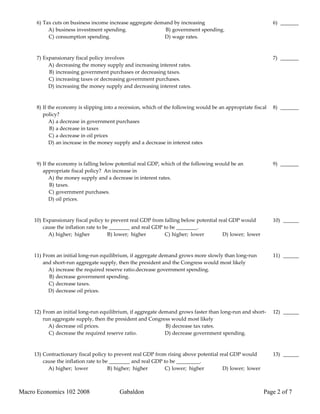
14) The aggregate demand curve will shift to the right ________ the initial increase in government        14) ______
         purchases.
           A) by the same amount as
           B) by more than
           C) by less than
           D) sometimes by more than and other times by less than


     15) The use of fiscal policy to stabilize the economy is limited because                                  15) ______
           A) the legislative process can be slow, which means that it is difficult to make fiscal policy
              actions in a timely way.
           B) changes in government spending and tax rates have a small effect on interest rates.
           C) changes in government spending and tax rates have a small effect on aggregate demand.
           D) the Internal Revenue Service (IRS) resist changes in tax rates, because of all the changes
              they would have to make to the tax code.


     16) Crowding out refers to a decline in ________ as a result of an increase in ________.                  16) ______
           A) private expenditures; government purchases
           B) government purchases; private expenditures
           C) government purchases; tax rates
           D) tax revenues; unemployment


     17) The crowding out of government spending by private spending will be greater the                       17) ______
           A) less sensitive consumption, investment, and net exports are to changes in the price level.
           B) less sensitive consumption, investment, and net exports are to changes in interest rates.
           C) more sensitive consumption, investment, and net exports are to changes in interest rates.
           D) more sensitive consumption, investment, and net exports are to changes in the price level.


     18) An economic expansion tends to cause the federal budget deficit to ________ because tax               18) ______
         revenues ________ and government spending on transfer payments ________.
           A) decrease; rise; fall                          B) decrease; fall; rise
           C) increase; rise; fall                          D) increase; fall; rise

     19) Suppose instead of a fixed amount of taxes that there is a tax rate of 10 percent. If pre-tax         19) ______
         household income increases by $10 billion and the marginal propensity to consume is 0.8, then
         consumption spending will increase by
           A) $8 billion.            B) $7.2 billion.         C) $9 billion.             D) $1 billion.

     20) An increase in the interest rate causes                                                               20) ______
          A) the money demand curve to shift to the left.
           B) a movement up along the money demand curve.
           C) the money demand curve to shift to the right.
           D) a movement down along the money demand curve.

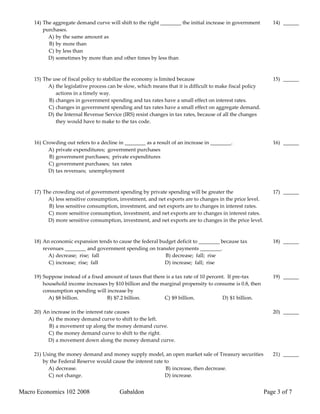
     21) Using the money demand and money supply model, an open market sale of Treasury securities             21) ______
         by the Federal Reserve would cause the interest rate to
           A) decrease.                                        B) increase, then decrease.
           C) not change.                                     D) increase.


Macro Economics 102 2008                  Gabaldon                                                          Page 3 of 7
22) Using the money demand and money supply model, an increase in money demand would cause             22) ______
         the interest rate to
           A) increase.                                 B) not change.
            C) decrease.                               D) increase, then decrease.


     23) When the Federal Reserve decreases the money supply, at the previous equilibrium interest rate     23) ______
         households and firms will now want to
           A) hold less money.                            B) buy Treasury bills.
           C) sell Treasury bills.                        D) neither buy nor sell Treasury bills.


     24) The interest rate on a Treasury bill that you pay $980 for today that matures in one year and      24) ______
         pays $1,000 is
           A) 3 percent.              B) 4 percent.            C) 2 percent.             D) 1 percent.


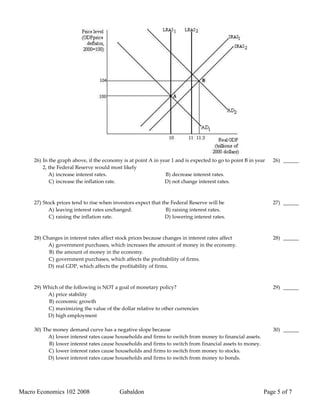
     25) In the graph above, when the money supply shifts from MS 1 to MS2 , at the interest rate of 3      25) ______
        percent households and firms will
          A) want to hold less money.                         B) sell Treasury bills.
          C) neither buy nor sell Treasury bills.             D) buy Treasury bills.


Macro Economics 102 2008                  Gabaldon                                                       Page 4 of 7
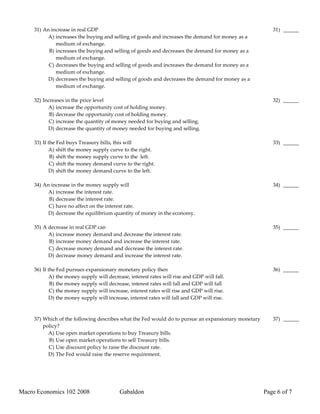
26) In the graph above, if the economy is at point A in year 1 and is expected to go to point B in year   26) ______
         2, the Federal Reserve would most likely
            A) increase interest rates.                        B) decrease interest rates.
            C) increase the inflation rate.                    D) not change interest rates.


     27) Stock prices tend to rise when investors expect that the Federal Reserve will be                      27) ______
           A) leaving interest rates unchanged.                 B) raising interest rates.
            C) raising the inflation rate.                     D) lowering interest rates.


     28) Changes in interest rates affect stock prices because changes in interest rates affect                28) ______
           A) government purchases, which increases the amount of money in the economy.
           B) the amount of money in the economy.
           C) government purchases, which affects the profitability of firms.
           D) real GDP, which affects the profitability of firms.


     29) Which of the following is NOT a goal of monetary policy?                                              29) ______
          A) price stability
          B) economic growth
          C) maximizing the value of the dollar relative to other currencies
          D) high employment

     30) The money demand curve has a negative slope because                                                   30) ______
           A) lower interest rates cause households and firms to switch from money to financial assets.
           B) lower interest rates cause households and firms to switch from financial assets to money.
           C) lower interest rates cause households and firms to switch from money to stocks.
           D) lower interest rates cause households and firms to switch from money to bonds.


Macro Economics 102 2008                   Gabaldon                                                        Page 5 of 7
31) An increase in real GDP                                                                        31) ______
          A) increases the buying and selling of goods and increases the demand for money as a
              medium of exchange.
           B) increases the buying and selling of goods and decreases the demand for money as a
              medium of exchange.
           C) decreases the buying and selling of goods and increases the demand for money as a
              medium of exchange.
           D) decreases the buying and selling of goods and decreases the demand for money as a
              medium of exchange.

     32) Increases in the price level                                                                   32) ______
           A) increase the opportunity cost of holding money.
            B) decrease the opportunity cost of holding money.
            C) increase the quantity of money needed for buying and selling.
           D) decrease the quantity of money needed for buying and selling.

     33) If the Fed buys Treasury bills, this will                                                      33) ______
            A) shift the money supply curve to the right.
             B) shift the money supply curve to the left.
             C) shift the money demand curve to the right.
            D) shift the money demand curve to the left.

     34) An increase in the money supply will                                                           34) ______
          A) increase the interest rate.
           B) decrease the interest rate.
           C) have no affect on the interest rate.
           D) decrease the equilibrium quantity of money in the economy.

     35) A decrease in real GDP can                                                                     35) ______
           A) increase money demand and decrease the interest rate.
           B) increase money demand and increase the interest rate.
           C) decrease money demand and decrease the interest rate.
           D) decrease money demand and increase the interest rate.

     36) If the Fed pursues expansionary monetary policy then                                           36) ______
            A) the money supply will decrease, interest rates will rise and GDP will fall.
             B) the money supply will decrease, interest rates will fall and GDP will fall
             C) the money supply will increase, interest rates will rise and GDP will rise.
            D) the money supply will increase, interest rates will fall and GDP will rise.


     37) Which of the following describes what the Fed would do to pursue an expansionary monetary      37) ______
         policy?
           A) Use open market operations to buy Treasury bills.
           B) Use open market operations to sell Treasury bills.
           C) Use discount policy to raise the discount rate.
           D) The Fed would raise the reserve requirement.


Macro Economics 102 2008                   Gabaldon                                                  Page 6 of 7
38) Contractionary monetary policy on the part of the Fed results in                                  38) ______
           A) an increase in the money supply, an increase in interest rates, and an increase in GDP.
           B) a decrease in the money supply, and increase in interest rates, and a decrease in GDP.
           C) an increase in the money supply, a decrease in interest rates, and an increase in GDP.
           D) a decrease in the money supply, a decrease in interest rates, and a decrease in GDP.

     39) Contractionary monetary policy causes                                                             39) ______
           A) aggregate demand to rise, and the price level to rise.
           B) aggregate demand to fall, and the price level to fall.
           C) aggregate demand to rise, and the price level to fall.
           D) aggregate demand to fall, and the price level to rise.


     40) If the Fed's policy is described as contractionary, then it would                                 40) ______
            A) use open market operations to buy Treasury bills.
             B) use open market operations to sell Treasury bills.
             C) lower the discount rate.
            D) lower the reserve requirement.


Macro Economics 102 2008                   Gabaldon                                                     Page 7 of 7

2008 macro fiscal & monetary policy exam

  • 1.
    Final Exam 2008 Monetary and Fiscal Policy, Name___________________________________ Attention: It is a violation of the USD integrity policy to copy or allow your work to be copied. Those in violation will receive the maximum penalty. Sign that you understand this policy and will uphold it: ____________________________________________ Signature Good Luck! MULTIPLE CHOICE. Choose the one alternative that best completes the statement or answers the question. 1) Which of the following is an objective of fiscal policy? 1) _______ A) high rates of economic growth B) energy independence from Middle East oil C) health care coverage for all Americans D) discovering a cure for AIDs 2) The largest and fastest-growing category of federal government expenditures is 2) _______ A) grants to state and local governments. B) transfer payments. C) defense spending. D) interest on the national debt. 3) The long-term financial situation of which of the following is a cause of concern? 3) _______ A) Social Security, but not Medicare B) Medicare, but not Social Security C) both Social Security and Medicare D) neither Social Security nor Medicare 4) The tax increases necessary to fund future Social Security and Medicare benefit payments would 4) _______ be A) small, but could discourage work effort, entrepreneurship, and investment, thereby slowing economic growth. B) small, and have little effect on economic growth. C) large, and could discourage work effort, entrepreneurship, and investment, thereby slowing economic growth. D) large, but would have little effect on economic growth. 5) An increase in individual income taxes ________ disposable income, which ________ 5) _______ consumption spending. A) increases; decreases B) increases; increases C) decreases; increases D) decreases; decreases Macro Economics 102 2008 Gabaldon Page 1 of 7
  • 2.
    6) Tax cutson business income increase aggregate demand by increasing 6) _______ A) business investment spending. B) government spending. C) consumption spending. D) wage rates. 7) Expansionary fiscal policy involves 7) _______ A) decreasing the money supply and increasing interest rates. B) increasing government purchases or decreasing taxes. C) increasing taxes or decreasing government purchases. D) increasing the money supply and decreasing interest rates. 8) If the economy is slipping into a recession, which of the following would be an appropriate fiscal 8) _______ policy? A) a decrease in government purchases B) a decrease in taxes C) a decrease in oil prices D) an increase in the money supply and a decrease in interest rates 9) If the economy is falling below potential real GDP, which of the following would be an 9) _______ appropriate fiscal policy? An increase in A) the money supply and a decrease in interest rates. B) taxes. C) government purchases. D) oil prices. 10) Expansionary fiscal policy to prevent real GDP from falling below potential real GDP would 10) ______ cause the inflation rate to be ________ and real GDP to be ________. A) higher; higher B) lower; higher C) higher; lower D) lower; lower 11) From an initial long-run equilibrium, if aggregate demand grows more slowly than long-run 11) ______ and short-run aggregate supply, then the president and the Congress would most likely A) increase the required reserve ratio.decrease government spending. B) decrease government spending. C) decrease taxes. D) decrease oil prices. 12) From an initial long-run equilibrium, if aggregate demand grows faster than long-run and short- 12) ______ run aggregate supply, then the president and Congress would most likely A) decrease oil prices. B) decrease tax rates. C) decrease the required reserve ratio. D) decrease government spending. 13) Contractionary fiscal policy to prevent real GDP from rising above potential real GDP would 13) ______ cause the inflation rate to be ________ and real GDP to be _________. A) higher; lower B) higher; higher C) lower; higher D) lower; lower Macro Economics 102 2008 Gabaldon Page 2 of 7
  • 3.
    14) The aggregatedemand curve will shift to the right ________ the initial increase in government 14) ______ purchases. A) by the same amount as B) by more than C) by less than D) sometimes by more than and other times by less than 15) The use of fiscal policy to stabilize the economy is limited because 15) ______ A) the legislative process can be slow, which means that it is difficult to make fiscal policy actions in a timely way. B) changes in government spending and tax rates have a small effect on interest rates. C) changes in government spending and tax rates have a small effect on aggregate demand. D) the Internal Revenue Service (IRS) resist changes in tax rates, because of all the changes they would have to make to the tax code. 16) Crowding out refers to a decline in ________ as a result of an increase in ________. 16) ______ A) private expenditures; government purchases B) government purchases; private expenditures C) government purchases; tax rates D) tax revenues; unemployment 17) The crowding out of government spending by private spending will be greater the 17) ______ A) less sensitive consumption, investment, and net exports are to changes in the price level. B) less sensitive consumption, investment, and net exports are to changes in interest rates. C) more sensitive consumption, investment, and net exports are to changes in interest rates. D) more sensitive consumption, investment, and net exports are to changes in the price level. 18) An economic expansion tends to cause the federal budget deficit to ________ because tax 18) ______ revenues ________ and government spending on transfer payments ________. A) decrease; rise; fall B) decrease; fall; rise C) increase; rise; fall D) increase; fall; rise 19) Suppose instead of a fixed amount of taxes that there is a tax rate of 10 percent. If pre-tax 19) ______ household income increases by $10 billion and the marginal propensity to consume is 0.8, then consumption spending will increase by A) $8 billion. B) $7.2 billion. C) $9 billion. D) $1 billion. 20) An increase in the interest rate causes 20) ______ A) the money demand curve to shift to the left. B) a movement up along the money demand curve. C) the money demand curve to shift to the right. D) a movement down along the money demand curve. 21) Using the money demand and money supply model, an open market sale of Treasury securities 21) ______ by the Federal Reserve would cause the interest rate to A) decrease. B) increase, then decrease. C) not change. D) increase. Macro Economics 102 2008 Gabaldon Page 3 of 7
  • 4.
    22) Using themoney demand and money supply model, an increase in money demand would cause 22) ______ the interest rate to A) increase. B) not change. C) decrease. D) increase, then decrease. 23) When the Federal Reserve decreases the money supply, at the previous equilibrium interest rate 23) ______ households and firms will now want to A) hold less money. B) buy Treasury bills. C) sell Treasury bills. D) neither buy nor sell Treasury bills. 24) The interest rate on a Treasury bill that you pay $980 for today that matures in one year and 24) ______ pays $1,000 is A) 3 percent. B) 4 percent. C) 2 percent. D) 1 percent. 25) In the graph above, when the money supply shifts from MS 1 to MS2 , at the interest rate of 3 25) ______ percent households and firms will A) want to hold less money. B) sell Treasury bills. C) neither buy nor sell Treasury bills. D) buy Treasury bills. Macro Economics 102 2008 Gabaldon Page 4 of 7
  • 5.
    26) In thegraph above, if the economy is at point A in year 1 and is expected to go to point B in year 26) ______ 2, the Federal Reserve would most likely A) increase interest rates. B) decrease interest rates. C) increase the inflation rate. D) not change interest rates. 27) Stock prices tend to rise when investors expect that the Federal Reserve will be 27) ______ A) leaving interest rates unchanged. B) raising interest rates. C) raising the inflation rate. D) lowering interest rates. 28) Changes in interest rates affect stock prices because changes in interest rates affect 28) ______ A) government purchases, which increases the amount of money in the economy. B) the amount of money in the economy. C) government purchases, which affects the profitability of firms. D) real GDP, which affects the profitability of firms. 29) Which of the following is NOT a goal of monetary policy? 29) ______ A) price stability B) economic growth C) maximizing the value of the dollar relative to other currencies D) high employment 30) The money demand curve has a negative slope because 30) ______ A) lower interest rates cause households and firms to switch from money to financial assets. B) lower interest rates cause households and firms to switch from financial assets to money. C) lower interest rates cause households and firms to switch from money to stocks. D) lower interest rates cause households and firms to switch from money to bonds. Macro Economics 102 2008 Gabaldon Page 5 of 7
  • 6.
    31) An increasein real GDP 31) ______ A) increases the buying and selling of goods and increases the demand for money as a medium of exchange. B) increases the buying and selling of goods and decreases the demand for money as a medium of exchange. C) decreases the buying and selling of goods and increases the demand for money as a medium of exchange. D) decreases the buying and selling of goods and decreases the demand for money as a medium of exchange. 32) Increases in the price level 32) ______ A) increase the opportunity cost of holding money. B) decrease the opportunity cost of holding money. C) increase the quantity of money needed for buying and selling. D) decrease the quantity of money needed for buying and selling. 33) If the Fed buys Treasury bills, this will 33) ______ A) shift the money supply curve to the right. B) shift the money supply curve to the left. C) shift the money demand curve to the right. D) shift the money demand curve to the left. 34) An increase in the money supply will 34) ______ A) increase the interest rate. B) decrease the interest rate. C) have no affect on the interest rate. D) decrease the equilibrium quantity of money in the economy. 35) A decrease in real GDP can 35) ______ A) increase money demand and decrease the interest rate. B) increase money demand and increase the interest rate. C) decrease money demand and decrease the interest rate. D) decrease money demand and increase the interest rate. 36) If the Fed pursues expansionary monetary policy then 36) ______ A) the money supply will decrease, interest rates will rise and GDP will fall. B) the money supply will decrease, interest rates will fall and GDP will fall C) the money supply will increase, interest rates will rise and GDP will rise. D) the money supply will increase, interest rates will fall and GDP will rise. 37) Which of the following describes what the Fed would do to pursue an expansionary monetary 37) ______ policy? A) Use open market operations to buy Treasury bills. B) Use open market operations to sell Treasury bills. C) Use discount policy to raise the discount rate. D) The Fed would raise the reserve requirement. Macro Economics 102 2008 Gabaldon Page 6 of 7
  • 7.
    38) Contractionary monetarypolicy on the part of the Fed results in 38) ______ A) an increase in the money supply, an increase in interest rates, and an increase in GDP. B) a decrease in the money supply, and increase in interest rates, and a decrease in GDP. C) an increase in the money supply, a decrease in interest rates, and an increase in GDP. D) a decrease in the money supply, a decrease in interest rates, and a decrease in GDP. 39) Contractionary monetary policy causes 39) ______ A) aggregate demand to rise, and the price level to rise. B) aggregate demand to fall, and the price level to fall. C) aggregate demand to rise, and the price level to fall. D) aggregate demand to fall, and the price level to rise. 40) If the Fed's policy is described as contractionary, then it would 40) ______ A) use open market operations to buy Treasury bills. B) use open market operations to sell Treasury bills. C) lower the discount rate. D) lower the reserve requirement. Macro Economics 102 2008 Gabaldon Page 7 of 7