Chapter 2: Gravity Model
Prepared by César R. Sobrino
Universidad del Turabo
November 3, 2017
1 / 28 Prepared by César R. Sobrino Chapter 2: Gravity Model
Outline
1 Largest trading partners of the United States
2 Gravity model:
influence of an economy’s size on trade
distance and other factors that influence trade
3 Borders and trade agreements
4 Globalization: then and now
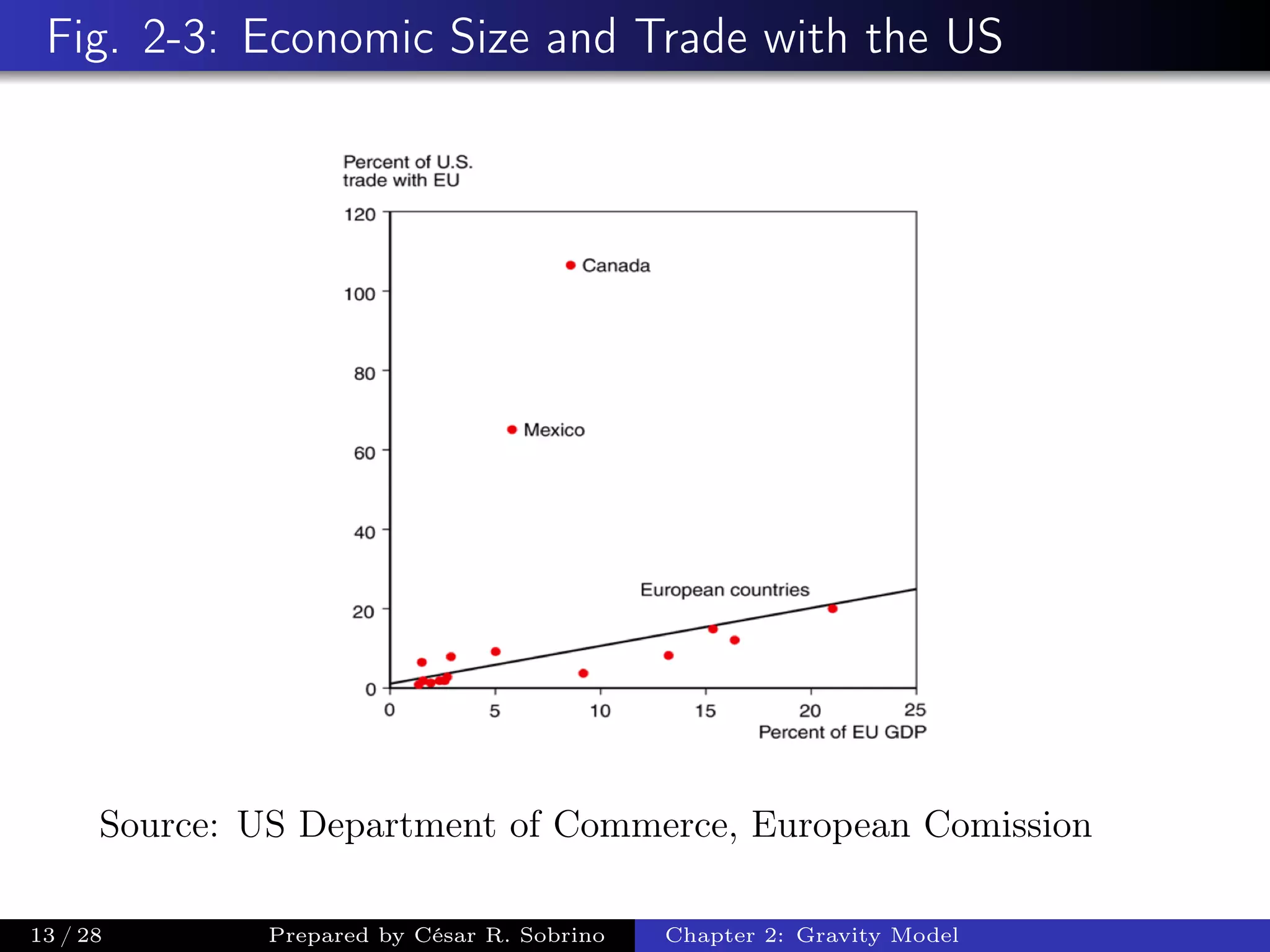
5 Changing composition of trade
6 Service outsourcing
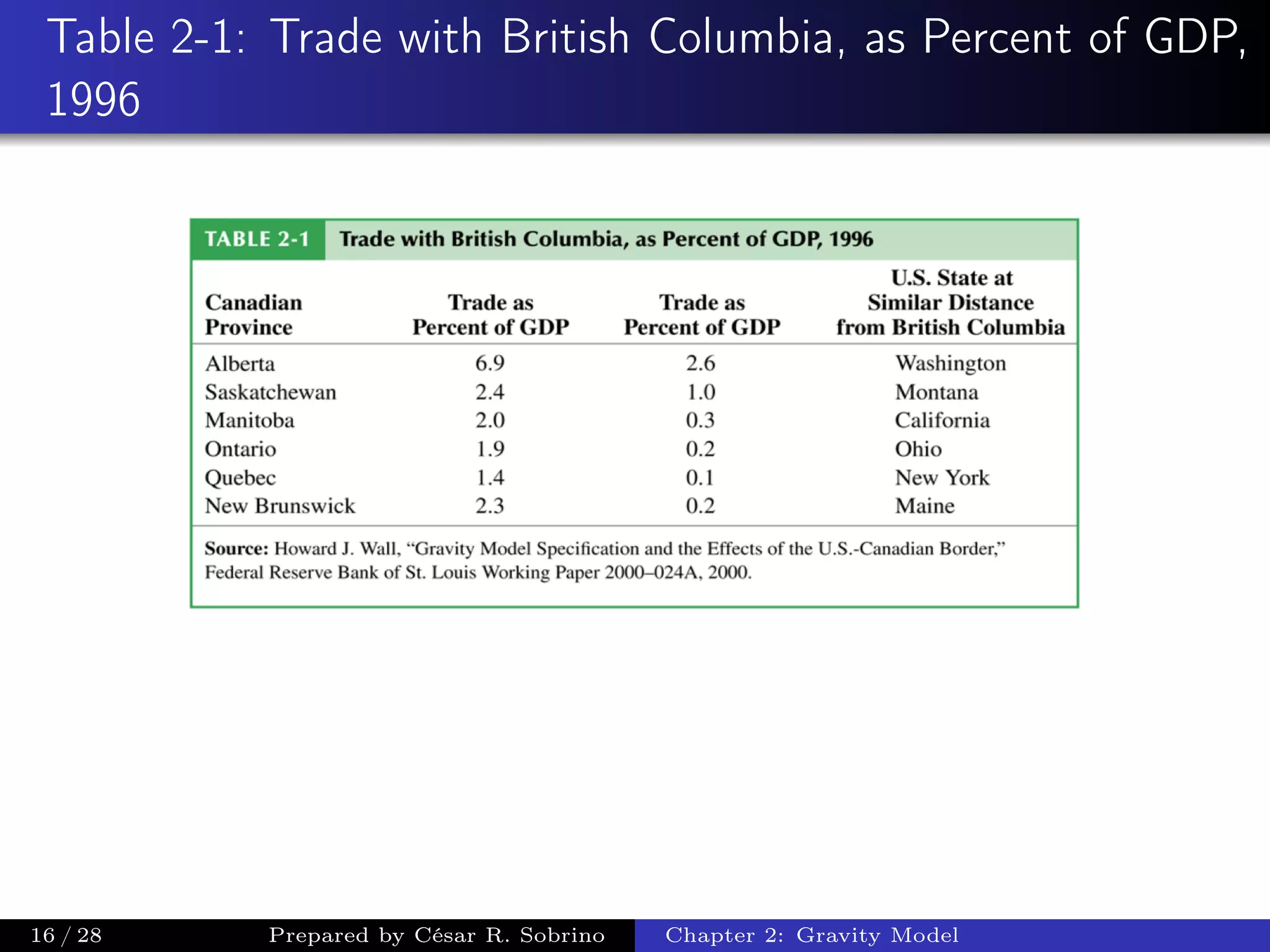
2 / 28 Prepared by César R. Sobrino Chapter 2: Gravity Model
Who trades with Whom
The 5 largest trading partners with the US in 2008 were
Canada, China, Mexico, Japan, and Germany.
The total value of imports from and exports to Canada in
2008 was about $550 billion dollars.
The largest 15 trading partners with the US accounted for
69% of the value of US trade in 2008.
3 / 28 Prepared by César R. Sobrino Chapter 2: Gravity Model
Fig. 2-1: Total US Trade with Major Partners, 2008
Source: US Department of Commerce
4 / 28 Prepared by César R. Sobrino Chapter 2: Gravity Model
Size Matters: The Gravity Model
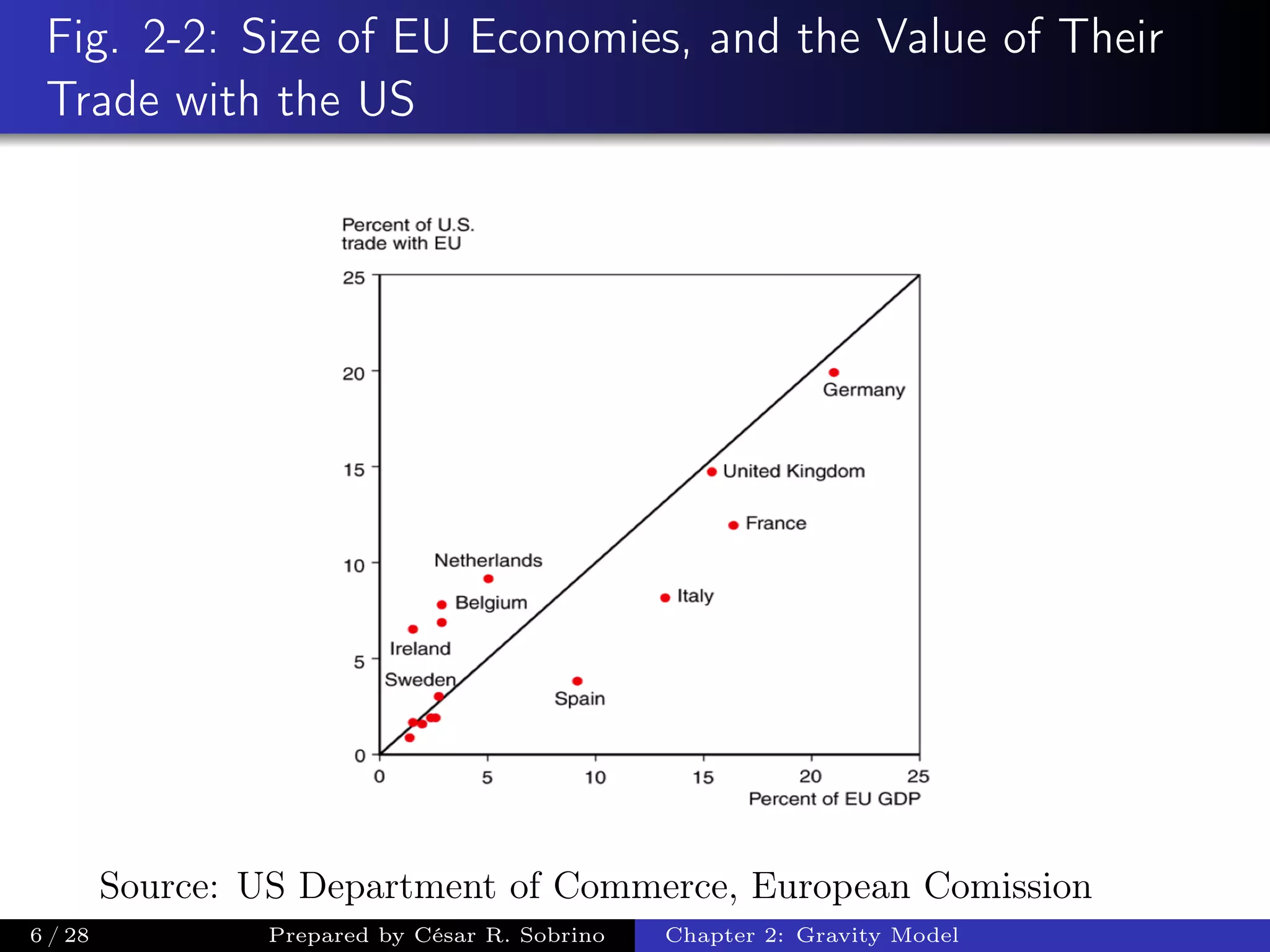
3 of the top 10 trading partners with the US in 2008 were
also the 3 largest European economies: Germany, UK„ and
France.
These countries have the largest gross domestic product
(GDP) in Europe.
GDP measures the value of goods and services produced in
an economy.
Why does the US trade most with these European
countries and not other European countries?
In fact, the size of an economy is directly related to the
volume of imports and exports.
Larger economies produce more goods and services, so they
have more to sell in the export market.
Larger economies generate more income from the goods and
services sold, so they are able to buy more imports.
5 / 28 Prepared by César R. Sobrino Chapter 2: Gravity Model
Fig. 2-2: Size of EU Economies, and the Value of Their
Trade with the US
Source: US Department of Commerce, European Comission
6 / 28 Prepared by César R. Sobrino Chapter 2: Gravity Model
Other things besides size matter for trade
1 Distance between markets influences transportation costs
and therefore the cost of imports and exports.
Distance may also influence personal contact and
communication, which may influence trade.
2 Cultural affinity: if two countries have cultural ties, it is
likely that they also have strong economic ties.
3 Geography: ocean harbors and a lack of mountain barriers
make transportation and trade easier.
4 Multinational corporations: corporations spread across
different nations import and export many goods between
their divisions.
5 Borders: crossing borders involves formalities that take
time and perhaps monetary costs like tariffs.
These implicit and explicit costs reduce trade.
The existence of borders may also indicate the existence of
different languages (see 2) or different currencies, either of
which may impede trade more.
7 / 28 Prepared by César R. Sobrino Chapter 2: Gravity Model
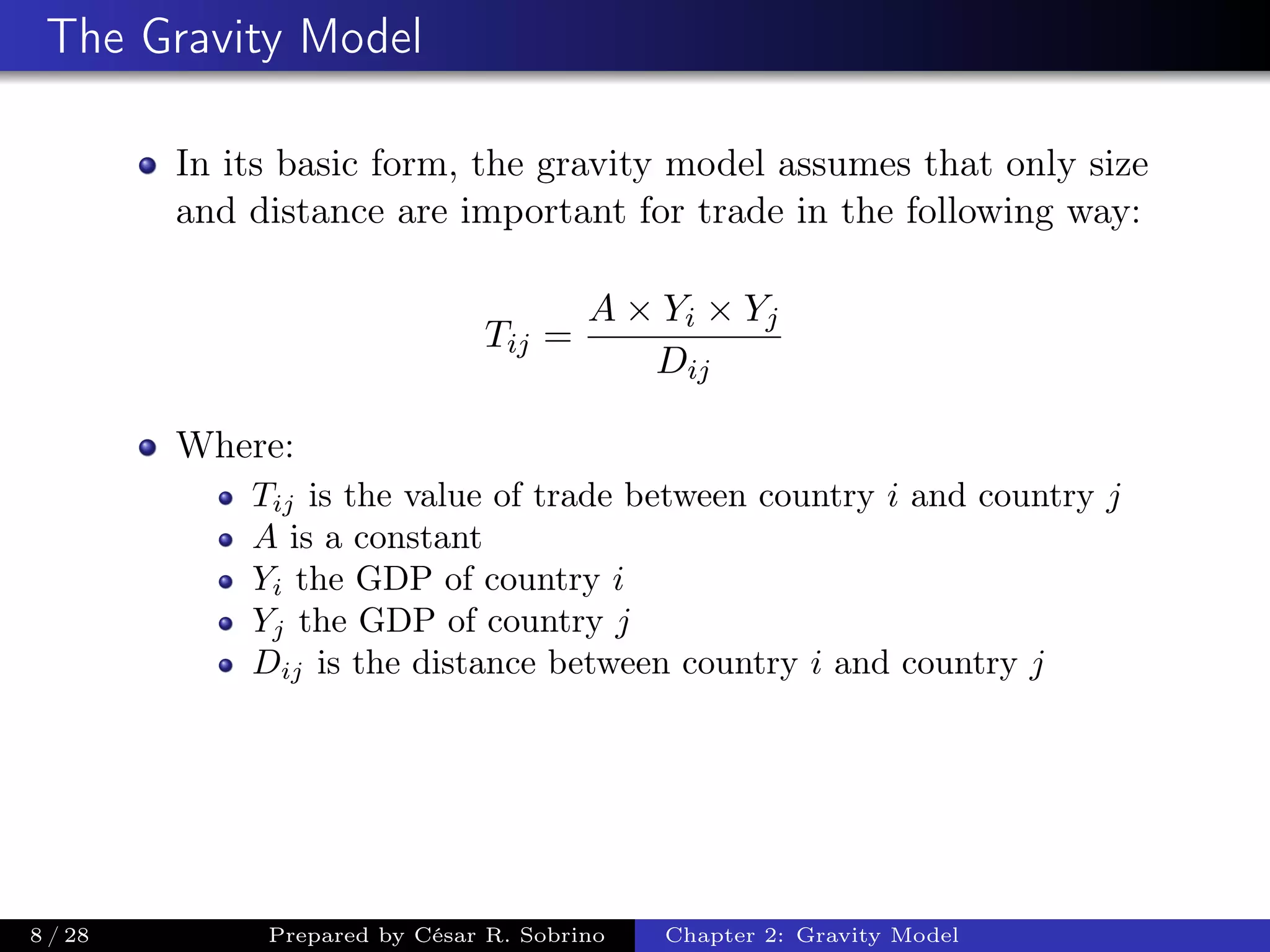
The Gravity Model
In its basic form, the gravity model assumes that only size
and distance are important for trade in the following way:
Tij =
A × Yi × Yj
Dij
Where:
Tij is the value of trade between country i and country j
A is a constant
Yi the GDP of country i
Yj the GDP of country j
Dij is the distance between country i and country j
8 / 28 Prepared by César R. Sobrino Chapter 2: Gravity Model
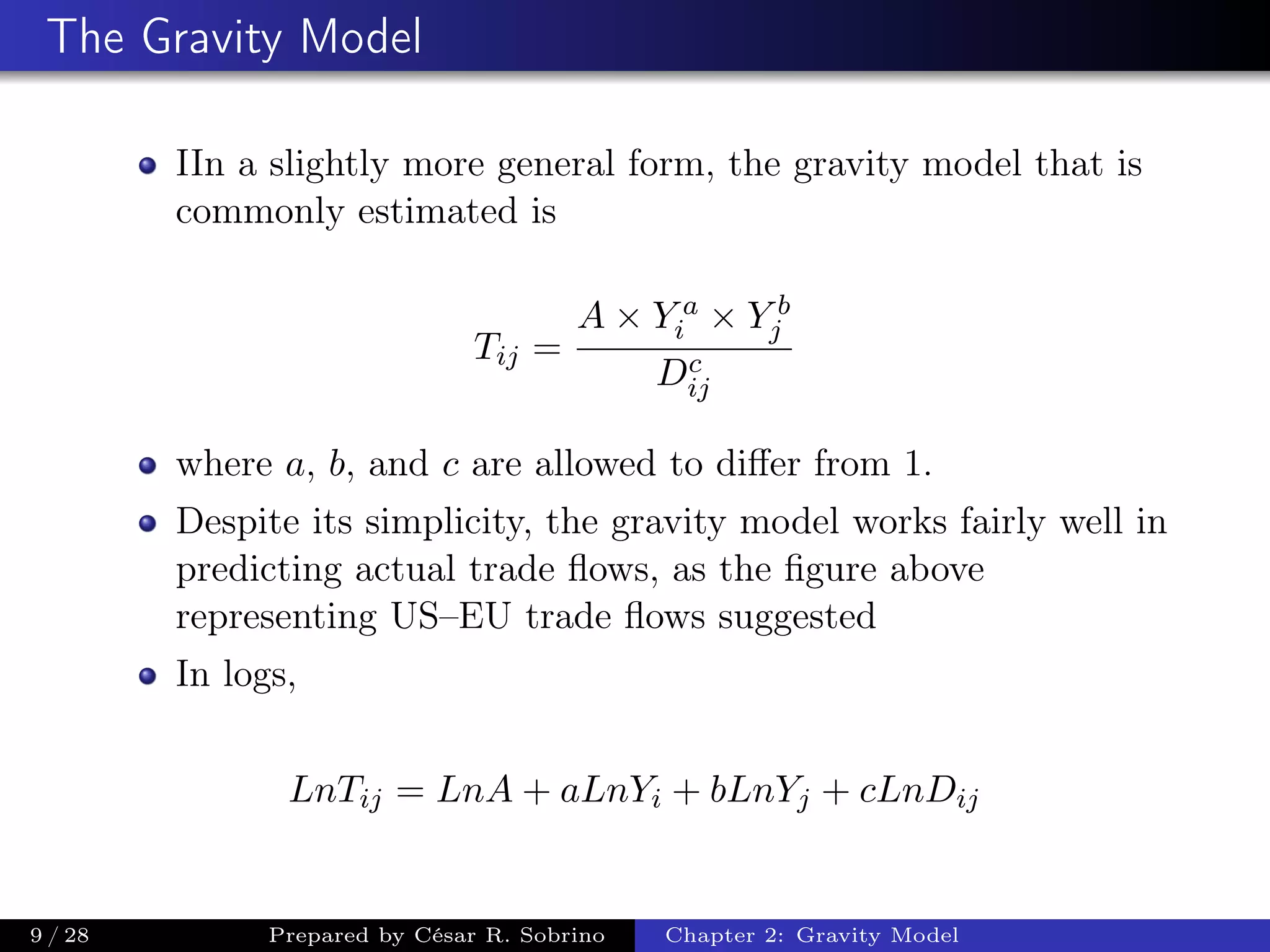
The Gravity Model
IIn a slightly more general form, the gravity model that is
commonly estimated is
Tij =
A × Y a
i × Y b
j
Dc
ij
where a, b, and c are allowed to differ from 1.
Despite its simplicity, the gravity model works fairly well in
predicting actual trade flows, as the figure above
representing US–EU trade flows suggested
In logs,
LnTij = LnA + aLnYi + bLnYj + cLnDij
9 / 28 Prepared by César R. Sobrino Chapter 2: Gravity Model
The Gravity Model: A Numerical Example
There are only four countries in the world: A, B, C, & D.
Their GDPs are 40, 40, 10, & 10, respectively.
So, the domestic spendings as a percentage of the global
spending are 40%, 40%, 10%, & 10%, respectively.
How is the trade level between them?
A B C D
A - 16 4 4
B 16 - 4 4
C 4 4 - 1
D 4 4 1 -
0.4 × 40 = 16 ; 0.4 × 10 = 4; and 0.1 × 10 = 1
10 / 28 Prepared by César R. Sobrino Chapter 2: Gravity Model
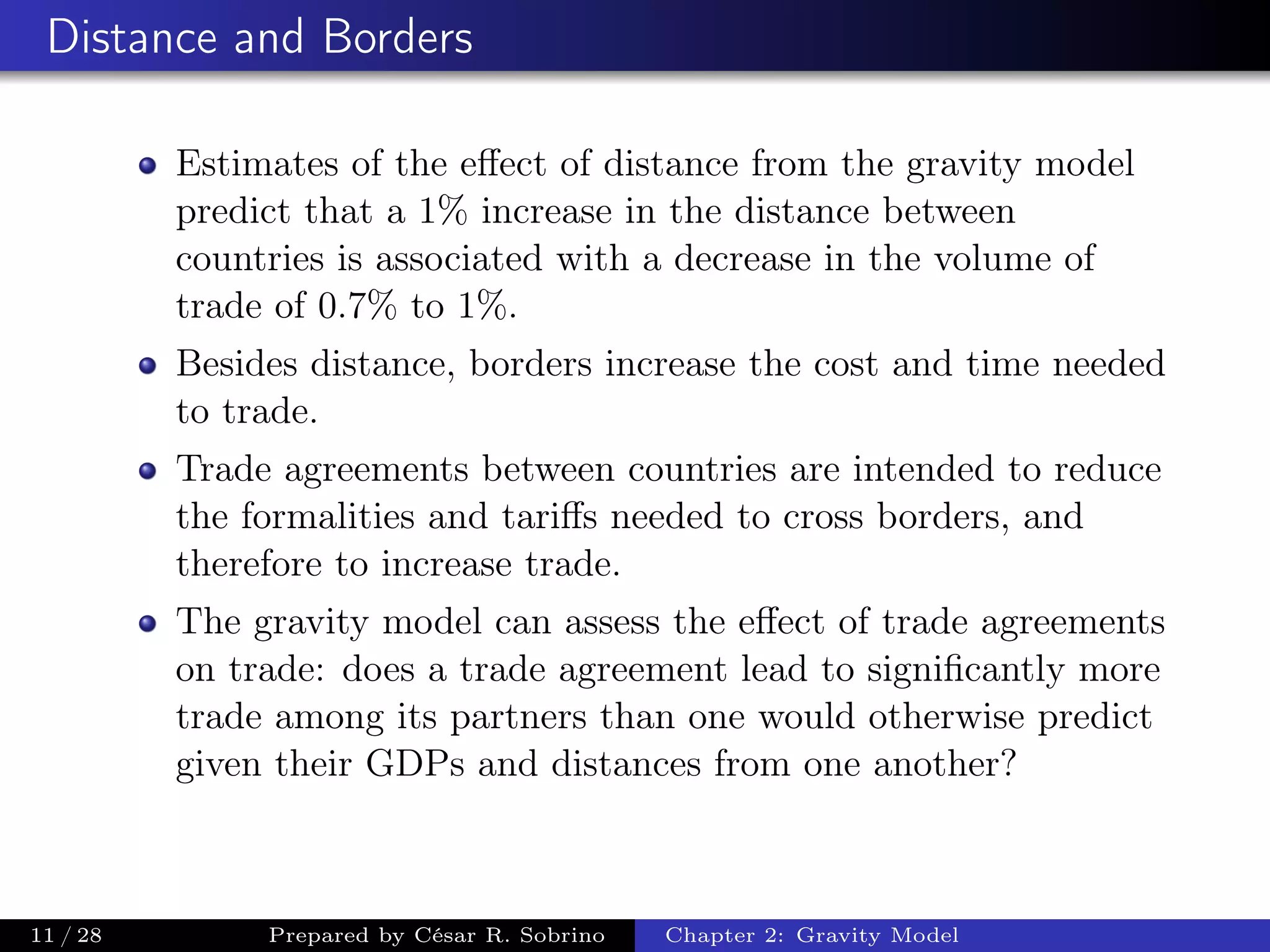
Distance and Borders
Estimates of the effect of distance from the gravity model
predict that a 1% increase in the distance between
countries is associated with a decrease in the volume of
trade of 0.7% to 1%.
Besides distance, borders increase the cost and time needed
to trade.
Trade agreements between countries are intended to reduce
the formalities and tariffs needed to cross borders, and
therefore to increase trade.
The gravity model can assess the effect of trade agreements
on trade: does a trade agreement lead to significantly more
trade among its partners than one would otherwise predict
given their GDPs and distances from one another?
11 / 28 Prepared by César R. Sobrino Chapter 2: Gravity Model
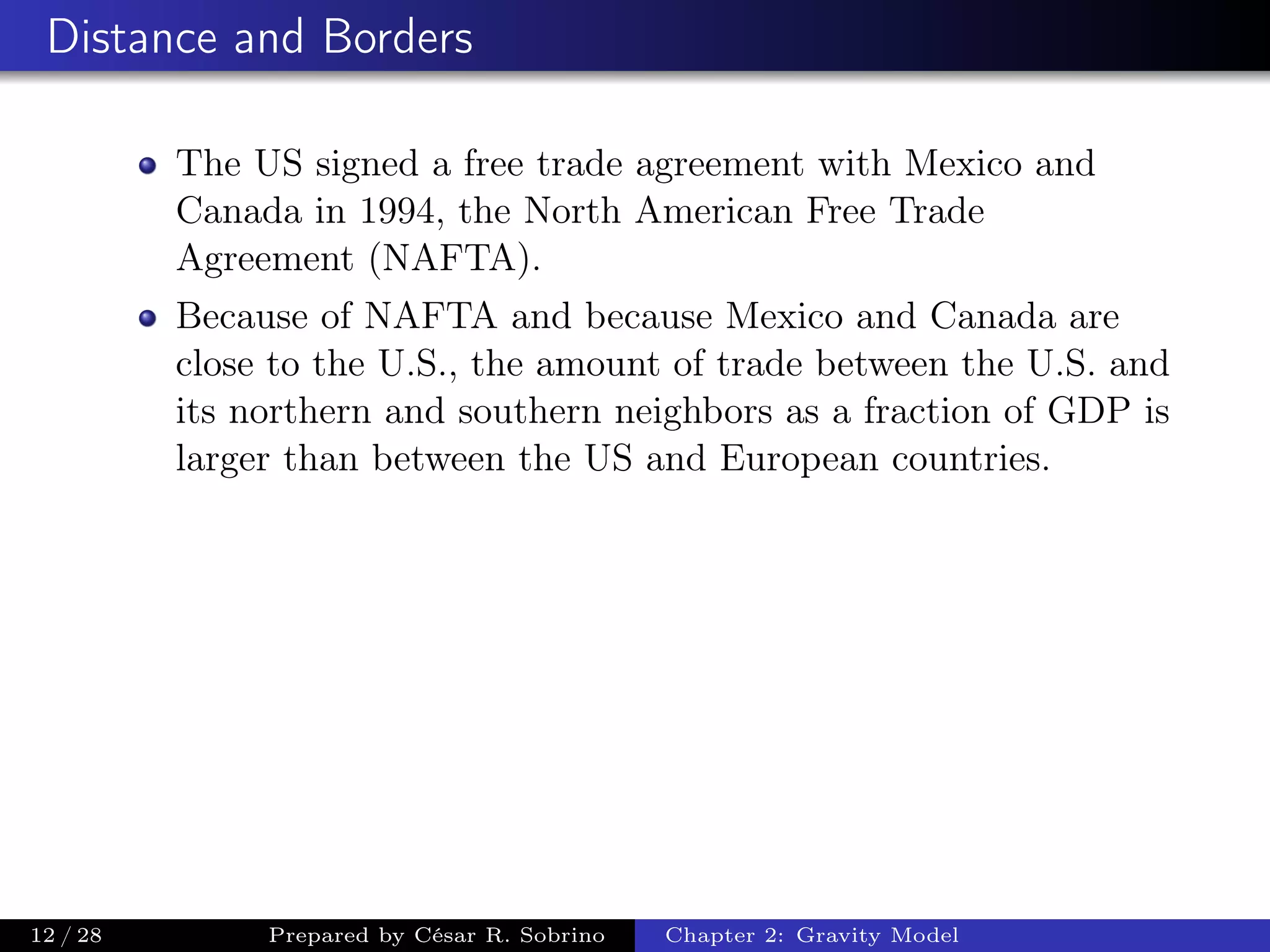
Distance and Borders
The US signed a free trade agreement with Mexico and
Canada in 1994, the North American Free Trade
Agreement (NAFTA).
Because of NAFTA and because Mexico and Canada are
close to the U.S., the amount of trade between the U.S. and
its northern and southern neighbors as a fraction of GDP is
larger than between the US and European countries.
12 / 28 Prepared by César R. Sobrino Chapter 2: Gravity Model
Fig. 2-3: Economic Size and Trade with the US
Source: US Department of Commerce, European Comission
13 / 28 Prepared by César R. Sobrino Chapter 2: Gravity Model
Distance and Borders
Yet even with a free trade agreement between the US and
Canada, which use a common language, the border between
these countries still seems to be associated with a reduction
in trade.
14 / 28 Prepared by César R. Sobrino Chapter 2: Gravity Model
Fig. 2-4: Canadian Provinces and US States That Trade
with British Columbia
15 / 28 Prepared by César R. Sobrino Chapter 2: Gravity Model
Table 2-1: Trade with British Columbia, as Percent of GDP,
1996
16 / 28 Prepared by César R. Sobrino Chapter 2: Gravity Model
Has the World Become “Smaller”?
The negative effect of distance on trade according to the
gravity models is significant, but has grown smaller over
time due to modern transportation and communication.
Technologies that have increased trade:
Wheels,sails, compasses,railroads, telegraph, steam power,
automobiles, telephones, airplanes, computers, fax
machines, Internet, fiber optics, personal digital assistants,
GPS satellites. . .
17 / 28 Prepared by César R. Sobrino Chapter 2: Gravity Model
Has the World Become “Smaller”?
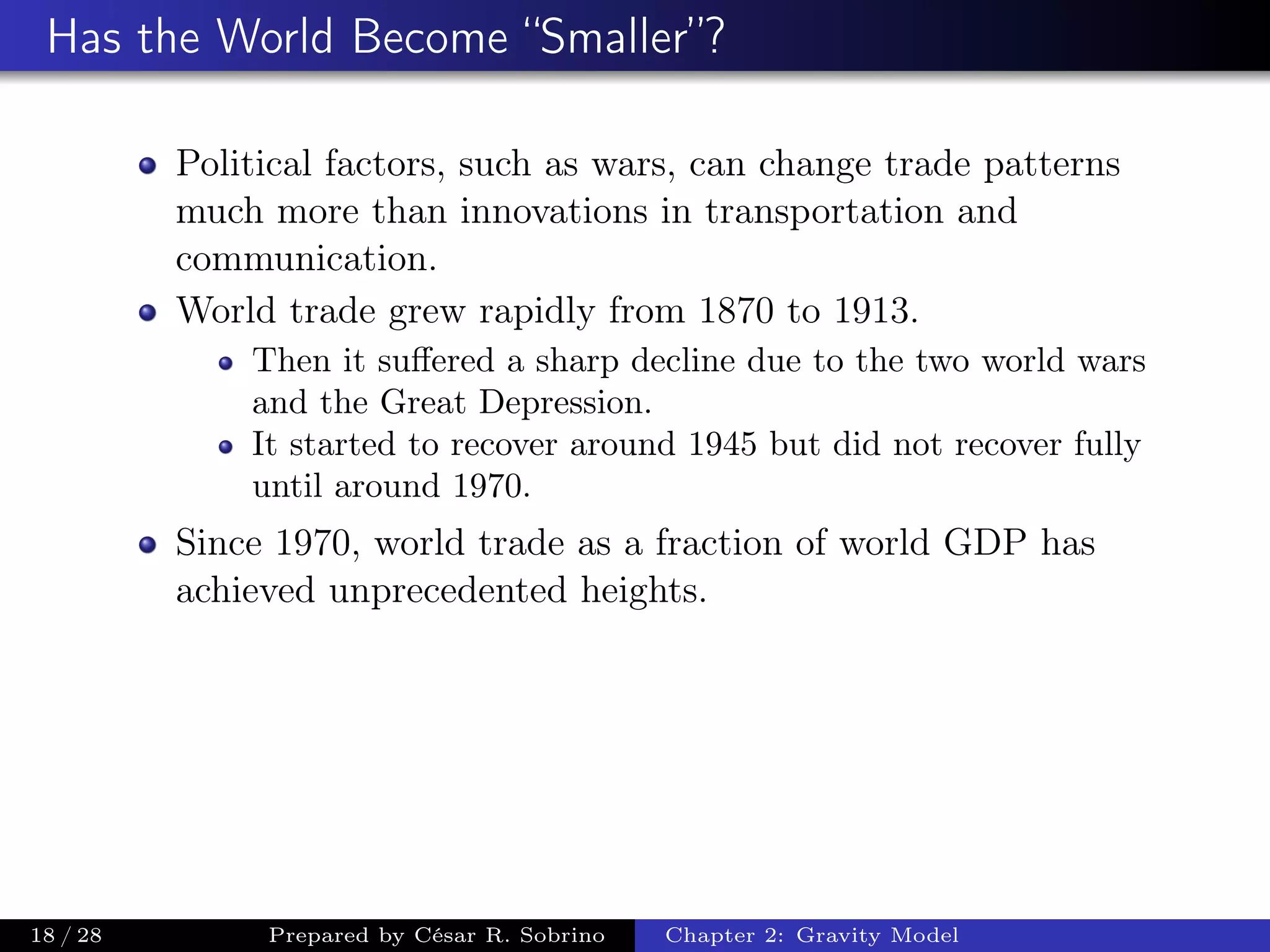
Political factors, such as wars, can change trade patterns
much more than innovations in transportation and
communication.
World trade grew rapidly from 1870 to 1913.
Then it suffered a sharp decline due to the two world wars
and the Great Depression.
It started to recover around 1945 but did not recover fully
until around 1970.
Since 1970, world trade as a fraction of world GDP has
achieved unprecedented heights.
18 / 28 Prepared by César R. Sobrino Chapter 2: Gravity Model
Table 2-2: % World Exports of World GDP
19 / 28 Prepared by César R. Sobrino Chapter 2: Gravity Model
Changing Composition of Trade
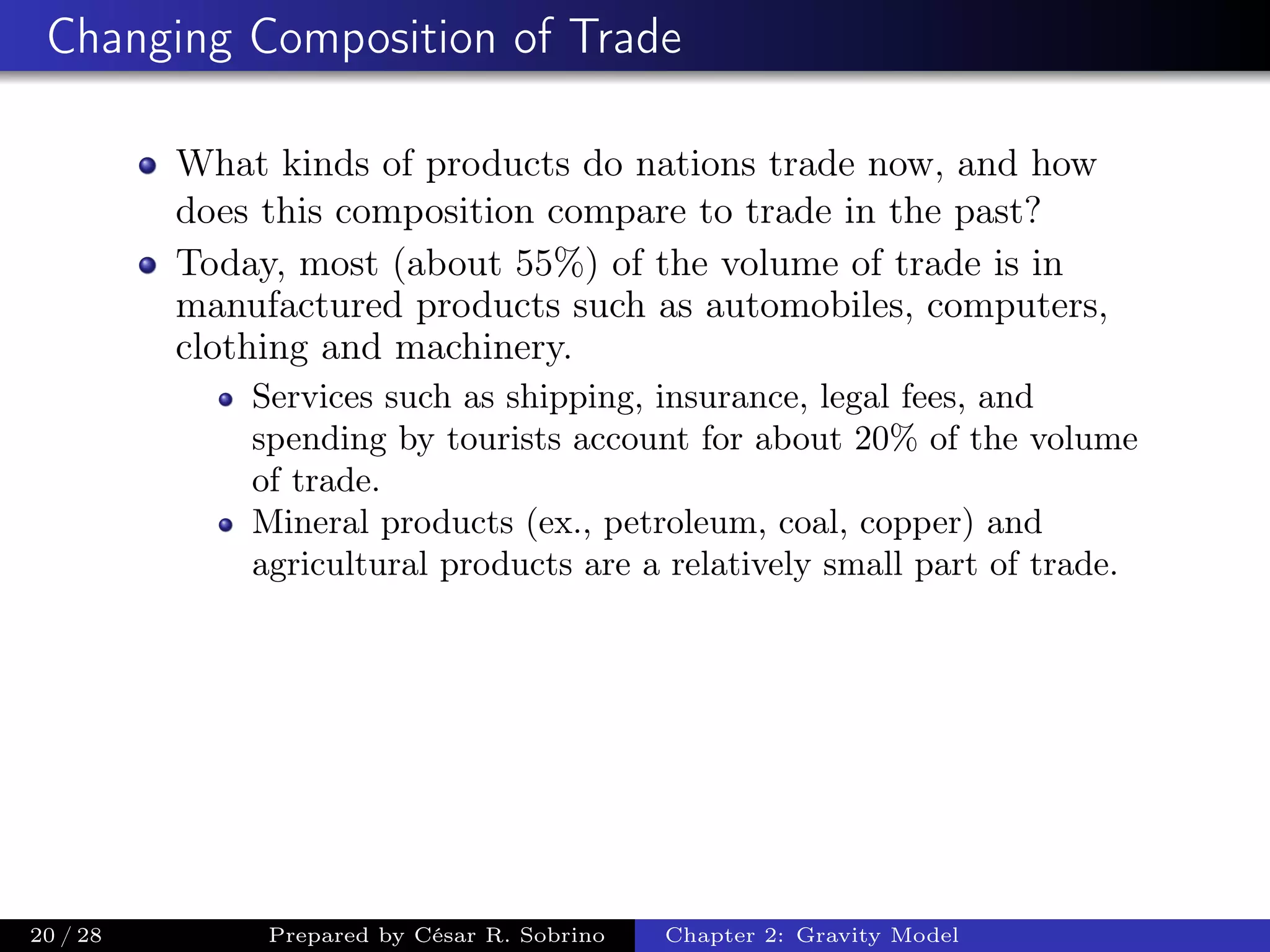
What kinds of products do nations trade now, and how
does this composition compare to trade in the past?
Today, most (about 55%) of the volume of trade is in
manufactured products such as automobiles, computers,
clothing and machinery.
Services such as shipping, insurance, legal fees, and
spending by tourists account for about 20% of the volume
of trade.
Mineral products (ex., petroleum, coal, copper) and
agricultural products are a relatively small part of trade.
20 / 28 Prepared by César R. Sobrino Chapter 2: Gravity Model
Fig. 2-5: The Composition of World Trade, 2008
Source: World Trade Organization
21 / 28 Prepared by César R. Sobrino Chapter 2: Gravity Model
Changing Composition of Trade
In the past, a large fraction of the volume of trade came
from agricultural and mineral products.
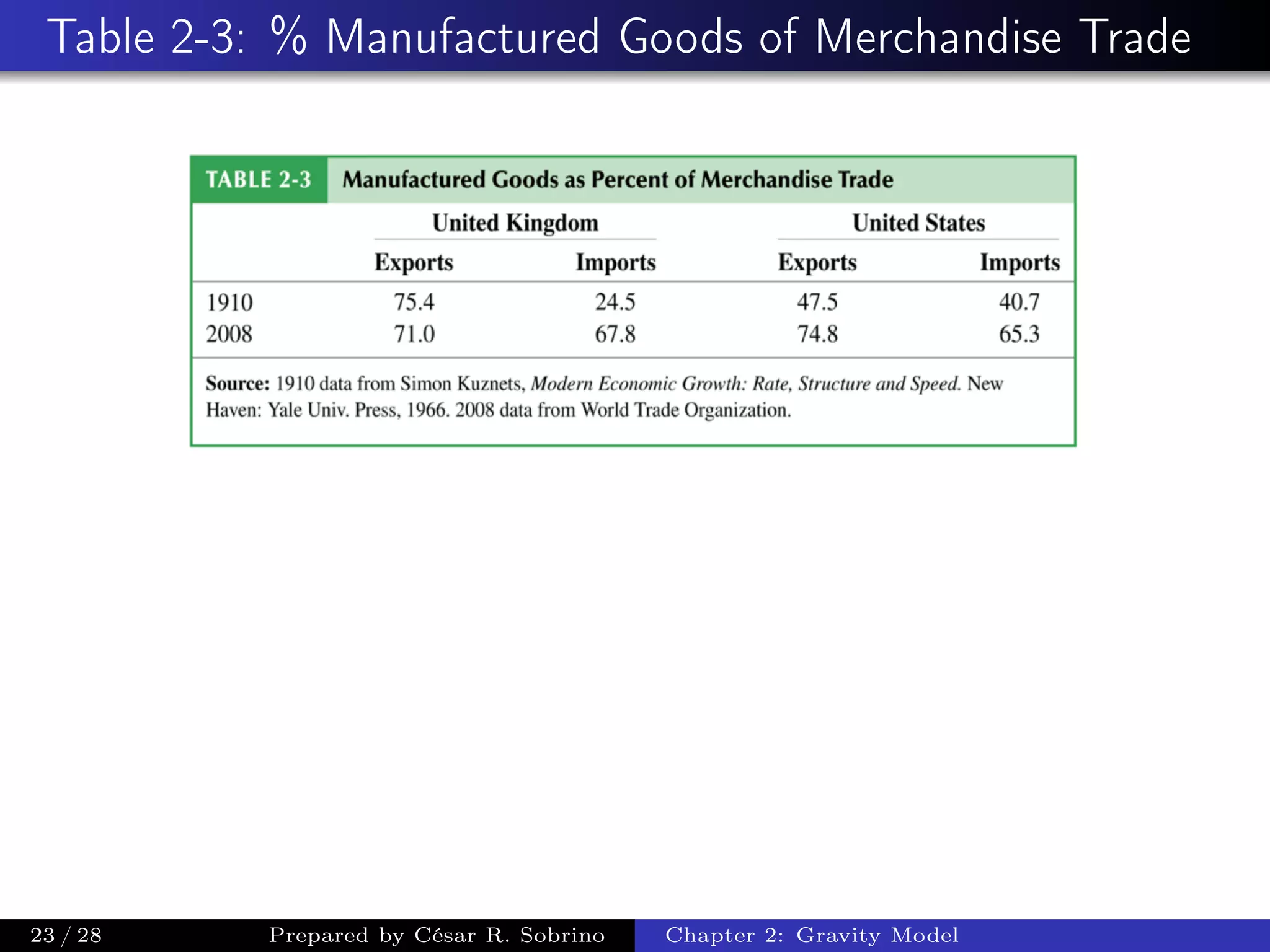
In 1910, Britain mainly imported agricultural and mineral
products, although manufactured products still represented
most of the volume of exports.
In 1910, the U.S. mainly imported and exported
agricultural products and mineral products.
In 2002, manufactured products made up most of the
volume of imports and exports for both countries.
22 / 28 Prepared by César R. Sobrino Chapter 2: Gravity Model
Table 2-3: % Manufactured Goods of Merchandise Trade
23 / 28 Prepared by César R. Sobrino Chapter 2: Gravity Model
Changing Composition of Trade
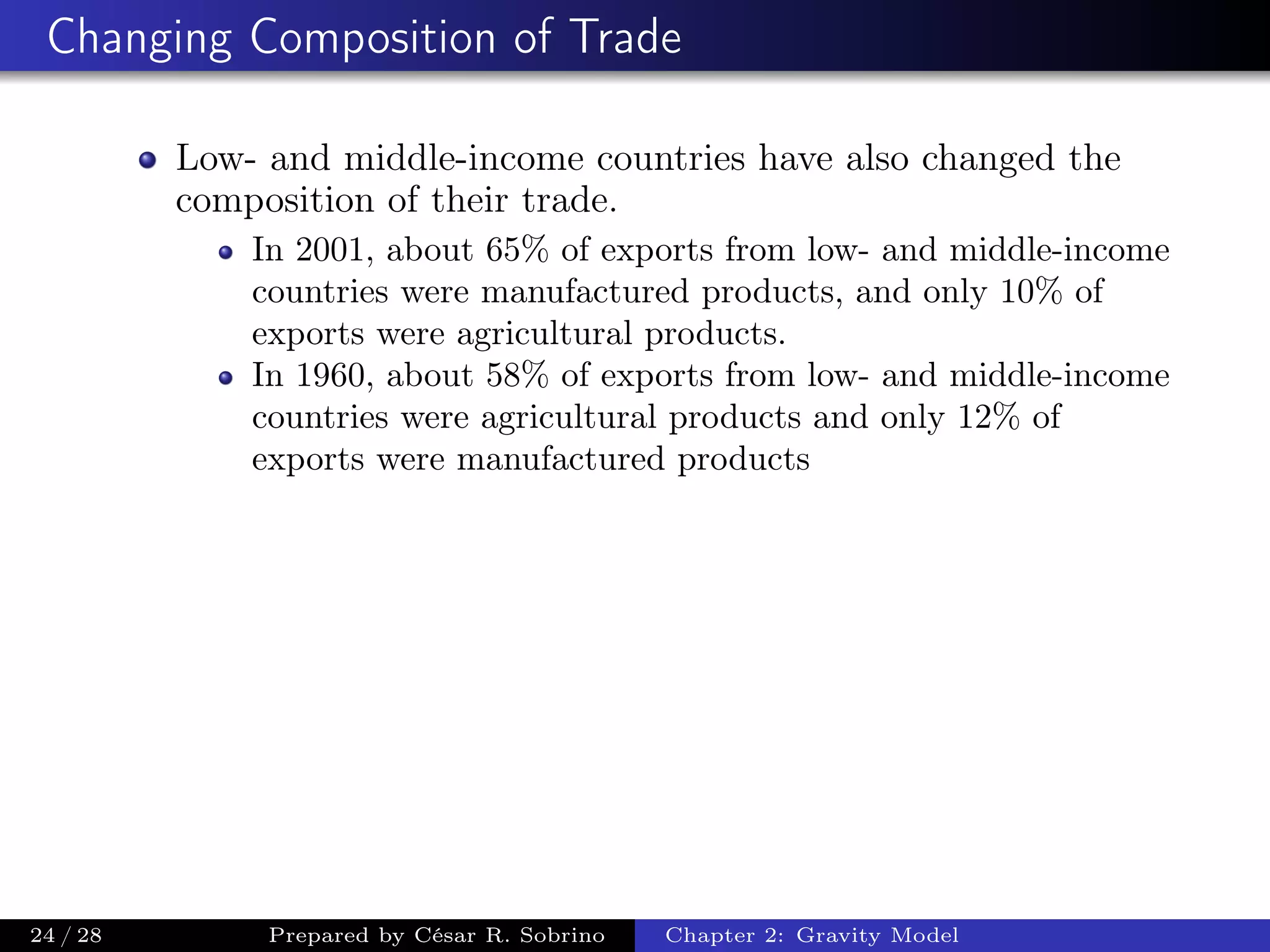
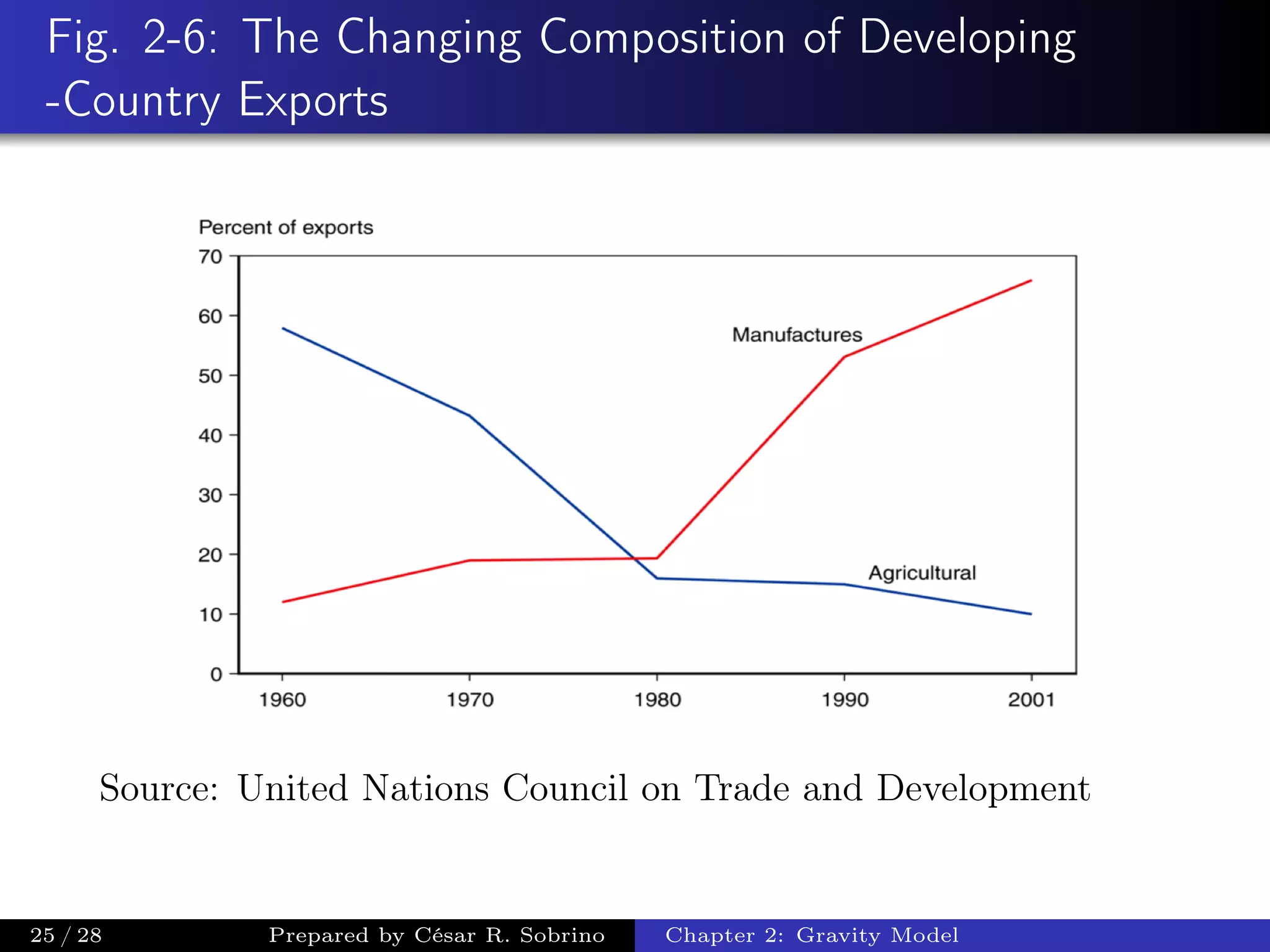
Low- and middle-income countries have also changed the
composition of their trade.
In 2001, about 65% of exports from low- and middle-income
countries were manufactured products, and only 10% of
exports were agricultural products.
In 1960, about 58% of exports from low- and middle-income
countries were agricultural products and only 12% of
exports were manufactured products
24 / 28 Prepared by César R. Sobrino Chapter 2: Gravity Model
Fig. 2-6: The Changing Composition of Developing
-Country Exports
Source: United Nations Council on Trade and Development
25 / 28 Prepared by César R. Sobrino Chapter 2: Gravity Model
Service Outsourcing
Service outsourcing (or offshoring) occurs when a firm that
provides services moves its operations to a foreign location.
Service outsourcing can occur for services that can be
performed and transmitted electronically.
For example, a firm may move its customer service centers
whose telephone calls can be transmitted electronically to a
foreign location.
Service outsourcing is currently not a significant part of
trade.
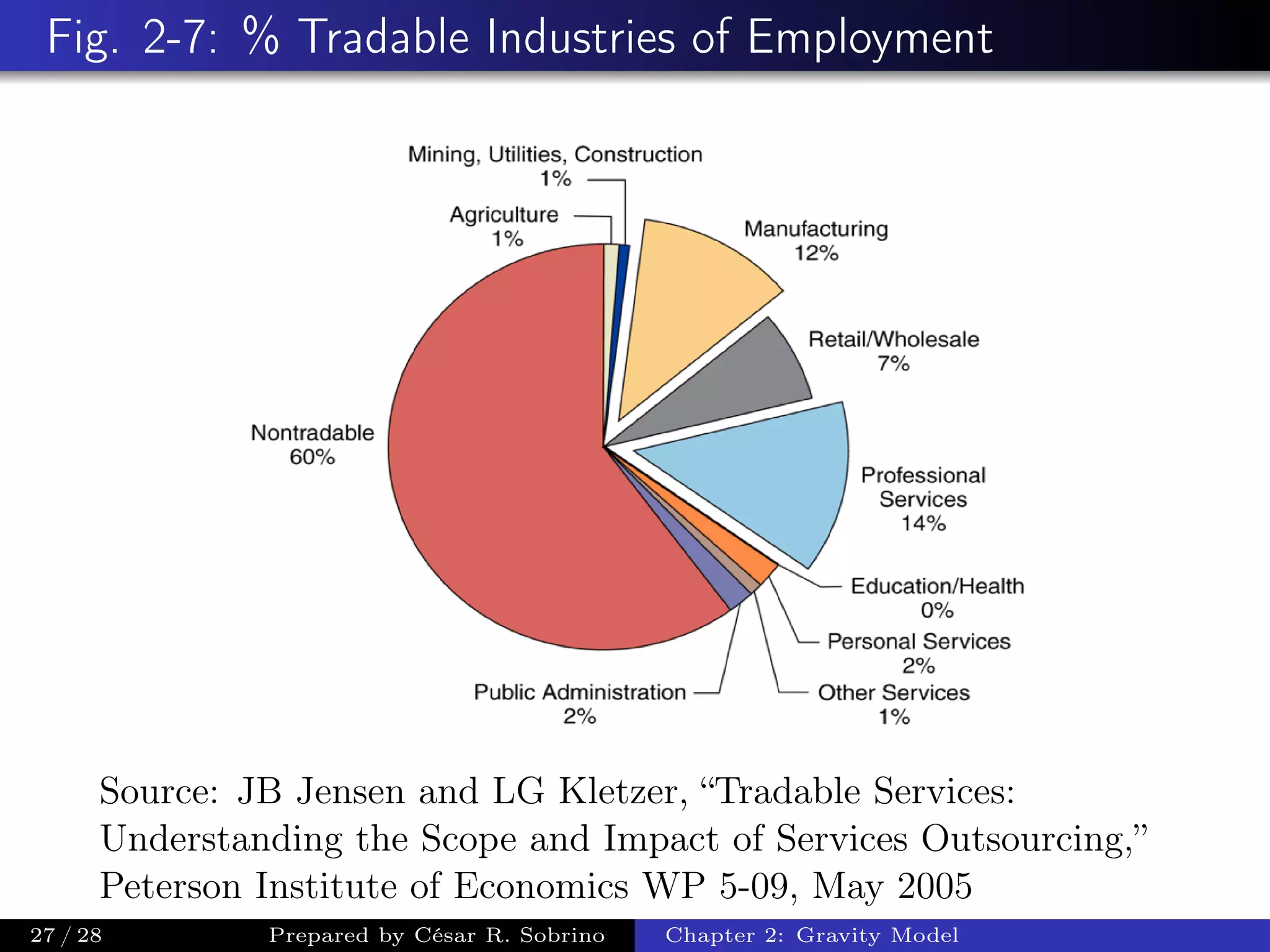
Some jobs are “tradable” and thus have the potential to be
outsourced.
Most jobs are nontradable because they need to be done
close to the customer.
26 / 28 Prepared by César R. Sobrino Chapter 2: Gravity Model
Fig. 2-7: % Tradable Industries of Employment
Source: JB Jensen and LG Kletzer, “Tradable Services:
Understanding the Scope and Impact of Services Outsourcing,”
Peterson Institute of Economics WP 5-09, May 2005
27 / 28 Prepared by César R. Sobrino Chapter 2: Gravity Model
Summary
1 The 5 largest trading partners with the US are Canada,
China, Mexico, Japan, and Germany.
2 The largest economies in the EU undertake the largest
fraction of the total trade between the EU and the US.
3 The gravity model predicts that the volume of trade is
directly related to the GDP of each trading partner and is
inversely related to the distance between them.
4 Besides size and distance, culture, geography, multinational
corporations, and the existence of borders influence trade.
5 Modern transportation and communication have increased
trade, but political factors have influenced trade more in
history.
6 Today, most trade is in manufactured goods, while
historically agricultural and mineral products made up
most of trade.
28 / 28 Prepared by César R. Sobrino Chapter 2: Gravity Model

Gravity model

  • 1.
    Chapter 2: GravityModel Prepared by César R. Sobrino Universidad del Turabo November 3, 2017 1 / 28 Prepared by César R. Sobrino Chapter 2: Gravity Model
  • 2.
    Outline 1 Largest tradingpartners of the United States 2 Gravity model: influence of an economy’s size on trade distance and other factors that influence trade 3 Borders and trade agreements 4 Globalization: then and now 5 Changing composition of trade 6 Service outsourcing 2 / 28 Prepared by César R. Sobrino Chapter 2: Gravity Model
  • 3.
    Who trades withWhom The 5 largest trading partners with the US in 2008 were Canada, China, Mexico, Japan, and Germany. The total value of imports from and exports to Canada in 2008 was about $550 billion dollars. The largest 15 trading partners with the US accounted for 69% of the value of US trade in 2008. 3 / 28 Prepared by César R. Sobrino Chapter 2: Gravity Model
  • 4.
    Fig. 2-1: TotalUS Trade with Major Partners, 2008 Source: US Department of Commerce 4 / 28 Prepared by César R. Sobrino Chapter 2: Gravity Model
  • 5.
    Size Matters: TheGravity Model 3 of the top 10 trading partners with the US in 2008 were also the 3 largest European economies: Germany, UK„ and France. These countries have the largest gross domestic product (GDP) in Europe. GDP measures the value of goods and services produced in an economy. Why does the US trade most with these European countries and not other European countries? In fact, the size of an economy is directly related to the volume of imports and exports. Larger economies produce more goods and services, so they have more to sell in the export market. Larger economies generate more income from the goods and services sold, so they are able to buy more imports. 5 / 28 Prepared by César R. Sobrino Chapter 2: Gravity Model
  • 6.
    Fig. 2-2: Sizeof EU Economies, and the Value of Their Trade with the US Source: US Department of Commerce, European Comission 6 / 28 Prepared by César R. Sobrino Chapter 2: Gravity Model
  • 7.
    Other things besidessize matter for trade 1 Distance between markets influences transportation costs and therefore the cost of imports and exports. Distance may also influence personal contact and communication, which may influence trade. 2 Cultural affinity: if two countries have cultural ties, it is likely that they also have strong economic ties. 3 Geography: ocean harbors and a lack of mountain barriers make transportation and trade easier. 4 Multinational corporations: corporations spread across different nations import and export many goods between their divisions. 5 Borders: crossing borders involves formalities that take time and perhaps monetary costs like tariffs. These implicit and explicit costs reduce trade. The existence of borders may also indicate the existence of different languages (see 2) or different currencies, either of which may impede trade more. 7 / 28 Prepared by César R. Sobrino Chapter 2: Gravity Model
  • 8.
    The Gravity Model Inits basic form, the gravity model assumes that only size and distance are important for trade in the following way: Tij = A × Yi × Yj Dij Where: Tij is the value of trade between country i and country j A is a constant Yi the GDP of country i Yj the GDP of country j Dij is the distance between country i and country j 8 / 28 Prepared by César R. Sobrino Chapter 2: Gravity Model
  • 9.
    The Gravity Model IIna slightly more general form, the gravity model that is commonly estimated is Tij = A × Y a i × Y b j Dc ij where a, b, and c are allowed to differ from 1. Despite its simplicity, the gravity model works fairly well in predicting actual trade flows, as the figure above representing US–EU trade flows suggested In logs, LnTij = LnA + aLnYi + bLnYj + cLnDij 9 / 28 Prepared by César R. Sobrino Chapter 2: Gravity Model
  • 10.
    The Gravity Model:A Numerical Example There are only four countries in the world: A, B, C, & D. Their GDPs are 40, 40, 10, & 10, respectively. So, the domestic spendings as a percentage of the global spending are 40%, 40%, 10%, & 10%, respectively. How is the trade level between them? A B C D A - 16 4 4 B 16 - 4 4 C 4 4 - 1 D 4 4 1 - 0.4 × 40 = 16 ; 0.4 × 10 = 4; and 0.1 × 10 = 1 10 / 28 Prepared by César R. Sobrino Chapter 2: Gravity Model
  • 11.
    Distance and Borders Estimatesof the effect of distance from the gravity model predict that a 1% increase in the distance between countries is associated with a decrease in the volume of trade of 0.7% to 1%. Besides distance, borders increase the cost and time needed to trade. Trade agreements between countries are intended to reduce the formalities and tariffs needed to cross borders, and therefore to increase trade. The gravity model can assess the effect of trade agreements on trade: does a trade agreement lead to significantly more trade among its partners than one would otherwise predict given their GDPs and distances from one another? 11 / 28 Prepared by César R. Sobrino Chapter 2: Gravity Model
  • 12.
    Distance and Borders TheUS signed a free trade agreement with Mexico and Canada in 1994, the North American Free Trade Agreement (NAFTA). Because of NAFTA and because Mexico and Canada are close to the U.S., the amount of trade between the U.S. and its northern and southern neighbors as a fraction of GDP is larger than between the US and European countries. 12 / 28 Prepared by César R. Sobrino Chapter 2: Gravity Model
  • 13.
    Fig. 2-3: EconomicSize and Trade with the US Source: US Department of Commerce, European Comission 13 / 28 Prepared by César R. Sobrino Chapter 2: Gravity Model
  • 14.
    Distance and Borders Yeteven with a free trade agreement between the US and Canada, which use a common language, the border between these countries still seems to be associated with a reduction in trade. 14 / 28 Prepared by César R. Sobrino Chapter 2: Gravity Model
  • 15.
    Fig. 2-4: CanadianProvinces and US States That Trade with British Columbia 15 / 28 Prepared by César R. Sobrino Chapter 2: Gravity Model
  • 16.
    Table 2-1: Tradewith British Columbia, as Percent of GDP, 1996 16 / 28 Prepared by César R. Sobrino Chapter 2: Gravity Model
  • 17.
    Has the WorldBecome “Smaller”? The negative effect of distance on trade according to the gravity models is significant, but has grown smaller over time due to modern transportation and communication. Technologies that have increased trade: Wheels,sails, compasses,railroads, telegraph, steam power, automobiles, telephones, airplanes, computers, fax machines, Internet, fiber optics, personal digital assistants, GPS satellites. . . 17 / 28 Prepared by César R. Sobrino Chapter 2: Gravity Model
  • 18.
    Has the WorldBecome “Smaller”? Political factors, such as wars, can change trade patterns much more than innovations in transportation and communication. World trade grew rapidly from 1870 to 1913. Then it suffered a sharp decline due to the two world wars and the Great Depression. It started to recover around 1945 but did not recover fully until around 1970. Since 1970, world trade as a fraction of world GDP has achieved unprecedented heights. 18 / 28 Prepared by César R. Sobrino Chapter 2: Gravity Model
  • 19.
    Table 2-2: %World Exports of World GDP 19 / 28 Prepared by César R. Sobrino Chapter 2: Gravity Model
  • 20.
    Changing Composition ofTrade What kinds of products do nations trade now, and how does this composition compare to trade in the past? Today, most (about 55%) of the volume of trade is in manufactured products such as automobiles, computers, clothing and machinery. Services such as shipping, insurance, legal fees, and spending by tourists account for about 20% of the volume of trade. Mineral products (ex., petroleum, coal, copper) and agricultural products are a relatively small part of trade. 20 / 28 Prepared by César R. Sobrino Chapter 2: Gravity Model
  • 21.
    Fig. 2-5: TheComposition of World Trade, 2008 Source: World Trade Organization 21 / 28 Prepared by César R. Sobrino Chapter 2: Gravity Model
  • 22.
    Changing Composition ofTrade In the past, a large fraction of the volume of trade came from agricultural and mineral products. In 1910, Britain mainly imported agricultural and mineral products, although manufactured products still represented most of the volume of exports. In 1910, the U.S. mainly imported and exported agricultural products and mineral products. In 2002, manufactured products made up most of the volume of imports and exports for both countries. 22 / 28 Prepared by César R. Sobrino Chapter 2: Gravity Model
  • 23.
    Table 2-3: %Manufactured Goods of Merchandise Trade 23 / 28 Prepared by César R. Sobrino Chapter 2: Gravity Model
  • 24.
    Changing Composition ofTrade Low- and middle-income countries have also changed the composition of their trade. In 2001, about 65% of exports from low- and middle-income countries were manufactured products, and only 10% of exports were agricultural products. In 1960, about 58% of exports from low- and middle-income countries were agricultural products and only 12% of exports were manufactured products 24 / 28 Prepared by César R. Sobrino Chapter 2: Gravity Model
  • 25.
    Fig. 2-6: TheChanging Composition of Developing -Country Exports Source: United Nations Council on Trade and Development 25 / 28 Prepared by César R. Sobrino Chapter 2: Gravity Model
  • 26.
    Service Outsourcing Service outsourcing(or offshoring) occurs when a firm that provides services moves its operations to a foreign location. Service outsourcing can occur for services that can be performed and transmitted electronically. For example, a firm may move its customer service centers whose telephone calls can be transmitted electronically to a foreign location. Service outsourcing is currently not a significant part of trade. Some jobs are “tradable” and thus have the potential to be outsourced. Most jobs are nontradable because they need to be done close to the customer. 26 / 28 Prepared by César R. Sobrino Chapter 2: Gravity Model
  • 27.
    Fig. 2-7: %Tradable Industries of Employment Source: JB Jensen and LG Kletzer, “Tradable Services: Understanding the Scope and Impact of Services Outsourcing,” Peterson Institute of Economics WP 5-09, May 2005 27 / 28 Prepared by César R. Sobrino Chapter 2: Gravity Model
  • 28.
    Summary 1 The 5largest trading partners with the US are Canada, China, Mexico, Japan, and Germany. 2 The largest economies in the EU undertake the largest fraction of the total trade between the EU and the US. 3 The gravity model predicts that the volume of trade is directly related to the GDP of each trading partner and is inversely related to the distance between them. 4 Besides size and distance, culture, geography, multinational corporations, and the existence of borders influence trade. 5 Modern transportation and communication have increased trade, but political factors have influenced trade more in history. 6 Today, most trade is in manufactured goods, while historically agricultural and mineral products made up most of trade. 28 / 28 Prepared by César R. Sobrino Chapter 2: Gravity Model