PATINKIN’S REAL
BALANCE EFFECT
Prof. Prabha Panth
Osmania University,
Hyderabad
Pricing in Classical and Neo-classical
theory
• Classical theory – Real sector and goods.
Relative prices based on real D and S.
• Neo-classical theory – monetary sector, with
absolute prices, given by Quantity theory of
money. SM then Ps 
• Relative prices are thus separated from absolute
prices.
• Dichotomy in pricing between Classical and
Neo-classical theories.
• Relative Ps and Absolute Ps are not inter related.
2Prabha Panth
Neutrality of Money
• How to reconcile Relative Ps (value) and
Money theory of prices?
• When QM it is assumed that all prices 
proportionally, so relative prices will not
change.
– This is the assumption of Homogeneity
– Also known as Neutrality of Money.
• If money is neutral, classical theory can be
accepted that there is no relation between
relative prices and absolute prices.
3Prabha Panth
Patinkin’s theory
According to Patinkin, the classical dichotomy is
invalid.
Relative Ps are affected by money Ps, because:
1) SM affects equilibrium in the commodity sector,
Because P the real value of cash balance ,
and people will spend less.
Demand for goods falls.
D for commodities < S of commodities. So
prices will fall
But DM (cash balance) , with excess DM
4Prabha Panth
2. The absolute or Money price depends on
SM in the economy.
If SM doubles, Absolute Ps will also
double.
So Absolute Ps will not remain stable.
3. In Neo Classical theory, when Ps, D for
goods , but DM  proportionately.
But SM is constant.
So excess DM leads to fall in the Price
level.
5Prabha Panth
• Thus changes in SM leads to change in
Absolute Prices.
• D for goods is dependent on Absolute Prices.
• D for goods changes with change in SM.
• Therefore there is connection between
Relative Ps and Absolute Ps.
• So the Classical Dichotomy is invalid,
• The real economy will not be in equilibrium if
there is change in Money Supply.
Dichotomy is invalid
6Prabha Panth
• Equilibrium in the Real Economy can be
restored even if money S changes.
• This can be done by making D and S
functions depend on:
1) The real value of cash balance, and
2) The relative prices.
This is done through the Real Balance
Effect.
Patinkin’s Real Balance Effect
7Prabha Panth
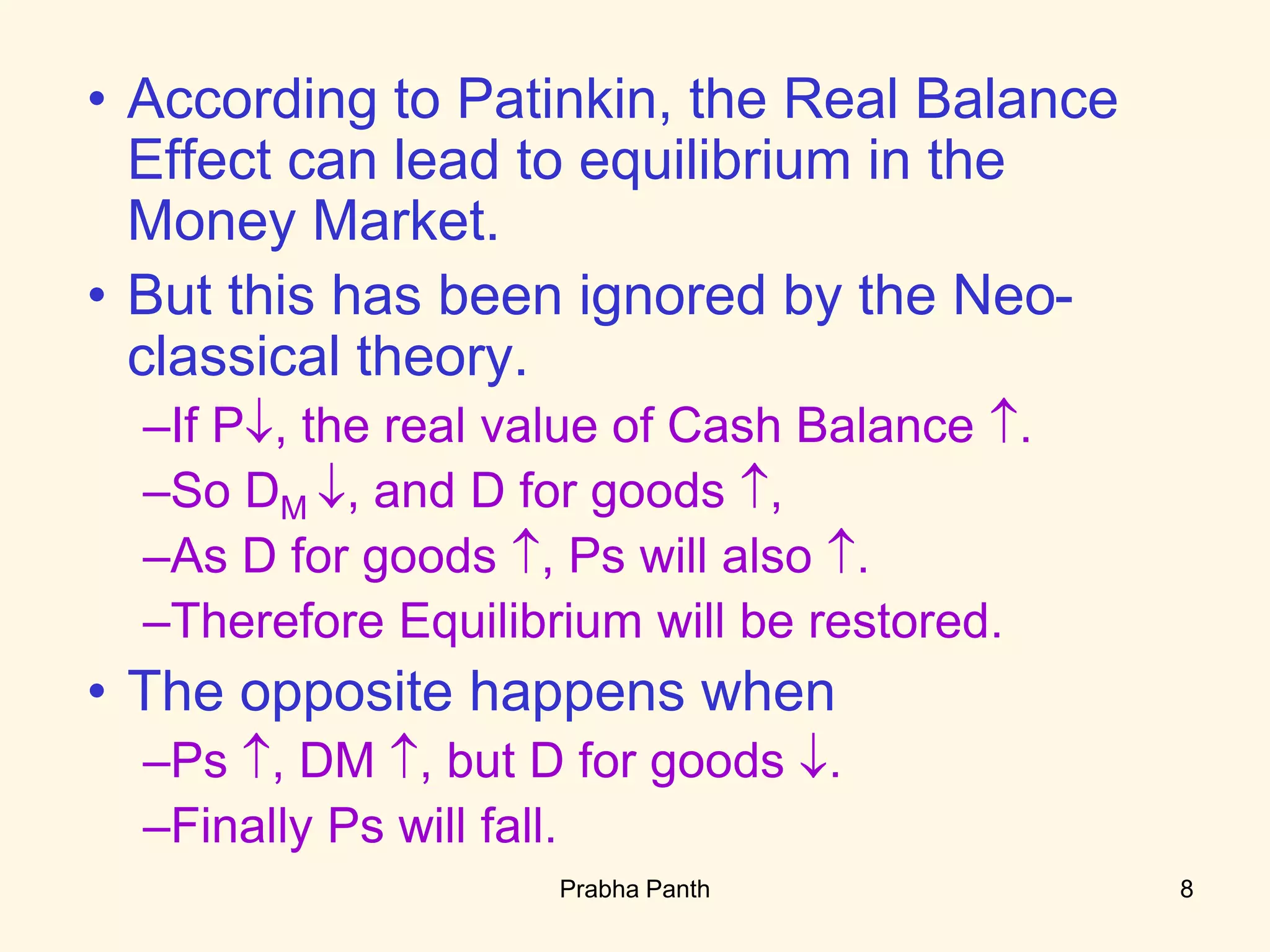
• According to Patinkin, the Real Balance
Effect can lead to equilibrium in the
Money Market.
• But this has been ignored by the Neo-
classical theory.
–If P, the real value of Cash Balance .
–So DM , and D for goods ,
–As D for goods , Ps will also .
–Therefore Equilibrium will be restored.
• The opposite happens when
–Ps , DM , but D for goods .
–Finally Ps will fall.
8Prabha Panth
• Therefore, the Real Balance effect leads to
stability in the P level.
• Thus Real Balance Effect removes the
Classical Dichotomy, by showing the inter
relationship between D and S of money and
commodities.
• But it also shows that Real Equilibrium of
Classical theory can be achieved when D and
S of Money changes.
• The Relative Prices will not change, but the
Level of Absolute Prices will change.
9Prabha Panth

Patinkin's Real Balance Effect

  • 1.
    PATINKIN’S REAL BALANCE EFFECT Prof.Prabha Panth Osmania University, Hyderabad
  • 2.
    Pricing in Classicaland Neo-classical theory • Classical theory – Real sector and goods. Relative prices based on real D and S. • Neo-classical theory – monetary sector, with absolute prices, given by Quantity theory of money. SM then Ps  • Relative prices are thus separated from absolute prices. • Dichotomy in pricing between Classical and Neo-classical theories. • Relative Ps and Absolute Ps are not inter related. 2Prabha Panth
  • 3.
    Neutrality of Money •How to reconcile Relative Ps (value) and Money theory of prices? • When QM it is assumed that all prices  proportionally, so relative prices will not change. – This is the assumption of Homogeneity – Also known as Neutrality of Money. • If money is neutral, classical theory can be accepted that there is no relation between relative prices and absolute prices. 3Prabha Panth
  • 4.
    Patinkin’s theory According toPatinkin, the classical dichotomy is invalid. Relative Ps are affected by money Ps, because: 1) SM affects equilibrium in the commodity sector, Because P the real value of cash balance , and people will spend less. Demand for goods falls. D for commodities < S of commodities. So prices will fall But DM (cash balance) , with excess DM 4Prabha Panth
  • 5.
    2. The absoluteor Money price depends on SM in the economy. If SM doubles, Absolute Ps will also double. So Absolute Ps will not remain stable. 3. In Neo Classical theory, when Ps, D for goods , but DM  proportionately. But SM is constant. So excess DM leads to fall in the Price level. 5Prabha Panth
  • 6.
    • Thus changesin SM leads to change in Absolute Prices. • D for goods is dependent on Absolute Prices. • D for goods changes with change in SM. • Therefore there is connection between Relative Ps and Absolute Ps. • So the Classical Dichotomy is invalid, • The real economy will not be in equilibrium if there is change in Money Supply. Dichotomy is invalid 6Prabha Panth
  • 7.
    • Equilibrium inthe Real Economy can be restored even if money S changes. • This can be done by making D and S functions depend on: 1) The real value of cash balance, and 2) The relative prices. This is done through the Real Balance Effect. Patinkin’s Real Balance Effect 7Prabha Panth
  • 8.
    • According toPatinkin, the Real Balance Effect can lead to equilibrium in the Money Market. • But this has been ignored by the Neo- classical theory. –If P, the real value of Cash Balance . –So DM , and D for goods , –As D for goods , Ps will also . –Therefore Equilibrium will be restored. • The opposite happens when –Ps , DM , but D for goods . –Finally Ps will fall. 8Prabha Panth
  • 9.
    • Therefore, theReal Balance effect leads to stability in the P level. • Thus Real Balance Effect removes the Classical Dichotomy, by showing the inter relationship between D and S of money and commodities. • But it also shows that Real Equilibrium of Classical theory can be achieved when D and S of Money changes. • The Relative Prices will not change, but the Level of Absolute Prices will change. 9Prabha Panth