THEORY OF INTEREST RATE
PRESENTED BY : VAIBHAV BHALOTIA
TABLE OF CONTENT
Loanable theory
What is interest ?
Types of interest
Rate of interest
Classical theory
WHAT IS INTEREST ?
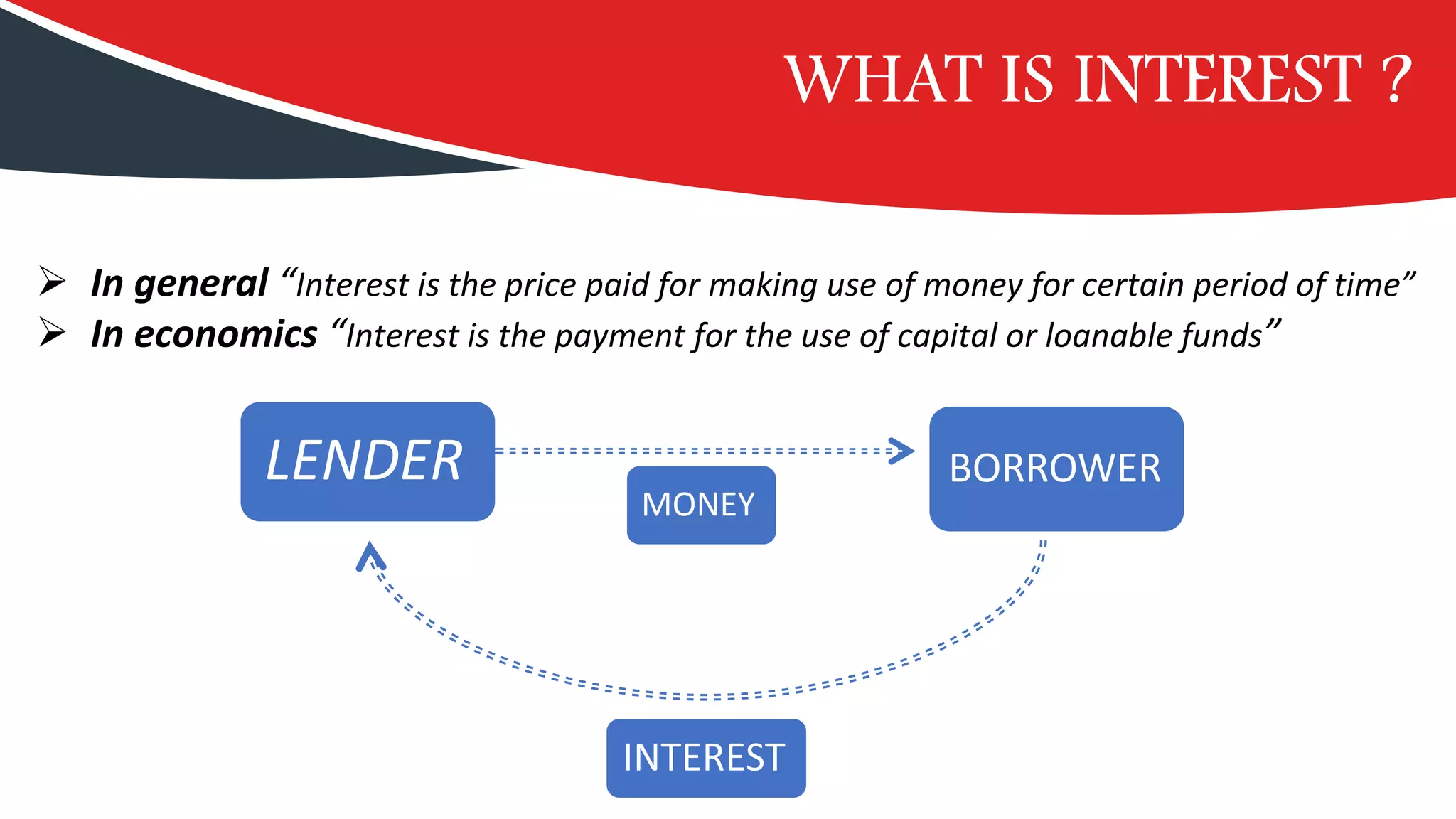
LENDER BORROWER
MONEY
INTEREST
➢ In general “Interest is the price paid for making use of money for certain period of time”
➢ In economics “Interest is the payment for the use of capital or loanable funds”
TYPES OF INTEREST
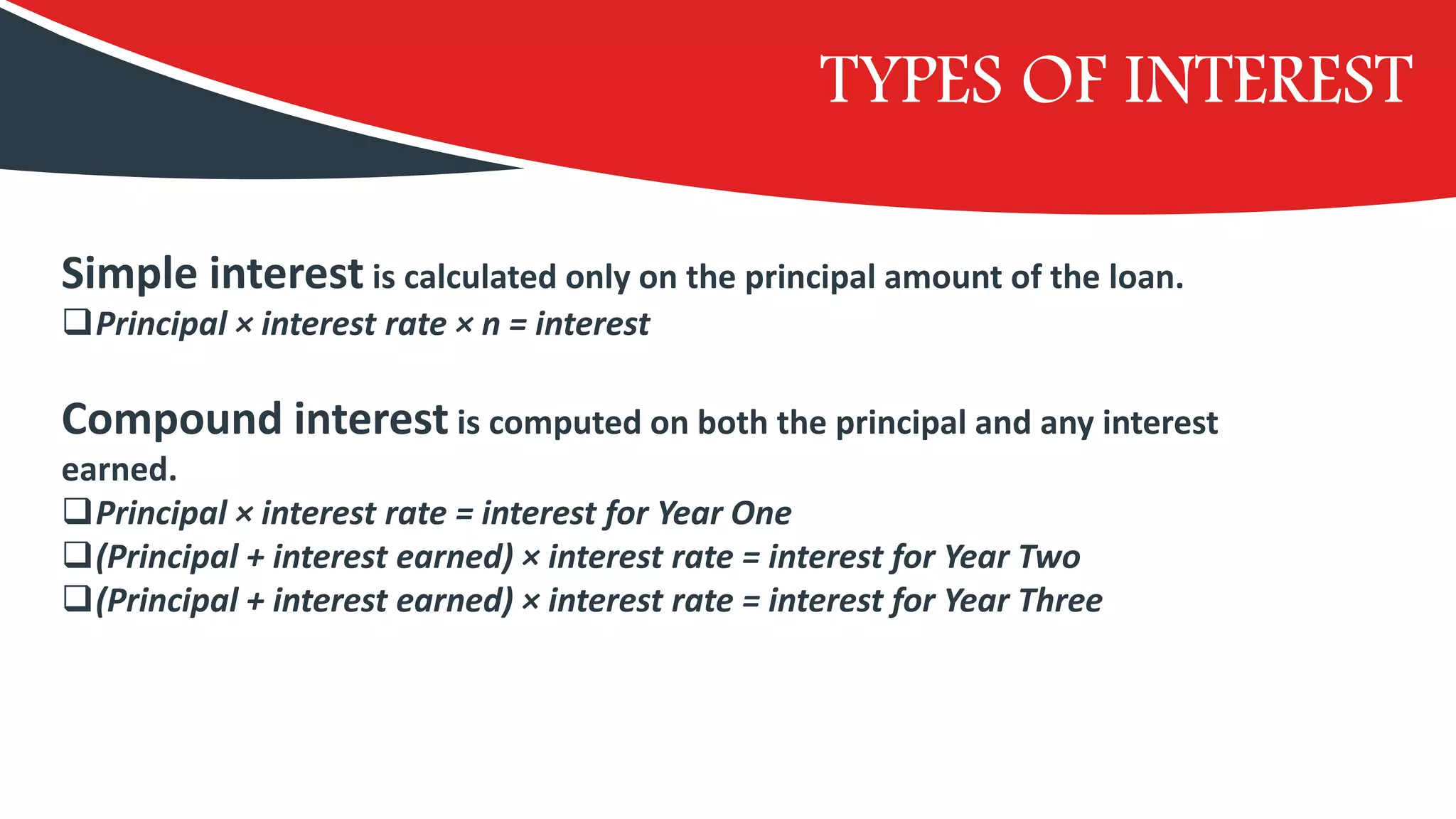
Simple interest is calculated only on the principal amount of the loan.
❑Principal × interest rate × n = interest
Compound interest is computed on both the principal and any interest
earned.
❑Principal × interest rate = interest for Year One
❑(Principal + interest earned) × interest rate = interest for Year Two
❑(Principal + interest earned) × interest rate = interest for Year Three
RATE OF INTEREST
WHY RATE OF INTEREST VARIES FROM PLACE TO PLACE, INDUSTRY TO INDUSTRY,
BORROWER TO BORROWER ?
Interest rates vary according to:
✓ the government's directives to the central bank to accomplish the government's goals
✓ the currency of the principal sum lent or borrowed
✓ the term for maturity of the investment
✓ the perceived default probability of the borrower
✓ supply and demand in the market
An interest rate is defined as the proportion of an amount loaned which a
lender charges as interest to the borrower, normally expressed as an annual
percentage.
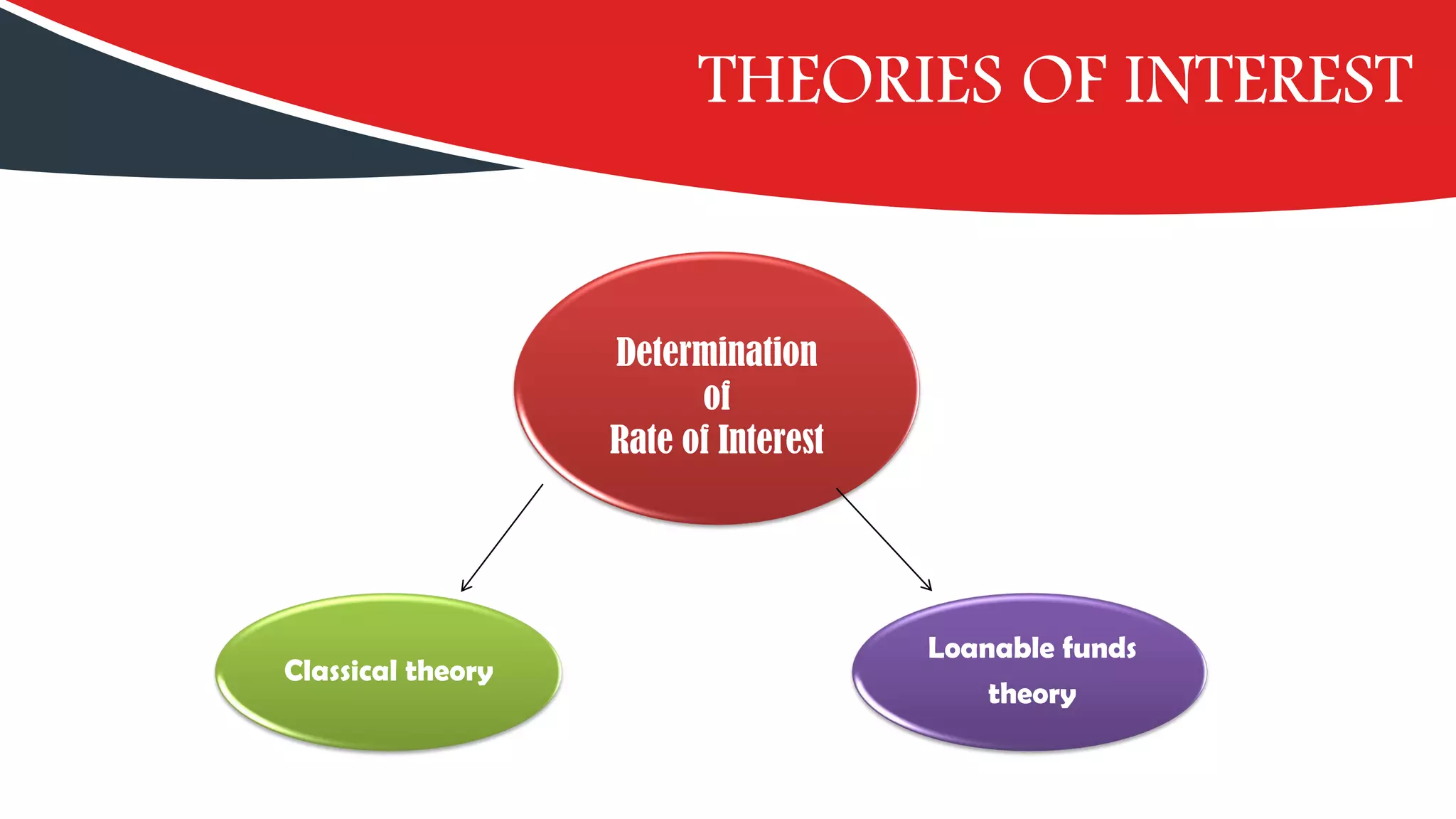
THEORIES OF INTEREST
Determination
of
Rate of Interest
Classical theory
Loanable funds
theory
CLASSICAL THEORY
▪ The classical theory of interest refers to the views of “Marshall,Cassel,Taussing etc.
▪ Theory is also known as the Demand and Supply theory of interest because it deals with
the Demand side as well as the Supply side
▪ Rate of Interest is determined by the demand for Capital (investment) and Supply of
Capital(Savings).
▪ Demand for capital comes from those who want to invest in business activities.
▪ Supply of capital is the result of savings. It comes from those who have the excess of
income over consumption.
Demand for Capital(Investment)
❖ Capital demand will be high for more productive uses first and then gradually with the increase in its
supply, will shift to less productive uses.
❖ Now a very important question arises is that how much capital a person will demand because when a
person borrows money he has to pay interest on it. The answer according to this theory is that demand
for capital can be raised to a point where marginal productivity of capital becomes equal to the interest
paid on it.
❖ This shows that there exists inverse relationship between demand for capital and the interest rate.
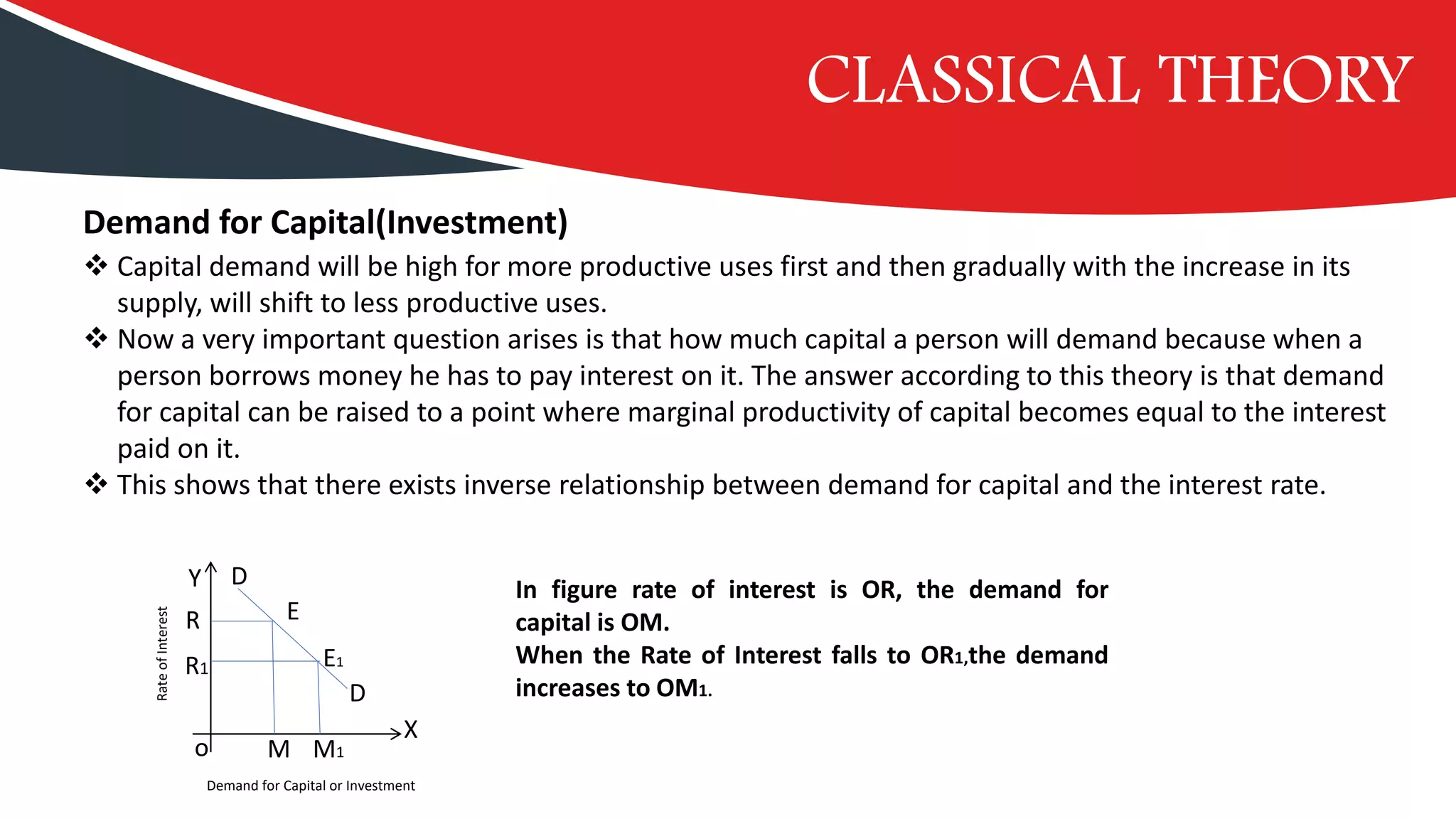
In figure rate of interest is OR, the demand for
capital is OM.
When the Rate of Interest falls to OR1,the demand
increases to OM1.
E
E1
R
R1
D
D
M M1
Y
X
Demand for Capital or Investment
RateofInterest
o
CLASSICAL THEORY
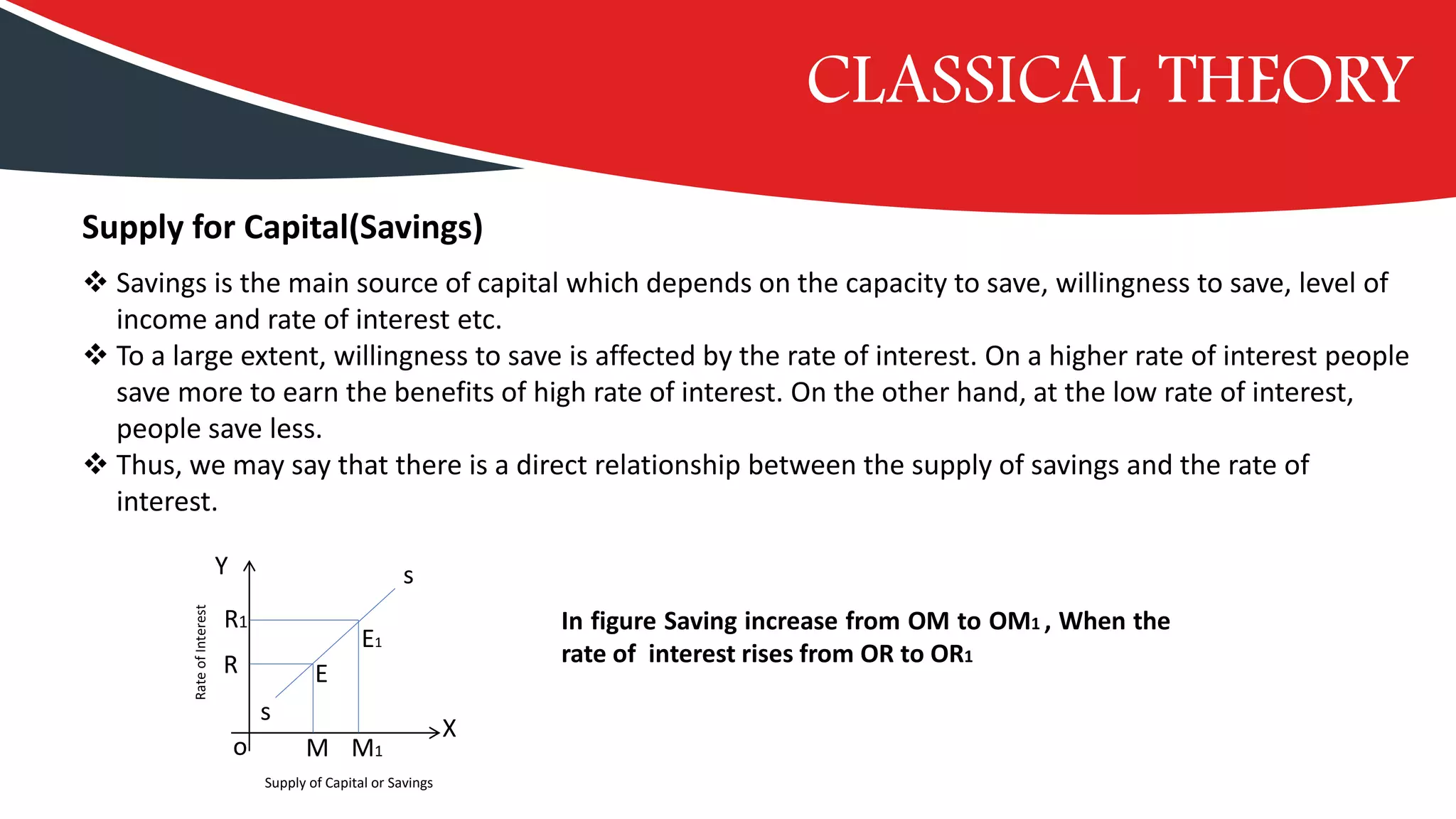
Supply for Capital(Savings)
❖ Savings is the main source of capital which depends on the capacity to save, willingness to save, level of
income and rate of interest etc.
❖ To a large extent, willingness to save is affected by the rate of interest. On a higher rate of interest people
save more to earn the benefits of high rate of interest. On the other hand, at the low rate of interest,
people save less.
❖ Thus, we may say that there is a direct relationship between the supply of savings and the rate of
interest.
o
E1
R1
R
s
s
M M1
Y
X
RateofInterest
E
Supply of Capital or Savings
In figure Saving increase from OM to OM1 , When the
rate of interest rises from OR to OR1
CLASSICAL THEORY
Interaction between Demand and Supply Curves of Capital
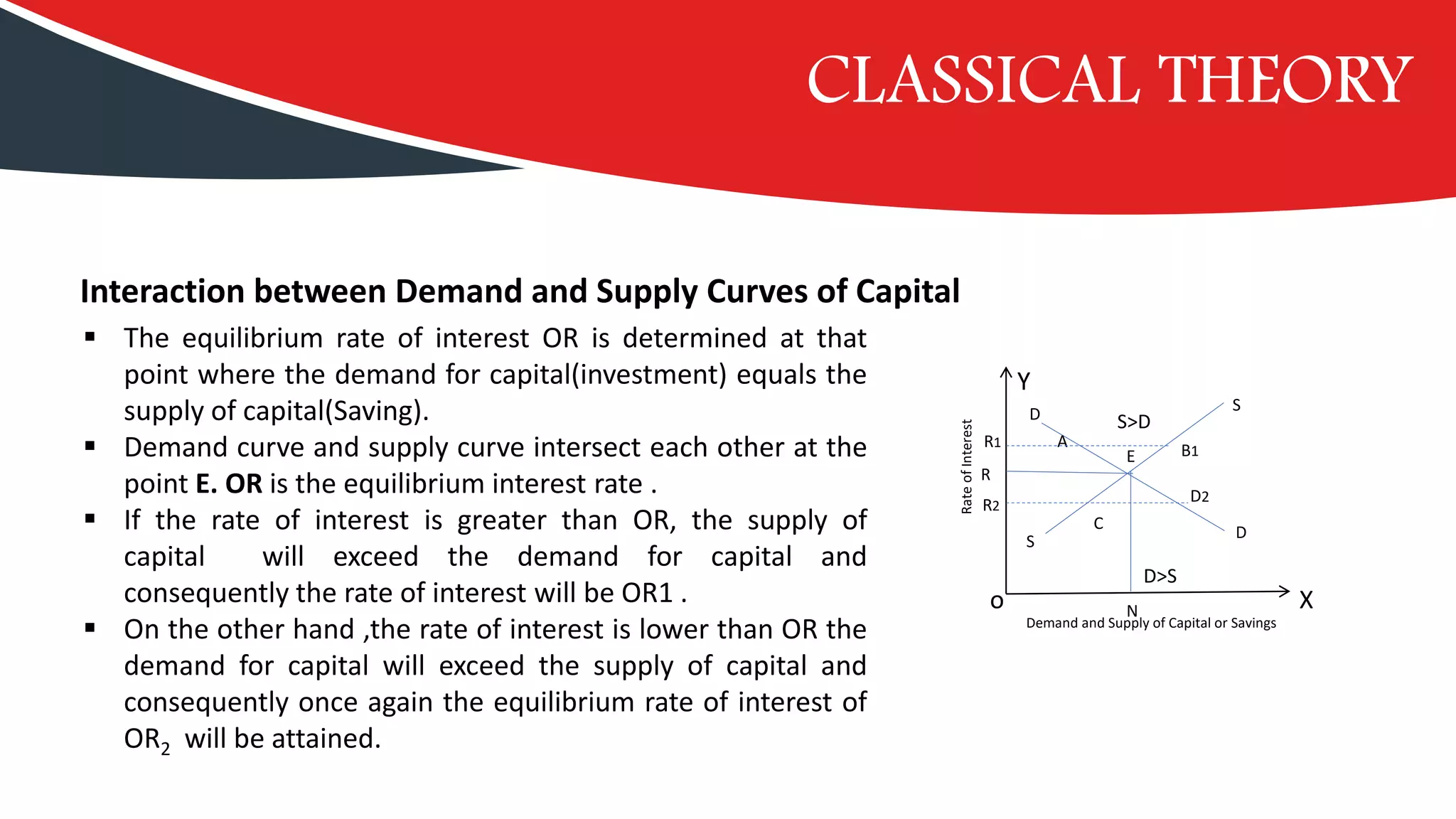
▪ The equilibrium rate of interest OR is determined at that
point where the demand for capital(investment) equals the
supply of capital(Saving).
▪ Demand curve and supply curve intersect each other at the
point E. OR is the equilibrium interest rate .
▪ If the rate of interest is greater than OR, the supply of
capital will exceed the demand for capital and
consequently the rate of interest will be OR1 .
▪ On the other hand ,the rate of interest is lower than OR the
demand for capital will exceed the supply of capital and
consequently once again the equilibrium rate of interest of
OR2 will be attained.
o
Y
X
Demand and Supply of Capital or Savings
RateofInterest
S>D
A
B1
D2
C
D>S
S
S
D
D
R1
R2
R
N
E
CLASSICAL THEORY
CRITICISM OF THE THEORY
The classical theory of rate of interest has been criticized on the basis of the following shortcomings as
discussed below:
✓Fixed Level of Income:
Classical theory assumes that the level of income remains constant. But in actual practice income changes with a
small change in investment. Thus, it is not correct to assume a fixed level of income.
✓Long Run:
Classical theory determines the interest rate through the interaction of demand and supply of capital in the long
run. Therefore, there was an urgent need of a theory which determines rate of interest in the short-run.
✓Full Employment:
This theory assumes that there is full employment of resources in the economy. But, in reality, unemployment or
less than full employment is a general situation. Thus, this theory does not apply to the present world.
✓Savings and Investment:
Classical economists assume that savings and investment are not inter dependent. But actually investment
changes, income also changes which leads to a change in savings. Thus, both are interdependent on each other.
LOANABLE FUNDS THEORY
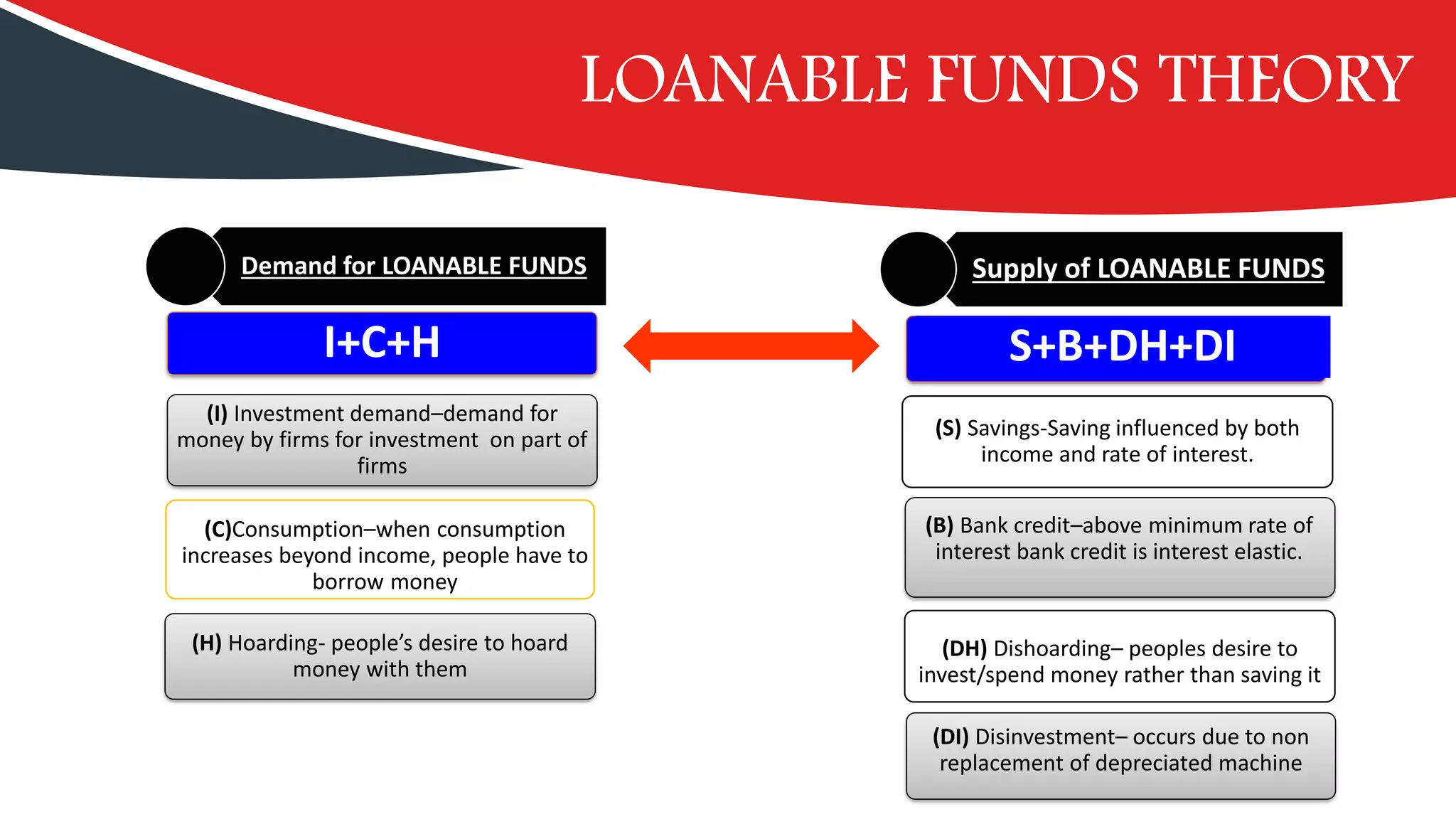
Supply of LOANABLE FUNDS
S+B+DH+DI
(B) Bank credit–above minimum rate of
interest bank credit is interest elastic.
(DI) Disinvestment– occurs due to non
replacement of depreciated machine
(S) Savings-Saving influenced by both
income and rate of interest.
Demand for LOANABLE FUNDS
I+C+H
(I) Investment demand–demand for
money by firms for investment on part of
firms
(C)Consumption–when consumption
increases beyond income, people have to
borrow money
(H) Hoarding- people’s desire to hoard
money with them
(DH) Dishoarding– peoples desire to
invest/spend money rather than saving it
LOANABLE FUNDS THEORY
▪ According to this, Interest is the price paid for the use of loanable funds.
▪ Demand for loanable funds is inversely related to the Rate of interest.
Demand for loanable Funds
Investment: Higher the rate of interest lower will be the demand for loanable funds for
investment
Consumption: There will be less demand for loanable funds at high rate of interest on the
other hand ,demand for loanable funds is more at low rate of interest
Hoardings: Demand for loanable fund is made by those people who want to hoard it.
Hoarding signifies keeping idle cash balances. Therefore, at higher rate of interest,
demand for loanable funds will be less and at low rate of interest it will be high.
Supply of loanable Funds
Savings: Private savings, individuals and corporate are the main sources of savings. Higher
the rate of interest ,the greater will be inducement to save and vice-versa.
Bank Credits: Bank Credit is also interest elastic. At higher rate of interest bank will lend
more credit.
Dishoarding: When the idle cash balances of the Past become active balances in the
present , and become available for investment, it is called dishoarding. If the rate of
interest is low, dishoarding would be negligible . When rate of interest is high ,people lend
the hoarded money and thus dishoard their savings.
Disinvestment: The amount which is kept apart annually as depreciation fund, is given on
loan. Higher the rate of interest , greater is the inducement to disinvest and lower the rate
of interest , lesser is the inducement to disinvest.
LOANABLE FUNDS THEORY
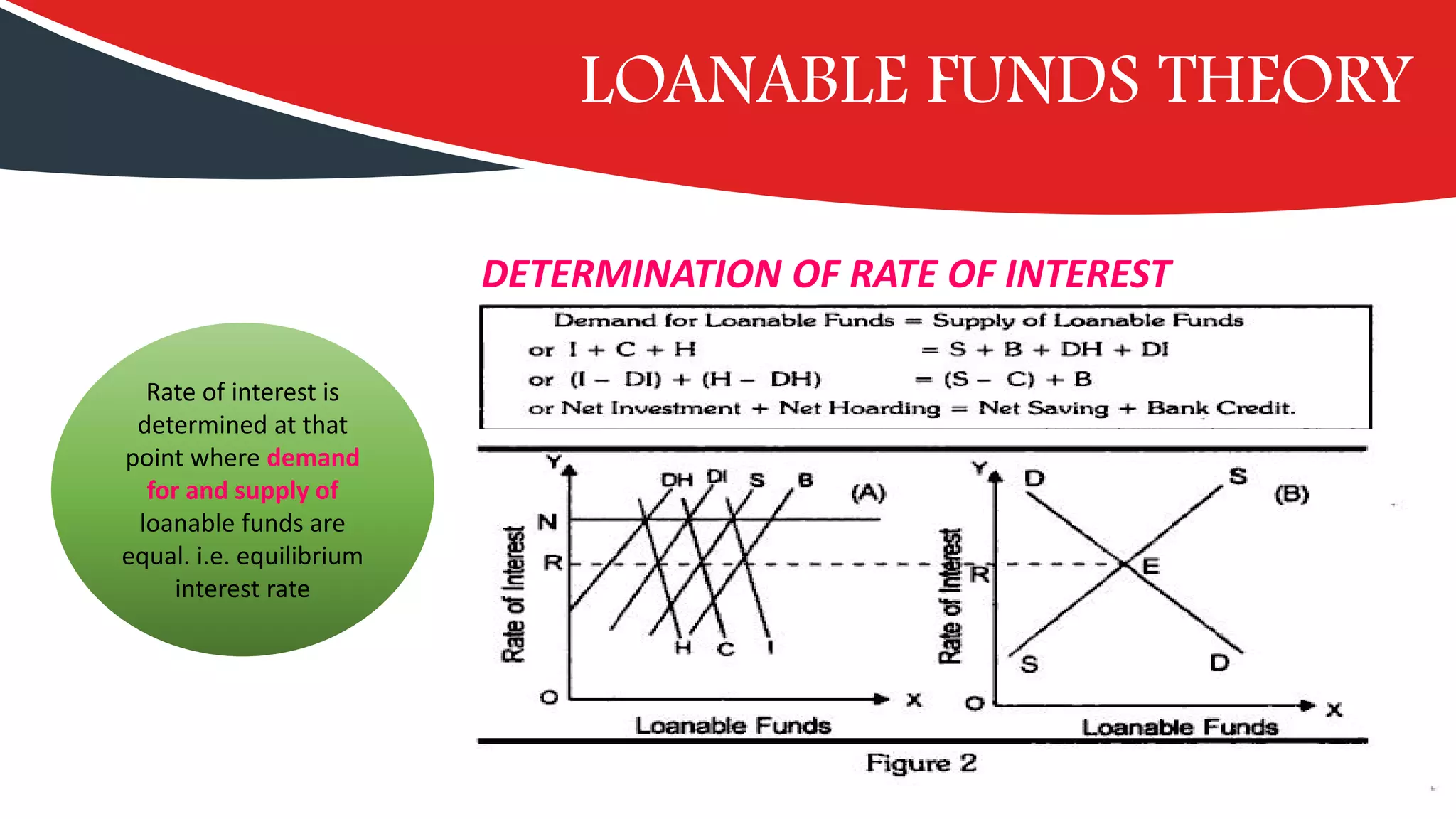
Rate of interest is
determined at that
point where demand
for and supply of
loanable funds are
equal. i.e. equilibrium
interest rate
DETERMINATION OF RATE OF INTEREST
LOANABLE FUNDS THEORY
✓ Saving are not Influenced by Rate of Interest-The theory gives undue importance to
rate of interest on savings .According to this theory, saving is the function of rate of
interest
✓ Investment is not Influenced by the Rate of interest-Keynes refuses the relationship
between the rate of interest and investment as postulated by the theory
✓ Wrong Synthesis of Real and Monetary Factors-The theory was criticized for
combining Monetary factors with real factors
✓ Unrealistic Assumption of full Employment: This theory also assumes full
employment, which is not correct
CRITICISM OF THE THEORY
Thank you…..

Theory of interest rate - loan theory

  • 1.
    THEORY OF INTERESTRATE PRESENTED BY : VAIBHAV BHALOTIA
  • 2.
    TABLE OF CONTENT Loanabletheory What is interest ? Types of interest Rate of interest Classical theory
  • 3.
    WHAT IS INTEREST? LENDER BORROWER MONEY INTEREST ➢ In general “Interest is the price paid for making use of money for certain period of time” ➢ In economics “Interest is the payment for the use of capital or loanable funds”
  • 4.
    TYPES OF INTEREST Simpleinterest is calculated only on the principal amount of the loan. ❑Principal × interest rate × n = interest Compound interest is computed on both the principal and any interest earned. ❑Principal × interest rate = interest for Year One ❑(Principal + interest earned) × interest rate = interest for Year Two ❑(Principal + interest earned) × interest rate = interest for Year Three
  • 5.
    RATE OF INTEREST WHYRATE OF INTEREST VARIES FROM PLACE TO PLACE, INDUSTRY TO INDUSTRY, BORROWER TO BORROWER ? Interest rates vary according to: ✓ the government's directives to the central bank to accomplish the government's goals ✓ the currency of the principal sum lent or borrowed ✓ the term for maturity of the investment ✓ the perceived default probability of the borrower ✓ supply and demand in the market An interest rate is defined as the proportion of an amount loaned which a lender charges as interest to the borrower, normally expressed as an annual percentage.
  • 6.
    THEORIES OF INTEREST Determination of Rateof Interest Classical theory Loanable funds theory
  • 7.
    CLASSICAL THEORY ▪ Theclassical theory of interest refers to the views of “Marshall,Cassel,Taussing etc. ▪ Theory is also known as the Demand and Supply theory of interest because it deals with the Demand side as well as the Supply side ▪ Rate of Interest is determined by the demand for Capital (investment) and Supply of Capital(Savings). ▪ Demand for capital comes from those who want to invest in business activities. ▪ Supply of capital is the result of savings. It comes from those who have the excess of income over consumption.
  • 8.
    Demand for Capital(Investment) ❖Capital demand will be high for more productive uses first and then gradually with the increase in its supply, will shift to less productive uses. ❖ Now a very important question arises is that how much capital a person will demand because when a person borrows money he has to pay interest on it. The answer according to this theory is that demand for capital can be raised to a point where marginal productivity of capital becomes equal to the interest paid on it. ❖ This shows that there exists inverse relationship between demand for capital and the interest rate. In figure rate of interest is OR, the demand for capital is OM. When the Rate of Interest falls to OR1,the demand increases to OM1. E E1 R R1 D D M M1 Y X Demand for Capital or Investment RateofInterest o CLASSICAL THEORY
  • 9.
    Supply for Capital(Savings) ❖Savings is the main source of capital which depends on the capacity to save, willingness to save, level of income and rate of interest etc. ❖ To a large extent, willingness to save is affected by the rate of interest. On a higher rate of interest people save more to earn the benefits of high rate of interest. On the other hand, at the low rate of interest, people save less. ❖ Thus, we may say that there is a direct relationship between the supply of savings and the rate of interest. o E1 R1 R s s M M1 Y X RateofInterest E Supply of Capital or Savings In figure Saving increase from OM to OM1 , When the rate of interest rises from OR to OR1 CLASSICAL THEORY
  • 10.
    Interaction between Demandand Supply Curves of Capital ▪ The equilibrium rate of interest OR is determined at that point where the demand for capital(investment) equals the supply of capital(Saving). ▪ Demand curve and supply curve intersect each other at the point E. OR is the equilibrium interest rate . ▪ If the rate of interest is greater than OR, the supply of capital will exceed the demand for capital and consequently the rate of interest will be OR1 . ▪ On the other hand ,the rate of interest is lower than OR the demand for capital will exceed the supply of capital and consequently once again the equilibrium rate of interest of OR2 will be attained. o Y X Demand and Supply of Capital or Savings RateofInterest S>D A B1 D2 C D>S S S D D R1 R2 R N E CLASSICAL THEORY
  • 11.
    CRITICISM OF THETHEORY The classical theory of rate of interest has been criticized on the basis of the following shortcomings as discussed below: ✓Fixed Level of Income: Classical theory assumes that the level of income remains constant. But in actual practice income changes with a small change in investment. Thus, it is not correct to assume a fixed level of income. ✓Long Run: Classical theory determines the interest rate through the interaction of demand and supply of capital in the long run. Therefore, there was an urgent need of a theory which determines rate of interest in the short-run. ✓Full Employment: This theory assumes that there is full employment of resources in the economy. But, in reality, unemployment or less than full employment is a general situation. Thus, this theory does not apply to the present world. ✓Savings and Investment: Classical economists assume that savings and investment are not inter dependent. But actually investment changes, income also changes which leads to a change in savings. Thus, both are interdependent on each other.
  • 12.
    LOANABLE FUNDS THEORY Supplyof LOANABLE FUNDS S+B+DH+DI (B) Bank credit–above minimum rate of interest bank credit is interest elastic. (DI) Disinvestment– occurs due to non replacement of depreciated machine (S) Savings-Saving influenced by both income and rate of interest. Demand for LOANABLE FUNDS I+C+H (I) Investment demand–demand for money by firms for investment on part of firms (C)Consumption–when consumption increases beyond income, people have to borrow money (H) Hoarding- people’s desire to hoard money with them (DH) Dishoarding– peoples desire to invest/spend money rather than saving it
  • 13.
    LOANABLE FUNDS THEORY ▪According to this, Interest is the price paid for the use of loanable funds. ▪ Demand for loanable funds is inversely related to the Rate of interest. Demand for loanable Funds Investment: Higher the rate of interest lower will be the demand for loanable funds for investment Consumption: There will be less demand for loanable funds at high rate of interest on the other hand ,demand for loanable funds is more at low rate of interest Hoardings: Demand for loanable fund is made by those people who want to hoard it. Hoarding signifies keeping idle cash balances. Therefore, at higher rate of interest, demand for loanable funds will be less and at low rate of interest it will be high.
  • 14.
    Supply of loanableFunds Savings: Private savings, individuals and corporate are the main sources of savings. Higher the rate of interest ,the greater will be inducement to save and vice-versa. Bank Credits: Bank Credit is also interest elastic. At higher rate of interest bank will lend more credit. Dishoarding: When the idle cash balances of the Past become active balances in the present , and become available for investment, it is called dishoarding. If the rate of interest is low, dishoarding would be negligible . When rate of interest is high ,people lend the hoarded money and thus dishoard their savings. Disinvestment: The amount which is kept apart annually as depreciation fund, is given on loan. Higher the rate of interest , greater is the inducement to disinvest and lower the rate of interest , lesser is the inducement to disinvest. LOANABLE FUNDS THEORY
  • 15.
    Rate of interestis determined at that point where demand for and supply of loanable funds are equal. i.e. equilibrium interest rate DETERMINATION OF RATE OF INTEREST LOANABLE FUNDS THEORY
  • 16.
    ✓ Saving arenot Influenced by Rate of Interest-The theory gives undue importance to rate of interest on savings .According to this theory, saving is the function of rate of interest ✓ Investment is not Influenced by the Rate of interest-Keynes refuses the relationship between the rate of interest and investment as postulated by the theory ✓ Wrong Synthesis of Real and Monetary Factors-The theory was criticized for combining Monetary factors with real factors ✓ Unrealistic Assumption of full Employment: This theory also assumes full employment, which is not correct CRITICISM OF THE THEORY
  • 17.